LGA Chair Cllr Louise Gittins' speech to the District Councils' Network’s Annual Conference
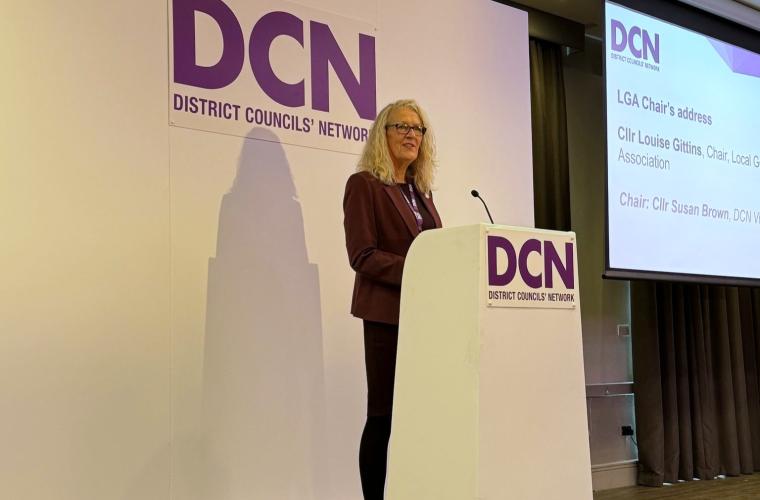
Good morning everybody.
Firstly I’d like to thank Cllr Sam Chapman-Allen and the entire DCN Leadership team for all of the important work you do in representing district councils up and down the country, and for arranging this fantastic conference. I have been really impressed with what I have seen and heard so far.
I continue to value your constructive engagement and support as we work together on behalf of our sector.
Our collective weight, unity and voice remain our most powerful tool in lobbying for positive change for our residents and showcasing good practice, and in leading the system for sector-led improvement.
Over the past few months, I have valued hearing the aspirations and concerns of district leaders through the various webinars and meetings organised by the LGA and DCN.
The feedback from these meetings have been very helpful in our engagement with Government. And I want to reassure you on that that everything that has been raised has gone back to government.
Like many of you, I’ve enjoyed the early spring weather over the past week.
Just as spring signals a sense of change around us – as fresh buds emerge, seeds burst into life, and landscapes transform – councils are embarking on a season of change, growth and new beginnings.
But, like with every Spring, not all flowers bloom and chill winds still descend.
Not every change of season is smooth or indeed welcomed with open arms.
It was winter when the English Devolution White Paper emerged.
As we flicked through its 118 pages it became clear that huge changes were going to become apparent.
Some of these potential changes have been universally backed.
For example, when it comes to devolution - genuine devolution - I can confidently say this is something we can all get behind.
We want every council in England to have the ability to secure devolution that works for them, their local economies and their residents.
More flexibility at a local level could allow councils to ensure the services they provide are even more effective for local people, and meet the needs of residents.
Councils are on the frontline of communities and know better than anyone what will work for their local area. They are best-placed to decide themselves knowing what will work best in the local level.
In my own council, we have been speaking with local businesses and residents on what devolution might mean for our area, the principles, funding and investment that will drive our communities and economies forward.
Across all councils, there should be a clear opportunity for powers and responsibilities to be devolved down from Strategic Authorities to local government, including on employment and skills, and licensing, where this already works effectively at a local level.
But I think it is an understatement to say there is divided opinion about other changes in the white paper.
Many in our sector see the potential changes in local government reorganisation as huge opportunities.
Many see them as huge threats and risks.
Sometimes, we oscillate between both.
Others have already been – or are currently going – through reorganisation and have their own perspectives and experiences.
There are strong arguments, sincerely held and passionately made, on all sides, tiers and political viewpoints of our membership.
But I am clear when I say that the LGA I lead respects every view - and will respect every decision - equally.
It is our role to support our members through these changes as they navigate the future.
And as we look to that future we see one that is filled with uncertainty as well as possibilities and opportunities.
As well as facing the biggest set of changes in over 50 years, our sector faces ever-rising and increasingly complex community needs and rising costs within a challenging economic landscape.
At the same time we are seeing an accelerating pace of technology as well as persistent difficulties in attracting and retaining skilled personnel.
This week we have seen two hugely important moments that will have a big impact on the way we work in the future:
The decision to abolish NHS England and the introduction of the Planning and Infrastructure Bill.
The impact of these interventions are yet to be fully understood, but it is clear there will be even more change. And once more as we have demonstrated time after time, local government will stand up and face these challenges full on.
The LGA’s role in supporting our members is more important than ever.
We are here to champion and be the voice of local government, ensuring it has the resources, powers, and support needed to deliver the best possible outcomes for the people it serves.
We are alive to the fact that restructuring and reorganising councils will involve significant resourcing. We are calling on the Government to commit to funding councils upfront to deliver on these reforms.
Areas that have already gone through LGR have relied heavily on reserves to unitarise and estimates of one-off costs range from £25 million to £100 million.
But fighting for funding is not the extent to the support we are giving to our members.
Since the publication of the white paper, we have worked hard to put in place a support package to guide councils through various devolution and reorganisation journeys and recently confirmed our further support offer to member councils.
Our offer includes tailored support targeted to your own needs, specialist tools, events and webinars.
We have created resources to help explain and communicate the prospective changes and have sought to showcase the experiences of councils who have gone through devolution or LGR for others to learn from.
This, combined with our business as usual offer, from data, sector-wide support, and workforce recruitment and retention advice.
I hope you will find it useful but do not hesitate to get in touch if there is any further support you and your teams need.
And, we know we are not doing this alone, there are people there to support you. We are part of a bigger effort of bodies that are seeking to support their members.
A sector support working group, including representation from the LGA, DCN, CCN, MHCLG, Solace and other service specific sector bodies, has been established to support coordination of sector support activity related to LGR and devolution.
And picking up on some of the points that were made earlier about collaboration with the counties. I have been meeting with Sam and Tim Oliver, Chair of the CCN, on a weekly basis to try and work through these challenges.
We have produced a checklist document outlining the principles and key points to consider when data is being shared between councils as part of the Local Government Reorganisation business case process.
It is designed to help councils approach data sharing in an efficient way, whilst managing risk, and it was shared in my last bulletin. So, if any of you are still facing challenges let me know and I will raise it with Sam and Tim.
Councils are the key to solving our biggest national challenges and critical in promoting sustainable and inclusive local economic growth.
District councils are central to shaping their local places with many wonderful examples, and I’m not going to list all of them, but I do want to mention Huntingdonshire District Council embedding health and wellbeing in their placemaking plans.
There are countless examples of districts driving their local places forward and it is vital that councils can continue their important work of boosting local economies.
It is essential that the forthcoming Spending Review provides all councils with a significant and sustained increase in overall funding that reflects current and future demand for services.
Our latest analysis published last month shows that if current trends continued, by the end of 2028/29 cost and demand pressures would add £21.4 billion to the cost of delivering council services.
Without adequate funding in the forthcoming Spending Review, councils could face a funding gap of more than £8 billion by 2028/29.
We will continue to be clear with government that the focus on structural change must not hinder the delivery of crucial services that so many people rely upon day after day.
This includes support for those with special educational needs and disabilities, adult and children’s social care, housing and temporary accommodation, and the adoption of new digital technologies, where we know that real savings and growth can be achieved with the right funding.
As we travel further on our reorganisation journeys, we’ll need to work together as we adapt to the unexpected challenges. However, there will also be opportunities to discover new paths, and build stronger connections with each other.
Our success will depend on our ability collaborate, adapt, and stay united as a sector when the road takes unexpected turns, or when we encounter the occasional pothole but hopefully not too many potholes!
Thank you for the work you do day in day out. Councils remain vital in delivering for local people and places, and I know that even with all the change in our sector you continue to provide the support and leadership that is needed.
We value you as councillors, and we value you as members of the LGA. As the national voice of local government, we are strongest when we speak cross-party for every region and every tier of our sector.
Thank you for everything you do to represent district councils every single day.