About the framework
LGA Governance Framework:
- Approved 7 March 2018
- Amended 6 June 2018, 18 July 2018, 21 April 2021, 19 July 2024, 6 June 2025, 5 December 2025, April 2026
Part 1: Governance arrangements
Purpose*
1.1 A company's governance framework acts as the rules, practices, and procedures that guide how the company is managed and controlled. It defines the roles, responsibilities, and processes for effectively and efficiently running the business, including ensuring the company's operations are legal, ethical, sustainable, and successful.
1.2 The governance framework acts as an essential supporting structure, a framework of rules and practices by which the board ensures accountability, fairness and transparency in how the company runs.
1.3 This LGA governance framework also applies to the Improvement and Development Agency (IDeA), where relevant. The sections that apply to the IDeA have been asterisked*.
1.4 The purpose of the LGA is to represent, wherever possible by consensus, the interests of Member Authorities to national governments, to Parliament, to political parties, to European and other international institutions and to other bodies, and to negotiate on behalf of local government.
General*
2.1 This governance framework should be read in conjunction with the Articles of Association of the Local Government Association (LGA). If anything in the Governance Framework contradicts what’s in the Articles of Association, then the Articles will be considered to be correct.
2.2 *The political balance of the LGA’s governance arrangements is calculated in accordance with Article 8 of the Articles of Association.
3. Definitions*
| Term | Definition |
|---|---|
| Audit & Risk Assurance Committee | This committee monitors financial integrity, internal control, risk management, and conduct, reporting to the LGA Board and General Assembly. |
| Code of Conduct | A set of principles and standards that elected members are expected to uphold, including acting with integrity, lawfulness, and respect. |
| Councillors’ Forum | Open to all elected members from LGA member councils. This provides a space for topical discussions, speaker sessions, and policy committee reports. |
| Finance & Performance Committee | This committee covers financial strategy, performance management and risk assessment. |
|
Fire Commission / Fire & Rescue Authority Committee |
This represents councils responsible for fire and rescue. The committee handles operational issues. |
| General Assembly | The LGA's sovereign body composed of all member authorities. It meets annually to elect office holders, amend the constitution, and consider motions. |
| HR & Remuneration Committee | This committee oversees the pay structure and allowances for members holding responsibilities within LGA governance structures. |
| IDeA (Improvement & Development Agency) | A subsidiary of the LGA, focused on delivering improvement support to councils and managing related funding. The IDeA is an Associated Employer with the LGA and IDeA companies treated as a single entity for employment rights. |
| Lead Members | The Chair, Vice-Chair, and Deputy Chairs of each Policy Committee. They guide the committee’s work and influence agendas and decisions. |
| LGA (Local Government Association) | The national membership body for local authorities in England. It represents councils, supports best practice, and lobbies on their behalf. Within this Governance Framework the term Company and Association are also used interchangeably to refer to the LGA. |
| LGA Board | The main decision-making body responsible for strategic direction, budget approval, management of internal resources, and oversight of LGA activities. |
| Members (Councillors) | Members are elected representatives of local authorities. In the LGA context, members form the various boards, committees, and governance structures. They set strategic direction, approve budgets, and represent local authorities nationally. |
| Outside Bodies | These are external organisations to which the LGA appoints representatives. The term Outside Bodies also includes national Employer Bodies. |
| Policy committees | Thematic committees responsible for developing and overseeing policy work. |
| Political Balance | This reflects the proportion of political representation within member authorities, used to ensure fairness across governance structures. |
| Political Conventions | Guidelines that maintain cross-party consensus, ensure impartiality, and regulate group representation, especially during politically sensitive times. |
| Political Group Offices | Internal support structures within the LGA for each political group. These offices help elected members coordinate, strategise, and communicate politically. |
| Scheme of Allowances | The agreed framework that outlines payments made to elected members holding formal LGA roles (e.g., chairing committees). |
| Scheme of Delegation | A framework outlining how decision-making powers are distributed among the LGA, its committees, and officers. |
| Special Interest Groups (SIGs) | Member authority groups with common interests, recognised by the LGA. They contribute to policy and share best practices. |
| Standing Orders | Rules governing the conduct of meetings, motions, debate, voting, and attendance within LGA governance. |
| Strategic Authorities | A Strategic Authority is a legal corporate body in England, defined by the Devolution and Community Empowerment Act 2026, that allows for two or more local authorities to voluntarily pool responsibility and receive devolved powers from central government. They serve as regional governing bodies to enhance transport, economic development, and regeneration across council boundaries and may include a combined foundation strategic authority (a non-mayoral combined authority or a non-mayoral combined county authority) or a mayoral strategic authority (a mayoral combined authority, a mayoral combined county authority, or the GLA). |
| Strategic Policy & Oversight Committee | Supports the LGA Board by providing oversight of the development of policy positions, holding policy committees accountable, and ensuring coordination and consideration of cross-cutting issues. |
| Substitutes | Alternate members from the same political party who attend in place of full members (not allowed on some key meetings like the LGA Board). |
| Task and Finish Groups | These groups are temporary, focused groups appointed to deliver on specific projects or issues. They are small, not always politically balanced, and report to the commissioning body. |
| Voting at General Assembly | Voting is weighted and can involve all members. Some associate members and combined authorities may have limited voting rights. |
| Weighted Electorate | A method used by the LGA to ensure fair voting across councils of different sizes. Larger councils carry more weight in votes to reflect their population. |
4. Roles and conduct*
4.1 While conducting LGA business all democratically elected local representatives serving on the LGA’s member structures, or otherwise representing or undertaking business on behalf of the LGA, are required to operate in accordance with the member code of conduct of the local authority they are representing as well as the LGA’s Code of Conduct for Political & Independent Appointees and the Member-Officer Protocol.
4.2 Duties and responsibilities set out the respective accountabilities of all roles on the LGA’s governance structure. These accountabilities are linked to Special Responsibility Allowances, are refreshed annually and are reviewed alongside the Scheme of Allowances (Article 21 of the Articles of Association). The duties and responsibilities have been attached at appendix 1.
5. Governance structure
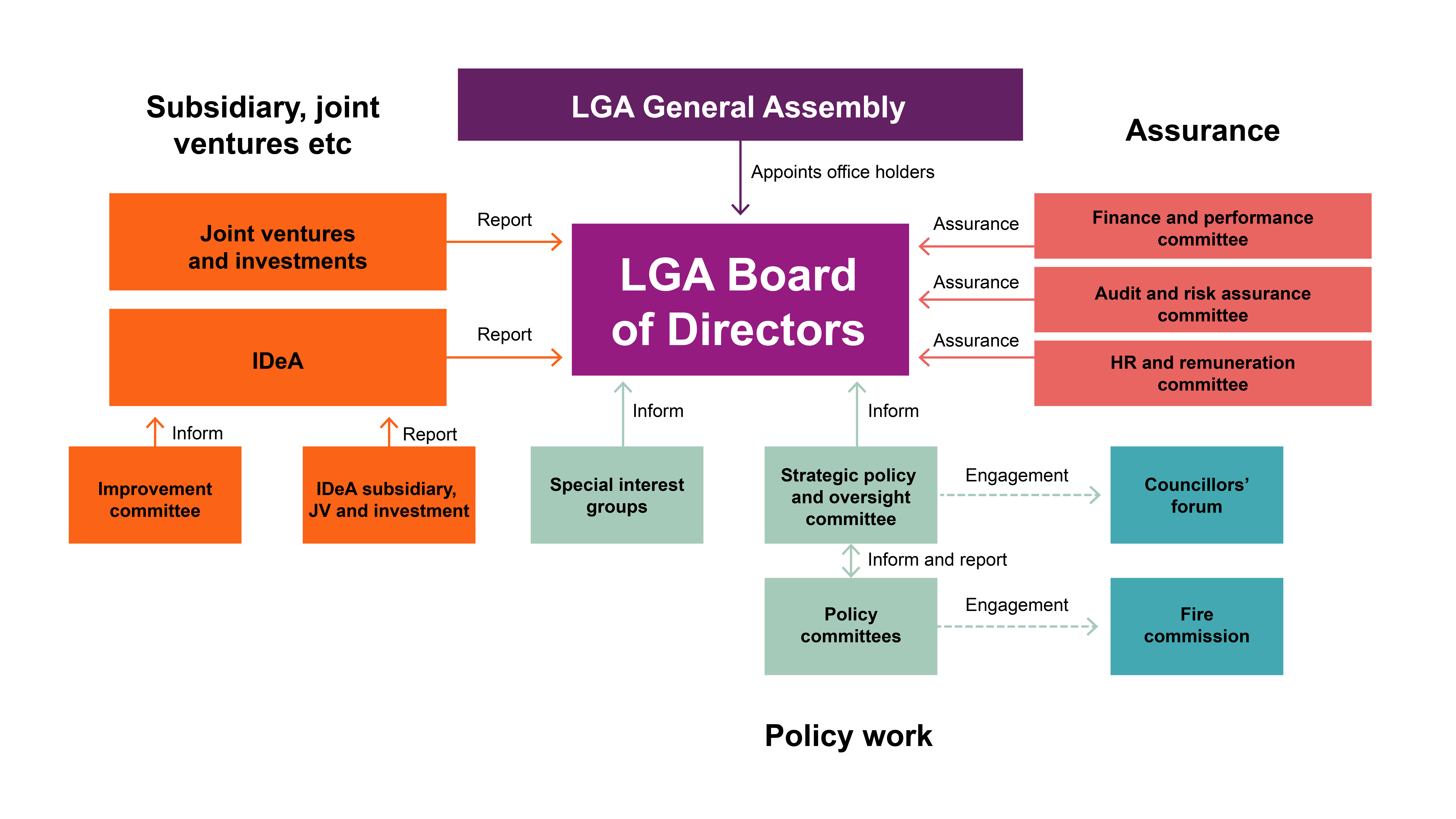
6. General Assembly
6.1 The General Assembly is made up of all the Company’s members in general meeting. Its powers, responsibilities and procedures are set out in Part 2 of the Governance Framework.
7. LGA Board*
7.1 The LGA Board is the Board of Directors of the Association. The General Assembly appoints directors of the LGA Board unless otherwise stated in the company’s Articles of Association. Appointments of directors to the Board are made on a politically balanced basis and consist of the chair, vice and deputy chairs, who are elected annually by the General Assembly. The LGA Board’s powers and responsibilities are set out in Part 4 of the Articles of Association.
7.2 When considering business at meetings of the LGA Board, a director must always act in the best interests of the company as required under their legal duties set out in the Companies Act 2006, and not in the interests of their Member Authority or political group.
7.3 The LGA Board:
7.3.1 sets the strategic direction of the Company;
7.3.2 directs the activities and business of the Company and ensures its proper management, including appropriate capacity, capability and resources;
7.3.3 is responsible for oversight of the management of internal resources and for policies on resource management;
7.3.4 agrees the annual budget and business plan;
7.3.5 agrees the Governance Framework and the Scheme of Delegation;
7.3.6 considers applications to join the LGA’s associate schemes;
7.3.7 agrees the terms of reference of the Strategic Policy & Oversight Committee and Assurance Committees annually and receives for information terms of reference for policy committees;
7.3.8 receives reports from the Assurance Committees, Strategic Policy & Oversight Committee and any other committee or group reporting to it after each meeting (reports relating to IDeA matters will be submitted to the IDeA Board);
7.3.9 receives annual reports of any joint venture companies;
7.3.10 receives and recommends to the General Assembly the LGA’s consolidated financial statements and annual report of the Audit & Risk Assurance Committee;
7.3.11 recommends amendments to the Articles of Association to the LGA General Assembly;
7.3.12 recommends motions to the General Assembly for consideration;
7.3.13 establishes committees;
7.3.14 deals with any complaints received in relation to the Code of Conduct for Political & independent Appointees.
8. Strategic Policy & Oversight Committee*
8.1 Membership of the Strategic Policy & Oversight Committee is made up of the following:
8.1.1 The Chair and Vice Chairs of the Company;
8.1.2 The Chairs of the Policy Committees (as defined below) and the Chair of the Improvement Committee of the IDeA.
8.2 The Strategic Policy & Oversight Committee:
8.2.1 oversees the development of LGA policy, ensuring its coordination and consideration of cross-cutting issues and representing the views of local government; however, any particularly contentious policy issues will be referred to the LGA Board for decision;
8.2.2 supports the LGA Board to set the strategic direction of the LGA in relation to policy issues;
8.2.3 approves the terms of reference of policy committees and reviews their work plans annually;
8.2.4 receives reports from the policy committees after each committee meeting
8.2.5 reviews risks in relation to LGA policy;
8.2.6 holds the Policy Committees and Fire Commission to account.
8.3 In the event that a member is unable to attend the Strategic Policy & Oversight Committee, a substitute from the same political party will be permitted.
9. Policy Committees
9.1 The purpose of the Policy Committees is to develop, steer and oversee all policy activity within the areas delegated to them, in line with the priorities set by the Strategic Policy & Oversight Committee on behalf of the LGA Board, providing advice and reporting to the Strategic Policy & Oversight Committee. There are nine policy committees:
• Children, Young People & Families
• Culture Tourism & Sport
• Fire & Rescue Authority
• Health and Wellbeing
• Inclusive Growth
• Local Government Resources
• Neighbourhoods
• Public Service Reform and Innovation
• Safer & Stronger Communities
9.2 The policy committees are each made up of 18 members and are politically balanced in accordance with Article 8 of the Articles of Association.
9.3 The Policy Committees are responsible for determining their own work programmes based on the terms of reference and priorities set by the Strategic Policy & Oversight Committee. They fulfil their purpose by:
9.3.1 engaging with and developing a thorough understanding of councils’ priorities in relation to their particular area, including engagement with Councillors’ Forum;
9.3.2 contributing to the development and delivery of the LGA Business Plan;
9.3.3 overseeing programmes of work to deliver, through extensive engagement with councils, the strategic priorities set by the LGA Board; and
9.3.4 reporting to the Strategic Policy & Oversight Committee on their activities.
9.4 The political balance of each policy committee may be maintained by the attendance of substitutes.
10. Fire Commission
10.1 The Fire Commission provides a forum for all authorities in membership/ associate membership of the LGA with responsibility for fire and rescue to come together to:
10.1.1 discuss matters of common interest and concern;
10.1.2 represent the views and concerns of the fire community in relation to fire service modernisation;
10.1.3 take the lead on day-to-day policy issues affecting fire authorities;
10.1.4 exchange good practice; and
10.1.5 influence the priorities and activities of the LGA.
10.2 Representation and voting on the Fire Commission is reviewed annually against population figures and other relevant changes and updated accordingly. Figures are published on the LGA website.
10.3 The Commission is led by the Fire & Rescue Authority Committee and chaired by the Chair of that Committee.
11. Assurance Committees
11.1 The following committees are defined as “assurance committees” (to be chaired by an LGA Board director) reporting and providing assurance to LGA Board:
11.1.1 Finance & Performance
11.1.2 Audit & Risk*
11.1.3 HR & Remuneration*
11.2 When considering business at meetings of assurance committees, a member must always act in the best interests of the Company in accordance with their legal duties under the Companies Act 2006 and not in the interests of their Member Authority or political group.
11.3 All assurance committees are made up of one member nominated by each of the political groups, at least one of whom must be an LGA Board Director. The Chair of the LGA Board may not be a member of the Audit & Risk Assurance Committee. Assurance committees are not politically balanced.
11.4 Assurance Committees will be chaired by a member who is an LGA Board Director. Substitutes are not permitted.
12. Audit & Risk Assurance Committee*
12.1 The purpose of the Audit & Risk Assurance Committee is to support the Board in its responsibility to ensure that the LGA is a financially sound and efficient organisation which makes effective use of its resources in pursuit of its strategic objectives. Specifically, the Audit & Risk Assurance Committee reviews the effectiveness of the risk management framework established by management to identify, assess, and manage risk.
13. HR & Remuneration Committee*
13.1 The HR & Remuneration Committee is responsible for key HR policies. It makes recommendations to the Board regarding major changes to the organisational structure, including financial implications and risks.
14. Finance & Performance Committee
14.1 The Finance & Performance Committee supports the LGA Board in its financial oversight duties. It covers financial strategy, performance management, risk assessment and reporting, ultimately helping the LGA achieve its strategic objectives.
15. Group Leaders Committee
15.1 The Group Leaders Committee is a committee of LGA Board.
15.2 It is made up of the Chair of the LGA Board and all the LGA Board Vice Chairs. Substitutes from the same political party are allowed from amongst the LGA Board Deputy Chairs only.
15.3 The Group Leaders Committee may agree administrative arrangements for business and meetings of the LGA Board, Strategic Policy & Oversight Committee and Councillors’ Forum including dates and times of meetings and agenda items.
15.4 Group Leaders Committee will have the right to call for relevant items to be placed on agendas of LGA Board, Strategic Policy & Oversight Committee and Councillors’ Forum.
15.5 LGA Board or any committee may, from time to time, delegate particular decisions to the Group Leaders Committee. These meetings will be minuted and subject to the same rules as other committees of the LGA Board. Any decisions approved at this meeting will be reported to the next meeting of LGA Board.
15.6 The Group Leaders Committee has delegated authority to sign off urgent policy lines, consultation responses or letters on behalf of the LGA that fall under the responsibility of the Strategic Policy & Oversight Committee. Whenever the Committee approves anything in this way, it will be reported to the next meeting of the Strategic Policy & Oversight Committee. However, this delegation should only be used where it is not possible to get the necessary approval at a normal meeting of SPOC. The LGA will keep a record of all decisions made under this delegation.
16. Councillors’ Forum
16.1 Councillors’ Forum has a core membership of 100 members and is politically balanced. However, any elected member of an LGA member council may attend.
16.2 Councillors’ Forum offers a programme of topical external/internal speakers and discussions and receives reports from the Chair of the LGA, policy committees and others that are of interest to the LGA’s wider membership. It may also be used as a means of consulting, engaging and passing information to the wider membership.
16.3 Councillors’ Forum has no decision-making powers and does not act as an assurance committee to the LGA Board.
17. Improvement & Development Agency for Local Government (IDeA) Company Board*
17.1 The IDeA (a company limited by guarantee with no share capital with a board of up to 10 directors appointed by the LGA, its parent company) is established to operate in complete alignment with the LGA strategic goals, policies, and culture, and specifically to:
17.1.1 assist, advise and encourage local authorities to improve their performance and to support and promote innovation and change in local government;
17.1.2 promote and encourage high standards of governance, service delivery and operational efficiency and to support local authorities to continuously improve through a sector-led improvement approach and exchange of good practice;
17.2 To deliver its objects, the IDeA:
17.2.1 receives grants from government departments, including the Ministry of Housing, Communities and Local Government and contracts awarded through successful competitive bidding process to deliver improvement services to all local authorities in England;
17.3 The IDeA board of directors are responsible for:
17.3.1 managing the IDeA Company's business, for which purpose they may exercise all the powers of the Company;
17.3.2 directing the activities and business of the IDeA and ensure its proper management in accordance with its Memoranda and Articles of Association and with the strategic priorities and direction of the LGA;
17.3.3 contributing to the development of the LGA business plan;
17.3.4 overseeing delivery of projects commissioned outside the LGA;
17.3.5 reporting to the LGA Board on their activities;
17.3.6 complying with their duties under the Companies Act 2006
17.4 The directors of the IDeA Board are set out the IDeA’s Articles of Association.
17.5 Where a member’s home council is being discussed at the IDeA Board or one of its committees, the member will generally be considered to have an interest in that item.
18. Task and Finish Groups*
18.1 Task and Finish Groups may be established by the LGA Board in accordance with its powers of delegation in the Articles of Association, or a committee to oversee a specific project, or issue or business plan priority. Task and Finish Groups must have a defined life cycle, linked to their output, and are accountable to the body that established them.
18.2 Task and Finish groups should include members with relevant experience or expertise. They will be made up of at least one member per group and be small enough (normally no more than 10 members) to enable effective working.
18.3 Task and Finish groups must include at least one member from the parent board or committee, but that person need not chair the group. Chairs of Task and Finish groups may be appointed from any political group. Proportionality will be observed in the appointment of Task and Finish Group chairs, but not so strictly as to inhibit the appointment of the chair most appropriate to the role and purpose of any particular task group. Substitutes are not permitted.
18.4 Task and Finish groups will generally have delegated authority to oversee a project, within a remit approved by the sponsoring Board or Committee. Normally, there should be no need for the Task and Finish group to seek further approval from a sponsoring Board or Committee unless they propose a significant departure from the original objectives or design of the project.
18.5 The body that commissions a Task and Finish group will set its terms of reference.
19. Lead members of policy committees*
19.1 The Lead Members of the Policy Committees and Improvement Committee are the Chair of the Committee and the Vice-Chair and Deputy Chairs of the Committee.
19.2 In addition to leading the work of their committee, lead members will develop, agree, and promote the interests of the LGA to the Government, Parliament, partners, and the press, in relation to their committee’s policy area.
19.3 The Lead Members may agree administrative arrangements for business and meetings of their committee including dates and times of meetings.
19.4 The Lead Members will have the right to call for relevant items to be placed on an agenda.
19.5 Lead Members have delegated authority to sign off policy lines on behalf of the LGA, consultation responses or letters. Whenever lead members approve anything in this way, it will be reported to the next meeting of the Committee. However, this delegation should only be used where it is not possible to get the necessary approval at a normal meeting of the committee. A record of all decisions made under this delegation will be maintained by the LGA.
20. Substitutes*
20.1 Substitutes from the same political party are permitted to attend meetings of the Policy Committees, Improvement Committee, Lead Members meetings and the Strategic Policy & Oversight Committee. Substitutes at the Group Leaders Committee must be LGA directors. If attending a meeting as a substitute, that member has the same speaking and voting rights as a full member of the committee. Substitute members may also attend committee meetings when they are not acting as a substitute. In such cases, they may speak but not vote.
20.2 Substitutes are not permitted to attend the LGA Board, the Company Board of the IDeA or assurance committees.
21. LGA Associate schemes
21.1 The LGA may establish Associate schemes for local, regional and national public bodies, on such terms as shall be determined by the LGA Board. Associate members are local, regional and national public bodies whose purpose and priorities align with those of the LGA.
21.2 Associate schemes may be generic or tailored to reflect the particular nature, priorities and relationship with the LGA of different groupings.
22. Strategic Authorities
22.1 Strategic Authorities in England and Wales, as defined by the Devolution & Community Empowerment Act 2026, may be invited into LGA membership via a bespoke membership subscription offer to access to all benefits and influence through forums and nominations, but without any formal voting rights or inclusion in political balance calculations of the LGA. Upon admission through their bespoke membership Strategic Authorities will be considered a Member Authority but without the ability to appoint its Member Authority Representatives.
22.2 Strategic Authorities will be offered membership via a bespoke paid membership model that combines membership, policy and commercial elements informed by sector engagement and pilot learning.
Part 2: Standing Orders of the General Assembly of the LGA
Meetings of the General Assembly of the LGA
23. Introductory provisions
23.1 A reference in the Governance Framework to the General Assembly is to the Member Authorities in general meeting or to the general meeting itself, as the case may be.
23.2 The General Assembly shall be held on such days and at such places as may be decided by the LGA Board.
23.3 Once each year, the General Assembly will elect the directors of the LGA Board. This shall be the Annual Meeting. Other meetings (known as extraordinary general meetings or EGMs) may be held as required.
23.4 The General Assembly shall deal with such business (including at the Annual Meeting) as may be determined by the LGA Board.
24. Calling the General Assembly
24.1 A General Assembly may be called at any time by the Chief Executive with the approval of the LGA Board and must be called within 21 days of a written request from Member Authorities representing at least 5% of the total voting rights of all the Member Authorities having a right to vote at general meetings and made in accordance with section 303 of the Companies Act 2006.
24.2 The Chief Executive shall:
24.2.1 not less than three months before the Annual Meeting, and not less than 28 clear days before each extraordinary general meeting, send to each Member Authority, to their chief executive or clerk, all LGA Board members and the Association's auditors a notice stating:
(a) the date, time and place of the meeting (and in the case of an Annual Meeting shall specify the meeting as such); and
(b) if a special resolution is proposed, the full text of the resolution and that it is a special resolution, together with a proxy card; and
24.2.2 not less than 10 working days before the Annual Meeting, or extraordinary general meeting, send to each Member Authority Representative appointed by a Principal Council, and publish on the Association's website, an agenda specifying the business to be transacted.
24.3 Notice must be given in hard copy form, electronic form or by means of a website, in each case in accordance with the Companies Act 2006.
24.4 The accidental omission to give notice of a General Assembly meeting to, or the non-receipt of notice of a meeting by, any person entitled to receive notice, or a technical defect in the timing or manner of giving such notice of which the directors are unaware shall not invalidate the proceedings of that meeting, shall not invalidate the proceedings at that meeting.
24.5 At extraordinary meetings called under this rule, no business other than that mentioned in the agenda shall be transacted.
24.6 A valid requisition for an extraordinary meeting may consist of a single letter or of two or more letters in the same form on which the member authorities signifying the request amount in total to the requisite numbers.
25. Attendance and speaking at the General Assembly
25.1 A person is able to exercise the right to speak at the General Assembly when that person is in a position to communicate to all those attending the meeting, during the meeting, any information or opinions which that person has on the business of the meeting.
25.2 A person is able to exercise the right to vote at the General Assembly when:
25.2.1 that person is able to vote, during the meeting, on resolutions put to the vote at the meeting;
25.2.2 that person's vote can be taken into account in determining whether or not such resolutions are passed at the same time as the votes of all the other persons attending the meeting; or
25.2.3 that person has received a postal or electronic ballot in advance of the General Meeting setting out the details of the matters to which the votes are to be cast and how such voting shall be effected.
25.3 The LGA Board may make whatever arrangements it considers appropriate to enable those attending a general meeting to exercise their rights to speak or vote at it.
25.4 In determining attendance at the General Assembly, it is immaterial whether any two or more persons attending it are in the same place as each other.
25.5 Two or more persons who are not in the same place as each other attend the General Assembly if their circumstances are such that if they have (or were to have) rights to speak and vote at that meeting, they are (or would be) able to exercise them.
26. Quorum
26.1 The quorum for the General Assembly shall be one-third of the total number of Member Authorities.
26.2 No business other than the appointment of the General Assembly Chair is to be transacted at a General Assembly if the persons attending it do not constitute a quorum.
27. Chairing the General Assembly
27.1 At the Annual Meeting, the President shall chair the General Assembly so as to elect the Chair and thereafter the Chair shall chair the General Assembly. At other meetings of the General Assembly, the Chair, or in their absence the senior Vice Chair, or in their absence another Vice Chair or person chosen by the meeting, shall preside. The person presiding as chair of the General Assembly at any time is the General Assembly Chair.
28. Adjournment of general meetings
28.1 If the persons attending the General Assembly within half an hour of the time at which the meeting was due to start do not constitute a quorum, or if during a meeting a quorum ceases to be present, the General Assembly Chair must adjourn it.
28.2 The General Assembly Chair must adjourn a general meeting if directed to do so by the meeting.
28.3 The General Assembly Chair may adjourn a meeting at which a quorum is present if:
28.3.1 the meeting consents to an adjournment; or
28.3.2 it appears to the General Assembly Chair that an adjournment is necessary to protect the safety of any person attending the meeting or ensure that the business of the meeting is conducted in an orderly manner.
28.4 When adjourning a general meeting, the General Assembly Chair must:
28.4.1 either specify the time and place to which it is adjourned or state that it is to continue at a time and place to be fixed by the LGA Board; and
28.4.2 have regard to any directions as to the time and place of any adjournment which have been given by the meeting.
28.5 If the continuation of an adjourned meeting is to take place more than 14 days after it was adjourned, the Association must give at least seven clear days' notice of it:
28.5.1 to the same persons to whom notice of the General Assembly is required to be given; and
28.5.2 containing the same information which such notice is required to contain.
28.6 No business may be transacted at an adjourned general meeting which could not properly have been transacted at the meeting if the adjournment had not taken place.
29. Voting at the General Assembly
29.1 Member Authorities shall be entitled to vote on all matters at the General Assembly as follows:
29.1.1 in areas with both a county and district councils, each district council shall have one vote and the county council shall have votes equal to the number of district councils in its area;
29.1.2 the total number of votes of unitary councils shall represent the same proportion of the total votes of county and district councils, as the total population of unitary councils in relation to the total population of county and district councils. Votes shall be allocated between individual unitary councils on the basis of population bands that are reviewed and determined by the LGA Board from time to time; and
29.1.3 the population for this purpose shall be as given in the latest figures published by the Registrar General before the convening of each Annual Meeting.
29.2 Welsh Principal Councils in corporate membership shall be entitled to vote only as follows:
29.2.1 On the election of Chair, Vice Chairs and Deputy Chairs and on questions of estimated expenditure and subscriptions, each Principal Council will have one vote.
29.2.2 On non-devolved matters directly relevant to their statutory duties and responsibilities, each Principal Council shall be entitled to the same number of votes as a unitary council within their population band as determined under the relevant articles of the Articles of Association.
29.3 Welsh Member Authorities which are not in corporate membership through the WLGA will have voting rights equivalent to that of a unitary council within their population band on all matters.
29.4 Where a Member Authority is entitled to more than one vote, then:
29.4.1 the Member Authority Representative(s) appointed by the Member Authority and attending the General Assembly shall be entitled to cast collectively all votes of that Member Authority;
29.4.2 written notice of the intention of those Member Authority Representatives present on behalf of an appointing Member Authority to exercise the votes of those Member Authority Representatives not present (or not appointed) by the same Member Authority must be given to the Chief Executive not less than five clear working days in advance of the meeting. The notice must be from the Member Authority in question; and
29.4.3 it shall be the responsibility of the Member Authority Representatives present to ensure that they are in agreement as to how their Member Authority's votes should be cast.
29.5 In the case of an equality of votes, the General Assembly Chair shall have the casting vote in addition to any vote(s) he or she may be entitled to cast as a Member Authority Representative on behalf of their appointing Member Authority.
29.6 Questions shall wherever possible be determined by a show of hands.
29.7 Voting be exercised in advance of the General Meeting by postal or electronic ballot. Where such method of voting is adopted, Member Authorities will receive advance notice setting out the details of the matters to which the votes are to be cast and how such voting shall be effected.
29.8 Any votes at General Assembly will be determined by a simple majority of the weighted vote.
29.9 Where a paper ballot takes place, any voting card not completed in full and signed by the democratically elected local representative will be considered a spoiled vote and will not be counted.
29.10 Should it not be possible on the day of the meeting to calculate on the actual votes cast, weighted in line with Article 8 of the Articles of Association, the result will be determined retrospectively and the LGA will notify the Chief Executive of all member authorities of the result of the ballot within three working days of the meeting of the General Assembly.
30. Order of Business
30.1 The order of business at each annual meeting of the General Assembly shall be:
30.1.1 Appointments and Business
• Election of President
• Election of Chair, Vice-Chairs and Deputy Chairs
• Note appointment of Vice-Presidents
• Amendments to the LGA Articles of Association (if required)
• Audited Accounts
• Annual Report of the Audit & Risk Assurance Committee
• Approval of Minutes of previous General Assembly
• General Assembly Motions
30.2 The Chair may, at their discretion, alter the order in which business is taken.
31. Notices of Motion
31.1 At any meeting of the General Assembly motions may be moved of which notice is given as set out below.
31.2 Notice of a motion to be moved at the Annual Meeting, shall be given in writing to the Chief Executive of the LGA not less than forty-two clear days before the meeting. In the case of special meetings notice shall be given not less than twenty-one clear days before the meeting.
31.3 The LGA Board shall determine whether notices of motion, other than those to be submitted to a special meeting, to be moved at any meeting of the General Assembly shall instead receive consideration by the Strategic Policy & Oversight Committee or by a policy committee. Members submitting notices of motion shall be informed of the LGA Board’s decision in such cases.
31.4 Only motions which meet the following criteria will be considered by the Board for debate at the General Assembly:
• The motion calls upon the Association to change the Articles of Association.
• The motion calls upon the Association to change the way it relates to and provides services to its membership.
• The motion raises issues of national importance to local government:
o on which the Association does not have a policy and is not already taking action in accordance with that policy; and
o asks the Association to pursue a course of action rather than just express a view on an issue.
31.5 Preference will be given to motions which have already received the support of several local authorities or have been agreed by a regional grouping.
32. Motions and Amendments without Notice
32.1 The following motions may be moved without notice:
32.1.1 To appoint a Chair for that Meeting or the remainder of the meeting;
32.1.2 Motions relating to the accuracy of the minutes, closure, adjournment, order of business, or next business;
32.1.3 Adoption of reports or recommendations of the LGA Board, Strategic Policy & Oversight Committee, Audit & Risk Assurance Committee or other approved governance structure and any subsequent resolutions;
32.1.4 That a matter be referred back to the LGA Board, Strategic Policy & Oversight Committee, Audit & Risk Assurance Committee or other approved governance structure;
32.1.5 That representatives of the media be excluded from the meeting;
32.1.6 That leave be given to withdraw motions;
32.1.7 Suspending standing orders set out in the Governance Framework.
33. Amendments to resolutions
33.1 An ordinary resolution to be proposed at the General Assembly may be amended by ordinary resolution if:
33.1.1 notice of the proposed amendment is given to the Association in writing by a person entitled to vote at the meeting at which it is to be proposed not less than 48 hours before the meeting is to take place (or such later time as the General Assembly Chair may determine); and
33.1.2 the proposed amendment does not, in the reasonable opinion of the General Assembly Chair, materially alter the scope of the resolution.
33.2 A special resolution to be proposed at the General Assembly may be amended by ordinary resolution, if:
33.2.1 the General Assembly Chair proposes the amendment at the general meeting at which the resolution is to be proposed; and
33.2.2 the amendment does not go beyond what is necessary to correct a grammatical or other non-substantive error in the resolution.
33.3 If the General Assembly Chair, acting in good faith, wrongly decides that an amendment to a resolution is out of order, the General Assembly Chair's error does not invalidate the vote on that resolution.
34. Minutes
34.1 No motion or discussion shall take place upon the minutes except upon their accuracy and any question of their accuracy shall be raised by motion. If no such question is raised, or if it is raised then as soon as it has been disposed of, the Chair shall sign the minutes.
35. Rescission of Earlier Resolution
35.1 No notice to rescind any resolution passed within the preceding twelve months, and no notice or amendment to the same effect as one which has been negated within the preceding twelve months, shall be proposed. This standing order shall not apply to motions moved in pursuance of the report or recommendation of the LGA Board, Strategic Policy & Oversight Committee, Audit & Risk Assurance Committee or other approved governance structure.
36. Rules of Debate
Respect for Chair
36.1 A representative, when speaking, must stand and address the Chair. They shall direct his speech to the question under discussion. When the Chair rises during a debate any member then standing must immediately stop speaking and sit down. If two or more delegates rise the Chair shall call on one to speak. The Chair shall decide all questions of order and their ruling upon all such questions or upon matters arising in debate shall be final and shall not be open to discussion.
Motion or Amendment – Procedure
36.2 A motion or amendment shall not be discussed unless it has been proposed and seconded by representatives of authorities in membership of the Association.
36.3 Representatives of authorities in corporate membership may propose and second motions or amendments only where these are of direct relevance to their statutory duties and responsibilities. They may not be seconded by a representative from the same authority as the mover of the motion or amendment.
Content of Amendment
36.4 An amendment must relate to the motion and either:
36.4.1 Leave out words;
36.4.2 Leave out words and insert or add others; or
36.4.3 Insert or add words.
36.5 Any such amendment must not have the effect of negating directly the original motion.
When a Member may speak again on a Motion
36.6 No representative shall address the meeting more than once on any motion or amendment except:
36.6.1 The mover of an original motion shall have the right to reply immediately before the motion, or any amendment to it, is put;
36.6.2 If the seconder of an original motion or amendment formally seconds and sits down without speaking upon it, they may reserve the right of addressing the meeting later; and
36.6.3 On a point of order or personal explanation.
Length of Speech
36.7 No speech shall exceed three minutes except the speech of the proposer on the original motion which shall not exceed five minutes.
Debate on Amendment
36.8 Every motion or amendment shall be in writing, signed by the mover and delivered to the Chief Executive when it has been seconded.
36.9 After a motion or an amendment has been seconded, it shall not be withdrawn without the leave of the meeting.
36.10 A representative may, with the consent of their seconder and of the meeting, signified without discussion, alter a motion which has been proposed or of which notice has been given if the alteration is one which could have been moved as an amendment thereto.
36.11 A proposer of a motion or of any amendment may, with the concurrence of the seconder and the consent of the meeting, withdraw the motion or amendment which they has proposed and it shall not be competent for any representative to speak upon it after the proposer has asked permission for its withdrawal, unless such permission shall have been refused.
36.12 If an amendment is rejected, other amendments may be moved on the original motion. If an amendment is carried the motion, as amended, takes the place of the original motion and becomes the motion upon which any further amendments may be moved.
36.13 A further amendment shall not be moved until the meeting has disposed of every amendment previously moved. After all amendments have been disposed of, the motion before the meeting shall be put without further debate.
Motions which may be Moved During Debate
36.14 A representative who has not already spoken in the debate may at the conclusion of a speech of another representative move without comment:
36.14.1 “that the question be now put”;
36.14.2 “that the debate be now adjourned”;
36.14.3 “that the meeting proceed to the next business”; or
36.14.4 “that the meeting do now adjourn”.
36.15 On the seconding of which the Chair, if in their opinion the motion before the meeting has been sufficiently discussed, shall, subject to the mover’s right of reply, put the question to the vote and, if it is carried, the motion before the meeting shall be put to the vote or the subject of debate shall be deemed to be disposed of for that day, or the meeting may stand adjourned as the case may be.
Personal Explanation and Points of Order
36.16 A representative may rise on a personal explanation or a point of order at any time and is entitled immediately to address the Chair on the matter; but
36.16.1 A personal explanation shall be confined to some material part of an earlier speech by the representative and on which a misunderstanding has occurred;
36.16.2 The representative who raises a point of order must specify immediately a Standing Order and say how it has been broken or infringed;
36.16.3 In either case the representative’s speech must be confined to the personal explanation or point of order;
36.17 The ruling of the Chair on a personal explanation or point of order is not open to discussion.
37. Notices
37.1 All notices and communications required by these standing orders to be sent or delivered may be electronic or sent by post, and any such notices or communications shall be deemed to be received on the day on which in the ordinary course of first class post they would be received.
38. Suspension of Standing Orders
38.1 Any of the preceding standing orders may be suspended at any meeting, in respect of any business on the agenda for such meeting, provided that two-thirds of democratically elected local representatives appointed by authorities in full membership of the LGA who are present and voting so decide.
Part 3: Standing Orders for all LGA meetings other than General Assembly
39. Attendance at meetings*
39.1 All meetings of the LGA Board, IDeA Board assurance committees and Strategic Policy & Oversight Committee are confidential and will be attended only by their appointed directors and members, LGA staff and external people, who have been invited to attend.
39.2 Other meetings are not open to the wider public; however, representatives from partner organisations or the media may attend Policy Committees or Improvement Committee in an observatory capacity with the permission of the Chair.
39.3 Meetings of Policy Committees and Improvement Committee will be divided into non-confidential and confidential parts. Unless agreed otherwise by the Chair, observers will be requested to leave the meeting when a confidential item is to be discussed.
39.4 Councillors’ Forum meetings are open to the media and representatives of any member authority to attend in an observatory capacity.
39.5 Observers shall not take part in discussions without the consent of the Chair. Observers shall not have the right to vote.
39.6 At every meeting, each representative of a member authority in attendance, either in person or online, shall have their name recorded by the meeting clerk.
39.7 Should the Chair not be present at the meeting, it will then be chaired by the Vice Chair or most senior Vice Chair. If neither the Chair nor Vice Chair(s) are present, the meeting will be chaired by the most senior Deputy Chair.
39.8 Recording of hybrid or online meetings may be allowed at the discretion of the Chair (and with the agreement of all the members) but solely for the purpose of ensuring accuracy of the minutes. Recordings shall thereafter be deleted once the minutes have been approved.
40. Quorum
40.1 The quorum at meetings of LGA Board shall consist of a majority of voting members, provided that representatives of at least three political groups represented on the meeting are present.
40.2 The quorum at all other meetings shall consist of one third of voting members, provided that representatives of at least three political groups represented on the meeting are present.
41. Order of Business*
41.1 The order of business at all meetings subject to the formal governance framework shall be:
• Declarations of Interest.
• Chair’s announcements.
• To approve as a correct record the minutes of the last meeting.
• To dispose of business (if any) remaining from the last meeting.
• To transact business in the order stated on the agenda paper.
• To receive and consider reports/minutes of Task and Finish groups.
41.2 The Chair may, at their discretion, alter the order in which business is taken.
41.3 In addition to this, LGA Board and IDeA Board will have an item to note the duties of directors under the Companies Act 2006.
42. Minutes*
42.1 No motion or discussion shall take place upon the minutes except their accuracy and any question of their accuracy shall be raised by motion. If no such question is raised, or if it is raised then as soon as it has been disposed of, the minutes shall be agreed as a true and accurate record.
43. Board reporting*
43.1 An ‘AAA’ (alert, advise, assure) report (for IDeA Board and assurance committees) or Key Issues report (for policy committees and SPOC) will be completed at the end of each meeting and signed off by the Chair, to be submitted to the meeting that the committee reports to. Whenever possible, the Chair will be invited to speak to the AAA or Key Issues report at the next meeting of the parent body.
44. Rescission of Earlier Resolution*
44.1 No notice to rescind any resolution passed within the preceding 12 months, and no notice or amendment to the same effect as one which has been negated within the preceding 12 months, shall be proposed. This standing order shall not apply to motions moved in pursuance of the report or recommendations of task groups.
45. Voting at meetings other than General Assembly*
45.1 The LGA endeavours to give members from different political groups the opportunity to contribute to the Company’s work and to the development of policies which represent, as far as possible, consensus between the political groups and between groups of Member Authorities. However, there will be some occasions when consensus cannot be reached and in such cases a vote will be taken.
45.2 Each member of the committee, working group or other LGA governance body shall have one vote. In the case of an equality of votes the Chair of the board, committee, working group or other LGA governance body shall have the casting vote in addition to any vote(s) that he or she may be entitled to cast as a member of the committee.
45.3 When a vote is taken, the following will apply:
45.3.1 All votes at the LGA Board, IDeA Board, Improvement Committee, the Improvement Committee Lead Members meeting and assurance committees will be decided by a simple majority.
45.3.2 In relation to policy positions discussed at the Strategic Policy & Oversight Committee, Policy Committees, Task & Finish Groups and Group Leaders’ Committee, a proposal must receive the support of two-thirds of the members present and the support from at least one member from three or more political groups to be approved.
45.3.3 In relation to policy positions discussed at Lead Members’ meetings, a proposal must receive the support of 60% of the members present and the support from at least one member from three or more political groups to be approved.
45.3.4 The LGA will acknowledge a diversity of views on policy positions if consensus cannot be achieved.
45.3.5 Votes on non-policy issues at the Strategic Policy & Oversight Committee, Policy Committees or Task & Finish Groups will be decided by a simple majority.
45.4 Questions shall wherever possible be determined by a show of hands. But a ballot may be held if:
45.4.1 at any time the Chair considers it desirable, or
45.4.2 immediately after they have declared the result of voting by a show of hands, representatives from not less than a third of the voting members present at the meeting request a ballot.
45.5 Where any member requests it immediately after a vote is taken, their vote will be recorded in the minutes to show whether they voted for or against the resolution or abstained from voting.
45.6 If requested by a third of the voting members present at the meeting, a recorded vote will be taken, where the names of each member present will be recorded in the minutes to show whether they voted for or against the resolution or abstained from voting.
46. Suspension of Standing Orders*
46.1 Any of the preceding standing orders may be suspended at any meeting, in respect of any business on the agenda for such meeting, provided that the majority of the representatives who are present and voting so decide.
47. Respect for Chair*
47.1 When the Chair rises or asks for silence during a debate any member must immediately stop speaking and sit down. The Chair shall decide all questions of order and their ruling upon all such questions or upon matters arising in debate shall be final and shall not be open to discussion.
47.2 Whilst a member is speaking, other members will remain silent.
47.3 The Chair may direct (or a member may move), in respect of any member considered to be misconducting themselves, that the member will not be heard further.
47.4 The Chair may direct (or a member may move) either:
47.4.1 that the member in question leaves the meeting; or
47.4.2 that the meeting is adjourned
47.5 The Chair, in the event of a general disturbance at any meeting which they consider to be disrupting the orderly transaction of business, may adjourn the meeting for as long as is considered necessary.
47.6 Mutual respect, trust and courtesy should be reflected in all meetings, both formal and informal, between members and officers. All members and officers must avoid personal attacks, behave professionally and respect each other's distinct roles always demonstrating mutual respect and courtesy to ensure effective governance and organisational confidence.
Part 4: LGA Political Conventions
48. General*
48.1 The LGA operates on a cross-party consensual basis as the single voice of local government.
48.2 The LGA supports diversity; there is more than one correct response to society’s problems and member authorities must have the right to respond to their communities in different ways. Differences must be respected and minority views must be heard. It follows that member authorities of the LGA and their democratically elected representatives will not criticise publicly other member authorities of the LGA.
48.3 The LGA will seek to find solutions to problems of conflict by discussion; it will endeavour to avoid adversarial styles of political debate which assume that opposition views are incorrect because of their source; it will seek mechanisms designed to find new solutions rather than reiterating conventional wisdom.
49. Political Administration of the LGA*
Political Structures/Cross Party Working
49.1 In the event of no group having an overall majority within the Company (that is over 50 per cent of the total weighted electorate), the principle of each political group playing a part in the Company will be respected. In line with Article 8 of the Articles of Association, immediately after principal elections each year, the revised political balance of the LGA will be calculated and shared with the political groups.
49.2 Once the political balance is confirmed, the Group Leaders will enter into negotiations over the allocation of Chairs, Vice and Deputy Chairs on all the LGA’s political structures. If the political groups are unable to agree the allocation of Chairs, Vice and Deputy Chairs, the largest group will choose their Chairs, Vice and Deputy chairs first, followed by the second group and then the other groups in order or proportionality. A group that has a Chair of a committee may not also have a Vice Chair or Deputy Chair on that same committee.
49.3 Where there is no overall majority and the positions of Chairs and Vice Chairs are shared, the business of the LGA will continue to be conducted by consensus or majority opinion. In these circumstances, groups not holding the position of Chair or Vice Chair will be entitled to a Deputy Chair. Chairs and Vice Chairs must reflect the views of the LGA as a whole, regardless of the political group from which they are drawn. Political group offices may be used to issue statements on behalf of the group concerned, so long as their status is clear and the titles of LGA officeholders are not used.
49.4 Where there is an overall majority, that group holds Chairs and Vice Chairs, with Deputy Chairs appointed by all eligible groups. Groups are entitled to a Deputy Chair if their share of the weighted electorate exceeds 5 per cent.
50. Appointment of Chairs, Deputy Chairs, Vice Chairs, members and substitutes*
50.1 On behalf of LGA Board, each Group Leader will approve appointments for their group. These will include Chairs, Vice Chairs, Deputy Chairs, members, balancing members and substitutes to:
• Policy Committees
• Councillors’ Forum
• Assurance Committees
• The Improvement Committee of IDeA Board
• Fire Commission
• Workforce, pension and other employer bodies
• National & Regional Peers
• Any outside bodies, including European and international bodies
• Task & finish groups
50.2 The LGA Board will appoint the Chair and councillor members of the IDeA Board on the recommendation of the Group Leaders.
50.3 The appointment of Chairs and Vice Chairs across the nine policy committees and Improvement Committee shall be on the basis of the LGA’s political balance rules.
50.4 The appointment of Chairs and Vice Chairs across all the assurance committees shall be on the basis of the LGA’s political balance rules.
51. Arrangements for chairs and other office holders following elections*
51.1 In the period immediately after elections and before the first meeting of newly constituted Committees, it is normal for Chairs and other office holders to remain in place, provided they remain as democratically elected local representatives. Temporary nominations can be made if incumbents lose their seats or resign. If the elections result in a change in the largest party, however, it will be important for the existing Chair to act in concert with other party spokespeople until the new arrangements are in place.
52. Special Interest Groups*
52.1 If 10 or more Member Authorities with common features, interests or concerns request by formal notice to the Chief Executive, the LGA -acting through the LGA Board - may establish a Special Interest Group (SIG). Membership shall be open to all Member Authorities with those common features. Political proportionality does not apply.
52.2 In any case of doubt as to whether a Member Authority is eligible for membership of a SIG, the LGA Board shall determine the matter.
52.3 SIGs are able to speak for their interests as part of the LGA provided that their policies or statements do not conflict with or undermine LGA policy as a whole, or damage the interests of other member authorities.
52.4 Detailed information on the process and procedure for setting up and running a SIG is set out in the Statement on Special Interest Groups.
52.5 Each SIG shall report annually on its activities to the relevant policy committee:
• Association of Local Government Archaeological Officers (Culture, Tourism & Sport)
• Association of North East Councils Special Interest Group (Strategic Policy & Oversight Committee).
• Britain’s Leading Edge (Inclusive Growth)
• Coastal Issues (Neighbourhoods)
• Co-operative Councils Innovation Network (Public Service Reform & Innovation)
• Councils with ALMOs Group (Inclusive Growth)
• County Councils Network (Strategic Policy & Oversight Committee)
• Local Councils Network (Strategic Policy & Oversight Committee)
• F40 Group of Education Authorities (Children, Young People & Families)
• Funding Mechanism for Internal Drainage Boards (Neighbourhoods)
• Key Cities (Strategic Policy & Oversight Committee)
• Local Authority Pension Funds (Local Government Resources)
• National Association of British Market Authorities (Culture, Tourism & Sport)
• National Association of Police, Fire and Crime Panels (Fire & Rescue Services)
• New Nuclear Local Authorities (Neighbourhoods)
• NuLeaf - Nuclear Decommissioning and Radioactive Waste Management (Neighbourhoods)
• Public Transport Consortium (Inclusive Growth)
• Rural Services Network (Inclusive Growth)
• Special Interest Group of Metropolitan Authorities (Public Service Reform & Innovation)
• Strategic Aviation Special Interest Group (Inclusive Growth)
• World Heritage UK (Culture, Tourism & Sport)
52.6 The LGA Board will review the work of each SIG every five years.
53. Conflicting Interests of Member Authorities*
53.1 Local authority interests in the national financial settlements for local government may differ and create conflict between individual or groups of authorities. The LGA will seek to ensure that such differences do not damage the case for the overall quantum of resources but will recognise the right of authorities, individually or in groups, to make their own case and to have technical support to do so, even where this may be in conflict with the interests of other authorities. Authorities are expected to respect each other’s positions and to bear in mind the need to express arguments about the merits of their own case, rather than the perceived weaknesses of others.
54. Emergency Situations*
54.1 In situations that threaten the organisation, the reputation of local government or the well-being of communities that the LGA represents, the LGA’s Chair and Group Leaders will constitute an Emergency Group to lead the Association’s response. The Group may supplement its membership as it considers appropriate to the circumstances of the emergency. This will be set out in more detail in the Emergency Response Plan.
55. Urgent decisions*
55.1 Urgent Board decisions of the LGA and IDeA that cannot await their next board meetings shall be taken by way of written resolution in accordance with Article 14 of the LGA’s Articles of Association and Article 9 of the IDeA’s Memorandum and Articles of Associations, following prior consultation with the Chief Executive.
56. Support for Political groups*
Budget allocation
56.1 Political groups recognised by the LGA, whose total share of the weighted electorate is five per cent or more, are entitled to receive reasonable support from the LGA to enable them to play their part in influencing parties on behalf of Member Authorities.
56.2 The LGA will allocate the following funding:
56.2.1 The cost of salaries for Group Office staff in line with a maximum establishment agreed with the LGA Board; and
56.2.2 A purchasing budget, divided on the basis of the political balance of the LGA. Political groups may use their purchasing budget to secure additional staff, specially commissioned research or support services. The budget must be spent in line with the LGA’s financial procedures, including the spending limits set out in the Scheme of Delegation.
56.3 The allocations between the Groups will be reviewed and adjusted annually to reflect changes in proportionality and financial pressures within the LGA.
Group Office staff
56.4 Staff appointed to support the political groups will be employees of the LGA and will be entitled to have normal access to the data and documents produced by the LGA. Staff will be managed by the Chief Executive of the LGA or their nominee.
56.5 The establishment for each Group Office includes a political administrator, who is responsible for providing administrative support to the Group Office.
56.6 In agreement with their Group Leader, Heads of Group Office may sign off policy lines or press releases on behalf of their Group. Heads of Group Office may not approve any decision that relates to the LGA’s company business.
Group Office meetings
56.7 The costs of political group meetings will be charged to the Group’s budget. Groups may choose to pay expenses or special responsibility allowances to Group Office Holders.
56.8 Subject to availability, meeting and conference rooms in the LGA’s headquarters may be used at the appropriate internal rate for LGA activities. Refreshments will be charged to the Group budget.
56.9 During pre-election periods when the LGA does not engage in political controversy, facilities at the LGA’s headquarters may not be booked by LGA political groups without the approval of the Chief Executive or their nominee. Group Offices may not organise meetings involving other party members without consultation with all LGA Group Leaders.
57. Impartiality of Staff*
57.1 As in local authorities, staff and anyone working for the LGA, with the exception of Group Office staff, will be politically impartial and will give all groups, their officers and spokespersons, equivalent advice, assistance and support, as resources allow. All staff will strive to ensure that the rules and conventions governing the Company’s work are implemented fully and fairly.
57.2 All staff outside the Group Offices must seek the approval of the Chief Executive if they wish to stand for, or hold, elected office.
57.3 Political groups may, with the agreement of the Chief Executive, invite officers of the LGA to attend Group meetings to provide information, advice or confidential briefings on particular matters.
58. Representation on Employer Bodies, Outside Bodies and Delegations*
Outside Bodies, including International Bodies
58.1 Every effort will be made to ensure that all Groups recognised by the LGA are represented fairly on outside bodies, both numerically and in terms of the range and type of appointments made. Where more than one appointment is made onto an individual outside body, these appointments will be made in line with the LGA’s political balance rules.
58.2 Where appointments are made at the request of policy committees, each policy committee should aim as far as possible to reflect the LGA’s political balance in relation to:
58.2.1 The totality of appointments to outside bodies; and
58.2.2 Specific appointments to individual outside bodies, subject to the constraints set by the number of places.
58.3 Members nominated to represent the LGA on outside bodies are responsible for representing the views of the LGA as a whole. They will be expected to provide regular feedback to their nominating committee or the LGA Board.
58.4 In relation to its appointments, as far as possible, the LGA will follow the rules set out by the outside body in its Articles of Association, Terms of Reference or equivalent governance document. Unless otherwise stated in the outside body’s governance document, LGA appointments will run for one year from 1 September to 31 August.
Delegations
58.5 The purpose of LGA delegations is to represent the interests of local government to other bodies to maximum effect. It is important to balance the interests of effectiveness (which will often imply small, tightly focused delegations) and representativeness which implies larger numbers.
58.6 The Chair of the LGA, or of the relevant policy committee, in consultation with officers, will agree the most appropriate structure, and representation for the meeting. Where small delegations are preferred, the LGA will not necessarily be represented by the Chair and/or office holders of appropriate governance structure and political balance will not be an overriding factor in deciding representation.
58.7 Where larger numbers are appropriate, every effort will be made to ensure politically balanced delegations. The relevant committee will be informed of the meeting and advised of the composition of the delegation and will receive copies of briefings and feedback from the meeting.
58.8 It is recognised that at times there will be private, informal or party political meetings where it is inappropriate for the delegation to be politically balanced. In this instance the delegation may be briefed or attended by non-political staff to provide support.
Select committees
58.9 It is generally expected that select committees will be attended by LGA Directors, Policy Committee Chairs or senior LGA staff. Where attending a select committee as a representative of the LGA, members will be expected to speak on its behalf and not as a political representative or a member of their home council.
59. Wales*
59.1 In recognition of its constitutional position, Wales may be invited to be represented on outside bodies and delegations which are set up to address those matters of concern to England and Wales as a whole.
60. Public Statements on behalf of the Association*
60.1 Public statements made in the name of the LGA, by any member speaking on behalf of the LGA, or as a representative of the LGA, must represent the views of the LGA as a whole and not those of any one political group. However, where it is not possible to gain agreement across all the groups, it is acceptable to issue a statement wherever three of the groups agree. In such cases, the dissenting group(s) may put out a statement of their own.
60.2 The following procedures for media and public statements will apply subject to special arrangements during an election period set out elsewhere in the Governance Framework.
Planned LGA publications or similar
60.3 The Group Leaders or their representatives should agree the approach to be adopted and determine:
60.3.1 In whose name, if any, the statement should be made;
60.3.2 A suitably experienced democratically elected local representative, or a slate of suitably experienced democratically elected local representatives, to speak on behalf of the LGA on the broadcast media, with details of their availability; and
60.3.3 In the absence of agreement, or of a suitably experienced democratically elected local representative, an appropriate senior officer to speak on behalf of the LGA.
60.4 A briefing note will be prepared setting out the LGA’s policy position as the basis of any statements and comments made on behalf of the LGA.
Government announcements and decisions where the LGA has advance notice
60.5 The process is as for planned LGA statements, with additional emphasis on the need for flexibility and pace to meet externally set timescales.
Announcements and developments of which the LGA has no advance notice
60.6 Precise handling will inevitably vary from case to case depending on the circumstances, but the key principles are that:
60.6.1 As far as possible, statements should reflect a cross-party view within the LGA;
60.6.2 Where such a view can be established, the Chair or Vice Chair may issue a statement; and
60.6.3 If this is not possible written statements should be issued in the name of the LGA without any personal attribution and an appropriate senior officer will be made available for broadcast interviews.
60.7 Where the LGA has an established policy position this will form the basis of any public statement. Where this is not the case, discussions will be held with the appropriate lead members to establish the basis of the LGA’s reaction to any statements.
60.8 On occasions it may be appropriate for groups to issue their own public statements. The status of such news releases/statements will be made clear.
60.9 To preserve political impartiality, no public statement will be made by the LGA or staff of the LGA without the agreement of the Chair and all group leaders:
60.9.1 during the period between publication of notice of poll and the holding of local authority elections;
60.9.2 during the period between the announcement of a dissolution of Parliament and the holding of a General Election;
60.9.3 during the period of a campaign for a national referendum and the referendum vote.
61. Conferences*
Chairing Sessions
61.1 Where possible the Chairs or other lead members of the appropriate Board should be invited to introduce and/or chair LGA events relevant to that Board.
61.2 Where the nature or timing of the event precludes this, chairing arrangements should be discussed and agreed with the Group Offices.
LGA Members as speakers
61.3 The LGA will ensure as far as possible that the line-up of speakers at its conferences achieve a balance of gender, ethnicity, type of authority and geographical spread. Although it is not possible to achieve a precise political balance in any one conference, the following factors will be considered when involving democratically elected local representatives as speakers or as chairs:
61.3.1 Are they presenting the formal LGA position (for example as chair of a Committee), or of their authority, or a political view? If the latter, the conference must include speakers from the other groups.
61.3.2 If there are a number of sessions, the chairs and/or speakers will as far possible be distributed between the main Groups according to political proportionality.
61.4 When identifying councils to illustrate good practice, efforts will be made to ensure that as far as possible all parties are represented.
Ministers and other politicians
61.5 Ministers speak at many LGA events. This is important as it reinforces the LGA’s status as the national voice for local government and helps maximise delegate numbers.
61.6 Where a Minister is speaking at a one-day event, it will not always be practical or appropriate to include speakers from the other political parties. However, the following factors will be taken into account:
61.6.1 If the focus of the event is largely on the implementation of, or practical implications for local authorities on, new legislation or new Government procedures or guidance, it will not normally be necessary or appropriate to involve speakers from the other political parties; and
61.6.2 If the focus of the event is to debate a new or developing aspect of Government policy, then the programme should normally involve speakers from the other political parties.
61.7 The programme for major two- or three-day events should always be politically balanced.
61.8 The lead members of the sponsoring Board or committee and/or the political offices will be consulted on the selection of political speakers.
Appendix 1: Duties and responsibilities of members*
Chair of the LGA
Accountabilities
• To chair meetings of the LGA Board (the Board of Directors of the LGA company), General Assembly, Strategic Policy & Oversight Committee and Councillors’ Forum, ensuring that they operate in accordance with the Articles of Association and Governance Framework of the Company and the requirements of the Companies Acts where appropriate.
• To lead the LGA Board to provide strategic direction to the Company, consulting as appropriate with the Strategic Policy & Oversight Committee and the Chief Executive and taking into account the best use of resources.
• To be the principal political spokesperson for the Company and for local government as a whole, leading debates on key public policy issues of the day, undertaking media interviews, and making speeches at appropriate events, acting in liaison with the leaders of the political groups.
• To be the principal representative of the LGA and of local government as a whole, at meetings with ministers, parliamentarians, partner bodies and others.
• To take the lead at member level in engaging with member authorities, including undertaking an annual programme of visits on behalf of the LGA to member councils and partner bodies.
• To undertake a range of activities including hosting events and delegations, making visits, writing articles, participating in peer challenges and making presentations, ensuring that the role is visible and recognised across the sector, with government, with partners and in the media.
• To manage, in conjunction with the Chief Executive and the Company Secretary of the LGA, any issues arising as a consequence of directors failing to meet their obligations under company law, including conflicts of interest, non-attendance at board meetings or sharing of confidential information.
Travel and expenses
The role will require attendance at meetings in London and in other parts of the country.
Reasonable travel and subsistence costs incurred in the discharge of the Chair’s duties will be paid by the LGA.
Remuneration
Remuneration is set out in the Scheme of Members’ Allowances.
Vice Chairs of the LGA
Accountabilities
• As a director on the LGA Board, to contribute to the development of the strategic direction of the LGA in consultation with the Chief Executive, taking into account the best use of resources.
• To attend and contribute at meetings of the General Assembly, LGA Board, Strategic Policy & Oversight Committee and Councillors’ Forum.
• To work with, and if appropriate deputise for, the Chair, as a principal representative of the LGA.
• As a director of the Company, to be active in advancing the interests and policies of the Company and the wider local government community through public comment, debate and participation in meetings, conferences and other events.
• To lead political engagement with member councils under the control of the group to ensure that they understand the benefits of, and remain in, membership.
• To clear and comment on draft positions, papers and media releases within often demanding timescales or to arrange alternative clearance procedures when not personally available.
• To develop and maintain effective relations with the political party at national, regional and member authority level.
• To provide leadership to the political group and be responsible for progressing LGA policies within the group and for the activities of the political group office.
• To ensure positions on LGA structures and external bodies are filled in line with requirements of proportionality and timing and to liaise with the group’s appointments on those structures to ensure the proper conduct of the LGA’s affairs.
• To undertake a range of activities, including regular visits to councils and groupings of councils, writing articles and making speeches on the work of the LGA, providing peer support and mentoring to individual councillors and groups of councillors and ensuring the role is visible and recognised in the group and in the sector as a whole.
• To encourage councils in membership to undertake a peer challenge.
• In addition to the above, the Senior Vice Chair will act on behalf of the Chair of the Company in their absence.
Travel and expenses
The roles will require attendance at meetings in London and in other parts of the country.
Reasonable travel and subsistence costs incurred by the Vice-Chairs of the Company in the discharge of their duties will be paid by the LGA.
Remuneration
Remuneration is set out in the Scheme of Members’ Allowances.
Deputy Chairs of the Company
Accountabilities
• As a director on the LGA Board, to contribute to the development of the strategic direction of the LGA, taking into account the best use of resources.
• To attend and contribute at meetings of the General Assembly, LGA Board and the Councillors’ Forum.
• As a director of the Company, to be active in advancing the interests and policies of the Company through public comment, debate and participation in meetings, conferences and other events.
• To develop and maintain effective relations with the relevant political party at national, regional and member authority level.
• To undertake a range of activities, including regular visits to councils and groupings of councils, writing articles and making speeches on the work of the LGA, participating in peer challenges and ensuring the role is visible and recognised in the group and in the sector as a whole.
• To engage with member councils under the control of the Group to ensure that they understand the benefits of, and remain in, membership.
• To encourage councils in membership to undertake a peer challenge.
Travel and expenses
The roles will require attendance at meetings in London and in other parts of the country.
Reasonable travel and subsistence costs incurred by the Deputy-Chairs of the Association in the discharge of their duties will be paid by the LGA.
Remuneration
Remuneration is set out in the Scheme of Members’ Allowances
Role description for Assurance Committee Members
There are three assurance committees:
Audit & Risk Assurance, Finance & Performance and Human Resources & Remuneration. Audit & Risk Assurance Committee and Human Resources & Remuneration Committee cover both the LGA and IDeA. Finance & Performance just covers the LGA.
Audit & Risk Assurance Committee is responsible for:
• Reviewing the financial statements prepared for the LGA Group.
• Reviewing the processes and framework relating to the management of the LGA’s overall risks, internal controls and corporate governance arrangements and consider the level of assurance that can be taken from those processes.
• Reviewing the appointments of the external and internal auditors.
• Considering issues of probity and conduct and agree action necessary to ensure that the practice for the LGA Group reflects an appropriate ethical framework. Receive reports of investigations into complaints received relating to the work of the LGA Group and against elected members in the course of their duties undertaking LGA Group business; determine whether any further action is required.
• Seeking expert advice where necessary to provide independent internal or external assurance on key issues. Where it is considered by the Chair that across the Committee members there is insufficient accounting and/or control environment knowledge or experience, co-opt a specialist resource to provide additional guidance and insight.
• Presenting an annual report to the LGA General Assembly, the LGA Board and the individual company boards for LGA Group companies under its control, detailing the activities of the Committee during the year.
Finance & Performance Committee is responsible for:
• Overseeing the development and maintenance of the LGA’s financial and performance plans and medium-term financial strategy (MTFS) and any other financial plans.
• Overseeing the LGA’s strategic asset plans and the performance of both its operational and investment assets.
• Overseeing the strategic development of the LGA’s income generating activities in support of its MTFS, including the development and delivery of the Commercial Strategy.
• Reviewing and monitoring financial, asset and income generation plans and their link to operational performance.
• Reviewing major contracts which require Board approval before they are considered by Board and makes recommendations to Board regarding those contracts.
• Reviewing key financial, asset and performance risks and reports any issues regarding these risks to the Audit and Risk Assurance Committee (ARAC).
• Ensuring that there is good triangulation between the MTFS, the Business Plan, the People Plan, the Asset Plan and the Commercial Strategy.
• Approving proposed business cases for drawdown of funding from the Transformation Fund and approves any other business cases delegated to it by the Board.
• Maintaining oversight of the finance and asset management functions, key financial and asset management policies and other financial and asset management issues that may arise.
HR & Remuneration Committee is responsible for:
• Agree policies relating to the remuneration and severance (including redundancy) terms for employees, ensuring that they align with other key employee policies and with the values of the organisation.
• At the Chair’s discretion, consider and make recommendations to the Board on changes to the organisational structure that impact 20 or more employees, either as a result of Future LGA or other events such as loss of grants or contracts. Advise on the process, financial implications and risks.
• Agreeing the contractual terms and remuneration of the chief executive and other designated senior managers, including the process for the performance review and appraisal of the chief executive.
• Overseeing the process for the appointment of senior roles and ensuring appropriate member involvement.
• Developing, periodically reviewing and commending to the LGA Board plans and arrangements for job evaluation or pay benchmarking and any consequent action.
• Commissioning any relevant independent legal or professional advice, research, reviews and benchmarking studies to ensure compliance with all relevant legal and regulatory requirements, including equality legislation.
• Monitoring progress on the delivery of the LGA’s People Strategy.
• Monitoring progress on the delivery of the LGA’s Equalities, Diversity and Inclusion Strategy and supporting action plans.
• At the Board’s direction, commissioning the Independent Remuneration Panel (IRP) to undertake reviews of the Members’ Scheme of Allowances in line with the Articles of Association.
• Overseeing the implementation of approved recommendations from the IRP.
Assurance committees meet up to six times per year and must be chaired by a member of the LGA Board.
Assurance Committee Members Accountabilities
• To attend and participate in meetings of their committee.
• To ask questions and hold officers to account in relation to the areas covered by their committee.
• To read and understand all committee papers in advance of the meeting, and to keep abreast of all developments in relation to the areas covered by the Committee.
• Where required, to take responsibility for a specified issue or area of work.
Expected time commitment
Up to seven hours per meeting. There will be up to six meetings per year.
This role will require attendances at meetings in London and in other parts of the country, but most meetings will be online.
Remuneration
Remuneration is set out in the Scheme of Members’ Allowances.
Role description for of Strategic Policy & Oversight Committee Members
The Strategic Policy & Oversight Committee is responsible for:
• overseeing the development of LGA policy, ensuring its coordination and consideration of cross-cutting issues and representing the views of local government; however, any particularly contentious policy issues will be referred to the LGA Board for decision;
• supporting the LGA Board to set the strategic direction of the LGA in relation to policy issues;
• approving the terms of reference of policy committees and reviews their work plans annually;
• reviewing risks in relation to LGA policy;
The Strategic Policy & Oversight Committee meets six times per year and is made up of:
• The Chair of the LGA;
• The Vice Chairs of the LGA;
• The Chairs of the LGA’s Policy Committees and the Chair of the Improvement Committee of the IDeA.
Strategic Policy & Oversight Committee Members Accountabilities
• To engage with councils and groupings of councils to secure their views and involvement in developing the strategic direction and priorities for the LGA, taking into account the best use of resources.
• Committee chairs to engage with members with an interest in their policy area.
• To communicate back to the wider membership the work and achievements of the LGA and the Strategic Policy & Oversight Committee.
• To contribute to the development of LGA policy on cross-cutting policy issues.
• To attend and participate in meetings of the Strategic Policy & Oversight Committee.
• To attend conferences and other events as appropriate.
• To keep abreast of all developments locally and nationally in relation to the areas covered by the Strategic Policy & Oversight Committee.
• Where required, to take responsibility for a specified portfolio and act as spokesperson.
Expected time commitment
Up to seven hours per meeting. There will usually be six meetings per year.
This role will require attendances at meetings in London and in other parts of the country.
Remuneration
There is no specific allowance for this role as membership of the Strategic Policy & Oversight Committee is included within the allowance paid to Office Holders of the Company and committee chairs.
Role descriptions: LGA Policy Committees
The LGA Policy Committees are central to achieving the LGA’s strategic objectives. They are responsible for:
• developing a thorough understanding of council priorities in their programme area;
• helping to shape the LGA business plan; and
• overseeing a programme of work to deliver, through engagement with councils, the strategic priorities set by the LGA Board and Strategic Policy & Oversight Committee
Each Committee has full responsibility for its designated policy area(s). Committees may hold up to five formal meetings a year. However, more importantly, Committees are encouraged to find their own most effective way of working that ensures active engagement with councils and groups of councils, and not be restricted by a set timetable of formal meetings in London.
Each Committee has a Chair, who also sits on the Strategic Policy & Oversight Committee, and four vice/deputy Chairs drawn from the other four groups. There are currently nine Committees:
• Children, Young People & Families
• Culture Tourism and Sport
• Fire & Rescue Authority
• Health and Wellbeing
• Inclusive Growth
• Local Government Resources
• Neighbourhoods
• Public Service Reform and Innovation
• Safer and Stronger Communities
Chairs of Policy Committees Accountabilities
• To lead the members of the committee to set the priorities and forward plan in line with the LGA Business Plan, and to oversee its delivery.
• To secure the views and active involvement of the wider membership to inform the committee’s priorities and policy lines.
• To direct the work of the committee in line with the priorities of the LGA taking into account the best use of resources.
• In relation to the policy area(s) covered by the committee, to be the principal representative of the LGA, and of local government as a whole, at meetings with ministers, parliamentarians, partner bodies and other key decision-makers.
• To be the principal political spokesperson for the LGA, and for local government as a whole, in relation to those policy areas, including media interviews, writing articles and making speeches at appropriate events.
• To communicate to the wider LGA membership the work and successes of the committee.
• To chair committee meetings, one-day conferences and other events initiated by the committee.
• To manage relationships with vice/deputy chairs, and committee members to secure consensus on the priorities and programme.
• To actively manage the roles and responsibilities across the committee to make best use of the talent and experience of committee members.
• To sit on the Strategic Policy & Oversight Committee and report on the work of the policy committee.
• To attend Councillors’ Forum and present the Chair’s activities report on behalf of the committee.
• To work as appropriate with other LGA committees, contributing to the wider development of LGA priorities.
Knowledge and experience
The Chair may hold the relevant portfolio in their home authority, or have significant experience/knowledge of, and commitment to, the policy area(s) covered by the committee.
Travel and expenses
This role will require attendances at meetings in London and in other parts of the country. Reasonable travel and subsistence costs incurred by the Chairs of Committee’s in the discharge of their duties will be paid by the LGA.
Remuneration
Remuneration is set out in the Scheme of Members’ Allowances.
Expected time commitment: 10.5 – 14 hours per week.
Vice/Deputy Chairs of Policy Committees Chairs Accountabilities
• To work with the Chair and other committee members to develop the programme plan for the committee taking into account the availability and need to make best use of resources.
• Where appropriate, to deputise for the Chair of the committee in their role as principal representative of the LGA on the policy area(s) covered by the Committee, including undertaking speaking engagements and media work.
• To lead/participate in task and finish groups set up to look in more detail at specific areas of policy.
• To attend residential conferences and other events initiated by the committee, leading and chairing sessions as required.
• To chair Committee and Lead Member meetings in the absence of the Chair.
• To fulfil all other responsibilities of a committee member, set out below.
Knowledge and experience
Vice-Chairs/Deputy Chairs may be Portfolio Holders for that policy area in their home authorities or have significant experience/knowledge of, and commitment to, the policy area(s) covered by the Committee.
Travel and expenses
This role will require attendances at meetings in London and in other parts of the country. Travel and subsistence costs incurred in attending Board meetings should be met by the member’s home authority.
Remuneration
Remuneration is set out in the Scheme of Members’ Allowances.
Expected time commitment: 3.5 – 7 hours per week, including preparation and attendance at meetings.
Vice/Deputy Chairs are required to complete a Register of Interest form and to update it annually, or when an individual’s circumstances change.
Policy Committee Member Accountabilities
• To actively engage with councils and groupings of councils to secure the views and involvement of the wider membership to inform the committee priorities and policy lines and act as an advocate for the LGA and its work.
• To work with the Chair and Vice/Deputy Chairs to develop the programme plan for the committee taking into account the availability of and need to make best use of resources.
• To attend and actively participate in committee meetings.
• To attend conferences and other events initiated by the Committee.
• To read and understand all committee papers in advance of the meeting, and to keep abreast of all developments locally and nationally in relation to the policy areas covered by the committee.
• Where required, to take responsibility for a specified policy issue or area of work and act as spokesperson.
• To take on appointments to outside bodies relevant to the policy area covered by the committee.
Knowledge and experience
Board members may be Portfolio Holders for that policy area in their home authorities or have experience/knowledge of, and commitment to, the policy area(s) covered by the Board.
Travel and expenses
This role may require attendance at meetings in London and in other parts of the country. Travel and subsistence costs incurred in attending Committee meetings should be met by the member’s home authority.
Remuneration
Remuneration is set out in the Scheme of Members’ Allowances.
Expected time commitment: up to 3.5 hours per week
Members are required to complete a Register of Interest form and to update it annually, or when an individual’s circumstances change.
Role description: Fire Commission
The Fire Commission provides a forum for members and key partners to come together to discuss matters of common interest and concern to fire and rescue authorities and to exchange good practice. The Fire Commission is led by the Chair of the Fire & Rescue Authority Committee, with the Deputy and Vice Chairs providing cross-party oversight of its work.
All fire and rescue authorities in full or associate membership of the LGA have the right to representation and voting on the Commission. Additional members from fire authorities are appointed as necessary by the political groups to ensure political balance.
The Commission should meet a minimum of twice a year with additional meetings held as and when required.
Ordinary members of the Fire Commission are not remunerated. Members of the FSC are remunerated.
Chair of the Commission Accountabilities
To chair meetings of the Commission, and to secure the views and active involvement of the wider membership to inform the LGA’s fire and rescue service priorities and policy lines.
Remuneration is set out in the Scheme of Members’ Allowances. This allowance covers the role of Fire Commission Chair and Chair of the FSC. The Chair is required to complete a Register of Interest form and to update it annually, or when their circumstances change.
Travel and expenses
This role will require attendances at meetings in London and in other parts of the country. Reasonable travel and subsistence costs incurred by the Chair of the Commission in the discharge of their duties will be paid by the LGA.
Commission Members Accountabilities
• To attend and actively participate in Fire Commission meetings and other related activities.
• To read and understand all agenda papers in advance of the meeting, and to keep abreast of all developments locally and nationally in relation to the areas covered by the Fire Commission.
• To report back to home authority and appropriate local/regional groupings and act as an advocate for the LGA and its work.
• To attend conferences and other events initiated by the Commission and/or FSC.
Travel and expenses
This role may require attendance at meetings in London and in other parts of the country. Travel and subsistence costs incurred in attending Commission meetings should be met by the member’s home authority.
Role description: National Lead Member Peers
The LGA’s mission is to support, promote and improve local government. The LGA’s Peer Programme is a critical part of the Company’s work on sector-led improvement and innovation. It falls into 4 categories:
• Peer challenge (each local authority is entitled to one free corporate peer challenge every three years)
• Mentoring
• Bespoke work with council political groups and top teams
• Internal LGA activity - for example supporting the Leadership Academy.
Along with the Improvement Committee of the IDeA, Lead Member Peers lead improvement work from a political perspective, working closely with their respective group office. There are two types of lead peer – national (who cover the whole country) and regional (who work in their own geographical area).
Accountabilities
• To ensure that the LGA’s improvement programme reflects political priorities.
• To work closely with the relevant LGA Group Leader, Group Office, Regional Peers and Principal Adviser to ensure effective management, deployment and development of the peer pool and of individual member peers.
• To work with the Regional Lead Peers to gather intelligence and understand the political and other issues affecting the performance of individual councils.
• To develop and maintain networks and channels of communication with council leaders, council group leaders and local government bodies.
• To identify innovation and best practice that can be shared across the sector.
• To work with the relevant Group Improvement and Innovation mechanism and Principal Advisers to ensure that intelligence and best practice from councils drives improvement across local government.
• To work directly with those councils perceived to be most at risk in conjunction with the relevant Principal Adviser.
• To contribute to the development of the LGA's improvement products and services and to help promote them to local authorities.
• To encourage councils in membership to undertake a peer challenge.
Role description: Regional Lead Member Peers
Accountabilities
• To support the National Lead Member Peer to ensure the effective management, deployment and development of individual member peers and the peer pool generally.
• To gather intelligence and understand the political and other issues affecting the performance of individual councils.
• To develop and maintain networks and channels of communication with council leaders, council group leaders and local government bodies.
• To work with the relevant Group Improvement and Innovation mechanism and Principal Advisers to ensure that intelligence and best practice from councils drives improvement across local government.
• To work directly with those councils perceived to be most at risk, in conjunction with the Principal Adviser.
• To identify innovation and best practice that can be shared across the sector.
• To contribute to the development of the LGA's products and services and to help promote them to the sector.
• To encourage councils in membership to undertake a peer challenge.
• Improvement Committee members are precluded from undertaking the role of a National or Regional Member Peer role.
Travel and expenses
The roles will require attendance at meetings in London and travel across the country.
Reasonable travel and subsistence costs incurred by the Lead Peers in the discharge of their duties will be paid by the LGA.
Remuneration
Remuneration is set out in the Scheme of Members’ Allowances.
Expected time commitment: Variable
Regional and National Member Peers are required to complete a Register of Interest form and to update it annually, or when an individual’s circumstances change.
Chief Executive of the LGA
The Chief Executive Officer (CEO) is the highest-ranking officer and is appointed to both the LGA and responsible for implementing the strategic direction set by the LGA board, culture, and high-level decision-making for the LGA and matters specifically delegated to them. Reporting to the LGA Board, and managing day-to-day operations, lead senior management, and as the main liaison between LGA and stakeholders.