Since 2021, Hounslow’s Community Development Team has pioneered a place-based approach to community engagement, partnership working, and local democracy. By embedding officers in neighbourhoods, facilitating networks of voluntary and community groups, and transforming traditional council forums into collaborative spaces, the team has built the infrastructure for genuine civic participation and collective action.
Summary
The Hounslow Community Development Team works alongside residents to help them identify and deliver on their priorities, aspirations, and needs, supporting Members (Councillors) as community leaders. The team’s approach is rooted in being part of the community, not separate from it, and is enabled by a strong presence on the ground, Community Development Networks (CDNs), and Area Forums.
This case study outlines the journey, operational model, and impact of the team’s work, offering insights for others seeking to strengthen local communities.
Background
The origins of Hounslow’s Community Development Team lie in the aftermath of the COVID-19 pandemic, when the council recognised the urgent need to reconnect with residents and rebuild trust. Engagement levels were low, especially among marginalised groups, and the voluntary, community, and social enterprise (VCSE) sector—despite its vibrancy and diversity—was fragmented and lacked coordination. Members (Councillors) felt unsupported in their roles as community leaders, and many residents perceived the Council as distant and unresponsive.
In response, the council established a dedicated team with a clear purpose: to work with residents to help them identify and deliver on their priorities, aspirations, and needs, while supporting Members as active leaders in their communities. The team’s remit was shaped by critical feedback in a 2020/21 report, which highlighted the need for stronger community leadership and more effective engagement. The ambition was to move beyond traditional consultation and scrutiny, towards a model that placed the council within the community—listening, facilitating, and enabling action.
Strategic programmes such as the Thriving Communities Strategy, Equalities, Diversity and Inclusion Strategy, and the Localities Programme either provided the framework for this work, and/or were shaped as a direct result of it. The team was tasked with building sustainable connections, supporting the rollout of Community Hubs, developing Community Development Networks (CDNs), and revitalising Area Forums.
Structure
The Community Development Team is led by a Community Development Manager, supported by a Community Projects and Insights Manager (CPIM) and five Place-Based Community Development Officers (CDO).
Each CDO is assigned to a locality, acting as the Council’s “eyes, ears and heart on the ground.” Their role is multifaceted: they build relationships with residents, VCSE groups, businesses, and Members; facilitate CDNs and Area Forums; conduct regular outreach; and act as conduits for local insight.
The CPIM oversees borough-wide initiatives, such as the PlayZones project, which secured £1M investment for new sports facilities in deprived areas, and produces community insight reports that inform a strategic approach to expanding community outreach work, as well as service delivery and policy. Currently, the focus of this role is on building an interactive AI tool to support Members, Services and the wider community gain instant access to data and interrogate it.
Officers are expected to demonstrate empathy, adaptability, and strong facilitation skills, managing complex relationships and navigating sensitive issues.
Partnership working is central to the team’s effectiveness. Hounslow was selected for the Business in the Community (BITC) Place Programme, thanks to its concentration of strategic business partners (Heathrow, Sky, Primark, Brentford FC, etc.), active council and VCSE sector, and neighbourhoods with high deprivation. The team coordinates joint initiatives with BITC, focusing on youth employment, food insecurity, and digital inclusion.
The team also supports the development and operation of Community Hubs, working with partners such as Citizens Advice, RNIB, Job Centre Plus, NHS social prescribers, and a wide range of VCSE organisations. Hubs provide integrated, locality-based support (Council and non-Council), informed by community insight and stakeholder engagement.
Funding and resources
The team is funded through a central council budget, covering staff, oncosts, and operational expenses. Additional external grants have been secured for specific projects, such as PlayZones and CDN consortium bids for community run initiatives.
The team’s key resources are its skilled staff, deep local knowledge, and the tools and methodologies of community engagement—particularly Asset Based Community Development and Appreciative Inquiry. Though, the areas of work and how they have been set up to inform one another represents a methodological approach in its own right.
How they work
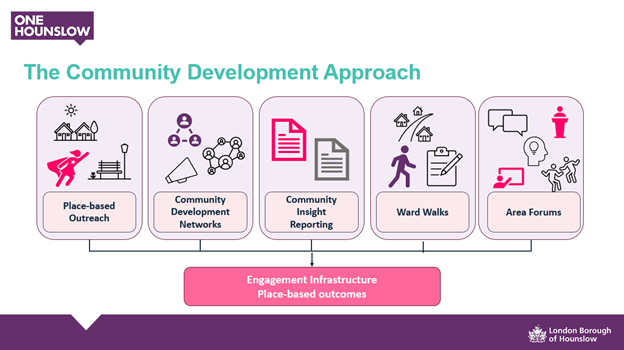
The operational model of the Community Development Team is rooted in presence and accessibility. Officers spend the majority of their time out in communities, conducting outreach visits, attending local events, and facilitating meetings. Only two days a week are spent in the office; the rest is dedicated to building relationships, gathering insight, and supporting action on the ground. Figure 1 below shows the core areas of work which make up the ‘Community Development Approach’ which support the team to both achieve its purpose and build the ‘engagement infrastructure’ – between communities, and between communities and the Council.
Figure 1 – The Community Development Approach
What is engagement infrastructure
When we talk about “engagement infrastructure,” we mean the systems, relationships, and processes that make meaningful, ongoing engagement possible—not just one-off consultations or reactive outreach. It’s the difference between building bridges and simply crossing them when we need something.
Historically, much council engagement has been transactional: a survey here, a consultation there, often driven by statutory requirements or project deadlines. This approach can feel extractive—communities are asked for input when the council needs data, but rarely see how their contributions shape decisions. The result? Low trust, skewed engagement results, and decisions that fail to reflect lived experience.
Engagement infrastructure flips this model. It’s about creating permanent, trusted channels for dialogue and collaboration – this is essentially what the Community Development Approach produces as a byproduct when it sets about achieving its purpose.
As one internal reflection put it: “Quantitative insight data is like an engine light—it tells you something is wrong, but not what or how to fix it. Engagement infrastructure is the mechanic providing you with qualitative data to work out what is going on; and the means to act on it.”
Without this foundation, additional investment in engagement often delivers diminishing returns. With it, engagement becomes a shared endeavour—building resilience, reducing duplication, and creating a culture where communities and councils work together as partners, not adversaries. As a result of this approach, Hounslow is seeing improved levels of trust, connectivity, engagement and democratic participation – which is ultimately helping with more informed local decision-making and accountability.
Place-based working
Place-based working is the foundation of Hounslow’s Community Development Approach. Rather than applying a one-size-fits-all model, the team works within defined localities, tailoring engagement and support to the unique needs, assets, and priorities of each area. This can only be achieved through a strong emotional and physical presence on the ground – as such, officers are out on the ground at least 2-3 times a week, and not necessarily with a pre-determined objective in mind; sometimes it's just about checking in.
Place-based working ensures that engagement is not transactional but relational—responsive to context and grounded in community ownership.
Community Development Network (CDNs)
At the heart of the team’s approach are the Community Development Networks. CDNs are locality-based networks that bring together 80–100 groups in each area, including faith organisations, resident associations, youth clubs, health and wellbeing groups, arts and cultural organisations, and grassroots activists. Officers facilitate bi-monthly meetings, shaped by the community and focused on shared priorities.
CDNs support groups to develop bottom-up place visions—shared objectives and action plans that build on local strengths and address inequality, deprivation, and community priorities. They promote asset sharing, enabling groups to access venues, resources, and expertise. CDNs have enabled the formation of consortia for joint funding bids, reducing competition and increasing the likelihood of success. Officers provide up-to-date information on funding streams, facilitate partnership development, and support bid writing.
Capacity building is a key function, with CDNs offering training, peer support, and skill-sharing opportunities.
Example: The Heston & Cranford CDN, in one of the most deprived neighbourhoods, developed a bottom-up place vision using a strengths-based approach. Over 80 groups collaborated to achieve maximum impact, forming consortia to bid for external funding (e.g., £100k fund), demonstrating how facilitation improves partnership working and supports communities to bring in their own investment aligned to local objectives.
Community insight reports
Community Insight Reports were originally developed to provide a regular snapshot of local priorities, engagement trends, and emerging issues across Hounslow. While they are no longer produced monthly, the principle behind them remains central to our approach: turning raw engagement data into actionable intelligence.
Today, CIRs are evolving into a dynamic, AI-enabled process. We are developing an agent that will draw on the Community Development Team’s data and integrate it with large volumes of engagement and insight data from across the council. This will allow services and decision-makers to access real-time, locality-specific intelligence to inform planning, resource allocation, and engagement strategies. The ambition is to move from static reporting to an interactive tool that supports evidence-based decision-making and strengthens the link between community voice and council action.
Ward walks
Ward Walks are a practical tool for connecting officers, Members, and residents. Each year, the team conducts 44 ward walks with councillors, involving hundreds of officers, services, partners, and community organisations. These walks provide opportunities to identify local issues, gather insight, and develop collaborative solutions. They are a key mechanism for building trust and demonstrating the council’s commitment to being present and responsive.
Area forums
Area Forums have been transformed from scrutiny spaces with little influence into collaborative platforms for action planning and partnership. Engagement has increased dramatically, with participation rising from an average of 5 to 86 per forum (and up to 186 at peak). Forums now serve as marketplaces for ideas, connecting residents, Members, council services, and external partners. They develop action plans, foster partnerships, and support Members as active leaders in their communities.
Each Area Forum local action plan, is co-produced by residents, councillors, and Council services, ensuring shared ownership and accountability. Actions are practical and time-bound, with clear leads assigned—often combining council teams, VCSE partners, and community groups. For example, recent Bedfont and Feltham plans include:
- Feltham High Street safety improvements through multi-agency collaboration, tackling anti-social behaviour with CCTV coordination, youth outreach, and enforcement measures.
- Bedfont High Street pedestrian safety via bollard installation and increased parking enforcement following ward walks.
- Environmental action on fly-tipping and land management in South Bedfont Estate, with councillors lobbying for stronger enforcement and maintenance plans.
- Infrastructure projects such as the Baber Bridge improvement scheme, linking to wider green space and cycling route upgrades.
Progress is reviewed at subsequent forums, creating a cycle of delivery and feedback rather than one-off discussions. This approach embeds transparency and continuity, turning forums into engines for local problem-solving and partnership working.
Lessons learned
- The journey has not been without challenges. Budget cuts and the non-statutory nature of the service have placed pressure on resources. Cuts to the Thriving Communities Fund have also limited the team’s ability to support new initiatives.
- Demonstrating value for money is difficult without resources for impact measurement or pre-existing easy to use methodologies (this is something we are working with the London Council’s Engagement Network to explore together).
- There is also an ongoing risk /temptation that engagement infrastructure could be used to extract data for council ambitions, rather than empowering communities.
- The private sector’s dominance in the engagement space—often at high cost and with less genuine community embedding—remains a concern, especially as it often markets itself as a ‘quick-win’ solution that operates outside even the best built engagement infrastructure in a space.
Despite these challenges, the team’s successes are clear. Area Forums and CDNs have transformed local engagement and democracy. Place-based working is now recognised across London, with other councils seeking to replicate the model. Projects like PlayZones and Heston in the Loop have brought significant investment and recognition.
If starting again, the team would launch CDNs earlier and focus more on community-led mechanisms and empowerment. The importance of being led by the community, rather than reinforcing a paternalistic relationship between Council and community, is a key lesson – it has allowed us to value community capacity and capability better, which supports better partnership working and ultimately lead to better outcomes for residents.
Advice for others
For those seeking to replicate Hounslow’s approach, the following principles are key:
- Invest in building strong, locality-based networks that enable collaboration, reduce duplication, and maximise impact.
- Prioritise strengths-based approaches and asset sharing to empower communities and foster sustainable change.
- Facilitate regular, inclusive meetings and provide practical support for partnership development and funding bids.
- Ensure communication is clear, accessible, and responsive to the needs of diverse groups.
- Recognise the importance of digital inclusion and provide tailored support for those facing barriers.
- Be prepared to adapt meeting formats and engagement strategies to increase accessibility and participation.
- Build strategic partnerships with business, statutory services, and funders to leverage resources and expertise.
- Focus on sustainability, governance, and inclusivity to ensure networks remain effective and representative.
Annex: examples of some community development team achievements
The Community Development Team’s work is best understood through the tangible changes seen across Hounslow’s neighbourhoods and estates. Every initiative, partnership, and project is rooted in the team’s commitment to empowering residents, fostering collaboration, and responding to local priorities. Whether supporting young people, transforming public spaces, or building networks of mutual support, the team’s approach is practical and people-centred.
The following examples illustrate the breadth and impact of this work. They show how the team connects with residents on the ground, enables community-led action, and delivers improvements that matter—from new playgrounds and youth programmes to resident-led gardens, foodbanks, and safer streets. Each story reflects the values of partnership, inclusion, and local ownership that underpin the team’s approach.
These thematic examples are drawn from recent updates and reports and highlight the diversity of achievements delivered for and with Hounslow’s communities.
1. Supporting young people and families
- Facilitated youth groups (e.g. Rise and Thrive, Perfectly Imperfect, W4 Youth, Hogarth Youth) to access funding, build capacity, and deliver inclusive activities.
- Co-designed youth democracy projects, arts programmes, and sports initiatives, including the Youth Democracy Ambassadors and community art projects for children.
- Enabled free and low-cost sports sessions (Brentford FC Foundation, Team Keane Watersports), after-school clubs, and creative workshops for young people from low-income backgrounds.
- Supported playground development and PlayZones consultations, ensuring young people’s voices shaped design and delivery.
2. Resident-led improvements and community iunitiatives
- Transformed underused spaces into vibrant community gardens (Harlech Gardens, Henley’s Orchard), led by residents and supported by partners like Cultivate London.
- Supported resident groups to lead events (Convent Way Community Champions, Jubilee celebrations, Community Fun Days) and secure funding for their ideas.
- Helped establish foodbanks, coffee mornings, and adult learning classes, tackling isolation and supporting wellbeing on estates.
3. Partnership working and multi-agency collaboration
- Connected youth groups, VCSE organisations, and funders to deliver wraparound support for vulnerable young people and families.
- Worked with Housing, Estate Improvement Teams, and external partners (Thames Water, Groundwork London, SHEWISE) to deliver infrastructure, safety, and wellbeing projects.
- Facilitated intergenerational projects and community quizzes, building cohesion and understanding across generations.
4. Enhancing public spaces and community safety
- Led engagement and secured funding for new playgrounds, outdoor gyms, and green space improvements (Brabazon Playground, Heston Farm, Sparrow Farm Estate).
- Addressed anti-social behaviour, fly-tipping, and waste management through ward walks, targeted enforcement, and resident-led campaigns.
- Improved pedestrian safety and accessibility with precinct changes, bollard installations, and parking reviews.
5. Inclusion, wellbeing, and strategic engagement
- Supported refugees, asylum seekers, and isolated residents to access services, employment support, and ESOL classes.
- Delivered targeted workshops on women’s safety and wellbeing and promoted health and food growing activities.
- Organised engagement days and consultations for new community hubs, ensuring resident priorities shape service design (Meadowbank, Cranford).
6. Strengthening local networks and community hubs
- Built and sustained Community Development Networks (CDNs), meeting 100+ groups every two months to share learning, coordinate action, and support residents.
- Supported community centres and hubs (Proctors Close, Bedfont Lane, Belvedere House) to expand their offer and become focal points for local engagement.