To address low breast cancer screening rates in Dudley and Netherton, a mobile screening unit was relocated to a central location, and a targeted awareness campaign was co-produced with local women. This led to an increase in screening uptake across all general practices surveyed, with 74% of respondents screened at the central location and 65% preferring it due to convenience. The initiative also demonstrated a commitment to reducing inequalities, as women from minority ethnic groups were more likely to prefer the central location.
The challenge
Dudley Council is committed to reducing health inequalities and improving health outcomes for all residents. This case study highlights our innovative approach to increasing breast cancer screening rates among women in the Dudley and Netherton Primary Care Network (PCN), an area with high deprivation levels and historically low screening uptake. All other PCNs in Dudley have screening coverage above the national average (69.9%), but Dudley and Netherton PCN coverage is significantly lower (61.6%).
Graph 1 - Breast cancer screening coverage by primary care network (2023/24)
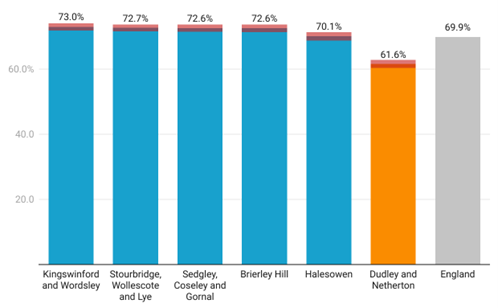
Dudley and Netherton PCN (yellow), England average (grey), 95% CI (red)
Historically, the Dudley and Netherton PCN has not had a suitable location for the mobile breast cancer screening service, contributing to these low screening rates. Recognizing that geographical barriers and lack of local access contribute to low screening rates, we identified the need for a more accessible location for the mobile breast cancer screening unit. Our Healthcare Public Health and Healthy Places & Communities teams collaborated with community development workers and the Breast Screening Service to identify and evaluate potential sites.
Improving health and reducing inequalities is a key priority for Dudley Council. We are committed to addressing the wider determinants of health, including access to healthcare services. This initiative reflects our dedication to ensuring that all residents have the opportunity to participate in preventive healthcare programs, regardless of their socioeconomic background or geographical location.
The solution
We implemented an innovative, multi-pronged approach to address the low breast cancer screening uptake:
1. Locating an Additional Mobile Screening Unit: We located an additional mobile screening unit in Central Dudley, chosen for its accessibility and convenience.
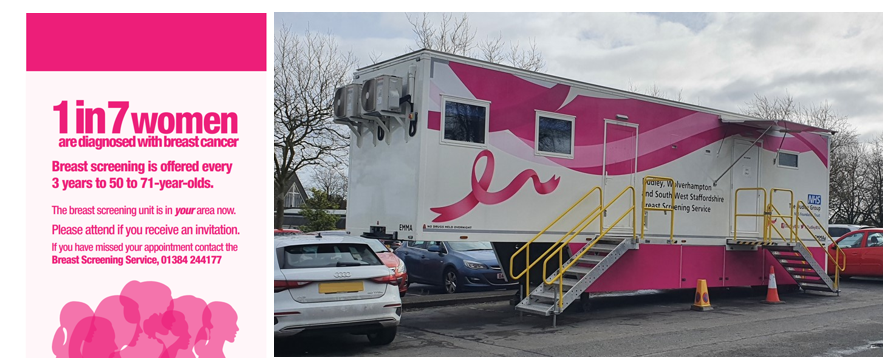
2. Community-Based Awareness Campaign: We co-produced an awareness campaign with women in the target demographic, utilizing social marketing principles to maximize engagement. This image was then shared through social media channels and posters in local businesses, and by printing the image onto pharmacy dispensing bags.
Throughout this initiative, community involvement was prioritized. The awareness campaign imaging and messaging were co-produced with local women in the target demographic through the Birmingham and Black Country ICB Black Breasts Matter project to ensure relevance and effectiveness. Interestingly, the design favoured by most women was not the design team's initial preference, highlighting the importance of including the target audience in the design process. This co-production approach fostered community ownership and engagement, contributing to the campaign's success.
Leveraging their local knowledge, our community development workers worked with local women to identify suitable sites for the mobile screening unit's relocation. An evaluation was conducted to gather feedback on the new location and the awareness campaign, allowing participants to share their experiences and suggestions.
Awareness campaign image and Mobile Screening Van located at Stafford Street Carpark, Central Dudley
The impact
To evaluate the impact of this initiative, we surveyed 231 women across three general practices. We found that this initiative resulted in several positive outcomes:
1. Increased screening uptake across all three general practices surveyed. The largest increase was in St. James Medical Practice where screening coverage increased from 55.2% to 61.1% (+5.9%). Notably, this practice was closest to the new site, highlighting the impact of location on screening uptake.
Graph 2 - Change in screening uptake (percentage)

2. Strong preference for the new location among women screened. 74% of survey respondents were screened at the central location, with 65% preferring it due to convenience, proximity, and quicker travel time. Women from minority ethnic groups were more likely to prefer the central location, highlighting its role in reducing inequalities. Women said:
“I was more inclined to go because of the convenience of getting to it”
“As a [disabled] person it is a familiar location for me and I was able to use all the crossings from one end of the car park to the other”
“I think location is vital. It needs to be safe for women. Free to park. Private. Secluded. All to encourage women to have their breasts screened”
“location is important as you are nervous enough about appointment without worrying if you can get there having it easy location helps with this”
3. Increased awareness of breast cancer screening among women in the target demographic. Six months later, over half (52%) of women surveyed remembered the campaign, with most women seeing it in pharmacies (29%), the Cancer Awareness Bus (27%) and social media (27%).
Percentage of respondents who remembered the campaign

How is the new approach being sustained?
Dudley Council is committed to sustaining the positive impact of this initiative by:
- Ensuring that future locations for the mobile screening unit are accessible to women in Dudley and Netherton, considering factors such as proximity to public transportation, free parking, and disability access.
- Enhancing collaboration with local businesses and community organizations to further increase the reach of health promotion campaigns.
- Continuing to monitor and evaluate screening uptake data to assess program effectiveness and inform future program development
Lessons learned
This initiative reinforced several key principles:
Health promotion campaigns require diverse strategies that combine traditional and digital outreach methods to maximise reach. Collaborating with local businesses and community organizations provided further opportunities to reach diverse audiences. Crucially, community involvement played a crucial role in developing relevant and effective health promotion campaigns that resonated with the target audience.
Accessible and convenient healthcare services are essential to reduce inequalities and enhance health outcomes. This initiative highlighted that the location of breast screening services significantly influences uptake, particularly for women from minority ethnic groups. Future programs should prioritize accessible locations with convenient transportation options
Continuous evaluation is necessary to assess program effectiveness and inform future program development. This includes incorporating systems for collecting and analysing qualitative feedback to understand the program's impact and identify areas for improvement based on user experience.
Contact:
Dr. Oliver Topping, Public Health Registrar
[email protected]
Parminder Bathia, Senior Health Improvement Practitioner
[email protected]
Dr. David Pitches, Public Health Consultant
[email protected]