The Leeds Health and Care Partnership includes health and care organisations from across Leeds who are working together to improve the health of people in Leeds.
Leeds system visibility approach
The challenge
In order to improve flow, the Leeds systems needed to understand better demand and drivers of delay. Data was siloed and not easily accessible across partners, with an additional issue that this often led to the data not being trusted or surfaced in a timely manner to take action.
Aim
Working alongside the Enhanced Care at Home, Active Recovery at Home, Transfers of Care and Rehab and Recovery Beds projects, the aim was to be able to make system level decisions and improvements utilising an end-to-end single source of truth. This would:
- enable evidence-based decisions to manage system pressure,
- improve the efficiency of services and
- enable the most independent outcomes for patients.
The approach
Using a ‘Team Leads’ approach, there was a partnership agreement to develop a system visibility solution in 2022 to provide a clear view of performance across the UEC system, giving visibility of the immediate challenges. Key to the success of this approach was being able to combine the digital solution with an organisational mechanism to make best use of the digital solution. This involved:
- System visibility: having the data and technology to bring all data together and turn it into the right insights and making those insights accessible to people across the system.
- Active leadership: where the insight is used to make decisions and drive improvement. This requires the right governance structures in place and the right culture in the system to make data driven decisions and hold people accountable.
System visibility

Data and technology
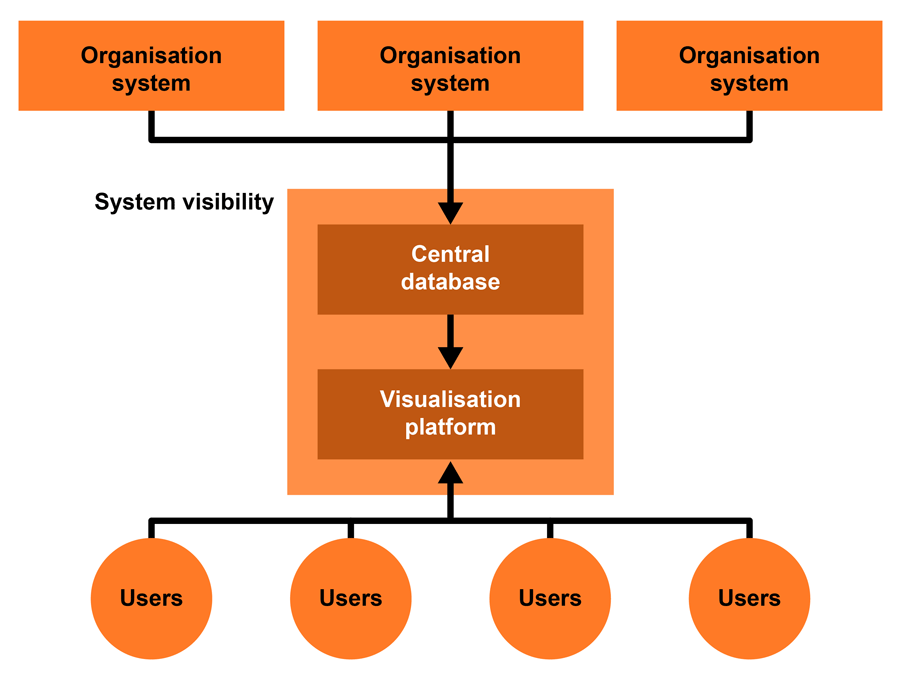
The existing architecture and technology were developed to allow for improved sharing of data from each organisation, into a central repository against a defined set of data items. This data was then developed further, with each service defining what best in class data capture looks like. Data is now shared between organisations to be able to understand the full picture of pressure and flow across the system.
Organisation system
Insights
To ensure that the right insights could be gathered, it was key that there was clarity about what success was for the whole system, being clear about what services needed to be included in this, and the KPI for each service, to enable decisions and interventions to lead to improvement. Useful questions driving this process were:
- Outcomes: how do we measure how well the service promotes long term independence?
- Flow: is this service supporting as many people as possible in the most timely manner.
- Service delivery: can we find a measure of service performance which might vary service to service?
Finally, a visualisation of these metrics was developed with an agreed data source for each.
| Service | Outcomes | Flow | Service delivery |
|---|---|---|---|
| System measure | Volume of long term care placements and packages | Total residents delayed across the system, and measure in each service | Measured within each service |
| Acute - front door | Admissions | Attendances | Four-hour breaches |
| Acute - inpatients and discharge |
Proportion of complex discharges |
General and acute bed occupancy percentage |
Complete length of stay (CTR/NCTR) |
| Transfers of care function (including social care assessments) | Number of long-term placements | Number of open assessments | Complete assessment times |
| UEC community services (UCR type services) | Percentage discharged with no further action | Number of referrals | Percentage of accepted referrals |
| Reablement (home backed IC) | Effectiveness (change in start and end care need) Percentage independently discharged | Queue | Number of starts/complete length of stay |
| Short term beds (various) | Percentage discharged home Percentage of readmissions |
Queue | Length of stay (CTR / NCTR) |
| Home-care packages (long term care) | Number of new packages Average size of packages |
Time to source, queue | N/A |
| Residential/nursing placements | Number of starts Nursing/residential split Percentage of readmissions |
Time to source, queue | N/A |
System report
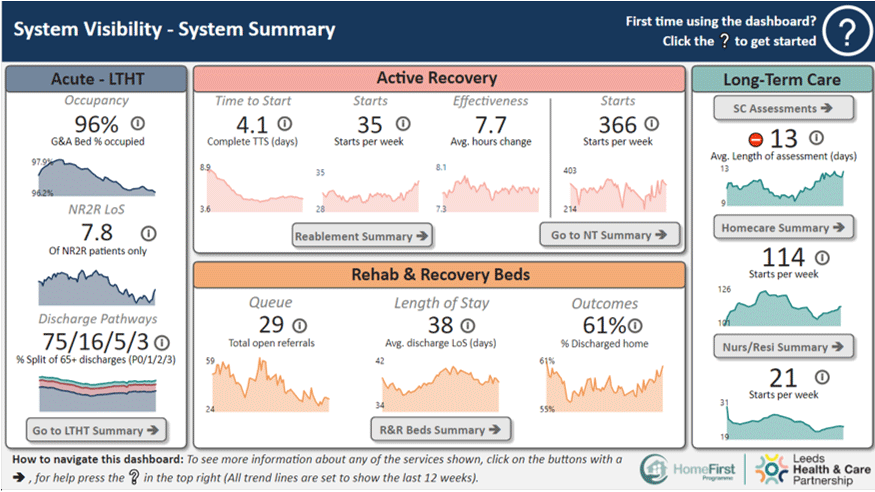
By utilising the data shared between organisations and using a logical suite of metrics, it is now possible to have a clear view of how each service is performing in three key areas:
- Queues: Is the service meeting demand?
- Efficiency: Is the service delivering what we expect?
- Outcomes: Is the service quality what we expect?
This allows for an overall summary of system performance and pressures to be produced which is used for tactical weekly decision making about how to immediately address these pressures and monitor impacts over time.
An example of system report
Service specific reports
It is also possible to generate service specific reports (e.g. for Reablement), providing a detailed view of the service operations down to a caseload view. These can now be used as a single joined up view of caseload and performance to allow service themes to be actioned and individual patient actions and next steps to be monitored.
Active leadership: problem-solving, decision-making collaboration and accountability
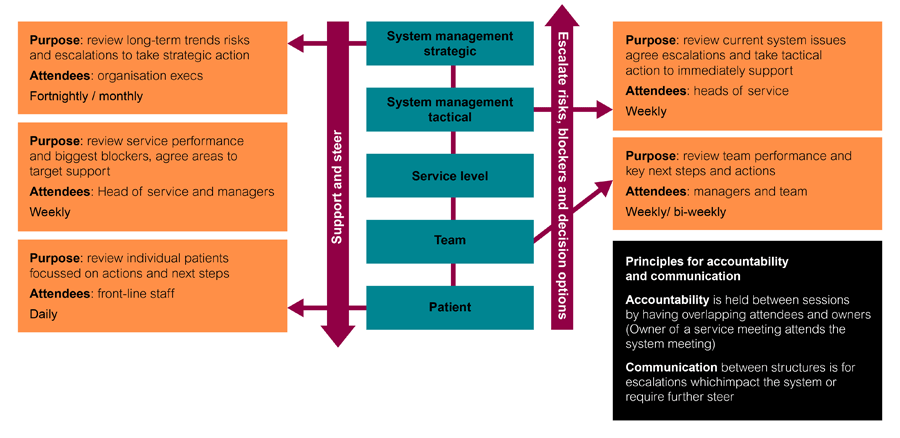
System working and improved decision making was achieved by putting in place structures (and governance arrangements) for people to work, communicate and be held accountable across organisations. Thus, the right people were getting together to make data driven decisions and getting to the root cause of the underlying issues.
The diagram [below] shows how at each level staff are organised, with a clear purpose set out for how to use the data for decision making.
Culture
A level of transparency has now been created between organisations through the shared data visibility. This allows everyone to be looking at the same single source of truth.
By creating the system visibility tool and a structure for using this for decision making, the link to how this is delivering better outcomes for people is explicit. Through this, staff are supported to make both the short-term tactical decisions and long-term transformational decisions.
Setting this shared vision alongside governance structures allows for a culture of data driven decision making which directly benefits the people of Leeds using health and care services.
Impact/outcomes
The system visibility approach has contributed to ensuring people remain independent for longer and to services being available for those that need them –some examples of impact are set out below:
- August 2024-January 2025: 31 per cent reduction in hospital lost bed days for people needing supporting on discharge that no longer needed to be in hospital.
- August 2024-January 2025: Reduced reliance on Pathway 2 short term community beds – bed occupancy down from 280 to 185 beds.
- August 2024-January 2025: 24 per cent increase in number of people supported at home rather than being admitted to a bedded setting after their time in hospital or community beds.