Introduction
North Devon Council recognised that the needs of some of our most vulnerable residents would be met more effectively through a collaborative, multi-agency approach. Those who find themselves homeless or in insecure accommodation often face difficulty in accessing the support and services to progress into stable and healthy housing. This spurred an initiative to integrate service provision and provide wrap-around support for those with housing need. Working in partnership with the existing charity, the Freedom Community Alliance, the council created an enhanced rough sleeper service, expanding its capacity to exercise the non-statutory power to accommodate, and provide a robust prevention and recovery service to combat homelessness.
Challenge and context
Like most Local Authorities, North Devon reckons with the deprivation and poverty which are direct consequences of the national housing and cost-of-living crises. These issues intensify existing vulnerabilities, in turn having a devastating impact on individuals in our communities. In particular to North Devon, high property prices and low incomes give us an affordability ratio of 10, much higher than the national average. Our shortage of affordable housing is exacerbated by the significant proportion of properties which are second homes (just under 5 per cent) or short-term holiday rentals (4 per cent). These pockets of poorly distributed wealth are in stark contrast to the deprivation experienced by high proportions of residents. For instance, seven of our neighbourhoods are in the 20 per cent most deprived in England, and 15.6 per cent of households are living in fuel poverty (Department for Energy Security & Net Zero, Sub-regional Fuel Poverty, England, 2024 (2022 data).
The polycrisis manifests in high numbers of rough sleepers and those in unstable accommodation. In our district (of just under 100,000 residents) there are, on average, between 65 to 80 households in Temporary Accommodation each night. Alongside this, there are on average 40 people that we are aware of each night who have no fixed abode, though it is likely the true number exceeds this.
Rough sleeping is more often than not accompanied by other needs and struggles, linked to their personal history. Many also experience poor physical and mental health or struggle with debt, poverty or addiction issues. The services available to help our clients through these difficulties can entail a level of bureaucracy which makes them inaccessible and/or unattractive to those whose needs are multi-faceted and complex. Aside from the administrative difficulty, the process can require individuals to tell their story over and over again to new people who they are unlikely to trust, aggravating historic trauma.
The service was established to follow our vision that 'North Devon will be a sustainable, inclusive community; fostering prosperity and wellbeing for all.' It represents our commitment to provide flexible specialist accommodation pathways to meet service demand for some of our most complex clients to reduce the numbers who end up homeless and improve flow rate through the existing provision.
What challenges do you face and how are these managed?
Maintaining services despite significant financial pressures is an ongoing challenge. Government funding through the Rough Sleeper Initiative has not been guaranteed year on year. Our Rough Sleeper Coordinator has had to fight for this funding, feeding back key data to prove the success and undeniable value of the service. Now, the bidding process for these funds has ceased and there is stronger financial certainty over the future of the project. For 2025/26, the council is working with £426,862 worth of Rough Sleeping Prevention and Recovery Grant to fund its services. Financial pressures will remain however, due to third-sector factors such as NI payments, not to mention the alarming inflation of utility costs and the significant demand for services as residents struggle to cope in this financial climate.
Increasingly extreme weather also presents additional challenge to the centre during winter. Major efforts are made to ensure everyone is off the streets as the temperatures get colder, and if cold weather provision is triggered, the Freedom Centre Hub becomes a base to shelter those with nowhere else to go.
What we did
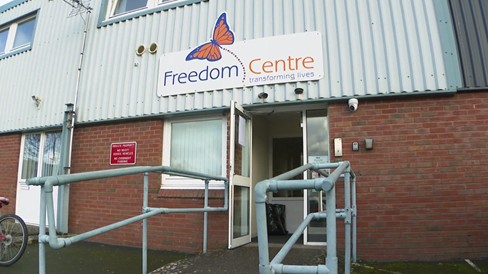
The Freedom Community Alliance has operated a Day Centre to support the homeless in the area since 2007. Originally, the council had use of a spare room at the back of The Freedom Centre to co-locate some members of staff. After the COVID-19 pandemic, the Centre transformed its office into an open-plan co-working space to develop a fully integrated approach between the council officers and the Freedom Centre team. The Centre has over 20 members of staff with different specialties, including:
- accommodation support workers
- day centre staff
- a co-located drug and alcohol specialist
- welfare-security
- a mental health support nurse
- the recently established bespoke GP surgery with a GP and nurse.
The council’s Enhanced Outreach Team is made up of several specialist staff including a:
- rough sleeper coordinator
- rough-sleeper housing officer
- anti-social behaviour officer
- community safety partnership officer
- accommodation for ex-offenders officer.
The team also rely on the mutually-beneficial links they have fostered with another local agencies. These include the police, probation, street marshals, drug and alcohol services, the North Devon and Torridge Community Safety Partnership, the NHS and charities like Encompass, to name a few. Continual contact between these services enables all agencies to maintain a coherent approach and deliver consistent messages to clients.
How does the service work?
Each day an outreach team visits those sleeping rough on the streets or in tents and those residing in our outside pods. They investigate any reports of rough sleepers which come from public StreetLink reports or other agencies who operate in the area.
These daily checks ensure that our vulnerable citizens are safe and well and provide the opportunity to identify any additional support they may require. Rough sleeping clients are encouraged to attend the day centre where most of their essential needs can be met. As well as access to services provided by the specialist team, they have the opportunity to receive hot food and food parcels, clothing, a hot shower, laundry services, post, computer and internet use, charging facilities and gym access. On top of which, clients are welcomed into an accepting and supportive community. The hub also creates an ideal location where other services can hold sessions to meet with clients, such as the DWP, and charities like The Eddystone Trust or Man Down UK.
The multi-agency approach at the Freedom Centre allows us to provide wrap-around support for our clients. In one place, for instance, they can speak to the Day Centre team who will help them set up a bank account and apply for Universal Credit, meet with a Housing Officer who can advise them on their appropriate banding for social housing and receive support from their allocated worker to navigate shared housing dynamics and master new life skills. Because these services are co-located, opportunities to connect with clients are increased, and the team are able to identify needs early on, either offering practical therapeutic support or signposting clients to services who can address their needs. The integrated team benefit from daily briefings so that any updates can be considered and so that clients are supported dynamically from all sides.
We fund eight pods with 365-day support, which bridge the gap between rough sleeping and bricks-and-mortar temporary accommodation. We also, through the partnership with Freedom, provide temporary accommodation houses which are managed by Support Workers. The Freedom Centre manages 51 bed spaces which, combines with the pods, enable a step-up, step-down approach. It can be important to support clients gradually from rough sleeping into permanent accommodation, and so the stages in between are tailored to the individual to protect their safety and prepare them for success in their new housing, reducing the risk that they return to rough sleeping.
Ricky talking about his experience of staying in Barnstaple's rough sleeper pods.
By maintaining regular contact with clients at all stages of their journeys, even once out of immediate need for shelter, the team can identify those who are at risk of becoming homeless again and input tailored prevention measures before relief measures are needed. We believe we can best meet each individuals’ needs through a multi-agency, holistic approach. One type of approach will not be suitable for all clients. We accept people for who they are, see the value in every individual, welcome them and do our very best for them. We are not here to judge actions or motives, rather to assist and support people.
The difference
The council’s support and input to the Freedom Centre provides clear benefits for its clients. Many are prevented from rough sleeping, and if they do unfortunately become homeless, often their time spent on the street is reduced. Client-focussed solutions support those who might not cope (let alone flourish) in a one-size fits all system. This means their needs are addressed and they are more likely to graduate into permanent, sustainable accommodation. The collaborative approach has been revelatory for all parties involved and the team consistently deliver dynamic, holistic and compassionate care to all clients.
Between 1 April 2024 and 31 March 2025, 125 clients accessed rough sleeper accommodation (pods or TA). 29 clients moved into supported accommodation, and 31 were supported to independently manage their own tenancies in the private rented sector, and nine secured accommodation via the Devon Home Choice social housing register.
The work of the Freedom Centre carries benefits not just to the individuals who receive support, but also to the wider community. Freedom’s GP service, Inclusion Health Devon, helps clients who may struggle to engage with mainstream services to receive much-needed, consistent medical care. This, in turn, relieves pressure from other local GP surgeries and it is well known that early community health interventions prevent escalation of conditions to require Emergency care or hospital admission. Community safety is supported by reducing criminal justice costs and collaboration with other agencies leads to swift and informed responses from the local Police and the Street Marshall team.
Lessons learned
The Freedom Centre hub is not purpose-built and is a testament to the fact that local authorities don’t necessarily need a bespoke venue to provide high quality and much needed services. The vital element is the collaboration of services, better achieved through co-location of those services. Rather than merely exchanging contact details, sharing a space every day with a variety of disciplines and agencies results in a more efficient service and more consistent client experience. This removes the discouraging feeling for clients that they are being bounced around between services who keep passing the buck.
North Devon Council is incredibly proud of this partnership and model of work. Its unique client offer rightly draws a lot of attention from other authorities, and the Centre is committed to sharing knowledge and best practice surrounding its work with rough sleepers in the community.
One particularly impactful legacy is that the Centre frequently hosts Police Students on placements. This educates future officers about the reality of the lives of some of the residents who will be in their care and supports the development of a police force who are aware of the importance of partnership working with homelessness services.
Are there going to be similar programmes going forward?
The support on offer to the rough-sleeping community has continually improved, using the space in different ways and increasing in scope where needs were identified. A new role of Rough Sleeper Prevention Officer was developed in 2025 to further boost the emphasis on preventative interventions. And there is also now a filled Apprenticeship role, encouraging new career pathways into this exciting and varied field of work.
The work of the Freedom Centre is fully supported by North Devon members who, through the 2025 Housing Strategy, have committed to sustain, support and bolster the offer which the council will provide into the future.
Whilst the majority of what is provided through freedom is not a statutory requirement for the council, we recognise that there is huge value for local area in committing to more than simply our legal duty. In fact, we see this provision as part of our moral duty to look after those who need help in our community, and all are agreed that the work done is instrumental in tackling the ongoing challenges faced by our residents.
Contact and further information
Natasha Rowland, Rough Sleeper Coordinator [email protected]
Further information
- BBC Spotlight on the service
- YouTube playlist including client stories
- more stories can be found on the Council’s Instagram account.