This case study examines how Somerset Council, following the wave of unitary authority creations in 2019 created their Target Operating Model, helping the new council navigate financial pressures and foster a new shared culture focused on delivering better resident outcomes.
This case study explores how Somerset Council developed its Target Operating Model (TOM) in the 2019 to 2023 wave of unitary authority creations. It examines how this high-level, aspirational model, created through intensive collaboration, is acting as a vital compass. It is helping the new council (formed from one county council and four districts) to navigate financial pressures and foster a new shared culture focused on delivering better resident outcomes including ‘digital by choice’ services.
The challenge
In the period following its creation, Somerset Council faced significant and immediate challenges stemming from the practical reality of bringing together five different organisations, systems and cultures. It faced the challenge of siloed working, not just between legacy councils but within previous service areas, where teams were using four or five different systems to perform similar functions.
Becoming a new council necessitated a major workforce restructuring programme. For staff, this was a period of considerable change and uncertainty as the new unitary council began to take shape. At the same time, the new unitary faced financial challenges, entering a state of financial emergency immediately after vesting day. This created a pressing need to operate differently.
The council needed a compass to guide its direction and a clear map of what working at Somerset Council would look and feel like. This vision would ensure people and communities of Somerset were at the heart of new council’s operations.
Without this, the new organisation risked remaining a collection of separate parts focused on smaller service goals rather than becoming a single, cohesive entity working towards the same collective goal.
The approach
A TOM is a blueprint for how an organisation will operate to achieve its strategic goals. For Somerset, recognising the disunity caused by structural reform, it adopted the TOM as part of its unifying solution. It offered a way to create a shared vision for the new council’s direction and foster a common understanding of how it would work as a unified council.
The aim was to develop a high-level aspirational document rather than a traditional detailed, organisational blueprint. This approach helped secure buy-in from senior leadership, some of whom initially questioned the TOM’s relevance for a local authority having previously viewed it as a primarily private sector tool.
This high-level TOM would instead describe how the new council would work, innovate and challenge itself to achieve its strategic goals. The TOM would be dynamic and used continuously to steer decision-making and design services across the organisation.
Building for success
Somerset’s TOM was developed in-house through a cross-organisation effort. The process, from initial drafting with subject matter experts to final sign-off, was completed in under eight months. The goal was to create a model that was co-designed and co-produced, engaging everyone from cabinet members to frontline staff. This ensured it would be a tool for genuine transformation, not merely a bureaucratic exercise.
The TOM was primarily guided by the new council’s vision, priorities, organisational values and behaviours, with the original LGR business case providing secondary input. This ensured the TOM was built on the council’s foundational principles and future aspirations which had evolved since the LGR business case was created.
The process of drafting the TOM began with a small group of subject matter experts from within the council. This was reviewed by a working group comprising service directors. Through a series of workshops, directors themselves articulated the benefits they wanted to the TOM to realise, fostering a powerful sense of ownership over the final product.
Ensuring robust representation for digital, data, and technology was essential. The council’s ambition was to be ‘digital by choice’, guiding residents towards service access methods that suited their preferences. Officers and members alike shared their views to help develop clear working practices and address the potential challenges of mobilising change.
The collaborative engagement led to five core themes, each with subject matter expert lead:
- People and Skills
- Digital and Technology
- Service and Process Design
- Data Insights and Evidence
- Governance and Decision Making
Place, People and Communities were placed at heart of the model reflecting the overall purpose and direction of the new council.
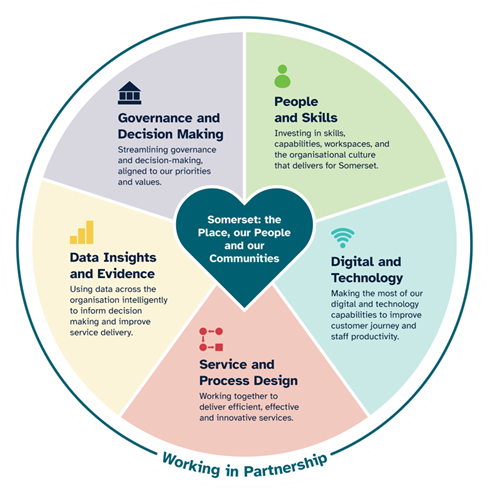
Once the themes were established, the executive leadership team offered feedback to refine the model. Elected members were kept informed and feedback sessions were held with specific groups such as frontline staff, and disability and LGBTQ+ networks. This guided the creation of content that was inclusive and accessible, reaching beyond those familiar with digital and transformation terminology.
To maintain momentum, the project lead quickly adapted when board meetings were cancelled due to the financial emergency. They utilised video communication, sending a short, recorded explainer directly to senior leaders. This allowed leaders to review and approve the TOM’s direction of travel without needing a formal meeting.
This agile approach was highly effective and praised by the Chief Executive for its efficiency.
The benefits
The TOM is already having a significant impact, despite it still being early days. It has effectively provided a shared vision for aligning the newly merged organisation.
The most immediate benefit has been the high level of senior buy-in. Elected members now regularly quote the TOM in executive meetings to support proposals, demonstrating its role as a key strategic driver. This top-level endorsement is crucial for embedding the model within the council’s culture.
The TOM is being integrated into core organisation processes to guide the council’s new transformation programme. It serves as a tool to prioritise change, ensuring any new project and process change is challenged against the model and not taken forward if it moves the council away from its vision. It will support the development of streamlined business cases to ensure alignment with organisational priorities and is embedded in corporate performance metrics to track progress against its aspirational goals.
Crucially, being agile is a core principle outlined in the TOM. Moving forward, the TOM will enable more innovation to take place by empowering teams to experiment and trial approaches enabling discovery work to take place without detailed cost estimates upfront.
This approach is ensuring that the TOM is not just a poster on the wall; it’s a practical tool used daily to challenge existing ways of working and align all transformation efforts.
Key takeaways
Somerset Council’s journey in developing its TOM offers valuable lessons for other councils, particularly those navigating the complexities of LGR.
- Reframe the TOM to fit your needs: Don’t feel constrained by traditional, rigid models. Somerset’s success came from creating a high-level, aspirational document that provided a direction of travel rather than a detailed map.
- Bring leaders on the journey: Ensure they are informed of the approach from the beginning, articulate its benefits and ensure they are updated throughout to secure their buy-in and maintain momentum.
- Co-production is non-negotiable: Investing time in a deeply collaborative process is the best way to secure organisational ownership and create a tool that people will use. Using co-design helps people feel heard and allows them to shape the future in uncertain times. Guiding stakeholders to articulate the benefits themselves is far more powerful than telling them and can frame the change as a positive vision.
- Embrace agile communication: In a fast moving and resource-constrained environment, don’t let formal governance slow you down. Using simple tools like short, pre-recorded videos can be a highly effective way to engage senior leaders and maintain momentum.
- In-house development is possible and powerful: With a clear vision and strong leadership support, it is possible to create a high impact strategic document internally, saving significant costs and ensuring the final product is tailored to the organisation’s unique context.
- Use the TOM to challenge everything: For the model to be effective, it must be actively used as a lens through which all decisions are viewed. By embedding it in prioritisation, business cases, and performance metrics, it becomes a living document that drives continuous improvement.
While the TOM has provided a crucial foundation, the journey for Somerset Council is ongoing. The real test will be in its continued application, ensuring that the collaborative spirit and clear vision that created the model remain at the heart of the council’s culture as it moves forward. By embedding the TOM into its daily operations, Somerset is building a resilient framework for transformation from which other councils can learn.