Lambeth Council partnered with Lightning Reach to streamline how residents apply for homelessness support and connect with other financial help.
At a glance
What went in
Priority area addressed
Transformation of Homelessness support, to improve data collection and prevention rates.
Budget
Under £100,000.
Other resource needed
- contact centre and housing staff time for training and implementation
- Lightning Reach configuration and support.
Timeframe to completion
- Lightning Reach live: January 2025
- full system integration: Q4 2025.
What came out
Improved documentation submission
Eighty-three per cent of residents include supporting documents with their initial application (compared to 0 per cent previously), reducing delays and back-and-forth.
Shorter call handling times
Call centre time reduced by 69 per cent for initial triage calls, freeing up staff capacity and improving responsiveness to initial enquiries.
More targeted interventions
Fewer interactions result in unnecessary applications and appointments, as residents are signposted earlier to appropriate support.
Increased self-service
Applicants receive upfront advice and guidance, helping them understand their options and reducing unnecessary demand.
Data for decision-making
Improved data collection on application trends, documentation, and resident needs to inform service planning and triage.
Executive summary
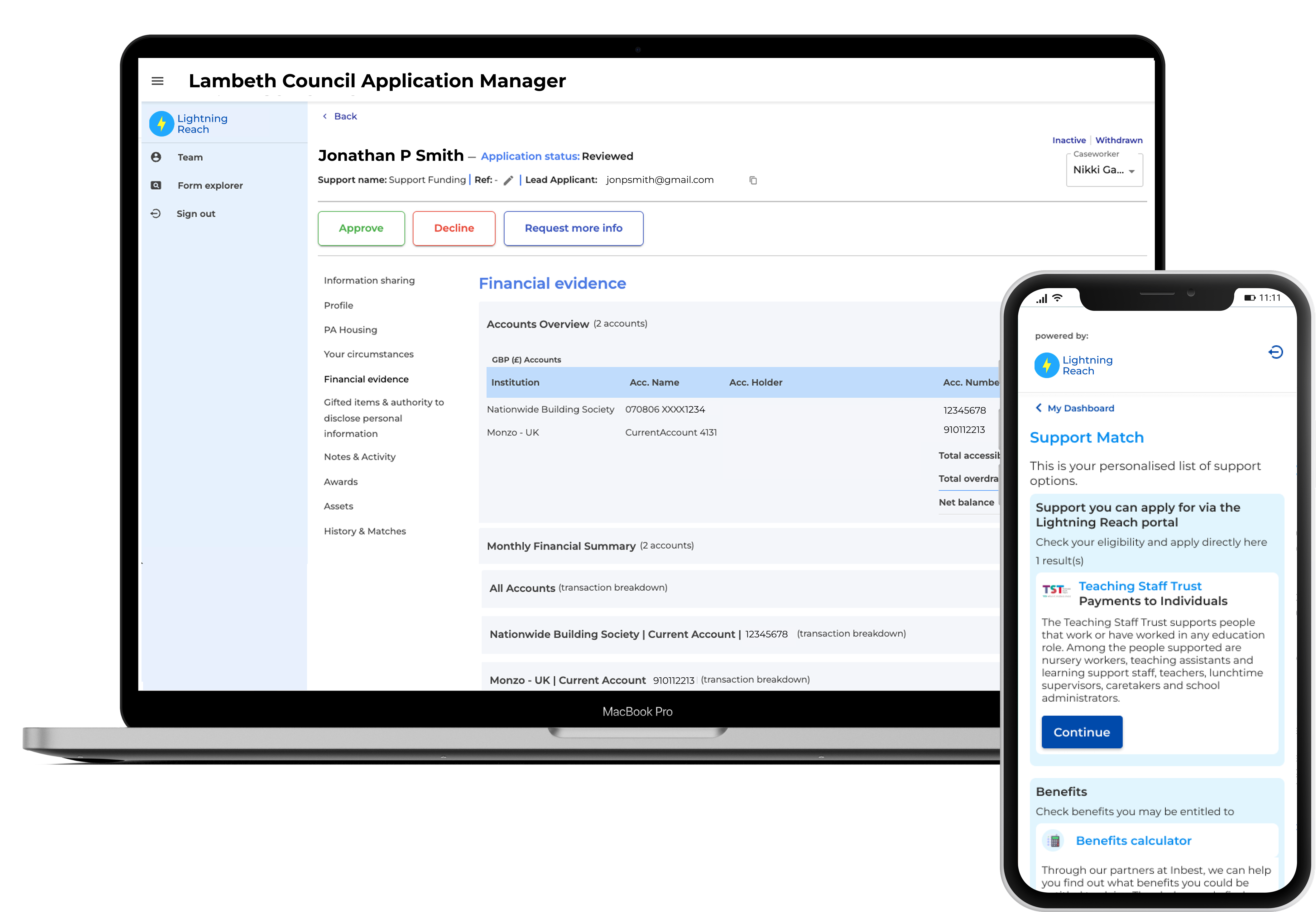
Lambeth Council partnered with Lightning Reach to streamline how residents apply for homelessness support and connect with other financial help. Through a new digital platform launched in Q1 2025, residents can now self-serve, upload key documents, complete ID checks, and access tailored advice in one place. This has significantly reduced call times and unnecessary appointments while improving the quality of information gathered up front. In its first year, over 1600 applications were submitted via Lightning Reach, with 83 per cent including documentation (up from 0 per cent previously). The project forms part of Lambeth’s wider transformation to deliver earlier, smarter, and more efficient homelessness prevention.
Challenge and context
In Spring 2024, Lambeth faced a highly fragmented homelessness contact system. Residents seeking support could email, call, visit in person, or apply online, with different forms used across each route. Minimal advice was offered at the point of first contact, and almost every enquiry led to an appointment, regardless of whether that was the right next step. As a result, staff time was heavily focused on information-gathering, rather than early intervention or prevention.
The pressures were significant. Lambeth was receiving hundreds of homelessness applications each month on top of an existing temporary accommodation (TA) waiting list of 40,000 people. Each household placed in TA was estimated to stay for an average of 10 years, at a cost of over £140,000 per case. There was a clear need to reduce the volume of applications and appointments, ensure only the most appropriate cases progressed, and support earlier redirection where possible.
With limited in-house IT capacity to deliver these changes at pace, Lambeth partnered with Lightning Reach as a core part of its transformation strategy. This enabled them to rapidly implement a digital triage model, offering:
- a consistent and streamlined application journey
- richer data capture at first contact
- built-in signposting to other local and national support options.
Together, this approach aimed to manage demand more effectively, reduce pressure on frontline staff, and ensure that residents were connected to the right support at the right time.
What we did
Digitised homelessness triage via Lightning Reach
- Built and launched a new digital homelessness application form hosted on Lightning Reach in January 2025.
- Residents now complete a guided form that adapts to their situation, upload documents (e.g. ID, proof of income), and receive relevant support matches including council services and external help.
- The platform includes built-in ID verification and lets officers view submissions via a secure portal.
Integrated with contact centre processes
- Lambeth updated call centre scripting to align with the new digital triage, setting clearer expectations with callers and routing them to the Lightning Reach form where appropriate.
- Staff and contact partners were trained to support applicants or complete the form on their behalf when needed.
Aligned with broader transformation work
- Lightning Reach sits within a wider redesign that also includes inbox reform, improved web content, and streamlined data capture across all channels. While Lightning Reach focuses on digital triage, these parallel efforts help maximise its impact.
The difference
The transformation programme has had a significant impact over 2025. The project has seen:
- a 15 per cent reduction in the number of applications received
- a 55 per cent reduction in the number of new placements into temporary accommodation
- a six per cent reduction in the number of households in temporary accommodation.
Between late January and December 2025:
- 1600 applications were submitted via Lightning Reach
- 83 per cent of submissions included supporting documents (up from 0 per cent previously)
- 59 per cent of applicants completed an ID check
- 67 per cent reduction in call handling time (as form replaces information-gathering calls), and a 13 per cent reduction in appointments.
- 30 per cent of applicants have accessed additional support of £40K (including grants and financial support) through Lightning Reach
- Fewer unnecessary appointments and applications. Residents are increasingly only applying when eligible and appropriate.
User case study
Jason, a teacher out of work due to health issues, was referred by Lambeth Council to the Lightning Reach portal. As well as receiving critical housing advice from the Council team, he also searched for additional support on the portal, and successfully secured a £750 grant to help with living costs while seeking work. The financial support eased immediate pressures, helping him cover essentials, plan a move to London, and move forward with confidence toward returning to teaching.
It’s a place you can go where no one judges you, they just help you find support. It was exactly what I needed during this difficult time. Just thank you for the support and assistance.”
Lessons learned
- Good triage needs good form design: Investing time up front to design clear, logic-based forms led to better quality submissions and less back-and-forth with residents.
- Providing clear, upfront advice helps manage demand: By giving residents clear outcomes (e.g. if they need an appointment or can get help another way), the council was able to redirect residents earlier and avoid unnecessary demand on staff
- Change requires alignment: Aligning call centre scripts, inbox triage and staff workflows ensured Lightning Reach was fully embedded into Lambeth’s end-to-end process.
- Plan phased integration to reduce delays and unlock benefits: A key learning was to better anticipate IT needs early on. Staging the integration could have eased pressure on internal teams and helped realise efficiency gains sooner.
- Iterate quickly: Lightning Reach’s agile support allowed fast tweaks to the form and dashboard based on user feedback; for example, improving document upload steps or question phrasing.
- Data is a long-term asset: Lambeth is now using reporting data from Lightning Reach and other sources to better understand demand trends and refine services. This will expand as more integrations go live.