Leicestershire’s Health and Wellbeing Board has committed to using a Health in All Policies approach across Leicestershire and it is identified as a priority within the Leicestershire Joint Health and Wellbeing Strategy 2022-2032.
To make this happen, a proposal was taken through the Council’s chief officer and key member groups and all Departmental Management Teams, for health considerations to be routinely embedded in key council decision-making processes. The creation of a ‘health considerations’ section in County Council papers and decision-making documents (such as Cabinet and Scrutiny Committee papers) was agreed by the Corporate Management Team.
A recommendation from members of key departments affected by this change in process was for a training package be developed, to support staff to consider the relevant health implications and any mitigations that might be required. Additional support was required to develop workforce capacity, skills and confidence within this area.
A new dedicated HiAP Officer post was created, with the primary objective to establish an approach within the County Council and create a model that could be shared with district councils and the wider system of partners that make up Leicestershire’s Health and Wellbeing Board.
In developing a model, consideration was given to:
- Existing guidance and evidence on HiAP, effective implementation and on communicating health, health inequalities and the wider determinants of health
- Workforce skills and knowledge, and peoples’ capacity to consider health in addition to their existing workload
- Priority workforces ie, those in a position to ensure council-wide consideration to health such as democratic services, and policy teams
Based on recommendations from the Local Government Association and The Health Foundation, two primary objectives for workforce development emerged:
- Improving understanding among the workforce of why wider determinants matter, how they affect health and the role of the council in responding to this.
Learning and training content was developed drawing on Leicestershire’s Health Inequalities JSNA chapter, which highlights geographical areas and population groups most vulnerable to health inequalities. This supports decision-making by helping practitioners identify where and for whom health considerations should be prioritised, in line with the principle of proportionate universalism.
The content was piloted within the County Council, and with district council colleagues.
To secure support and ‘buy-in’ to the learning and training, the offer was presented to existing Boards, groups and teams to demonstrate how creating a wider understanding of health, and upskilling staff, could be beneficial to their work. In addition to helping achieve their goals, benefits were identified which included being better able to contribute jointly to corporate aims, achieve cost savings through prevention and synergies, and improve decision-making accountability.
Additionally, to minimise impact on workforce capacity and enable people to easily see the health impacts and potential mitigations, a Health Impact e-form was created. This is a short-form health impact assessment (HIA) that mirrors existing internal equality and environment impact assessment processes and generates the necessary text for Cabinet and Scrutiny reports.
The process from model development to launch took around 11 months. This involved developing and incorporating a HiAP intranet page with associated guidance, a Health Impact e-form, a specific section within the Cabinet and Scrutiny report template, e-learning and a tiered training model (below). Support from the Council’s communication team enabled the launch to be a ‘call to action’ and was widely shared through internal news channels.
Leicestershire tiered training model
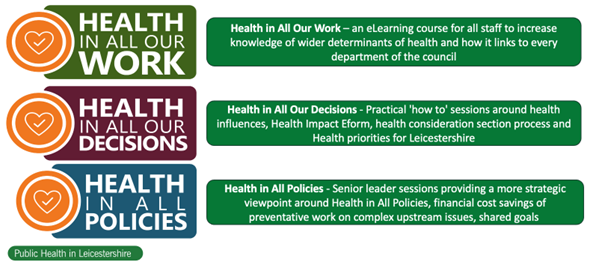
The model has strengthened relationships between the Public Health department and other council departments. Outcomes from implementation include:
- Across the organisation there is a greater understanding of the relationship between health and the council’s policies and practice. So far, more than 150 e-learners have accessed the e-learning modules and an additional 115 staff have received the delivered training. 100% of learners said they would be able to apply the learning to their work, and they were very confident in their understanding of key factors that shape health
- Health implications are being considered earlier in decision making when there is greater opportunity to consider options to improve health or mitigate negative impacts. This has included decisions such as on libraries facilities, embedding health considerations into the design of new school buildings and the placement of Gigahubs (to improve broadband access and speeds in mostly rural areas)
- Public health data is being used alongside other datasets to inform decisions.
There has been agreement over the scenarios when the Public Health department will be required to comment on, and support, decision making led by other council departments. Examples of outcomes of this approach include:
- With planning colleagues, a response will be sought on planning applications that fall into one of the 15 MSOA areas indicated in the Health
- Inequalities JSNA and those relating to the sale of corporately owned land
- With Environment and Transport colleagues, there has been a full Health Impact Assessment on:
- The Leicestershire Highways design guide redesign
- The Local Transport Plan 4 (this plan now has health as a key priority, with improved cycling infrastructure being just one example of a tangible change in policy)
‘I thought the training was really interesting and it definitely made me think about things I hadn't before. I didn't realise how many opportunities within our team there were to consider health inequalities’
Building on this work, a process of regular reporting to the Health and Wellbeing Board is being established, ensuring transparency and accountability for health considerations in decision-making. The model is now also being rolled out across district councils, which hold decision-making responsibilities in key areas such as housing, environmental health, parks and leisure.