This resource is for councillors that are members of Scrutiny Committees, and the officers that support them. It has been developed by the LGA SEND Children’s Improvement Advisers and shaped by the contributions of councillors, the National Network of Parent Carer Forums, Directors of Children’s Services, Shaping Governance, and the Centre for Governance and Scrutiny.
Introduction
PDF version of the resource
If you would like a pdf version of this resource, go to "Print this page" and choose "save as pdf" as your destination.
Support for children and young people with Special Education Needs and Disabilities (SEND) is delivered through a system of partnership between local councils, education and health partners, parents and carers, and children and young people. The support is focused on supporting children and young people with SEND to achieve the best possible educational and other outcomes, preparing them for adulthood.
Councils are facing growing challenges in delivering effective support for children and young people with SEND. Demand for support continues to rise, with the number of children with Education, Health and Care Plans (EHCPs) having more than doubled since 2015, alongside an increasing complexity of need. At the same time, many local authorities face significant financial pressures, with insufficient funding to meet demand. Whilst need, and the costs of meeting need, has increased, outcomes for children and young people with SEND have not improved.
National reforms to the SEND system are underway, but change will take time, and councils, health and education partners need to work collaboratively now, to support sustainable improvement so that children and young people receive the support they need to thrive.
Scrutiny forms a core part of the governance and accountability framework around children’s services improvement. It plays a vital role in holding partnership decision makers to account and providing constructive support and challenge. In this period of active reform, scrutiny as a critical role in supporting sustainable improvement, inclusive practice and financial resilience. Effective scrutiny is increasingly relational, partnership focused and system-wide. It amplifies the voices of children, young people and families, while promoting a culture of learning and improvement. Scrutiny committees are therefore well-placed to be powerful agents for change and have a positive impact on the lives of children and young people with SEND, and their parent carers.
This guide has been developed by the Local Government Association (LGA) to support scrutiny committees and the officers that work alongside them. It offers suggested areas of enquiry for SEND scrutiny and questions that will support scrutiny committees to understand how well their council and partners are supporting children and young people with SEND. It also provides some useful context and explainers on key elements of the SEND system.
Legislative context
The Children and Families Act 2014 changed the way statutory agencies were required to work to support children and young people with SEND from birth up to the age of 25, requiring them to collaborate to design and deliver a system of support for children, young people and their families, and introducing EHCPs which replaced Statements of SEN.
The SEND Code of Practice 0-25 is statutory guidance on identifying, assessing and meeting the needs of children and young people with SEND, that supports the Act.
Under the Children and Families Act 2014, local authorities must:
- Have regard to the SEND code of practice: 0-25 years
- Take account of the views, wishes and feelings of children, young people and their parents/carers
- Keep educational and care provision for these children under review, consulting with young people directly
- Make advice and information available to children, young people and their parents/carers, and publish a ‘Local Offer’
- Review EHCPs annually
- Consider preparation to adulthood and transition planning as part of young people’s plans from age 14
- Put in place co-operation across local partners for personal budgets – parents and young people have the right to request this
Local area partnerships (councils, Integrated Care Boards (ICBs) and other key education, health and care partners) are accountable for SEND provision, within a system where leadership and delivery responsibilities are distributed across statutory partners. This adds a layer of complexity to an already challenging context, but scrutiny is well-placed to understand how the whole system interacts, and to work jointly across children’s, adult and health scrutiny committees to influence council and partner decision-makers through cross-cutting recommendations.
Since January 2023, Ofsted and CQC have adopted the Area SEND inspection framework to evaluate how effectively local partnerships work together to support children and young people with SEND and their families, focusing on lived experience and outcomes.
Foundations of good SEND scrutiny practice
There are some key building blocks that will help you create the right conditions for your scrutiny of SEND services to have a meaningful impact.
Committees can be most effective when they can demonstrate:
- A commitment to working in a child-centred way to understand the views and experiences of children and young people and their parents and carers.
- A proportionate approach to scrutiny activity with a focus on areas where insight and influence can add the most value and avoiding unnecessary duplication or data demands on services.
- A clear understanding of the legislative and policy framework.
- Knowledge of the local context for delivering SEND services.
- Clear scrutiny recommendations that are monitored for impact on the system, and on the lives of children.
- Alignment and join-up with other scrutiny committees and partnership boards (such as those with adult and health remits) to fully explore how the council and partners are meeting the needs of children and young people with SEND up to age 25.
- A ‘critical friend’ approach to develop effective relationships with decision makers in a challenging national context, and to build a shared understanding - ‘are we doing things right?’ and ‘are we doing the right things?’
Barnet Children and Education Overview and Scrutiny Committee – developing relationships
The committee has begun a programme of visits to schools to gather teachers’ perspectives on supporting pupils with SEND and the challenges faced by schools. Committee members have also met with frontline SEND staff to better understand their work.
An appreciative approach – your SEND scrutiny superpower!
National reform of the SEND system is widely recognised as necessary, with local areas facing significant challenges in meeting growing demand. It is understandable that within this context, scrutiny of SEND has the potential to be received by decision makers as overly critical or adversarial, rather than as a ‘critical friend’.
An appreciative approach focuses on understanding what is working well and building on this to improve, rather than looking at problems and trying to fix them. Appreciative questions can be a powerful tool to shift scrutiny discussions from deficit to development and learning. Through turning an appreciative (or strengths-based) lens on scrutiny of SEND, scrutiny committees can build trusting relationships with officers, partners and parent carers, and reduce defensiveness. This will help to foster the right conditions for meaningful conversations, creativity, strategic coproduction and a shared vision for the future.
A simple way for scrutiny committees to do this is to use an appreciative framing for questions and lines of enquiry. Instead of focusing questions on problems, reframe the questions to shine a spotlight on what is working well and why. Keep a focus on outcomes for children and young people by centring your reviews around their needs and experiences, rather than more narrowly about services or individuals. This will help you to focus on what children and young people need and want, rather than what has historically been delivered. The examples below show how an appreciative question can support a more constructive and solution-focused inquiry.
| Concern | Appreciative framing |
|
Why are we seeing declining performance in the timeliness and quality of EHCPs? |
When the EHCP assessment process works well for families, what does that look like? How can we make this a reality for more families? |
|
Why are parents and carers not feeling involved in designing SEND services? |
What examples do we have where parents and carers have felt co-production has worked really well? What can we learn from this and how can we apply it to more of our SEND services and delivery? |
|
Our Local Offer is not meeting the needs of children and families. |
What does an outstanding Local Offer look like for families? How can we achieve this? |
|
Numbers of children with SEND not accessing mainstream education |
I can see that the majority of children are accessing mainstream education, what would we need to do to meet the needs of more children in mainstream education? |
SOAR Framework
The SOAR framework (Stavros, J. M. & Hinrichs, G. 2009, The Thin Book of SOAR: Building Strengths-Based Strategy) is a strength-based tool for strategic thinking which focuses on ‘growing the good’ through exploring Strengths, Opportunities, Aspirations and Results. It can support scrutiny committees to appreciatively frame their enquiries and questions, and to draw out creativity and innovation. The diagram below shows key considerations for each category, using a review of a Local Offer as an illustrative example.
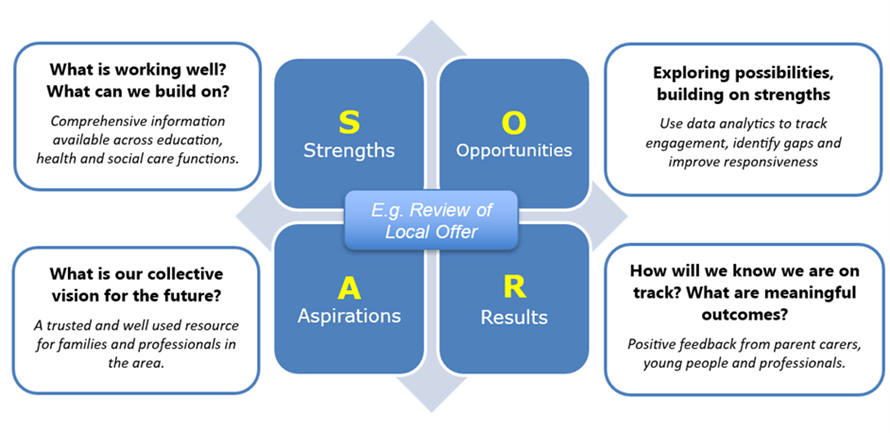
Using an appreciative approach to SEND scrutiny does not mean that scrutiny is not robust or challenging. It is about challenging people to think differently, to generate ideas, and to talk openly and constructively about issues.
Through opening up conversations and inviting people to consider their vision for the future, rather than focusing more narrowly on ‘fixing’ a particular problem or service, it is a collaborative and creative approach to scrutiny that can bring in voices and perspectives from across the whole SEND system.
Knowsley – a strengths-based approach to scrutiny reviews
In Knowsley scrutiny aims to take a balanced approach that highlights what’s working well, areas for improvement, and recommendations addressing:
- What are we doing well and need to continue?
- Where could we explore the opportunity to do more than we currently do or do it better?
- What could we start doing?
The Children Scrutiny Committee’s task and finish review recognised the dedication, creativity, and resilience of staff who continued to deliver strong support for children and young people with SEND despite challenging circumstances. This positive focus was balanced with constructive recommendations for improvement.
Drawing on expertise and lived experience
Scrutiny committees can strengthen their work and impact by involving children, young people and parent carers as witnesses and through co-production. This builds relationships and brings qualitative evidence and different insights into SEND scrutiny. Committees may wish to agree how best to structure collaboration and co-production in their local context in discussion with their Director of Children’s Services, Lead Member for Children’s Services, and democratic services officers.
Hearing the voices of children and young people with SEND
Some scrutiny committees directly involve young people either by appointing them as co-optees or by inviting them to share their stories and questions with councillors.
West Sussex engagement of Youth Cabinet
West Sussex’s Children and Young People’s Services scrutiny committee has ongoing involvement of its Youth Cabinet in scrutiny sessions, inviting young people to give evidence and shape questions. This involvement has helped members understand how policies impact the daily lives of young people. See the full case study at West Sussex County Council - CFGS.
Whilst direct involvement of young people with SEND works well for some councils, there are other ways to ensure that their views and experiences are central to scrutiny. This could involve building relationships with existing youth engagement structures, engaging young people outside of scrutiny committee meetings, providing opportunities for young people to pre-record questions, and visiting early years settings, mainstream and special schools, and colleges.
Even if children are not always physically present in your scrutiny meetings, they should always be at the centre of your scrutiny discussions. As corporate parents, councillors are often asked to consider ‘would this be good enough for my child?’ – an equally useful question in considering the experiences of children and young people with SEND.
However your committee engages with children and young people with SEND, you need to ensure that all children and young people are given the support they need to participate in a way that is meaningful, is appropriate to their needs, and respects their contributions.
Engagement with parent carers and Parent Carer Forums
When scrutinising SEND, committees will need to think about how they engage both with their Parent Carer Forum (PCF) and with parent carers as individuals.
PCFs provide strategic representation of parent carers’ voices in the local area and work to influence and improve services by engaging with families, councils and other partners. Whether your scrutiny committee invites PCF representatives to provide evidence, co-opts them onto the committee or a working group, or engages in other ways, the PCF is a key partner for effective SEND scrutiny.
Scrutiny should also ensure it seeks out and provides opportunities to hear about the experiences of parent carers as individuals, whether this is through surveys, consultation sessions, workshops or inviting parent carers to be interviewed as witnesses.
Task and Finish groups
Scrutiny committees may want to create a time-limited task and finish group to explore a particular topic or issue. The membership of a task and finish group does not need to be restricted to committee members, offering an opportunity to involve other councillors with an interest or experience in SEND, as well as those with relevant experience in areas such as health or adult services. It can also provide a way to collaborate with and involve partners across health, education and the voluntary sector, and an opportunity to consider creative ways for young people to help shape scrutiny work.
Surrey Children, Families and Lifelong Learning Select Committee
Surrey Children, Families and Lifelong Learning Select Committee set up a task group to explore the experiences of parents and carers of children and young people with additional needs and disabilities and consider how the council could better support them. It involved in-depth primary research and engagement of parents, carers and young people, as well as SEND case officers and Members.
A series of focus groups with 25 parents and carers were held, systematically analysed, and triangulated with data on the volume and nature of SEND casework, data on tribunals and complaints, and an internal audit of case officer communications. Focus groups with officers were also held to hear their perspectives on their relationships with parents and carers. A series of recommendations that went to Cabinet including those relating to staffing and training, have been taken on board.
Evidence base for SEND scrutiny: building a local picture
Scrutiny of SEND will be most effective and impactful when committees build an evidence-based understanding of the needs of children and young people to ensure that services are effective, child-focused and accountable. The SEND system is complex but there are a number of ways committees can build a picture of their local context to inform decisions on where to focus their attention:
Inspection framework and outcomes
Scrutiny committees can provide an assurance role around inspection preparation by aligning their enquiries with the Local Area Partnership SEND Inspection framework’s principles and evaluation criteria and holding leaders from across the partnership to account for SEND improvement. After an inspection report is published, committees can contribute to addressing identified areas for improvement and priority action.
In an area with a SEND Improvement Board, scrutiny committees can consider how their work will complement and add value to existing activity. Where appropriate, committees may wish to invite Improvement Board representatives to share updates or jointly explore barriers to improvement.
Rotherham Improving Lives Select Commission – focus on continuous improvement
Following a positive SEND inspection judgement demonstrating significant improvement, the Commission continued to monitor progress against the post-inspection action plan, and has built opportunities to look at particular issues into its annual work programme.
Interpreting SEND data
The right data and insight can support scrutiny committees to ask the right questions, drill down into particular issues, and understand progress. Scrutiny committees should understand what data is collected locally, and how this is used in the planning and delivery of services. The degree to which data sets are joined up across the partnership, and that performance is contextualised through benchmarking and the lived experience of children and families, are also indicators of SEND system maturity.
Scrutiny committees should make regular use of a well‑structured data dashboard to monitor progress against key SEND priorities, quickly spot emerging gaps, and ensure their challenge and recommendations are driven by clear, up‑to‑date evidence. Suggested data sets that may be useful to explore are at Appendix 1.
Listening to children, young people, parents and carers
The lived experiences and voices of families should be central to the evidence base for SEND scrutiny, and thread through all scrutiny work. Many councils will have existing mechanisms for hearing the views of young people and parent carers that can be drawn on, and scrutiny committees will want to hear from parent carers and develop relationships with their local Parent Carer Forum (see Drawing on expertise and lived experience).
Key areas of enquiry for scrutiny of SEND
Some of the core SEND themes that scrutiny committees may wish to explore are outlined below, together with key lines of enquiry for each. Notable omissions are home to school transport and finance as both areas have a breadth and complexity that warrant dedicated scrutiny in their own right.
Scrutiny activity should be proportionate and purposeful, concentrating on key areas where there is an opportunity to influence and support improvement. Recommendations arising from SEND scrutiny will need to remain mindful of the financial context and challenges that shape the delivery of SEND services, to ensure that proposals are both meaningful and achievable.
References and further information
SEND Code of Practice (DfE, 2015) – statutory guidance underpinning the SEND system
Children and Families Act 2014 (Part 3) – legislation underpinning SEND provision
Solving the SEND Crisis report (September 2025), Education Committee
Area SEND framework: findings from the first 2 years of inspections - GOV.UK
LGA Children’s improvement support for Members
A councillor's workbook on scrutiny | Local Government Association
LG Inform – LGA’s local authority benchmarking tool
Appreciative Governance - Shaping Governance
Acknowledgements
With thanks to all parent carer representatives, scrutiny chairs, corporate partners and LGA associates whose invaluable contributions have shaped and informed the development of this resource.
Chris Munday, LGA Children’s Improvement Adviser, Helen Watson, LGA Children’s Improvement Adviser, Cllr Cordelia Law, Torbay Council, Cllr Jodie Watts, Bracknell Forest Council, Cllr Laura Mayes, Wiltshire Council, Cllr Patricia Parkes, Cheshire West and Chester Council, Cllr Victoria Bamisile, Milton Keynes City Council, Cllr Dr Natalie Rothwell-Warn, Gloucestershire Council, Cllr Leigh Redman, Somerset Council.
Sarah Clarke, Co-Chair and Director for the South East, National Network of Parent Carer Forums, Martin McAndrew, Director for the North West, National Network of Parent Carer Forums, Su Turner, CEO Shaping Governance, members of the ADCS Inclusive Education Policy Network, and the Centre for Governance and Scrutiny.
Appendix 1: Suggested SEND Scrutiny Data Sources
Scrutiny committees play a vital role in holding local systems to account and driving improvement for children and young people with SEND. To do this effectively, councillors need access to timely, relevant, and well-structured data that reflects both lived experience and system performance.
This appendix outlines key data sources that can support scrutiny activity through supporting committees to understand local need, understand delivery strengths and challenges, and monitor outcomes. Each category is linked to common themes and questions that committees may wish to explore to build a picture of their local SEND system, identify areas for further exploration, and to follow trends over time.
Data can be contextualised and understood through using national, regional and statistical neighbour comparisons, and through additional qualitative insights from partners, children and young people with SEND, and parent carers.
Local population and needs of children and young people with SEND
- Number of children and young people aged 0–25 receiving SEN support
- Breakdown by primary and secondary need using DfE categories (e.g. autism, speech & language)
- Age group (early years, primary, secondary, post-16)
- Gender and ethnicity
- School type (mainstream, special, independent/non-maintained special)
- Cared for children and children in need
- Total EHCPs maintained by the LA (year-on-year change)
- Number of children and young people 0–25 with an EHCP
- % of new EHCPs issued within the 20-week statutory timescale
- Health contributions to EHC needs assessments: number and % returned within 6 weeks
- EHCPs by setting type and education phase
- Appeals, mediation, and tribunal outcomes
- Parent/carer satisfaction with EHCP process
EHCPs - timeliness, quality, and accountability of statutory processes
Supports scrutiny of statutory compliance and multi-agency coordination
Good Level of Development (GLD) Outcomes
GLD is a crucial early indicator of how well children, including those with SEND, are developing foundational skills before starting formal education.
- % of children achieving a GLD at the end of the Early Years Foundation Stage
- GLD outcomes for children with SEND compared to their non-SEND peers
- Breakdown of GLD attainment by primary need, ethnicity, gender, and disadvantage status
- Trends in GLD over time to identify improvements or areas of concern
- Links between early GLD outcomes and later educational progress/attainment
- Analysis of access to early years support and interventions linked to GLD performance
Educational attainment and progress
Enables scrutiny of educational outcomes for children and young people with SEND
- Key Stage outcomes for children and young people with EHCPs and SEN Support compared to their non-SEND peers
- Key Stage outcomes for children and young people with EHCPs and SEN Support compared to other children with EHCPs and SEN support nationally
- Progress 8 / Attainment 8 scores for secondary pupils
- Early Years Foundation Stage Profile outcomes for children with SEND.
Inclusion & Placement
Helps assess how inclusive the local system is and where pressures lie
- % of children and young people with SEND educated in mainstream vs specialist provision
- Rates of permanent and fixed-term exclusions for SEND pupils
- Attendance and persistent absence figures
- Number of children and young people educated out-of-area +associated costs
Preparation for Adulthood – post-16 pathways and future life planning
- Young people aged 16-18 not in education, employment or training (NEET)
- Number of annual reviews completed for young people 14-25 with an EHCP
- Outcomes for young people with SEND at 19 (qualifications, destinations)
- Supported internships, apprenticeships and employment rates.
Health & Wellbeing – scrutiny of access to health services/service delivery
- Waiting times for CAMHS, speech and language and occupational therapy
- Access to therapies specified in EHCPs
- Mental health prevalence and service uptake
- Number of children on young people currently on the Dynamic Support Register, and the breakdown of children coded red, amber, green and blue
- Personal care packages and equipment: include number of review of care packages from NHS all age Continuing care
- Number of NHS continuing care requests and outcomes
- Personal health budgets; how many children and young people have a personal health budget in the year-to-date, how many children have a personal wheelchair budget in the year-to-date, how many children were eligible for section 117 aftercare (support under the Mental Health Act)?
Finance
It is important for scrutiny committees to set their SEND scrutiny and recommendations within the context of budget pressures and investment decisions
- High Needs Block budget allocation, spend and forecast
- Cost pressures (e.g. independent placements, transport)
- Savings or efficiencies achieved through inclusion strategies
Parental & Pupil Voice – ensuring that scrutiny is informed by lived experience
- Parent Carer Forum survey results.
- Feedback from children and young people with SEND.
- Complaints and compliments data
- Number of SEND first-tier tribunals related to therapies and number of SEND first-tier tribunal extended appeals related to health
Benchmarking – comparative metrics to contextualise and identify learning
- Key indicator comparison with statistical neighbours and national averages
- Ofsted/CQC inspection outcomes and follow-up actions
Scrutiny of SEND provision for children with additional vulnerabilities
- Number of children in care, children in need and children with child protection plans with EHCPs or SEN Support
- Total number of children who are electively home educated on census date, and by reasons for being Electively Home Educated (EHE)
- The total number of children of compulsory school age who are not in suitable education or are missing education on census date, including reason for children missing education (CME)
Much of this data can be sourced from the LGA’s LG Inform platform, particularly through its Local Area SEND Report and related datasets developed with the Department for Education.
Appendix 2 – Integrating SEND into an annual work plan
| Term | Focus | Key Activities |
| Autumn (Sept-Dec) | Strategic Planning & SEF |
|
| Spring (Jan-Mar) | Transitions & Inclusion |
|
| Summer (Apr-July) | Performance & Preparation |
|
Themes to consider year-round |
Suggested Task and Finish Group Topics |
|
|
Barnet’s Children and Education Overview and Scrutiny Committee
The committee holds one dedicated SEND meeting a year which is attended by a representative from Barnet Parent Carer Forum. Other SEND items are brought to meetings throughout the year as needed.
A task and finish group looked at the rise in elective home education and found that SEND is a huge contributory factor. Recommendations included:
- A new clearer web page bringing together all the information on SEND and clarity on the EHCP process.
- Improved promotion of services available to children with autism (especially those without a formal diagnosis)
- Improved early intervention to support students with SEND in schools and inclusive practice.
Appendix 3: Glossary
Alternative Provision: education arranged by a local authority or academy trust for or children of compulsory school age who, for a range of reasons, cannot attend a mainstream school or special school.
Child and Adolescent Mental Health Services (CAMHS): Services that assess and treat children and young people with emotional, behavioural or mental health difficulties.
Co-optees: Scrutiny committees can invite individuals from outside the council to sit on scrutiny committees as voting or non-voting co-optees, or to be part of task and finish groups. Common co-optees include parent governors, parent carers, Parent Carer Forum representatives, and young people.
Co-production: an equal and reciprocal partnership where everyone’s experience, knowledge and skills are used to create better outcomes. Professionals work with children and young people with SEND and their families to design deliver, and review services and support. Co-production can be individual level e.g. through the planning of an EHCP, or strategic, at a system or wider service level.
Dynamic support register (DSR): Enables systems to identify adults, children and young people with increasing and/or complex health and care needs who many require extra support, care and treatment in the community as a safe and effective alternative to admission to hospital.
Early Years SEN Support: Targeted short-term support in early years settings (for children aged 0–5) to address identified developmental or learning needs, delivered through graduated interventions and close collaboration between providers, parents, and the local authority.
EHC Needs Assessment: A statutory process by which the local authority gathers detailed information about a child or young person’s special educational, health, and care needs to decide whether they require an education, health and care plan.
Education, health and care plans (EHCPs): An EHC plan details the education, health and social care support that is to be provided to a child or young person who has SEN or a disability. It is drawn up by the local authority after an EHC needs assessment of the child or young person has determined that an EHC plan is necessary, and after consultation with relevant partner agencies. It must be finalised within 20 weeks of an EHC needs assessment starting and reviewed every 12 months.
Education other than at school (EOTAS): educational arrangements made for children and young people with an EHCP who, for various reasons, cannot attend what would be considered a typical school setting. This would be put in place as part of an EHC needs assessment under section 61 of the Children and Families Act 2014. EOTAS is different from elective home education.
Graduated Approach: A model of action and intervention in early education settings, schools and colleges to help children and young people who have SEN. It is based on a four-stage cycle of assess, plan, do and review
High Needs Block: A dedicated strand of funding within the Dedicated Schools Grant that local authorities use to support pupils whose needs exceed the core entitlements of schools, including those with EHC Plans and place-led top-ups for specialist settings.
Local Offer: A published directory maintained by each local authority detailing all the education, health, social care, and voluntary sector services available to children and young people with SEND and their families in that area.
National Network of Parent Carer Forums: A network of 154 Parent Carer Forums in England. Works in strategic partnership with health, education and social care to improve services for children and young people aged 0-25 with SEND.
Parent Carer Forum: Forum for parents and carers of children and young people aged 0 – 25 with SEND in a local area who work together to influence and improve services by engaging with families and working with local authorities, education providers, health providers and others.
Personal Budget: A portion of the funding identified in an EHC Plan that families (or young people) can request to receive directly, giving them more choice and control over how certain elements of their support are arranged and delivered.
Preparing for Adulthood (PfA): Used to describe the transition from childhood into adult life. Local authorities, education providers and their partners should work together to help children and young people to realise their ambitions in relation to: higher education and/or employment, independent living, participating in society and being as healthy as possible in adult life.
SEN Code of Practice: The statutory guidance that support Part 3 of the Children and Families Act 2014, setting out how local authorities, education settings, and health and social care providers should identify, assess and provide support to children and young people with SEND.
SENDIASS: Special Education Needs and Disabilities Information, Advice and Support Service. Provides information and support to parents/carers whose children have special educational needs.
SEND Partnership Board: A multi-agency strategic forum comprised of local authority members, health representatives, parent carer forums, schools and other stakeholders that is tasked with overseeing implementation of the local SEND strategy.
Special Educational Needs and Disabilities Coordinator (SENDCo/SENCo): A qualified teacher who has responsibility for co-ordinating SEND provision. Every school or maintained nursery school has a SENCo.
Statutory Override: Temporary accounting measure to keep spending deficits relating to SEND off the council’s main balance sheet. This is currently in place until the end of 2027/28.
Sufficiency: refers to a local authority’s statutory duty to secure enough high-quality education and support places to meet the needs of children and young people with SEND
West Sussex – SEND jargon Buster
The council’s glossary of commonly used SEND acronyms and what they stand for