Family Mentors are a highly trained paid peer workforce that deliver the Small Steps at Home manualised evidence-based programme of child development and preventative health support to parents of 0- to four-year-olds.
Introduction
Unique to Nottingham, the Family Mentor Service has been developed through Small Steps Big Changes (SSBC), funded through The National Lottery Community Fund’s 10-year A Better Start programme (2015-25). Delivered by three Nottingham community and voluntary sector organisations, the Family Mentor Service supports families and improves children’s outcomes, alongside providing social value by recruiting and employing local people based on aptitude not qualifications.
The challenge
SSBC utilises a test and learn approach to improve 0- to 4-year-olds’ outcomes in four ethnically diverse Nottingham wards. When consulted, local parents requested ongoing emotional support, reassurance and expertise around parenting in the form of a non-judgmental, peer-led, home visiting service.
The solution
In 2015, SSBC launched the Family Mentor Service, which embodies the SSBC principle “Children at the heart, parent's leading the way supported and guided by experts.” The Family Mentor Service helps guide and support parents to achieve the best outcomes for their children through the delivery of an evidence-informed, home visiting programme – Small Steps at Home (SS@H), and other community-based activities. Unique to Nottingham, it benefits from nine years of test-and learn-with extensive evaluation.
The Family Mentor Service is delivered by a paid peer workforce, employed by established community and voluntary sector partners (The Toy Library, Home-Start Nottingham and Framework Housing Association). Family Mentors are recruited from the local communities. Prior educational qualifications are not necessary for the role of Family Mentor. However, good literacy and numeracy skills and the ability to undertake on-the-job training are required. Family Mentors are parents, grandparents, and those with lived experience of parenting with a passion for parenting or caring for children, and a desire to help children and families to reach their full potential.
Family Mentor vacancies are advertised online and promoted locally in community venues. Family Mentors and volunteers also discuss the recruitment and application process with parents they support who may be interested in the role. In our ethnically diverse wards, applications from multilingual speakers are encouraged.
Shortlisted candidates attend an assessment day focused on team working, interpersonal skills, non-judgmental support, and time management. An English test is also administered. Successful candidates are then interviewed individually to ensure they would match well with families they will support.
Successful candidates receive Level 2 accredited on-the-job training, tailored to the needs of Family Mentors and underpinned by trauma-informed principles such as safety, trust, choice, collaboration, empowerment, and cultural sensitivity. The training builds on a Family Mentors’ existing knowledge as parents or caregivers, enhancing their understanding and empathy towards the families they work with. Many Family Mentors work within their local communities and receive thorough training in safeguarding and maintaining professional boundaries.
To meet training requirements, additional support is provided, including IT skills to upskill those who had previously only used their mobile phones for IT purposes. Candidates who fall short on the English test but are otherwise successful, are given support and six months to work towards Functional Skills English Level 1 and then reassessed.
Ongoing professional development is crucial to the Family Mentors' ability to meet families’ needs. For example, training provided by the Early Intervention Speech and Language Team at Nottinghamshire Healthcare NHS Foundation Trust has made Family Mentors the largest source of appropriate referrals to early intervention speech and language services (2022/23). Family Mentors also received Trauma-Informed Training to support Nottingham’s Trauma-Informed Strategy agreed by the Nottingham and Nottinghamshire Violence Reduction Unit.
An inclusive workplace is paramount to attracting and maintaining a diverse workforce. Although not all Family Mentor workplace premises offer dedicated prayer or quiet rooms, religious worship is accommodated by means of prayer breaks and colleagues creating a respectful environment.
The impact
A workforce survey across the three Family Mentor Service providers shows that the workforce has social and demographic similarities to the parents and caregivers they support. The FM workforce ethnicity profile closely matches the Nottingham Census 2021.
Family Mentor Service workforce ethnicity profile chart
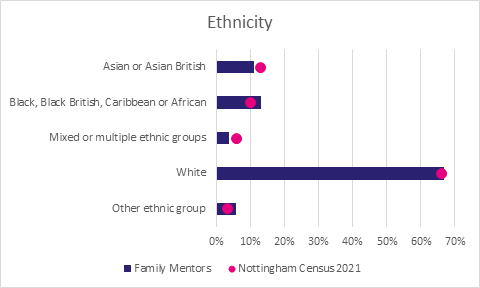
Framework, which operates in more ethnically diverse areas of Nottingham, has a workforce that is 50 per cent White and 50 per cent from ethnic minority backgrounds, speaking 17 different languages. This diversity makes the service accessible, as multilingual Family Mentors can deliver Small Steps at Home in families’ native languages.
The diverse workforce contributes to making the Family Mentor Service an accessible service for families. As of January 2024, 1,056 children were signed up for the Service, which meant that 40 per cent of eligible families living in the four SSBC wards are engaged. Family Mentors have delivered SS@H or community groups to 5,328 individual children, totalling 111,668 interactions. Notably, 74 per cent of children were living in the 10 per cent most deprived Local Super Output Areas at time of sign-up.
Higher participation rates are observed among Asian/Asian British (36.6 per cent) and Black African Caribbean children (48.4 per cent) compared to White British children (35.1 per cent). Non-English-speaking families have rated the service as one of the most accessible in Nottingham City’s Primary Care Networks.
External evaluation by Nottingham Trent University shows positive outcomes for participating children and families:
- Children in the Small Steps at Home program for over 18 months had the highest mean scores in the 24-Month ASQ scores, including communication, gross motor, fine motor, and personal-social domains.
- Increased visits correlated with statistically significant improvements in 12-month gross motor scores and 24-month fine motor scores.
- A strong, positive relationship was found between visit frequency and an increase in 12-month communication scores.
- Parents reported better well-being and confidence, healthier eating habits in children, and improved sleeping routines.
- Family Mentor staff observed improvements in children’s confidence, language skills, and English proficiency for non-native speakers. Additionally, there were better parent-child interactions and increased safety awareness among parents.
- Parents value their relationships with Family Mentors, praising their non-judgmental approach and trust-building. All parents would recommend the Family Mentor Service to a friend or family member if they were eligible.
The Family Mentor Service also makes a wider social contribution to the local communities they work in and were awarded the Social Value Award in the 2023 Nottingham and Nottinghamshire Integrated Care Board Health and Care Awards. The social contribution of the Family Mentor Service was evident in the workforce survey among 54 Family Mentors.
- Almost all Family Mentors are parents and live in Nottingham.
- 41 per cent volunteered before becoming mentors, often with SSBC or its partners, showcasing the value of volunteering as a pathway to paid employment.
- 7 per cent of mentors are in their first paid job, while 28 per cent returned to work after a break.
- 41 per cent of mentors came from households without an income from paid work, and their employment led to increased household income.
- 74 per cent of mentors work less than 30 hours per week, allowing flexibility for childcare needs; 35 per cent are single parents.
- Mentors reported increased confidence in areas such as safeguarding, computer use, child development, and building trust with families.
- Family Mentors report good job satisfaction and see the positive impacts of the Family Mentor Service on both themselves and the families they support. They feel prepared for a vast range of future job opportunities, both within and beyond early years career paths.
How is the new approach being sustained?
As a workforce, Family Mentors continue to update their knowledge based on family feedback and information from across the partnership. The Family Mentor Service will be extending delivery of Small Steps at Home on a small scale, through the Health Inequalities and Innovation Fund made possible by the Nottingham and Nottinghamshire Integrated Care Board.
This fund provides resources to local projects aimed at reducing health inequalities by finding new ways of working. In line with the funding aims, the Family Mentor Service will be a targeted-selective intervention for families identified in collaboration with Midwifery, Children's Public Health 0-19 Nursing Service and other health practitioners and focused on the earliest stage of a baby’s life from birth to 12 months. In addition, SSBC is exploring the licensing of the Small Steps at Home program for use in other areas.
Lessons learned
- Initially, the concept of recruiting staff living in close proximity to service users was met with some reservations due to concerns about work-life balance and the nature of the Family Mentor work, which can be emotionally charged and includes child safeguarding. However, working in their own area of residence has generally worked well for Family Mentors and having lived experience of the communities they work in is a core component of the Family Mentor Service.
- On-the-job training and support enable recruitment based on qualities rather than formal qualifications.
- The Level 2 accreditation gives recognition of the robustness and quality of the Family Mentor training programme.
- The recruitment process has helped unsuccessful candidates gain confidence, often leading them to secure volunteer roles, further training, and eventually paid employment.
- Inclusive recruitment and workplace practices are paramount in attracting and maintaining a diverse workforce. Part-time and flexible working enable Family Mentors to maintain a good work-life balance.
- In addition to supporting families, the Family Mentor Service strengthens community capacity and provides accessible job opportunities for new and returning job seekers.
Contact
Dr Nadine Otting, Small Steps Big Changes, Research and Learning Officer
Email: [email protected]
Stacey Lochhead, Framework Housing Association Family Mentor Service, Service Manager,
Email: [email protected]