Foreword
This workbook has been designed as a learning aid for councillors. It can be equally used by those who have been recently elected. Or to reflect on aspects of your role even if you have been elected for some time. The workbook is a useful reminder of some of the key skills, approaches and tactics involved in neighbourhood and community engagement. Regardless of whether you are in control, opposition or a No Overall Control council.
It is important to engage with your residents and communities to be effective as a ward or division councillor. The workbook will highlight key topics around effective neighbourhood and community engagement. And provide you with some pointers on how to develop a style and approach that you are comfortable with.
The workbook offers few firm rules for effective community engagement as everyone approaches the role in different ways. Based on many factors in both your political and non-political life. There is no presumption about ‘typical areas’ or ‘typical councillors’ and the workbook is intended more as a direction marker rather than a road map.
It is not necessary to complete it all in one session and you may prefer to work through the material at your own pace. The key requirement is to think about your own approach to neighbourhood and community engagement – how the material relates to your local situation, the people you serve and the council you represent.
In working through the material contained in this workbook you will encounter several features designed to help you think about the issues surrounding the development of neighbourhood and community engagement. These features are represented by the symbols shown below:

Guidance
This is used to indicate guidance, research, quotations, explanations, and definitions that you may find helpful.

Challenges
These are questions or queries raised in the text which ask you to reflect on your role or approach – in essence, they are designed to be thought-provokers

Case studies
These are ‘pen pictures’ of approaches used by councils elsewhere.

Hints and tips
A selection of good practices that you may find useful.

Useful links
These are signposts to sources of further information that may help with principles, processes, methods, and approaches.

Guidance
“Some people think that being a councillor is about being important in the town hall – wrong! The political work is important but the most important role for a councillor is mixing and fixing in the communities you represent. That is where you can really make a difference. By being the ‘cabinet member’ for your ward and showing real community leadership.”
Cllr Richard Kemp, Liverpool City Council
Understanding neighbourhoods and communities
In the context of this workbook, the terms ‘neighbourhood’ and ‘community’ are used in a broad sense to mean one or more of the following:
- General or specific geographical areas that are defined as workplaces or categorised by their residential nature, for example an area with a defined population size, a single housing estate, a block of streets within a ward area.
- Groups of people defined by the areas they live or work in, for example ward residents or the ‘community’ of individual towns and villages.
- Groups of people defined by something other than their residential or workplace environments, in other words communities defined on the grounds of race, colour, age, class, faith, disability, or sexuality.
- Every neighbourhood or community is made up of different individuals and groups, whose views, interests, and ambitions.
- May often be at odds and may not always be reconcilable. This is not a reason for ignoring the importance of neighbourhood and community engagement but is the very challenge which you will face in getting people more actively involved in the issues which affect them.
- Ward councillors are in the front line of neighbourhood and community engagement. As a community leader, you are best placed to understand the challenges faced by your constituents. And working with a wide range of individuals and organisations in the area, you can help them to decide how best to respond.
- It is only at a local level that problems such as access to social housing, crime, deprivation, and anti-social behaviour can be understood and addressed. Few other community leaders have the mandate to coordinate different interests, reconcile diverse views and encourage open debate and dialogue in the way that you can.
The strengths and knowledge that you bring to this engagement process are:
- An understanding of your ward – the demographics, the key issues facing local people and the way that services are being delivered.
- The representation of local voices – you are a channel of communication between the communities you serve and the council, representing the views of others and speaking up for the ‘hard to reach’ or ‘seldom heard’.
- Communicating and influencing skills – you can help to ensure that the views of local people are considered when decisions are made by the council or outside bodies and matters are reported in the media.
- All of this provides you with a strong basis on which to act for and in support of local people.
- For example, you can:
- Assess whether there is general satisfaction with council services – or those run locally by other agencies – and whether local people believe they are getting value for money from what is being spent.
- Speak with confidence on behalf of your neighbourhoods or communities when issues affecting them are debated or decisions need to be taken.
- Promote partnership working between public, private and civil society organisations in response to recognised community needs.
- Support community calls for action and promote self-help among your constituents by understanding their aims, aspirations, views, and tactics.
However, there is far more to effective engagement than the points above. Good neighbourhood and community engagement is about far more than you more than just representing the views of local people. Your role is to encourage people to play a more active role themselves in the decision-making processes of the council.
Communities and councillors
Community leadership in a changing environment
The role of a ward or division councillor continues to evolve over time. Events such as the recent Covid-19 pandemic, overseas conflicts, and economic challenges coupled with the way members of the public engage with politicians and local politics constantly change the local political environment. However, this can also be set against several recent key pieces of legislation which provide a framework against which councils and councillors undertake their community leadership roles.
Localism and devolution
There is compelling evidence that taking decisions closer to the people affected leads to better outcomes and saves the taxpayer money. As such, there has been a significant drive in recent years to devolve decision making powers away from Westminster and put power in the hands of local communities.
The Localism Act was introduced in November 2011. Its aim was to better enable local councils, communities, and individuals to act on local priorities by giving them greater powers. The Act covers a wide range of issues relating to local public services, with a particular focus on the general power of competence, community rights, neighbourhood planning and housing.
The key measures of the Act were grouped under four main headings:
- new freedoms and flexibilities for local government
- new rights and powers for communities and individuals
- reform to make the planning system more democratic and more effective
- reform to ensure decisions about housing are taken locally.
Since the introduction of the 2011 Act, local government has been at the heart of making things happen – by transferring powers, assets, resources, and decision making down to grass roots communities. The Department of Communities and Local Government published A plain English guide to the Localism Act
Guidance The Localism Act – some aspects relevant to community engagement
General power of competence – this power replaced the previous duty of wellbeing and gave councils the same broad powers as an individual to do anything unless it is prohibited by statute. It gave councils greater freedom to be creative and entrepreneurial, and to acting directly in the interest of their communities as well as in their own financial interest.
Predetermination – provisions were introduced to clarify the principle of predetermination in local government, allowing members to engage in an open and rigorous debate with their local communities about council business.
Community right to challenge – under these provisions, a broad range of alternative service providers are able to submit expressions of interest to run services, with the potential to trigger a council procurement exercise.
Community right to bid – these provisions allow parish councils and local voluntary and community groups to prepare bids to purchase listed community assets should a local authority choose to dispose of them.
Further to this, the Cities and Local Government Devolution Act 20163 provided a legal framework for the implementation of devolution deals with combined authorities and other areas. Devolution deals are agreements between central and local government, granting councils new flexibilities and freedoms when making decisions for their local area.
Devolution deals are agreements between central and local government, granting councils new flexibilities and freedoms when making decisions for their local area. Devolution, therefore, provides the opportunity to ensure that decisions are taken as close to residents as possible. Many local authorities are also looking to take this one step further through ‘double’ or onward devolution – passing down control of services to town and parish councils, as well as community groups.
Devolution, therefore, provides the opportunity to ensure that decisions are taken as close to residents as possible. Many local authorities are also looking to take this one step further through ‘double’ or onward devolution – passing down control of services to town and parish councils, as well as community groups. The LGA has consistently made the case for devolution through councils to communities. This becomes ever more important as local areas rethink how public services are delivered following recent health and financial pressures. Therefore, it is right that councils consider the role of local people in designing, commissioning (or decommissioning) and delivering those services. Your role in community engagement is fundamental to ensuring that services are provided effectively.
Strong community leadership is fundamental to being a good local councillor. It’s about being approachable to residents, making them feel involved in decision making and standing up for their interests.
It also means acting as a broker between different groups of residents or partners, as well as communicating the strategic goals of the council in a local context. This can be challenging, but councillors are uniquely placed to fill that role, owing to the democratic mandate we’ve been given.
Against this backdrop of increased localisation, there are three compelling reasons why councils need to be effective in engaging effectively with their communities:
- There is a primary responsibility to consult and involve their stakeholders – the principles and legal frameworks around localism and devolution are intended to give more say and power to local communities.
- Effective engagement can help to improve reputation and build trust among the residents. Against a background of recent economic challenges and the impact of the COVID-19 pandemic, councils need to do all they can to demonstrate that they are delivering value for money by keeping their residents well informed.
- It is fundamental in building the capacity of communities to solve their own problems without the need for costly statutory sector provision or intervention. This is not just about the need to save money – although that is undoubtedly a driving force – but is about the need to recognise that society is changing with a more connected population demanding greater participation in shaping the lives of their own communities.
Ward councillors, as democratically elected leaders representing their communities, have a unique role to play in enabling the local engagement which will drive strong, connected communities – what we sometimes refer to as ‘neighbourhood and community engagement.’
For many councillors, this is a welcome opportunity to reshape their role away from bureaucratically driven, paper-heavy meetings and processes, towards more creative roles, leading and energising their local communities and encouraging self-organised groups to be ambit.
Guidance: The LGA in action
The LGA is working to support councils to better engage their communities in the design and delivery of services - something we are calling community action. The LGA has developed a ‘community action’ web resource. This provides information and case studies about how councils can involve communities in the design and delivery of services.
Six guiding principles
We have developed six guiding principles for councils looking to make community action work. Each includes tips for effective working; things to look out for; and questions for councillors and officers to ask as they plan, implement and review community action initiatives. Every community is different. The ideas, guiding principles, and local action should reflect the needs of the community you are working with – whether that community is defined by geography (such as a ward) or a specific group (such as older people)
As the sector undertakes a fundamental rethink of how public services are delivered considering this and ongoing community and financial challenges, it is right that we consider the role of local people in designing, commissioning (or decommissioning) and delivering those services and empowering their communities. The community action web resource contains information based on conversations with councils across the country, illustrating where community action is happening, as well as guiding principles, tools and resources for other areas looking to work in this way.

Challenge 1: Engagement – who are you talking about?
Think about your specific ward area. What neighbourhoods and communities are you serving as a community leader?
General or specific geographical areas:
Groups of people defined by the area in which they live or work:
Groups of people defined by something other than their residential or workplace environments:
Look again at your list. Have you included any ‘seldom heard’ or ‘hard to reach’ groups, for example groups of older, younger, or disabled people or specific minority ethnic groups? What about transitory or newly arriving communities, for example commuters, travellers, migrant workers, refugees, or asylum seekers?
Ways that councillors can encourage greater engagement
In your day-to-day role as a ward councillor you may already carry out lots of activities that help to encourage citizens and communities to get more involved in the decision-making processes of your council, for example providing information through the local media, holding meetings with community groups or raising awareness of relevant issues through posters or leaflets.
You may also conduct face to face advice surgeries or make use of digital technology to ensure that opportunities for engaging with local people are maximised, for example the use of social media to let people know essential information, encourage discussion and to solicit responses to email and online surveys.
However, not everyone will want to participate to the same extent. While some people will want to engage with you and actively participate in a dialogue about their issues and concerns, others will be content to let you represent their interests or just keep them informed about what is going on locally. Much of this will depend on each person’s perception of ‘authority’ figures, and their receptiveness to direct engagement (see the ‘participation matrix’).
This means you will have to adopt a range of approaches to suit the issue and the perceptions of the local community. The other factors that you will need to consider in encouraging greater engagement from citizens and communities are:
- Who best to engage with, i.e., all constituents, or targeted groups that have a particular interest or stake in the issues concerned? As part of this, you may also need to consider the risks involved in not engaging with some community groups.
- The usefulness and applicability of different engagement techniques given the individuals or communities concerned, for example using a postal questionnaire survey may not be the best way to solicit responses from some communities that are distrustful or fearful of officialdom.
- The ease of accessibility and cost justification for engaging with the community concerned. Any engagement activity should be economic, efficient, and effective, but also user-friendly, and any costs involved should be commensurate with the resources at stake in any decision-making process.

Case study
“For me, being a good community leader is about being a part of my community, listening to their needs and acting to deliver outcomes, usually working with other partners such as the police, other local authorities, and the voluntary sector. The voluntary sector is becoming increasingly essential to the delivery of services as central government funds to local authorities decreases.
Campaigning is something I enjoy enormously therefore I am always involved in projects that look to make a difference to our community, for example, as Mayor of Amersham, my community fundraising group raised £120,000 to install an outdoor gym, Street Snooker, table tennis, cricket, football, basketball and handball courts to celebrate the London 2012 Games and to promote health and fitness to the whole community that was accessible to all, DDA compliant, free and fun!
At a national level, I campaigned for the 12A cinema classification, which has benefitted most families in the UK. Being a community leader is incredibly satisfying and I absolutely love what I do. I have been elected since 1999 and a community volunteer and campaigner since 1995. Try it! The more you do, the more you want to do. It is the most satisfying role I have ever had.”
Cllr Mrs Mimi Harker OBE, Buckinghamshire Council
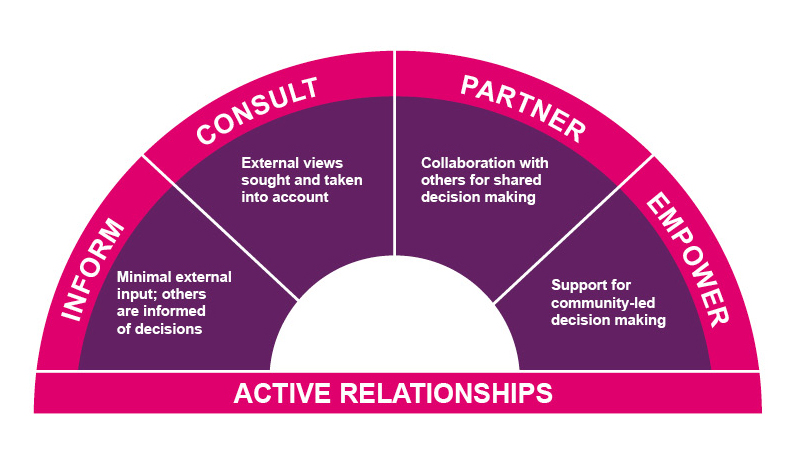
The spectrum of engagement
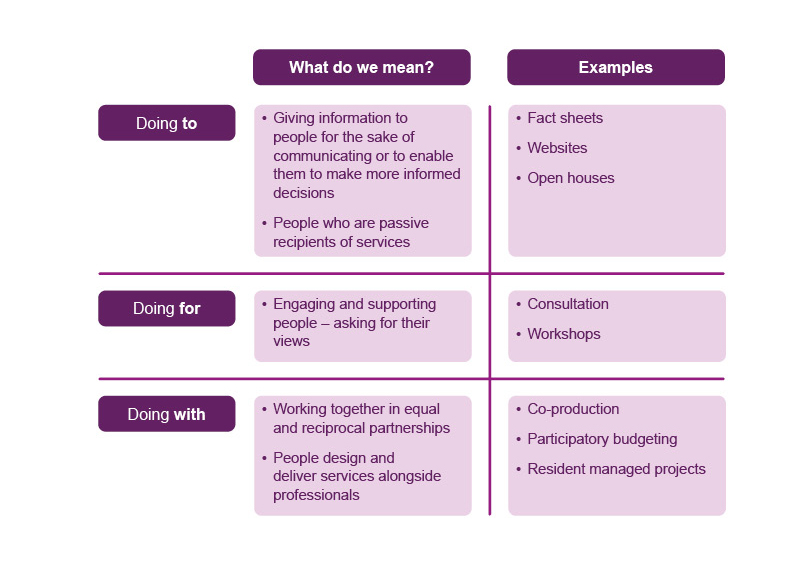
You will need to adopt a range of engagement methods and practices to suit the parts of the community you are trying to engage with and the nature of what you are trying to engage on. Engagement practices vary in terms of the level of power they give to citizens and the intensity of participation it affords.
Because of this, people often refer to a ‘spectrum’ of engagement. Running across this spectrum is the idea that activities at one end focus on ‘doing to’ people, and, at the other, are activities that are ‘done with’ all these types of engagement have a place and will be suited to diverse needs at various times.

Hints and tips
Do:
- Find out what groups and organisations are active in your ward – some, like the police, will be obvious, others less so.
- Find out what concerns and ambitions they have and look for common ground and areas of disagreement.
- Develop a shared vision for the ward that is achievable and not in conflict with council policy.
- Develop a plan that will guide you and your partners in making the vision a reality.
- Tell fellow councillors and residents about what you are doing.
- Encourage and enable others to take the lead on matters close to their hearts.
- Remember that as an elected councillor you have democratic integrity and a responsibility to represent everyone
in your ward – not just those who voted for you. - Understand that some partner organisations will not have the freedom and flexibility you possess.
- Involve council officers when necessary and appropriate.
- Celebrate success and share your experience with others facing similar challenges.
Do not:
- Try to do everything yourself – your role is to conduit between the various local groups and organisations and between them and the council.
- Attend every meeting and event held in your ward – it is not necessary, and you will quickly become exhausted.
- Try to solve every problem that comes your way – other people and organisations may have more resources and expertise than you have.
- Forget the needs and opinions of individuals.
- Become associated with pressure groups unless you feel that their agendas are compatible with your role as a councillor.
- Hoard information – sharing knowledge about local matters will lead to better working relationships and better outcomes.
- Expect to agree with everyone or for them to agree with you – some negotiations will be tough and challenging.
- Complain – focus on getting things done instead
Contents What is co-production?
Increasingly, public service practitioners are taking the view that people’s needs are better met when they are involved in an equal relationship with professionals and others, working together to get things done. This is the underlying principle of co-production – an approach to delivering services that focuses on ‘working with’ citizens and communities.
Co-production is defined as:
‘…a means of delivering public services in an equal and reciprocal relationship between professionals, people using services, their families and their neighbors.’
As defined by NESTA and the New Economics Foundation (NEF).
It is a different from traditional models of delivery as it moves away from citizens being ‘passive’ recipients of services. Instead, the role of professionals is to facilitate an environment that allows citizens to use their own skills and knowledge to shape services themselves, with the understanding that the people, their carers, and communities are experts in their own lives; they are therefore essential partners in the design and development of services.
As a result of this definition, there is no one set way of ‘co-producing’ services. However, it is based on a defined set of principles:
- recognising people as assets
- building on people’s existing capabilities
- promoting mutuality and reciprocity
- developing peer support networks
- breaking down barriers between professionals and recipients
- facilitating rather than delivering.
For further information:
- Cooperative toolkit: What is co-production
- Co-production in commissioning and market shaping
- Co-production catalogue - NESTA
Challenge 2: Your role in encouraging people to get involved
Imagine that a particular community of people in your ward has been very hostile about council plans to grant fund the installation of wind generators by a number of community groups to reduce the ‘carbon footprint’ of the area. You know that the concerns being raised by the community are unfounded and based on some erroneous information being circulated by a local protest group. You are keen to get people to come forward and support the council’s plans. What ideas do you have for raising the matter locally and trying to begin a dialogue on the pros and cons of the grant funding plans.
Towards community engagement
The benefits of neighbourhood and community engagement:
Increasing the engagement and participation of citizens and communities in local government planning and decision making can produce benefits for all concerned. This is illustrated in the table below:
The benefits of neighbourhood and community engagement
| Council | Community | Citizens |
| Can help to ensure better congruence between the council’s ‘vision’ and what happens in practice. Decision making should be based on representative views - engagement can help to supply this. Can help to reduce the influence of pressure groups and single-issue politics. Can help to improve feedback on strategic proposals and generate innovative ideas for consideration by the council. Increases participatory democracy and can help to improve the reputation of members as legitimate community leaders. |
Can help to improve the democratic accountability of councils. Increases representation and can help to identify community leaders. Can help to improve the community’s understanding of the business of local government. Can help to ensure that strategies and plans take account of local social, economic and environmental factors. Can help to foster the development of consensus and community competence |
Should engender a sense of involvement and participation in decision making.
Can help individuals to better understand the nature of local government |
The changing context of community leadership and engagement
Local government is under pressure in a way not experienced for many years. Expectations are rising and budgets getting smaller. Services are better but trust in many institutions is falling. In this context, a serious effort to involve and understand residents is more important than ever. Public organisations and institutions find themselves in a tricky position. The challenges they face are arguably as hard as they’ve been at any point in post-war history.
There have been a series of major blows to trust in the system, running back over the last ten or fifteen years. One of the most recent of these was the horrific Grenfell tragedy, which had a major impact on trust for local government.
These have made engagement both more difficult and more important. By creating meaningful conversations with residents, councils can ‘trust their way’ to a stronger relationship with those they serve. The LGA produced a comprehensive LGA guide to community engagement in 2019. Since then, there have been significant changes to the wider social context which have increased the emphasis on building trust and strengthening communities.
The resources in the guide support the basic, statutory aspects of engagement, with a particular focus on pure consultation. It explores best practice, legal requirements, and the pre-emptive steps you can take to get engagement around decision-making right. This includes assets to help you choose your channels and messengers and decide whether you need to formally consult. There are also resources supporting the evaluation of consultation, and the use of insight.
New Conversations 2.0 - LGA guide to engagement
A move towards neighbourhood and community governance
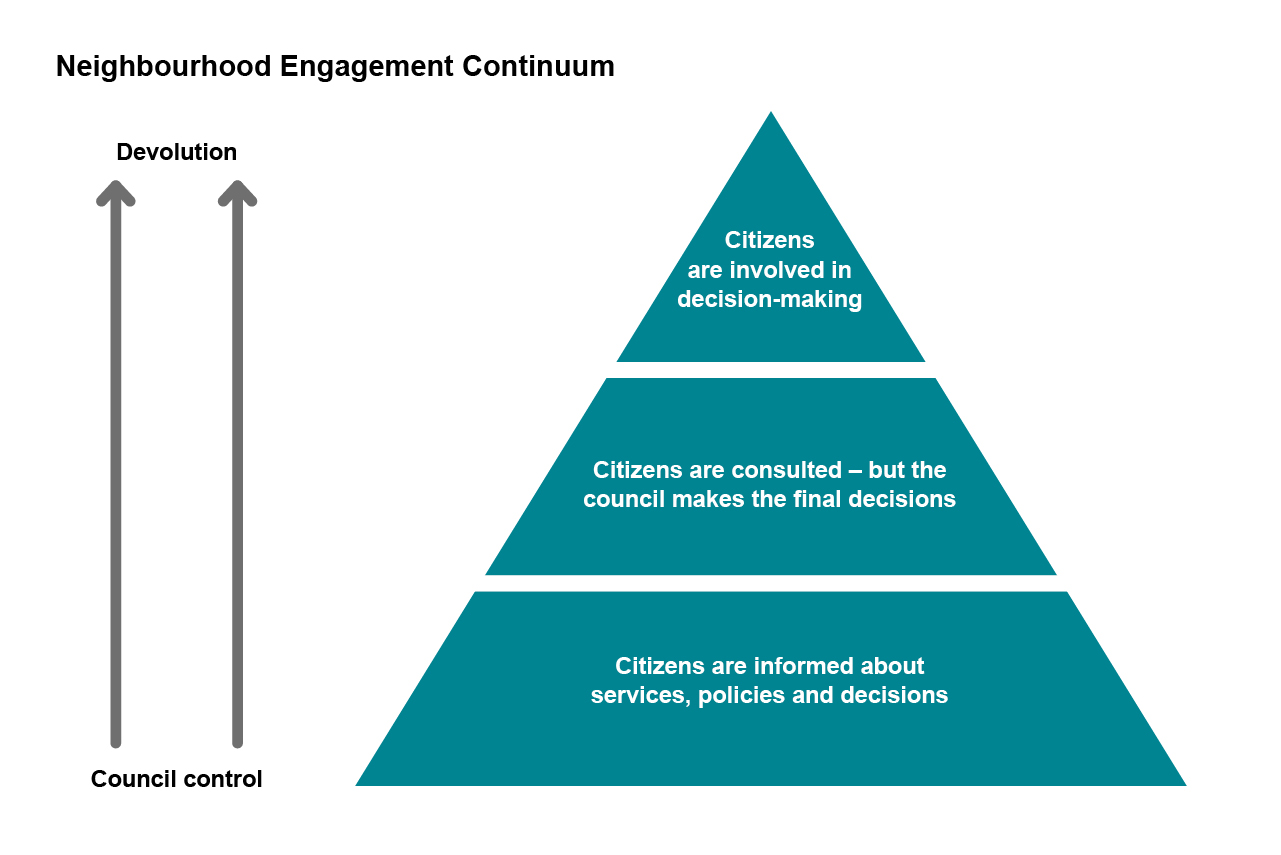
In the last decade, there has been a move to encourage more participatory democracy in local government, i.e., local councils using their role to inform, consult and involve local people in working towards community clarity and consensus on needs, problems, and desired strategies.
Many councils have sought to take the idea of participatory democracy further, by encouraging some element of neighbourhood and community management or governance. For example:
- Area or ward committees, often with coopted stakeholder representatives, which consider plans and proposals for the local area and may have delegated budgets for commissioning projects and services.
- Various forms of participatory budgeting, which allow local people to come together and make decisions about how public sector resources are spent in meeting their needs.
- Place-based working, where local partner agencies work with individuals and groups in the community to share knowledge, resources, and assets in tackling community concerns.
Within this, local authorities will often adopt a ‘place-shaping’ role, providing support to enable individuals and community groups to solve their own problems.
- Formal community-based groups, which govern or manage aspects of public service delivery, for example tenant management organisations, which give housing tenants more control over their homes and neighbourhoods.
There are a wide variety of these neighbourhood working models which are used in one or more of the following areas: consultation, advocacy, service delivery or design, networking, needs assessment, capacity building or performance monitoring.
Case study: Kingston's Citizens' Assembly on Air Quality - Royal Borough of Kingston upon Thames
The Royal Borough of Kingston committed to increasing the use of participatory democracy to develop responses to difficult issues. One of these issues was to address issues around air quality in the borough. The council held their first Citizens’ Assembly in 2019 to ask residents “how do we collectively improve air quality in Kingston?
While Kingston’s air quality is not poor by London Borough standards, there are parts of Kingston that regularly experience high levels of pollution. Difficult decisions needed to be made about how the council and residents worked together to improve the air quality.
The Assembly brought together 38 randomly selected residents who met for two weekends in November and December 2019. Following an intensive weekend learning about causes and impacts of poor air quality, the ‘assembly members’ agreed a set of short-, medium- and long-term recommendations for the council, residents, and council partners.
A Citizen’s Assembly was seen as the ideal way for residents to participate in the decision-making process, capturing a range of local views and reaching a consensus about what action to take.
Four independent advisory group members advised to the council on providing balanced and accurate evidence to the assembly. The advisory group members came from academia and specialist air quality organisations.
Assembly members considered the evidence that they had heard, and worked together to create five overarching recommendations, which were:
- Remove pollutants within school boundaries.
- Prioritise changes to planning rules and enforcement to place indoor and outdoor air quality as the highest priority.
- Plan to urgently invest in greener and accessible transport and infrastructure for all.
- Increase residents’ awareness of air pollution and encourage positive behaviour change.
- Accelerate the transition to sustainable vehicles.
Lessons learned:
- Well-facilitated deliberation challenges pre-held beliefs, enabling residents with different viewpoints to reach a consensus
- A Citizens’ Assembly hands over decision making to residents, with implications for budgets and control over the agenda
- A random but demographically representative sample of residents generate recommendations which can be said to be representative of the borough as a whole
- A full Citizens’ Assembly is a resource and time-intensive process, with the success of the assembly being dependent on the quality of the evidence offered
- An assembly results in a well-informed group of residents, some of whom have been happy to return to the council for follow on discussions. This resource could be valuable in the future
Challenge 3: Engagement in your area
It is likely that there is a wide range of neighbourhood and community engagement schemes and projects operating in your council area.
Using your local knowledge, write down as many examples as you can think of:
Take this list and spend some time looking through your ‘full council’ minutes for the last year or searching the council’s website using the words ‘community’, ‘neighbourhood’, ‘participation’, ‘engagement’, ‘survey’ and ‘consultation’.
You are likely to discover a lot more council-funded schemes than you have on your list!
Neighbourhood and community engagement has a rightful place as one of the key processes involved in planning and decision making. As such, it should not be viewed as an additional task, but as a core part of the business of local government. It is not a resource burden, but a way of ensuring that scarce resources are better targeted in meeting community needs. And it does not challenge the authority of councillors, but provides a useful way of enhancing their role, strengthening democratic legitimacy, and encouraging community development -something that many councils and councillors are already doing as part of the devolution agenda.
Challenge 4
It is likely that there is a wide range of neighbourhood and community engagement schemes and projects operating in your council area. Using your local knowledge, write down as many examples as you can think of:
Take this list and spend some time looking through your ‘full council’ minutes for the last year or searching the council’s website using the words ‘community,’ ‘neighbourhood,’ ‘participation,’ ‘engagement,’ ‘survey’ and ‘consultation.’ You are likely to discover a lot more council-funded schemes than you have on your list!
Why does it matter?
Research consistently shows that communities that are engaged – that is, where diverse groups, organisations and individuals from the public, private and voluntary sectors communicate with each other and contribute to the wellbeing of their community – tend to have happier, healthier people and lower levels of crime and anti-social behaviour.
At the same time, there is concern about the decline in voting in local elections, more people living on their own, threats to community cohesion and an increasingly detached attitude towards their local area and what is going on there.
Councillors have a key role to play here because they are the interface between citizens and the council, and they have the power to demonstrate directly what they have achieved for the people they represent. Through surgeries, casework, the media, local events, social and voluntary groups, newsletters, blogs and so on, they can effect change and communicate their achievements to local people.
In politics it is often easy to look for the big gesture, the big plan, the big policy statement. But tangible achievement at ward level need not be like that. Time after time, research and case studies show that little things mean a lot when it comes to improving things for local people.
Guidance
“For a variety of reasons, life is easier in a community blessed with a substantial stock of social capital. In the first place, networks of civic engagement foster sturdy norms of generalised reciprocity and encourage the emergence of social trust. Such networks facilitate coordination and communication, amplify reputations, and thus allow dilemmas of collective action to be resolved. Finally, dense networks of interaction probably broaden the participants’ sense of self, developing the ‘I’ into the ‘we’.”
Professor Robert Putnam, Harvard.
Working in partnership
Community leadership is about councils, both councillors and officers, enabling local
communities to determine their own future. It is not traditional, top-down leadership, but involves councillors and officers using all the tools at their disposal to engage communities in making their own difference. It promotes a partnership of shared commitment to promote a shared vision for the locality.
Councillors need to have:
- the ability to build effective partnerships with other local organisations and communities
- a commitment to community engagement and empowerment
- the ability to respond effectively to local priorities
a sound understanding of local governance arrangements - an understanding of the local community and the groups and organisations within it
- access to key people in other agencies within that community
- access to officers and key people within local authority.
The landscape of partnership working is shifting with new opportunities emerging.However, the central concern for councils and councillors remains to promote the social, economic, and environmental wellbeing of their areas, achieving sustainable communities.
The key role is to:
- provide for local communities – articulation of aspirations, needs and priorities
- co-ordinate the actions of public, private, voluntary and community organisations
- shape and focus existing and future activities of these organisations to meet community needs.
Whether you are working at the ward or whole council level, to produce a community strategy there must be a process of community planning. Key stakeholders must be involved in this process. These could be large groups like the police, health authorities and schools, or smaller ones, such as voluntary groups, local businesses, and community groups.
Partnerships of all kinds are at the heart of community planning and neighbourhood renewal agendas. While multi-agency in their composition, their purpose is to bring together statutory, non-statutory, private, voluntary and community organisations to promoting and improving residents’ quality of life. Having an agreed strategy can provide a framework for different organisational processes and mobilising a wide range of agencies, organisations, and community interests.
Partnerships should:
- build consensus around an agreed vision for the future
- see their own interests in the context of a bigger picture
- encourage the development of sustainable communities
- identify conflicting objectives and needs
- build trust and closer working relationships, where appropriate
- develop a clear understanding of each partner’s roles and responsibilities
- review existing partnership and consultation arrangements
- share data and analysis
- share resources and provide a coordinated response to community priorities
- shape and focus existing and future activities of agencies
- produce a community strategy.
Challenge 5
(a) What have you achieved in partnership with others – as a councillor, in your private life or in a job – that you could not have achieved alone?
(b) What were the advantages of working in partnership?
(c) What were the disadvantages?
(d) What lessons have you learnt as a result?
Partnerships will not necessarily be cosy, friendly affairs where everyone thinks the same way – have you thought about how you will deal with representatives of other organisation and groups who may have different views and who may even be hostile or aggressive?
The future for neighbourhoods and communities
The provisions of the Localism Act set in place a programme of reform which enables councils to build on many of the themes already well-established in local government, i.e., community leadership, democratic accountability, effective partnership working and the empowerment of citizens to have a bigger say in the public services they receive and the places they live.
In support of this, councils need to continue to use a range of different approaches to community engagement.
Namely, to:
- Inform – through newsletters, websites, texting, press releases, etc.
- Consult – via surveys, focus groups, etc.
- Involve – by coopting local people onto decision-making bodies so they have a bigger say or – by full devolution – so they have the say in decision making, for example participatory budgeting or the management of a community asset.
Effective councillors want their constituents to be as informed and involved as possible in the decisions that make a difference to their lives. Many have already developed innovative ways to help local people influence decisions, and to hear from a wider range of residents. They recognise that any further changes which result from the localism agenda can only strengthen their role as community leaders, able to engage more effectively with local people.
Challenge 6: Where do you go from here?
Look back over the material contained in earlier sections of this workbook and consider the following:
- What key action points can you identify in relation to your role in neighbourhood and community engagement, i.e. what three or four things might you start doing, keep doing or stop doing?
- Have you identified any gaps in your knowledge or shortcomings in your personal skills?
If so, please set these out below and identify how any further training or development might help you, for example further reading, research, attending courses, coaching, mentoring, work shadowing, etc.
Final summary
No one has a more crucial role than ward councillors in ensuring that local democracy works and is believed in by residents. It is important to recognise that there are two essential strands to this:
-
representative democracy – in which council councillors are elected to represent their local communities
- participative democracy – in which councils seek to engage and involve local communities in the decisions that affect them most closely.
Representative and participatory democracy are not in competition with each other and there is a compelling need for better links between elected and community representatives. In their role, ward members are well placed to encourage and channel this neighbourhood and community engagement and to champion both a local voice and greater local choice.
Neighbourhood and community engagement has a rightful place as one of the key processes involved in planning and decision making. As such, it should not be viewed as an additional task, but as a core part of the business of local government. It is not a resource burden, but a way of ensuring that scarce resources are better targeted in meeting community needs. And it does not challenge the authority of councillors, but provides a useful way of enhancing their role, strengthening democratic legitimacy and encouraging community development – something that many councils and councillors are already doing as part of the devolution agenda.
Appendix
Sources of further information and support
The Local Government Association’s (LGA) website is an invaluable source of help and advice for all those in local government and contains guidance and case studies on all aspects of neighbourhood and community engagement within its ‘Connecting with communities’ section.