The local government leader perspective
This report details findings from the first LGA leaders pulse survey 2024: How do local government leaders feel in 2024? revealing the views of 70 English council leaders.
It provides a cross-sector view of where how leaders feel, where they feel the most pride and optimism in their work, their views on key upcoming challenges and their wishes for the future.
How do council leaders feel?
The inaugural LGA leaders pulse survey 2024 reveals a clear sense of optimism and 'can-do' attitude. Leaders have high confidence that their council has what it needs to deliver on a range of priorities, especially community engagement, building strong local politics and growing the economy. There is a sense that, given sufficient support and independence, local government can lead in tackling the challenges facing communities.
This optimism is striking because it is set against a formidable set of cross-cutting challenges and service pressures. Finance and budgeting is a key challenge for three quarters of leaders; many express pride in their council’s ability to continue delivering high quality services despite tight financial constraints.
...of leaders see demand pressures on services as a key challenge, with housing and homelessness, adult social care, children and young people services and planning and development identified as the service areas leaders think will present the greatest challenges over the coming year.
Leaders’ key wishes from central government is for sustainable funding, certainty, and more freedom. Leaders feel that greater devolution and longer-term financial frameworks will liberate councils, harnessing the powerful optimism expressed by leaders in this survey to respond to new opportunities and challenges and engage with local communities.
Delivering for residents
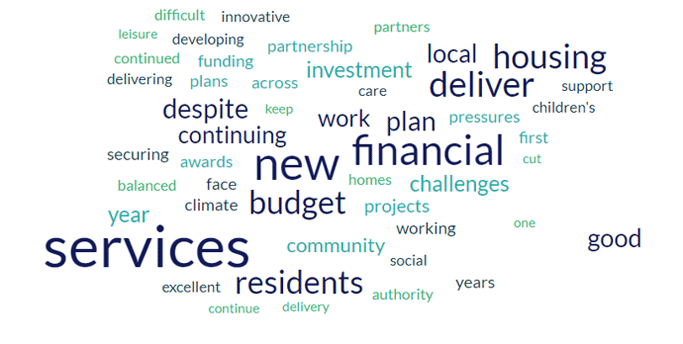
Council leaders have many sources of pride, but delivering for residents under tight financial conditions is the most common
Council leaders spoke of their pride in delivering a diverse range of local priorities. However, ensuring the financial sustainability of the council was one of the most frequently highlighted sources of pride. This featured alongside successful housing projects, delivery of services and supporting local communities.
Other sources of pride included: widening collaboration and partnership working with local and national government, as well as community organisations; economic development; combating climate change; electoral success and taking over in the May elections; improved community engagement and communication , and; innovating and transforming services through technology and process change.
The hard work and dedication of council staff was also highlighted:
The resilience, commitment and determination of our staff, who have continued to deliver vital services for our citizens in the face of some of the greatest financial and political challenges ever faced by this local authority.”
As [leader of the council], what has made you most proud of your council over the last 12 months?
Financial challenges
The biggest cross-cutting challenges are financial too
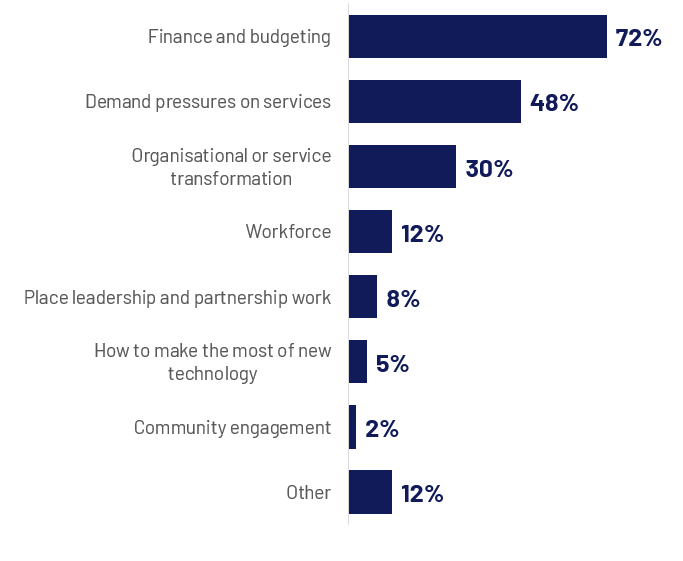
- Almost three quarters of council leaders see finance and budgeting as an upcoming challenge for their council. Almost half say the same about demand pressures on services. For three in 10, organisational or service transformation is one of the greatest future challenges.
- Finance and demand burdens are both seen as more pressing for leaders of unitary, London or metropolitan borough councils – almost nine in ten say budgeting is an area of the greatest challenge, while over three quarters say the same for demand pressures. This likely reflects their wider service responsibilities.
- For shire district leaders, finances are also the top source of pressure, mentioned by six in 10. Service transformation ranks second on 38 per cent, followed by demand pressures (22 per cent). They also see both workforce (20 per cent) and place and partnership work (13 per cent) as areas of greater future challenge than leaders of unitary councils.
Views among the county council leaders who responded were broadly in line with the overall council leaders sample.
Community engagement is the least likely to be seen as an area of challenge, likely reflecting the optimism leaders have in their ability to promote community engagement (discussed below). Making the most of new technology is also less likely to be seen as an area of greatest challenge.
In which one or two of the following areas, if any, do you currently expect the greatest challenges for your council over the next 12 months?
This is leading to an expectation of change in service funding
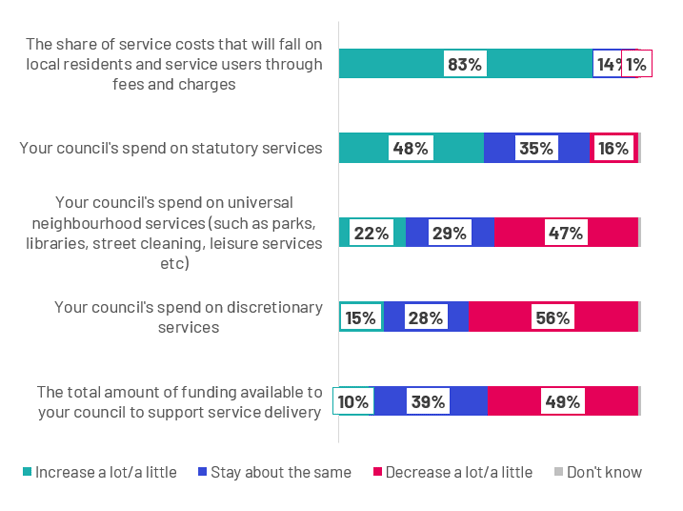
Over eight in 10 council leaders say the share of service costs that will fall on local residents and service users through fees and charges will increase in the coming year. Just one per cent say they will decrease. This score is higher still – 93 per cent – among leaders of unitary, London and metropolitan councils.
The public are generally understanding of the need for additional funding for public services: recent polling finds a majority of the UK public (40 per cent) would support increased spending on public services, even if it means higher taxes or borrowing.
The balance of spending on statutory and discretionary services is expected to continue to shift: Almost half (48) per cent expect increased spending on statutory services, while 56 per cent anticipate lower spending on discretionary services. This figure is higher still among unitary council leaders (77 per cent).
A similar proportion of leaders say they expect decreases in other key financial areas:
- 49 per cent expect a decrease in the total amount of funding available to the council to support service delivery.
- 47 per cent expect a decrease in council spend on universal neighbourhood services, rising to 64% of Unitary Council leaders.
To what extent do you anticipate each of the following changing for your council, if at all, over the next twelve months?
Achieving future goals
Yet leaders have high confidence in achieving their future goals
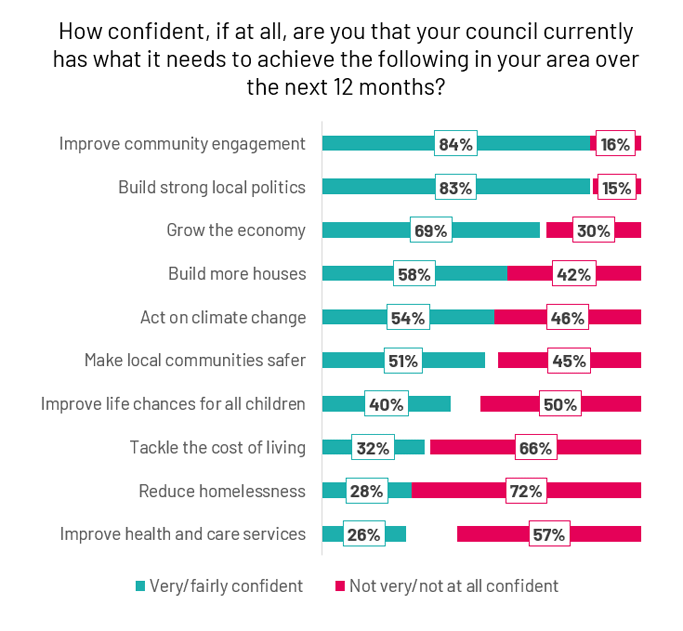
Despite funding concerns, and service and cross-cutting pressures, leaders express a high level of confidence that they have what they need to achieve multiple objectives over the coming year.
A majority express confidence across a range of areas: most notably in improving community engagement, building strong local politics and growing the economy, but also in building more houses, acting on climate change and making communities safer.
Reducing homelessness is the area of lowest confidence; almost three quarters of leaders are not very (or not at all) confident they have what they need to tackle the issue. Other areas of lower confidence are dealing with the cost of living, improving life chances for all children and improving health and care services.
How confident, if at all, are you that your council currently has what it needs to achieve the following in your area over the next 12 months?
Devolution
Leaders have not felt supported by national devolution policy
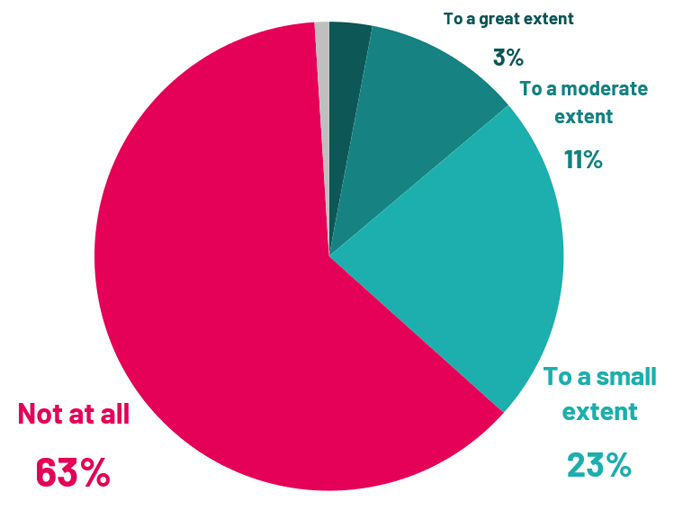
Sixty-three per cent have felt that the national devolution agenda has “not at all” supported them to deliver priorities for local communities over the past five years – rising to 70 per cent of shire district leaders.
One in seven leaders (14 per cent) say they have been supported to a moderate or great extent by the national devolution agenda – rising to just over one in five (22 per cent) of unitary, London and metropolitan council leaders.
Perceptions are somewhat more positive among leaders from the North East, North West and Yorkshire and Humberside: here, over one in ten (13 per cent) say they have felt supported “to a great extent”, and over a quarter have felt supported “to a moderate extent” (28 per cent).
However, for leaders in these regions too the largest group say they felt not at all supported in delivering their priorities by the national devolution agenda over the past five years (41 per cent).
To what extent, if at all, has the national devolution agenda supported your council to deliver its priorities for local communities over the last five years?
A long-term funding settlement
What one wish do council leaders have for local government? A long-term funding settlement
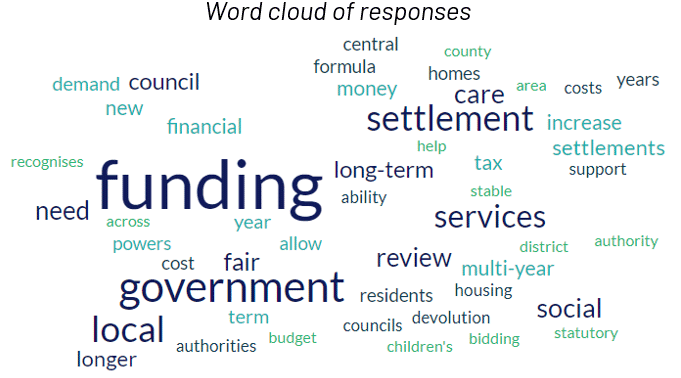
For many council leaders, their one wish for the coming year is fiscal. A very common theme across leaders was a wish for longer-term funding frameworks that would give them certainty (and ideally more money) over a longer period, rather than annual deals. Another request was for ‘fairer’ funding.
Other key wishes also have a financial underpinning: for instance, requests for greater flexibility and autonomy in setting business and council tax rates, additional support for housing and homelessness services, or greater ability to means test or charge local services.
A multi-year funding settlement, so that even if we're not getting more money we at least know what we're playing with”
And if you had one wish for local government over the next 12 months, what would it be?
The good news
The challenges facing the local government sector are significant and well-known. Yet our survey suggests a strong sense of underlying optimism among council leaders, even on tricky topics such as building more houses and acting on climate change. The sense is that, given sufficient support and independence, there are no obstacles leaders consider insuperable.
Despite the challenges, the survey and wider developments show signs that improvement is possible for the position of local government: Leaders’ optimism can be transmitted to council staff and kindle a narrative of improvement. By modelling optimism leaders can build resilience among their employees. Increased motivation among staff may help to improve perceptions of responsiveness (Public services face crisis of confidence as election looms, Ipsos). Optimism can make a greater difference in these areas.
Local government is becoming more visible. The issue of housing now regularly features as a top five concern for the British public in monthly polling and seven in 10 agree there is a housing crisis in Britain (Rent controls and expanding social housing are popular with public, Ipsos) drawing increasing attention to key local government policy areas.
The May 2024 local elections saw a great deal of change and were seen as a vital bellwether for the UK Government at the time, attracting a level of national interest usually reserved solely for general elections.
Local government is better represented at the national level. Analysis by the Local Government Chronicle found that at least 103 Members of the new Parliament have recent local government experience – a number not far off the number of Conservative Party MPs (121). In a Parliament with a record number of new MPs from all walks of life, their legislative experience and insights into the sector will be important assets.
...Members of the new Parliament have recent local government experience
The coming few years are likely to continue to be challenging for all parts of government and public services. But the confidence and optimism of local government leaders uncovered in this research is an important foundation for improving perceptions and the quality of services delivered to local people.
Technical note
This report has outlined the findings from a survey of council leaders carried out by Ipsos on behalf of the LGA.
All 320 English council leaders were invited to take part, and in total 70 completed the survey: this represents an unadjusted response rate of 22 per cent. Fieldwork was online, between 15 July and 8 August 2024, with three reminder mailings sent.
Data presented here has been weighted to represent the wider Leader population on three dimensions: political control, local authority type, and English region.
While this survey has a small base size, it represents a sizeable proportion of the overall population of council leaders. This means that while results cannot be interpreted as statistically significant, gaps between results are indicative of wider sentiment in the leader population.
Sub-analysis is conducted with leaders from district councils and unitary, London and metropolitan borough councils, as these categories have a sufficiently large base size for analysis.
County council leaders were not interviewed in sufficient numbers to draw indicative inferences about their views, but where relevant their responses are mentioned.
Social care, housing and planning
Overall, housing and homelessness is the service area seen as the expected source of greatest challenge for the next year. This aligns with public polling ahead of the Local Elections in May 2024, which found housing was a top ten issue influencing how people voted.
However, the results differ markedly between leaders of shire districts and county, unitary, London and metropolitan councils, reflecting their different responsibilities.
For unitary council leaders, adult social care, children and young people services, and housing and homelessness services rank closely together as the source of the greatest challenge – 73 per cent, 72 per cent and 69 per cent respectively. Concern about planning and development (25 per cent) and waste and recycling (7 per cent) is far lower than the overall leader average.
County council leaders who responded put adult social care and children’s services at the top of their list of service challenges. For shire district leaders, housing and homelessness services is near-unanimously seen as the service area of greatest challenge: 95 per cent say they expect challenges here. Planning and development is second on 63 per cent, followed by waste and recycling on 55 per cent.
In which two or three of the following service areas, if any, do you currently expect the greatest challenges for your council over the next 12 months?