The requirement and approach
This research was carried out by Whole Systems Partnership for the Local Government Association (LGA).
The purpose of this work is to provide the LGA with evidence to underpin a workforce plan for children and family social workers in England. The work started in late February 2024 and has been overseen by a small project group from within the LGA plus a slightly wider reference group. The reference group met on three occasions to refine the specification and advise on model development, data sources and other relevant intelligence [1]. The reference group also sign-posted to a small number of other contacts who provided additional data and intelligence that were followed up and incorporated into the modelling.
The requirement for the work was to understand and model the children and family social care workforce for England at a national level in the context of the ‘pipeline’ of trainees over the next 3-5 years and the projected need over the coming 5-10 years. The work needed to take into account current posts in councils including vacancies, social workers in other agencies such as the independent sector and the NHS and any other related factors that would impact on the sufficiency of this workforce through to 2034.
In the initial specification the contribution of agency staff was not considered to be in scope. However, in light of the initial analysis of available data, and the recognition that the growth in agency staff that fill vacancies is relatively high compared to historic levels, the flow between councils employed and agency staff was subsequently included. In contrast, the detailed information about specific roles such as child protection, independent reviewing officers and practice educators was not found to be consistent enough to include in the modelling although case-holder roles were identifiable and have been reflected. This latter inclusion is particularly important in relation to the question of sufficiency as it enables a relationship between capacity and future needs/demand.
Analysis of data sources
Sources
We analysed three primary sets of data for this work, as shown in Table 1.
|
Source |
Purpose |
|---|---|
| DfE children’s social work workforce data (2017-2023) | In-post workforce headlines and characteristics including LA employed and agency (two data sets) |
| Social Work England (2020-23) | Registration totals, starts and ending by age group |
| Skills for Care – Social Work Education Report | Data on starts and finishes in social work education including other demographic information |
These data sources are of high quality but address specific requirements and therefore have different scopes:
- Department for Education (DfE) data provides specific workforce data on people working as children and family social workers in LA posts or as agency staff including age profiles, vacancies, fill-rates etc however, it cannot be used to indicate flow in and out of the profession due to inter-LA moves double counting leavers and joiners.
- SWE provides detail on everyone registered as a social worker (in all sectors and for all client groups), including flows in and out, irrespective of whether the person is working – however, as a high-level indication of the workforce that might be available and for intelligence on numbers and ages of social workers entering the registered workforce this is an invaluable resource.This data is not available publicly, but we are grateful to SWE for allowing us to use the data to inform this model. This report has been shared with them to enable them to review the way in which their data has been used.
- Skills for Care data provides good data on flows into and out of education including age profiles, completion rates and whether people are working in social work 15 months after qualification, however it cannot distinguish between destination on completion between adult and children and family social workers although it does indicate the split for where people are working (roughly 60/40 children and family/Adults).
We have therefore used the above data sources as points of triangulation to ensure the resultant modelling reflects historic trends, giving confidence in forecasts whilst allowing for assumptions made on the basis of this approach to be challenged and varied.
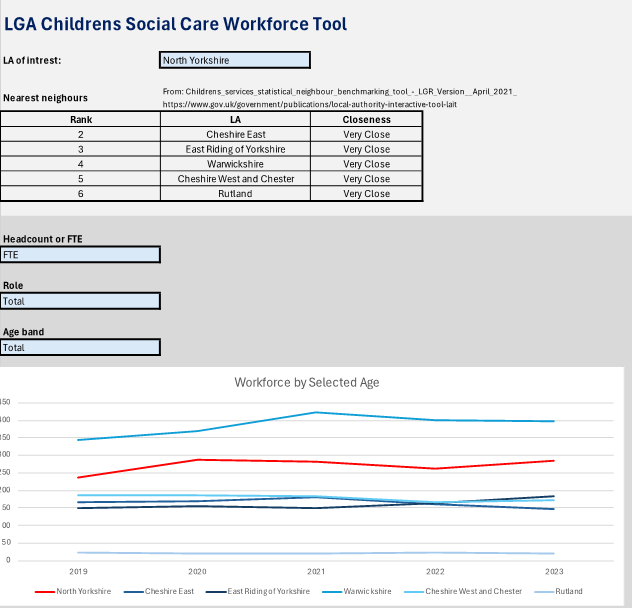
It is expected that this work will generate significant interest from councils or regional bodies. However, the level of detail required to model at these levels was agreed to be out of scope and in place it was decided to produce a data dashboard using the DfE data. This dashboard contains more detailed comparative data than was appropriate for the modelling work and enables both LA and Regional historic outputs to be generated as illustrated in Figure one. This tool is now with the LGA core team who will decide on how to share it.
Analysis
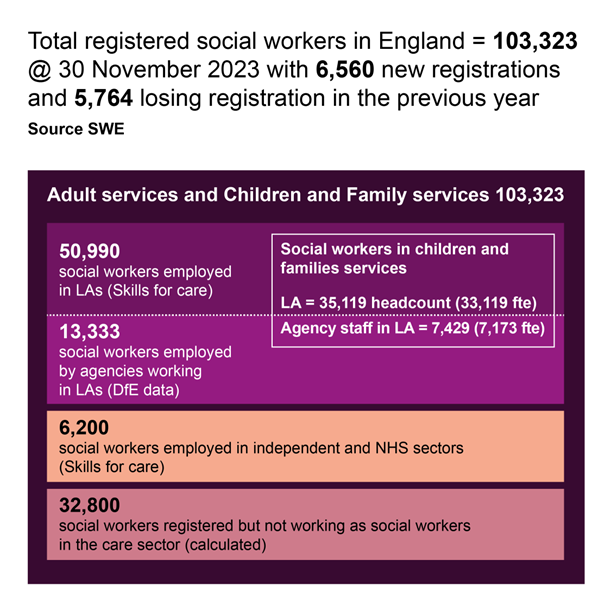
Due to the different sources of data and what they represent we have used our analysis to build a picture of the children and family social workers employed by councils as part of a nested hierarchy as illustrated in Figure two. The significance of this nested approach in the context of future sufficiency of children and family social workers in councils is to recognise that the capacity for delivering children and family social work in a councils is part of a larger picture. It is therefore helpful, for example, to consider the balance between agency and employed workforce in LAs; or between in-work and non-working registered social workers, both of which could be as significant, and potentially more significant than the pipeline of new trainees who will take time to both recruit, train and progress in terms of capability.
DfE children’s social care workforce
These two datasets provide a full and rich source of data from 2017 to 2023 by councils of the following key data items:
|
Headlines data set: |
Characteristics dataset: |
|---|---|
|
|
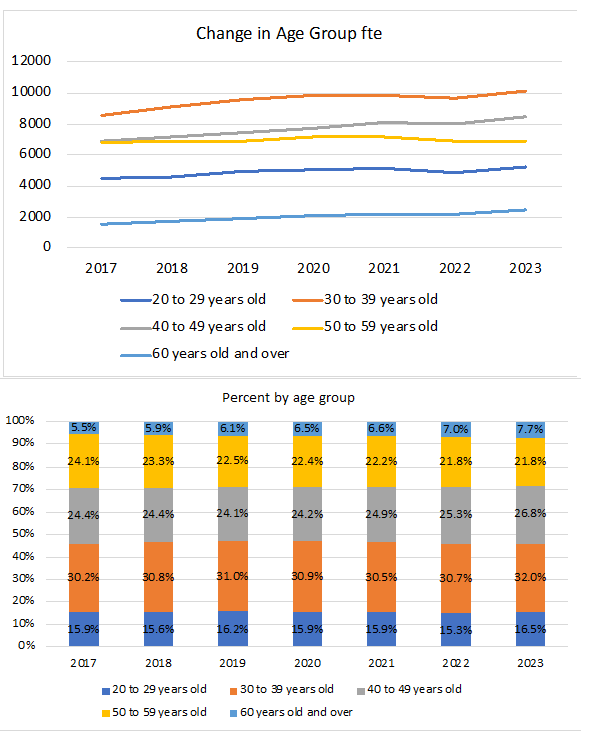
Between the years of 2017 and 2023 we can observe the following patterns within the children and family social work capacity in councils:
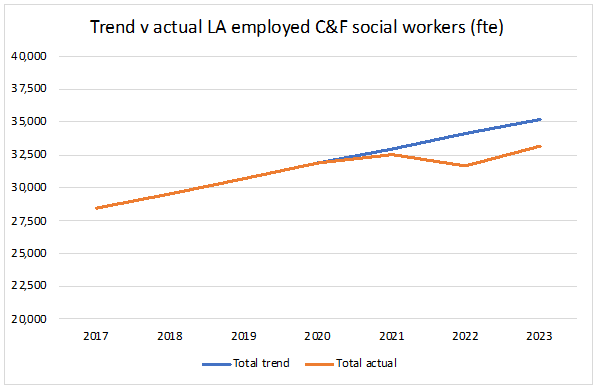
- The total full-time equivalent (FTE) in-post workforce increased from 28,493 to 33,119 (+16.2 per cent), however, whilst <50’s broadly followed this pattern the FTE for 50–59-year-olds in the workforce only rose by 0.8 per cent whilst that for the over 60s rose by 54.3 per cent. This suggests that a disproportionate number of people in their 50s are leaving the profession whilst those in their 60s are working for longer (Figure three).
- There was an overall drop in capacity between 2021 and 2022 of 863 FTE (-2.7 per cent) with the largest drop in the under 30s (-6.4 per cent) slightly off-set by an increase in the >60s (+2.8 per cent). This drop in capacity was partially though not fully restored by 2023 (Figure four).
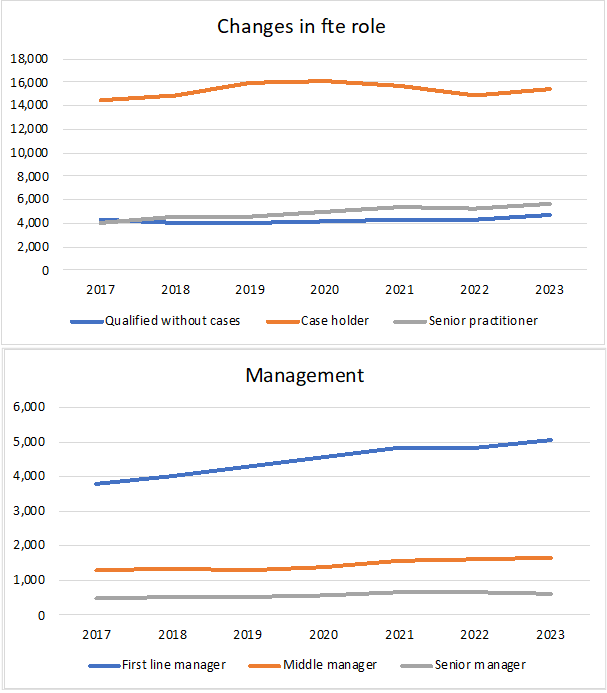
- A split between practitioner and management roles between 2017 and 2023 saw an increase in practitioner capacity of 12.7 per cent compared with 30.6 per cent for management. Within the practitioner roles caseholders only rose by 6.9 per cent whilst senior practitioners rose by 36.9 per cent and qualified staff without cases rose by 9.1 per cent (Figure five).
The bullet points above are illustrated in the following charts:
Social Work England
The wider context of registered social workers in England has been provided by Social Work England. This data has been used to sense check turnover assumptions (given that DfE data double counts turnover between LAs) and to give an indication of the potential within the registered but not working social work workforce (see Figure 2). The data from this source was available from 2020 to 2023 (census date of 30 November) and has provided numbers registered and joining the workforce by 5 year age bands.
We have used the Social Work England data to estimate turnover rate as it relates to people leaving the profession rather than moving from one local authority to another (as in the DfE data).
Skills for Care
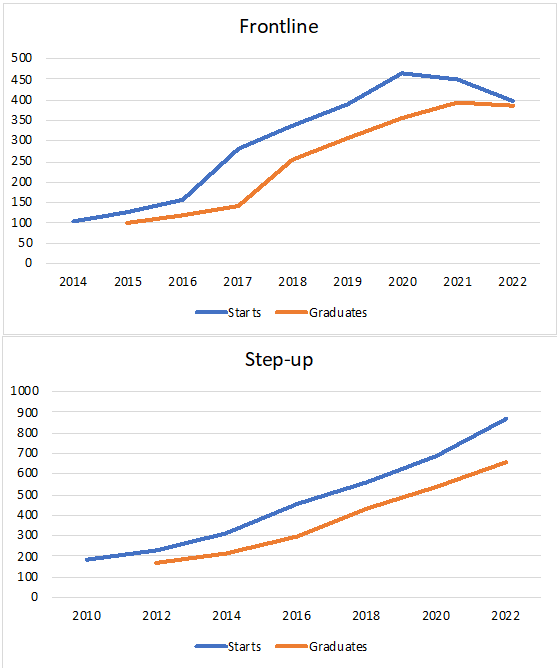
Skills for Care data includes information about places, completion rates and destination after social work training in England. It should be noted that most people who train do so on a generic course only opting for work in Children and Families services following training. However, the Frontline and Step-up graduate training programmes provide a more direct graduate route into this workforce and have had a significant and growing impact over the last 10-14 years (Figure seven).
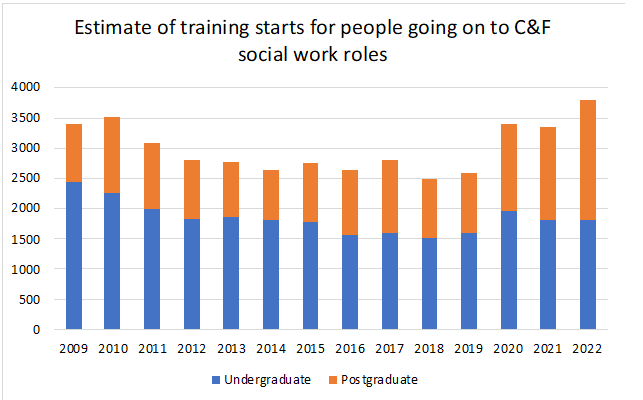
When combined with traditional undergraduate and post-graduate training programmes, and using the proportion of people working in adult vs children and family roles post-graduation, it is possible to estimate the pipeline progressing to a substantive role. Figure seven provides that estimate and clearly shows the impact of the Frontline and Step-up courses particularly in the latter years of 2020-2022. Between 2010 and 2015 the proportion of people using a post-graduate route for training represented between 32 per cent and 36 per cent but has subsequently grown to 53 per cent in 2022.
The model and its outputs
Approach and model structure
The chosen modelling approach has been to use a system dynamics (stock and flow) model. The advantage of using this approach is that it is well suited to high level, aggregate and strategic challenges where flow and delays are a significant factor. The model has been developed to reflect four related areas as shown in Figure eight. The components of the model, and brief walk-through of how it works, can be described as:
- A sector that models the supply chain for children and family social workers that is pre-populated with existing trainees (headcount).
- A flow through to the LA workforce taking account of:
- People not continuing in a social work role and therefore leaving the system;
- A conversion rate from headcount to full time equivalent (FTE) to take account of part time working;
- A flow into agency working where this is preferred.
- The actual or forecast workforce capacity and capability by age (see Figure three for detail) that accounts for people joining or leaving the councils employed workforce including moves between LA and agency employed staff.
- The agency workforce that can grow or decline in response to vacancy levels in the LA workforce.
- A demand driver that can be set to reflect trends in the number of cases or other underlying social or demographic changes.
The model runs in such a way as to generate annual outputs that match historic data (2019-2023) through a process of assumption building for the flows. It then continues to apply these assumptions, some of which are modifiable by the end user, to generate the forecast from 2024 to 2034.
![the image shows a the model used for this project to forecast the local authority workforce. It includes new trainee starts and the agency workforce, and takes into account trainees not taking up roles, leaving the profession and retiring. It also considers demand drivers.]](/sites/default/files/images/15.144_Figure%209%C2%A0%C2%A0%C2%A0%C2%A0%C2%A0%20Model%20structure.png)
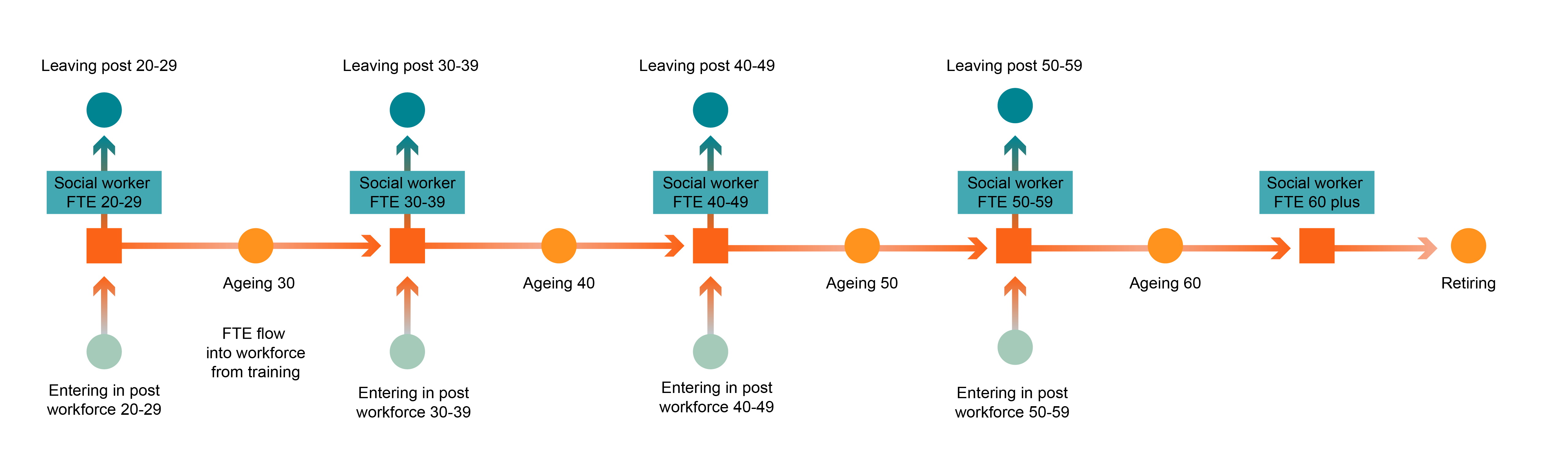
The detailed stock-flow of the workforce capacity sector is illustrated in Figure ten where the initial FTE (capacity) for the workforce is used to initialise the model after which ageing, coupled with net inflows (from training or from agency staff) and outflows (through turnover and retirement), are used to generate the forecast capacity requirement. The latter is determined by a linked sector within the model that simulates future need/demand whilst also reflecting any desired future levels of vacancies and therefore the optimal call on vacancy staff.
Model assumptions
This section outlines the assumptions and their rationale in the different sectors of the model shown in Figure eight. As has been demonstrated in section two of this report it has been necessary to knit together data from different sources. It has therefore, on occasion, been necessary to triangulate this data to provide assumptions that fill gaps in ways that are entirely consistent, if not necessary, with the data available.
Training pathway
This model sector reflects headcount and has two flows, one for graduate and one for undergraduate entrants to training using the data outlined in section two to estimate the split of those in standard training courses that fill roles in children and family services. We have assumed:
- Three years training for undergraduate and one year for postgraduate courses.
- A 91 per cent completion rate for undergraduate and 95 per cent graduate (SfC data).
- 45 per cent of new trainee starts are postgraduate from 2023 (SfC data).
- A minimum number of training places available each year of 3,500 (default assumption with options).
- 81 per cent of those completing undergraduate courses going on to a children and family social work role and 86 per cent for postgraduate (SfC data).
- Age profile on graduation for undergraduates of 49 per cent <30, 46 per cent 30-39 and 5 per cent >40.
- Age profile on graduation for postgraduates of 44 per cent <30, 46 per cent 30-39 and 10 per cent >40.
- A 0.96 headcount to FTE conversion rate to account for part time working.
Workforce in a LA children and family social worker post
This sector is split by 10-year age bands and FTE and is initialised and calibrated to actual outputs described in section 2 of this report up to and including 2023. It then forecasts capacity and age profile based on the inflow from training, movement between agency and LA employed and factors in a COVID-19 effect seen in the data. We have reflected SWE data for turnover aggregated into 10-year age bands but adjusted to recognise that people will move in and out of the workforce but retain their registration status.
Agency capacity
We have created an agency capacity based on DfE data and sought to replicate the recent increase in this capacity in a way that reflects the equivalent reduction in FTE employed by LAs. To achieve this, we have assumed that 70 per cent of the reduction in LA FTE workforce took up an agency role. We have also assumed that as a result of the target to reduce vacancies (see below) there will be less demand for agency staff based on an agency cover rate of 80 per cent and that 50 per cent of any reduction in demand for agency staff would generate a flow back into the LA workforce. Finally, in order to calculate a cases per caseholder output that matches with the data in 2023 (16.8) we have assumed that 73 per cent of agency staff carry cases.
Demand driver
We have provided for four options as a demand driver as follows:
- No growth.
- Demographic change using ONS <18 population for the next 10 years at -0.16 per cent pa.
- Trend data for the growth in cases from DfE dataset, which for the period 2017 to 2023 has been +1.1 per cent on average, but with high growth pre-COVID-19 at 3.2 per cent growth pa and no increase since 2019.
- A user defined input.
In addition, this sector creates an additional demand driver related to the vacancy rates on the basis that current levels (2023 at 19.6 per cent) are higher than pre-COVID-19 levels of c.16 per cent and should ideally be reduced. We have created an option on the model interface to target a future vacancy rate that has the effect of requiring more people to flow into the workforce over and above the demand driver and then apportioning that additional workforce flow between new trainees (that will have an inbuilt delay) and reversing the evidenced flow from council to Agency that has occurred in recent years. This has to assume that this is possible and that attractive and flexible working arrangements can be provided in the local government sector.
Baseline model outputs
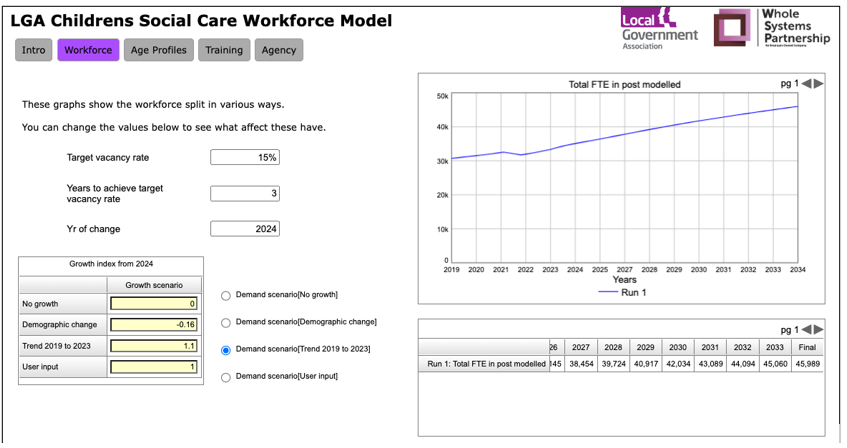
Figure four illustrates the model interface with an output for total FTE in post in a councils that matches historic data from 2019 to 2023 and then projects forward the FTE workforce to 2034 based on:
- Demand growth of 1.1 per cent pa.
- A gradual reduction in vacancy levels to 15 per cent over three years (noting an increase from c.16 per cent in 2019-21 following by a jump up to 21 per cent during 2022 reducing to c.20 per cent in 2023) – i.e. a return to just below pre-pandemic levels. This is addressed by a combination of additional training of new social workers and people being attracted back into LA employment from agencies.
- A ‘floor’ for new training places being made available across England of 3,500 a year compared to c.2,600 in 2021 but around 3,400 in 2020 and 2021 and c.3,800 in 2022.
A range of other model outputs are generated using this baseline, including:
- LA FTE children and family social workers in post: as illustrated in Figure ten above this rises steadily under the baseline scenario from 32,952 in 2023 to 45,989 by 2034.
- Agency FTE: after the rise witnessed between 2019 to 2023 from 5,754 FTE to 7,638 in 2023 the model, under the baseline scenario that relies on attracting some of the agency workforce back into LA employ, forecasts a gradual fall to 5,823 by 2031 after which agency requirements start to rise again. This reflects a change from 26.5 per cent of capacity being agency in 2019, rising to 33.4 per cent in 2022 and then falling to 23.0 per cent by 2034.
- New LA workforce capacity: under this baseline scenario the majority of new capacity entering LA employment would still be from new trainees (c.2,500pa), with additional flow from agency to LA employed averaging 267pa between 2024 and 2028 reducing gradually to just below 200pa in the longer term.
- Cases per caseholder: between 2019 and 2023, the number of cases per caseholder rose from 16.7 to 17.1 and then fell back to 16.8. Our baseline scenario forecasts a relatively level rate of cases per caseholder falling slightly to 16.4 by 2034.
- LA employed staff age profiles: the baseline scenario does not affect underlying age profiles.
- Training starts: the number of training starts at 3,500 is sufficient for this scenario with no need to increase capacity over the 10 year period.
Scenarios
What if we vary the demand driver?
To create this scenario we have deployed each of the demand driver options as follows:
- Slight reduction in demand based on <18 population of -0.16 per cent a year.
- No demand changes.
- Demand trend at +1.1 per cent a year (default scenario).
- Demand drive set at +2 per cent a year.
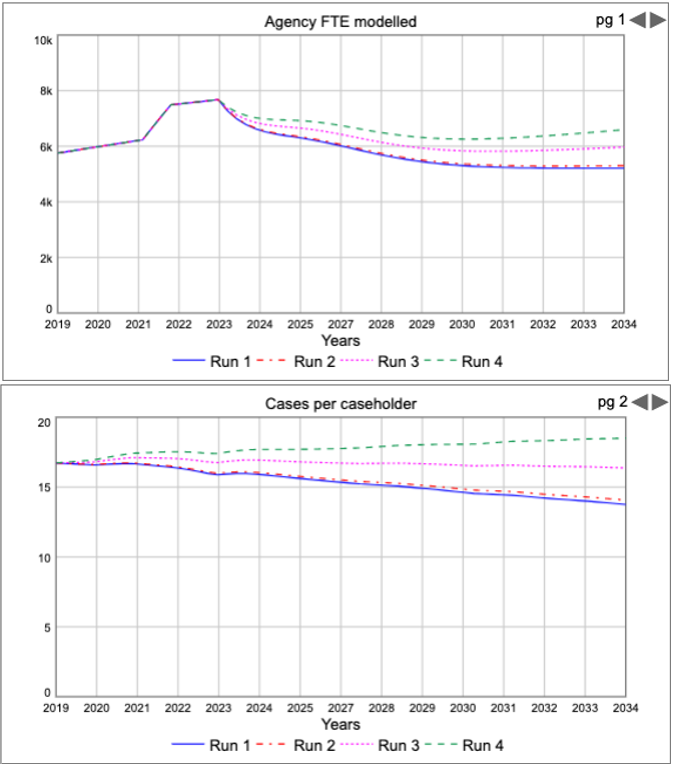
The outputs from these scenarios are as follows (illustrated in Figure 11):
- LA FTE children and family social workers in post: as the model seeks to match demand and capacity there is minimal effect on this output, i.e. 46,000 FTE in post by 2034, although scenarios 1 and 2 result in 46,406 and 46,357 respectively whilst options 3 and 4 result in 45,989 (default) and 45,644 respectively.
- Agency FTE: the greater the rise in demand the greater is the agency staff requirement, so on this occasion model outputs vary from an end point of 5,212 for option 1 to 6,595 for option 4.
- Cases per caseholder: lower growth assumptions allow for reductions in cases per caseholder with option 1 producing an end point of 13.8 compared to the baseline of 16.4. Higher growth results in an increase in cases per caseholder to 18.5 by 2034.
- Training starts: the baseline of 3,500 new trainee starts pa is sufficient under all of these scenarios.
What if we lower the training numbers?
To create this scenario we have adopted the default growth assumption (+1.1 per cent pa) but lowered the floor for training numbers by 250 in each scenario (3,500, 3,250, 3,000, 2,750, 2,500). It should be noted that the model will compensate if more training starts are needed.
- LA FTE children and family social workers in post: As the training numbers reduce so does the FTE workforce reduce resulting in a range from 45,989 in 2034 (default assumption) down to 39,739 (still significantly above the current level of 32,952) – see Figure 12.
- Agency FTE: the number of agency FTE would remain largely unchanged under these scenarios.
- Cases per caseholder: this would rise on each reduction in trainee numbers by roughly 0.6 cases per caseholder for each 250 reduction in training numbers, with 19 cases per caseholder increasing to 19 by 2034 under the 2,500 trainee starts assumption.
![the images show two graphical representations of model outputs under different training number assumptions to illustrate the information in the paragraphs above.]](/sites/default/files/images/15.144_Figure%2013%20Model%20outputs%20under%20different%20training%20number%20assumptions_0.png)
What if we have a more ambitious target for vacancies?
Under this scenario we adopt the baseline demand drivers (+1.1 per cent pa) and training places (minimum 3,500 starts) but reduce the target vacancy rate from 15 per cent to 14 per cent, 13 per cent or 12 per cent. This scenario has minimal effect on the total FTE in post in LAs or on cases per caseholder but reduces the agency workforce employed by 2034 from 5,968 to 5,043 and the percentage of the workforce in agency roles from 23 per cent to 20 per cent by the same time (see Figure 13).
![the image shows a graphical representation of model outputs under different vacancy level targets to illustrate the information in the paragraphs above.]](/sites/default/files/images/15.144_Figure%2014%20Model%20outputs%20under%20different%20vacancy%20level%20targets_0.png)
Conclusions
The analysis and modelling undertaken for this project, informed by the external reference group, suggests:
- That maintaining recent training capacity at a minimum of 3,500 places a year is essential to ensure sufficiency going forward – without these sustained levels the model reflects ‘boom and bust’ behaviour, i.e. requiring future injections of training places well in excess of the 3,500 in future years;
- The number of cases per case holder is a key output and the scenarios demonstrate that unless training numbers are maintained and vacancy levels reduced there is a real risk that workload will increase with the possibility that this will fuel a vicious downward cycle that makes it more and more difficult to attract and retain children and family social workers;
- The model has the potential to generate further insights and has been made available to the LGA team for further testing.
References and Resources
[1] Invitees to the Reference Group, including the LGA lead managers Clive Harris and Louise Smith, were Jane Humphreys (LGA), Suzanne Hudson (LGA), Anastasia Davies (West Midlands Children’s Services), Paul Brewster (West Midlands Children’s Services), John Coleman (Warwickshire County Council) and Nigel Chapman (London Borough of Brent).