Introduction
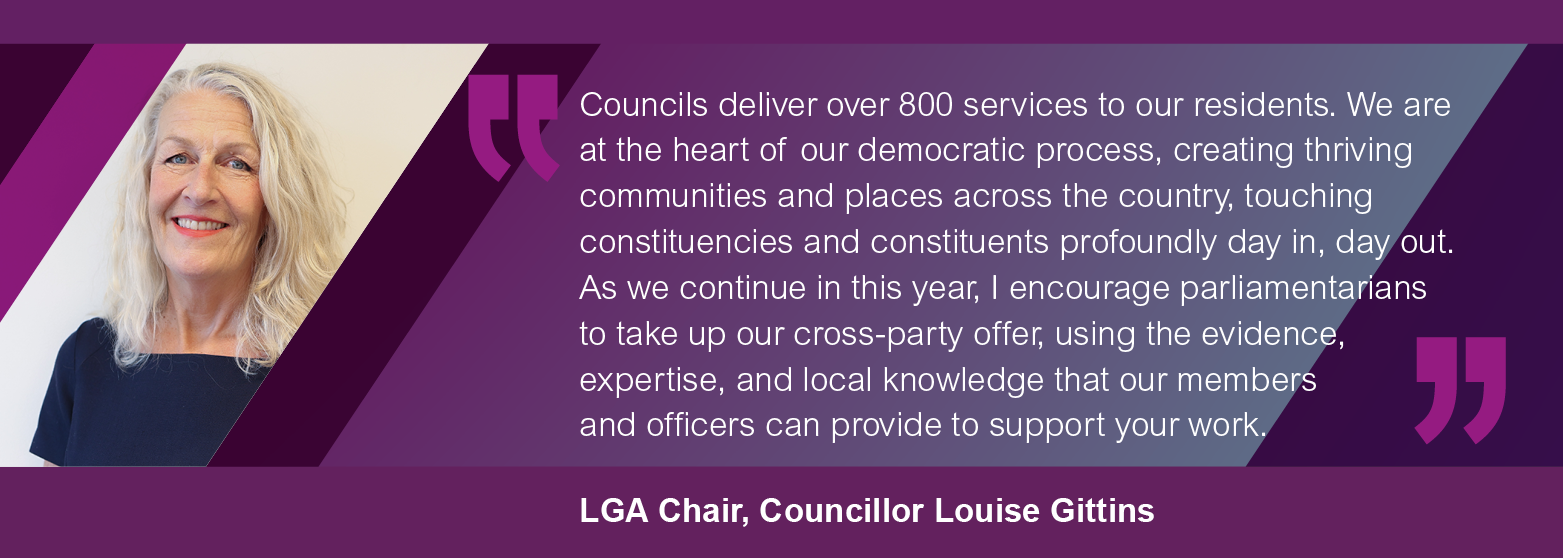
Local government is at the heart of our democratic process, creating thriving communities and places across the country. With councils responsible for delivering over 800 services to our residents, our world is one that touches your constituency and constituents profoundly day in, day out. From adult social care and children’s services to our housing, roads, and schools, a new Parliament presents a great opportunity for nationally and locally elected members to come together to work in partnership.
Ahead of the election in July, the LGA’s White Paper for local government called for a reset of the relationship between central and local government to deliver the transformative change our communities need. With a third of MPs having local government experience as either councillors or officers, they understand firsthand the important role that councils play locally, as innovators, providers and conveners of services, and place leaders. Councils hold the keys to solving some of our biggest national challenges – from ending the housing crisis, to achieving net zero, improving the nation’s health and wellbeing, driving inclusive economic growth and prosperity, and supporting children and young people to have the best start in life.
Against this backdrop, I am delighted to have been elected Chair of the Local Government Association (LGA) at such a pivotal time to represent councils of all regions, tiers, and political colour, and I pay tribute to my predecessor, Shaun Davies MP, for his leadership before joining you in Parliament. As the national voice of local government, we will continue to ensure our sector is at the heart of Whitehall and Westminster’s efforts to tackle some of our nation’s biggest priorities. As a cross party organisation, we will also work to offer constructive challenge to government as we secure the evidenced-based reforms we need to deliver public services, built on the knowledge and good practice of councils.
With one in four councils likely to have to apply for exceptional financial support (EFS) in the next two financial years, there has never been a more difficult time for local government. Councils find themselves in an increasingly precarious position, facing the toughest of decisions. The LGA will continue to work with Parliament as we ensure our councils have the funding they need to sustain the vital services that our residents rely on every day.
In another busy year, we engaged with parliamentarians on a wide range of issues to promote the value of local leadership in creating sustainable growth, improved public services and a stronger society. In our Parliamentary report for 2023/24, I am pleased to provide an update on our engagement with MPs and Peers as you conducted your important business of scrutiny and legislation.
With yours and your teams’ support, the LGA has continued to campaign on behalf of our membership, as an organisation with some of the highest engagement with Parliament and its committees. In fact, we contributed to just under 20 parliamentary inquiries between November last year and this May, providing thought leadership and challenge on a range of issues that matter to the public from housing and planning, devolution, SEND, tobacco and vaping, driving skills and more. We were mentioned nearly 200 times during the last Parliamentary session too and offered just under 100 bespoke briefings to parliamentarians. This report further highlights the vast variety of ways the LGA has advocated for positive change on behalf of councils and we are grateful to our LGA Vice-Presidents and all MPs and Peers for their support over the past year on the national stage. We look forward to continuing working with Government and Parliament on the full range of legislative proposals and White Papers over the next year.
My thanks also to all the local leaders who have taken time out of their busy schedules to share their experiences in evidence to various parliamentary committees on behalf of the LGA, our special interest groups, or their own councils. This report, and the LGA’s efforts to shape the parliamentary agenda, would not be possible without their support.
In this new year, I would like to renew our cross-party offer – please work with us (by contacting [email protected]) and use all the evidence, expertise, and local knowledge that our members and officers can provide to support your national campaigns. 2025 will be a year of tremendous challenge and change but we have a powerful opportunity to join up and support each other for the benefit of the people and places we serve. By working together, I am confident that it is one that we will take.

LGA Chair
Councillor Louise Gittins
Overview

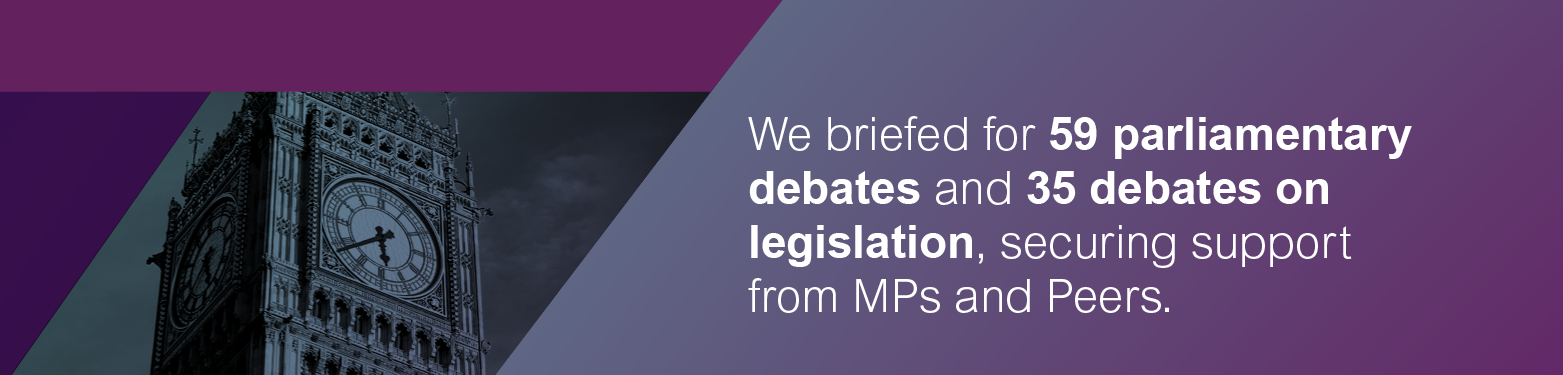
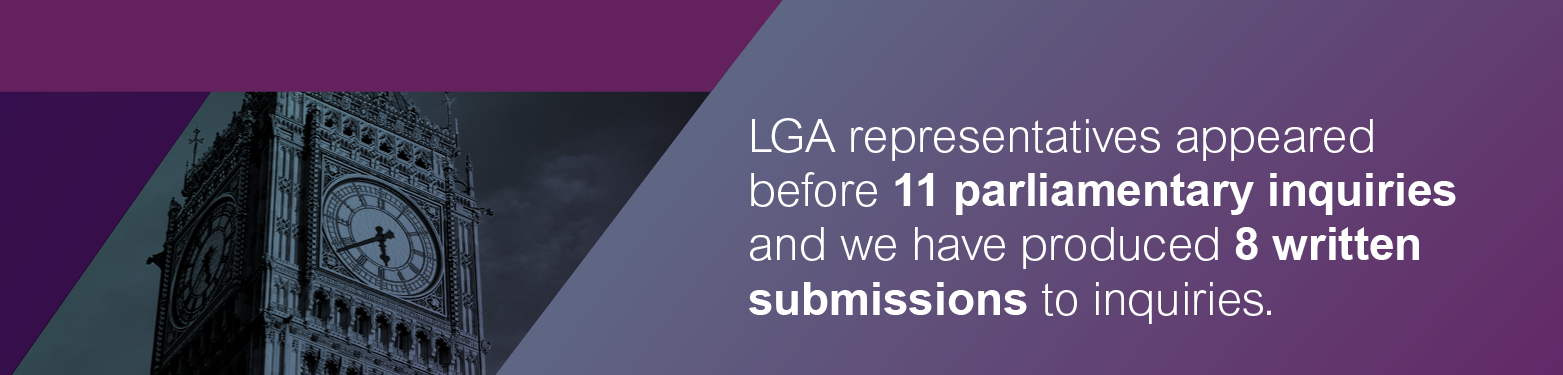
The LGA is the national voice of councils. A vital part of our role is working with parliamentarians as we seek to inform debates, the scrutiny of legislation that affects local government and shape the reports of select committees and All-Party Parliamentary Groups.
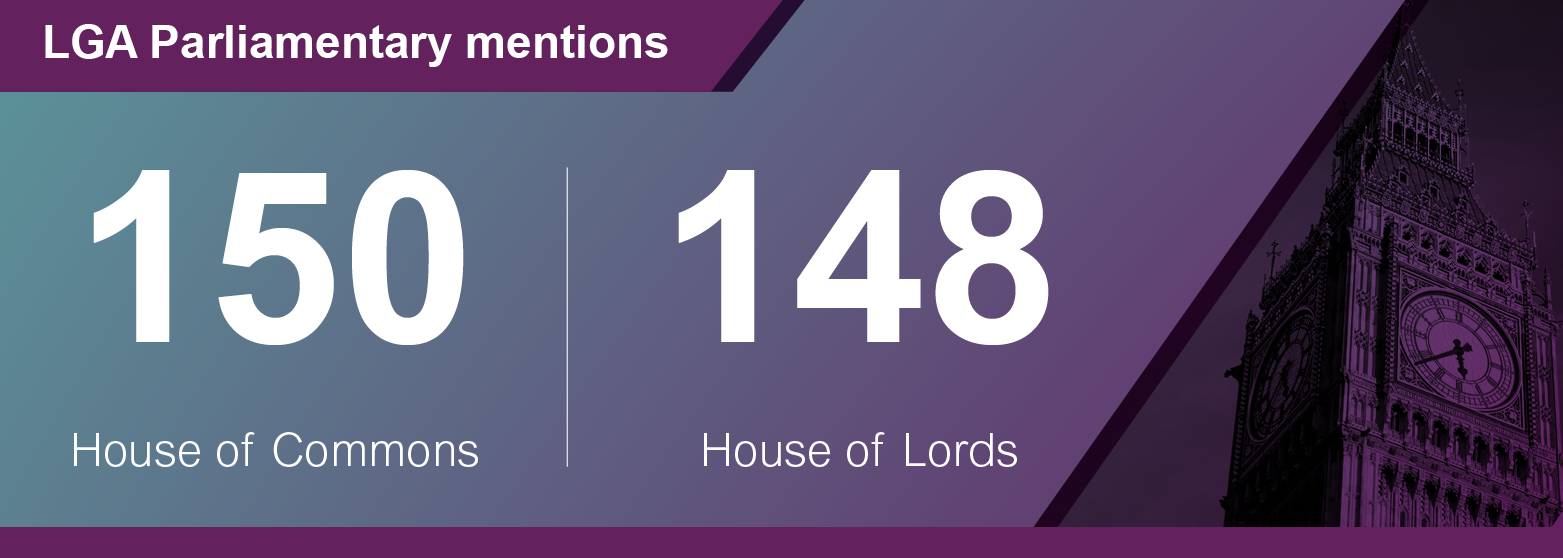
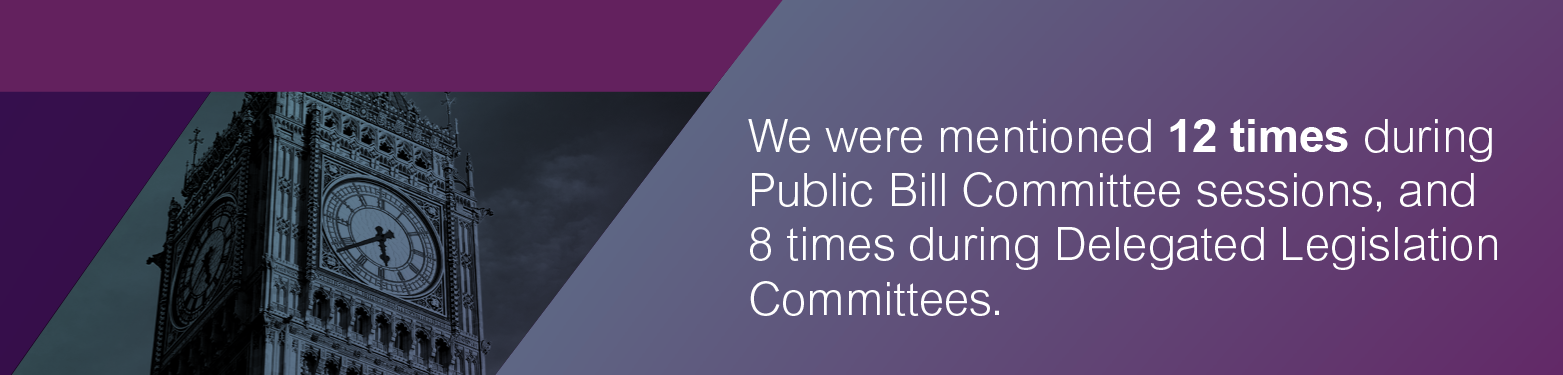
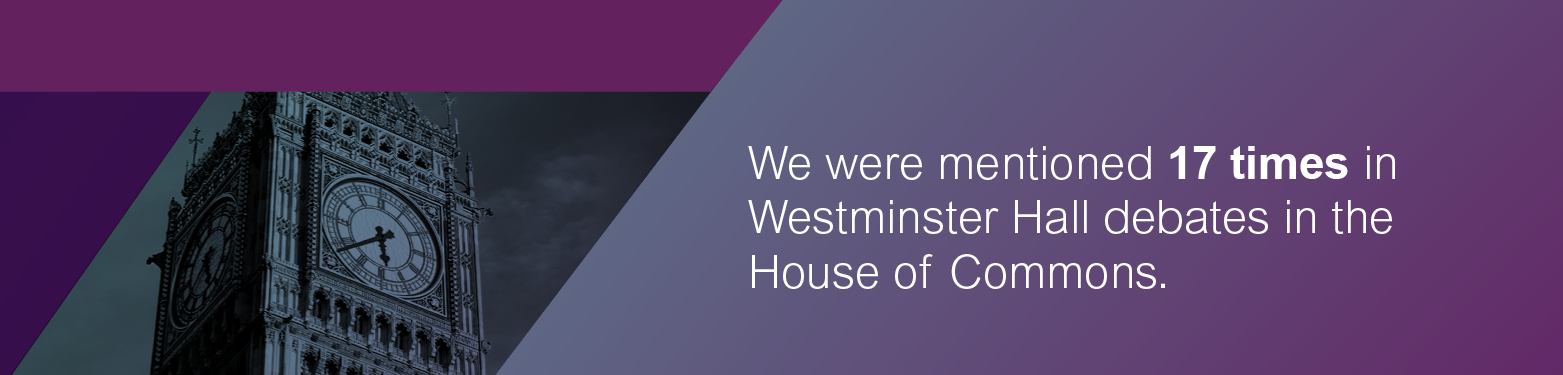
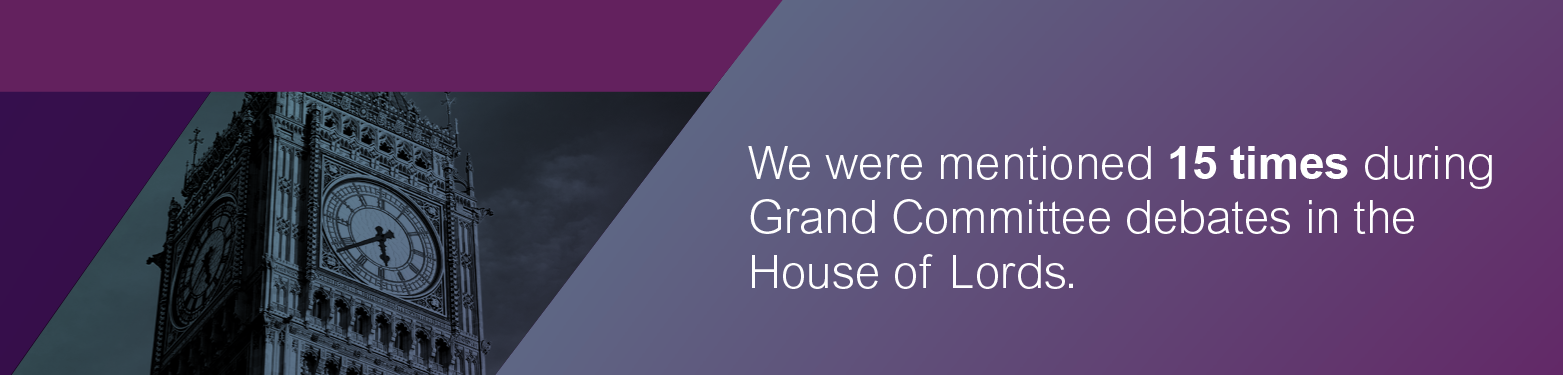
The LGA benefits from a significant profile in Westminster. In the 2023-24 parliamentary session we were quoted 196 times in Parliament.
To help deliver this the LGA has informed the debates on scrutiny of a wide range of primary legislation, successfully lobbying for significant reforms to a wide range of legislation, including the Tobacco and Vapes Bill, Leasehold and Freehold Bill, Renters (Reform) Bill and the Economic Activity of Public Bodies (Overseas Matters) Bill in the last Parliament.
References in the Chamber
References in Committee
References in non-Chamber debates
References in writing
Funding for local government
We have helped deliver this through…
Funding for local government: Legislation
- The Non-Domestic Rating Act gained Royal Assent on 26 October 2023. The LGA briefed MPs and Peers throughout the Bill’s passage in Parliament and welcomed that the Government was legislating for a package of measures alongside revaluations once every three years. We supported measures to improve valuation accuracy and timeliness including new duties for ratepayers to notify the Valuation Office Agency (VOA) of information on the calculation of their rateable value. We also welcomed the clarification that the new online system for receiving information from ratepayers will enable the VOA to share information with billing authorities and that the VOA will test this functionality and share information with billing authorities as part of the soft launch of the new system. We supported the reforms to material changes of circumstances due to the COVID-19 pandemic and supported the changes in the Bill which will mean that material changes of circumstances should relate to physical changes only.
- During the Grand Committee of the Non-Domestic Rating (Rates Retention: Miscellaneous Amendments) Regulations 2024 in the House of Lords in March 2024, LGA Vice President Baroness Taylor of Stevenage (Labour) questioned whether the Government has given consideration to the LGA's asks of giving councils more flexibility on business rates reliefs and the ability to set their own business rates multipliers (or, to set a multiplier above and below the nationally set multiplier).
- In a House of Lords debate on the Combined Authorities (Finance) (Amendment) Regulations 2024, LGA Vice President Baroness Taylor of Stevenage (Labour) reiterated the LGA's view on council tax rises never being the solution to the long-term pressures faced by councils.
Funding for local government: Inquiries
- Councillor John Fuller, Conservative Vice Chairman of the LGA's Economy and Resources Board, gave evidence to the Levelling Up, Housing and Communities Committee inquiry into Financial distress in local authorities. Councillor Fuller appeared alongside Councillor Graham Chapman, Vice Chair of SIGOMA, and Councillor Claire Holland, Acting Chair of London Councils. Councillor Fuller highlighted to committee members that the sector is £4 billion short of just maintaining services at where they stand and warned that more councils are facing Section 114 notices as the demand and cost of services outstrips funding and income. The LGA previously identified three key areas of council activity that are experiencing sharp financial and/or demand pressures: adult social care and winter pressures; children's services; and housing and homelessness services. As part of our Save Local Services campaign in the run-up to the Autumn Statement, the LGA called on the Government to ensure that all councils have sufficient funding to deliver their 2023/24 budgets, set balanced budgets for 2024/25 and develop medium-term financial strategies that are not characterised by substantial funding gaps. Parliamentary Under-Secretary of State for Local Government Simon Hoare MP also gave evidence to the Committee in a later session. The LGA was referenced throughout that session with our figure of councils facing a funding gap £4 billion over the next two years being used in a question by Committee member Mary Robinson MP (Conservative, Cheadle) to the Minister. Furthermore, in the Secretary of State for Levelling Up, Housing and Communities Michael Gove MP’s evidence session to the inquiry, the Committee challenged the Secretary of State on the LGA’s findings of a survey warning one in five councils were considering issuing a section 114 notice 2023/24. The LGA was ultimately referenced through the final report, specifically in relation to the funding gaps faced by councils and the precarious position of adult social care.
- Ahead of the Liaison Committee’s hearing in March 2024, we briefed relevant Select Committee chairs for the evidence session into the work of the Prime Minister. The Prime Minister Rishi Sunak MP mentioned the LGA during the Liaison Committee regarding the Local Government Finance Settlement and council's spending power. Chair of the Levelling Up, Housing and Communities Select Committee Clive Betts MP also referenced LGA research into the threat of council bankruptcy.
- The LGA submitted written evidence to the Public Accounts Committee inquiry on the Whole of Government Accounts (WGA) 2021-22. We highlighted how the continuing crisis in local audit has had an impact on WGA as the delay in auditing and signing off accounts has meant that many local authorities have been unable to submit their accounts in time to be included in WGA. For 2021/22 this was 146 English local authorities (and 157 including Wales and Scotland).
Funding for local government: Debates
- The Chancellor, Jeremy Hunt MP, delivered his Autumn Statement in November 2023, which set the Government’s ambition to build a stronger and more resilient economy. The Chancellor set out his plan to increase growth and productivity by supporting businesses and getting more people into work, whilst also investing in infrastructure and levelling up. MPs got a chance to have their say on the Statement in debates afterwards, with several such as John McDonnell MP (Labour, Hayes and Harlington) and Mike Kane MP (Labour, Wythenshawe and Sale East) highlighting the LGA’s concerns of a £4 billion gap in local council funding over the next two years. In our on-the-day briefing, which summarised the key announcements for councils, we expressed disappointment that the Chancellor’s Statement failed to provide funding needed to protect the services that many people in our communities rely on. The LGA was, however, pleased that the Government acted on our call to unfreeze Local Housing Allowance rates, which is a positive step in helping support the most vulnerable in our society afford rising rents. It was also good that the Government committed to ensuring councils will be able to set planning fees to cover the full cost of processing some major applications which will mean local taxpayers no longer have to foot the bill.
- Following the Autumn Statement, Peers got a chance to express their views on the Chancellor’s measures in a debate. LGA Vice President Baroness Pinnock (Liberal Democrat) specifically highlighted the LGA’s concerns of a £4 billion gap in local council funding over the next two years, emphasising our analysis that the funding gap in 2023/24 is equivalent to councils stopping all spending on waste collection, library services and recreation and sports combined.
- In February 2024, councils received confirmation of funding for 2024/25 in the final local government finance settlement. The House of Commons debated and approved the Settlement in the first week of February. Ahead of the debate, we continued to call on the Government to ensure that all councils have sufficient funding to deliver their 2023/24 budgets, set balanced budgets for 2024/25 and develop medium-term financial strategies that are not characterised by substantial funding gaps. These points were echoed by many parliamentarians during the debate, particularly by LGA Vice Presidents such as the Chair of the Levelling Up, Housing and Communities Committee Clive Betts MP – who highlighted concerns around the number of councils that could potentially face Section 114 notices within the next year.
- Towards the end of March 2024, the House of Lords debated the state of local government finances. Having briefed LGA Vice President Lord Shipley (Liberal Democrat) before the debate, concerns related to the £14 billion backlog in local road repairs as well as cost and demand pressures arising from the £4 billion funding gap we estimated in October 2023 that councils were facing over the next two years. LGA Vice Presidents Baroness Scott of Needham Market (Liberal Democrat) and Baroness Taylor of Stevenage (Labour) also echoed Lord Shipley’s points – adding that LGA analysis shows that by 2024/25, cost and demand pressures will have added £15 billion to the cost of delivering council services since 2021/22. Councils of all political colours started this financial year in a precarious position and having to scale back or close a wide range of local services. Baroness Bull (Crossbench) and The Earl of Clancarty (Crossbench) illustrated this during the debate by noting the hit that services such as arts and culture will take. Lord Hussain (Liberal Democrat) highlighted our warning that, one in five councils are at risk of issuing a Section 114 notice.
- Towards the end of May 2024, in one of the final debates of the Parliamentary session, LGA Vice President Helen Morgan MP (Liberal Democrat, North Shropshire) held a debate on the “crisis” in local government funding. She highlighted the compounding pressures of the real-terms cuts to local government budgets and the rising demand for services, particularly adult social care. Echoed in the debate were our warnings that councils of all political colours started this financial year in a precarious position and are having to scale back or close a wide range of local services.
Funding for local government: Questions
- During Treasury oral questions in December 2023, Kerry McCarthy MP (Labour, Bristol East) challenged the Chief Secretary to the Treasury Laura Trott MP on the Provisional Local Government Finance Settlement and the LGA's view that it does not provide enough funding to meet the severe cost and demand pressures on councils.
- In response to an Oral Question from Shadow Minister for English Devolution and Local Government Jim McMahon MP (Labour, Oldham West and Royton) on council funding, Minister for Local Government Simon Hoare MP highlighted his conversations with the LGA on section 114 notices.
- In February 2024, Lord Dubs (Labour) highlighted the financial difficulties facing many local authorities around the country. Whilst welcoming the additional £600 million in funding for local government announced towards the end of January, Lord Dubs stressed that this was still “a drop in the ocean compared to the cutbacks local authorities have faced since 2010”. The LGA had consistently expressed concerns around the number of councils that could potentially face Section 114 notices within the next year. We therefore welcomed our participation in an expert panel to advise local government and the Department for Levelling Up, Housing and Communities on financial sustainability into the future, as referenced by the Government’s representative in the House of Lords, Baroness Scott of Bybrook, in response to Lord Dubs’ question.
- In May 2024, LGA Vice President Baroness Taylor of Stevenage (Labour) asked a question in the House of Lords on the pressures councils have experienced due to the increasing internal drainage board levies, and called for a long-term solution. Fellow LGA Vice President Baroness Bakewell of Hardington Mandeville (Liberal Democrat) as well as former LGA Chairman Lord Porter of Spalding (Conservative) echoed these concerns. Responding to the debate on behalf of Government, Baroness Scott of Bybrook acknowledged that while the Department for Levelling Up, Housing and Communities has given an extra £3 million outside the Local Government Finance Settlement to the 15 worst affected councils, the scale of costs being passed onto certain councils is not sustainable. The LGA supports a revised approach to the current funding method.
Adult social care, health and wellbeing
We have helped deliver this through…
Adult social care, health and wellbeing: Legislation
- The Conservative Government’s Tobacco and Vapes Bill had its Second Reading in the House of Commons in April 2024. The Bill included a new law to stop children who turn 15 this year or younger from ever legally being sold cigarettes or other tobacco products, alongside measures to crack down on youth vaping and strengthen enforcement of these new laws. This is in addition to a broader package of measures to tackle youth vaping – including banning the sale and supply of disposable vapes under environmental legislation and the new excise duty on vaping products announced in the Spring Budget. MPs voted 383 to 67 in favour of the Government's Tobacco and Vapes Bill. We briefed MPs ahead of the debate that the LGA is fully supportive of the Government’s smokefree generation ambitions, which will improve the life chances of people across the country, as well as measures to restrict the availability and marketing of vapes to children.
- The Chairman of the LGA’s Community Wellbeing Board, Councillor David Fothergill, gave evidence to the Tobacco and Vapes Public Bill Committee towards the end of April 2024. In the session, we underlined our support of the Government’s smokefree generation ambition whilst making the case for tougher penalties for those selling tobacco and e-cigarettes to those underage. In particular, we called for councils to be given the power to issue Fixed Penalty Notices (FPNs), and warned that the success of the new legislation will be dependent upon the ability to enforce it and it is therefore crucial that adequate powers, funding and resources are dedicated towards this. The LGA also submitted written evidence to the committee.
Adult social care, health and wellbeing: Inquiries
- Councillor Victor Chamberlain gave evidence as a representative of the LGA’s Local Infrastructure and Net Zero Board to the Levelling Up, Housing and Communities Committee inquiry on Disabled people in the housing sector in February 2024. Throughout the session, Councillor Chamberlain echoed the LGA’s asks of a need to build a range of suitable housing options for disabled people and particularly ones with accessibility features and home adaptations. The insufficiency of the Disabled Facilities Grant to meet demand for housing adaptations was also significantly highlighted. The LGA called for the Government to fully fund the Grant and review the £30,000 cap on Grant expenditure per home – which is now insufficient for most major building work costs. The session was notably highlighted by the BBC in their reporting of Government promises to increase these funds being shelved – which was announced the day after Councillor Chamberlain’s comments. The LGA’s call for greater support to develop local and regional registers of existing adapted properties was referenced in the Committee’s final report.
- The LGA submitted written evidence to the Public Accounts Committee inquiry on NHS England's modelling for the Long-Term Workforce Plan. We highlighted that Ccear priorities which must be included in a national workforce strategy for adult social care are: staff recognition, value and reward; investment in training, qualification and support; career pathways and development; building and enhancing social justice, equality, diversity and inclusion in the workforce; effective workforce planning across the whole social care workforce; and expansion of the workforce in roles which are designed in coproduction with people who draw on care and support, and in roles which enable prevention and support the growth of innovative models of support.
- The LGA was mentioned throughout the Home Affairs Committee report on drugs, which calls for a new legislative and funding framework that enables a public health approach to drugs and risk-reducing interventions, such as establishing a pilot drug consumption facility. The LGA gave oral and written evidence to the inquiry in 2022.
- The LGA's case studies on joined-up thinking between housing and health professionals was mentioned in the Health and Social Care Committee's inquiry session on Prevention in health and social care. The LGA was also mentioned in another session of the inquiry in relation to the engagement of public health teams in infrastructure, transport and planning. We were ultimately referenced in the final report, specifically in relation to concerns around poor quality residential environments that negatively impact people's health and wellbeing.
- The Women and Equalities Committee held a one-off evidence session on the Prevalence of STIs among young people. The witnesses in particular discussed access to sexual health services, with Dr Claire Dewsnap from the British Association for Sexual Health and HIV warning of the real terms cuts in funding over the past decade that has led to a deterioration in services. The LGA has echoed this with analysis showing that over two thirds of council areas have seen rates of gonorrhoea and syphilis increase since 2017 as sexual health services reach breaking point. We called on the Government to provide extra funding so local sexual health clinics can meet rising demand and publish a long-term plan to help prevent and treat sexually transmitted infections.
- The LGA submitted written evidence to the Public Accounts Committee inquiry on Reducing the harm from illegal drugs. We stressed how councils are committed to ensuring drug users get the right treatment and support, as part of their public health and other wider responsibilities. We underlined our view that local government is best placed to assess and meet the need for public health interventions, including substance misuse treatment and prevention. Our written evidence is referenced throughout the final report.
- The LGA submitted written evidence to the Public Accounts Committee inquiry on Reforming adult social care in England. Key messages included how shifting the narrative around social care to something far more positive is essential to reducing the invisibility of the sector and helping the public to think of the service as a benefit to society and a priority for investment; meaningful engagement throughout the design and delivery of services is crucial; reform must embed realism and coproduction throughout the process; alongside funding we need a commitment to wider reform that tackles the most important issues; and developing a dedicated pathway for people to work in adult social care is a very positive step. The LGA's evidence was mentioned in the final report, specifically in relation to our concerns that much of the additional funding delivered in the Autumn Statement would go on meeting pay and inflationary pressures.
- The LGA was referenced in the House of Lords Food, Diet and Obesity Committee inquiry, specifically in reference to analysis conducted on data from the national child measurement programme. We also submitted written evidence to the inquiry, focusing on how health inequalities in England are stark and have deepened as a result of the economic impacts of the pandemic and the rising cost of living. Shadow Minister for Primary Care and Public Health Preet Kaur Gill MP also noted discussions she held with the LGA in this area in an evidence session.
Adult social care, health and wellbeing: Debates
- In May 2024, Peers discussed the challenges faced by those with disabilities. LGA President Baroness Grey-Thompson (Crossbench) and LGA Vice President Baroness Brinton (Liberal Democrat) spoke powerfully about the many issues that are challenges for disabled people – including transport, access to benefits, work, education, housing and healthcare. Councils and their partners play a key role in supporting people to achieve their goals, for instance through both social care support and home adaptions. In particular, the LGA has consistently highlighted how vital it is that there are a range of suitable housing options for disabled people, which offer a real choice over where to live – whether in social housing, the private rented sector, homes to buy or specialist housing with care and support.
- In May 2024, the House of Lords debated the Integration of Primary and Community Care Committee’s report ‘Patients at the centre’. The inquiry was launched to examine existing systems, consider the challenges facing the sector and identify barriers preventing further integration. The LGA had given evidence to the inquiry in 2023 – highlighting the willingness of councils to work with integrated care systems and emphasising how the three main factors driving variability were history, complexity and relationships. The debate also saw former LGA Chairman Lord Jamieson (Conservative) make his maiden speech in the House of Lords, where he welcomed the report’s recommendations – many of which are in line with the work of the LGA, including a focus on prevention and early intervention and the crucial roles of primary, community and social care, integration, colocation, data sharing and a genuine, joined-up approach. This was further outlined in a major publication by the LGA in the week following this debate, The Care Act 2014: Ten years on from Royal Assent.
- The Lords debated the challenges faced by children and young people in accessing support for their mental health in November 2023. Peers discussed how patchy implementation of policies has fuelled a postcode lottery in provision, meaning that children and young people do not get a consistent offer of support. Research commissioned by the LGA found that whilst there have been a raft of successive policies and strategies to improve mental health outcomes for children, however there has been a missed opportunity to significantly ease pressure on the system by increasing the availability of preventative and early intervention support. Briefing ahead of the debate, the LGA stressed that there is also much positive practice and councils and their partners are exploring innovative ways to support children’s mental health, with examples including Durham County Council, Portsmouth and Solihull Metropolitan Borough Council.
- Kicking off 2024, LGA Vice President Bob Blackman MP (Conservative, Harrow East) led a Westminster Hall debate on aspirations towards a smokefree future. We welcomed the Government’s ambition to be smokefree by 2030 and echoed Mr Blackman’s sentiments during the debate of supporting the Government's progressive move to consider raising the legal age of sale for all tobacco products.
- Peter Gibson MP (Conservative, Darlington) led a Westminster Hall debate on the use and sale of illegal vapes towards the end of January 2024. The LGA’s concerns around the 200 million disposable vapes that are thrown away every year and their environmental impact was specifically highlighted by Mr Gibson during the debate. The LGA, likewise, supports a ban on disposable vapes. As referenced in the debate, it is clear that current measures to prevent children vaping in the first place and the environmental harm caused are inadequate and urgent action needs to be taken.
- The LGA briefed MPs ahead of a debate on carer's allowance proposed by Christine Rees MP (Labour, Neath) in April 2024. In particular, the debate highlighted the invaluable contribution provided by caregivers. The Minister for Disabled People, Health and Work, Mims Davies MP (Conservative, Mid Sussex), referenced evidence that nearly 1 million people now receive carer's allowance, and the weekly rate increased this month to £81.90 from £53.90. In our briefing, the LGA made point that councils offer a wide range of support to unpaid carers as noted in our publication The Care Act 2014 and unpaid carers.
Adult social care, health and wellbeing: Questions
- In an answer to a Written Question from Stephanie Peacock MP (Labour, Barnsley East), the Parliamentary Under-Secretary of State (Department for Culture, Media and Sport) Stuart Andrew MP highlighted the Department's collaboration with the LGA to provide guidance on how local councils can tackle loneliness.
- In an answer to a Written Question from Caroline Nokes MP (Conservative, Romsey and Southampton North) on disabled people and their access to pedestrian areas, Parliamentary Under-Secretary of State (Levelling Up) Jacob Young MP highlighted the Department for Levelling Up, Housing and Communities' engagement with the LGA on this issue.
- In an answer to a Written Question from Alex Cunningham MP (Labour, Stockton North) on mental health services and support for autistic people and people with a learning disability, Minister for Mental Health Maria Caulfield MP highlighted the LGA's work with local systems to identify and address challenges in implementation.
- Baroness Barker (Liberal Democrat) emphasised the crisis facing sexual and reproductive healthcare with questions in the House of Lords in March 2024. Specifically, the LGA’s report showing that services throughout the UK are at breaking point, with people being turned away from services was highlighted during the debate. Our analysis, using data from the Office for Health Improvement and Disparities, specifically on the increase in diagnosis rate of gonorrhoea in almost all council areas was also referenced by Baroness Merron (Labour). In our on-the-day briefing for the Public Health Grant allocations to local authorities 2024/25, which was cited by Lord Hunt of Kings Heath (Labour), we underlined our concerns that the Grant received by councils has been reduced by £880 million, which has resulted in a reduction in councils’ ability to spend on STI testing, contraception and treatment.
- In response to a Written Question from Lord Swire (Conservative) on what discussions the Government has had with local authorities on the financing of those in social care, Parliamentary Under-Secretary of State (Minister for the Lords) Lord Markham highlighted the regular conversations held with the LGA regarding the costs of meeting the needs of adults who draw on care and support.
- In response to a Written Question to the Department of Health and Social Care from The Marquess of Lothian (Conservative) on what discussions the Government has had with the LGA on steps they are taking to ensure that local councils in England are able to meet their statutory duties to provide adult social care for 2025–26 in accordance with the Care Act 2014, Parliamentary Under-Secretary of State (Minister for the Lords) Lord Markham (Conservative) highlighted the regular conversations held with the LGA to understand the pressures that are being faced.
Narrowing inequalities and protecting communities
We have helped deliver this through…
Narrowing inequalities and protecting communities: Legislation
- The Criminal Justice Bill was considered by MPs on the Bill Committee and Councillor Sue Woolley, Lead Member for the LGA’s Safer and Stronger Communities Board, gave evidence on councils’ work alongside partners such as the police to make their communities safe and tackle anti-social behaviour. Councillor Woolley specifically highlighted the LGA's view of the importance of Community Safety Partnerships (CSPs) and our concerns that the focus on making CSPs more accountable to Police and Crime Commissioners will create a top-down approach that undermines the partnership working they are built on. Councillor Woolley also urged the Committee to not bring in measures that potentially criminalise those sleeping rough, but instead focus on prevention that is multi-agency and data-led and considers the drivers and levers of homelessness and anti-social behaviour.
- The Pedicabs (London) Act gained Royal Assent on 25 April 2024. The LGA welcomed the Bill throughout its passage in Parliament. We urged Transport for London, as the named licensing authority in the Bill, to consult with the relevant London boroughs to ensure that the work already being done by councils to tackle pedicab-related anti-social behaviour and safety concerns is taken into consideration when deciding the regulatory framework. We also expressed that it is crucial that this new licensing framework is in line with the Department for Transport’s taxi and PHV statutory standards, which seek to ensure that licensing authorities have robust safeguarding processes in place to protect vulnerable passengers. To note that during the Second Reading of the Pedicabs (London) Bill in the House of Commons, LGA Vice President and Shadow Minister for Local Transport Simon Lightwood MP (Labour, Wakefield) emphasised how the LGA has been calling for action on pedicabs for years.
Narrowing inequalities and protecting communities: Inquiries
- Councillor Sue Woolley, Conservative Deputy Chairman of the LGA's Safer and Stronger Communities Board, gave evidence to the Home Affairs Committee inquiry into Police and Crime Commissioners (PCCs). Councillor Woolley appeared alongside Donna Jones, Chair of the Association of Police and Crime Commissioners, and Dr Rick Muir, Director at the Police Foundation. During the session, Councillor Woolley emphasised the work needed to raise awareness of the PCC role, give the public the tools to judge performance and ensure genuine democratic accountability at the ballot box. Councillor Woolley further underlined the need for the PCC model beyond the core policy role to be flexible, reflecting that what is right for one area may not be appropriate for others, depending on local circumstances and other governance structures. The LGA noted that not much discussion was afforded to the important role of Police and Crime Panels (PCPs), and wrote to the Committee afterwards to set out concerns regarding the funding of PCPs.
- The LGA submitted written evidence to the Public Accounts Committee inquiry on Homes for Ukraine. Our submission focussed on the objectives of the scheme and how it was set up; funding provided for the scheme; challenges and future risks; and arrival numbers and checks conducted on applicants and sponsors. The LGA was ultimately referenced throughout the final report, specifically in reference to decisions around visas.
- The LGA submitted written evidence to the Public Accounts Committee inquiry on Asylum accommodation. Our key message was that councils want to work with the Government on developing a better system for accommodating and supporting asylum seekers. The LGA's evidence is referenced in the final report, specifically in relation to rises in homelessness for those leaving asylum accommodation and the need for a more robust cross-system approach to minimise impacts on local housing and homelessness services and reduce the risks of destitution.
- The LGA submitted written evidence to the Public Services Committee inquiry on the Transition from education to employment for young disabled people. Councillor Martin Tett, Chair of the LGA’s People and Places Board, presented oral evidence to the committee. In responding to this inquiry, the LGA informed committee members that councils have a varied role and multiple statutory duties in supporting young disabled people transitioning from education to employment, but that the national employment and skills system is currently too centralised, short-term, and operates in silos, making it difficult to coordinate provisions. The LGA continues to call for councils and combined authorities to be permitted additional powers and resources to take a more strategic approach to coordinating and commissioning provision. This includes the implementation of the LGA’s Work Local proposals.
Narrowing inequalities and protecting communities: Debates
- The LGA was mentioned throughout a February 2024 House of Lords debate on digital exclusion, particularly in reference to the lack of funding (LGA Vice President Baroness Bennett of Manor Castle and Baroness Jones of Whitchurch) and the LGA's report The role of councils in tackling digital exclusion (Lord Clement-Jones).
- The issue of reinforced autoclaved aerated concrete (RAAC) in public buildings, particularly education settings, dominated the news agenda. A House of Lords debate on reinforced autoclave aerated concrete (RAAC) in schools in February 2024 saw Lord Addington (Liberal Democrat) directly referencing the LGA’s concerns around temporary classrooms. Councils have been working hard to support schools with RAAC and minimise disturbance to pupils’ education since the Department for Education (DfE) guidance changed at the end of the 2023 summer holidays. This has included assisting schools with finding alternative spaces where buildings have had to close and also in their discussions with DfE. LGA Vice Presidents Baroness Brinton, Lord Storey (Liberal Democrats) and the Bishop of St Albans (Independent) also echoed the LGA’s sentiments. The LGA also emphasised how vital it is that DfE covers all the revenue and capital costs incurred by councils related to RAAC identification, remediation and mitigation in schools and other educations settings in their area (in particular in non-maintained schools). This includes costs even where RAAC has subsequently not found to be present.
- We worked with Stephen Timms MP (Labour, East Ham) to secure a debate on the Household Support Fund (HSF). The debate came in the run-up to the end of the tranche 3 of the fund, when the future of the fund was uncertain. We briefed MPs ahead of the debate, calling for the fund to be extended for at least another year. Several MPs, including David Simmons MP (Conservative, Ruislip, Northwood and Pinner) and Barbara Keeley MP (Labour, Worsley and Eccles South) highlighted the LGA’s research into the impact of ending the fund.
- The LGA was referenced throughout a House of Lords debate on housing benefit in March 2024, specifically by LGA Vice President Baroness Thornhill (Liberal Democrat) in relation to the LGA's concerns over the adequacy of what is being allocated, and by LGA Vice President Baroness Eaton (Conservative) in relation to research by the LGA highlighting that the Government could save £780 in housing benefit for every social home that is built.
- LGA Vice President Tim Farron MP (Liberal Democrat, Westmorland and Lonsdale) led a Westminster Hall debate on Government support for people recently granted asylum at the end of March 2024. The debate, highlighted the current key pressure for councils being the scale of the move on from asylum accommodation and support as part of the asylum decision-making backlog clearance. Data from the Centre for Homeless Impact indicated that the amount of street homelessness from those leaving asylum housing increased by 223 per cent in June to September 2023 when backlog clearance programme began, and some areas are reporting very acute increases in homelessness pressures. Whilst quicker decision-making is welcome, we expressed our keenness to work with the Government on a more robust cross system approach to minimise impacts on local housing and homelessness services and reduces the risks of destitution.
- In May 2024, Jonathan Gullis MP (Conservative, Stoke-on-Trent North) led a Westminster Hall debate on social cohesion and democratic resilience. The debate centred around the Khan review and delved into critical issues facing modern societies. Members discussed the importance of fostering social cohesion amidst growing diversity and the need to address the underlying factors contributing to division. Concerns were raised regarding the role of social media in exacerbating polarisation and spreading misinformation, highlighting the necessity for effective regulation. Additionally, there were calls for greater community engagement and empowerment to strengthen democratic institutions and promote inclusivity. Ahead of this debate we briefed MPs, in particular highlighting our Debate Not Hate campaign which aims to raise public awareness of the role of councillors in their communities and improve support for local politicians facing abuse and intimidation.
- In a House of Lords debate in May 2024 on the importance of skills for the success of the UK economy and for the quality of life for individuals, Lord Aberdare (Crossbench) highlighted LGA data on the number of national employment and skills-related schemes or services across England. The LGA briefed Lord Aberdare and LGA Vice Presidents prior to the debate highlighting that our analysis (April 2021) reveals that across England, £20 billion is spent on at least 49 nationally contracted or delivered employment and skills related schemes or services managed by 9 Whitehall departments and agencies, multiple providers and over different geographies.
- We briefed MPs ahead of a Westminster Hall debate on free school meal provision, calling for a review of the income threshold and for Government to implement auto-enrolment, to support more children facing food poverty.
Narrowing inequalities and protecting communities: Questions
- In response to multiple Written Questions from Helen Morgan MP (Liberal Democrat, North Shropshire), Ruth Cadbury MP (Labour, Brentford and Isleworth), John Spellar MP (Labour, Warley), Rachael Maskell MP (Labour, York Central) and Tanmanjeet Singh Dhesi MP (Labour, Slough) on the prevalence of reinforced autoclaved aerated concrete (RAAC), Parliamentary Under-Secretary of State (Local Government and Building Safety) Lee Rowley MP urged utilising advice available on the LGA website that is in line with the guidance from the Institution of Structural Engineers.
- In response to a Written Question from Jamie Stone MP (Liberal Democrat, Caithness, Sutherland and Easter Ross) on the prevalence of reinforced autoclave aerated concrete (RAAC) in libraries, Minister of State for Media, Tourism and Creative Industries John Whittingdale MP highlighted the Department's work with the LGA to ensure library services are alerted to available advice and guidance.
- In response to a Written Question from Sarah Champion MP (Labour, Rotherham) on ensuring the Victims Funding Strategy (VFS) is effectively communicated to the relevant authorities, Parliamentary Under-Secretary of State for Victims and Violence against Women and Girls Laura Farris MP highlighted her Department's communications with the LGA on the VFS principles and its implementation.
- In an answer to a Written Question from Mary Kelly Foy MP (Labour, City of Durham) on supporting women's refuges, Parliamentary Under-Secretary of State (Housing and Homelessness) Felicity Buchan MP underlined her Department's close work with the LGA in supporting councils with best practice workshops.
- In response to a Written Question from Caroline Lucas MP (Green Party, Brighton Pavilion) on domestic abuse, Parliamentary Under-Secretary of State (Housing and Homelessness) Felicity Buchan MP highlighted her Department's close working relationship with the LGA on safe accommodation to ensure that councils have the support they need to deliver their duty requirements.
- We worked with Mike Amesbury MP (Runcorn and Helsby) to table a written question on the number of children who are eligible, but not registered for free school meals.
Narrowing inequalities and protecting communities: Events
- We attended and contributed toward the APPG for Ending Homelessness debate on the Criminal Justice Bill and the proposed measures that will criminalise homelessness.
Children, education and schools
We have helped deliver this through…
Children, education and schools: Legislation
- In a motion for leave to bring in a Bill on requiring every school to have access to a qualified mental health professional, Munira Wilson MP (Liberal Democrat, Twickenham) quoted a report by the LGA that found "a missed opportunity to significantly ease pressure on the system by increasing the availability of preventative and early intervention support.”
- At the Second Reading of the Schools (Mental Health Professionals) Bill in the House of Lords in March 2024, Lord Watson of Invergowrie (Labour) gave attention to LGA evidence suggesting that NHS specialist mental health services are turning away one in three children and young people referred to them for treatment.
Children, education and schools: Inquiries
- The LGA was mentioned throughout the Education Committee inquiry session on children's social care, with specific reference to the LGA's concerns around the £4 billion funding gap we estimated in October 2023 and how one in five councils are potentially facing bankruptcy over the next two years. The LGA submitted written evidence to this inquiry in February 2024. In our submission we referenced that there are currently insufficient placements and acute challenges around placements for children with particularly complex and/or challenging needs. We also raised that councils’ ability to mitigate the funding and demand pressures they face has been hampered by a financial framework characterised by one-year funding settlements and repeated delays to funding reforms.
- In May 2024, the LGA submitted written evidence to the Public Accounts Committee inquiry on Preparations to extend childcare entitlements for working parents in England. With the prorogation of Parliament prior to the general election, this evidence was not published online. In our submission, the LGA raised that high quality early years provision can generate sustained and significant improvement outcomes. However, funding for early entitlements is insufficient and is impacting the quality and cost of childcare provision. A more holistic view of what works, what would support the workforce, and how to ensure there is high quality early education and childcare should be considered. Committee chair, Dame Meg Hillier MP (Labour, Hackney South and Shoreditch), sent a letter to the permanent secretary at the Department for Education summarising findings from the evidence submitted.
Children, education and schools: Debates
- Baroness Andrews (Labour) put forward a debate on the importance of good quality early years education provision and environments, particularly since the COVID-19 pandemic, in November 2023. LGA Vice President Baroness Twycross (Labour) spoke at the debate and focused on LGA concerns that the sector needs an effective workforce plan to ensure quality early years provision, by focusing on recruitment into the sector as well as ongoing training and development needs for retention. She also suggested any workforce plan should include childminders to address an increasing reliance on childminder agencies. Lord Storey (Liberal Democrat), also an LGA Vice President, emphasised the benefits of early years education in teaching new academic, social and emotional skills.
- In January 2024, during an Opposition Day debate on children not in school (national register and support), Vicky Ford MP (Conservative, Chelmsford) agreed with the LGA's ask for the introduction of a register of children who are out of school due to elective home education. The LGA briefed MPs and opposition spokespersons ahead of the debate, recognising that councils are committed to supporting children who are missing out on school, tackling the disadvantage gap in educational attainment, and ensuring every child has the support they need to achieve their potential.
- During a Westminster Hall debate in January 2024, on school attendance, Vicky Ford MP (Conservative, Chelmsford) specifically referenced the LGA's ask for a cross-government, child-centred strategy to tackle rising disadvantage and the wider factors that contribute towards persistent-absence children missing out on school.
- In January 2024, during a motion for leave to bring in a Bill on requiring every school to have access to a qualified mental health professional, Munira Wilson MP (Liberal Democrat, Twickenham) quoted a report by the LGA that found "a missed opportunity to significantly ease pressure on the system by increasing the availability of preventative and early intervention support."
- In March 2024, the LGA was referenced throughout a House of Commons debate on SEND provision, most notably by Robin Walker MP (Conservative, Worcester) in relation to our calls for a cross-Government strategy for children and young people and for the Government to use the SEND improvement plan to recognise the vital interconnection between SEND and mental health.
- In the beginning of May 2024, the LGA briefed MPs ahead of a Westminster Hall debate on youth homelessness. We highlighted the stark homelessness figures released earlier in that week that revealed as many as 112,660 households are now living in temporary accommodation including 145,800 children. Members from across the House echoed the LGA’s concerns, calling for urgent action to support the 136,000 young people presenting to councils as homeless.
- In May 2024, the LGA briefed MPs ahead of a Westminster Hall debate on the Healthy Start scheme. We called for the Government to increase the value of Healthy Start payments and move to a system of auto-enrolment. Emma Lewell-Buck MP (Labour, South Shields) highlighted our concern that the take-up of Healthy Start has remained persistently low. To remove barriers to uptake, she called for Government to automatically enrol all eligible families on an ‘opt-out’ basis.
Children, education and schools: Questions
- LGA Vice President Lord Scriven (Liberal Democrat) asked a Parliamentary question in December 2023 on unaccompanied asylum-seeking children and the number placed in hotels while waiting for local authority placement. The LGA has briefed extensively in this area, especially in relation to the Illegal Migration Act, the accommodation of asylum-seeking children in hotels, wider housing issues, and human trafficking. In response, Government Whip Lord Gascoigne clarified that from November 2021 to November 2023, 32 unaccompanied children aged 12 and under were temporarily accommodated in hotels, awaiting placement. Lord Gascoigne reaffirmed that "local authority care is the right place for the children in question" and that the Government would ensure councils will receive appropriate funding and support.
- In April 2024, the LGA briefed Peers ahead of a Parliamentary question on the expansion of free childcare. We highlighted that funding for early years entitlements is insufficient, which is impacting the quality and cost of childcare provision, and that wider reform of the childcare system is needed to provide a truly accessible and affordable offer for parents in every community.
Children, education and schools: Events
- LGA Chair Councillor Shaun Davies met the Minister for Veterans' Affairs Johnny Mercer MP to discuss work around care leavers and supporting Afghan households. We welcomed the Minister’s role being cross-departmental, given the importance of a wide range of services in supporting care leavers. We also welcomed action taken by the Government to directly improve outcomes for care leavers, such as the Civil Service Care Leavers Internship Scheme.
- In January 2024, the LGA attended a roundtable on school attendance that was co-chaired between the Children’s Commissioner and the Department for Education. During the roundtable, LGA representatives shared our support for register of children not in school, but called for greater collaboration between local government and schools to support identify vulnerable and at-risk children.
- In collaboration with Become, we briefed MPs and Peers on care leavers ahead of a Parliamentary screening in March 2024 of two short films highlighting the negative impact of distance moves on children in care.
Places to live and work
We have helped deliver this through…
Places to live and work: Legislation
- The Renters (Reform) Bill had its long awaited Second Reading in the House of Commons in October 2023. Our briefing to MPs provided a helpful explainer of the Bill and the key issues for councils. LGA Vice President and Chair of the Levelling Up, Housing and Communities Committee, Clive Betts MP (Labour, Sheffield South East) highlighted that for the Bill to be successful, councils need to be adequately resourced for enforcement and proactive work in the private rented sector. LGA Vice President, Andrew Western MP (Labour, Stretford and Urmston) raised our concern that it will be almost impossible for councils’ to enforce compliance with the ban on landlords re-letting or remarketing their property within three months of using 'landlord need' eviction grounds, unless further measures such as Rent Repayment Orders are introduced. The Public Bill Committee met to begin their line by line consideration of the Bill and Amendments in November 2023. The LGA was disappointed that several amendments we supported in our briefing on the Bill at the time failed to reach agreement. In our April 2024 briefing ahead of Report Stage in the Commons, we expressed frustration at how a number of key measures were watered down in an effort to get the Bill moving through Parliament after months of delay. Chief among our concerns were the potentially indefinite delay to the abolition of Section 21 ‘no fault’ evictions and the establishing of a six month fixed term on all tenancies, a change that meant that the Bill no longer delivered on its pledge to bring an end to fixed term contracts, and unfairly restricting tenants from leaving unfit properties. The Bill ultimately did not make it through the Parliamentary session as the General Election was called in May 2024. We are now working with the new Labour Government on the newest iteration of the Bill – the Renters' Rights Bill.
- The LGA monitored the Leasehold and Freehold Reform Bill throughout its journey in Parliament. We expressed that while the sector, including the LGA, supports the broad intentions of the Bill, to make leasehold ownership fairer and more affordable for leaseholders, it is vital that any new requirements on councils to ensure compliance with the legislation are fully funded through new burdens funding. The LGA specifically briefed MPs and Peers ahead of the Bill’s Report Stage and Third Reading, before being introduced to the Lords, where we particularly highlighted our long standing ask to bring buildings of under 11 metres within scope of the protections of the Building Safety Act 2022. The Bill became an Act of Parliament by gaining Royal Assent on 24 May 2024.
- The LGA was referenced throughout the Second Reading of the High Streets (Designation, Review and Improvement Plan) Bill, specifically by LGA Vice Presidents Baroness Taylor of Stevenage (Labour) and Baroness Bennett of Manor Castle (Green) on our concerns that the Bill focuses on the wrong measure and will be counterproductive in protecting and enhancing high streets. The LGA also briefed MPs ahead of Report Stage. We deemed the Bill as unnecessary and a distraction from what councils really need to protect and enhance the future of their high streets. We urged the Government should instead invite local leaders for more meaningful engagement with Ministers, enabling discussion on a more effective alternative offer.
- The Levelling Up Bill and Regeneration Bill faced much scrutiny in the House of Lords. The LGA, provided briefings from early September 2023 during Report Stage on the key amendments for local government. We supported an amendment requiring national development management policies (NDMPs) to be subject to parliamentary scrutiny and minimum public consultation requirements, which passed. The LGA had long highlighted that NDMPs must not take precedence over local plans and must receive proper scrutiny. We were also pleased that Peers voted in favour of Baroness Pinnock’s (Liberal Democrat) Amendment 235, which will allow councils to set planning fees locally. Baroness Pinnock quoted LGA analysis which showed that 305 out of 343 local authority planning departments had a deficit totalling £245.4 million in 2020 and 2021.
- The LGA’s Head of Pensions, Joanne Donnelly, gave evidence to the Economic Activity of Public Bodies (Overseas Matters) Public Bill Committee in September 2023. We highlighted a number of concerns with the wording of the Bill and how it might impact on the pensions functions of councils. Chief among our concerns were Clauses 4 and 5 which would have prohibited councillors from expressing perfectly legitimate opinions during pensions committee meetings and lead to vexatious legal action being brought against councils. Clause 4’s bans making statements in support of boycotts would have stifled appropriate and proper discussion at committee meetings about concerns relating to investments’ risk factors. Clause 5 enabled restrictions imposed by the Bill to be enforceable via judicial review and restricted the court to only accept cases where the applicant has sufficient interest in the subject matter of the proposed application. The Bill went on to specify that such an applicant is someone affected by the decision in question. The LGA sought clarifications and amendments to protect local authorities from uncertainty, and at worst, vexatious legal actions being brought simultaneously with potential enforcement action from the proper regulator. Throughout the Bill’s journey in Parliament, the concerns we raised in briefings were referenced by MPs and Peers across all political parties.
Places to live and work: Inquiries
- Councillor Amanda Serjeant, Deputy Chair of the LGA’s People and Places Board, gave oral evidence at the Work and Pensions committee’s non-inquiry session on People and skills and the UK Shared Prosperity Fund (UKSPF) in November 2023. Councillor Serjeant emphasised the LGA’s position that the UKSPF had succeeded in devolving some of the funds for employment and skills to the local authority level, but had an unusual underspend primarily due to the short-term nature of the fund and the short notice of provision to councils.
- Also in November 2023 was the Transport Committee’s inquiry session on Accessible transport, in which Councillor Linda Taylor, representing the LGA’s Local Infrastructure and Net Zero Board, gave oral evidence. Cllr Taylor explained the challenges in procuring accessible vehicles for things like home to school transport and community transport, street environment issues, and the enforcement of legal obligations that taxi drivers have, such as providing accessible vehicles and picking up assistance dogs/guide dog, and the difficulty councils face regulating “out of area” licenced taxis.
- The LGA was mentioned throughout the Government's response to the Levelling Up, Housing, and Communities Committee's report on Funding for levelling up, specifically in relation to data and metrics. Councillor Kevin Bentley previously gave evidence to the Committee on behalf of the LGA, and highlighted local government’s view that distributing funding via competitive bidding rounds is ineffective. We made the case that devolution offers the best value for money and called for all funding to be streamlined and allocated to areas based on need.
- Councillor Gillian Ford, Deputy Chair of the LGA’s Community Wellbeing Board, gave evidence on Digital exclusion amongst older people to the Women and Equalities Committee in February 2024. Councillor Ford highlighted how rural areas in particular face specific challenges – with the Committee being signposted to analysis by DMS Consulting for the LGA finding that a significant gap remains between rural and urban areas in terms of gigabit coverage. The LGA’s support for councils was also emphasised, particularly through the Digital Inclusion Programme and case studies such as Middlesbrough Council’s Staying Put Agency – which adopts a collaborative approach with Age UK to support elderly and disabled people to improve their ability to access the internet to reduce the impact of loneliness and isolation. We previously submitted written evidence to the inquiry.
- The LGA submitted written evidence to the House of Lords Built Environment Committee inquiry on High streets in towns and small cities. Councillor Vikki Slade as Deputy Chair for the Local Infrastructure and Net Zero Board gave evidence on behalf of local government. Throughout the evidence session, the LGA argued that high streets and town centres have always evolved and will continue to do so to respond to both local and national challenges. LGA evidence emphasised that numerous stakeholders must work together to design high streets that deliver for local people and businesses, to ensure long-term viability. We also highlighted that there are significant barriers that councils face, including permitted development rights, a lack of long-term funding without capital investment, and multiple competitive funding pots. However, with the right tools in place, high streets will deliver for all communities. The LGA submitted supplementary written evidence to the Inquiry that has subsequently been published. In a subsequent session in March 2024, the LGA's position on business rates was highlighted.
- In response to the Work and Pensions Select Committee inquiry into the devolution of employment, the LGA highlighted its long running campaign ‘Work Local’. People that are long-term unemployed or economically inactive, including those with physical and mental health needs, often require bespoke, intensive and wrap-around support. To help people with physical and mental health needs back into the jobs market, it is vital to bring employment, health and skills and other services together packaged around the individual. The LGA continues to work with the Government to support shared ambitions that support people back into work, improve productivity, and facilitate local and national economic growth
- Councils are best placed to understand the digital needs of their areas and ensure that local policy, such as planning and highways regulation, is streamlined to help improve connectivity. In written evidence submitted to the Public Accounts Committee, the LGA recognised that digital access and skills are essential to enabling people to fully participate in an increasingly digital society and engage in a 21st century education and employment. However, the LGA also noted that there remain concerns between the lived experiences of mobile connectivity versus the reported coverage. Greater collaboration between communication providers, councils and community organisations is essential; delivering fully funded digital champions within local government can help facilitate conversations and ensure the right infrastructure is in place to reduce digital inequalities.
- Councillor Louise Gittins, as Chair of the LGA Children and Young People Board gave oral evidence to the Transport Committee inquiry on Strategic Transport Objectives. Alongside representatives from the Urban Transport Group and CPRE, the countryside charity, Councillor Gittins made the case for locally driven approach to transport objectives, underpinned by high level national guidance. The Committee heard from all witnesses that funding uncertainty and inflexibility stymie innovation and the development to long term plans. They also stressed that the Government needs to recognise that each place is different, reflecting geographies, local economies and communities and should produce guidance that reflects this reality.

Places to live and work: Debates
- Lord Goddard of Stockport (Liberal Democrat) kicked off a debate on fire safety in December 2023 by highlighting how we must integrate fire in one place, where all the standards and policies will be made and where one person will be held accountable. LGA Vice Presidents Baroness Brinton, Baroness Pinnock and Lord Tope (Liberal Democrats) also echoed Lord Goddard’s comments, and specifically highlighted the LGA’s comments around the fire risks presented by technologies such as lithium-ion batteries in e-bikes, e-scooters and disposable vapes and the need for a new Bill to address these issues. Peers also referenced the significant strain that housing revenue accounts (HRAs) are under and our concerns that the costs of fixing social housing blocks will fall on councils already overstretched HRAs and housing associations.
- The LGA briefed MPs ahead of Peter Aldous MP's (Conservative, Waveney) Westminster Hall debate on Colleges Week 2024. During the debate, Peter Aldous referenced the LGA's briefing, outlining concerns that poor-quality, insufficient and fragmented careers education, information, advice and guidance (CEIAG) is a persistent and key barrier to youth employment. It was also raised that the wider skill system is too centralised making it difficult for local bodies to plan, target and join-up provisions.
- The LGA briefed MPs prior to a debate on the implementation of the Shared Rural Network. Sarah Dyke MP (Liberal Democrat, Somerton and Frome) highlighted the LGA's view of a disconnect between the coverage that mobile network operators claim and the experience of residents.
- The LGA was referenced by Chris Loder MP (Conservative, West Dorset) during a Westminster Hall debate on the provision of broadband for rural communities. The MP specifically referenced LGA data that the digital phone switchover will see the 1.7 million people who access technology enabled care and support at risk of being left without a connection.
- In a House of Lords debate on pavement parking in February 2024, Lord Holmes (Conservative) highlighted the need to make our streets safer by ensuring that local authorities have the appropriate and effective tools at their disposal to ban pavement parking. LGA Vice President Baroness Eaton (Conservative) echoed these concerns and referenced the LGA’s calls on Government to bring about this long overdue change and help councils meet national targets to encourage more walking and cycling, while protecting older and vulnerable people from injury. Baroness Eaton also highlighted the fact that more than three years have passed since the Government consultation to introduce a ban ended.
- In a House of Lords debate on housing and young people in March 2024, Lord Young of Cookham (Conservative) emphasised the importance of engaging with the LGA to "drive through the radical changes that are needed".
- In March 2024, LGA Vice President Catherine West (Labour) led a Westminster Hall debate on Social Housing Occupancy Levels, emphasising the ever growing numbers of people waiting for social homes. The LGA briefed ahead of the debate, highlighting the most recent figures that showed more than 1.2 million households on council waiting lists in England and over 109,000 households living in temporary accommodation, with councils spending £1.74 billion on temporary accommodation alone.
- The LGA briefed Peers ahead of a debate, brought forward by LGA Vice President Baroness Taylor of Stevenage (Labour) on the impact of removing the right of local authorities to retain 100 per cent of receipts from right to buy sales. Whilst the right to buy can and has delivered home ownership for many, we do not believe the system in its current format works for councils and those in need of social housing. Opposition Peers echoed the LGA’s concerns over the growing and unsustainable number of people being forced into temporary accommodation.
Places to live and work: Questions
- In response to parliamentary questions asked by LGA Vice President Helen Morgan MP (Liberal Democrat, North Shropshire) concerning the digital switchover, Minister of State Julia Lopez referenced the LGA's working group, to which DSIT attends, and published guidance from the LGA for councils on how to raise awareness among residents.
- In a Written Question from the Lord Bishop of Chelmsford to the Department for Levelling Up, Housing and Communities on the impact of the empty homes premium since its introduction in 2013, specific reference was made to the LGA's findings that empty homes in England have risen by nearly 10 per cent in the past five years.
- In an answer to a Written Question from Lord Clement-Jones (Liberal Democrat) on digital exclusion, Parliamentary Under-Secretary of State (Minister for AI and Intellectual Property) Viscount Camrose highlighted the LGA's influence on BT's Digital Voice service.
- The LGA's report 'the path to inclusive footways' was referenced in a written question from Afzal Khan MP (Labour, Manchester, Gorton) to the Department for Transport. In response to a similar Written Question from LGA Vice President Wera Hobhouse MP (Liberal Democrat, Bath) on whether the Secretary of State for Transport has considered the LGA's The Path to Inclusive Footways report and the views of local authorities on proposals to improve management of pavement parking, Minister for Roads and Local Transport Guy Opperman MP committed to giving careful consideration to the views expressed by the LGA.
Places to live and work: Events
- The LGA co-hosted a roundtable on Digital Connectivity with LGA Vice President Helen Morgan MP (Liberal Democrat, North Shropshire) and Councillor Mark Hawthorne, LGA Digital Connectivity Spokesperson, leading discussions. The event focussed on access to telecommunication services, the role of councils, and how to tackle digital exclusion. All the major telecoms firms attended alongside other interested stakeholder groups. Attendees agreed that further collaboration was needed, and government funded digital champions were a great place to start. The LGA will continue to develop its Digital switch over hub to support councils with their preparations for the digital switchover and 2G/3G switch off.
Strong local democracy
We have helped deliver this through…
Strong local democracy: Legislation
- We briefed MPs and Peers on the LGA's concerns and opposition towards the Local Government (Pay Accountability) Bill. The Bill purported to “ensure transparency and accountability on council salaries” by requiring Full Council to meet and approve by resolution the salary for any roles advertised or appointed at or over £100,000 a year (a figure that is not indexed in any way). We urged the Government to withdraw support for this Bill due to the measures being unnecessary and unhelpful. Workforce challenges are already hampering councils’ ability to provide valued services, with more than nine in 10 experiencing staff recruitment and retention difficulties. The Bill ultimately did not make any progress as the 2024 General Election was called.
- Inquiries
- In September 2023, LGA Senior Vice Chairman Councillor Kevin Bentley spoke at the APPG on Devolution’s meeting on the LGA’s Levelling Up Locally inquiry. Two members of the inquiry’s expert steering group, Professor Michael Kenny, Director of the Bennett Institute for Public Policy at the University of Cambridge and Osaro Otobo, Member of British Youth Council, also spoke on the panel. Councillor Bentley reiterated the inquiry’s conclusion that nothing short of a radical reset of the relationship between national and local government is needed to truly ‘level up’ and tackle regional challenges and inequalities. He highlighted that while the Government has made some progress, the pace has stalled and we need to go further and faster to empower our communities, including deepening devolution of powers and rolling out single ‘trailblazer’ style budgets to all places that want them
- The LGA was mentioned throughout the Lords Constitution Committee inquiry session on Voter ID, with the Minister for Local Government Simon Hoare MP praising the LGA's focus on the delivery of quality and reliable public services.
Strong local democracy: Debates
- In a House of Lords debate on the Disability Action Plan, Parliamentary Under-Secretary of State (Department for Work and Pensions) Viscount Younger of Leckie highlighted the need to draw best practice from the LGA in supporting disabled candidates during elections.
- In a May 2024 House of Commons debate on Political violence and disruption: Walney report, Minister for Security Tom Tugendhat MP highlighted the LGA's survey that 70 per cent of local councillors felt at risk at least some of the time while fulfilling their role.
Strong local democracy: Questions
- In an answer to a Written Question from Vicky Foxcroft MP (Labour, Lewisham, Deptford) on the Department for Levelling Up, Housing and Communities' plans to publish further details of the sector support programme with the LGA which will consider support to councillors and prospective candidates for locally elected office, Parliamentary Under-Secretary of State (Levelling Up) Dehenna Davison MP highlighted that the 23/24 sector support programme has now been published and is available on the LGA website.
- In an Oral Question about councillors having to publish their home addresses tabled by LGA Vice President, Baroness Eaton, Lord Rennard mentioned the LGA’s Debate Not Hate campaign, quoting our figures fact that seven out of 10 councillors had experienced abuse from the public.
Sustainability and climate action
We have helped deliver this through…
Sustainability and climate action: Legislation
- The LGA was mentioned throughout a debate on Town and Country Planning (Fees for Applications, Deemed Applications, Requests and Site Visits) (England) (Amendment) Regulations 2023, specifically in relation to issues with recruiting planning officers. In another debate on the Regulations, Minister of State (Housing and Planning) Rachel Maclean MP highlighted engagement with the LGA on income from planning fees being directly invested in planning services.
- In a General Committee debate on the Draft Packaging Waste (Data Reporting) (England) (Amendment) Regulations 2024 and the Draft Waste Enforcement (Fixed Penalty Receipts) (Amendment) (England and Wales) Regulations 2023, Ruth Jones MP (Labour, Newport West) queried whether the Government will work with and listen to the LGA to remove the cap on fixed penalty notices for fly-tipping, littering and graffiti as well as explore how more stringent court fines for the worst offenders could help councils to investigate and prosecute fly-tippers and deter repeat offenders.
- During Grand Committee of the Waste Enforcement (Fixed Penalty Receipts) (Amendment) (England and Wales) Regulations 2023 in the House of Lords, LGA Vice President Baroness Bakewell of Hardington Mandeville (Liberal Democrat) echoed the LGA's calls for the cap on Fixed Penalty Notices to be removed and highlighted our calls to work with the Government and the Sentencing Council to review court guidance.
Sustainability and climate action: Inquiries
- Councillor Darren Rodwell, Chair of the LGA’s Local Infrastructure and Net Zero Board, gave evidence to the Environmental Audit Committee’s inquiry into air quality targets. Throughout the session Councillor Rodwell made the case that councils are eager to improve air quality for the benefit of their communities and the environment. But to do this, local government needs a clear national policy, regulatory and financial implementation plan for delivering on air quality targets that backs local action. This must include interim targets and be backed with sustainable funding and appropriate powers for councils.
- In an inquiry session on The Government's resources and waste reforms for England, Jonathan Djanogly MP (Conservative, Huntingdon) directly referenced LGA written evidence in relation to the delay in implementation of Extended Producer Responsibility and how councils cannot use the additional time to prepare until they receive a timeline for implementation and confirmation of funding. The LGA was ultimately mentioned in the final report, specifically in reference to how uncertainty around the requirements of the programme has hampered councils from investing and improving their services, delayed procurement, and undermined councils' efforts to increase recycling rates.
- The LGA was mentioned throughout the Environmental Audit Committee report on heat resilience and sustainable cooling, specifically in relation to the Natural England Green Infrastructure Framework, retrofitting and protecting vulnerable people. Councillor Linda Taylor, as Deputy Chair of the LGA’s Local Infrastructure and Net Zero Committee, had given evidence to the inquiry in October 2023, making the case that councils need a national framework, with a clear role and place-based funding allocations for councils, to deliver on adaption and ensure their communities are resilient to extreme weather events.
- The LGA provided written evidence to the Business and Trade Committee’s inquiry on Industrial Policy. To secure national economic growth, every local economy needs to be firing on all cylinders. Only with the right powers and adequate long-term funding which allows councils to plan properly, can local government play a leading role in unlocking the labour market, building new affordable homes, creating jobs, plugging skills gaps and delivering on other key government priorities.
- In January 2024, Councillor Paula Widdowson gave oral evidence to the Energy Security and Net Zero Committee inquiry on heating our homes, appearing alongside Mayor Dan Norris, Metro Mayor for the West of England and Fay Holland, Senior Energy Policy Adviser at Energy Systems Catapult. Councillor Widdowson highlighted the long standing LGA position that locally led climate action is both more efficient and profitable, promoted through the LGA's campaign Make It Local.
- In February 2024, Councillor Emily O’Brien, Deputy Leader of LGA’s People and Places Board, gave oral evidence to the Environment, Food and Rural Affairs non-inquiry session on Flooding. Alongside representatives from the Environment Agency, National Flood Forum, Nature Friendly Farming Network, Councillor O’Brien emphasised the need for a single place-based pot for councils to adequately meet their responsibilities, such as Flood and Water Management Act Schedule 3 and capacity building.
Sustainability and climate action: Debates
- On the back of November 2023’s King’s Speech, a Lords debate on the economy, transport, energy and the environment took place in which relevant legislation was discussed by Peers, including the Offshore Petroleum Licensing Bill, Automated Vehicles Bill, Tobacco and Vapes Bill and Pedicabs (London) Bill. The LGA previously published an on-the-day King’s Speech briefing which highlighted net zero ambitions as only being achieved by central government working with both local government and business to establish a deliverable plan for achieving net zero in an affordable and inclusive way. The LGA called on a net zero plan to include multi-year place-based funding allocations stimulating the market to respond on skills, workforce and materials supply chains. On transport, and specifically autonomous vehicles, the LGA highlighted that such vehicles can dramatically improve people’s quality of life especially in areas where bus services struggle to support them.
- The LGA briefed MPs from across the house ahead of a Westminster Hall debate, brought forward by Sarah Jones MP (Labour, Croydon Central), on fly-tipping. Our briefing, which contributed to Ms Jones’ opening speech, called on the Government to help local authorities crack down on fly-tipping by lifting the cap on fixed penalty notices, reviewing sentencing guidance and providing adequate and long-term funding. Our examples of best practise were referenced throughout the debate, highlighting councils that have cut fly-tipping with innovative strategies and effective community engagement.
- The LGA briefed MPs in February 2024 ahead of a Westminster Hall debate, brought forward by Laurence Robertson MP (Conservative, Tewkesbury), on flooding. Our briefing argued that successful flood and coastal erosion risk management requires increased cooperation and cross-border partnerships. We are also calling for a more flexible funding model, combining capital and revenue funding into a single place-based pot.
Questions
- In response to Written Questions from Alexander Stafford MP (Conservative, Rother Valley) on introducing, developing and publishing a land use framework, Minister for Natural Environment and Land Use, Trudy Harrison MP highlighted the Department's discussions with the LGA.
- Events
- In October 2023, the LGA launched its Back Local Climate Action campaign, calling on the Government to change approach to delivering net zero and support place-based approaches which are proven to deliver faster and more efficiently. We wrote to the Secretary of State for Energy Security and Net Zero Claire Coutinho MP, alongside London Councils, the District Councils Network (DCN) and the County Councils Network (CCN), to outline the case for local climate action collectively call on government to support devolved, local approaches. We held a well-attended drop-in event in Parliament where we discussed with MPs and Peers the innovative climate projects councils are leading and called on them to back local climate action.
Sector-led improvement
Office for Local Government (Oflog)
Oflof: Inquiries
- Lord Morse, interim chair of Oflog, and Josh Goodman, chief executive, appeared in front of the Levelling Up, Housing and Communities Committee in February 2024 to discuss their organisation's remit. The wide-ranging session covered a number of themes, including Oflog’s purpose and role, collection and use of data, ‘early warning conversations’ with councils and governance arrangements, including its independence from Government. Specific references were made of the LGA and concerns expressed by Committee members around Oflog duplicating work already achieved by the LGAs LG Inform platform and our Corporate Peer Challenges.
- Councillor Abi Brown, Chairman of the LGA’s Improvement and Innovation Board, also gave evidence to the Levelling Up, Housing and Communities Committee inquiry on The Office for Local Government (Oflog). Some of the key issues discussed were Oflog’s relationship with the sector, the Local Authority Data Explorer and how together with LG Inform it can strengthen local government performance transparency, and Oflog’s ‘Early Warning Conversations’ and how that complements the LGA’s Corporate Peer Challenges. Additionally, Councillor Brown stressed the importance of ensuring Oflog’s independence so that it is not subject to seeking approval from Ministers for its work.
Culture, Tourism and Sport
We have helped deliver this through…
Culture, Tourism and Sport: Inquiries
- Councillor Liz Green, Chair of the LGA Culture, Tourism and Sport Board represented the LGA in the Culture, Media and Sport Committee’s third collection of oral evidence in their inquiry into Women’s sport. The discussion focused around why growth in elite levels of women’s sport – particularly football and rugby – has not always been reflected in growth in grassroots levels. Councillor Green highlighted local examples of how valuable local authority funding is, with councils being the biggest provider of local facilities for grassroots sports.
- The LGA provided written evidence to the Culture, Media and Sport Committee inquiry on Grassroots music venues. Our evidence was referenced in the final report, specifically with regard to the significant funding pressures councils are facing.
Culture, Tourism and Sport: Questions
- In response to a Written Question from Thangam Debbonaire (Labour, Bristol West) on the number of libraries that have closed since 2010, Minister of State for Data and Digital Infrastructure Julia Lopez MP highlighted her Department's engagement with the LGA in getting robust, accurate and timely data which can be used to support both advocacy and improvement.
Afterword from Baroness Tanni Grey-Thompson, President of the Local Government Association
As we reflect on the 2023/24 parliamentary session, I am delighted to acknowledge the significant achievements of the Local Government Association (LGA) in championing the priorities of local government across Westminster and Whitehall.
The past year has been one of challenge and opportunity for councils across the country. The LGA’s tireless lobbying has ensured that the voices of local leaders are heard loud and clear in Parliament. From influencing policy decisions to advocating for the resources our communities need, the LGA’s work remains as vital as ever.
In the last Parliament, I had the pleasure of championing the issues that matter most to councils, including on community sports provisions and the impact on young people and the social return on such investment, local partnership with the community and voluntary sector, and the impact of the Budget on arts, heritage and cultural venues, where I was pleased to highlight the LGA’s Commission on Culture and Local Government.
I am pleased that the Football Governance Bill has been reintroduced to this Parliament and I will continue to push for recognition of the contribution of councils in driving positive outcomes for both football and the broader community.
I would like to extend my heartfelt thanks to all parliamentarians who have supported local government during in the last session. The commitment and dedication of MPs and Peers, including our invaluable LGA Vice Presidents, has been truly outstanding. Your advocacy on behalf of councils has made a real difference to the lives of residents and the ability of local authorities to deliver vital services.
My thanks also extends to the exceptional staff at the LGA, for their diligent research, insightful briefings, and unwavering support to parliamentarians, equipping us with the knowledge and understanding to make informed decisions for the benefit of communities across the country.
As we look ahead, it is clear that collaboration between local government, parliament and government will remain essential. Together, we can ensure our local communities continue to thrive, and councils continue to be empowered to deliver the services that people rely on every day.

Baroness Tanni Grey-Thompson DBE DL
President, Local Government Association