In 2023, Archives: Wigan & Leigh initiated a series of Reminiscence Workshops in local care homes. They aspired to use their collections - which cover 800 years of history) - to reach new audiences and improve the health and wellbeing of local people living with dementia. Thirteen one-hour long sessions have been run across four care homes to date, with between ten and fifteen participants attending each session. Activities typically include: looking at, discussing and handling replicas of archival documents such as photographs, postcards and recipe cards; reading or listening to excerpts from oral history transcripts, books, or Wigan Archive’s Heritage Magazine; and handling of carefully selected museum or game objects.
The challenge
How do we, as an archive service, contribute to the council’s health-related strategic priorities, outlined in ‘The Wigan Deal’ and, later, the ‘progress with unity’ forward plan?
How do we encourage members of the community – who face barriers to visiting us in person – to engage with archival collections?
The solution: taking replicas of archival items to care homes for reminiscence workshops, to encourage engagement and stimulate long term memories of people living with dementia.
The impact
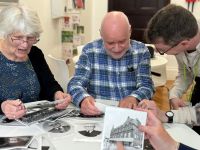
The residents enjoy the opportunity that each session brings, to interact with others through storytelling. The replica collection items and related discussions stimulate their long-term memory and boost their mood, leading to lasting positive effects. The success of these sessions, with both residents and care home staff, has led to requests for repeat visits.
How is the new approach being sustained?
The Reminiscence sessions are now included as a regular feature in the service’s future engagement plans.
Lessons learned
Through the process of developing and presenting our full range of themed sessions over the past year, we have learnt a number of lessons in regard to delivery:
- allow space for silence – quite often when presenting a document or object and then asking a question, there will be moments of silence longer than in usual engagement sessions with the public. It is important to let this space sit and not to try and fill the silence. It often means the participant is processing both thoughts and memories alongside the sensory stimulation.
- take a range of material – sessions work well when there is a mixture of sensory objects. We take photocopies of our original documents and photographs as participants enjoy handling them, some get quite attached to them and want to keep them, and often there are refreshments in the room at the same time. We also take handling objects from the museum collections which are usually more robust. The tangibility of these work well for participants with visual impairments. For the same reason we have also recently incorporated the use of scents in sessions as another aid for reminiscence.
- movement is key – for most sessions we prefer an open space with the participants seated around the edge. This allows us and other staff to move freely. It also means we can get the participants moving in gentle ways. They remain seated but we have found that taking games such as a ring toss or bean bags help stimulate both physical activity and engagement in the session. It also aids in uniting the group as we go around the room.
- use name badges – at the start of every session we ask each participant their name and write it on a sticky label. This is either then stuck on their clothing or on the arm of the chair they are seated on. It is helpful for us as visitors to the home, but it also helps to create a personal connection with the participants, especially if we have moments of one-on-one working within the session.
Contact
Contact: [email protected]