
Executive summary
Local Government Association (LGA) is the business name of the following organisations which are working in partnership to deliver fully integrated services covered by this strategy:
- Local Government Association (LGA)
- Improvement and Development Agency for Local Government (IDeA)
The Medium-term financial strategy (MTFS) outlines the financial plans and priorities of the LGA Group (comprising the LGA and IDeA) for the next five years, from 2025/26 to 2029/30, setting out a financial path to provide an ambitious, resilient, flexible and responsive financial base for the LGA Group to operate from.
The LGA and IDeA business models are affected by the following four key factors:
- Our current cost base is subject to rising inflationary pressures, duties and taxes, including the impact of the higher employer national insurance contributions (ENICs).
- Most current sources of income from our key grants, membership subscriptions and commercial income streams are expected to remain cash flat, meaning a real term reduction.
- Higher demand for our offer from our members, and greater delivery demand from our funders.
- The organisation is trying to build capacity and new capability, investing in change and technology.
Modelling suggests an initial 2025/26 budget gap of £3.1 million which will need to be addressed through a combination of efficiencies in controlling our cost base and increasing income generation.
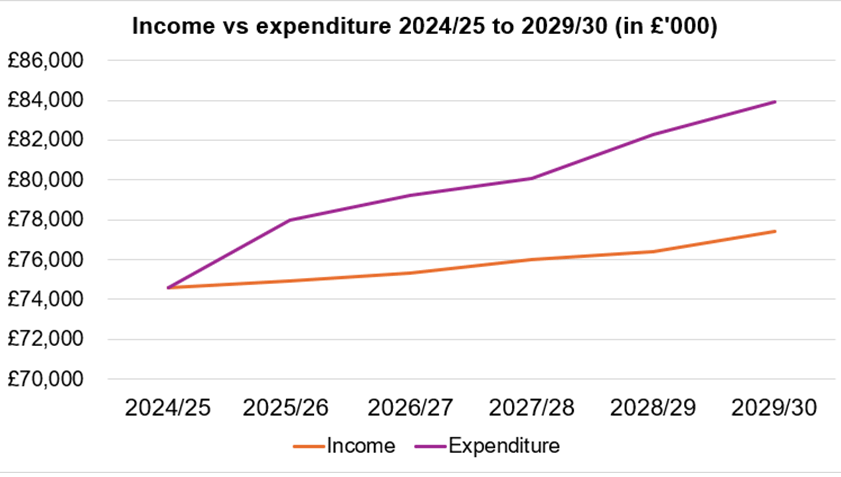
The above pressures are expected to persist over the MTFS period to 2029/30, such that costs are expected to increase at a faster rate than incomes, leading to widening funding gap each year. Modelling shows a cumulative MTFS budget gap of £24 million by the end of 2029/30, if there are no interventions, as shown in the graph below.
The MTFS sets out how the LGA and IDeA will achieve its objectives through a combination of strengthening and diversifying our revenue and income sources, increasing our capacity through investment in our organisation, and driving down costs in a sustainable and values-driven way to help bring spending and income in line with our strategic vision in the long term.
Over the MTFS period, different levers will be needed and/or available in different years. The lead time for structural changes to take effect and generate savings or additional income dictates that the 2025/26 response will need to focus initially on short term tactical changes and may need to be funded through a controlled and prudent use of reserves.
Plans for longer term strategic changes will commence during 2025/26 but will need time to be developed and generate results.
The MTFS will be reviewed and updated bi-annually, including ahead of annual budget setting to inform our approach, to reflect changing circumstances and ensure its continued relevance.
Part one: background and baseline
Economic, strategic and organisation context
We operate in a dynamic and evolving environment, characterised by:
Changing member needs and expectations
- Devolution, Local Government Reorganisation (LGR), Public Sector Reform (PSR) and a wider reform agenda - the proposed changes to the local government landscape will have an impact on the LGA, including through potential membership changes
- Ongoing funding pressures vs increased and more complex demand from members
- Growing expectations for value and return on membership investment
Competitive landscape
- Competition from alternative service providers, and through more open market tenders
- Need to clearly articulate our offerings / exploit our Unique Selling Proposition (USP) and enhance member value proposition, and the need to adapt to new delivery models in a rapidly changing marketplace
Technological disruption
- Rapid advancements in technology impacting all aspects of service delivery
- Cybersecurity threats and the need to protect member data
- The rise of social media and its impact on member engagement and communication
Changing regulatory environment
-
Evolving legal and regulatory requirements, including those impacting employment law, data, procurement, competition, and governance
Economic outlook
We also operate in an uncertain economic and financial environment, with several key factors directly impacting our finances including:
Inflation
- CPI inflation expected to pick up to 2.6% in 2025 (Office of Budget Responsibility (OBR))
- Inflation to peak at 3.7% in late 2025, before returning to hit 2% target by the end of 2027 (Bank of England)
Wage Inflation
- Annual wage growth expected to be 4.0% in Q4 2024
- Remaining at the same level in Q4 2025, before falling to 3.5% in Q4 2026
- Government steer to pay review bodies is that 2025/26 awards should be 2.8%
Public sector budgets
- Likely budget constraints, potentially leading to service reforms or cuts
- A budget gap expected each year to 2028/29
- Awaiting promised multi-year financial settlements
GDP Growth
- Expected to rise from 0.75% in 2024 to 1.5% in 2025 (Bank of England)
- Hovering around 1.5-1.8% through 2028 (OBR)
Unemployment
-
Stable at around 4.3-4.4% with a slight expected increase before easing
Alignment with LGA strategic framework
The MTFS is designed to align closely with the new organisational strategic framework to ensure we can afford to sustainably deliver our long-term ambitions.
The strategic framework drives the change, and sets the values-driven prioritisation agenda, articulating, exploiting (and not losing) our USP as the voice of local government with unrivalled access to sector specialists and insights.
The new Strategic framework set out as follows:
- Purpose – the LGA exists to strengthen local government so communities thrive
- Vision – this means championing and being the voice of local government, ensuring that it has the resources, powers and support to deliver the best possible services
- Goals – to champion and represent local government, to continually improve local government, to inspire and promote innovation in local government and to maintain a strong and sustainable LGA
- Values – collaboration, inclusion, ambition and respect
The MTFS is data-driven and insight-led, designed to meet the aspirations of the strategic framework to make the organisation more flexible and adaptable to future changes through bold and ambitious plans, reconnecting with our core purpose, and promoting strategic decision-making, rather than opportunistic / organic development.
The MTFS initially sets out the key assumptions that have been used to forecast the organisation’s immediate budget gap, and the tactical levers that directly inform setting the 2025/26 Budget.
To deliver the overarching business strategy, and address the long-range budget gap position, investment in change, technology and building new capacity will be needed. It is not possible to address the structural financial issues without that investment.
In addition, the LGA Board will need to approve setting in motion other enabling strategies, reviews and plans to secure the long-term vision and priorities that the board has set. These are the MTFS and the following:
Communications and engagement strategy
A comprehensive strategy that will inform, involve and inspire three key groups – staff, members and external stakeholders. It will ensure alignment across the organisation and build trust in the LGA’s strategic direction. The scope of this strategy will be to ensure we have an engaging and communicative approach to embedding the LGA strategic framework.
Business plan
A high-level plan that articulates corporate deliverables and milestones aligned to the LGA strategic framework and agreed Key Performance Indicators (KPIs) including short- and long-term activities for revenue growth, marketing and financial management. This will include an income generation plan.
Strategic people plan
A refreshed people plan will capture the organisational culture and development needed to deliver the LGA strategic framework, digital transformation, and budget objectives. Based on evidence it will delineate the key pillars that will deliver the Future LGA programme and ensure the organisational values and behaviours are deeply embedded. The key pillars of the strategic people plan will include the equality, diversity and inclusion (EDI) action plan which will allow for full integration across all people related activities, as well as learning and development, leadership framework, performance management, governance, engagement, and wellbeing.
Digital plan
Development of a digital plan to ensure we have the right data, digital and technology tools and capabilities to deliver for our internal and external stakeholders.
Asset plan
Guided by our location and workforce needs, including redevelopment options, rethinking workspaces with a focus on value, productivity, and financial sustainability. The creation of a detailed plan for creating collaborative and productive workspaces that work for our diverse workforces considering value for money, external pressures on teams and financial constraints.
The MTFS will remain a live document and be reviewed bi-annually to ensure that the best modelling of expected outcomes is updated, in support of the organisational decisions arising from the new Strategic framework (through the associated plans), and to provide assurance to the LGA and IDeA Boards that the future strategic company business models remain on track to be financially resilient and sustainable.
Plan and indicative timelines
| Strategic framework | Indicative timeframe | Strategic leadership team accountable officer | Member board governance |
|---|---|---|---|
| Business plan | Q2 2025 | Director of Strategy and Policy | LGA Board |
| Communications and engagement strategy | Q3 2025 | Director of Communications and Engagement | LGA Board |
| Strategic people plan | Q3 2025 | Assistant Chief Executive | LGA Board |
| Asset plan | Q4 2025 | Director of Partnerships and Improvement | LGA Board |
| Digital plan | Q4 2025 | Director of Strategy and Policy | LGA Board |
| Medium-term financial strategy | Refresh Q4 2025 |
Director of Finance and Corporate Resources (current Chief Operating Officer) |
LGA Board IDEA Board |
LGA Group funding sources (2024/25)
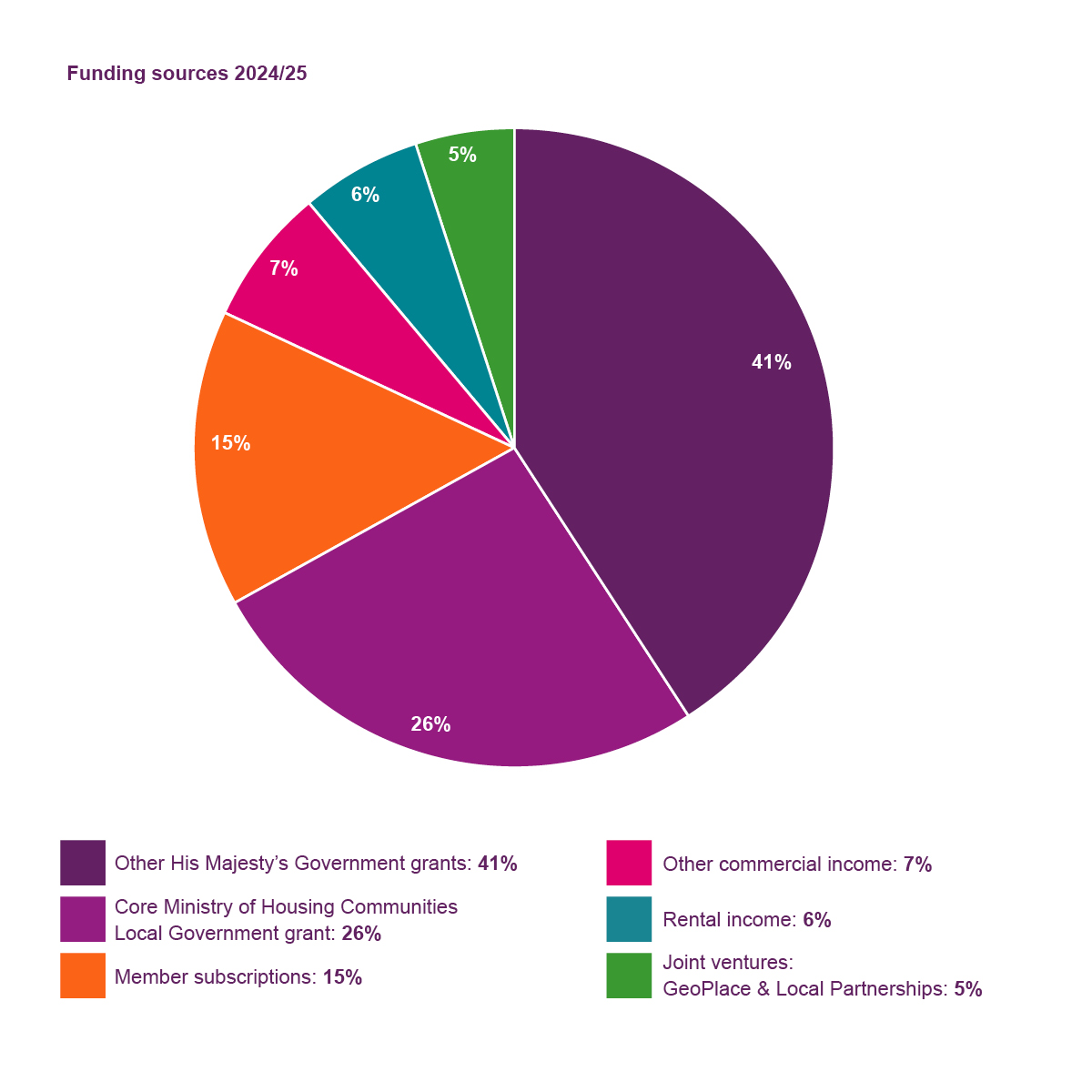
The key sources of funding for the LGA and IDeA are set out in the table below. Roughly two thirds of income is secured through grants and service contracts, with one sixth from membership subscription and one sixth from all other sources.
Table 2: LGA Group Income 24/25
LGA Group expenditure (2024/25)
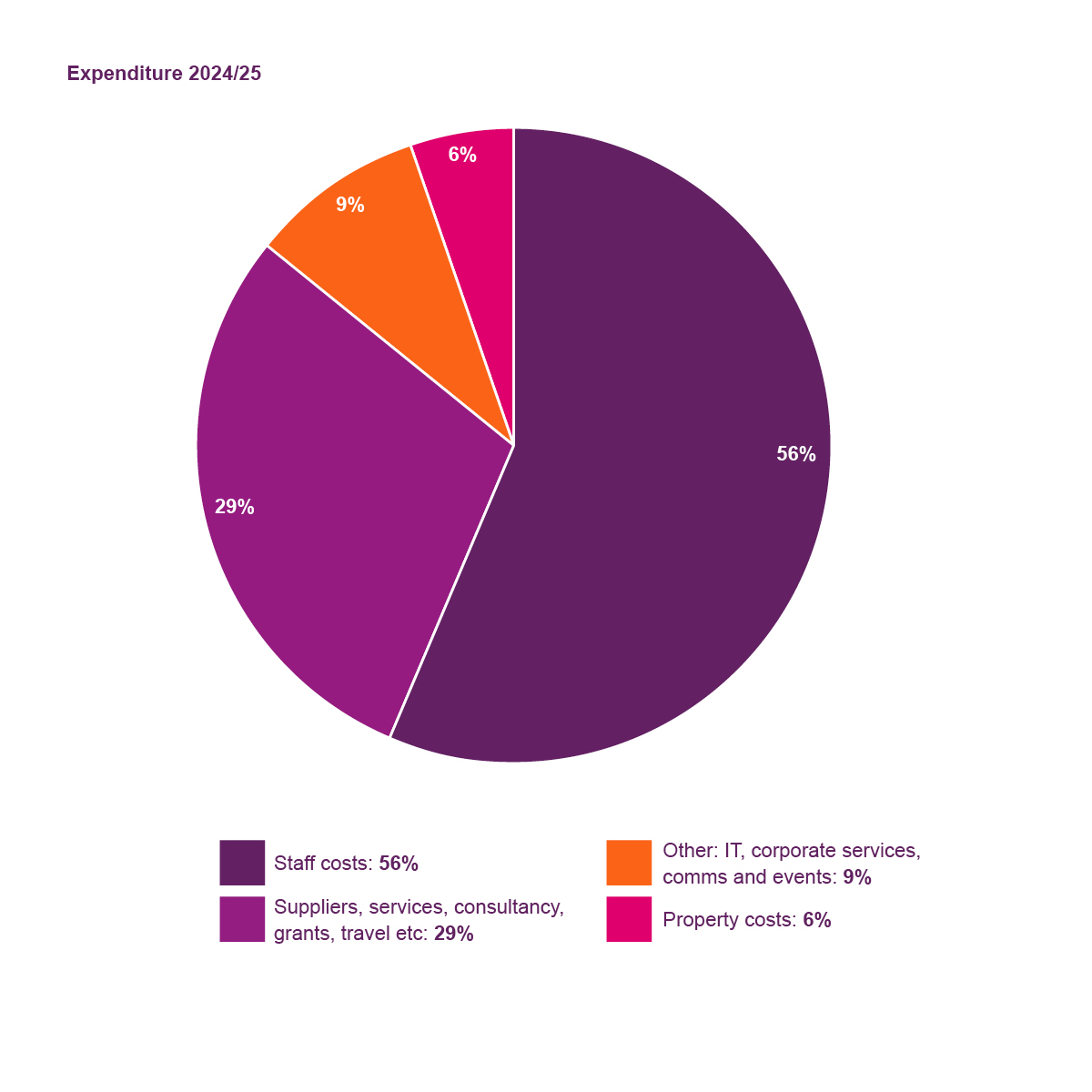
The key classifications of expenditure for the LGA and IDeA are set out in the table below. More than half of expenditure is spent on staff costs.
Table 3: LGA Group expenditure 24/25
|
Expenditure |
|
|---|---|
| Staff costs (pay and pensions) | £42 m (56%) |
| Suppliers, services, consultancy, grants, travel etc | £21.6 m (29%) |
| Property costs, including interest on loans for refurbishment | £4.1 m (6%) |
| Other: IT, corporate services, comms & events | £6.9 m (9%) |
| Total 24/25 | £74.6 m |
Our current position
The latest 2024/25 forecast outturn expects income to exceed expenditure by £1.6 million primarily due to a higher contribution towards overheads from completing a long-term contract.
Business model pressures
The last formal medium-term financial plan was in 2016, focused on company restructures necessary to gain tax advantages. The action plan saw the incorporation of the LGA into an unlimited company, and the transfer of the assets, liabilities, and business of three subsidiary companies into the LGA company to centralise the ownership of the property assets.
There was also a recognition of the need to focus on the diversification of income for the LGA Group to avoid relying too heavily on government grant funding. This included setting the agenda to be more ambitious, pursuing new income generation opportunities while protecting our tax status, and bringing in a Business Development post to develop an income generation policy and to formalise identification of new commercial income sources.
Much has changed since 2016, and while the company re-structuring has brought benefits, there has been limited success in building new income streams that deliver significant recurring net benefits to the bottom line. Inflation has instead driven costs into the business. People costs have risen, both in terms of annual pay uplifts, but also there has been pay point drift upwards. Each year our salary uplift alone is £0.4 million per 1% increase in pay. If subscriptions were uplifted by inflation that would be an extra £0.2 million per year – not enough to cover this cost increase. Cost absorption has been a tool, especially in the Partnerships and Improvement Directorate, but it is not sustainable without a shift in strategy and approach.
The current four key factors affecting the LGA and IDeA business model are:
1. Our current cost base is subject to rising inflationary pressures, duties and taxes
- Public sector pay rises, expected to be at 3% for 2025/26, dropping to 2% in later years
- Increased ENICs from the 2024 autumn budget has resulted in additional £0.7m unexpected costs for 2025/26 onwards which will also need to be managed within existing budgets
- Impact of inflation on the cost of other goods and services, estimated at 2% per annum
2. Most current sources of income from grants, membership subscriptions and commercial income streams expected to remain flat
- While some modest (2%) income growth is assumed from our commercial activities, it is assumed that income from our key sources (the MHCLG core sector support grant, membership subscriptions and dividends) will remain cash flat
3. Demand for our offer from our members, and greater delivery demand from our funders
- Increased demand and pressures for unfunded work on behalf of our members, including supporting the Covid-19 Inquiry and Devolution White Paper
- Increased demand from our funders to provide more output from existing funding
- Member demand for paid-for services may diminish due to LGR work
4. Building capacity and new capability, investing in change and technology
- We need to be more flexible in our offers, as the sector adapts to new legislation, opportunities and challenges
- We want to increase our capacity to invest in opportunities for income growth; and
- We want to lead sector thinking in emerging markets such as cyber/AI technology.
This strategy outlines key actions to radically rethink our business model, ensuring financial resilience amid changed in the landscape of local government we will have by 2030, and to deliver the priorities of the new strategic framework.
Approved in June 2024, the Future LGA programme will implement the levers identified in this MTFS over the next few years. The degree of change implied is significant and may need to be funded through a controlled and prudent use of reserves.
MTFS Budget Gap modelling
Under the four key factors set out above, the MTFS has modelled a 2025/26 baseline budget.
The LGA Group cost base, driven by staff cost inflation and additional ENIC costs, is expected to grow by a combined £3.8 million, while our income, with the key sources of the MHCLG core grant, membership subscriptions and dividends expected to remain largely flat, is only expected to grow by £0.7 million, creating an indicative LGA Group budget gap of £3.1 million for 2025/26 (four per cent of turnover).
The systemic pressures – cost inflationary pressures rising faster than largely flat incomes as described previously – are expected to persist throughout the MTFS five-year period.
Modelling shows the budget gap worsening by c.£0.5 - 0.9 million each year subsequently, to an assumed cumulative total LGA Group budget gap of c.£24 million over the five-year period of 2025/26 to 2029/30 as set out in the table and chart below
Table 4: Budget gap modelling 24/25 to 29/30
|
Current 2024/25 £’m |
2025/26 £’m |
2026/27 £’m |
2027/28 £’m |
2028/29 £’m |
2029/30 £’m |
|
|---|---|---|---|---|---|---|
| Income |
£74.6 |
£74.9 |
£75.3 |
£76.0 |
£76.4 |
£77.4 |
| Expenditure |
£74.6 |
£78.0 |
£79.2 |
£80.7 |
£82.3 |
£83.9 |
| Difference |
£0.0 |
(£3.1) |
(£3.9) |
(£4.7) |
(£5.9) |
(£6.5) |
The modelled budget gap is if no action is undertaken. The rest of the MTFS sets out the plans and structural levers to address and bridge the budget gap across the range of expenditure types and income sources.
Part two: addressing the budget gap
The LGA ambition, as set out in the strategic framework, is to be financially resilient now and,and funders in the future, to continue to lead sector improvements, policy and support for our members. In order to achieve this, the organisational budget gap must be addressed each and every year to ensure the company remains sustainable and solvent.
This requires the LGA a holistic approach to company’s finances; making savings across staff and non-staff costs, and generating additional sources of income to create the solid foundation needed for a financially sustainable organisation.
The key strategic levers at our disposal may be summarised as:
- What we do – being clear what we want the organisation to achieve for our members and funders; in line with our purpose, vision, goals and values.
- Prioritising – being clear about what we will (and will not) do, within our funding arrangements, using our members’ expertise and insight
- How we do it – our structural set up, including our staffing model, use of external expertise, and the maintenance of our USP as unrivalled sector experts
- Where we do it from – developing an asset plan, taking into account the desire to be more flexible and enhance our regional teams
- Using our resources wisely – efficient cost control and exploitation of technology
- Invest to save / invest to grow – bold risk taking
- Building capacity – accept the need to invest in priority areas and to secure additional capabilities and support for our ambitious change programme / add flexibility which could lead to additional short term cost implications.
A multi-year approach is essential, as different levers will be needed and/or available in different years. Given the lead time for structural changes to take effect and generate savings or additional income, the 2025/26 response will need to focus on short term tactical changes, while plans for longer term strategic changes will commence but will need time to be developed and generate results.
Short term tactical response
The 2025/26 focus will be on “quick wins” to save money or generate additional income, while being mindful of the need to build extra capacity in some areas. The detail of this is set out in the separate 2025/26 Budget Board paper.
For staff costs, major structural changes require consultation, so savings will come mainly from vacancy and role management. Our Strategic leadership team has already added more rigour to stronger establishment control processes related to this.
Non-staff costs savings will come from discretionary / commissioning spend reviews and freezes, collaborative procurement exercises and corporate directives (for example, mandates on travel/stationery).
Within improvement grants and contracts there will be internal efficiencies to protect contributions towards central overheads but there are also opportunities for new programmes and/or new funding sources for services which cannot be funded from existing sources.
Income generation will prioritise conferences, sponsorships, and expanding existing offers.
With the LGA Group expecting a surplus in 2024/25, the 2025/26 Budget paper proposes the creation of a “transitional reserve”, to ring-fence funding for 2025/26 and beyond to pay for unfunded specific issues, such as:
- The COVID-19 Enquiry costs, which the LGA Group has funded on behalf of the sector
- Any future work on LGR or Devolution, which is not subject to other funding secured from government departments
- Investment in Artificial Intelligence development (including Microsoft Copilot) to enhance our digital, data and technology capability
- Seed funding for future assessed and appraised external partnership investments
Longer term strategic planning
The LGA strategic framework plans will focus on addressing the following:
- Alignment of our core priorities to the strategic framework
- Robust business cases for additional/new capabilities and functions
- Clear and transparent process for establishment control
- Pragmatic (and ambitious) targets for income generation
- Steady and regular reporting against financial measures of success including our budgeting and forecasting process
- Regular review of MTFS
To support this work, the MTFS longer term strategy is focused on structural changes to reduce costs and boost income generation, requiring the commissioning of a series of reviews, including:
- Business plan including an income generation plan and new approach for investment
- Organisation re-design and restructure programme
- Directorate service reviews
- Strategic people plan, including a pay and grading review
- Asset plan, including a new strategy for asset management
- Digital plan
- Communication and engagement strategy
Each of the above are explored in more detail in the following sections.
There will need to be ongoing prioritisation reviews of our service offerings and policy initiatives, including regular member and funder engagement, to manage demand.
Some proposed initiatives may have political sensitivities which may need to be carefully managed and consulted on, which will take additional time. Member engagement will be sought on several specific long-term strategic issues with political implications, including:
- The long-term funding options of the Covid-19 enquiry
- Longer term use of 18 Smith Square and Layden House
- Membership issues, including changes to the membership fee model and discount schemes
- The long-term funding options for the LGA change programme
- The ongoing use of reserves
Strategic people plan
The 2025/26 staff cost of living increase has been modelled at 3.0%, adding £1.2 million to the baseline of c.£40 million staff costs in 2024/25.
The Autumn Budget of 31 October 2024 has raised the ENICs from 13.8% to 15.0%, and lowered thresholds, to run from 1 April 2025. This rate increase will result in an additional cost of c.£0.7 million from 2025/26 onwards.
Short term tactical response
For 2025/26, the focus for staff cost management is on vacancy and establishment control. SLT has already added more rigour to the recruitment processes, ensuring that only essential roles are being filled, considering the differences between permanent, fixed term, or agency staff, plus relevant internal and external secondment opportunities.
During budget setting, each director and their cost centre budget holders were asked to identify the roles needed to deliver their objectives for the coming year. This is generally based on the existing business plan (which runs from September to August each year in line with the political calendar), notwithstanding that the financial year extends beyond that period. It is assumed that, unless specified, that work will continue for the entirety of the year.
The current staff required in post (using the November payroll data) in each cost centre are modelled so that the correct individual scale points (and any increments to be gained for the upcoming year) are used to calculate the staff cost for each cost centre. Vacancies are typically added at the lowest scale point for the new post grade.
Therefore, the staff cost profile is usually close to the “theoretical maximum” cost of the cost centre, as it (usually) assumes that all posts will be filled for the whole year, whereas we know that where staff leave and recruitment is undertaken in the year, the new joiner will usually be at the bottom of the pay scale, plus at any given point in the year there will be a proportion of roles vacant due to the time taken to recruit. Our current staff turnover is approximately 10% annually.
The LGA and IDeA have previously held a central “vacancy factor” of approximately 2% of staff costs, managed by strategic finance through a corporate cost centre, which is unwound throughout the year as part of the quarterly forecast process to account for the expected savings for the organisation of unfilled posts. For 2025/26, the vacancy factor is being decentralised to individual directorates, so that budget owners understand the extent of the corporate staff saving target (rather than having an element being effectively invisible).
Longer term strategic planning
We will undertake a comprehensive review of how the organisation is designed and operates to deliver the priorities set out in the strategic framework, within the financial parameters set by the MTFS. Over time, the organisation has grown as we have gained new contracts, grants and duties. There has been upward pay drift as we have sought to recruit in competitive markets in London and the south.
We need to be able to attract and retain the best talent, and provide for progression, but at the same time we must control our pay bill in the face of rising costs, including the ENICs duties. A new strategic people plan will help us do this; a comprehensive review of our establishment, grading, role, location, pay and reward strategy will test compliance on equal pay, align any inconsistencies in our costs and create succession routes.
A programme of deep service reviews, by directorate, will be undertaken to determine the most efficient and effective way to deliver agreed outcomes, including consideration of the potential for new income, commissioning, partnership and technology solutions.
A review of the long-term management of Local Government Pension Scheme pension costs, following the triennial valuation calculated as of 31 March 2025 (affecting contributions for 2026/27 onwards), will be undertaken.
Management and budgeting of non-staff costs
Roughly 45% of the cost base of the LGA Group is non-staff costs. The MTFS model assumes that inflationary pressures of 2% will be generally applied to this expenditure in 2025/26.
Non-staff costs cover a wide range of expenditure types, including central infrastructure costs (such as utilities, audit, insurance), member allowances, plus hotels, travel and subsistence, and the use of third-party contractors and consultants to support grants and policy areas.
Short term tactical response
It is recognised that there are some costs where there are contractual inflationary increases which need to be accounted for. The property management contract is expected to increase by more than 2% for 2025/26, and overall IT costs are also expected to rise (though due to the growth in the staff establishment, the cost per person is expected to decrease in 2025/26).
All non-staff costs have been reviewed to ensure that all cost is necessary, and discretionary pots (such as commissioning budgets, where the amount to be spent in furtherance of our priorities may be determined each year) have been identified.
All budget holders are being challenged to review discretionary spend and to determine whether the value can be kept flat (i.e. a real-terms saving) or reduced.
A rapid review of all current and projected procurement spend has been undertaken to see if efficiencies may be made through ‘bundling’ collaborative procurement exercises of similar purchases.
Corporate directives (for example mandates on travel/stationery expenditure) are being considered.
Longer term strategic planning
Longer term, the focus is on continual improvement initiatives, such as a wide-ranging review of organisational compliance (consistent procurement and expenses compliance as an example), and a root and branch review of all cost lines, to deliver year on year efficiencies.
Greater emphasis will be made on cross-organisational buying power and better utilising existing mechanisms to reduce non-staff expenditure on travel, expenses, and allowances.
A more detailed review of procurement practices, and opportunities for volume/scale efficiencies, will be undertaken.
Colleagues will also be encouraged to take part in cross-organisational reviews, and to offer suggestions for future efficiencies.
Grant and contract management plan
Grants and contracts are also subject to the cost inflation pressures, often with little contractual opportunity to increase income funding to offset the rising cost base.
Grant-funded areas, especially the main MHCLG sector support grant, have a good track record of reducing costs each year to live within their budget envelope. This has been achieved through re-prioritising focus areas, reducing non-staff costs through changing working patterns, and staff reductions for unsupported deliverables. It is not viable to sustain that without a shift in strategy and approach.
We have received a ministerial “Minded to” letter to the value of £19.2 million for the MHCLG sector support grant for 2025/26, which is the same cash level as 2024/25. Therefore, an additional £0.5 million of staff costs needs to be accounted for on a like-for-like basis.
Short term tactical response
Each year, central functions costs are assessed against expected income, to set an overhead contribution margin for grant and contract funded programmes. Recently, these programmes have been asked to contribute an average of 15% of income towards overheads.
Due to competitive pressures and funding arrangements, there have been some varying contribution across programmes. Some agreements, like the MHCLG and Partners in Care and Health (PCH) programmes, fund specific costs separately, as certain functions are excluded from the overhead calculation (e.g. the comms function).
Activity in the Partnerships and Improvement Directorate will focus on internal efficiencies and reprioritisations to protect contributions towards central overheads, including identifying workstreams that can no longer be provided from current funding. Board Members will be asked for decisions on prioritisation, and funders are consulted about adjusting deliverables.
Short term opportunities for new programmes (such as the Centre for Digital Excellence) and/or new funding sources for services which cannot be funded from existing sources.
Longer term strategic planning
The multi-year spending review may result in longer funding contracts covering several years and adding a certain income certainty.
More work will be done to increase our bidding capacity and capability, as more contracts are likely to be commercially tendered for. It is intended that inflationary increases in income received are built into multi-year bids wherever possible.
However, significant income reduction, weather through contract losses, funding cuts or inflation could result in substantial financial burden, including exit costs and reduced contributions to overheads.
To address this, the Director of Partnerships and Improvement will collaborate with grant and service contract programme managers to review the current grant funded offers, share best practice and assess income generation potential within current grants and contracts, focusing on identifying opportunities for alternative markets. See more in the next section on income generation.
The minimum 'contribution to overhead' rates will be reviewed and move towards being harmonised across contracts, subject to negotiation with funders, with the goal of phasing out individual funding side arrangements where possible.
Annual budget-setting processes will involve member consultation to determine whether existing activities no longer covered by grant funding should be stopped, alternative sources of funding sought, or the activity monetised into a chargeable service.
Income generation
The LGA has successfully diversified its income streams over the last decade and has seen significant increases in the amounts of income achieved from government contracts and grants as well as increasing the income from our properties. The MTFS assumes that there will be some modest 2% inflationary increase in income (excluding the key sources of MHCLG sector support grant, membership fees and dividends).
Short term tactical response
It usually takes time and investment to generate new income opportunities. Therefore, in 2025/26, the focus is on looking to increase volumes of existing offers. It is recognised that some Directorates have greater access to commercial income generation activities.
The Director of Communications and Engagement is leading a review of all events and conference offerings, to review pricing options (including the balance of free versus paid events), and potential for expanding sponsorship opportunities.
Longer term strategic planning
The LGA will transition from an ad-hoc towards a systematic approach to income generation activities over the long term, aligned to the LGA strategic framework, so that we are clear what we will and will not do, and why.
An income generation approach to increasing income across the business will require focus across several initiatives and themes as follows:
- Existing services: a review of existing product and service offers, to review pricing structures, volumes and markets to see what can be expanded or exploited at minimal marginal cost. The Business Development Manager will lead a cross-organisational review of all income lines to stress test pricing mechanisms, sponsorship opportunities and markets to identify growth potential and opportunities, including the feasibility of converting our current offers into paid-for services if funding is withdrawn.
- New ventures: there is ambition to invest in new and emerging technology opportunities to help the sector through innovation, but also to provide investment growth opportunities for the LGA. Separate seed funding may need to be made available for these ventures, and patience must be allowed to allow time for future returns to be generated.
- Bidding capacity: a plan will be developed for identifying and engaging in competitive tenders in line with the determined organisational appetite for attracting new bidding opportunities. Capacity will be developed to support business development processes, assist with multiple income generation projects and broker collaboration between teams.
- Membership subscriptions: To mitigate the potential impact of LGR and devolution by reviewing membership approach, including combined/mayoral/strategic authorities, Strategic Finance will lead a full root and branch review of the fees pricing methodology, including the appropriateness of caps and collars, and discounts available.
- Treasury: strategic finance will ensure the LGA maximises investment returns from the range of pooled arrangements, within the agreed risk profile, remaining mindful of making the best use of spare funds above its funding floor, for outcomes in pursuit of MTFS aims, and providing alternative investment options where appropriate.
In order to provide an opportunity to invest in innovative ventures and partnerships for the betterment of local government, but with future income generation potential for the LGA, we will do further work to formalise the processes to identify, verify and prioritise viable opportunities, define objectives and develop project plans to meet them within a new Investment Strategy, all subject to proper investment analysis and appraisal mechanisms being put in place.
Digital plan
The LGA needs a clear roadmap for digital transformation, with actionable steps to address immediate needs and long-term objectives. The plan will ensure the LGA remains agile, responsive, and capable of supporting local government in the future.
The first stage is to complete a comprehensive review of our digital data and technology capabilities. This review will form part of a four-phase project to develop the new digital plan that aligns with both current and future needs of the LGA and our stakeholders.
Short-term tactical response
To undertake the initial review of our digital data and technology capabilities we have commissioned Change Network. They will undertake a detailed assessment of our existing digital infrastructure, systems, and resources, considering previous reviews and existing platforms such as M365, CRM, and LG Inform. The key tasks include:
- Evaluating the current digital data and technology landscape across the LGA, including business systems like HR, Payroll, Finance, and customer-facing platforms such as the website and LG Inform
- Reviewing ongoing initiatives and projects to identify quick wins and areas for immediate improvement, particularly regarding data management, utilisation, and reporting
- Gathering insights from stakeholders through interviews and workshops to capture perspectives on digital needs and challenges
- Benchmarking against best practices and other relevant organisations to understand where the LGA stands in terms of digital maturity and business intelligence
The output of this phase will be a comprehensive report that highlights strengths, weaknesses, opportunities for improvement, and immediate actions to enhance digital and data capabilities.
In addition to the review, there is also a refresh of the IT laptop estate being undertaken in spring 2025.
Longer term strategic planning
In the longer term we will aim to develop:
- A Digital plan: developing an overarching strategy for digital capabilities across the LGA, ensuring integration with all operational functions
- Business intelligence: enhancing data collection, analysis, and utilisation to inform strategic decision-making at all levels
- Data infrastructure: improving data governance, management, and infrastructure, with a particular focus on developing a robust and accessible data library for both staff and member councils
- IT infrastructure: strengthening technology infrastructure to support LGA operations and informing future procurement of outsourced services
- Security and resilience: addressing cyber threats and ensuring business continuity for all stakeholders
- Skills: developing a digitally and data-skilled workforce to sustain transformation and support ongoing innovation
Asset plan
Over the last eight years there has been significant investment into our two buildings – 18 Smith Square and Layden House. The latter’s office floors are now fully let, with the Retail Units expected to be fully let within the 2025/26 financial year.
Short term tactical response
In the short term, the effect of the new Layden House Retail Unit lets should increase expected rental income (which is recognised over the life of the lease, notwithstanding that there could be ‘rent free’ periods initially).
A review of the use and pricing structure of the 18 Smith Square conference suite could identify opportunities to increase room and catering hire income.
It is expected that the total building management contract will be subject to above-inflation cost rises for 2025/26. A re-procurement exercise will be undertaken during 2025/26.
Longer term strategic planning
The LGA will develop a new asset plan aligned to the LGA strategic framework - this is needed to provide clear direction about the long-term determination of the LGA’s location needs nationally, rethinking workspaces with a focus on value, productivity, and financial sustainability, and the future of Smith Square in particular, including the creation of financing plans for investment / redevelopment.
While the buildings are positive assets on the balance sheet, based on the current financing, income and expenditure position, we break even on the revenue basis. For Smith Square, the occupancy levels of Floors 4-6 remain lower than the pre-Pandemic period. Given the changes to the workforce composition, location and contract terms that might flow from a new strategic people plan, options will be brought to the LGA Board to consider any further sub-letting opportunities, ahead of a new asset strategy being approved.
This new strategy development will be initiated in 2025 given the sensitivity and complexity of decisions that are needed to determine future options for Smith Square, and the current position in the maintenance and investment cycle for the building.
There are several remaining loans from the original purchase and redevelopment of 18 Smith Square, which include claims on a share of net proceeds in the case of a property sale, that will need to be considered in any long-term plan.
Part three – legal and equalities considerations
Legal considerations
Company directors have a fiduciary duty to act in the best interests of the company, ensuring that financial resources are used effectively and responsibly. They are responsible for preparation and approval of the company’s budget.
This involves setting financial targets and allocating resources in line with the company’s strategic goals and testing the budget assumptions that are put forward.
Directors must identify potential financial risks and implement measures to mitigate them, in the interests of the company’s financial health.
A separate Budget paper, informed by the MTFS, will be provided to the LGA and IDeA Company Boards for consideration and approval prior to the start of each financial year.
Equalities considerations
The LGA has duties under The Equality Act 2010 (the Act) which relate to the following protected characteristics: age, disability, gender reassignment, marriage and civil partnership, pregnancy and maternity, race, religion or belief, sex and sexual orientation.
In summary, the LGA and IDeA company boards must, in the exercise of their functions, have due regard to the need to:
- eliminate unlawful discrimination, harassment and victimisation and other conduct prohibited by the Act
- advance equality of opportunity between people who share a protected characteristic and those who do not
- foster good relations between people who share a protected characteristic and those who do not
It is not an absolute requirement to eliminate unlawful discrimination, harassment, victimisation or other prohibited conduct, or to promote equality of opportunity or foster good relations between persons who share a protected characteristic and those who do not. It is a duty to have due regard to the need (other than the duty to prevent sexual harassment) to achieve the goals listed above.
The weight to be attached to the duty will be dependent on the nature of the decision and the circumstances in which it is made. This is a matter for SLT and the LGA and IDeA Company Boards, bearing in mind the issues of relevance and proportionality.
SLT and the LGA and IDeA Company Boards need to understand the impact or likely impact of the decision on those with protected characteristics who are potentially affected by the decision. The extent of the duty will necessarily vary from case to case and due regard is such regard as is appropriate in all the circumstances.
Any equalities implications arising from cuts, budget reductions, or changes to services or strategies identified in the processes set out in this report will be duly assessed via an Equalities Impact Assessment (EQIA) and considered as part of the appropriate decision-making process, in line with the LGA people policies.
Part Four – risks
The MTFS development has identified new risks relating to both the economic and LGA financial context, plus those arising from the MTFS strategic plans, which will be incorporated into the revised LGA and IDeA risk management framework, when developed.
Risks will be monitored through the regular reporting to Audit and Risk Assurance Committee and company boards, to inform any adjustments needed to the MTFS.
1. Risk: MTFS not being properly monitored, creating a disconnect from strategic plans
Mitigation: Clear oversight plan for the different strands of the MTFS, plus overall oversight at company board level
2. Risk: Capability gaps causing contractual defaults
Mitigation: Skills review as part of the strategic people plan
3. Risk: Loss of corporate knowledge from flexible/temporary workforce
Mitigation: Better use and retention of information assets (digital plan)
4. Risk: Pension triennial valuation being below fully-funded level
Mitigation: Due to external factors – can be monitored only
5. Risk: Seed funding not generating financial returns
Mitigation: Development of an income generation plan and proper opportunity assessment tools and monitoring
6. Risk: Capacity/capability gaps for new business development/bidding for contracts
Mitigation: Organisational design work to ensure cross-team working and flexible resourcing under the strategic people plan
7. Risk: Capacity gaps for new business won/speed of mobilisation
Mitigation: Enhanced opportunity risk assessment as part of the income generation plan
8. Risk: Impact of LGR on fees and membership
Mitigation: Board request to remove fees cap immediately; full review of methodology proposed within MTFS
9. Risk: Loss of members due to adjustments to fees and/or discounts
Mitigation: Assistant Chief Executive role developed to include member retention responsibility
10. Risk: Rental voids as refurbishment approaches
Mitigation: Development of an asset plan
11. Risk: New premises being prohibitively expensive
Mitigation: Asset plan to have a range of costed options
12. Risk: Refurbishment being prohibitively expensive
Mitigation: Asset plan to have a range of costed options
13. Risk: Building valuations falling
Mitigation: Due to external factors – can be monitored only