Background and context
Background
31ten was commissioned by the LGA, as part of the LGA’s sector support programme for 2024/25, to facilitate bringing together lead members across regions to work together to address significant budget pressures relating to children’s services, adult social care and housing. The project ran from September 2024 to March 2025, through a series of roundtables for lead members for children’s social care (CSC), adult social care (ASC) and housing.
The aim was to create a space for peer-to-peer learning, sharing and increasing understanding of significant budget pressures between service portfolio holders and amongst peers.
The intended outcomes were:
- greater understanding of key themes and pressures – including local differences
- stronger relationships between officers and members and peers
- peer to peer learning and sharing of challenges and solutions.
Approach and delivery
| September to October 2024: Design |
|
|---|---|
| November 2024 to March 2025: Delivery |
|
| March 2025: Report |
|
Summary of roundtables delivered
An outline of the sessions that were delivered between November 2024 and March 2025 is highlighted below. The topic for each session was agreed in consultation with regions, with housing and CSC identified as the priority areas of focus for regions.
Approximately 100 lead members participated in the roundtables across the three topic areas.
Housing
Three sessions were delivered:
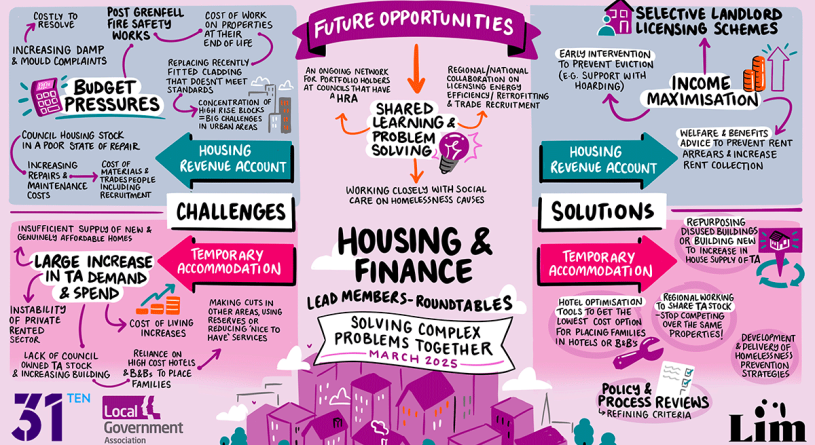
- an in-person session for the South-East region focusing on overarching financial challenges for housing services
- a countrywide virtual session focusing on financial challenges relating to Temporary Accommodation (TA)
- a countrywide virtual session focusing on financial challenges relating to the Housing Revenue Account (HRA).
Sessions were attended by lead members with responsibility for either housing or finance.
Children's services
Four sessions were delivered:
- an in-person session for the West Midlands region
- virtual sessions for:
- East of England region
- North West region
- South West region.
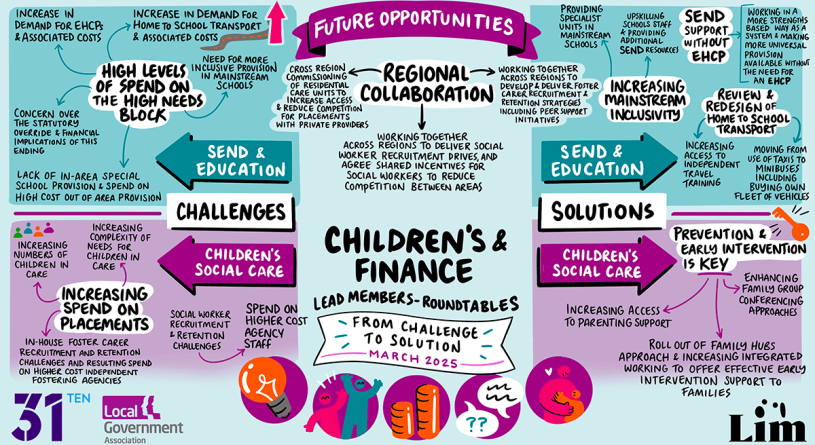
Sessions covered challenges relating to CSC, education and support for children with SEND.
Sessions were attended by lead members with responsibility for either children’s services or finance.
Adult social care
One session was delivered:
- a virtual session for the South West region.
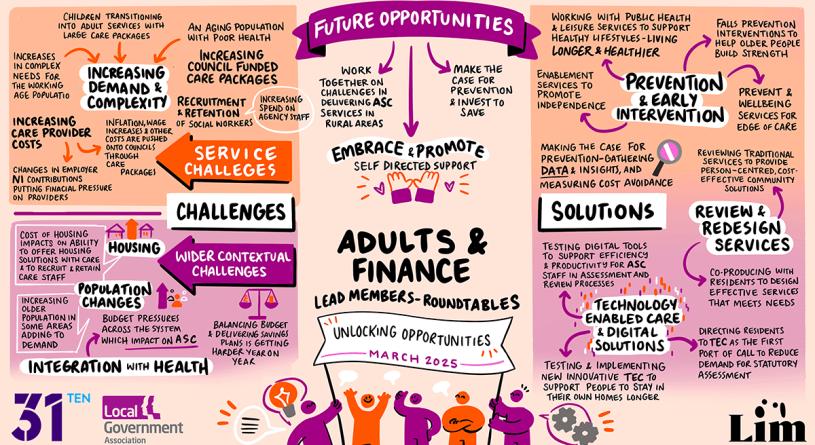
The session covered challenges relating to older adults, working age adults, and adults transitioning from children’s services to adults services.
The session was attended by lead members with responsibility for either adult’s services or finance.
Overarching themes from roundtables
The three thematic areas highlighted below were identified as key challenges across topic areas.
Increasing need for services
Participants highlighted increased numbers of people with reason to draw on support and care as a key challenge across the three topic areas; with an increasing adult population with care needs, increasing numbers of children coming into care or requiring SEND support, and increasing homelessness, demand for TA and need to complete works on council owned properties identified as the key drivers across housing and social care services. Complexity of need is adding further pressure on service demand.
Increased cost of delivering services
Alongside increasing demand, which is driving up costs, participants highlighted that the cost of delivering services is also increasing. For housing, the cost of buying land, building supplies and tools for maintenance are all increasing. For CSC, placement costs are increasing, and Independent Fostering Agencies are being used more, which cost more than in house foster carers. For ASC, a range of additional costs for providers mean that care costs are increasing. Recruitment and retention challenges are also driving up costs across all three areas.
Difficult financial decisions and challenging savings targets
Regions who participated in the roundtables highlighted the large proportion of council budgets being spent on social care, and provision of TA. Participants reflected on the difficult financial decisions being made as a result; having to reduce non-statutory service provision, use council reserves to cover additional costs, or make cuts in other parts of the council to cover spend in CSC, ASC or housing.
The three thematic areas highlighted below were identified as key to addressing financial challenges across topic areas.
Early intervention and prevention
Children’s roundtable attendees highlighted the need for earlier intervention to prevent children from entering the care system, through parenting programmes, and holistic family support, and to increase access to services for early intervention and prevention for children with SEND. Adults’ roundtable attendees reflected on the importance of services to support adults to remain healthier and independent for longer, to reduce or avoid longer term care costs. Prevention was also a strong theme in housing roundtables, with homelessness prevention and welfare benefits support to maximise resident income and prevent rent arrears highlighted as key.
Changing the narrative to a strengths based one, which promotes independence
This was a key theme in children’s and adults roundtables; the importance of working in a strengths-based way to build on people’s strengths as opposed to focusing on what they are not able to do. For ASC this means increasing promotion of self-directed support and co-producing new, lower cost community-based care options to support people to remain independent in their communities. For children’s services, this means focusing on supporting children with SEND to build independence skills, changing the narrative around the EHCP, and supporting more children to be able to attend a mainstream school.
Using capital funding to build or repurpose existing buildings for accommodation solutions
Lead members who attended roundtables talked about building in house provision as key to meeting resident needs and addressing financial challenges. For CSC, attendees spoke about developing in house residential provision to support children to remain in area and address rising placement costs. For ASC, developing provision to meet the needs of an increasing older population, using data to forecast need. For housing, attendees spoke about developing in house TA solutions to meet increasing needs and reduce reliance on current high-cost accommodation options like hotels and B&Bs.
Key themes from housing roundtables
Housing key challenges
Housing solutions
Key themes from children’s roundtables
Children’s social care key challenges
Children’s social care solutions
Education and SEND key challenges
Education and SEND solutions
Key themes from adults roundtable
Adult social care key challenges
Adult social care solutions
Future opportunities
Roundtable participants were asked to identify opportunities that they would like to take forwards to continue sector led learning and regional collaboration. Key opportunities highlighted across the roundtables are outlined below.
| Regional collaboration |
Several opportunities were identified for regional collaboration and joint working to reduce duplication, competition for resources, and maximise access to placements:
|
|---|---|
| Sharing what works |
Opportunities were identified for ongoing sharing and learning, both regionally and nationally. Examples include:
|
| Bringing together links between service areas |
Opportunities were also identified for closer working between housing services, and ASC or CSC. Examples include:
|
Differences between regions
Some clear common challenges emerged from the roundtables, alongside common solutions that were being delivered across the country. However, there were some regional differences in the challenges faced, which are outlined below. As only one region participated in the ASC roundtable offer, it has not been possible to identify regional differences in this topic.
| Challenges specific to regional geography and demographics |
|
|---|---|
| Differences in financial challenges between regions |
|
Connections between topic areas
Through the roundtables, we have identified some crossover between ASC, CSC and housing financial challenges, which highlight opportunities for joined up working between service areas. These are outlined below.
| Housing costs | The increasing costs of housing are impacting on the ability of ASC and CSC services to develop, procure and offer housing solutions with care and support, and to recruit and retain care staff. This is having an impact on ASC and CSC budgets through spend on agency staff, higher placement costs, and challenges in developing in-house accommodation-based support. There is an opportunity for join up between housing and social care to identify cost effective housing solutions. |
|---|---|
| Causes of TA demand | Some of the root causes for the increase in TA demand may have links to ASC and CSC services. For example, adult homelessness because of unmet mental health needs, or families with complex needs who could be supported to maintain a stable home through early help support from CSC. There is an opportunity for services to work together to identify families and adults at risk and deliver joint interventions to support people to maintain tenancies. |
| Transitions | Some of the pressure on ASC services and budgets has been identified as coming from children with complex needs transitioning into adult services. There is an opportunity for more joined up transitions planning between CSC and ASC, and work to build independence skills for children early in the transition process. |