Summary
Background
In March 2025, the Local Government Association distributed an online survey to all Heads of Community Safety within local authorities in England and Wales, exploring their authority’s approach to the anti-social behaviour case review process to inform central government’s development of anti-social behaviour policy. Of the 339 local authorities in England and Wales, 77 responded – a response rate of 23 per cent.
Key findings
- To trigger a case review, more than a third of respondents (37 per cent) use eligibility caveats in addition to the statutory threshold. Of those that use additional caveats, 44 per cent stipulate that a victim cannot apply if there is an ongoing investigation, whilst 43 per cent stipulate that that application must be made within one month of the last incident having been reported.
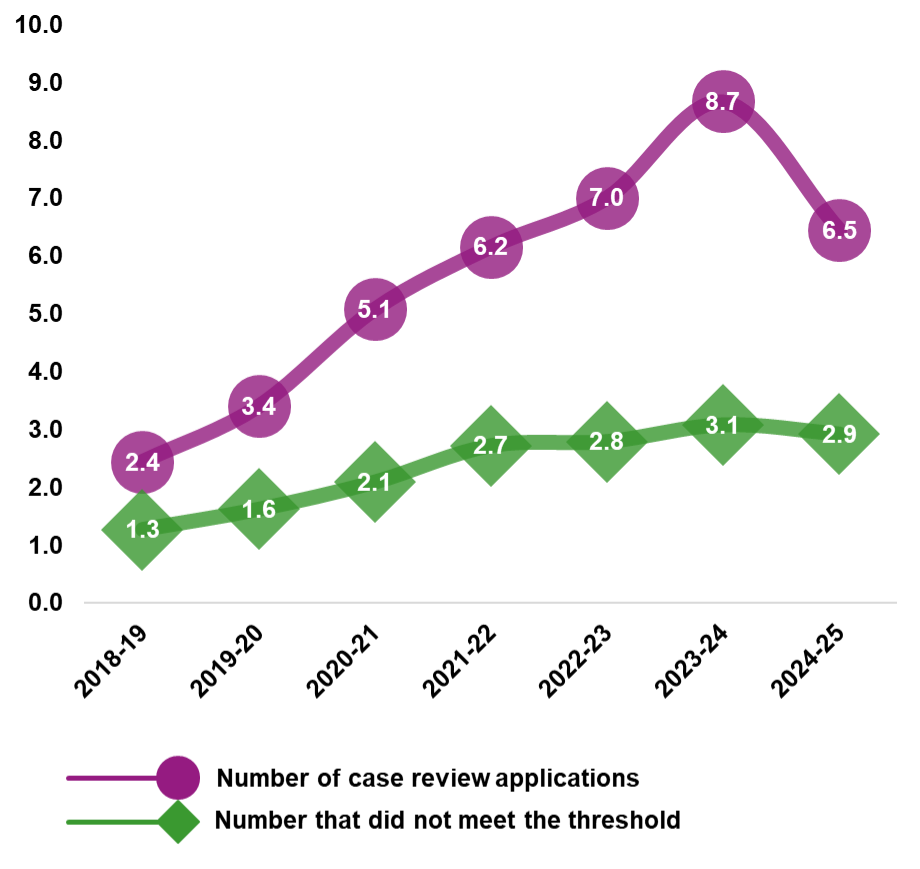
- The mean average number of case review applications received per respondent authority has risen gradually over the past seven financial years, from an average of 2.44 applications per authority in 2018/19, rising to a peak of 8.67 in 2023/24. In this time, cases that did not meet the threshold made up between 36 per cent and 52 per cent of all applications.
- Considering support for victims, 86 per cent of respondents have a single point of contact for victims, whilst 82 per cent keep victims informed throughout the process. Furthermore, 90 per cent review whether or not more could be done for cases that do not meet the eligibility threshold.
- Considering the choice of case review panel chair, there was, generally, an even spread of internal and externals chairs. External chairs tended to be drawn from other local authorities or partner agencies including the police and housing associations, and respondents emphasised that internal chairs, where used, were sufficiently independent to each investigation.
Introduction
In spring 2025, the Local Government Association (LGA) distributed an online survey to all local authorities in England and Wales to understand their authority’s approach to the anti-social behaviour case review process. The survey was live for three weeks, between 20 March and 10 April 2025.
The survey was conducted to inform and support anti-social behaviour policy development and explores the local authority’s threshold used to initiate a case review, case review numbers over the past seven financial years, the approach to victims, the choice of case hearing chair, as well as promotion of the process among the community.
Methodology
The online survey was distributed by the LGA’s Research and Information team via email to all Heads of Community Safety or equivalent positions at local authorities across England and Wales. Recipients were sent a maximum of two reminders.
Of the 339 local authorities in England and Wales, a total of 77 authorities responded – a response rate of 23 per cent. This level of response means that these respondents should not necessarily be taken to be widely representative of the views of all local authority Heads of Community Safety. Rather, they are a snapshot of the views of this particular group of respondents.
As shown in Table 1, metropolitan district authorities had the strongest response rate at 33 per cent, whilst county councils and London boroughs had the lowest response rate at 14 per cent and 15 per cent respectively.
Considering regional differences, Table 2 shows that the North East had the highest response rate at 42 per cent, closely followed by Yorkshire and the Humber at 40 per cent, whilst the East of England and Wales had the lowest rate of response at 14 per cent.
|
Type of council |
Number of questionnaires |
Number of responses |
Response rate |
|---|---|---|---|
| District |
164 |
36 |
22% |
| County |
21 |
6 |
29% |
| London borough |
33 |
9 |
27% |
| Metropolitan district |
36 |
18 |
50% |
| Unitary (inc. Welsh Unitary) |
85 |
21 |
41% |
|
Region |
Number of questionnaires |
Number of responses | Response rate |
|---|---|---|---|
| Eastern |
50 |
7 |
14% |
| East Midlands |
39 |
11 |
28% |
| London |
33 |
5 |
15% |
| North East |
12 |
5 |
42% |
| North West |
36 |
8 |
22% |
| South East |
70 |
20 |
29% |
| South West |
29 |
5 |
17% |
| West Midlands |
33 |
7 |
21% |
| Yorkshire and Humber |
15 |
6 |
40% |
| Wales |
22 |
3 |
14% |
In addition, the following should be considered when interpreting the findings of this survey:
- To make the findings more representative of all councils, their responses were weighted by their region and council type.
- Where tables and figures report the base, the description refers to the group of people who were asked the question. The number provided refers to the unweighted number of respondents who answered each question. Please note that bases can vary throughout the survey.
- Numbers and percentages are provided for any questions where the base was less than 50. Please note, however, that weighted percentages are adjusted to reflect the target population, meaning they may not correspond directly to the unweighted counts, and two unweighted base numbers which are the same may have different weighted percentages.
- Throughout the report, percentages may not appear to add up to exactly 100 per cent due to rounding.
Anti-social behaviour case review process
This section contains analysis of the full results from the survey.
Case review threshold
Information sharing
Respondents were asked which organisations their council was currently sharing information related to ASB incidents with. As shown in Table 3, 79 per cent of councils were sharing information about ASB incidents with the police, 78 per cent with housing providers and 67 per cent with drug and alcohol services. These were also the top organisations in single-tier and county councils and districts. Eighty-two per cent of single-tier and county councils were sharing ASB – incident information with police and housing providers, whilst in districts a slightly lower percentage - 76 per cent shared with police and 75 per cent with housing providers.
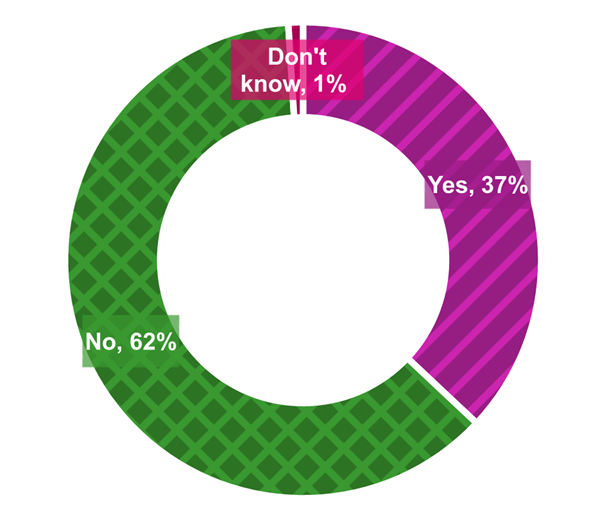
Base: all respondents (77).
|
|
Per cent |
|---|---|
| Yes |
37% |
| No |
62% |
| Don't Know |
1% |
Base: all respondents (77).
Examples of additional caveats
Respondents who did have caveats in place were then asked what these were. As shown in Table 4, over two-fifths (44 per cent) reported that the process cannot be initiated if there is an ongoing investigation, whilst a similar proportion (43 per cent) reported that the application must be made within one month of the last incident having been. Around a quarter (23 per cent) reported that the process cannot be initiated if a live complaint or investigation with another agency linked to the incidents is ongoing, whilst 60 per cent of respondents indicated another caveat not listed.
|
|
Number | Per cent |
|---|---|---|
| Cannot apply if there is an ongoing investigation |
12 |
44% |
| Application must be made within one month of the last incident having been reported |
11 |
43% |
| Live complaint or investigation ongoing with any other agency linked to the incidents |
6 |
23% |
| Other, please specify |
17 |
60% |
Base: all respondents using additional caveats (29). Respondents were able to select more than one option
Other caveats detailed by respondents included:
- reasonable action was not taken in response to the initial complaint(s)
- initial complaint(s) was reported in the legitimate way, meeting qualifying requirements (for example, having been reported within one month of the alleged behaviour having taken place)
- victim is at risk of harm due to the anti-social behaviour
- initial complaint(s) was no more than six months ago
- there must be a link between the three reports of anti-social behaviour
- the behaviour must be persistent
- the victim is not currently going through the authority’s official complaints procedure
- a case review must not have already taken place in response to complaints of behaviour of the same nature
- the complaint(s) cannot be “frivolous”.
Reasoning
Respondents who did have caveats in place were then asked the main reason why their council uses these caveats in addition to the statutory threshold. A total of 28 respondents detailed their authority’s reasoning, and these reasons have been analysed and grouped into common themes.
Around half of the comments explained that additional caveats were in place to ensure that any investigations relating to that case – including by partner agencies – had concluded before a review of the case could reasonably take place. As one authority explained, allowing the original investigation to conclude “gives a clearer picture of whether actions have not been done and/or were not effective”.
Around a third of comments mentioned that additional caveats – typically caveats that are more lenient than the statutory threshold – were used to protect victims, particularly in cases where the victim is a vulnerable individual or at risk of harm. One authority observed that “additional vulnerabilities carry higher risks” and therefore in some cases, “it is not appropriate to wait for more incidents to take place before activating a review”.
A fifth of comments explained that additional caveats were used to ensure that only appropriate cases are put forward for review. Respondents explained that this is to limit the risk of vexatious complaints, and to ensure that resources and time are spent instead on more serious cases.
Around a tenth of comments reported that caveats are used to manage resident expectations, ensuring that the case review process is seen as a separate, additional action for specific cases rather than an extension of the service for all cases.
A further tenth of comments explained that additional caveats were in place as these had been set at a regional level, or devised in partnership with other relevant agencies – for example, the police.
Other reasons mentioned by one or two respondents each included:
- to support the use of other methods of resolution or remedial action
- to ensure that cases being reviewed are sufficiently recent
- to minimise the duplication of work, if the case is already under review or following the organisation’s complaints process
- for further clarification on the statutory guidance
Case review numbers
Respondents were asked to provide the number of case review applications that had been received within their authority and the number of these that did not meet the threshold, individually for each year since 1 April 2018. Respondents were asked to leave this question blank if they did not have access to the figures, and to only use a zero where this was a true zero.
The mean average number of case review applications received by responding authorities has seen a steady increase since 2018/19, rising gradually to a peak of 8.67 case review applications in 2023/24. There appears to have been a slight decline in the number of applications for the most recent financial year, to 6.45 case review applications. However, due to the timing of this survey, figures for 2024/25 cover only up to 1 March rather than 31 March.
The mean average number of case review applications that did not meet the threshold has also risen gradually over the period, yet at a slower rate than the average total applications. For example, in 2018/19, applications that did not meet the threshold counted for more than half of all applications (52 per cent), and this fell gradually to 36 per cent in 2023/24The full results for this question are shown in Table 5 and Figure 2.
|
|
Number of case review applications received (mean) |
Number that did not meet the ASB threshold (mean) |
Percentage that did not meet the threshold |
|---|---|---|---|
| 1 April 2018 – 31 March 2019 |
2.44 |
1.27 |
52% |
| 1 April 2019 – 31 March 2020 |
3.40 |
1.62 |
48% |
| 1 April 2020 – 31 March 2021 |
5.08 |
2.09 |
41% |
| 1 April 2021 – 31 March 2022 |
6.16 |
2.72 |
44% |
| 1 April 2022 – 31 March 2023 |
7.01 |
2.79 |
40% |
| 1 April 2023 – 31 March 2024 |
8.67 |
3.08 |
36% |
| 1 April 2024 – 1 March 2025 |
6.45 |
2.92 |
45% |
| Mean total per authority |
39.21 |
16.49 |
42% |
Base: all respondents – base varies for each year (46 – 68).
Base: all respondents – base varies for each year (46 – 68).
Case review hearing approach
Respondents were asked to indicate the approach that their council takes to the case review hearing; specifically, their approach to victims and the selection of hearing panel chair. The results for this question are shown in Table 6 and Table 7.
Victims at case review hearings
Considering their approach to victims, more than four-fifths of respondents reported that victims can provide a statement to be read aloud at the hearing (85 per cent), that victims can personally attend the initial part of the hearing (84 per cent), and that victims are kept informed throughout the hearing process (82 per cent). Furthermore, 72 per cent of respondents reported that victims can have a representative attend on their behalf. Eleven per cent of respondents reported that victims are only advised of the hearing outcome and therefore not kept informed throughout the process. The results for this section are shown in Table 6.
|
|
Per cent |
|---|---|
| Victim can provide a statement to be read aloud at Case Review hearing |
85% |
| Victim can personally attend initial part of Case Review hearing |
84% |
| Victim can have a representative attend Case Review hearing on their behalf |
72% |
| Victims are kept informed throughout the Case Review hearing process |
82% |
| Victims are not kept informed throughout the Case Review hearing process and are only advised of the outcome |
11% |
Base: all respondents (75). Respondents were able to select more than one option.
Respondents who reported that they do not allow victims to attend the initial part of the case review hearing were asked why this is the case. A total of eight respondents provided comments, and reasons included:
- hearings are operational and professional
- the panel must be able to speak freely and openly
- victims are represented in other ways – for example, through a statement
- logistics such as scheduling or location can be a barrier for large authorities.
Three respondents noted that there is the potential to review this, to ensure victims can attend the initial part of the hearing.
Panel chair selection
Considering the choice of case review hearing chair, 30 per cent of respondents reported that hearings are led by a chair from the local authority – that is to say, internal – whilst 21 per cent reported that they are led by an external chair, independent to the authority. A further 44 per cent reported that the chair can be either internal or external. The results for this section are shown in Table 7.
|
|
Per cent |
|---|---|
| Case review hearings in your council can be chaired by either an internal or external chair |
44% |
| Case Review hearing is led by a panel chair who is internal to your council |
30% |
| Case Review hearing is led by a panel chair who is external to your council |
21% |
| Other, please specify |
21% |
Base: all respondents (75). Respondents were able to select more than one option.
Respondents who indicated another approach to the case review process were asked to describe this. Fifteen respondents provided comments, which have been grouped into common themes.
Over half of the comments emphasised that regardless of whether the chair is internal or external to the organisation, they are always sufficiently independent, neutral, and experienced in anti-social behaviour legislation and policy.
Other themes mentioned by one respondent each included:
- the authority undertakes an informal review for cases that do not meet the threshold
- an external chair is only used in complex cases
- there is difficulty in sourcing an external chair
- the local police force has responsibility for case reviews
- the local district councils have responsibility for case reviews, rather than the county council
- a victim support organisation keeps victims informed.
Internal panel chair selection
Respondents who indicated that they use an internal panel chair for the case review hearings were asked to select the reasons why this is the case. As shown in Table 8, a third of respondents (33 per cent) indicated that the lack of availability of external independent chairs was a factor in the use of internal panel chairs, whilst a tenth of respondents (10 per cent) reported that they had no time available for the recruitment process, and a further 4 per cent reported an inability to appoint. Thirteen per cent of respondents were unsure why an internal panel chair was used, whilst more than half of respondents (60 per cent) indicated another reason not listed for this choice.
|
|
Per cent |
|---|---|
| Lack of availability of external independent chairs |
33% |
| No time available for recruitment process |
10% |
| Inability to appoint |
4% |
| Other, please specify |
60% |
| Don’t know |
13% |
Base: all respondents (56). Respondents were able to select more than one option.
Respondents who indicated another reason had the opportunity to specify what this reason was. A total of 33 respondents provided other reasons, and these have been analysed and grouped into common themes.
Nearly two-thirds of comments clarified that the internal chair selected will always be sufficiently independent of the case, either from a different department or with no prior involvement in the case.
Around a quarter of comments flagged that the cost of using an external chair is a barrier for those authorities that do not have the funding for this.
Other reasons mentioned by one or two respondents each included:
- the use of an internal chair speeds up the process, supporting a quicker resolution for all parties involved
- the use of an internal chair is a result of legacy structures within the authority that have not been updated
- case review hearings form part of another community forum, which is led by an internal chair
- there is an insufficient number of case review applications to warrant the recruitment of an external chair
- the hearing panel includes a few different agencies, therefore an internal person tends to chair.
External panel chair selection
Respondents who indicated that they use an external panel chair for their anti-social behaviour case review hearings were asked to indicate the organisation type(s) that they use to source panel chairs. Other local authorities were the most popular source of external chair, indicated by 60 per cent of respondents, followed by the police, indicated by 53 per cent of respondents, and housing associations, indicated by 33 per cent of respondents. A further 5 per cent reported having selected a chair from a care or health board, whilst 41 per cent indicated other organisation types not listed. The full results are shown in Table 9.
|
|
Per cent |
|---|---|
| A council other than yours |
60% |
| Police |
53% |
| Housing Association |
33% |
| Integrated Care Board (ICB) or Local Health Board (Wales) |
5% |
| Other |
41% |
| Don’t know |
0% |
Base: all respondents using an external chair (50). Respondents were able to select more than one option.
Single point of contact for victims
Respondents were asked if their authority has a single point of contact for victims. The majority of respondents (86 per cent) reported that they had a single point of contact for victims, while 14 per cent did not. The full results are shown in Table 10.
|
|
Per cent |
|---|---|
| Yes |
86% |
| No |
14% |
| Don’t know |
0% |
Base: all respondents (76).
Further action for cases not meeting the threshold
Respondents were asked if their local authority reviews whether more could be done for cases that do not meet the case review threshold. The vast majority of respondents (90 per cent) reported that their authority did review whether more could be done, whilst 6 per cent reported that they did not, and a further 4 per cent were unsure. The full results are shown in Table 11.
|
|
Per cent |
|---|---|
| Yes |
90% |
| No |
6% |
| Don’t know |
4% |
Base: all respondents (76).
Promotion of case review process
Respondents were asked how, if at all, their authority promotes the anti-social behaviour case review process in their local area. By far the most popular way to promote the case review process, the vast majority of respondents (91 per cent) use their local authority website, or the website of relevant partners, to promote the case review process. Thirty-one per cent use information advice and guidance services, whilst a similar proportion (28 per cent) use social media. Nine per cent promote the process through leaflets and fliers, whilst 7 per cent use other hard copy advertising. Twenty-four per cent indicated another method of promotion, whilst 5 per cent do not currently promote the process. The full results are shown in Table 12.
|
|
Per cent |
|---|---|
| Via websites, including websites of the local council and relevant partners |
91% |
| Information, advice and guidance services e.g. CAB |
31% |
| Social media |
28% |
| Leaflets and fliers delivered to residents |
9% |
| Other hard copy advertising |
7% |
| None of the above |
0% |
| Other, please specify |
24% |
| We do not currently promote the ASB Case Review |
5% |
Base: all respondents (76). Respondents were able to select more than one option.
Respondents who indicated another method of promotion had the opportunity to specify what this was. A total of 19 respondents detailed other methods, and these have been analysed and grouped into common themes. These were:
- through relevant partner agencies, including the police, local healthcare services, or the Parish Council
- directly to victims when dealing with requests
- through local initiatives such as anti-social behaviour awareness week or public engagement roadshows
- through online hub resources, including video explanations of the process.
Case review application process
Respondents were asked how victims are able to apply for the case review process within their local authority. The most frequently cited method for case review applications was a form submitted online, indicated by 81 per cent of respondents. Sixty-nine per cent reported that the process can be applied for by letter or email, whilst 54 per cent reported that it can be applied for by telephone, and 47 per cent reported that a hard copy templated form, available online, could be submitted. Forty per cent of respondents reported that applications for review could be made face to face, and a further 21 per cent indicated another means of initiating the application process. The full results for this question are shown in Table 13.
|
|
Per cent |
|---|---|
| Form submitted online |
81% |
| In writing, by letter or email |
69% |
| By telephone |
54% |
| Form downloaded from the internet and submitted in hard copy |
47% |
| Face to face |
40% |
| Other, please specify |
21% |
Base: all respondents (76). Respondents were able to select more than one option.
Respondents who indicated another means of application had the opportunity to specify what this was. A total of 17 respondents provided comments, which have been analysed and grouped into common themes. Other means specified by respondents were:
- via the police or 101 (non-emergency police telephone number)
- a form completed by an officer on behalf of and in the presence of the victim
- a form requested to be posted out to the victim by the authority
- via a local library
- via an unspecified third-party group.
In addition, five local authorities explained that they consider the accessibility needs of victims, and they can provide an alternative approach for those who may face accessibility issues during the process.
Further comments
Respondents had the opportunity to provide any further comments on the topic of the anti-social behaviour case review. A total of 25 respondents provided additional comments, and these have been analysed and grouped into common themes.
Around a quarter of comments offered an evaluation of how well the case review process works within their authority, identifying areas for development or improvement. These included:
- funding for other means of resolution, for example, mediation
- the reported lack of involvement of social housing providers.
- other “barriers that may hinder an effective review”.
In addition, one authority described how a recent process refresh had had a notably positive impact on their authority’s approach, transforming them into “great opportunities for agencies to get together and come up with innovative ideas”.
A fifth of the comments outlined the joined-up approach used within their authority or region, bringing together neighbouring authorities or relevant external agencies to ensure collaboration and standardisation, mitigating the risk of a “postcode lottery” when it comes to the efficacy of the case review process.
In addition, around a fifth of the comments emphasised that the aim of the process is to protect victims, describing the measures they take to ensure victims are heard and respected.
Yet, a further fifth of the comments explained that the process often does not meet the expectations of victims as there are no real powers to compel compliance with the panel’s recommendations. One authority highlighted that “there is a danger that people submit an application…thinking it will lead to a magic solution”, whilst another observed that “there appears to be very few instances where victims are left feeling satisfied”.
Furthermore, around a sixth of comments described how resource-intensive the case review process can be, for already understaffed and under-resourced teams. As one authority explained, “the current process […] puts a great resource responsibility on the council, even when it is not the council investigation that has been found wanting”.
Other themes mentioned by a few respondents each included:
- the difficulty in finding external, or independent and appropriate chairs
- the need for clearer guidance around the process
- the potential for the system to be abused by individuals to pursue personal grievances
- the current statutory threshold making it difficult for authorities refuse case review applications where more nuance in the approach may be required (for example, where both the victim and the accused may, legitimately, be seen as victims)
- the use of ongoing preventative action for applications that do not meet the threshold, to limit the possibility for further escalation
- the fact that a case review should not be needed, if a case is dealt with appropriately in the first instance.
Annex A: Questionnaire
This survey will capture your thoughts on the approach your council takes on the ASB Case Review process. Your responses will support the lobbying with central government that LGA is undertaking on behalf of our members.
Thank you for taking the time to complete this survey. You can navigate through the questions using the buttons at the bottom of each page. Use the 'previous' button at the bottom of the page if you wish to amend your response to an earlier question.
All responses will be treated confidentially. Information will be aggregated, and no individual or authority will be identified in any publications without your consent. Identifiable information may be used internally within the LGA but will only be held and processed in accordance with our privacy statement. We are undertaking this survey to aid the legitimate interests of the LGA in supporting and representing authorities.
The deadline for completing this survey is Thursday 3rd April 2025. If you would like to see an overview of the questions before completing the survey online, you can access a PDF here: link.
If you have any questions about this area of policy development, please contact [email protected]. If you have any questions about how to respond to the survey, please contact [email protected]
Please amend the details we have on record if necessary.
- Name
- Authority
- Job title
- Email address
The statutory threshold for eligibility for the ASB Case Review is three or more reported incidents in the last six months. Does, or not, your local council have caveats which are used in addition to this statutory threshold? Caveats may include: cannot apply if there is an ongoing investigation, or application must be made within one month of the last incident.
- Yes
- No
- Don't know
If yes at Q2, caveats in place:
Please select from the list below which caveats your local council uses. Select all that apply
- Cannot apply if there is an ongoing investigation
- Application must be made within one month of the last incident having been reported
- Live complaint or investigation ongoing with any other agency linked to the incidents
- Other, please specify
Please write in the main reason why your council has caveats which are used in addition to the statutory threshold.
Please write in the case review application and ASB threshold numbers from 2018 to 2025 for your local council. Please leave blank if figures not known. Only use a zero if there were no applications or cases that did not meet the threshold:
|
|
Number of case review applications received | Number of these that did not meet the ASB threshold |
|---|---|---|
| 1st April 2018 – 31st March 2019 | ||
| 1st April 2019 – 31st March 2020 | ||
| 1st April 2020 – 31st March 2021 | ||
| 1st April 2021 – 31st March 2022 | ||
| 1st April 2022 – 31st March 2023 | ||
| 1st April 2023 – 31st March 2024 | ||
| 1st April 2024 – 1st March 2025 |
Please select from the following options the approach that your council currently uses for ASB Case Review hearings. Select all that apply
- Victim can provide a statement to be read aloud at ASB Case Review hearing
- Victim can personally attend initial part of ASB Case Review hearing
- Victim can have a representative attend ASB Case Review hearing on their behalf
- Victims are kept informed throughout the Case Review hearing process
- Victims are not kept informed throughout the Case Review hearing process and are only advised of the outcome
- ASB Case Review hearing is led by a panel chair internal to your council
- ASB Case Review hearing is led by a panel chair external to your council
- ASB Case review hearings in your council can be chaired by either an internal or external chair
- Other, please specify
Please provide the main reason why victims are currently not able to attend the initial part of the ASB Case Review hearing in your council.
Please select from the list below the reasons why your council uses an internal chair for its ASB Case Review hearings. Select all that apply
- Inability to appoint
- No time available for recruitment process
- Lack of availability of external independent chairs
- Other, please specify
- Don’t know
If council uses external chair:
Please select from the list below the organisation types from where your external chair is drawn: Select all that apply
- A council other than yours
- Police
- Integrated Care Board (ICB) or Local Health Board (Wales)
- Housing Association
- Other
- Don’t know
Does your local council have or not a single point of contact for victims?
- Yes
- No
- Don't know
Does your council review or not whether more can be done for those cases that do not meet the ASB case review threshold?
- Yes
- No
- Don't know
How does your council promote the ASB case review in your local area? Select all that apply
- Via websites, including websites of the local council and relevant partners
- Leaflets and fliers delivered to residents
- Other hard copy advertising
- Social media
- Information, advice and guidance services e.g. CAB
- None of the above
- We do not currently promote the ASB Case Review
- Other, please specify
In which of the following ways can the ASB review be applied for at your council? Select all that apply
- Form submitted online
- By telephone
- In writing, by letter or email
- Form downloaded from the internet and submitted in hard copy
- Face to face
- Other, please specify
If there is anything else you wish to add that has not been covered, please use the space below.
End of survey