City Health Care Partnership CIC, East Riding of Yorkshire Council, VSE Collaborative Forum, Hull City Council, Humber and North Yorkshire Health and Care Partnership, Hull University Teaching Hospitals, working with OPTICA and The PSC.
The challenge
In 2022, in common with other systems, Hull University Teaching Hospitals (HUTH) was experiencing:
Significant volume of discharge delays
- Over 200 people on supported discharge pathways were delayed every day.
- These patients spent on average six to seven days after the 'no-criteria to reside' point delayed in hospital.
- Delayed patients have worse outcomes and experiences and were at an increased risk of deconditioning.
- Discharge delays had a knock-on impact on wider hospital flow, including ambulance handover, A&E performance, and elective recovery.
Insufficient intermediate care capacity
- Contributed to discharge delays in acute and community hospitals.
- Resulted in patients being discharged on sub-optimal pathways.
- Unequal access to rehab and reablement support.
Ambition
How can health and care partners in Hull and the East Riding of Yorkshire design and deliver an improved, integrated discharge and intermediate care model?
The approach
Fundamental to the success of the approach was the way that system partners and leaders came together from the outset and agreed to tackling this together.
Integrated ways of working were underpinned by:
- The signing of a programme memorandum of understanding, committing all delivery partners to shared ways of working.
- The development of a robust and shared programme ambition defined by patient need, and not organisational or geographic boundaries.
- The introduction of regular touchpoints for programme SROs to meet and make decisions collaboratively.
A co-produced, new discharge model was developed involving:
- Over 150 people with lived experience and 100 operational staff engaged in the programme.
- In-person workshops, bringing together staff from different organisations to work collaboratively.
The solution: a new, integrated discharge and intermediate care model
Key components of this model
In-hospital
- Introduction of a co-located integrated discharge hub at Hull Royal Infirmary, bringing together NHS, local authority and VCSE staff in one-place.
- Mobilisation of a new, ‘fit-for-discharge’ ward at Hull Royal Infirmary to enable faster and better discharge planning.
- Introduction of two VCSE discharge co-ordinators within the discharge hub.
In the community
- Increased homebased and bedded intermediate care capacity, enabling more people to access ‘recovery first’ rehab and reablement support.
- Alignment of intermediate care pathways across organisational and geographical boundaries.
- Commissioning of three new voluntary sector discharge support services.
Digital enablers
- OPTICA* (Optimised Patient Tracking & Intelligent Choices Application) is a secure cloud application, built by NECS in collaboration with NHS Trusts and local authorities, which tracks all admitted patients and the tasks relating to their discharge in real time through their hospital journey. The data used also feeds into the national data collections.
- A benefits realisation approach was taken to the roll out of OPTICA.
- OPTICA was embraced rapidly by ward staff (through well received training) and other departments, particularly as it removed the requirement to record multiple data items on paper; enabled instant feedback and visibility of progress once a patient had been referred to the discharge hub; and allowed instant visibility of performance.
- In addition, shared access to Patient Administration System for health and social care partners was put in place.
Evidence based decision making
Having “one shared version of the truth” and “no more arguing about what the number is” provided evidence for key decision making at ward, service and strategic level. Examples of how the information was used include capacity and demand modelling resulting in further investment decisions such as increasing home care capacity.
There was a governance structure for overall reporting and monitoring linked to the transfer of care and UEC boards.
Benefits
- A tool that was easy to use for staff and supported much more efficient ways of working, including a 32 per cent reduction in time spent on discharge tasks, and freeing up of one grade 9 social worker.
- Improved data and understanding to support reliable capacity and demand planning.
- One system providing accurate and reliable data, which is trusted by partners.
- Improved data and understanding to support reliable capacity and demand planning.
- A single process and pathway to support a consistent discharge to assess model.
Outcomes
December 2022-December 2024
- Average NCTR position has fallen from 221 to 86 at HUTHT – a reduction of 60 per cent.
- Patients spend on average, three fewer days delayed in hospital before discharge.
- A 10 per cent increase in the number of patients being discharged straight home from hospital.
- Forecast £12 million of annual financial savings each year realised through a reduction in discharge delays in acute and community settings, as well as reduced demand for social care.
There has been a significant shift in the empathy and understanding of partners across the system. Having walked a mile in each other’s shoes, there is a better understanding of the challenges each organisation faces and how we can better mobilise solutions to realise better outcomes for people”.
- Gareth Everton, Director of Integration and Commissioning, East Riding of Yorkshire Council
Roll out across the ICS
From roll out in 2024, OPTICA is now being used by 30 acute wards in all four acute trusts in Humber and North Yorkshire; six local authorities; and six integrated discharge teams and community health service teams.
Next steps
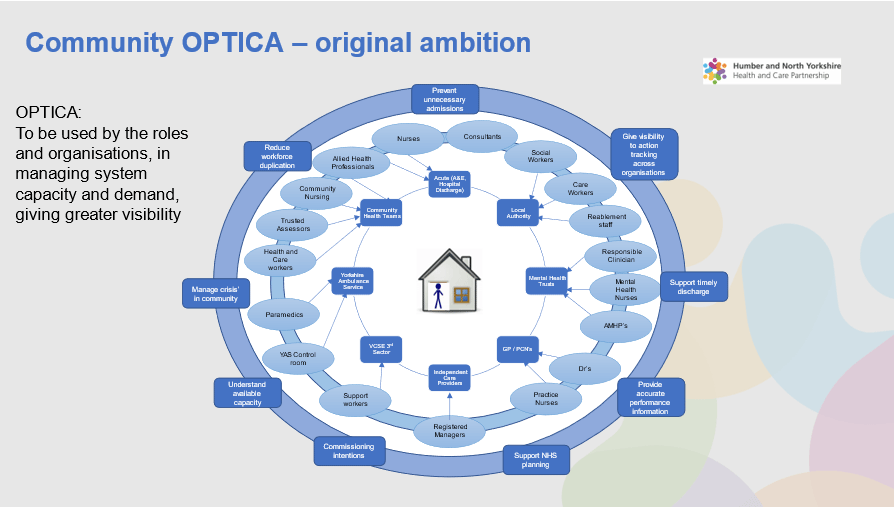
The ICB would now like to develop and roll out Optica Community.This would enable further visibility of patients and bed capacity in community services.
Contact
Benefits approach
Below highlights the approach we took to define and identify benefits of OPTICA.
Identification of benefits:
- consultation with discharge teams
- understanding discharge processes
- identifying quantitative measures.
Planning benefits realisation:
- understanding how to measure benefits
- identifying how benefits will be monitored/reviewed, including baseline figures and targets for realisation
- documenting a benefits realisation plan.
Implementation of benefits plan:
- measurement of baseline quantitative figures
- circulation of pre-implementation qualitative survey to discharge staff
- scheduling: monitoring/review points for benefits realisation.
Community OPTICA - original ambition