
Overview
We have developed this report to provide an overview of the improvement support provided by Partners in Care and Health (PCH) in delivery of the 2024-25 sector improvement support programme commissioned by Department of Health and Social Care (DHSC). Beginning on 1 July 2024 and awarded to PCH following competitive tender, this nine-month programme was developed to support local authorities and practitioners to deliver adult social care and public health statutory services and, improve care and support so that everyone can access high quality care that enables choice, control and independence.
This report highlights the reach of our improvement support provided to the sector at a local, regional and national level over the length of the programme, demonstrating the value of sector-led improvement support in response to the increasing challenges faced by the sector. We outline our impact on enabling local authorities to identify support needs and implement intelligence led, innovative solutions to drive improved operational and strategic service delivery.
Who we are
PCH is a partnership between the Local Government Association (LGA) and the Association of Directors of Adult Social Care Services (ADASS), formed to work collaboratively in the promotion and delivery of improvement, transformation, and innovation across adult social care and public health care and support in England. As a national programme, PCH works closely and collaboratively with the nine ADASS regional teams, ADASS policy networks and director of adult services (DASS) groups throughout the year to help shape and identify programme priorities.
For our funders, we utilise our extensive data and intelligence network to support in the development and delivery of national improvement programmes, using our policy and operational expertise to outline sector support requirements and facilitate the correct allocation of resources to maximise quality of care across the sector.
For local authorities and adults social care practitioners, we work in collaboration with services to implement sector-led improvement support. We support councils to diagnose their current service challenges and work with them to scope and implement innovative solutions that will help improve their provision of adult social care and public health services. Our learning and expertise is then shared across the sector, via our established research and guidance portfolio, with the resources available for councils to implement best-practice solutions to realise positive changes.
Key highlights
“Invaluable for a new cabinet member - It’s ultimately helped me manage my time a lot better and be far more productive where it matters. I’d even say without exaggeration that it’s been life changing.”
Elected Member following reception of PCH Leadership Peer to Peer Targeted Support Offer
Objectives
The 2024/25 Continuous Improvement programme was developed to provide support to local authorities and their partners in delivery of their adult social care and public health care and support. Utilising our extensive sector intelligence and close working relationships between our subject experts and DHSC policy leads, this joint-partnership programme between DHSC and PCH was developed to deliver on the following objectives:
- support local authorities and their partners to meet their adult social care and public health legislative duties under the Care Act 2014
- support councils to improve their care and support, ‘providing the right support at the right time to councils’ to help them provide tangible improvements for people accessing adult social care and public health
- support councils who are at risk of failing to deliver their statutory adult social care and public health functions or meet relevant funding conditions, following completion of their Care Quality Commissioning (CQC) adult social care assessment.
Sector priorities
The three priority pressures to be addressed through the 2024/25 sector improvement plan
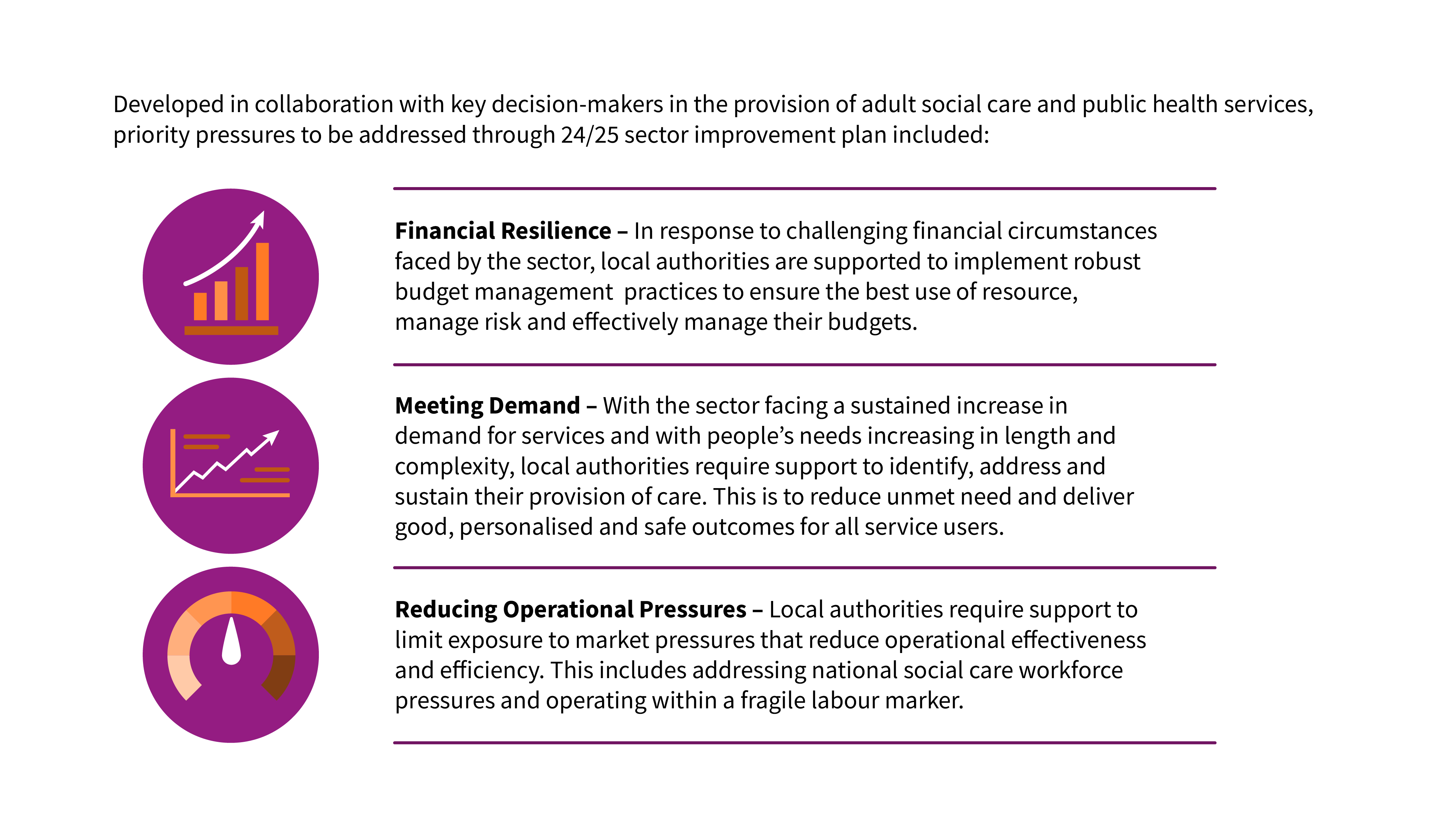
Developed in collaboration with key decision-makers in the provision of adult social care and public health care and support, priority pressures to be addressed through 2024/25 sector improvement plan included:
- financial resilience – In response to challenging financial circumstances faced by the sector, local authorities are supported to implement robust budget management practices to ensure the best use of resource, manage risk and effectively manage their budgets.
- meeting demand – With the sector facing a sustained increase in demand for care and support and, with people’s needs increasing in length and complexity, local authorities require support to identify, address and sustain their provision of care. This is to reduce unmet need and deliver good, personalised and safe outcomes for all service users.
- reducing operational pressures – Local authorities require support to limit exposure to market pressures that reduce operational effectiveness and efficiency. This includes addressing national social care workforce pressures and operating within a fragile labour marker.
Programme development
In execution of the programme, we developed a diverse portfolio of support offers aligned with the four core themes specified within the CQC Assessment framework for local authority assurance. Developed in collaboration with our sub-contractor Social Care Institute for Excellence, and formalised as a collection of interrelated workstreams, our support offers were commissioned to enable sector-led, outcomes focused improvement, placing the needs of the council or system accessing support at the heart of the solution.
Our workstreams for the 2024/25 continuous improvement programme were broken down as follows:
Support offers
With the needs of local authorities and practitioners at the centre of approach to improvement, each workstream developed a comprehensive, credible and easy to navigate suite of support offers to enable improved delivery across adult social care and public health care and support. Developed with councils and drawing on insight and intelligence gathered through our unique relationship with regions, national intelligence networks and partnerships, our support offers can be categorised as
- Targeted support offers: Targeted support offers are allocated where support is most needed and offered to councils on an individual basis. Support offers are designed to enable the immediate implementation of solutions to deliver improved service delivery, delivering improved outcomes for people who draw on care and support.
- Universal support offers: Support offers are designed to enable councils to identify opportunities for self-improvement against proven techniques/operating standards used across the sector. Support includes workshops, learning events and best in class guidance documents.
- Intensive support: Rapid and direct support to local authorities following a CQC assessment rating of “Requires Improvement” or “Inadequate”, supporting the development of the council’s strategic improvement plan and providing support to identified priority areas.
“(PCH) quickly planned and executed the work and gave us very helpful advice, tailored to our circumstances. We have been able to use the recommendations to form an action plan to take forward with key colleagues and I am confident that we will see improvements as a result.”
Council officer following reception of PCH safeguarding pre-CQC assessment support Offer
Regional teams work closely with DASSs to understand support requirements specific to LAs and regions and support PCH in developing and delivering support, alongside CHIAs.
For the 2024/25 Continuous Improvement programme, the data below provides an overview of the support offers provided by PCH to the sector across the four CQC thematic areas:
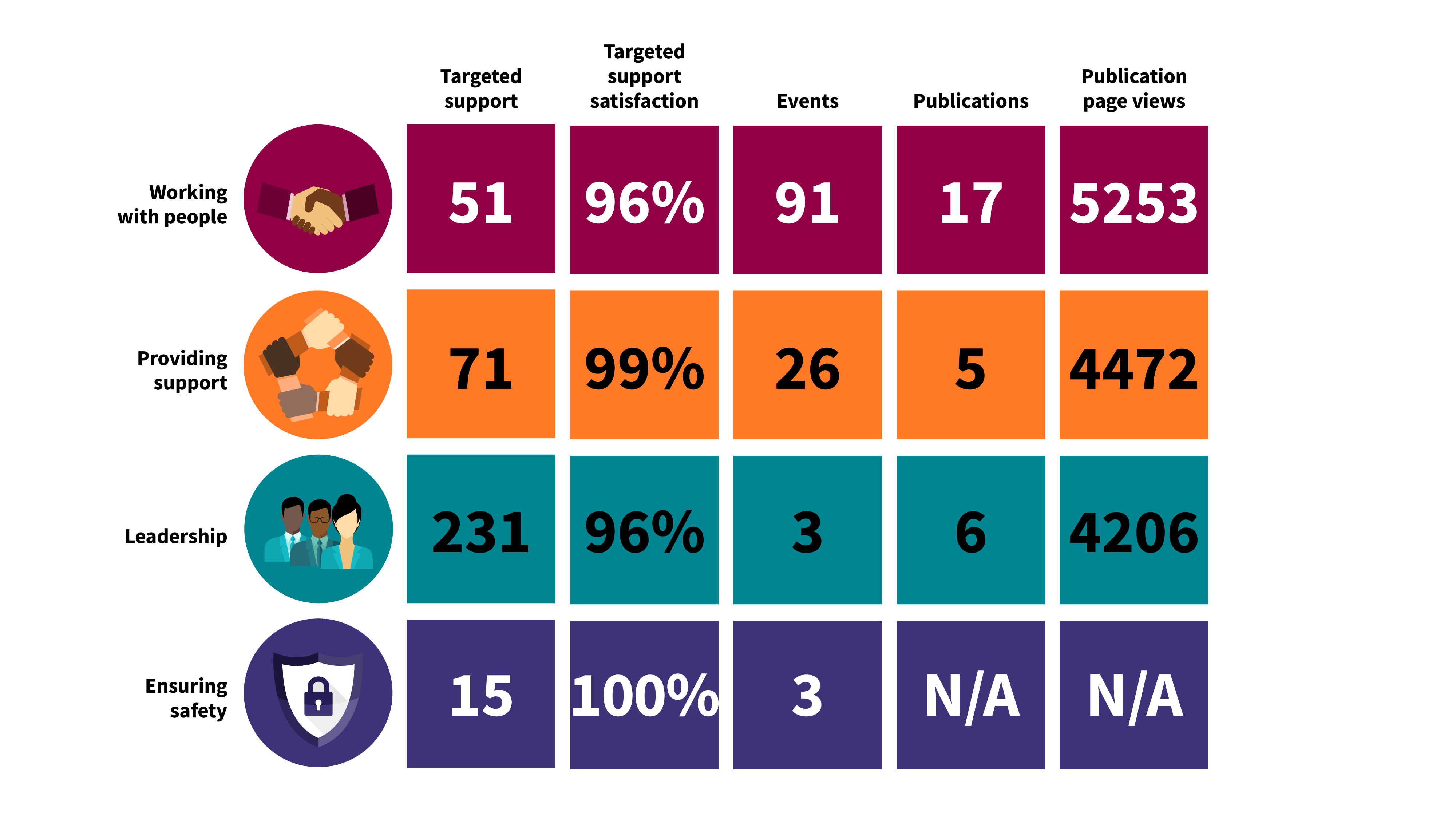
The image above provides an overview of the support offers provided by PCH to the sector across the four CQC Thematic Areas: working with people (51); providing support (71); leadership (231); ensuring safety (15)
2024-25 Targeted support offer summary
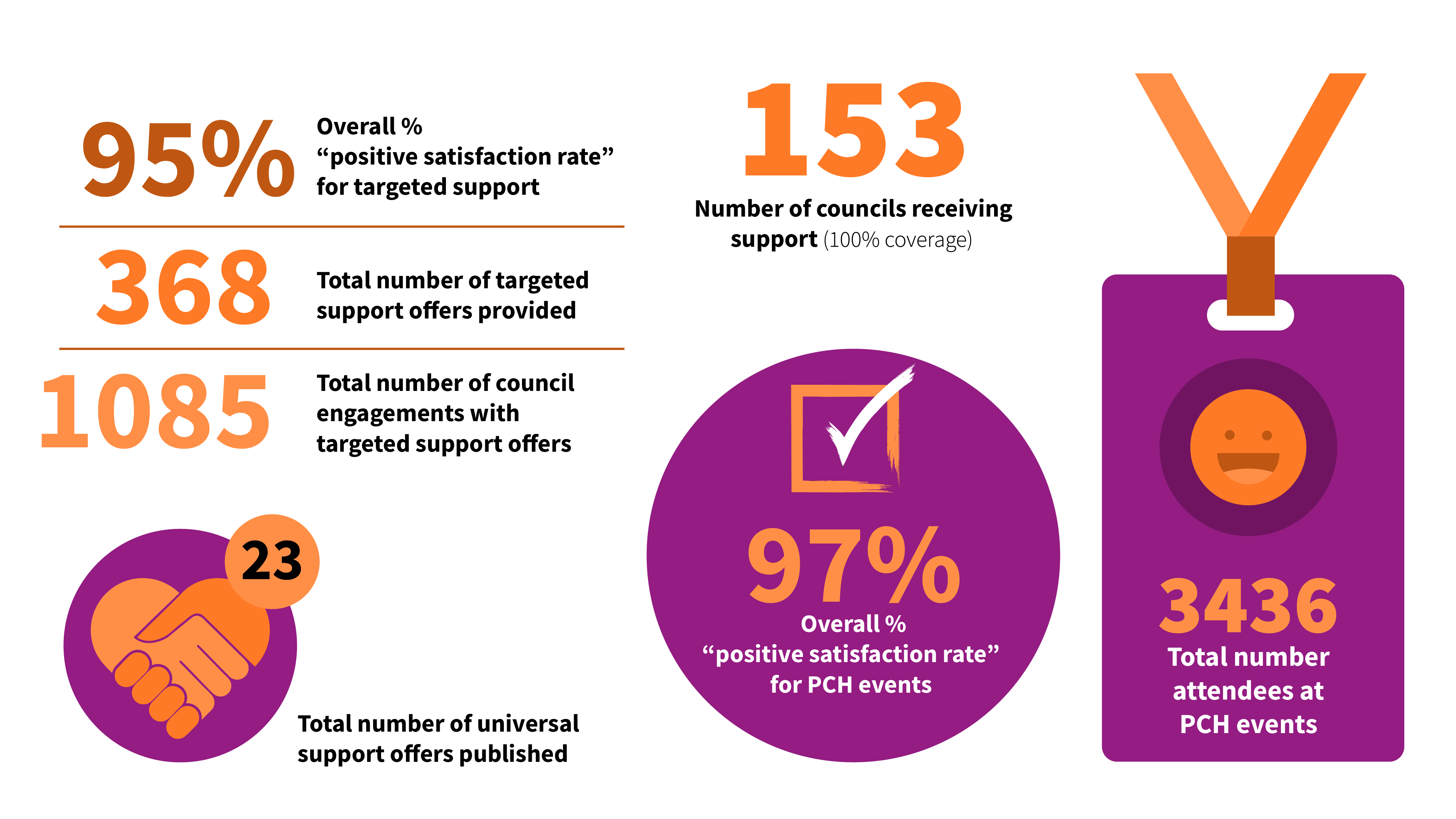
Over the course of the 2024/25 programme, Partners in Care and Health delivered 389 instances of targeted support to the sector, with all 153 local authorities accessing a minimum of one piece of targeted support over the length of the programme.
In delivery of the programme, we achieved 100 per cent coverage across the nine local authority regions, with ADASS regional leads and our Care and Health Improvement Advisers (CHIAs) working with council leadership to assess their social care service needs and priorities and match each council with the relevant targeted support offer. Overall, our targeted support delivered in 2024/25 achieved a 95 per cent positive satisfaction rating from local authorities receiving support, with 94 per cent agreeing that the support offer met the objectives agreed in the Support Agreement.
Events
As part of our universal support offer to councils, PCH delivered 85 events in 2024/25 across workstreams, attracting 3,436 attendees throughout the year. Carefully designed around emerging sector priorities and informed by the latest policy, practice, and research, each event was led by respected subject matter experts who brought deep insight and practical guidance. The programme included webinars, publication launches, and interactive workshops, delivered in collaboration with partners across adult social care.
By combining in-person and virtual events, we maximised accessibility and reach, with 153 councils participating in at least one event-- reflecting strong national engagement. For the events surveyed as part of our feedback and evaluation approach for 2024/25, feedback was highly positive, with 97 per cent of attendees satisfied overall and 93 per cent agreeing that the event objectives were successfully met, demonstrating the programme's value in strengthening sector knowledge, collaboration, and capacity.
Universal support offer: summary
In 2024/25, PCH continued to expand its library of resources to help councils strengthen adult social care and support. Our 20 published universal support offers— a suite of evidence-based guidance, templates, tools, and publications— was designed to provide councils with quick, accessible, and practical information to drive sector-led improvement. This year’s publications showcased case studies, shared practical resources, and highlighted best practice examples from across the sector, enabling councils to integrate proven approaches into everyday operations. PCH universal support offers, including publications and case studies, received 79,398 page views over the length of the programme, underscoring their relevance and reach.
Working with people:
PCH look to support local authorities and practitioners to help people manage their health and wellbeing so they can maximise their independence and control. Through enabling timely and correct assessment of health, care, wellbeing and communication needs, we look to support councils ensure that current and future care needs are met, building resilient services that meet needs of the individual and help them live healthier lives.
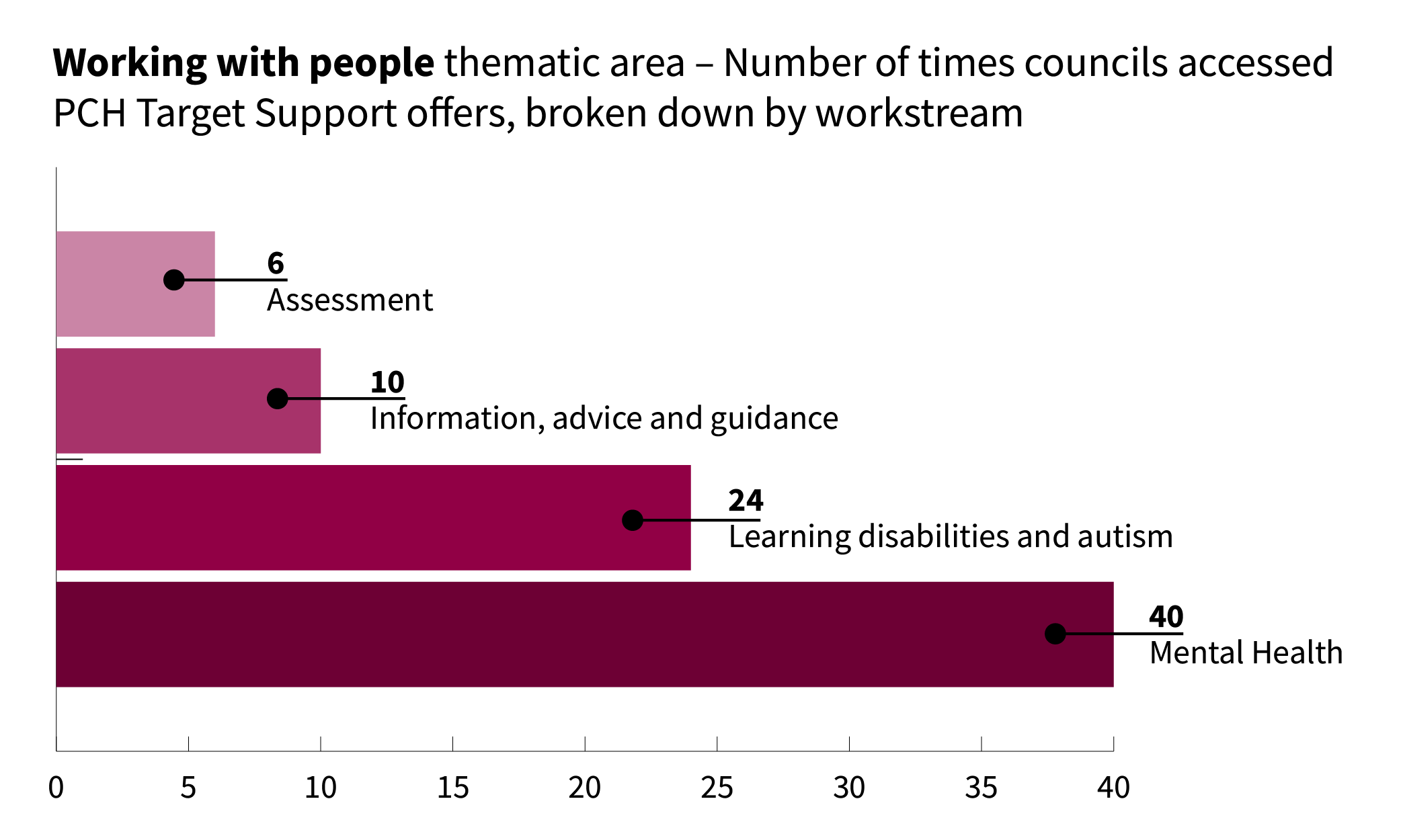
The image above shows the number of times councils accessed PCH targeted support offer broken down by workstream: mental health (49); assessment (6); information, advice and guidance (10); learning disabilities and autism (24)
Delivering access to care
People looking to access care must be supported to access timely, relevant information that enables them to make informed decisions on the type of care that is available and accessible to them. Through our Information and Advice Maturity Assessment, councils have been supported this year to diagnose the strengths and weaknesses of their current adult social care (ASC) information and advice service. Assessed against performance criteria developed by the sector, councils are supported to place the customer journey at the heart of their service design, developing a fit-for-purpose directory of resources that are relevant to needs of the individual and/or community accessing care.
Mental health support
We recognise that with the growing number of people facing mental health problems each year, local authorities are looking to ensure that their service are equipped to provide the assessment and care planning required to deliver the best quality outcomes for patients. Through our mental health peer challenge support offer, we reviewed council and system partners approaches to bespoke area of mental health social care, assessing current service delivery and providing a series of recommendations to deliver improved care and support in areas including mental health discharge, community health transformation and Section-117 after care. We also worked with council leadership to support the implementation of Approved Mental Health Professional National Service Standards in the delivery of adult social care, working with councils to identify their current position and develop improvement plans to improve operational service delivery.
Building the right support
We understand that as the financial pressures increase on the adult social care sector, local authorities remain pressured to meet ever increasing number of adult with long-term complex care needs, whilst operating within a fragile care market that has seen multiple increase in the cost of care. To support councils to address these challenges, we have supported councils facing budget pressures associated with high-cost adult social care funded support for autistic people or people with a learning disability, supporting local authorities to:
- increased knowledge and awareness of the obligation to secure the least restrictive care for individuals that have been sectioned under the Mental Health Act
- revise their Medium-Term Financial Strategies becoming reflective of the spend drivers and mitigations
- review the commissioning context to assess whether there is an appropriate level of support from health and social care for providers working with individuals with high support needs.
Our “Shared Lived Best Practice Support” offer has been developed to help councils reduce reliance on high-cost long-term placements, supporting councils to ensure that people with a learning disability have more equal access to ordinary homes. Our targeted support offers, combined with our best practice guidance for improving housing choice for people with a learning disability, were developed to support councils to implement innovative solutions to enabling people with a learning disability have more equal access to ordinary homes
We recognise that local authorities are at different stages of their journey to digitise their approach to assessing care needs, with authorities keen to transition their assessment and care support planning approach towards a digital-first solutions. We have focused this year on supporting councils to embed innovative digitising and streamlining assessment approaches across adult social care, empowering councils to adopt digital solutions to reimagine their delivery model and prioritise improved assessment approaches via greater data integration and the implementation of digital discharge process.
These sessions reinvigorate my enthusiasm for the work. It's easy to get bogged down in day-to-day challenges, but coming together reminds me of the bigger picture and why this work matters”.
Council officer following reception of PCH Digitising and Streamlining Assessment Targeted Support Offer
Supporting unpaid carers
Developed in collaboration with partners across our network this year, we published our No Wrong Doors for Young Carers Maturity Matrix and accompanying case study to support councils to assess their progress in embedding whole system approaches to supporting young carers, young adult carers and their families in the wider provision of care.
Providing support
Providing support delivery overview
Through our improvement support to the sector, we support local authorities in providing the best care and support to meet the needs of the people in their communities. We work with councils and care providers to ensure that the provision of care and support is responsive to current and also future demand. We work alongside councils to support the delivery of integrated, place-based care through a skilled, valued, and diverse workforce that reflects the communities it serves.
Through our improvement support to the sector, we support local authorities in providing the best care and support to meet the needs of the people in their communities. We work with councils and care providers to ensure that the provision of care and support is responsive to current and also future demand. We work alongside councils to support the delivery of integrated, place-based care through a skilled, valued, and diverse workforce that reflects the communities it serves.
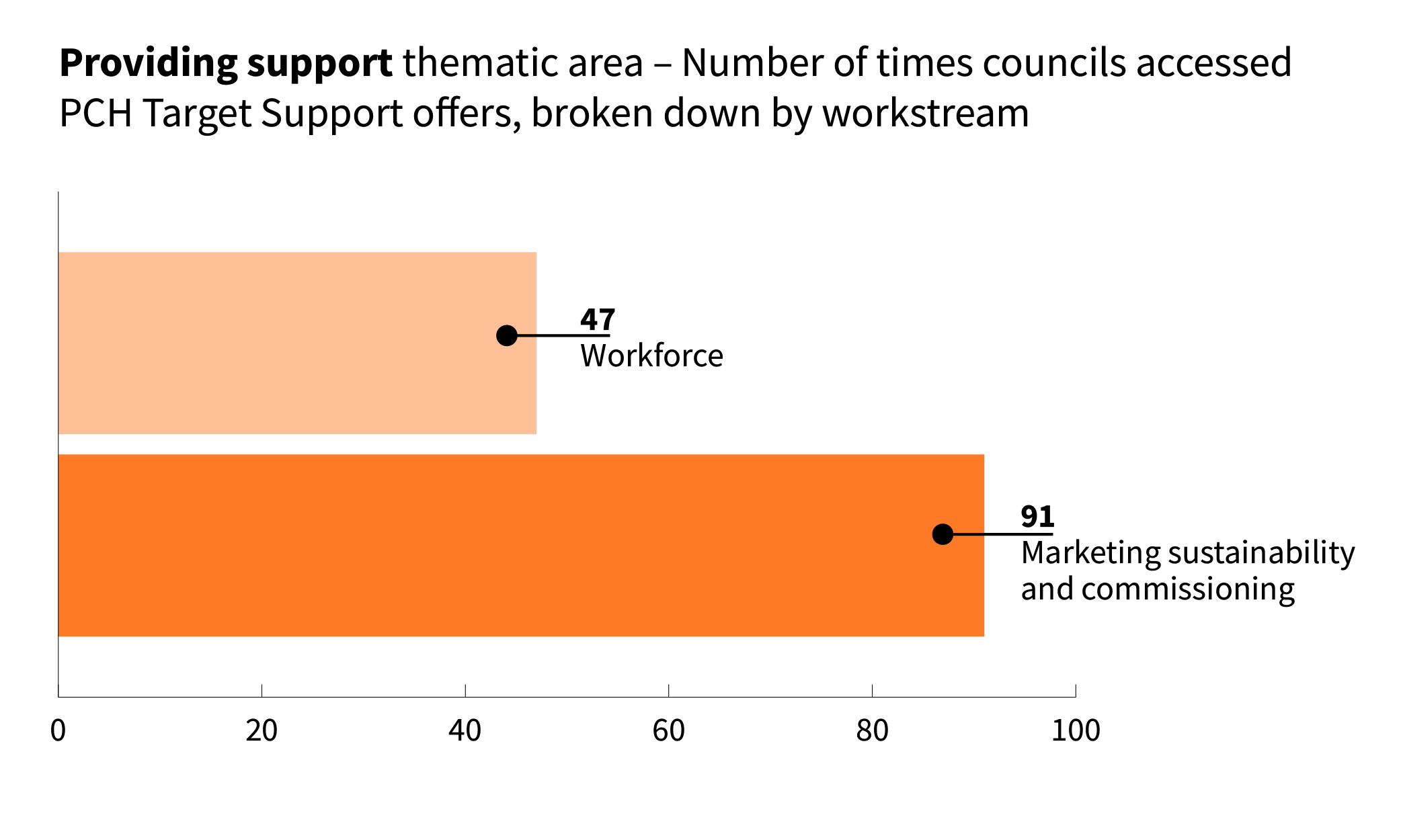
The graph above shows the number of times councils accessed PCH Targeted Support Offer, broken down by workstream: workforce (47); market sustainability (91).
Market sustainability and strategic commissioning
We are committed to continually improving the sectors approach to strategic commissioning, working directly with councils to improve their commissioning skills, effectively manage risk and deliver integrated services that improve the quality and experience of care for individuals and local populations. We worked directly with councils to adopt an evidenced-based review of their overall commissioning function and its effectiveness, supporting councils to identify areas for improvement and, provide recommendations to help improve councils in areas such as operational commissioning, strategy implementation and staff development.
We commissioned a series of webinars to support local authorities in their approach to commissioning high-cost care packages. Delivered to 480 attendees in total, we worked with commissioners to enhance their skills to ensure cost effective decision making and maximise best value for the people accessing support. Delivered as part of our wider Commissioning Financial Intelligence support offer, we provided councils with practical skills to negotiate individual high-cost care and support packages, achieving great cost efficiencies and better outcomes for the people and communities accessing support.
“It has given us the confidence to test new ways of working, move away from traditional approaches, and act more innovatively and creatively."
Council officer following reception of PCH Strategic Commissioning Review Targeted Support Offer
Delivering a strong and valued workforce
We recognise the vital role the social care workforce plays in improving lives across communities. For social care leaders, planning for and retaining a skilled, diverse, and fulfilled workforce is a key priority. We work with councils, as place leaders, to co-develop strategic workforce plans tailored to local neighbourhoods and places. These plans drive meaningful improvement—addressing immediate workforce challenges while enabling long-term transformation. In addition to helping places to embed a strategic workforce planning approach that delivers change, our targeted support helps to build internal capability and confidence in evidencing clear prioritisation and alignment of key strategies as well as equity of experience and outcomes across communities.
Through our “Retention Reset” Programme, we empower councils with the tools and insights needed to modernise their retention practices and approaches, delivering intelligence-led workshops to deliver improved frameworks for evaluating and enhancing workforce retention strategies.
“Improved retention reduces direct and indirect costs of employing/training new staff and is good for the organisation’s reputation as a large employer”.
Council officer following completion of PCH “Retention Reset” targeted support offer
We continue to provide expert improvement support in the ethical international recruitment of social care professionals, working in direct partnership with DHSC, UKVI and CQC to shape national international recruitment policy and, facilitating the sharing of information, good practice across local, regional and national networks.
Ensuring safety
Through our internal expertise and support offers, we work with local authorities to establish and maintain safe systems of care, implementing procedures and assurance standards to ensure that individuals experience safety across their care journey. We have supported councils and regions to understand their safeguarding narrative, auditing processes and reviewing established practices to ascertain:
- the quality of safeguarding work, including safeguarding pathways
- the quality and robustness of safeguarding structure in the provision of care
- the effectiveness of Safeguarding Adult Boards and overarching strategic governance.
Once completed, we have worked with councils to action immediate improvements to the quality of their safeguarding activity, supporting the implementation of practical solutions to imbed “Make Safeguarding Personal” throughout internal safeguarding processes, encouraging effective safeguarding policy and practice at a personal and organisational level.
"Receiving this support has been most welcome and we feel provides us with a good foundation to build forward.”
- Council officer following reception of PCH Safeguarding Pre CQC Assessment Support Offer
Leadership
Leadership: delivery overview
We work with local authorities to run efficient adult social care and public health care and support, helping the implementation of effective governance and management at all levels to deliver statutory services, manage resources and mitigate risks to service delivery. By setting up this accountability infrastructure, we work with councils to foster a learning and improvement culture, implementing digital innovations and place-based prevention measures to deliver equality of experience, outcome and quality of life for people accessing care.
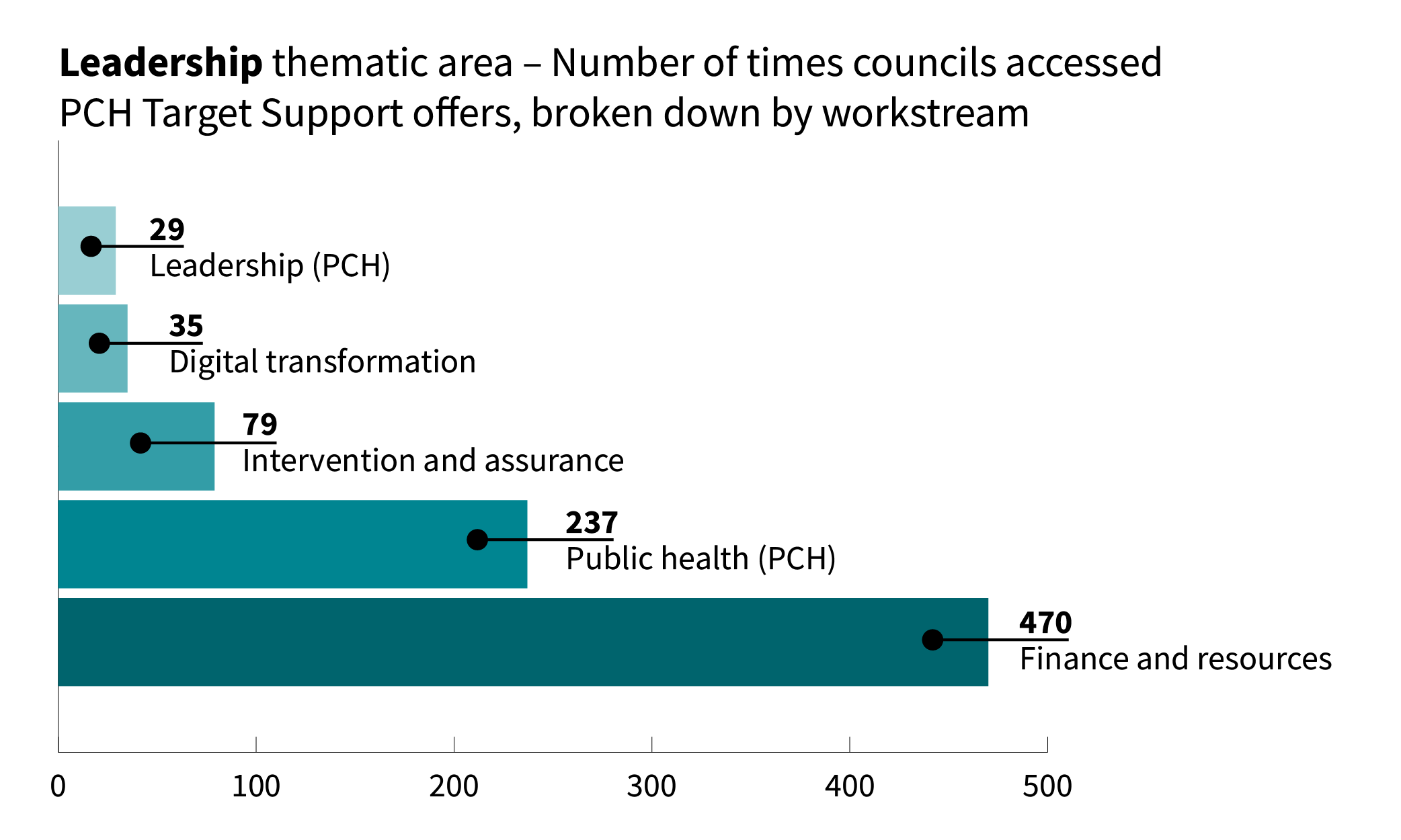
The graph above shows of times councils accessed PCH targeted support offers broken down by workstream: leadership (29); digital transformation (35); intervention and assurance (79); public health (237); finance and resources (470)
Managing resources
In response to escalating financial pressures within adult social care, our targeted financial reviews were delivered to individual councils, providing tailored support aligned to local requirements and strategic priorities. These reviews offered critical insights into resource utilisation, the robustness of financial planning, and the realism of savings proposals. Councils received expert commentary on their Medium-Term Financial Plans, including assessments of demographic pressures, inflationary impacts, and the deployment of additional funding.
Complementing this, the Narrative Use of Resources Review provided councils with structured analysis leveraging LG Inform data, enabling enhanced financial governance and optimisation of statutory service delivery. At a regional level, the Use of Resources model was deployed to benchmark financial performance against national demographic and expenditure data.
Complementing this, the Narrative Use of Resources Review provided councils with structured analysis leveraging LG Inform data, enabling enhanced financial governance and optimisation of statutory service delivery. At a regional level, the Use of Resources model was deployed to benchmark financial performance against national demographic and expenditure data.
Digital transformation
As part of the ongoing digital transformation of adult social care and support across the sector, we provided councils with strategic, hands-on support to leverage digital tools and solutions to address service pressures in adult social care and public health services. Through our “What Good Looks Like” digital self-assessment tool, councils were supported to baseline their digital maturity, benchmark regionally, and align digital strategies with sector best practice. This targeted support enabled the identification of improvement priorities and the development of tailored action plan, enhancing digital planning, improving alignment with regulatory expectations, and strengthened regional collaboration.
To build digital capability across the workforce, the programme also delivered a national offer to improve digital confidence and knowledge. This included communities of practice for occupational therapists and social workers, online events on emerging topics such as AI and consent, and the creation of a national Digital Champions Network to foster peer learning and innovation.
Leadership support
Developed in collaboration with local authority adult social care and public health senior management teams, we supported councils assess their current leadership capacity and skills in the provision of adult social care and public health care and support.
In collaboration with ADASS, the Leadership Review for Adult Social Care Senior Management Teams provided targeted support to councils, assessing leadership capacity and capability to meet statutory responsibilities and engage effectively across the health and care system. Outcomes included increased self-awareness among senior leaders and strategic insights for Chief Executives, Directors and Lead Members to evaluate leadership sufficiency within Adult Social Care (ASC).
Further support was provided through our peer-to-peer coaching and mentoring for political and officer leadership, enabling councils to navigate complex system dynamics, influence Integrated Care Boards (ICBs) and Integrated Care Partnerships (ICPs), and drive local priorities. The Leadership Essentials programme equipped elected members with the tools to lead effectively across health, care, and wellbeing agendas.
“It just provided me with headspace and time to reflect in a safe and non-judgemental space.”
Director following reception of PCH Leadership Peer-to-Peer Coaching and Mentoring Targeted Support Offer
To enhance place-based collaboration, tailored workshops were delivered to Health and Wellbeing Boards, clarifying their role and purpose within wider system partnerships. Councils gained a clearer understanding of place-based working and strengthened engagement with providers, VCSE organisations, and community stakeholders to address health inequalities.
Collectively, these initiatives enhanced strategic leadership, improved cross-sector collaboration, and empowered councils to deliver more resilient, equitable adult social care and support.
Public health and prevention
Developed and co-designed with councils, we have worked with the sector and elected members to strengthen local leadership in addressing health inequalities. Through targeted engagement, elected members were supported to understand the national and local context of prevention, identify ward-level opportunities, and recognise the role of the whole council in improving population health.
As part of our approach to deliver placed-based prevention measures in the provision of health and social care, we continue to provide support to local authorities in the undertaking and completion of the Public Health Strengths and Risk Self-Assessment, helping Directors of Public Health to identify their own strengths and risks in the provision of public health services. Our targeted support focuses on building resilience, improving service performance, and prioritising actions that reduce health inequalities. By fostering a culture of continuous improvement, councils can set realistic yet ambitious goals that reflect local needs.
"The systematic and structured approach to the self-assessment really helped hone down our priorities – the opportunity to then talk those through was critical to understanding the key areas we needed to focus on as a council.”
Council officer following reception of PCH Public Health Strengths and Risks Self-Assessment Targeted Support Offer
Through our “Enabling Health in All Policies” support offer, we have helped integrate prevention into all decision-making, addressing the wider determinants of health and tackling inequalities. Councils self-assess against the HiAP framework, building a clear picture of strengths, challenges, and opportunities, ultimately developing strategies that align corporate objectives with improved health outcomes.
Intensive support offer
As per contractual requirements for the 2024-25 Continuous Improvement Contract, PCH has provided support to councils who have been identified as unable, or at risk of being unable to provide statutory duties, helping councils to develop and implement improvement plans to improve operational service provision. We provided comprehensive support to councils in preparation for their upcoming CQC assessments, working directly with frontline workers and managers to strengthen staff preparedness and enable the council to meet essential assurance criteria ahead of their assessment.
Following conclusion of their assessment, we provided support to all councils rated as “Requires Improvement”, working directly with councils to design and implement planned improvement works to address areas of improvement as identified during the CQC assessment process. Led by our Care and Health Improvement Advisors, we provided tailored support packages aligned with the council’s improvement plan targets, working directly with council leadership to implement immediate solutions to directly address key service level challenges.
As part of our delivery of this support offer, we have continued to share our learning with the sector, sharing actionable insights and practical tools to empower local authorities to drive improvement, ensure compliance and ultimately delivering better outcomes for those who draw on adult social care and support.
This document is designed to empower local authorities with actional insights and practical tools for driving improvement, ensuring compliance and ultimately delivering better outcomes for those who draw on adult social care services.
Looking forward
Following the success of 2024/25 Continuous Improvement Programme, we have again been commissioned by DHSC to deliver its continuous improvement programme for 2025-26, providing targeted and universal support offers to the sector to help drive forward improved service delivery and performance. Continuing our partnership with SCIE, we will deliver quality and innovative improvement support offers, empowering councils to deliver care and support that support everyone to access high quality care that enables choice, control and independence.