Foreword
This is a Growth and Reform Network report for the Local Government Association, produced in partnership with the Future Governance Forum. The Growth and Reform Network is an ambitious new initiative, in partnership with the Future Governance Forum and Metro Dynamics, whose mission is to bridge the gap between national policy development and implementation at the local and regional levels. We bring together mayors, local leaders and practitioners with national policymakers to support the development of the innovative ideas, policy and practice that can drive local growth and reform.
This report puts the spotlight on the critical role of councils in enabling inclusive economic growth.
After a decade of slow growth and flatlining productivity, the Government has put kickstarting growth and raising living standards at the heart of its ambitions for change. This report identifies the essential role that councils have to underpin inclusive growth, ensuring that our residents and businesses are central to providing that growth and benefit from the opportunities that growth brings.
In an increasingly uncertain global context, returning to sustained economic growth will require leadership and expertise from across the whole country. It will require local, regional and national government working in partnership together and with the private sector. Crucially, as this report sets out, there is untapped potential in the role of local councils as growth facilitators.
Councils are convenors of place. We are the front door for our places, ambassadors for international firms and capital looking for new opportunities and honest brokers able to forge new investment partnerships with transformative potential for our communities. Through our planning powers we shape the environment for growth, and develop transport, energy and digital infrastructure to support businesses large and small.
Through our ever-closer working with mayoral combined authorities, councils work collaboratively to overcome barriers to growth in towns, cities, rural and coastal areas. This report, commissioned by the LGA, provides new research that shows how £276 billion could be added to the economy through place-based industrial strategies across the whole country. Growth that supports every community and place.
The message from the report is clear: councils are a force for growth. National government cannot deliver on its ambition to deliver higher living standards in every part of UK without local councils. This report provides helpful recommendations which will help the LGA develop its blueprint for inclusive growth.
Cllr Tom Hunt
Chair of the LGA’s Inclusive Growth Committee
Acknowledgements
Written and researched by Annabel Smith, Hamida Ali, Rosie Fogden, Kristina Stipetic and Tanya Singh.
The authors would like to thank Ben Lucas, Chair, Growth and Reform Network and Founding Director, Metro Dynamics, for his input into this report.
The authors would also like to thank members of the steering group for their thoughts and feedback over the course of this project:
Eve Roodhouse, Director of Strategy and Policy at the Local Government Association
Sam Blakeman, Research Officer, Special Interest Group of Municipal Authorities (SIGOMA)
Kerry Booth, Chief Executive, Rural Services Network
Dan Corry, Chief Economist, The Future Governance Forum
Simon Edwards, Chief Executive, County Councils Network
Chris Henning, Chair, Association of Directors of Environment Economy, Planning and Transport (ADEPT)
James Hood, Director, District Councils Network
Kate Josephs, Chief Executive, Sheffield City Council
Dr Henry Kippin, Chief Executive, North East Combined Authority
Dianna Neal, London Councils, Associate Director: Economy, Skills and Growth
Jacquie Russell, Director Policy, Performance and Communications, Salford City Council
Pam Smith, Chief Executive, Newcastle City Council
Tom Stannard, Chief Executive, Manchester City Council
Patrick White, Managing Director, Metro Dynamics
Nathan Yeowell, Executive Director, The Future Governance Forum
This work would not have been possible without the invaluable contributions of the interviewees who generously shared their time and expertise:
Fiona Bolam, Chief Officer, Economy and Skills at Leeds City Council
Rob Bridge, Chief Executive of Cambridgeshire and Peterborough Combined Authority
Cllr Hannah Dalton, Leader of Epsom and Ewell Borough Council
Damien Dacey, Executive Director of Strategy and Inclusive Growth, East Midlands Combined County Authority
Mark Doran, Executive Director of Growth and Environment, Hertfordshire County Council
Cllr Lorna Fielker, former Leader, Southampton City Council
Pete Gladwell, Head of Public Sector Partnerships, Legal and General
Mark Goldstone, Senior Policy Manager, Confederation of Business and Industry
Natasha Hayes, Executive Director of Place, Great Yarmouth Borough Council
Rebecca Heron, Strategic Director Growth and Development, Manchester City Council
Alex Hearn, Director of Economy and Place, Bristol City Council
Chris Henning, Chair of Association of Directors of Environment, Economy, Planning and Transport (ADEPT)
Stephanie Holt, Director of Economy and Communities, Kent County Council
Sam Howarth, Principal Officer to the Mayor of York and North Yorkshire, York and North Yorkshire Combined Authority
Jackie King, Chief Executive, Epsom and Ewell Borough Council
Si Chun Lam, Head of Research, Intelligence and Inclusive Growth, West Midlands Combined Authority
Cllr Liz Leffman, Leader, Oxfordshire County Council
Andrew Lewis, Chief Executive of Liverpool City Council
Ian Miller, Chief Executive, Wyre Forest District Council
Sarah Norman, Chief Executive, Barnsley Council
Matt O’Neil, Executive Director, Growth and Sustainability, Barnsley Council
Tom Walker, Executive Director, Economy, Investment and Public Health, Essex County Council
Cllr Grace Williams, Leader of London Borough of Waltham Forest
We are also grateful to the elected members we heard from during both a private roundtable held during the LGA Annual Conference on 1 July 2025 and at the LGA’s Inclusive Growth Committee on 10 October 2025.
Executive summary
Productivity in England has flatlined since 2008/09 and has recently fallen again, despite successive national policy interventions. The current government has made growth its defining mission, with a renewed emphasis on driving prosperity from the grassroots and ensuring that every place can contribute to, and benefit from, national success. Delivering this ambition will require close collaboration across all levels of government, including local government.
Mayoral combined authorities have demonstrated the benefits of a sub-national approach to growth. Their experience shows how devolved leadership can unlock local potential and coordinate investment. The government has recognised these successes and now seeks to go further and faster, expanding devolution more widely.
Local councils, including those working within combined authorities, play a critical role across England. In areas with devolution, councils act as service providers and local growth enablers, shaping housing, transport, skills, and infrastructure. They also partner with wider regional and national governance structures to coordinate investment. In areas without devolution, councils remain the primary, and often only, source of local democratic economic leadership. Their understanding of local strengths, combined with their ability to act directly, makes them indispensable to growing the economy from the grassroots.
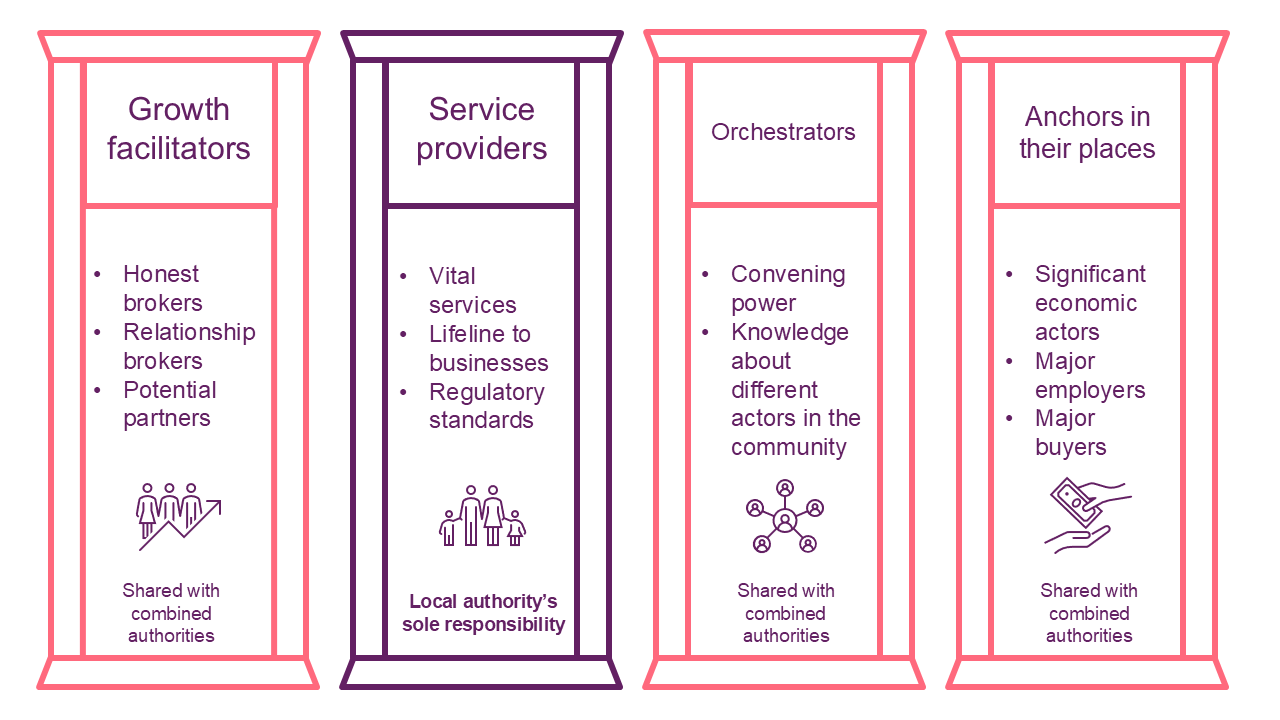
Local government’s role in driving inclusive growth is broad – as growth enablers, service providers, orchestrators, and anchor institutions. Its reach into every community enables action that strengthens local economies and expands opportunity.
Our shift-share analysis of industrial growth reveals £276 billion of untapped local economic opportunity – over a tenth of national output – which could be realised through place-specific industrial strategies. Local authorities also inject £117 billion annually into local economies as employers, service providers, and investors, generating direct and indirect economic impacts through jobs, procurement, innovation, and improved outcomes for residents.
Breaking this down by geography:
- Urban centres, home to our largest local economies, account for the bulk of this opportunity, worth £234 billion, or almost 13 per cent of their economies.
- Rural areas could add nearly £42 billion, over 11 per cent of the existing rural economy.
- Coastal areas could contribute £42 billion, or nearly 11 per cent of their current economy.
- Non-devolved areas could add £77 billion to the economy if local barriers to growth were addressed, equivalent to 12.6 per cent of local economic output.
Councils differ in geography, authority type, political control, and economic focus, and not all prioritise growth equally. Without effective communication between national government and local councils, much of this untapped potential, especially in areas outside current devolution priorities, could be lost.
Critical influencing factors
The ability of councils to drive inclusive growth is shaped by interdependent systemic factors that go beyond individual projects or services. Through extensive interviews with local and combined authority leaders for this project, four factors were consistently highlighted:
- Devolution: Councils increasingly operate alongside regional institutions led by mayors with overlapping responsibilities. Effective collaboration requires balancing assertive local leadership with engagement in regional strategy.
- Funding and flexibility: Financial pressure, centralised funding, and restrictive regulations limit councils’ capacity to innovate, while few incentives exist to retain growth benefits locally.
- Political leadership: Strong, consistent political vision enables councils to set priorities, attract talent, and embed inclusive growth in long-term strategy, translating plans into tangible outcomes.
- Connectivity across government tiers: Poor coordination and unclear roles between local, regional, and national government can hinder delivery. Structured engagement and sustained dialogue are vital.
Together, these factors shape councils’ ability to plan, prioritise, and act, providing the context in which inclusive growth can be realised.
Councils’ four-pillar role
We identified four central ways in which councils underpin inclusive growth, the ways that these work in practice and the ways these are influenced by the critical influencing factors outlined above. We also reflect on how – and the extent to which – these roles are shared with combined authorities. These pillars are:
- growth facilitators
- providers of vital services
- orchestrators
- anchors.
Together, they show that councils are central to driving inclusive growth, shaping communities, and unlocking local potential across England to support the national growth mission.
A blueprint to accelerate councils’ role in driving inclusive growth
Councils’ multifaceted roles position them as vital actors in unlocking national growth potential, yet there has been limited focus from national government on their role – particularly as growth facilitators. Our research has identified the following key recommendations for supporting councils to drive inclusive growth across their communities:
Funding
- Ensure funding is sustainable and multi-year with greater fiscal flexibility and sufficient resource to engage effectively with evolving devolution plans.
Cross-tier collaboration
- Co-ordinate growth support across local, regional, and national levels, including through data sharing.
- Share professional experience across tiers of government to improve cross-tier working and dialogue.
Local growth and investment plans
- Co-design Local Growth Plans with local authorities.
- Develop investment plans and pipelines of investable projects to feed into Local Growth Plans.
Councils’ role in non-devolved areas
- Develop growth and investment plans in non-devolved areas, including with the support of the LGA.
Local Government Association (LGA)
- Build an evidence base and share best practice on inclusive growth.
- Prioritise local growth as a focus for advocacy, support and advice.
- Provide targeted support for councils in non-devolved areas.
Introduction
Productivity in England has flatlined since 2008/09 and has recently fallen again, despite successive national policy interventions. Economic growth is vital: it creates prosperity, increases disposable income, supports public services, strengthens infrastructure, and reduces dependence on welfare. Strong, sustainable growth also improves quality of life, expands opportunities, and builds the foundations for resilient local economies. Delivering this requires close collaboration across all levels of government, including local government, to ensure growth benefits all communities.
Following more than a decade of modest productivity growth and persistent regional inequalities, there is a national focus on fostering an economy that not only grows but distributes opportunity fairly across all places. Inclusive growth – growth that enables all people and places to contribute to and benefit from prosperity – is central to this ambition. Achieving it requires a whole-system approach, drawing on the strengths of every tier of government and every part of the country, working collaboratively with shared purpose and clear alignment.
Growth is ultimately generated by the private sector. Local councils play a vital role in creating the conditions that allow businesses to invest, innovate, and expand, with this role currently being underarticulated in national growth conversations. At the same time, councils help ensure that this growth is inclusive: shaping local labour markets, supporting skills and education, enabling housing and infrastructure delivery, and connecting opportunity with need. By combining strategic leadership with practical action, councils help translate national priorities into local outcomes that are economically and socially sustainable.
Councils act as both democratic leaders and practical enablers of local growth. Their close connection to communities provides detailed understanding of local strengths, challenges, and priorities – insight that is essential for shaping growth that is inclusive and sustainable. In areas with devolved powers, councils contribute as place leaders and partners within wider regional governance structures, coordinating investment and aligning local and regional strategies.
In areas without formal devolution arrangements, councils often face additional challenges in fulfilling their economic leadership role. Without the enhanced powers, funding flexibility, and coordination mechanisms available in devolved areas, they can find it more difficult to influence regional investment decisions, plan over the long term, or engage systematically with national government on strategic priorities. Despite these constraints, such councils often deliver large scale infrastructure and regeneration projects that enable growth, alongside housing delivery, critical local services and supporting businesses. Across all geographies, councils’ combined operational and strategic roles make them central to ensuring that ambitions for inclusive and sustainable growth are achieved nationwide.
Realising this potential depends on trust, collaboration, and long-term commitment. Where local, regional, and national actors work together with shared purpose, progress can be rapid and resilient. Yet structural constraints – including short-term funding cycles, centralised regulation, and fragmented engagement across government tiers – limit councils’ ability to plan strategically and invest in the foundational conditions for growth. Overcoming these constraints will require an enabling relationship between central and local government, aligning resources, responsibilities, and incentives over the long term.
This report highlights councils’ existing role as powerful agents of inclusive growth. They contribute £149 billion to the national economy, including £117 billion to local economies, and hold levers such as business support, transport, and skills provision that can boost local industries. To quantify councils’ economic impact and local growth potential, our team conducted two original analyses – estimating direct and indirect impact from council expenditure data and assessing local sectoral potential – alongside 25 interviews with local leaders. These combined insights reveal barriers to local innovation and inform recommendations for national government, councils, and the LGA to strengthen the system that supports inclusive and sustainable prosperity.
The report does not offer a prescriptive playbook or rigid delineation of roles between councils and combined authorities. Local government varies across geography, economic structure, political priorities, and stages of devolution. Instead, the report identifies shared recommendations, recurring patterns, and illustrative examples framed through the four-pillar approach. These are intended to guide discussion and decision-making while recognising that application will differ locally. The focus is on demonstrating councils’ foundational role in local and regional economies, and how they contribute to strategic national priorities – including Local Growth Plans and the Industrial Strategy – through place-based collaboration and adaptive leadership.
By spotlighting councils as a force for growth, this report calls for a renewed national partnership that empowers local government to lead with purpose, collaborate across boundaries, and drive prosperity shared by every community.
The economic potential of local government
Councils play a central role in shaping local economic growth. Our research shows that local authorities across England are sitting on at least £276 billion of untapped economic opportunity – equivalent to more than a tenth of national output – that could be released by tackling place-specific barriers to growth. Our original quantitative analysis reveals the scope of the hidden potential and supports insights from our interview data on the need for place-specific strategies to realise it.
We arrived at this figure by conducting a shift-share analysis at the local authority level, measuring Gross Value Added (GVA) lost due to local barriers to growth. The method decomposes local economic performance into four components: national trends, sector composition, regional trends, and local conditions. This approach distinguishes structural disadvantages from missed local opportunities and builds bespoke counterfactuals for each authority, estimating how much local economies might have grown if sectors had performed in line with national, regional, and industrial trends. It does not represent the maximum possible potential of places, as it assumes that the current industrial makeup of the local economy is fixed. Rather, the analysis points to the value of targeted, place-sensitive interventions by identifying where local strategies can have the greatest effect. A detailed methodology can be found in Appendix A of this report.
The £276 billion untapped economic potential is equivalent to more than a tenth of national output that could be unlocked by addressing local barriers to growth through stronger place-based strategies and investment. The distribution of this potential varies, with established strategic authorities accounting for the largest block of untapped potential at £120 billion – or 11.9 per cent of their current output. Non-devolved areas, outside formal devolution deals or Priority Pathway areas, could unlock £77 billion, representing 12.6 per cent of local output. Urban centres across different devolution strategies account for £234 billion of untapped opportunity, reflecting their density of economic activity and complex local challenges.
| Devolution type |
Total potential (£ billion) |
Percent of GVA |
|---|---|---|
| Devolution Priority Pathway |
40 |
13.1% |
| Established Strategic Authorities |
120 |
11.9% |
| New Strategic Authorities |
39 |
12.4% |
| Non-devolved England |
77 |
12.6% |
| Total (all England) |
276 |
12.3% |
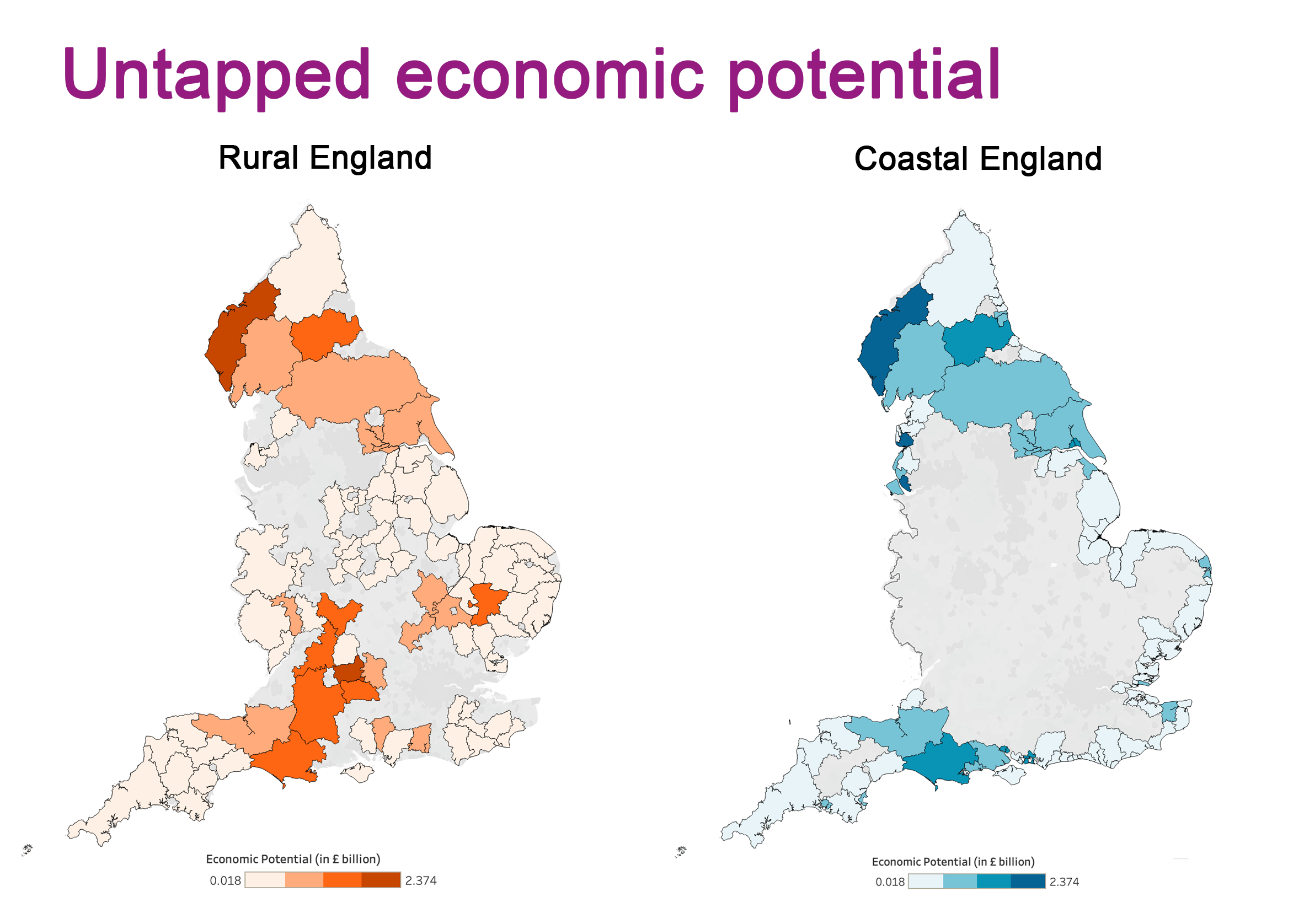
We also found that there is considerable variation across local authorities of the same type, as can be seen in the following maps of rural and coastal places. This means that unlocking potential cannot be done through a one-size-fits-all approach to urban, rural or other place-based policy. Each area will require a tailored strategy and a deep knowledge of its existing strengths and vulnerabilities to effectively catalyse inclusive growth.
Untapped economic potential: Rural and coastal England
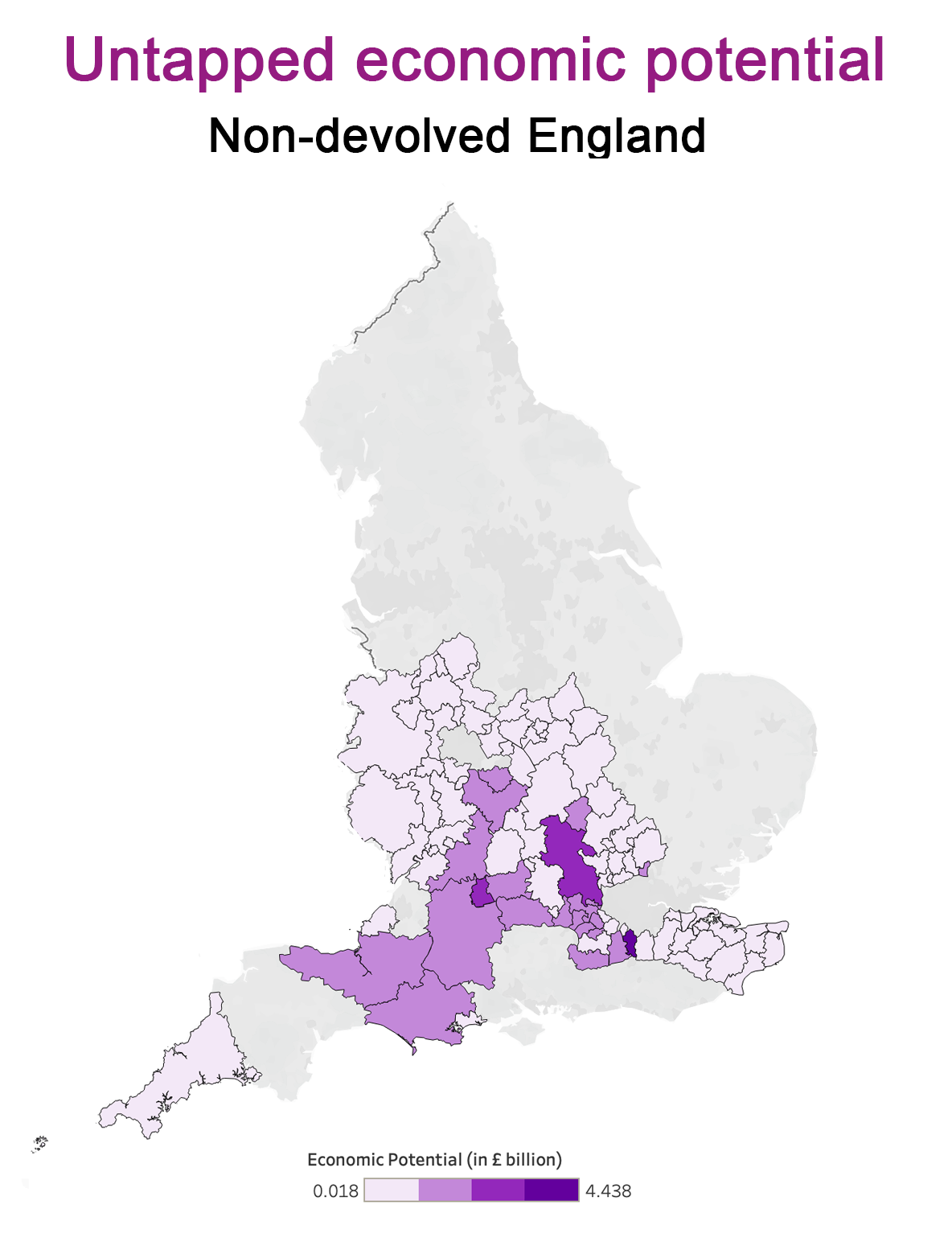
Sector-level analysis further illustrates where councils could make the greatest impact. In non-devolved areas, untapped potential is concentrated in IS-8 sectors, including professional, scientific, and technical activities, and information and communication. For instance:
- Malvern Hills has £481 million of untapped potential in professional, scientific, and technical activities.
- Vale of White Horse could realise £1.4 billion in information and communication.
- Broxbourne has £624 million of untapped potential in manufacturing.
Untapped economic potential: Non-devolved England
Next steps
These examples demonstrate that untapped potential is highly localised, both geographically and sectorally. Unlocking it requires councils to combine local insight with strategic investment, partnership-building, and innovative service design. It also highlights that councils’ role in the wider growth system is not always clearly visible, yet their actions can fundamentally shape the trajectory of local economies.
Recognising an area’s economic potential is only the beginning. Translating that potential into tangible outcomes requires local authorities to act with purpose, coordination and strategic insight. Councils must balance local priorities with broader regional ambitions, navigate resource constraints, and work collaboratively with combined authorities, the private sector, and other partners.
The following sections explore critical influencing factors followed by each pillar in detail, illustrating how councils leverage their unique capabilities to unlock economic opportunities, drive inclusive growth, and create resilient, thriving places.
Critical influencing factors
The effectiveness of councils in driving inclusive growth is shaped by a complex set of interdependent factors. These extend beyond individual programmes or service delivery, influencing how councils operate as growth facilitators, service providers, orchestrators, and anchors in their places. Evidence from interviews highlighted that councils’ capacity to deliver inclusive growth depends not only on internal skills or resources, but on the wider system in which they operate.
Four elements of this system are particularly influential: the extent and coherence of devolution, the clarity, consistency and vision of political leadership, the quality of relationships across tiers of government, and the stability and flexibility of funding arrangements. Together, these factors shape the strategic space available to councils, determining how far they can plan for the long term, coordinate effectively across institutions, and align economic and social priorities.
When these conditions are supportive, councils can act strategically and maximise the impact of all their roles. Coherent devolution gives them authority to shape local priorities, consistent political leadership provides direction, constructive relationships with other government tiers enable coordination, and stable, flexible funding allows long-term investment and adaptive responses to local needs. Under these conditions, councils can convene partners around shared objectives, align service delivery with wider economic goals, and invest in local assets and opportunities. Where these conditions are weak, fragmented governance, short-term funding, and limited collaboration constrain capacity and reduce inclusive growth efforts to isolated initiatives rather than sustained, system-wide strategies.
These systemic enablers and constraints therefore shape not only what local authorities can do, but how effectively they integrate economic, social, and place-based ambitions into a coherent inclusive growth strategy. The following sections explore how these conditions influence councils’ capacity to act as growth facilitators, service providers, orchestrators, and anchors in their places.
Impact of devolution
The widening and deepening devolution agenda has created a shared governance space between local authorities and combined authorities, with government plans for all of England to be represented by mayoral combined authorities making this the expected norm. Councils now operate alongside regional institutions with overlapping responsibilities, requiring careful coordination and negotiation.
True collaboration only works when both sides understand what the other can bring to the table. Otherwise, you end up duplicating effort or leaving gaps."
Senior Officer
The LGA’s own peer learning on devolution highlights that this landscape is still settling and that there is an inherent tension in the system, stating:
Eliminating points of contention between a council and [a mayoral combined authority (MCA)] … is neither desirable nor achievable. An element of tension is in-built into the combined authority model as councils have a responsibility to consider the needs of both their local area and the broader MCA footprint. Organisational boundaries cannot – and should not – always be rigidly defined or consistently maintained, particularly where responsibilities intersect, and joint working is required."
In practice, councils must balance engagement with regional structures to shape strategy and leverage resources, while articulating local priorities to ensure their communities are not overlooked. Interviewees highlighted the importance of councils articulating their assets and opportunities clearly, so that regional decision-making reflects local realities. For instance, in Liverpool, the council emphasised its health and life sciences cluster as a regional asset, ensuring that planning and investment decisions recognised the city’s unique capabilities without ceding delivery responsibility entirely. Similarly, in West Yorkshire, interviewees noted the need for flexibility across city and district boundaries to respond to functional economic geographies rather than rigid political boundaries. Devolution provides councils with an opportunity to influence regional strategy, but its benefits rely on a balance of collaborative engagement and assertive local leadership.
It will always be a shared responsibility between tiers of local government and a negotiation, not always an explicit one. It will evolve over time.”
Senior Officer
Interviewees in areas without devolution arrangements often described a more constrained operating environment. The absence of a formal combined authority means that these councils have limited access to the strategic forums, long-term funding frameworks and dedicated investment programmes available to devolved areas. This can restrict their ability to engage collectively with government, influence regional decision-making, or coordinate priorities across administrative boundaries. As a result, opportunities to align investment, share expertise and plan for inclusive growth at scale are often harder to realise.
Councils in non-devolved areas also highlighted the challenge of operating within short-term and competitive funding processes, which limit strategic planning and investment continuity. Some interviewees noted that, while awaiting devolution deals, their areas risk falling behind in institutional capacity and visibility. This delay can reduce influence over national policy and slow progress on local growth and inclusion priorities.
Participants suggested that non-devolved areas would benefit from a structured mechanism through which to engage government on economic growth and inclusive strategy. A formal forum or strengthened regional partnership could enable councils to coordinate priorities, share evidence and maintain a consistent dialogue with central government, helping to bridge the gap until devolution is in place.
Overall, devolution has created new opportunities for councils to strengthen their strategic role and collaborate across wider geographies. As governance arrangements continue to evolve, there remains scope to ensure that all areas have effective channels for engagement, investment and strategic dialogue, regardless of their formal devolution status.
Funding and flexibility
A sustained reduction in council funding against growing demand has left many authorities operating under severe financial pressure. Non-statutory functions, such as business support, inward investment, and skills development, have increasingly come under strain. Interviewees described situations where councils had the expertise and vision to drive local growth but lacked the resources to act. lacked the resources to act.
We know what needs doing, but without the funding and freedom to act, we are stuck managing crises rather than shaping opportunity.”
Senior Officer
Centralisation of funding and strict regulatory frameworks compound these pressures, limiting councils’ ability to proactively innovate or respond quickly to local circumstances. Several interviewees pointed to the absence of meaningful financial incentives for growth, such as the retention of local tax revenues, noting that councils often absorb the costs of investment without directly benefiting from the gains. In some areas, this has led to councils focusing on statutory responsibilities, while wider opportunities to catalyse growth remain unrealised.
Given the way funding is allocated, we end up doing the work but rarely seeing the rewards. It forces councils to focus on statutory duties like planning, and there’s little room to take risks or drive wider economic growth.”
Senior Officer
Councils’ capacity to deliver inclusive and sustainable growth is heavily influenced by funding flexibility, sustainability, and the presence of meaningful financial incentives.
Political leadership
Political vision and commitment emerged as a decisive factor in enabling councils to drive inclusive and sustainable growth. Strong and consistent leadership helps attract skilled officers, set coherent priorities, and maintain focus on long-term outcomes. In Waltham Forest, for example, interviewees highlighted how consistent place leadership over 15 years enabled the council to become the fifth-largest builder of council homes in London, while delivering complex regeneration projects that integrated housing, employment, and infrastructure objectives.
It’s political leadership that provides a clear vision for economic growth... It doesn’t start with a planning application – it starts with a clear vision and holding your nerve to secure the infrastructure you want to see for your place.”
Senior Councillor
The way you get things done is by having a clear vision and backing your officers to make it happen. Without that, even the best plans stall.”
Senior Officer
Leadership also matters for balancing inclusive growth with broader economic objectives. Councils like Leeds and Manchester have embedded inclusive growth into their strategic frameworks, explicitly linking housing, skills, transport, and employment to broader economic ambitions. Across interviews, it was clear that where elected members actively champion inclusive growth, the council’s ability to coordinate partners, secure investment, and influence regional strategy is strengthened through embedding this as a core principle of activity. Visionary political leadership is central to translating strategy into tangible outcomes, fostering coherence, and ensuring inclusive growth is embedded across council activities.
Strong political leadership on growth is vital. It provides direction, certainty and stability - a confidence that doesn't exist everywhere. Politicians can suffer for that but it gives officers cover, knowing they can try things.”
Senior Officer
The council won’t always get the kudos for the projects it supports, people won’t always understand what it took to get projects through or how they connect to other plans. As politicians you have to be really comfortable with that level of risk.”
Senior Councillor
Connectivity across government tiers
Interviewees repeatedly cited poor coordination and understanding between local, regional, and national government as a major constraint. Many reported duplicated effort, unclear roles, and missed opportunities to align strategy or funding.
Local government has expertise that Whitehall just doesn’t have. If they tapped into that more effectively, policy would land better and investment decisions would be smarter.”
Senior Officer
The splitting of former joint units, such as the Cities and Local Growth Unit, has at times reduced the capacity for central government to engage effectively with councils in a coordinated way on the local growth agenda. Several interviewees noted the importance of sustained engagement, joint problem-solving, and structured communication channels, particularly when implementing large-scale interventions like local growth plans or industrial strategy investments.
We’ve learned that getting around the table regularly, being honest about what each side can deliver, and having clear lines of communication is the only way to make complex initiatives actually work on the ground.”
Senior Officer
Strong connectivity and proactive, structured engagement across government tiers are vital to ensuring that local expertise informs policy and investment, unlocking opportunities for inclusive growth.
The four pillars of local growth
To illustrate the breadth and depth of the role councils play in fostering inclusive growth in their areas, we have developed a four-pillar framework in collaboration with senior local government representatives and wider stakeholders. While services and deliverables can and do intersect across the four pillars, these are intended to capture the multi-faceted role of councils in supporting growth across social and economic policy, statutory services, strategy development, and stakeholder engagement.
Our engagement with local authorities has consistently emphasised that much of what councils contribute is foundational but invisible. These contributions, which range from brokering complex partnerships to sustaining local services that underpin economic activity, are critical to ensuring that growth is inclusive and sustainable.
You can’t quite put your finger on it. It’s the kind of things no one else would do – ‘the secret sauce'."
Senior Officer
The Four Pillars framework recognises that councils operate in dynamic and context-specific environments, balancing local priorities with regional strategies, resource constraints, and the expectations of central government. By unpacking these pillars, we aim to illuminate how councils facilitate growth, deliver essential services, orchestrate partnerships, and anchor economic and social activity within their communities. Each pillar is explored in turn, illustrating both the breadth of council responsibilities and the practical examples through which they drive meaningful, place-based impact.
Pillar one: Growth facilitators
Councils’ crucial regulatory and place-shaping role as an honest broker is fundamental to local growth (spanning planning, building control, licensing and highways). They also play a wider role as partnership facilitators with developers and investors.
Among the four pillars, the role of councils as facilitators of growth emerged most consistently across interviews as the foundation of local economic success. While many actors contribute to growth, councils uniquely combine statutory powers, spatial insight, and long-term commitment to place. Their facilitative function often operates in the background, rarely visible but indispensable to creating the conditions where inclusive and sustainable growth can occur.
Interviewees consistently identified the planning function as central to this role. Councils’ ability to shape development through planning policy, master planning, and regulatory decisions gives them direct influence over the quality, character, and inclusivity of growth.
It is the single most powerful lever we have to steer the economy of a place.”
Senior Officer
Honest broker
Councils act as honest brokers between developers, landowners, and residents, balancing their duty to run an efficient and responsive planning service with their responsibility to secure lasting benefits for local communities. This involves not only adjudicating planning applications but negotiating Section 106 agreements, ensuring adequate infrastructure contributions, and aligning development with long-term spatial and social priorities.
Ours is a story of place leadership – it's put us on the map. 15 years ago, we were historically underfunded in terms of the demands on our services and what we could raise in council tax and business rates. Now we’re the 5th largest council home builder in England with the most affordable housing in any London borough in the last decade – this was the only way forward to improve outcomes for residents.”
Senior Councillor
The council is the ‘honest broker’ - we have the longevity, the commitment to quality, and are driven by what’s right for the place with no vested interest.”
Senior Officer
Interviewees also noted that this role often requires delicate judgement on councils’ part.
You have to be decisive enough to give investors confidence, but firm enough to make sure local people see the benefits of growth.”
Senior Officer
Equally, being an honest broker can’t result in a dead hand on the economy. Cities face a punishing viability challenge and it’s difficult for investment to convert to actual value so you have to be contextual not dogmatic and that agility isn’t naturally characteristic of local government.”
Senior Officer
Examples from places such as Waltham Forest and Bristol show how councils can use planning powers to capture value for communities through affordable housing, green infrastructure, and design quality, while maintaining a credible, business-friendly stance that supports investment.
The effectiveness of councils as honest brokers depends heavily on officer expertise and political backing. Where planning teams are empowered to negotiate creatively, councils can secure outcomes that are both commercially viable and socially responsible.
Partnership facilitator
Councils also perform a vital partnership facilitation role, connecting partners across the public and private sectors. This often means coordinating multiple agencies to ensure that development can progress smoothly, including transport authorities, utilities, housing associations, and government departments.
While councils may not always lead major investment negotiations, interviewees highlighted their irreplaceable contribution to the 'last mile' of delivery, resolving practical barriers and keeping projects on track.
The big deals might get signed elsewhere, but we’re the ones who make sure the lights get connected, the roads get built, and the planning conditions make sense.”
Senior Officer
Development partner
Geography and market conditions shape how councils act as development partners. In places where land values are lower or private investment is limited councils often intervene directly to unlock development and regeneration. Interviewees described situations where councils assembled land, provided enabling infrastructure, or established local delivery vehicles to bring forward sites that would otherwise remain stalled.
Councils are best placed to identify the need for investment in their place by setting out their ambition, identifying which sites are viable and finding the right partners. They also have the covenant strength and the levers to help secure that investment.”
Stakeholder
Sometimes the only way anything happens is if we step in. In weaker markets, there’s no private sector solution - the council must make it viable.”
Senior Officer
This willingness to intervene, however, is constrained by financial capacity and the regulatory environment. Councils that are empowered by their leaders to take calculated risks and invest strategically can play a catalytic role in shaping their economies. Those without sufficient flexibility or funding often face the difficulty of identifying opportunities they cannot pursue.
The growth facilitator role captures the distinctive combination of statutory power, local insight, and convening authority that councils bring to the economic landscape. Through their planning functions, their relationships with investors and developers, and their interventions in place-making, councils give shape and direction to growth that might otherwise be uneven or extractive.
“We’re not just gatekeepers. We’re enablers. Growth doesn’t happen without us setting the terms, holding the relationships, and seeing it through.”
Senior Officer
Councils’ ability to fulfil this role effectively depends on the broader system around them, including the devolution context given this is increasingly a shared space with combined authorities, funding mechanisms, political leadership, and the level of coordination across tiers of government. These influencing factors determine whether councils can act as proactive shapers of place or are confined to reactive regulation.
Case study: Wyre Forest - South Kidderminster Enterprise Park
Devolution status: Non-devolved England
The South Kidderminster Enterprise Park (SKEP) is a regeneration and employment project that successfully brought defunct sites, including the old British Sugar factory, back into use. It was originally proposed in 2012 and has subsequently been used by 17 businesses and provided £25 million to the local economy. To a place that topped the 10 per cent most deprived wards nationally, this represents a huge success.
Originally, a bid was put in for SKEP to have Enterprise Park status at the national level, but this was unsuccessful. However, the council saw potential in the area and used existing and emerging local policies to implement a local development order, which enabled the development to happen at pace and gave existing businesses greater flexibility. The council balanced the needs of the enterprise park development with the need to preserve the abundant existing natural resources, which are in turn leveraged to support Wyre Forest’s tourism industry.
Case study: Barnsley - Glass Works
Devolution status: Part of an Established Strategic Authority
Glass Works is an ambitious urban regeneration project that opened in 2021. A 269,000 square foot shopping and community centre located in the heart of the city, it boasts not only national and international shopping, but a local vendor’s market and family events.
The project faced many hurdles along the way. First, the area faced difficulty attracting investment because of low land values, a persistent problem that Northern local councils are well acquainted with. Several attempts were made to develop the centre privately, but those fell through and eventually the local authority stepped in, investing £140 million. Second, phase one of the construction was completed during the COVID-19 pandemic, making it all the more challenging to attract footfall. The council tackled this by creating an ambitious schedule of family-friendly events. This strategy paid off, with Glass Works seeing ever-increasing footfall since its opening. In 2021, footfall had already reached near pre-pandemic levels, bucking the nationwide trend and makes Glassworks stand out as an exemplary town centre. In an update to the cabinet, it was reported the town centre is having a substantial positive effect on locals’ health and wellbeing, providing them with an inclusive and welcoming social space for people of different backgrounds and all ages.
Case study: Great Yarmouth - Operations and Maintenance Campus
Devolution status: on the Devolution Priority Pathway
Great Yarmouth Borough Council is advancing a world-class Operations and Maintenance (O&M) Campus to support the next generation of offshore wind farms off the East Anglian coast. The ambition is straightforward but significant: deliver sustainable, resilient infrastructure that enables efficient offshore operations, create high-quality long-term jobs, accelerate local skills development, and reinforce Great Yarmouth’s position as a leading energy and logistics hub.
Great Yarmouth shares many of the same challenges as other coastal English towns: high unemployment, seasonality, depressed wages, and skill challenges, as shared in the council's Economic Strategy 2020 to 2025. But the council recognise that they are sitting on a game changing opportunity in the form of renewable energy. The East of England is the largest offshore wind cluster in the UK, meaning it has the potential to drive both the sustainable energy revolution and local inclusive growth. Indeed, our own analysis from Phase 1 showed that Great Yarmouth is sitting on £220 million untapped economic potential in the professional, scientific and technical sector, representing nine per cent of its economic output. Great Yarmouth partnered with Norfolk County Council to fund the project which is projected to create 650 jobs and refurbish 240 metres of river quay. The project started in 2021 and Phase 1 is expected to complete in 2026, Phase 2 in 2027.
Pillar two: Providers of vital services
Councils play an essential role supporting residents and businesses to thrive in their communities across hundreds of vital frontline services, thereby addressing key barriers to inclusive growth through early years, education and skills, and employment support. They are also a lifeline for businesses, providing vital services from business support to trade waste, licensing, environmental health and food standards.
While councils are often recognised for their role in enabling development, interviewees consistently emphasised that their most enduring impact on inclusive growth comes from their day-to-day role as providers of vital services.
If a place doesn’t work for its people, it won’t work for its economy. Growth starts with stability, and that’s what councils provide.”
Senior Officer
Councils deliver the essential functions that make places safe, liveable, and attractive for residents and businesses alike. This foundational role underpins all other forms of local growth activity.
This is massively underplayed. We know that having a good job is one of the critical determinants of health so, both in terms of outcomes for individuals and the sustainability of local government, the ability to help people into work is a really important part of the social care system.”
Senior Officer
Through hundreds of statutory and non-statutory services, councils sustain the conditions that allow businesses to operate and residents to flourish. Education, social care, housing, waste management, public health, and local infrastructure together form the backbone of local prosperity. This contribution is often overlooked in national policy debates but is critical to the functioning of local economies.
Social infrastructure
Many interviewees highlighted that councils’ influence on economic outcomes extends well beyond direct business support and physical regeneration. Their control of social infrastructure, from early years and education through to public health and social care, gives them unparalleled reach into the everyday lives of residents at a holistic level. These services shape opportunity, reduce barriers to participation, and help people move into and remain in work.
One participant described this as:
The invisible scaffolding of growth – the things that keep communities functioning and give people the chance to contribute.”
Councils’ ability to join up social and economic policy locally is one of their defining strengths. For example, integrating employment support with adult learning and health services was cited as an approach that helps those furthest from the labour market build the confidence and skills they need. This joined-up model not only delivers better outcomes for individuals but strengthens local labour markets and supports business productivity.
It’s a differentiator – we can draw in statutory services like children’s social care into the work of skills through our relationship with young people not in study or work and care experienced young people. We’re the only ones with the links into those statutory functions.”
Senior Officer
However, participants also warned that continued financial constraints are undermining this type of preventative work. Several noted that without adequate resourcing, councils are forced to prioritise statutory duties at the expense of the services that sustain long-term inclusion and growth.
We know the interventions that work – but the system is set up to deal with crises, not to invest in prevention.”
Senior Officer
Another cautioned:
In a world where scarce resources have got scarcer, every local authority has to think about what it can do and what it must do. Given the 1,300 pieces of statute that local authorities have to implement, the 25 per cent reduction in real spending power and the demands of its adults’ and children's services, councils have to stick to the things they must do.”
Senior Officer
Supporting local businesses and everyday economies
Beyond the social sphere, councils play an equally vital role in maintaining the everyday economy. For many small and medium-sized enterprises, their main point of contact with the state at any level is through the council. Licensing, trading standards, planning, and environmental health services may appear transactional, but they are fundamental background enablers to the smooth running of local commerce.
Interviewees described this as the 'lifeblood' of local economic systems – the practical, responsive support that keeps high streets trading and supply chains functioning. In some areas, councils also offer business advice, facilitate local networks, and help firms access funding or procurement opportunities. These activities create a more resilient and diverse business base, with direct links to employment and community wealth building.
The way we regulate, support and engage with small businesses matters. It’s not about red tape; it’s about helping them to succeed safely and sustainably.”
Senior Officer
Creating confidence and attractiveness
Councils’ role as service providers also plays a role in shaping how places are perceived by investors, visitors, and residents alike. Well-maintained public spaces, reliable transport, clean streets, and safe communities all contribute to a sense of confidence and belonging. These factors, while often considered ‘everyday’, were described by several interviewees as essential preconditions for attracting and retaining investment in their place.
Investors notice when a place is cared for. It signals competence and pride, and that changes the conversation about what’s possible.”
Stakeholder
This civic stewardship of maintaining the physical and social environment represents one of councils’ most tangible contributions to long-term economic health. Yet, as participants highlighted, it is also one of the most vulnerable to funding pressures. When resources are constrained, visible local maintenance and preventative services are often the first to be reduced, despite their proven impact on public confidence and local economic vitality.
Case study: Hertfordshire Step2Skills
Devolution status: Non-devolved England
Step2Skills is an employment support service that focuses on helping adults with barriers to engagement. It covers users with a wide variety of needs who may otherwise slip through the cracks of national employment service programmes, including those with low basic skills, learning or physical disabilities, mental health conditions, or simply those who lack the confidence to continue learning.
The Step2Skills brand was officially launched in July 2020, but it builds upon over three decades of employment support programmes under the previous name of Hertfordshire Adult & Family Learning Service (HAFLS).
From 2022 to 2023, Step2Skills successfully delivered the Inclusive Employment Project, which was a result of funding awarded by the EU’s European Social Fund. This project supported 367 individuals, 20 per cent of whom came from ethnic minority backgrounds, with tailored support. The programme successfully helped 60 per cent of its participants into employment, education and training. In 2022, Step2Skills was awarded funding by the UK government to deliver Multiply, which saw 9000 participants receive sustained maths support for two and a half years.
Pillar three: Orchestrators
Councils leverage their democratic and convening power to galvanise the energy of actors across public, private and voluntary, and community sectors.
Councils play a critical role in bringing together a diverse range of partners across the public, private, voluntary, community, faith and social enterprise (VCFSE), and education sectors to set and achieve shared goals for their places. Growth and prosperity are rarely delivered by a single organisation acting alone, and councils are uniquely positioned to convene, coordinate, and maintain momentum across public, private, and voluntary sectors to ensure individual efforts amount to more than the sum of their parts.
Interviews highlighted that the most effective councils demonstrate both humility and strategic insight, recognising where they can add value and where others are best placed to lead.
Our strength is in connecting people, ideas, and resources. We can’t do it all, but we can make sure the right people are in the room and working toward the same goal.”
Senior Officer
Whether in smaller local economies or across combined authority areas, councils act as facilitators and connectors, ensuring that collaboration translates into tangible outcomes for residents, businesses, and the wider local economy.
Building collaborative partnerships
Effective councils recognise that they cannot achieve growth alone. They convene diverse cross-sectoral partners around shared objectives. One officer reflected:
Our role is to make sure everyone who needs to be in the room is there and understands their part in making things happen. Without that, even the best plans can stall.”
Councils act as facilitators, helping partners align priorities, share resources, and maintain momentum toward common goals.
Councils are powerful convenors. We have brought key people together across partners in one room to build trust and a shared vision in the interests of pulling together. The council is no longer in the chair; it’s properly owned by the city.”
Senior Councillor
Another interviewee shared:
The best examples are councils which use their soft power, understand they can't act alone, and involve private sector partners who create growth. Sometimes we underestimate what councils do, but by bringing partners together, co-ordinating effort, and facilitating effective partnership they can secure significant investment.”
Stakeholder
Councils can use their convening power to get to know and develop relationships with their partners and to drive forward the things that matter in that place and which don’t depend on government telling you want to do.”
Senior Councillor
However, councils increasingly lack the capacity to invest in building these vital partnerships.
Orchestration needs teeth, and if you don’t have the structures to bring people together with a shared agenda, this is a struggle without the revenue funding for the capacity you need to connect to cultures in different organisations and build the relationships.”
Senior Councillor
Leading locally, supporting regionally
In smaller local economies, councils often take a central convening role, ensuring that initiatives are grounded in local priorities and needs. They provide structure, continuity, and credibility, enabling different organisations to work together effectively. Interviewees emphasised that in these contexts, the council is often the linchpin that enables collaboration to translate into tangible outcomes.
Within combined authority structures, orchestration is shared across a larger regional scale. Councils play a role in supporting efforts at the regional level while often taking the lead on specific initiatives.
At a regional level, councils are less about being the lead and more about connecting the dots – making sure local voices are heard and that everyone is pulling in the same direction."
Senior Officer
Strong regional coordination allows councils to influence investment and strategy while ensuring the priorities of local communities are represented.
Councils know their place better than anyone, with that knowledge at their fingertips. Combined authorities can convene across sectors, but councils bring the relationships at a more granular level.”
Senior Combined Authority Officer
In practice, effective orchestration requires councils to balance leadership, convening, and coordination, adapting their role to the scale and context of their local economy. Whether acting as the central convener within their geographical boundaries or coordinating across a combined authority region, councils’ ability to bring partners together around shared objectives is essential for setting strategic ambitions and turning these into tangible outcomes for sustained inclusive growth.
Elevating community voice
Councils are well placed to ensure inclusive growth reflects the realities of local life, and genuine community participation is essential to achieving this, with communities representing councils’ most important stakeholders. Residents know which issues matter most. Through everyday organising and mutual support, communities naturally focus on the needs that affect them most directly. Councils can amplify these voices and bring them into formal decision-making so that priorities reflect real experience rather than assumptions.
Participatory policymaking provides a clear route for this. Place-based engagement, community workshops, targeted conversations and co-design sessions all allow residents to shape priorities from the outset. These approaches build trust and help ensure strategies are grounded in what communities say they need.
Community participation also improves delivery. Tools such as participatory budgeting, resident input on project sites, collaboration with community organisations and panels that track progress help keep programmes responsive and accountable.
Capacity pressures mean councils cannot do this alone, making it central to their role as orchestrators with wider stakeholders. Partnerships with voluntary and community groups, faith organisations, housing associations and local businesses help broaden engagement and sustain it over time. By embedding participation throughout their work, councils can amplify community insight, strengthen local ownership and ensure inclusive growth delivers meaningful benefits for the people it is intended to support.
Case study: Southampton - Renaissance Board
Devolution status: on the Devolution Priority Pathway
Southampton’s Renaissance Board is an example of how powerful local councils can be when it comes to convening power. The Renaissance Board, formed in 2023, is an advisory board formed of members from the public, private, and academic sectors. With a mission to drive growth and development that will be shared equally across the area, it is a strong force benefitting disadvantaged members of the community.
Innovation drives growth, but it comes with risks that are not always easy for the public sector to swallow. Local councils like Southampton are well-positioned to draw on their knowledge to decide when and where to take risks. Creating partnerships between powerful institutions to share those risks takes time, care, and the ability to bring stakeholders on board to a shared vision of the future. Southampton Council has been able to successfully bring together representatives from across the public and private sector, including local universities, The Association of British Ports, Network Rail, the football club to work towards a shared vision of Southampton’s future.
Case study: Liverpool - Liverpool Visitor Economy Partnership
Devolution status: part of an Established Strategic Authority
Liverpool City has built a strong international reputation as a world-class destination for cultural tourism. From its designation of European Capital of Culture in 2008, to UNESCO City of Music in 2015, to the hosting of the Eurovision song contest in 2023, Liverpool City Council (LCC) has capitalised on the city’s strong cultural assets to drive inclusive growth, generating over £6 billion in 2023 alone and employing more than 58,000 people.
Moving forward, LCC has partnered with the Liverpool City Region Combined Authority (LCR) to broaden the visitor economy outward to bring the benefits of cultural tourism to the whole region, accomplished through the creation of the Local Visitor Economy Partnership (LVEP) and the new Destination Management Plan. LCR is working alongside the local councils of Halton, Knowsley, St Helens, Sefton, and Wirral to highlight the distinct features of each while planning easy transportation links to create the best possible visitor package. LCC have been proud to share their resources and expertise, allowing the whole region to benefit.
Pillar four: Anchors in place
Councils are significant economic actors in their own right as major employers and buyers in their places.
Councils act as major economic anchors, shaping the social, economic, and environmental landscape. They are some of the largest employers and buyers in their places, managing substantial budgets, commissioning services, and investing in capital projects. Councils also hold valuable assets in land and housing, although financial constraints limit their ability to deploy these fully.
Interviewees emphasised that councils’ economic footprint extends far beyond direct service delivery, influencing inclusive growth through employment practices, procurement decisions, and capital investment.
We are the place’s biggest employer and buyer. What we do shapes the economy day in, day out, even before you consider the services we provide.”
Senior Officer
Case study: Leeds - Leeds Anchor Network
Devolution status: part of an Established Strategic Authority
The Leeds Anchor Network (LAN), formed in 2018, connects organisations across the public and private spheres to help them maximise their benefits to the local community. It currently boasts 14 members including higher educational institutes, NHS trusts, utility companies, and the local council. Together, these institutions employ over 58,000 people and contributed over £720 million to the Leeds economy in 2020/21 (Leeds Anchors Playbook). The network has been committed to inclusive growth since its inception, actively collaborating to make a difference with their employment, procurement, and service delivery. The council has since designed a playbook for developing an anchor network to support other places wanting to take this approach.
Leeds’ success shows us that local authorities are able to effectively drive resources to where they are most needed, then orchestrate change by convening local institutions to leverage their powers as employers and procurers. Currently, 24 per cent of employees at anchor institutions live in the most disadvantaged local communities, meaning that more people are able to access good jobs because of the network. The LAN has successfully shifted many of its supply chains to local businesses, with over £1 billion of goods and services currently purchased locally. Such impressive success stories remind us not to underestimate the ability of local leaders in connecting with their communities.
Economic impact of councils
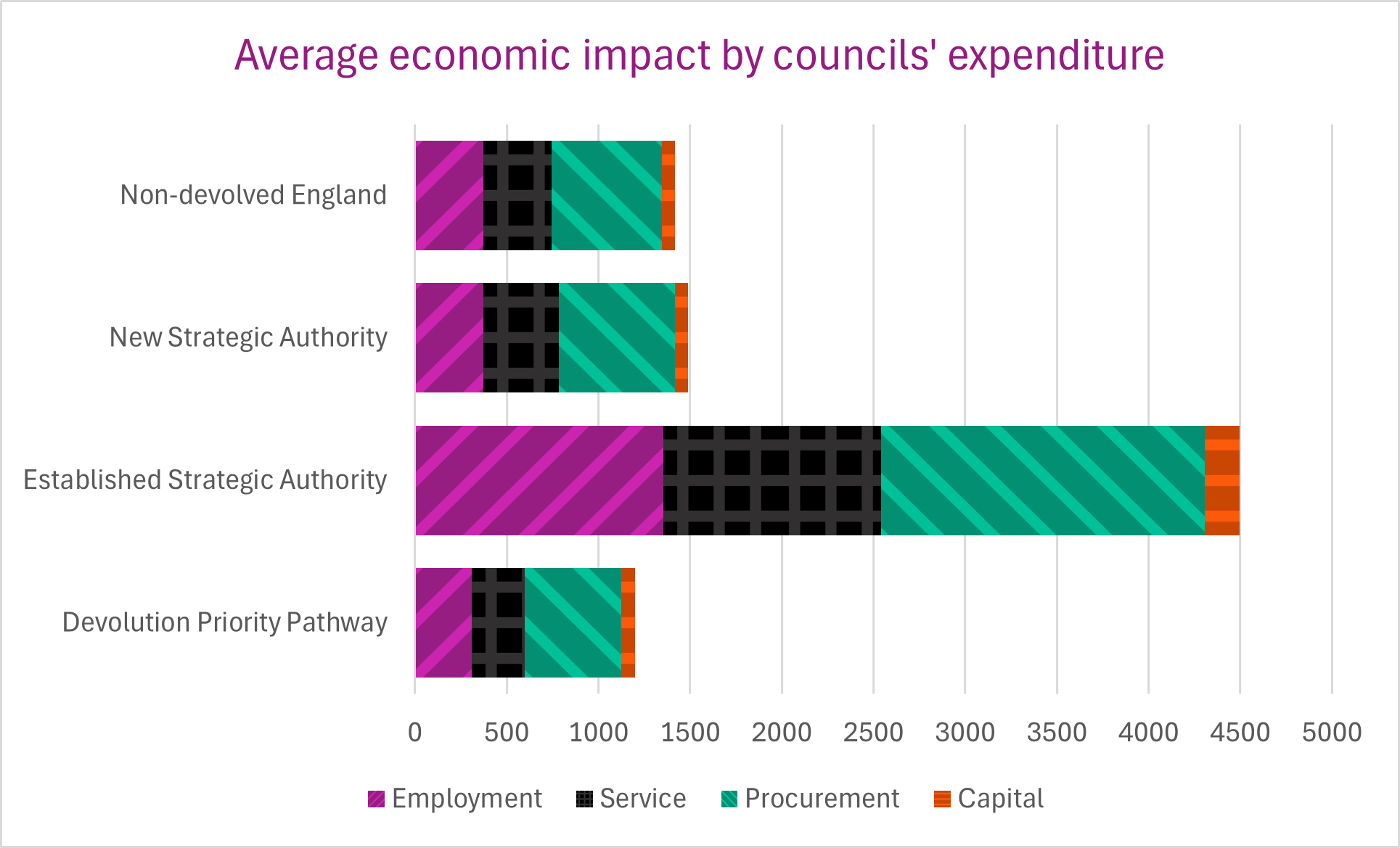
According to our research based on local expenditure data, councils already have a substantial impact, employing 1.18 million people and contributing a total of £149 billion annually to the whole economy and £117 billion to local economies through their roles as employers, investors, and service providers. Procurement alone contributes £875 per capita, employment £599 per capita, and services £565 per capita, with capital investment providing an additional £101 per capita. Even smaller, non-devolved councils collectively generate at least £30 billion in economic impact, including £23.7 billion in local economic activity and £1.3 billion in capital investment (figures based on GRN analysis of LGA Inform local authority-level expenditure data from 2024. For detailed methodology, please refer to the appendix).
| Economic lever |
Total impact (£ billion) |
Per capita (£) |
|---|---|---|
| Capital |
6 |
101 |
| Procurement |
59 |
875 |
| Service |
42 |
565 |
| Employment |
42 |
599 |
| Total |
149 |
2140 |
This impact is distributed differently across places and, as expected, we find that established strategic authorities, which include many of England’s major city regions, have the largest impact at nearly £4,500 per capita. This is partly a function of their larger spending allocation from national government, which is based on need and population.
Local authorities in other areas already have substantial impacts that should not be overlooked, for example, those within the devolution priority pathway contribute an average of £1,200 per capita to the economy. A detailed methodology can be found in Appendix B of this report.
Average economic impact by council's expenditure
Procurement and social value
Councils are among the largest investors in their local economies, spending substantial sums on goods, services, and infrastructure projects that range from social care and housing to transport, education, and community development. This purchasing power positions councils as key economic and social drivers with the ability to shape local prosperity.
Through strategic procurement, councils can embed social value, ensuring that every contract delivers benefits beyond the immediate service or product. This includes supporting local supply chains, promoting small and medium-sized enterprises, and creating opportunities for diverse and underrepresented businesses. Councils can also use procurement to encourage fair employment practices, provide apprenticeships and training, and strengthen workforce skills, helping residents to gain sustainable employment and progress in their careers.
Procurement can also drive environmental and social outcomes, such as promoting sustainable sourcing, reducing carbon footprints, and fostering community wellbeing. By prioritising suppliers and projects that deliver these broader benefits, councils ensure public investment contributes to stronger, more resilient communities.
Importantly, councils’ role in procurement extends beyond transactional relationships. They act as anchor institutions, shaping local economic ecosystems. By leveraging their buying power thoughtfully, councils can stimulate economic growth in every neighbourhood, strengthen local resilience, and ensure that prosperity is inclusive, reaching all residents and communities, particularly those historically marginalised or underserved. In this way, procurement becomes a strategic tool for councils to fulfil their broader mandate of fostering thriving, equitable, and sustainable communities.`
A blueprint to accelerate councils’ role in driving inclusive growth
Councils play a vital role in supporting local prosperity and inclusive growth, with opportunities to make a meaningful impact across all communities. Evidence from this research shows that achieving inclusive growth is complex and shaped by local economic, social, and institutional contexts. Many of the influencing factors are place-specific and require tailored, locally informed responses. This highlights the value of close and constructive engagement between national and local government, ensuring that councils’ strengths and insights inform policy design and delivery.
Based on our research, we have identified a set of guiding recommendations to support this shared approach. These are intended as flexible ideas rather than prescriptive instructions, relevant across national, regional, and local levels, and adaptable to each council’s context, priorities, and partnerships. The following recommendations set out practical ways to strengthen the conditions for locally led inclusive growth.
Key recommendations
Funding
Ensure sustainable, multi-year funding with fiscal flexibility
National government should introduce a sustainable, multi-year funding framework that provides councils with the certainty they need to plan and invest effectively. Consolidating fragmented and non-ringfenced funding streams would give councils the flexibility to respond to local priorities and to changing needs. Funding arrangements should also safeguard the long-term viability of both statutory and non-statutory services, recognising the vital role that prevention, community development and culture play in supporting inclusive growth.
As part of this approach, government should set out indicative capital allocations that extend well beyond Spending Review cycles. Greater visibility of future investment pipelines would strengthen long-term planning for infrastructure and regeneration, enable councils to align projects more strategically and attract co-investment, and support more confident management of delivery risks.
There is also strong support across local government for more substantive fiscal devolution. Giving councils greater control over local revenue streams, including the ability to benefit directly from local economic growth, would create clearer incentives for development and allow places to reinvest returns in local priorities. Options such as expanded business rate retention, more local discretion over council tax, and exploring land value capture mechanisms could all help strengthen the link between local growth and local benefit. These tools, taken together, would provide councils with the fiscal flexibility needed to deliver ambitious, place-based growth strategies.
Cross-tier collaboration
Coordinate action across local, regional, and national levels
Government should establish structured mechanisms for continuous engagement between local, regional, and national tiers in all areas. This would help align strategic priorities, improve policy coherence, and ensure national initiatives reflect local evidence and experience. Enhanced multi-level collaboration would support more consistent delivery, strengthen accountability, and enable joint responses to shared economic and social challenges. This could include initiatives such as an investment tracker, capturing levels of investment across English regions and monitoring disparities between London, the South East, and other regions, as highlighted in The Future Governance Forum’s Impactful Devolution 03: A Toolkit for Regional Growth and Industrial Strategy. Our interviews also suggest that a structured mechanism for engagement with central government such as a formal forum would be welcomed by councils in non-devolved areas.
Share professional experience across tiers of government to improve cross-tier working and dialogue
Government should work with local and regional authorities to operate a high-profile secondment programme, not limited to regional government as outlined in the English Devolution White Paper, enabling civil servants to gain experience in local government and vice versa. Such exchanges would foster mutual understanding, strengthen collaboration, and support more effective cross-tier working.
Local growth and investment plans
Co-design Local Growth Plans with local authorities
Reflecting best practice, combined authorities should partner with local councils to co-design Local Growth Plans that embed inclusive growth principles. Plans should be evidence-based, making the most of local and regional data, reflect the diversity of local economies, and ensure that growth generates fair employment, improved skills, and resilient communities.
Develop investment plans and pipelines of investable projects
Councils within combined authority areas should develop clear investment plans supported by a pipeline of investable projects. These plans should contribute to the development of Local Growth Plans, demonstrating how proposed investments deliver inclusive outcomes and attract both public and private finance to strengthen long-term local capacity.
Councils’ role in non-devolved areas
Develop growth and investment plans in non-devolved areas
Councils in non-devolved areas should prepare a local growth plan for their place. These should also be supported by clear investment plans and by pipelines of investable projects. As detailed below, we recommend that the LGA play a role in supporting places in non-devolved areas with these plans.
Local Government Association support
Build an evidence base and share best practice on inclusive growth
The LGA could strengthen the national evidence base by identifying and disseminating best practice in inclusive growth, including best practice in collecting data and monitoring the impact of inclusive growth policies. It should facilitate peer learning, support capacity building for local growth plans, broker relationships between councils and relevant government departments, advocate for evaluation of economic development programmes, and promote strategies for attracting and leveraging investment to deliver equitable, sustainable outcomes.
Prioritise local growth in advocacy and support
The LGA could continue to further prioritise local growth, allocating more of its resources to this area, advocating with government and providing advice and resources to support high-quality statutory and non-statutory services, including business support and regulatory services, that underpin inclusive growth.
Provide targeted support for councils in non-devolved areas
The LGA has the networks to support councils in non-devolved areas by assisting with the development of growth and investment plans and brokering relationships between councils and government departments, particularly the Department of Business and Trade and HM Treasury. Such support could include priming places for future devolution arrangements by helping to develop their project pipeline.
Appendix B: Analysis of councils as anchor institutions
Available on request. Please email [email protected].