
Executive summary
Disclaimer: This report was commissioned prior to government’s announced to abolish PCCs from 2028 and to delay some elections for Mayors
The government’s devolution agenda in England will change the landscape of how policing and crime is governed. New mayors, with multi-year funding and responsibility for a broad policy remit across their regions, are set to take on powers currently held by police and crime, and in some cases fire, commissioners. They will be responsible for holding the police to account, setting police and crime plans and budgets and become the elected voice of the public in policing.
The pace and scale of devolution are ambitious, with five priority areas set to elect mayors and potentially transfer Police (Fire) and Crime Commissioner (P(F)CC) functions by May 2026. Planning needs to happen now to give new mayors clear options and outline plans for how to incorporate policing and crime functions and make early, informed decisions that will help to keep their communities safe. Learning from existing mayoral areas, some of the major decisions new mayoral authorities should consider are:
- Governance: appointment of a Deputy Mayor for Policing and Crime and how they should work with the mayor, where fire and rescue will sit and how to get a strong grip on the complex finances and risks that come with policing
- Organisation design: whether to directly transfer existing Office of the Police (Fire) and Crime Commissioner (OP(F)CC) roles or spread them across the mayoral authority, how to ensure the right staff support for policing and crime and where to place it
- Culture: how far policing teams should be integrated into the wider culture of the mayoral authority and what the shared vision is
- People: whether pay, grades and terms will be harmonised and what people’s roles will look like
- Performance and scrutiny: how to maintain strong policing performance and oversight throughout transition and what role the Police and Crime Panel will play
- Infrastructure and technology: what ICT and physical space policing and crime will share with the mayoralty, and what should be uncoupled from the constabulary
Mayors can get significant benefits from taking on P(F)CC functions, not least the ability to join up public services across their region to prevent and reduce crime. Community safety is vital for regions to thrive and grow their economies. Oversight of policing and crime brings clear political risks too. A poorly handled high-profile crime event or policing failure can easily derail a mayoralty.
It is therefore essential that those establishing new mayoral authorities engage in constructive, open dialogue with P(F)CCs and their offices and with operational police and fire leaders now, so that they have a good understanding of what they will be inheriting and can hit the ground running. Central government can aid this process – without undermining its localist agenda – by clarifying key policy details, crafting clear legislation to underpin changes, and stewarding the priority devolution programme with care. The experience of areas that have already transitioned to a mayoral model and the support of organisations like the APCC and LGA will also be vital.
Introduction
Devolution is reshaping how government works in England. At the heart of structural changes, the current devolution agenda proposes the establishment of Mayoral Strategic Authorities (MSAs) with broad remits and clear sets of powers across different public services. As part of this, the government’s vision is for more mayors to take on the functions of Police and Crime, and Police, (Fire) and Crime Commissioners (P(F)CCs).
How can such transfers of power be made successfully? Policing and crime brings big budgets, big risks and big responsibilities, typically being the largest single function in a mayoral authority. New mayors and the local leaders involved in setting up mayoral authorities will need to ensure that transfers of power maintain and strengthen accountability of the police while also building systems that foster collaboration and joined-up strategies to prevent and reduce crime. Mayors may have better chances of achieving economic growth for their region if their community feels fundamentally safe.
This document aims to help answer the question of how to manage successful transfers of P(F)CC functions and guide areas where devolution is happening. We outline challenges and opportunities for policing governance in mayoral models and the design considerations that need to be made as new authorities are being established. We set out implications for managing the transition process itself and broad recommendations for central and local government and others involved in the process.
Our analysis draws on the experience of both politicians and staff in areas that have already transferred P(F)CC powers to mayoralties, as well as insights from current P(F)CCs and their offices, local government and national government stakeholders. We anticipate that more lessons will be learned as more areas go through devolution and hope this document is the start of an ongoing process of shared learning and evolving guidance. Our scope looked at the mechanics of transfer while remaining neutral on the policy question of whether a mayoralty is the ’right’ model for P(F)CC functions. We focused on local issues, though incoming mayors and others will need to be conscious of and involved in national developments, including the policing reform agenda.
This project was commissioned by the Association of Police and Crime Commissioners (APCC), delivered by Leapwise, and overseen by a steering group comprising the APCC, the Association of Police and Crime Chief Executives (APACCE) and the Local Government Association (LGA), with Home Office and Ministry of Housing, Communities and Local Government (MHCLG) input. Detail of the Leapwise research methodology is provided in Annex A.
Note on terminology
For the sake of brevity, we have generally used the following terms:
- ‘Deputy mayors’ for Deputy Mayors for Policing and Crime or their equivalents.
- ‘Mayoral Authority’ as a generic term to cover Mayoral Combined County Authorities, Mayoral Combined Authorities and Mayoral Strategic Authorities (this will be the new name for what are currently Mayoral Combined Authorities. Some will also be designated as Established Mayoral Strategic Authorities). Unless specified, we do not include London which has a unique set of governance arrangements.
- ‘P(F)CC’ and ‘OP(F)CC’ as a catch all term for PCCs who do not hold fire and rescue functions and PFCCs, who do.
How to use this report
This report is intended to support stakeholders in local areas where transfers of P(F)CC functions to mayoralties are set to take place, particularly P(F)CCs and their officers and local authority staff involved in devolution. Those already familiar with the policy context and agenda may skip to sections 4 and 5 on the target operating model and transition process.
Devolution of P(F)CC powers in context
The Police and Crime Commissioner role to date
Police and Crime Commissioners were established by law in 2011, replacing police authorities in England and Wales. Democratically elected to give the public more say in policing, set strategic direction for policing and hold forces to account while respecting the operational independence of the police, PCCs were also given powers to commission services and set funding levels. The creation of PCCs was a significant step in the devolution of policing, community safety and criminal justice.
The first PCC elections were held in 2012, with electoral geographies aligned to 43 police forces. Since then, the role has matured, with some PCCs also taking on responsibility for the governance of fire and rescue services since 2017. Each P(F)CC, and the office of politically restricted staff who support them (the OP(F)CC), operates slightly differently in response to local circumstances, history and the expectations of the P(F)CC. Some host violence reduction units or community safety partnerships while others work more narrowly to the statutory functions of a PCC, which include appointment and holding to account of chief constables, setting the police budget, setting the police precept and publishing a Police and Crime Plan.
Devolution to date
Over the last two decades government approaches to decentralisation have been mixed. At times, governments have sought to move power away from Westminster and across England through mechanisms like regional development agencies, Local Enterprise Partnerships (LEPs) and more recently through groupings of councils in combined authorities, often with a directly-elected mayor sometimes called a ‘metro mayor’. Devolution has not been uniform. Some localities have not pursued devolution, whilst others have with varying powers and governance structures. At the same time, there have also been shifts away from the general trend towards devolution. Different government departments have periodically sought to increase central control over local approaches (for example, through greater budgetary control like ‘ring-fencing’ of central funding for specific purposes), central targets or policy standardisation. Indeed, several aspects of the current police reform agenda led by the Home Office involve greater central direction-setting through a robust central police performance framework and strict controls on both overall officer numbers and the number of officers in neighbourhood policing roles.
Devolution has largely been done through a system of ‘deals’ where local areas negotiate a settlement of powers and funding agreements with central government. This has resulted in a complex map of devolution. Some deals have created a mayoral combined authority, or non-mayoral county combined authorities and others are agreements with single councils; exact powers differ across them.
There are five areas, shown in Figure 1 below, where the position of PCC with the duties and powers it involves, is currently held by a mayor. In all of these areas, the police boundary co- incidentally aligns to the Mayoral Combined Authority boundary. This includes London which has a unique statutory framework. Plans to transfer PCC functions to the mayor of the West Midlands Combined Authority were halted in 2019 due to local opposition and again in 2024 when the High Court found the Home Secretary had acted unlawfully.
There are a further nine areas that have mayoral combined authorities but do not currently hold PCC powers – in most cases because their geographies do not align neatly with police forces.
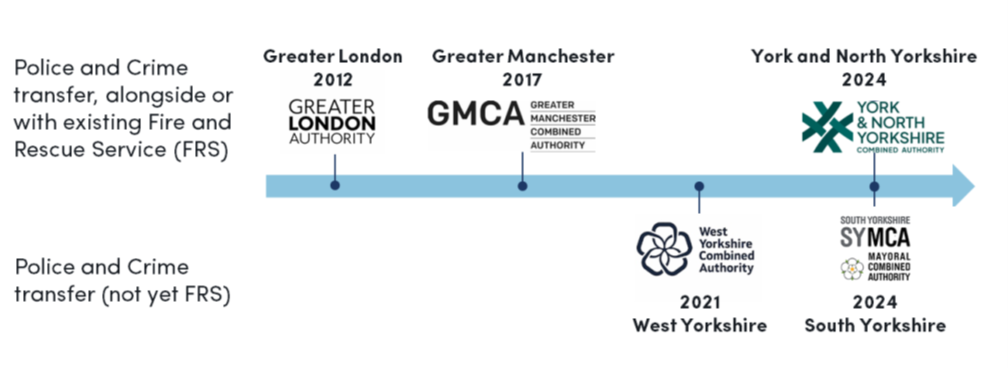
Figure 1 Previous transfers of Police and Crime Governance to Mayors, including Fire and Rescue where applicable
These devolution proposals do not apply to Wales, where local government is the responsibility of the Welsh Government. Wales has four democratically elected Police and Crime Commissioners and a well-developed culture of collaboration and preventative working across public services. There could be implications for Wales given this different system, prompting questions about consistency of models and policy across the nations.
Devolution today: policy intent
The government’s 2024 White Paper on English devolution and subsequent English Devolution and Community Empowerment Bill set out a new approach. They aim to significantly expand devolution and propose ‘devolution by default’ using a standard framework1 of powers rather than negotiating bespoke deals with individual areas. One of the government’s central policy aims is to achieve more joined-up public services and “Where geographies align with Police and Crime Commissioner and fire and rescue authorities, mayors will, by default, be responsible for those services.”
Transfer of responsibilities is less straightforward where service boundaries do not align: a mayor could not take on PCC functions for a force that operates outside of their electoral geography as this would break the principle of direct accountability. Fire and rescue service boundaries are often not co-terminus with current policing boundaries.
In the long term however, it is the government’s intention to allow the alignment of police, fire and other public service geographies. This could mean boundary changes, impacts on existing mayoralties, or mergers for police forces and fire and rescue services as the devolution agenda progresses, though none is imminent.
Policing and crime have not been front and centre of the government’s narrative on devolution in the context of the White Paper or Bill, which has focused largely on growth, transport, and housing. However, incoming mayors will need to be alive to the strategic importance of public safety, know what they are inheriting and be conscious of the level of risk involved. High profile crime incidents can put this into sharp relief.
Devolution today: pace and ambition
The devolution agenda and establishment of more mayoral authorities2 comes at the same time as local government reorganisation which aims to streamline local government through merging of ‘lower tier’ councils (districts, cities and boroughs) into larger unitary authorities.3
For most areas this will mean two major organisational shake-ups happening at once and means a great deal of local authority bandwidth will be taken up with managing change; local government reorganisation is a contentious and large-scale programme.

Figure 2: proposed timeline of devolution priority programme
The government has set a clear intention for these changes to happen at pace (see Figure 2 above). Six areas have been selected for the ‘Devolution Priority Programme’, which will see mayoral elections in May 2026 (see Figure 3 below), or May 2027 in the cases of Cumbria and Cheshire and Warrington. Timelines are dependent on the passage of primary legislation through Parliament.
There will likely be further devolution within this parliamentary term as other areas, including those who did not get accepted onto the priority programme, come on stream. The long-term aim is for ‘universal coverage’ of devolution across England.

Figure 2: Map of devolution priority areas and existing mayoral authorities with policing powers
Complications and unknowns
Responses to the consultations on each of the priority devolution areas have been published and the English Devolution and Community Empowerment Bill has been introduced to Parliament: it will now go through the parliamentary process and may change as a result. There is considerable uncertainty on the ground as to how the devolution agenda will develop, which can hinder good engagement and planning. As government continues to progress the primary legislation underpinning devolution, answers are urgently needed on crucial policy detail, including:
Timing
Under existing legislation, current P(F)CC terms are not due to end until the next planned election in 2028. Mayoral elections in the priority devolution areas are planned for 2026 or 2027, subject to legislative timetables. The transfer of PCC functions to a mayor will take place on 1st April 2027 in all priority devolution areas with the exception of Cumbria. Here the government has agreed to delay the mayoral election until May 2027, and the PCC functions will transfer at the same time.
Some P(F)CCs and stakeholders argue that it is not democratically sound to cut short terms and that a crossover period would allow for more considered, effective transfer. Others feel that a clean break is preferable to avoid ‘lame duck’ P(F)CCs, low officer morale as transition drags on, uncertainty for police forces and potential conflict in strategic direction and accountability between the mayor and the P(F)CC – albeit the P(F)CC retains their statutory role until the day of transfer. This could be further complicated in cases where P(F)CCs are also standing to become mayor.
Deputy mayors
The APCC has long argued that, given the workload and importance of the P(F)CC role, it should be a requirement of the legislation that mayors appoint a deputy mayor for policing, (fire) and crime. This requirement is a part of the English Devolution and Community Empowerment Bill, but will need to be debated and ratified through the parliamentary process.
Multi-force areas
One of the devolution priority areas, Norfolk and Suffolk, currently has two police forces and two PCCs, creating unique challenges within the fast-track programme. Government has set out provisions in the English Devolution and Community Empowerment Bill to allow a single mayor to take on these two sets of responsibilities and will require that a deputy mayor is appointed to cover each force area. This model is untested in any existing mayoralties. If the legislation passes as is, any future mayors that take on responsibility for two or more police forces will also be required to appoint a deputy mayor for each force.
The status of fire and rescue governance in devolution areas also presents complications that need to be factored into transfers, though it is not the primary focus of this report and requires further research. Fire and Rescue Authorities (FRA) are in some areas, including the devolution priority areas of Essex and Cumbria, a responsibility of the P(F)CC. In other areas of the country, they are standalone authorities and in others they are hosted by a county council, with decision making usually by committee. The English Devolution and Community Empowerment Bill does not allow for mayoral authorities to adopt a FRA committee system.
Opportunities and challenges of the mayoral model
Realising the benefits
The end goal of incorporating P(F)CC functions into mayoral systems must be to improve outcomes for the public. This means high-performing policing and crime governance teams who can work together with the wider public service system around them. In this section we explore some of the potential benefits of the mayoral model and some potential barriers to realising them. We also outline the differences between a P(F)CC and a mayor.
Existing P(F)CCs hold a system leadership role, collaborating effectively across public services and making a difference locally through ambitious plans and strong accountability. It is important that P(F)CCs who are not in devolution areas at present or are not part of a mayoralty for other reasons, do not lose out and are not excluded from partnership working. Indeed, powers to facilitate more effective local partnership working might be given to P(F)CCs, as they are to mayors.
Opportunities
P(F)CCs have achieved significant changes and benefits in policing in a range of ways. However, the devolution agenda also offers potential opportunities for improving community safety outcomes, for example through:
Collaboration
For local economies to prosper and for the core government goal of growth to be achieved, it is vital that local communities feel safe. Whether attracting inward business investment, revitalising high streets, or increasing use of public transport, effective policing and crime plans that are aligned with mayoral thinking and delivered through collaboration within one organisation should support this goal. This is enhanced when geographical boundaries align with other parts of the criminal justice and probation systems.
Prevention
There is a growing consensus that a joined-up, preventative approach is at the heart of public safety, recognising the links between crime, mental and physical health, economic disadvantage and other root causes. This kind of strategic approach needs different parts of the public sector to work together: being part of one mayoral authority with shared goals and the potential for shared budgets and commissioning could help.
Efficiency
Against a backdrop of budget pressures across public services, bringing P(F)CC powers into mayoral authorities could bring scope for efficiencies and economies of scale. This includes potential financial savings in back-office functions like HR and IT, but more broadly eliminating duplication and streamlining decision making. Being part of a larger organisation also gives policing and crime offices a larger pool of in-house skills and expertise to draw from.
Leverage
Deputy mayors reflect that the badge of the mayor’s office helps them to get leverage with other parts of the system, both through formal powers but also through the softer convening power and influence that a mayor can hold. Mayors can also leverage funds that can support community safety outcomes: one of the benefits of devolution for mayoral authorities is the ability to secure single integrated funding settlements which allow them greater flexibility over how to spend money locally.
Political visibility
P(F)CCs play a vital role in public life, but their role is not widely understood by the electorate4. Mayors, particularly in established metropolitan mayoralties such as Manchester and the West Midlands, appear to be an understandable model for the public, with some polling suggesting that more people can name their mayor than can name their local MP or council leader. Mayors will also have a direct line into central government through seats on forums chaired by the Prime Minister and Deputy Prime Minister.
Case study: West Yorkshire Combined Authority
In West Yorkshire Mayor Tracy Brabin and Deputy Mayor Alison Lowe have a ‘golden seam’ of preventing violence against women and girls running through the mayoralty. They have been able to use both the convening power and budget of the mayor to embed system-level interventions, for example by ensuring at the design phase that new mass transit transport systems would be woman-friendly, and linking women’s safety in to plans for the nighttime economy and green spaces.
Case study: Greater Manchester Combined Authority
The Greater Manchester ‘Vision Zero’ strategy aims to eliminate road deaths and life-changing injuries in the area by 2040. It is a collaborative effort that uses the mayor’s levers to bring together activities across policing, transport planning, education and more for a systemic approach to road safety
Challenges
Interviewees and focus groups also raised challenges and risks associated with mayoral models, particularly on managing the transition itself, which we will explore further in Section 5. The most pressing concern for local areas at present is getting clarity about transition timetables and for OP(F)CCs, police forces and fire services being included in relevant discussions with partners. Existing P(F)CCs, particularly in priority devolution areas, are obviously impacted by these proposals. Their views on the policy and its political implications differ, but their offices remain neutral and must endeavour to make a success of transition whatever the politics involved.
Other challenges include:
Dilution
P(F)CCs and their offices have developed clear and specific expertise in their core functions. This includes in-depth knowledge of policing and how to hold police forces to account effectively, and areas like commissioning of victim services and specialisms like complaints handling. Many were concerned that these core functions would be diluted or neglected in a larger organisation where the mayor has limited time. There is a risk of insufficient strategic focus on community safety as mayoralties may prioritise other agendas and competing demands from member local authorities. Many P(F)CC offices are co-located with police forces and have access to police systems: losing this proximity may make it harder to stay on top of force activity.
Bureaucracy
Existing OP(F)CCs can be agile due to their relatively small size and easy access to the sole political decision maker. There is a risk of slower decision making in a larger bureaucracy where mayoral time is split between multiple functions and demands.
Loss of expertise
Change management is hard. Bringing P(F)CC functions into mayoral authorities inevitably means turmoil for OP(F)CC staff, and potentially high turnover (particularly at senior levels) with resulting loss of accumulated knowledge as staff either choose to leave or find their roles change under restructure plans.
Confusion of roles
Under the P(F)CC model a chief constable is accountable to one P(F)CC, supported by a single chief executive and office. Under a mayoral model there is usually both a mayor and a deputy mayor to engage with, plus a wider corporate machine and set of officers. This could lead to some muddying of accountability and unclear direction if not handled well. Some interviewees also felt that deputy mayors carry less democratic accountability and visibility than standalone P(F)CCs.
Disruption to business as usual
Operational policing, fire and rescue services, the statutory duty of holding the force to account and delivery against existing Police and Crime Plans still need to happen during transitions. A key challenge will be to manage continuity and respond appropriately to external events throughout. Chief constables will require decisions from their P(F)CC at a time when they may be distracted by change and local politics, with an office facing significant upheaval.
Continued siloes
While a mayoral authority may remove some of the structural barriers to collaboration, it does not necessarily remove the cultural barriers. Work will still need to be done to ensure good integration and understanding between teams in a mayoral authority to ensure they all pull towards a shared agenda. Many existing mayoralties are in urban areas and collaboration may be harder in larger rural areas with less obvious regional identities and transport links.
P(F)CC, Mayor – what’s the difference?
What’s the same?
- In a mayoral model there is no change to the core statutory powers in relation to policing and crime governance themselves
- The change is in who exercises them: an elected mayor who also has a broader set of powers and responsibilities and potentially more public profile and national-level influence
- In both systems the chief constable of the local police force remains operationally independent and a ‘corporation sole’
- Fire and rescue services are overseen by the mayor at a strategic level, with day-to-day operations led by the chief fire officer
Deputy Mayor
- The mayor is publicly accountable and ultimately responsible for policing governance but may delegate most* responsibilities to an appointed Deputy Mayor for Policing and Crime (and fire, where applicable). In practice all have done so and legislation, as drafted, will make this a requirement for the future. Arrangements should be detailed in the constitution of the mayoral authority.
- The deputy is chosen by the mayor as a preferred candidate; they are usually politically aligned but do not need to be
- Appointment must be confirmed by the relevant Policing and Crime Panel (the mayor may override this)
- The deputy is an appointee of the mayoral authority** but their term of office is tied to electoral cycles. They are accountable to the mayor and can be dismissed by them. Their role is not to be confused with the distinct statutory ‘deputy mayor’, who must be chosen from a member authority to cover duties should the mayor be incapacitated
- Mayors, Deputies and P(F)CCs must all adhere to the Nolan principles of public life
|
What’s different? Deputy Mayor for Policing and Crime
|
P(F)CC
|
Target operating model
Design decisions
In this section we set out the design decisions that must be considered urgently if mayoral authorities are to achieve high performance policing, crime and fire functions. Central government is taking a purposefully localist approach and will not tell mayoral authorities what their operating model should be - so these decisions will need to be taken locally.
Every local area is different. Emerging mayoral authorities taking on policing and crime governance will need to find an operating model that works for their own area, through a period of collaboration with the existing OP(F)CC, Fire and Rescue Authority and others. Local government staff leading the design of mayoral authorities may lack experience of and expertise in policing governance and of the wider crime agenda. They can minimise risk by learning from those who do have such expertise.
Experience from previous transitions suggests that the model will mature and evolve over time. There is no ‘one size fits all’ approach. However, we have identified clear lessons from existing mayoral areas (and P(F)CC models) more widely.
Emergent mayoral authorities should examine these lessons, work through key design choices and prepare options and outline plans ready for incoming mayors and deputy mayors. We note however, that they cannot make assumptions about who the mayor will be or what their preferences are. Mayors, once elected, will have different visions for what kind of mayoralty they want to run – it might be interventionist and active or more of a strategic convener. The mayor might be experienced and active in the field of community safety or wish to delegate as fully as possible to a deputy mayor. Figure 5 below shows the main components of a target operating model for incorporating P(F)CC functions into a mayoral authority. For each component, we offer some high-level considerations that local areas will need to consider, a brief assessment of importance and risk based on our analysis and who the primary decision maker is – though the decision process should be consultative and informed by professional advice.
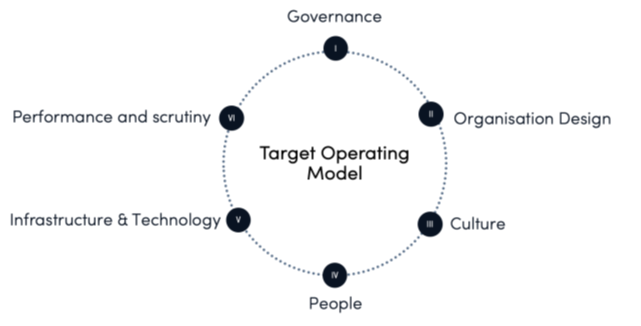
| Governance Top design decisions - checklist | Risk | Importance |
|
|
What is the risk to strong accountability of police if this isn’t addressed? 5 |
How much does this matter to mayors, P(F)CCs, OP(F)CC and CA staff? 4 |
Why governance matters
The schemes of governance that set out protocols, roles, risk management and decision making processes are a crucial part of any public sector organisation, providing transparency, clarity and a legal underpinning for how things are done. Those involved in setting up mayoral authorities will need to draft constitutional documents that set out governance arrangements in relation to policing powers and can find examples and templates online from existing mayoralties to draw from, including appointment agreements for deputy mayors and schemes of delegation. These operating principles, in relation to policing, are a decision for the mayor rather than the Authority as a whole.
P(F)CC functions are, legally speaking, unique within a mayoral authority in that they can only be conducted by the mayor (or in some cases by a delegated deputy), not by the wider membership of the authority. The mayor as P(F)CC has a distinct legal identity and financial liability. Schemes of governance must reflect the statutory responsibilities that come with policing and crime functions. In practice, it also feels different for staff working on community safety issues compared to other portfolios like transport or skills where decisions can be made at corporate or official level or via boards.
Good governance goes beyond constitutional arrangements and a tight grip of process. Many interviewees talked about how personalities, local circumstances, organisational culture and preferences really shape how things are done day-to-day. The personal and ideological alignment of the mayor and deputy mayor for example, and a strong, trusting relationship between them, sets the tone as much as the formal constitution. It matters to police forces that they can get timely, considered decisions from their P(F)CC equivalent and that there is clarity as to the relationship between the mayor, any deputy they appoint, officials and the police force – particularly the chief constable.
Considerations for local areas
| Design decision | Considerations | Timing | Decision maker |
| Who will be Deputy Mayor for Policing and Crime? |
Appointing a deputy gives mayors – who will be covering huge briefs - bandwidth and ensures that full attention be given to policing and crime. It is established precedent in all existing mayoral models and a requirement of the draft devolution legislation. Existing deputies and P(F)CCs argue strongly that it is essential to allow decision making and accountability to function properly. In multi-force areas, draft legislation proposes that a deputy is needed to cover each force. In these cases, the mayor will need to decide whether each deputy needs their own dedicated staff team, or whether the staff could be shared to pool resource and expertise. While there is no obligation for deputies to be appointed on merit, it would be wise for mayors to do so and choose preferred candidates for deputy who have a solid grasp of policing and crime issues and the right skill-set to perform the role well. Not appointing a deputy would mean a small cost saving on salary, and perhaps more straightforward governance as all functions that cannot be delegated to officials would remain solely with the mayor, but if legislation passes as is this will not be possible – and in any case would come with major political and practical risks. Mayors will need to appoint their deputies as soon as possible after election in order to avoid gaps in policing oversight and to be able to take on PCC functions promptly. |
Appointments can only be confirmed post-election, however mayoral candidates may informally choose a prospective deputy in advance of elections and communicate this as part of their campaign. Mayors could also run a more open recruitment process once in office to find a preferred candidate. | Mayor |
| Mayor for Policing and Crime be a full-time, paid role? | It is possible for the role to be part time, and this may offer flexibility, though most people doing the job consider it to be a full-time requirement. Deputies are not barred from taking other roles such as non-executive directorships or councillor positions unless there is a conflict of interest, but the mayor may take a view on whether these are desirable, given the risks of criticisms that are always present for paid political appointees having ‘second jobs’. To date all deputies have been paid at a rate similar to that of P(F)CCs. | On appointment of deputy. | Mayor (with HR advice |
| How do the mayor and deputy mayor work together? |
Authorities should consider a clear schematic of what issues need to be escalated to mayor; when and how the deputy and mayor will meet; which interactions are minuted and attended by officials; what their meetings cover (e.g. risks, performance, budgets); who sits on or chairs which boards; who fronts media; and what their respective interactions are with the police force and chief constable. Existing deputy mayors use a mix of formal structure and their own political judgement to determine some of these and the nature of the relationship may be driven by the mayor’s leadership style, the level of profile/ risk involved and their interest in policing and crime. Mayors should also take a view on whether to consult the cabinet or others on policing and crime issues. There is no obligation to consult them, and mayors may wish to either protect the autonomy of policing and crime governance or to take a more open approach: in any case the mayor remains the sole, accountable decision maker. |
After elections and appointment of deputy; may evolve over time | Mayor and deputy |
| Will there be a ‘public safety commissioner’? |
The English Devolution and Community Empowerment Bill allows mayors to appoint up to seven commissioners to assist them in their duties across seven areas of competence, including public safety. These appointments would be more akin to political deputies rather than directors employed on a permanent, merit-based basis. Untested in existing mayoralties, it is unclear what a public safety commissioner would add to the role performed by a deputy mayor for policing and crime, and there are clear risks of duplicated effort and cost, as well as confused governance and accountability, associated with such an appointment. Mayors may also wish to avoid the political risk of appointing more unelected advisers than necessary and would need to be able to justify the role to the public and to partners. If a mayor did choose to appoint a public safety commissioner as well as a deputy mayor for policing and crime, their respective roles and delegated responsibilities must be clearly delineated and communicated transparently. Mayors may choose, where relevant, to appoint a public safety commissioner to focus on fire and rescue instead of including this in the deputy mayor’s remit. Again, such an appointment would need clear rationale and a clear understanding of how the role relates to the deputy mayor for policing and crime.
|
After elections | Mayor |
| Where will fire and rescue governance sit? | Where fire and rescue powers have transferred to mayoral authorities to date, they sit under the portfolio of the deputy mayor and share a panel for scrutiny purposes. The mayor becomes the fire authority, with a distinct legal personality. Given the links between fire and rescue and policing as operational services, areas may wish to continue this model, particularly where the OP(F)CC transferring in already hosts fire and rescue and has existing arrangements and expertise. Fire and rescue also links in closely with resilience and with environment, housing and planning, so could be situated separately. To date this is only the case in London, which has a separate Deputy Mayor for Fire and Resilience. | Pre-transfer but may evolve after. | Mayor |
| How will the mayor ensure a good grip on finance and risk? | P(F)CC functions involve complex financial undertakings, with a ring-fenced budget that will be held by the mayor and is used to fund policing activity; underspend cannot be reallocated to other mayoral functions. They also come with a distinct set of risks, procurement and commissioning arrangements as well as assets and liabilities. For example, the police fleet and estate is a legal responsibility of the P(F)CC, and many oversee shared services. Under the Lead Force model, some forces also have responsibilities for national assets or functions. Mayoral authorities will need to understand the nuances of these to inform decisions about how finances, audits and risks are managed post-transfer and be aware of the implications of existing leases and contracts. Emerging mayoral authorities will need to take an early view on an appropriate approach to financial schemes of delegation and other aspects of control as this will fundamentally affect the appropriate scale and design of oversight functions. | Information gathering and understanding pre-transfer, arrangements set up for immediate | CEO and CFO |
| How will Deputy Mayors for Police, (Fire) and Crime work differently to P(F)CCs with local authorities | There is no uniform way in which P(F)CCs work with local councils. For example, some will me a member of FRA committees housed by a county council whereas some will hold the responsibility for fire themselves. It is clear that rather than just the P(F)CC working with councils, the Mayor and deputy will be expected to do so. The interactions Mayors have with councils and the expectations they set for deputies will determine whether interaction is different. | After elections and appointment of deputy; may evolve over time | Mayor and Deputy |
Organisation design
| Organisation design Top design decisions – checklist | Risk | Importance |
|
|
What is the risk to strong accountability of police if this isn’t addressed? 3 |
How much does this matter to mayors, P(F)CCs, OP(F)CC and CA staff? 4 |
Why organisation design matters
Mayoral authorities require a structure that both promotes collaborative, integrated working and sharing of skills and intelligence between teams and sets out clear roles, specialisms and management responsibilities. Existing mayoral authorities reflect that this takes a long time to get right: design evolves along with mayoral priorities and powers, as well as determining the required level of support to the deputy mayor. There is a natural tension between OP(F)CCs who might wish to retain their existing roles and sense of team in a new organisation (and moreover to ensure that sufficient expertise and capability exists to deliver policing and crime governance) and the wider mayoral authority’s desire for corporate integration.
The policing budget is ringfenced and there are some vetted, specialist functions that support the deputy mayor which cannot easily be done outside of the policing team including commissioning, policy, scrutiny management, casework and complaint handling.
In priority devolution areas, mayoral authorities do not yet exist, they will have to be formed and designed. There is an overarching question as to the starting point – they could be designed from scratch around expected mayoral powers, adapted from other mayoralties, borrowed from local authority models or indeed use the OP(F)CC (which already has the correct geography) as the backbone infrastructure which can be built out to include other functions.
| Considerations for local areas Design decision | Considerations | Timing | Decision maker |
| Will existing OP(F)CC roles transfer directly or be spread across the new authority? |
A direct ‘lift and shift’ of an OP(F)CC (excepting statutory roles - see below) can provide continuity for these teams to provide specialist and direct support to the deputy mayor. In a TUPE transfer roles are transferred ‘as are' in the first instance. Mayoral authorities have generally been inclined to then spread finance, HR, administrative and communications roles into their relevant wider corporate divisions rather than place them with policing teams. This can aid streamlining, but it should be noted that deputy mayors may benefit from specialist support on communications, for example - knowledge of correct protocol and sensitivity is required for responding to crime incidents, and on finance which is a major and complex task for policing teams – even if those roles sit in separate line reporting arrangements. |
Aligned to TUPE process; usually roles transferred directly and then restructure happens later | CEO (with mayoral steer) |
| What will happen to key statutory roles? |
P(F)CCs are currently served by statutory officers – a chief executive (who is usually head of paid service and monitoring officer) and a chief finance officer. It is a constitutional requirement set by government for the mayoral authority to have statutory officers that fulfil these roles for the whole organisation, so the deputy mayor does not have their own (London’s Mayors Office for Policing and Crime, is an exception). But decisions remain on how best to support the deputy mayor with sufficiently senior, dedicated advice. Finance on policing governance is nuanced and complex, and finance officers need the right clout and expertise to deal with their opposite numbers in policing. OP(F)CC chief executives have expertise as monitoring officers that is quite different from their local authority counterparts, and experience in dealing with police forces and effective holding to account. Mayoral authorities should consider how they can retain and support these valuable senior staff in a new structure. Statutory roles for fire and rescue services also require consideration. Unlike police forces, which remain independent under a mayoral system, fire and rescue services can become an integrated part of a mayoral authority and as such share statutory officers. Authorities will need to ensure the right support and delegation schemes are in place. |
After set-up | Central government |
| Will the policing /crime/ fire directorate stand alone, or be part of a wider corporate directorate, and what will it be called? | This will be driven by how the overall structure of the mayoralty reflects its strategic goals and the expertise of different directors. In West Yorkshire, policing started out as part of the strategy and communications division and is now part of ‘Policing, Environment and Place’, in Greater Manchester the ‘Safer and Stronger Communities’ directorate oversees policing, crime and fire. | Outline proposal pre-election, but likely to evolve over time | Mayor/CEO |
Culture
| Top design decisions - checklist | Risk | Importance |
|
|
What is the risk to strong accountability of police if this isn’t addressed? 1 |
How much does this matter to mayors, P(F)CCs, OP(F)CC and CA staff? 5
|
Why culture matters
It is not just the functions of existing OP(F)CCs that need to be integrated with mayoral authorities but also their cultures. This can cause conflict both during transition negotiations and once embedded. In areas where transition has already happened, some officers felt that the good working cultures they had developed in the OP(F)CC over years were lost, with clashes of leadership style. Most obviously for existing OP(F)CC chief executives and other senior officers, the move to a mayoralty can represent a loss of independence and status as they become one of a number of directors rather than the most senior leader. Teams go from being largely autonomous and specialist to a ‘cog in a much bigger system’, which can be tough. OP(F)CC teams are often long standing and are used to quick decision making and direct, frequent access to their P(F)CC. They are used to operating in a policing context, which is marked by an operational focus, unified command structures, speedy decision making and a structured approach to risk. Local authorities may feel more strategic, collective and deliberative. Staff on both sides can learn from each other.
Equally, some mayoral authority interviewees have found it difficult to incorporate teams that had ‘baggage’, or an attachment to how things were done in the past – as well as legacy problems from difficult transitions. These challenges may be exacerbated by the fact that new mayoral authorities are still developing their own strategies, styles and ways of working, and by changes in political leadership. None the less, OP(F)CC and mayoral authority staff are united by a shared geography, a shared commitment to public service and often galvanised by the opportunity to deliver more preventative, joined-up community safety services. Integrated cultures allow mayoralties to maximise the potential benefits of joined-up strategy and resourcing.
| Design decision | Considerations | Timing | Decision maker | ||||
|
Leaders need to balance the recognition that policing teams have a specialist function and some limitations to sharing due to vetting, with promoting good two-way communication across teams through activities like presentations, shared strategy sessions, cross-team secondments and joint project work.
|
Ongoing process post-transfer | CEO, Policing Director | ||||
| Leaders need to balance the recognition that policing teams have a specialist function and some | Leaders need to balance the recognition that policing teams have a specialist function and some | Leaders need to balance the recognition that policing teams have a specialist function and some | Leaders need to balance the recognition that policing teams have a specialist function and some |
People
| Top design decisions - checklist | Risk | Importance |
|
|
What is the risk to strong accountability of police if this isn’t addressed? 2 |
How much does this matter to mayors, P(F)CCs, OP(F)CC and CA staff? 5 |
Why people matter
For policing and crime governance to work well in a mayoral setting it needs a high-performing, motivated and expert staff team that is integrated structurally as well as culturally into the mayoral authority. A process of TUPE (Transfer of Undertaking (Protection of Employment)) must be used to transfer staff into a mayoral authority, a process which must be managed with due diligence, staff consultation and professional legal advice.
A risk is that transition leads to staff churn and loss of expertise that will need to be replaced, particularly where there has been insufficient engagement and respect of OP(F)CC staff. Sound management will be needed to ensure that good staff can be retained and new talent attracted. Leapwise experience of designing and supporting largescale change in policing and local government suggests that early engagement and reassurance for key individuals will be important.
Fire and rescue services are a major HR consideration as, unlike with operational policing which remains independent, fire and rescue staff become employees of a mayoral authority if transferring. In Greater Manchester, for example, fire and rescue service staff make up over 70% of the Combined Authority’s workforce. There is both a challenge and opportunity from the fact that recent inspections of fire and rescue have highlighted significant culture and conduct challenges within services5.
| Design decision | Considerations | Timing | Decision maker |
| Will pay, grades and terms be harmonised? | Mayoral authorities may wish to have consistency and fairness across the organisation and ensure that different teams are not on different pay and grading systems, terms and conditions (such as leave allowance, hybrid working policy, pension schemes). But harmonisation can also lead to poor morale or loss of staff if they do not feel that new terms are equal to or better than before. Unions should be engaged here. This is a particular issue for fire services, where many staff, represented by a powerful union and with distinctive roles, may transfer directly into the mayoralty. Some FRS staff will already be harmonised with local government pay and terms, though not necessarily all firefighters. Through national negotiating structures for Green and Grey book staff in FRS, the National Joint Council covers terms as well as pay and conditions - though there is scope to agree local arrangements. | Can be post-transfer, with direction of travel signalled early on | CEO |
| What will people’s roles look like? |
Mayoral authorities will develop expectations of staff around skills, values and performance. These may be adopted from the existing OP(F)CC or may be different. Authorities will in any case need to consider any support, training and upskilling needs. They will also need to decide how far to harmonise staffing structures and job titles and role descriptions. Any people risks and liabilities – such as ongoing grievances or legal issues – must also be taken on and managed appropriately. The scale and scope of existing OP(F)CCs is determined largely by decisions made by their P(F)CC: some are leaner than others, for example, and new mayors or deputies may find they want more capacity and capability to meet their needs. It may be helpful for new authorities to look at other high performing OP(F)CC teams to get a sense of options for potential shape, functions and size. |
Can be post-transfer, with direction of travel signalled early on | CEO |
Performance and scrutiny
| Top design decisions - checklist | Risk | Importance |
|
|
What is the risk to strong accountability of police if this isn’t addressed? 4 |
How much does this matter to mayors, P(F)CCs, OP(F)CC and CA staff? 2 |
Why performance and scrutiny matter
Performance and scrutiny are important for P(F)CCs and mayoral equivalents in two different ways. Firstly, checking and performance of the police force and holding them to account for delivery against agreed goals is a core function of a P(F)CC: this means gathering and understanding data and asking the right questions of the force to build public confidence. It is within the P(F)CCs remit to appoint chief constables, ensure adequate responses to inspections and performance challenges and act when delivery does not match up with the ambitions of the police and crime plan. Incoming mayors and their deputies could use the suite of guidance provided by the APCC to help them develop strong practices in this area, for example the PCC Accountability Framework, which is designed to support P(F)CCs in in fulfilling their statutory duty to hold chief constables accountable for delivering an efficient and effective police force. The framework provides guidance on oversight mechanisms, performance evaluation, and governance strategies.
Secondly, the activities of the P(F)CC or mayoral equivalent must be scrutinised by a Police, Crime (and sometimes Fire) Panel. Panels are made up of local authority and independent members. They can provide scrutiny, challenge and support. Fundamentally nothing about this set up should be different in a mayoral model – the challenge is to ensure that standards do not dip either during or after transfer of powers.
| Design decision | Considerations | Timing | Decision maker |
| How can policing performance be maintained through transfer and beyond? |
A P(F)CC retains their functions until the day of transfer to a mayor, so in theory there should be minimal disruption. Throughout the transfer process it is essential for OP(F)CC teams to maintain their access to policing data, reporting and people. At a point where staff and politicians are distracted by change, it could be useful for OP(F)CCs and policing colleagues to set out a clear understanding of any interim arrangements and ensure some roles are focused solely on business as usual. New mayors and their deputies will have their own visions for improving policing and may wish to review current performance monitoring arrangements. They could also benefit from induction and support from peers on the role and how to do it well (the APCC provides this as routine). |
Throughout transfer and beyond | OP(F)CC/ Mayor |
| What role will the Police and Crime Panel play? |
The composition and role of a Police and Crime Panel remain the same in a mayoral system, covered by the same statute and guidance as for P(F)CCs, and including fire where applicable. Mayoral status may help to keep panel members engaged and ensure meetings are quorate. The secretariat can be hosted by the mayoral authority or by a member council, though any advisers to the panel should be external to the mayoral authority. Local government reorganisation may prompt some changes to panel membership as more councils merge. The mayor will need to decide how much attendance at panel meetings is delegated to the deputy, though should attend high-profile meetings that relate to non-delegated functions, such as the annual precept meeting, or in the event of dismissing a chief constable. The mayor may choose to attend more. Panels may need additional guidance on scrutiny in a mayoral context and understanding of the different roles and responsibilities of the mayor/ deputy mayor, and how to balance fire and policing scrutiny at meetings. Panel chairs can also be invited to wider governance meetings such as mayoral cabinets. In mayoral authorities that oversee more than one police force, there will be a police and crime panel for each force, which should be attended by the relevant deputy mayor. |
Throughout transfer and beyond | Panel role set out in legislation |
Infrastructure and technology
| Top design decisions - checklist | Risk | Importance |
|
|
What is the risk to strong accountability of police if this isn’t addressed? 4 |
How much does this matter to mayors, P(F)CCs, OP(F)CC and CA staff? 3 |
Why technology and infrastructure matter
To perform their functions, P(F)CC equivalents in mayoral authorities and their staff need ICT systems and basic infrastructure from day one of the transfer. As with all the operating model considerations we have outlined, a balance will need to be struck between the needs and preferences of the incoming OP(F)CC and other functions of the mayoral authority.
| Design decision | Considerations | Timing | Decision maker |
| Will policing teams be on a shared ICT system with the mayoral authority? | Mayoral authorities may wish to harmonise ICT so that all staff are on shared systems with consistent e-mail addresses and access to relevant files and programmes. However, some OP(F)CCs share systems (also including HR policies and finance processes) with police forces and need to be able to access sensitive data, as well as migrate legacy knowledge such as financial data and records of policy decisions to new systems. Beyond keeping two sets of laptops, technological solutions like VPN systems may allow both objectives to be met. | Determine pre-transfer | CEO |
| What physical space will the policing team occupy? | Cross-team collaboration, proximity to the mayor, and realisation of economies may be easier in a shared office space. Policing teams can benefit from the wider capacity and skill sets of the mayoral authority, for example on data analytics. Many OP(F)CCs are currently co-located with police force headquarters, and the benefits of this physical closeness may be lost if they move to an office located further away – potentially an issue in larger geographical areas, for authorities covering multiple forces or in rural areas with limited transport. Policing teams are usually security vetted and as such will require an area where their digital and physical work is secure; vetting for any other staff in the mayoral authority who may support policing functions should also be considered. | Determine pre-transfer | CEO |
The transition process
Capacity
The overall process of creating a new mayoral authority is usually led by a director-level member of staff from a relevant council with involvement of senior sponsors, including council leaders, from other member organisations. They will have several workstreams to oversee to incorporate other mayoral functions such as transport, housing, skills and planning.
Transition is also a major programme of work for a P(F)CC’s office. It is difficult for a sufficiently senior staff member from within an OP(F)CC to manage on top of the day job, though using the knowledge of staff to get the process right and avoid pitfalls is crucial. There is a cost to managing transition which OP(F)CCs and councils are largely expected to fill from their existing resources. Options to manage the process can include a mix of:
- Appointing an internal project manager from within the OP(F)CC, while backfilling their day job
- Appointing an external project manager (typically on an interim basis), who may be jointly or fully funded by councils involved in setting up the mayoral authority
- Using external consultants to help manage some or all of the process
- Setting up a change programme with relevant working groups supporting different strands (which could include HR, legal, finance, estates, IT, data and so on) and an oversight board to sign off activities
Chief constables and chief fire officers may also nominate a staff lead to be involved in discussions or lead workstreams, as well as taking senior oversight themselves.
Partnership working
People who have been through transitions often found it a bruising process, where trust and open communication between parties could easily break down. Some OP(F)CC teams described feeling like ‘an afterthought’ or ‘bolt on’, excluded from proper consultation with local partners who showed little interest in understanding what P(F)CCs or their offices do. There has been a perception in some cases that OP(F)CC staff are invested only in protecting their roles and ways of working, running counter to the mayoral authority’s aims to integrate and join up different functions,
Some interviewees reflected that a ‘neutral mediator’ would be helpful to facilitate discussions between OP(F)CCs, police forces and the emergent mayoral authorities, and smooth over these tensions.
You are moving in what can be quite complicated and regulatory stuff - complaints, casework, dealing with the panel… you need early engagement with the Combined Authority so they understand what they are inheriting.”
Staff engagement
Transition to a new organisation can be disquieting for staff. Leaders who have been through transitions highlight the need to:
- Ensure due diligence and professional legal advice on TUPE processes for staff
- Be as transparent and open about processes as possible
- Offer good pastoral support and potentially professional advice
- Engage and communicate with staff and unions regularly
- Keep partners, especially the police force and fire and rescue services, informed and involved throughout
For our transition the vital bit was people, hearts and minds: building of trust however dysfunctional the process is.”
Providing continuity for operational policing
Day-to-day operational policing and fire and rescue services should continue as normal throughout the process of transfer of powers. Police chiefs are used to dealing with changes in political leadership through election cycles, which can mean changes of strategic direction, and an opportunity to refresh and reset the relationship between operations and oversight where needed.
Nonetheless, police forces and fire services – particularly at the senior leadership level – need to be consulted with and kept informed throughout transitions. Some may appoint a transition lead to attend meetings and working groups.
Police chiefs need to know who they should contact in the event of a major incident and what to do if a business problem that requires a decision of the P(F)CC or their equivalent arises while there is a gap in either political or official leadership. Clarity about who will be performing what roles, especially senior finance officers, is useful.
Vitally, future mayors and their support teams will need to consider that they will be immediately accountable for policing and fire. If policing or fire responses to high profile major incidents are criticised, for example, they will need to provide an immediate and visible position. Our interviews and discussions with operational leaders also highlighted that they are aware of the need to monitor specific operational risks and issues during transitions to Combined Authorities. For example, multi-agency safeguarding hubs (which bring together local councils, policing and other partners to monitor high risk individuals) could be disrupted by structural changes and failure to continuously monitor and manage risk would create an operational – and political – liability.
At a strategic level, mayors will also need to take time to understand the history and nuances of the force and its performance and any related sensitivities in community relations. One of their first jobs will be to produce a Police (Fire) and Crime Plan setting out the strategic direction for the force and review the Community Risk Management Plan (CRMP). Staff transferring who have expertise in developing these plans as well as a deep understanding of the local community safety landscape could be invaluable here.
Day One
The policing and crime team as well as the fire team needs to be able to continue to function immediately after the first day of transfer. Some critical elements that need to be agreed in advance and in place at a minimum for this to happen are:
- Due diligence and TUPE processes have been completed: staff are on the payroll, will get paid and will not be put on emergency tax codes, and have any relevant security clearances
- Access to either shared or legacy ICT systems – including access to police systems where needed
- A physical office space, equipment and staff passes, along with physical transfer of hard copy documentation or other key assets
- Continuity of ability to receive and manage complaints from the public, manage commissioned services and manage public communications, including statutory requirements such as freedom of information responses and publication of police performance information
- Immediate plans for inductions, training and joint team building
- Organisation charts, roles, governance structures and contact details are available
- Teams have an outline set of goals and deliverables to work to, and a clear sense of direction for longer term strategy
Waiting (or not) for the incoming mayor
- As we have outlined, some decisions can and should be prepared in advance, but ultimately the incoming mayor, and the team advising them, may wish to make different choices. Priority devolution areas are all working to slightly different assumptions on timelines, largely based on their degree of preparedness and their level of caution about how much officials can do ahead of political leadership and in the absence of any strong steers from central government. In either case, policing and crime will play a vital role in the devolution picture and the sector should be fully engaged in preparations
Recommendations and next steps
- Central government, with the combined vision of the Home Secretary and Deputy Prime Minister, could articulate more clearly what outcomes they wish to see from incorporating P(F)CC functions into mayoralties, alongside a unified vision for how local decision making will sit with the policing landscape reform agenda. While government is clear that it will leave local areas to best determine their own strategies and structures, we found that local areas do not always have a good sense of what government wants the devolution of P(F)CC powers specifically to achieve and why it might be better than the status quo.
- Government can also use its convening power to open up dialogue and unblock disagreements in local areas. The role of the Home Office and of the Ministry for Housing, Communities and Local Government is to ensure sound legislative underpinnings for transitions rather than to direct them, but it can also provide stewardship and support.
- We sometimes found a lack of mutual understanding and empathy between local government and P(F)CCs and their offices. The APCC and LGA will continue to work together to be a source of neutral information and advice, and to promote shared understanding of respective roles. This shared work has the potential to grow and further influence government.
- It is difficult for OP(F)CCs to engage with mayoral authorities that do not yet exist. Once the consultation phase of the devolution priority programme has been cleared and areas can start making solid plans, it must be clear who is responsible for designing the mayoral authority and its attendant governance in each area, ideally with a named individual to lead on the police, fire and crime element.
- There is much to learn, including on practical detail and pre-existing transition plans, from areas that have already transferred P(F)CC powers to a mayoral authority. Chief executives of OP(F)CCs and policing directors of existing Combined Authorities have working groups to share ideas and advice with and can also use visits and sharing of templates and documents to support each other.
- Local leaders of devolution, at both political and official levels, should engage in open consultation and collaborative design with the policing, crime and fire sectors, with standing invitations to relevant project boards and transition planning meetings. As with ‘access talks’ that are common in central government ahead of elections, there is a space for apolitical talks between chief constables, incumbent P(F)CCs and their officers and mayoral
- candidates to ensure that they have a good understanding of respective roles and issues before making public commitments.
- Looking ahead, government must also develop and communicate a clearer direction of travel for alignment of different public service geographies, including arrangements for Wales. The devolution agenda is a good opportunity to harmonise messy existing boundaries, and to strengthen collaboration and efficiency across police forces.
Annex A: Leapwise methodology
Research to inform this project took place in March-April 2025. Methods included:
- 24 semi-structured interviews and meetings (some attended by more than one person) with a mixture of Police (Fire) and Crime Commissioners from priority devolution areas, Deputy Mayors for Policing (Fire) and Crime, officers from existing mayoralties, senior local government staff in devolution areas, officers involved in previous transitions, central government policy officials, and sector stakeholders such as the National Fire Chiefs Council
- Four focus groups with officers from OP(F)CCs and combined authorities, which used a mix of online polling, discussion and presentations
- Engagements with the APCC board and wider membership
- Analysis of existing literature on transitions, plus relevant research and policy documents on devolution
Interviews and workshops were conducted on a Chatham House basis. Analysis of interviews and workshops was undertaken by Leapwise and tested with the project steering group, a partnership involving the LGA, APCC and APACCE. Leapwise adapted frameworks developed across their public sector and policing practice, using insights gained from extensive work on change management.
Contact
Association of Police and Crime Commissioners Lower Ground, 5-8 The Sanctuary, Westminster, London SW1P 3JS
Telephone: 020 7222 4296 Website: www.apccs.police.uk Email: [email protected]
The APCC provides support to all Police and Crime Commissioners and policing governance bodies in England and Wales.
Report updated 29th July 2025