Summary
Local authorities (LAs) play a vital role in improving take-up of early education entitlements among disadvantaged children. Our 2023/24 research showed that some LAs achieve take-up rates well above what might be expected, given levels of local disadvantage, labour market conditions and the mix of early education providers.
In autumn 2025, the LGA worked alongside early years experts to hold six roundtable discussions with 14 early years staff from LAs achieving higher-than-expected take-up (see list at the end of this document). These discussions explored new challenges created by the expansion of entitlements for working families and the overlap in eligibility, and sought further insights about “what works” to support take-up among disadvantaged children.
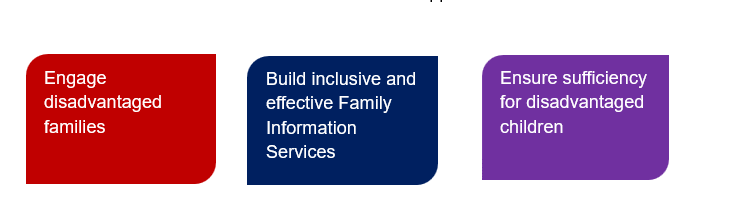
This guide brings together LAs’ experiences and practical ideas so early education and childcare teams can learn from each other’s approaches to:
The focus is on early learning for 2-year-olds (previously known as Families Receiving Additional Support, FRAS, or disadvantaged two year olds), as a significant minority of these children still do not access their funded place. Many of the approaches described could also be adapted for the universal offer, particularly if the drop in take-up among 2-year-olds eligible for early learning for 2-year-olds affects participation among disadvantaged 3-year-olds.
Engaging Disadvantaged Families
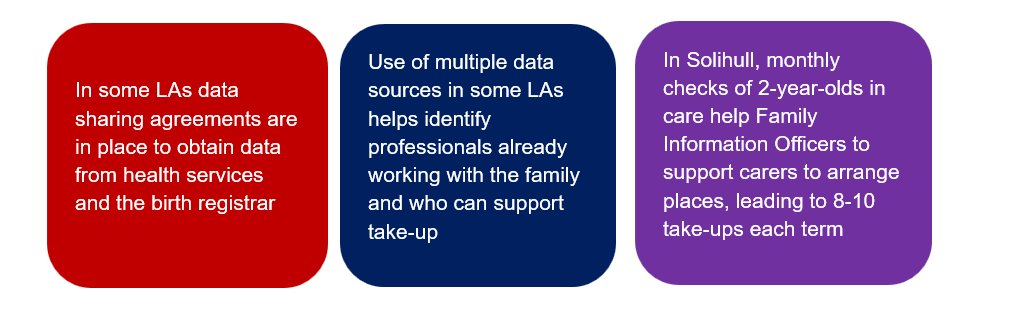
The evidence shows that the biggest impact on take-up comes from LAs providing effective support for families to make informed choices about early education. A relentless focus on reaching and engaging families of disadvantaged 2-year-olds enabled some LAs to achieve over 90 per cent take-up in some very deprived areas in 2023/24.
Achieving this high level requires significant resources, persistence and coordination across services as highlighted in the box below and outlined in the rest of the section.
Step-by-step approach to supporting early learning for 2-year-olds take-up
- Cross-check the DWP list against other internal data sources to ensure no eligible child is missed.
- Contact eligible families each term through a mix of post, email and text. Tailor the message and the mode of communication to suit different communities.
- Work with Family Hubs and other family-facing professionals, from health visitors to librarians, to promote the offer and support families to take it up.
- Partner with parents trusted community organisations to deliver culturally appropriate messages and reassurance.
- Follow up with families who have not applied or have incomplete applications to explore any barriers and offer practical help.
- Support families to find a suitable setting and advocacy if needed.
- Identify families with overlapping entitlements (early learning for 2-year-olds and working families) to meet DfE requirements, ensure accurate data and allow families to remain eligible for 15 hours if their work status changes.
- Follow up after take-up to check attendance and that the setting meets the families’ needs to ensure children enjoy and fully benefit from funded early education.
Step 1. Cross-checking eligibility
Each term, the Department for Work and Pensions (DWP) list of eligible children should be checked against other internal sources—such as early years and social care data—to make sure no child is overlooked. This helps identify children who may not appear on the DWP list, including those in care, refugees and children with special educational needs and disabilities (SEND).
Step 2. Contacting families
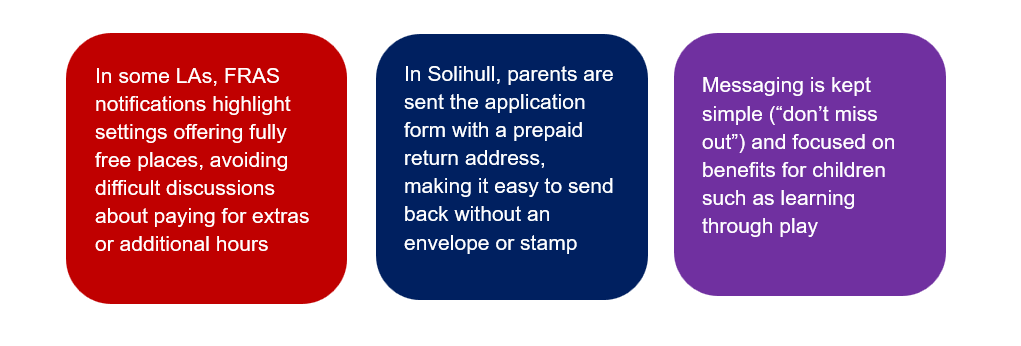
Eligible families are contacted termly by email, text or post. The method used depends on the information available and what works best for each community. Our research tentatively suggested that texts can help to boost take-up.
With the expansion of entitlements for working parents, it is important to reassure families eligible for early learning for 2-year-olds that they do not need to be in work or looking for work to claim this entitlement. Many families also benefit from reassurance about potential additional costs to access a funded place.
Step 3. Engaging other professionals
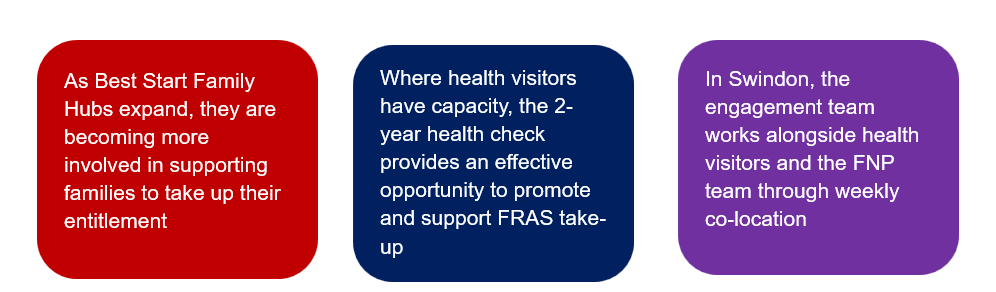
The involvement of Family Hubs, health visitors, Home Start, Family Nurse Partnership teams, Portage services and Virtual Schools is crucial. LAs invest time in maintaining close working relationships with these partners.
Step 4. Community engagement
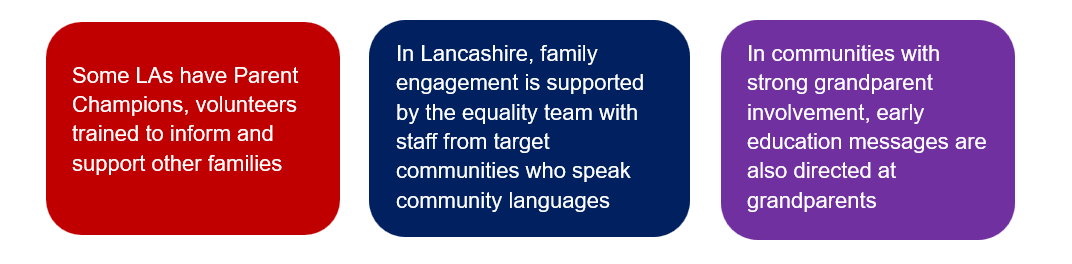
Working with trusted community partners is a very effective way to reach families. Messages tailored to specific cultures or languages help build trust and understanding.
Steps 5 and 6. Support families with the application and to secure a place
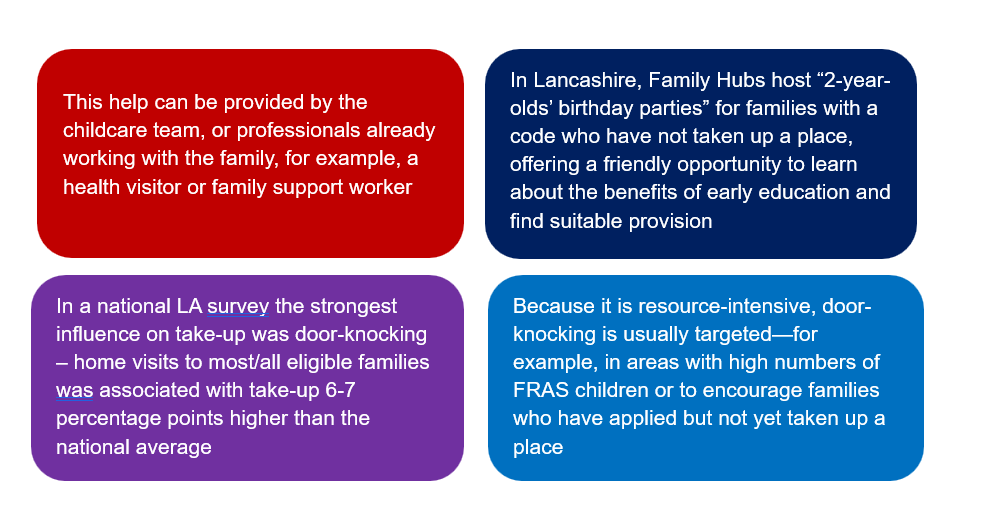
Families who do not apply or do not complete their applications are contacted to offer support and explore any wider needs.
Where families have an eligibility code but no placement, help is offered with finding a suitable setting and to advocate on issues such as charges or session times.
Depending on local circumstances, support with the application or securing a place may be provided by phone or through face-to-face contact.
Step 7. Managing double eligibility
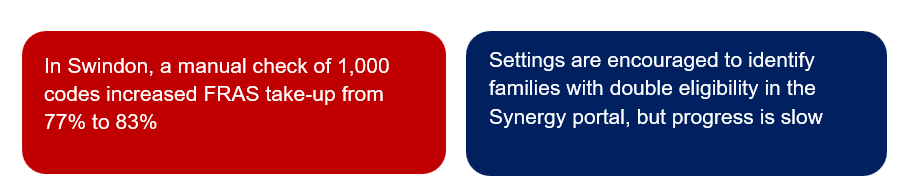
Families entitled under both early learning for 2-year-olds and the working entitlement often apply only as working parents. LAs spend considerable time identifying these families to meet DfE requirements, improve the accuracy of early learning for 2-year-olds take-up data and ensure families continue to be eligible for 15 hours if their employment circumstances change.
Step 8. Follow-up after placement
Some LAs call families after a place is taken up to check how the child is settling in and to follow up on irregular attendance. This not only supports safeguarding but also ensures that the setting is meeting the family’s needs, helping to ensure that children enjoy and reap the benefits of accessing early education.
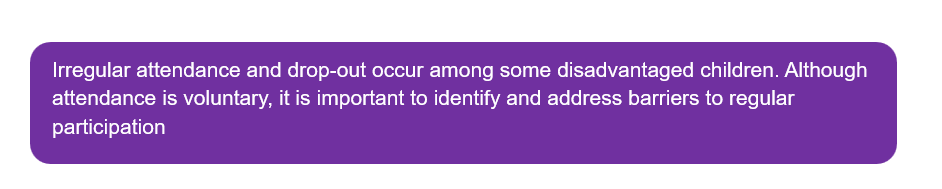
If falling take-up among early learning for 2-year-olds -eligible 2-year-olds leads to lower participation at age three, the approach described above could be adapted to track and support those children as they become eligible for the 3-year-old offer.
Additional funding could also be used to make the entitlement more appealing to some families, for example, by offering a free lunch (discussed below).
Inclusive and effective Family Information Services (FIS)
Roundtable discussions reinforced earlier findings that successful engagement relies on a strong, inclusive Family Information Service (FIS). Effective services hold up-to-date, detailed data on local needs and supply, and can adapt their offer to the needs of diverse communities.
While many parents can navigate digital systems to access early education, fully digital or outsourced FIS models risk excluding disadvantaged families. A balanced approach – combining accessible online tools with personalised local support – is required to ensure all families are supported to make informed early education choices.
The resources required to reach and support families reflect the level of disadvantage they face. Those needing the most help include children in care, parents with mental health difficulties, families experiencing domestic abuse, those with English as an additional language, families in poverty and children with SEND.
Over the past decade, many FIS teams have faced significant budget cuts, limiting their capacity to engage these families.
Local leaders should therefore review what resources are needed for a genuinely inclusive information and advice service – one that reaches all families, not only those who are more proactive, understand complex information or can navigate digital systems.
Supporting sufficiency for disadvantaged children
LAs have several tools to ensure enough suitable places for disadvantaged children, including:
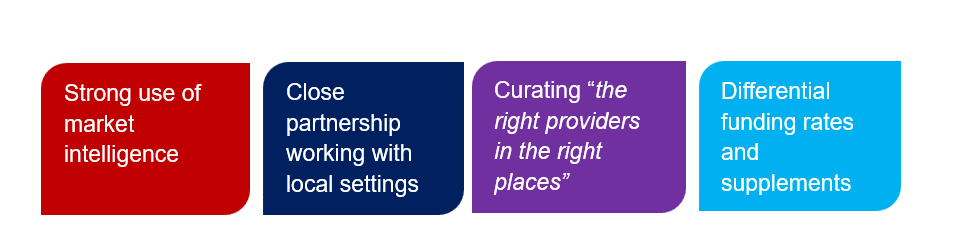
Market intelligence
LAs achieving strong take-up use data strategically to understand their local early education market and respond to changing needs. In these areas, early years census data is updated termly to show how inclusive early years services are by monitoring:
- the number of funded places available for each entitlement
- how funded hours are delivered, for example, termly or all-year round, and whether there are additional charges
- take-up among key groups such as early learning for 2-year-olds -eligible and SEND children.
This is complemented by “soft intelligence” from provider networks, meetings and day-to-day contact with settings.
Assessing inclusivity
To assess how inclusive local provision is, LAs could analyse data across all settings (including schools) to compare each setting’s profile with the average for the district or ward, using indicators such as:
- per cent of 2-year-olds claiming early learning for 2-year-olds
- per cent of 2-year-olds with an Education, Health, and Care Plan (EHCP), receiving SEN Inclusion Fund (SENIF) or Disability Access Fund (DAF)
- per cent of 2-year-olds claiming fewer than 15 hours
- per cent of 3-4-year-olds claiming only the universal entitlement
- per cent of 3-4-year-olds with an EHCP, receiving SENIF or DAF
- per cent of early learning for 2-year-olds 2-year-olds and 3-4-year-olds claiming fewer than 15 hours
Market intelligence should be regularly updated, as both family needs and provider capacity can change quickly.
LAs can use this information to:
- identify gaps in provision and plan how to address them
- help providers develop business plans
- support ongoing dialogue with settings about local priorities and changing needs.
Partnership with settings
Working closely with providers across all sectors enables LAs to build a shared understanding of:
- local needs and priorities
- where gaps exist and how they can be filled
- how providers can work together to ensure all children access early education.
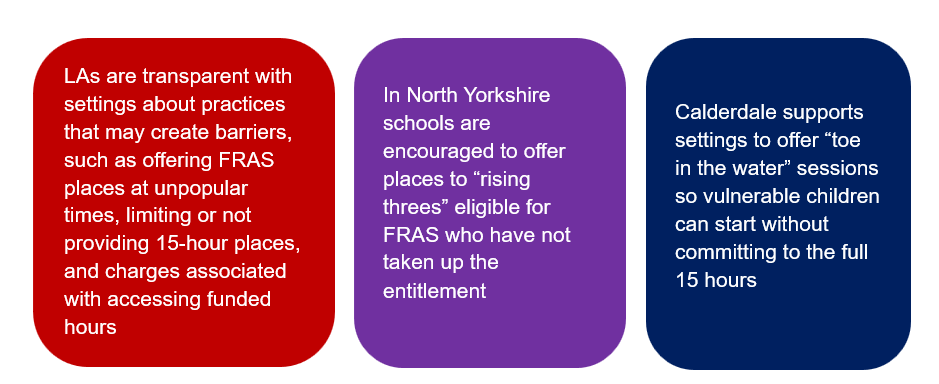
LAs support partnership working in different ways from digital platforms to early years networks and regular one-to-one contact. An example of a well-established and effective model is the Shared Foundation Partnership in York.
Curating “the right providers in the right places”
Even in a system increasingly focused on working families, many providers remain committed to serving disadvantaged children. LAs play a key role in supporting their financial viability.
For example, some LAs have used recent capital funding to:
- support settings offering a high number of places for children with SEND
- increase provision in disadvantaged areas where families have limited mobility
- sustain providers serving mainly disadvantaged families – for example, by helping schools host or take over voluntary pre-schools at risk of closure.
LAs also support providers that serve disadvantaged communities through sustainability grants, free or subsidised rent, SEND support and training, recruitment help, CPD, and business planning advice. Some authorities finance this support from underspends in early education funding, ensuring that vital inclusive places remain available.
Use of differential funding rates and supplements
LAs can provide differential funding for disadvantaged children through a higher hourly funding rate for early learning for 2-year-olds (over 2-year-olds in working families) or through a deprivation supplement. This differential could be used to encourage providers to offer more places for these children and/or to encourage parents to take up places.
There is an absence of robust evidence on whether and how differential funding rates and supplements can support take-up, but the roundtable discussions provided some insights into the issues that need to be considered when making decisions about their use.
Before using differential funding to encourage providers to offer places for disadvantaged children, LAs would need to ascertain from providers whether a differential (and what level of differential) would lead to more places being offered. LAs in the roundtable discussions with experience of using differential rates reported that they had not been effective in encouraging providers to offer additional places for disadvantaged children, even where providers were paid as much as 60p more per hour for these places. Moreover, roundtable participants suggested that even very large funding differentials may not be effective because providers make decisions using base funding rates or total funding amounts, with differential rates and supplements viewed only as complicating their financial planning. It was also suggested that providers offer places on a “first come, first served” basis and do not actively choose children on the basis of funding amounts. LAs will therefore need to use local intelligence from providers to understand whether differential funding can enhance the availability of places for disadvantaged children.
Differential funding could be used to encourage take-up amongst disadvantaged families by making additional funding conditional on giving parents a tangible extra benefit. Roundtable participants suggested that deprivation supplements and EYPP funding had been used effectively by some providers to offer free lunches or cover transport costs. To use this approach, LAs would need information from parents on what type of benefit would impact their take-up decisions. Information would also be needed from providers on the cost of delivering the benefit (to ensure that funding covered providers’ costs) as well as information on the likely proportion of children receiving the benefit (in order to understand the total cost for the LA[1).
There would also be some practical considerations:
- Using a deprivation supplement could be constrained by the maximum proportion of funding (12 per cent in 2025/6) permitted for all types of supplements.
- Using a deprivation supplement to cover the cost of a specific additional benefit for early learning for 2-year-olds could make financial planning simpler for providers than working with differential rates.
- Using a deprivation supplement to cover the cost of a specific additional benefit for early learning for 2-year-olds children would add uncertainty to the total funding cost for LAs because the funding would only be paid for early learning for 2-year-olds children who received the benefit.
- Some LAs may need to modify their funding administrative systems to implement differential rates and deprivation supplements.
[1] For example, there would be no additional funding for early learning for 2-year-olds children attending settings which did not provide lunches. If 50 per cent (half) of early learning for 2-year-olds children received five hot lunches each week (at a hypothetical cost of £2.50 for each lunch), the required additional hourly funding would be 42p per early learning for 2-year-olds hour (total weekly cost of £12.50 divided by 15 hours divided by 2 if lunch provision was 50 per cent ).
The guide was written by
Ivana La Valle Visiting Research Fellow, University of East London
Gillian Paull Visiting Senior Fellow, Centre for Analysis of Social Exclusion, London School of Economics and Political Science
With contributions from:
Glenda Brocklehurst Stockport Metropolitan Borough Council
Peter Cooper Hampshire County Council
Claire Crawford Centre for Education Policy and Equalising Opportunities, UCL
Julia Henry Rochdale Borough Council
Lydia Hodges Coram Family and Childcare
Sandie Leader Essex County Council
Jane Lewis Centre for Evidence and Implementation
Barbara Mands City of York Council
Warren Marchini Lancashire County Council
Lisa Morris Solihull Metropolitan Borough Council
Stacey Picken Telford and Wrekin Council
Rosie Ratcliffe Solihull Metropolitan Borough Council
Helen Smith North Yorkshire Council
Lynn Turner Swindon Borough Council
Ed Whitby Newcastle City Council
Flora Wilkie Local Government Association
Dawn Wood City of York Council
Nikki Wood Calderdale Metropolitan Borough Council
December 2025