Prof Lisa McNally’s blog powerfully reminds us that neighbourhood health is at its best when Public Health insight, prevention and genuine community partnership come together to create support that feels human, local and truly responsive to people’s lives.
When people talk about what good health support looks like, they rarely mention structures, contracts or governance. They talk about people. They talk about the neighbour who checks in, the nurse who knows their story, the community group they feel safe in. They talk about being seen and understood. And they talk about wanting help before things get worse, not after.
This is behind the principle of Neighbourhood Health. It is an approach rooted in the belief that the best health outcomes do not start in hospitals. They start in communities. As national policy increasingly highlights, neighbourhood health aims to bring care closer to where people live, join up support across organisations, and focus on prevention, recovery and reducing inequalities.
For people working in Public Health, this is familiar territory. It is the work we have always done. We understand local needs, shape healthier environments, support independence, and connect organisations that do not often talk to each other. Neighbourhood Health gives Public Health a clearer canvas. It is a chance to bring together evidence, relationships and community strengths in a way that feels real and local.
Below are the three domains where Public Health can make the biggest difference.
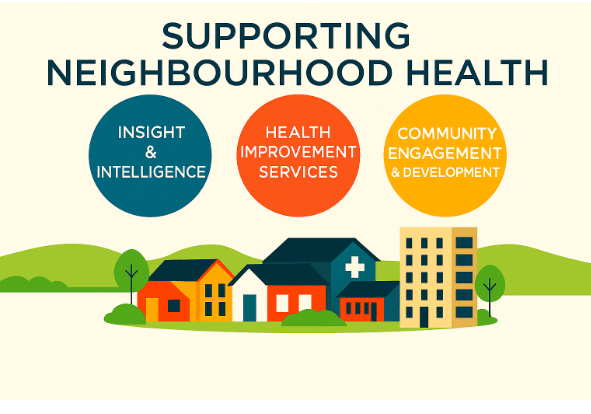
Domain 1: Insight and Intelligence — seeing neighbourhoods as people experience them
At neighbourhood level, insight becomes personal. We begin to see the stories behind patterns. We see which bus routes shape people’s access to services, which streets see higher emergency admissions, where isolation is quietly shortening lives, and which communities face cultural or language barriers that go unnoticed.
National thinking stresses the importance of population health management and linked local data, helping neighbourhoods target support earlier and more fairly. Public Health has long specialised in making sense of this picture. We bring together health, housing, education, employment and lived experience into one view of what a place needs in order to thrive.
Insight is not just analysis. It is connection. It is creating a shared understanding so that GPs, social workers, community leaders, mental health teams and voluntary groups pull in the same direction. It is also shining light on the inequalities that hide in plain sight. The mum juggling two jobs who cannot attend daytime appointments. The older man whose falls were not accidents but warnings. The family who never accessed support because letters were not in their first language.
And crucially, insight must feel safe. Case studies from councils show that when partners agree on responsible data sharing, with clear rules and transparency, frontline staff gain the information they need and residents gain confidence that their data is used for their benefit.
Done well, Public Health insight becomes the compass that guides neighbourhood decisions.
Domain 2: Health Improvement Services — making prevention and independence feel local
People often think neighbourhood health simply means more clinics in more places. Sometimes that is true. But most of the time, it means prevention, reablement and support woven into everyday life.
National analyses highlight several practical components. These include stronger community services, integrated teams for people with complex needs, urgent community care, easier access to specialist advice and short term rehabilitation that helps people recover at home when possible.
These are exactly the areas where Public Health is at its strongest.
Public Health can help neighbourhood teams connect people into:
- stop smoking support that reaches those with the highest prevalence
- healthy weight and physical activity programmes in familiar community settings
- falls prevention classes that improve mobility and reduce fear
- substance misuse services delivered with dignity and understanding
- sexual health support that feels private and respectful.
Local areas already show how well this can work. Integrated lifestyle services have improved access and reduced inequalities by placing prevention in the heart of community life.
Public Health also plays a key role in shaping intermediate care. These services help people recover after illness or injury, stay independent and avoid unnecessary hospital stays. National guidance continues to emphasise their importance.
At its best, prevention becomes part of daily routines, not something abstract or distant.
Domain 3: Community Engagement and Development — building health with people
Neighbourhood Health only works when it feels like something communities own, not something that is done to them.
Public Health has long understood the power of community centred approaches. These approaches recognise that trust, relationships and lived experience shape outcomes as much as clinical interventions do. Evaluations of community champion programmes show that trusted local voices can improve engagement, tackle misinformation and reach residents who may be missed by traditional services.
Research on community centred public health highlights how agency, belonging and social connection strengthen wellbeing and reduce inequalities.
Neighbourhood Health gives Public Health the chance to embed:
- co design as a standard practice
- culturally competent outreach that meets people where they are
- strong and fair partnerships with the VCSE sector
- practical support for unpaid carers who hold communities together
- community spaces that allow connection, resilience and support.
These approaches are not soft extras. They are often the difference between a service that people use and one that is simply available.
Pulling it all together — everyone rowing in the same direction
There is a phrase often used in neighbourhood discussions. It is the idea of everyone paddling in the same direction. It reflects a simple truth. Neighbourhood Health is less about designing perfect structures and more about aligning people, organisations and energy behind a shared purpose.
Public Health can help hold that alignment. By grounding decisions in evidence, placing prevention at the centre, and ensuring communities are genuinely involved, Public Health helps neighbourhoods create the conditions for healthier and fairer lives.
Neighbourhood Health is ultimately an invitation. It is a chance to build health in ways that feel human, local and hopeful. Public Health has the tools, the relationships and the ethos to make that invitation real.
One neighbourhood at a time.
Prof Lisa McNally
Director of Public Health
Worcestershire County Council