This briefing pack is designed to provide a foundational understanding of adult social care - what it is, why it matters, and how it operates within the council. It explores questions and challenges in key areas in health and adult social care from a senior leadership perspective.
Purpose
This briefing pack is designed to provide a foundational understanding of adult social care - what it is, why it matters, and how it operates within the council. It explores questions and challenges in key areas in health and adult social care from a senior leadership perspective.
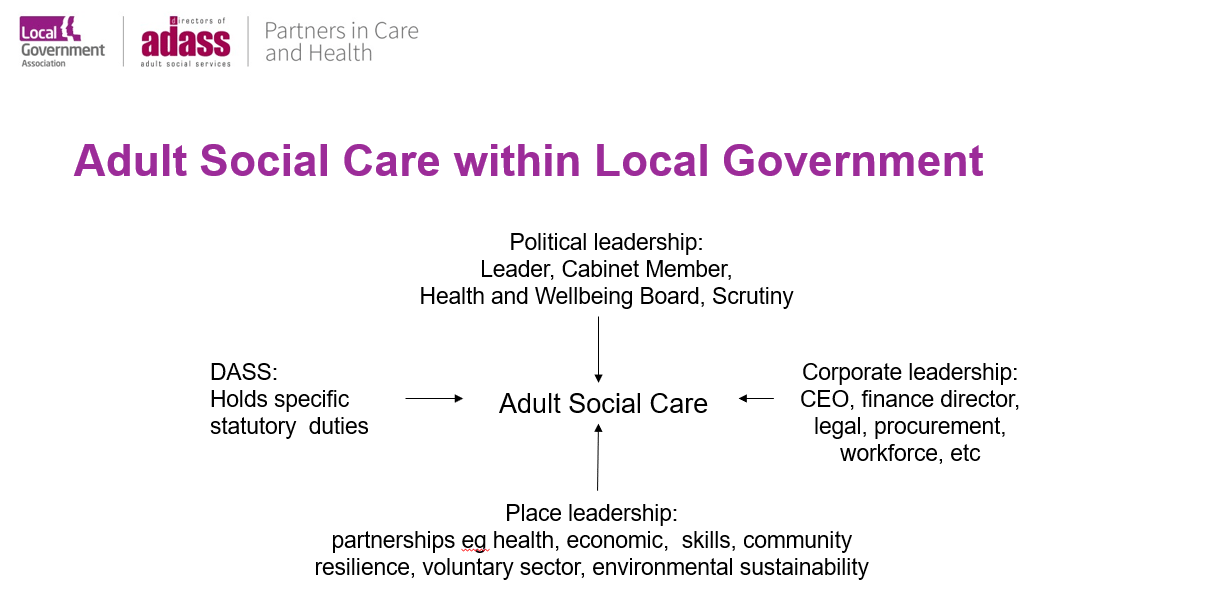
Every council with responsibility for adult social care will have a director of adult social services. This is a statutory role under the Care Act 2014 and is responsible for the leadership, delivery and quality of adult social care services. There is also a statutory role for lead members for ASC. The chief executive, with overall responsibility for the council's performance and strategic priorities, will work closely with director of adult social services to ensures adult social care services are safe, effective, and aligned with the council’s wider priorities.
Further resources can be found on both the Local Government Association and Association of Directors of Adult Social Services websites. Key publications include: The DASS Guide, ADASS Autumn Survey 2025, Must knows' for lead members for adult social care and Get in on the Act: Health and Care Act 2022. Further information to understand the headline measures of health and wellbeing in your area can be found in the LG Inform Health and Care: An overview for Lead Members report.
Introduction to adult social care
What is adult social care?
‘We all want to live in the place we call home with the people and things that we love, in communities where we look out for one another, doing the things that matter to us.’ (Social Care Future vision)
- The Care Act 2014 is the key legislative framework for how ASC is delivered through local authorities. Local authorities are responsible for assessing people’s needs and, if individuals are eligible, funding their care. Care is provided by councils, voluntary and private organisations, and informal networks like family and friends.
- Adult social care supports people to live independently, safely, and with dignity. It supports working age and older adults with health conditions, mental ill health, learning disabilities and autistic people, through practical, personal, and community-based assistance, such as help with daily tasks, home adaptations, reablement, residential care, and support for carers
- At its heart, adult social care is about rights, relationships, and enabling people to live the lives they choose. At its best, it ensures that everyone can pursue the things that matter most to them, regardless of age or health conditions.
How big is adult social care?
- In 2024/25, there were 2 million new requests for adult social care, with 888,755 adults receiving long-term support and 245,495 receiving short-term care aimed at maximising independence.
- The population is ageing, and people are living longer with complex health conditions. Healthy life expectancy has declined, and 17.3 per cent of adults have long-term conditions. 4.7 million people provide unpaid care, highlighting the essential role of informal carers.
- In 2024/25, £29.4 billion was spent on adult social care, equivalent to £633 per adult. Spending is higher for older adults due to their greater numbers, though the average cost per person accessing care is higher for younger adults. 96 per cent of care costs went to long-term care, with only 4 per cent to short-term support.
- There are 1.50 million people working in adult social care. In comparison there are 1.54 million people working in the NHS. The sector is diverse: 78 per cent female, 38 per cent from ethnic minority backgrounds, and 31 per cent non-British nationals. Most work in direct care roles, with a smaller proportion in managerial or regulated professional roles.
- As of 2024/25 social care is provided and organised by approximately 19,000 organisations and delivered in approximately 42,000 establishments. 84 per cent of adult social care staff worked for independent sector employers, 8 per cent were employed by direct payment recipients and 8 per cent worked for local authorities.
- The two main service settings are residential and domiciliary (home-based) care, both of which employ more than 500,000 staff. By job role, 76 per cent of posts were direct care workers (people who work directly with patients).
- 80 per cent of providers are running on digital systems, though up to 20 per cent of them – mainly SMEs - are still on pen and paper.
- Unlike the NHS, social care has never been free at the point of use. It is financially means-tested for most care situations and that depending on relative levels of deprivation, a large proportion of people who draw on care and support in their area may be paying for some or all their care. As such people with care and support needs are financial partners in their care and support. Adult social care within local government
The Care Act
The Care Act (2014) provides the framework for how councils must support adults with care and support needs, and their carers. Duties under the Act include:
- Promote individual wellbeing: all decisions must promote individual well-being, including dignity, health, independence, and participation.
- Prevent needs for care and support: provide services and interventions that reduce or delay the need for care.
- Promote integration: work with health services and other partners to integrate care and support.
- Provide information and advice: ensure accessible, comprehensive advice for residents, carers, and self-funders.
- Promote diversity and quality in services: develop a diverse, sustainable care market offering choice and quality.
- Co-operate with partners: collaborate with other agencies to deliver joined-up care.
- Safeguard adults at risk: protect adults at risk of abuse or neglect through robust systems.
The Care Act shifts adult social care from a crisis response to proactive support. It requires councils to promote wellbeing, maintain independence, and intervene early through a statutory duty to prevent, reduce and delay the need for care and support.
To fulfil this vision, prevention is understood in three layers:
- Primary prevention – universal information, advice, and community‑based activities that help people stay well.
- Secondary prevention – targeted early help for people beginning to struggle, such as falls prevention or support for carers.
- Tertiary prevention – reablement, rehabilitation and short‑term support that helps people with existing needs avoid further deterioration.
This duty applies to all adults, including those with unmet needs and carers at risk. Councils must ensure prevention is accessible, embedded in strategy and commissioning, and supported by sustained investment.
Effective prevention relies on strong community capacity, social connection, and integrated working across health, housing, public health, and the voluntary sector. Strong partnerships ensure people experience seamless support that flows well across services. There is a key opportunity for leaders to enable more joined‑up thinking across these partners to create a shared understanding of local needs; and champion a positive, proactive vision of prevention and wellbeing.
Other legislative duties
While the Care Act 2014 is the primary legal foundation for adult social care, councils must comply with a wider set of laws and regulations that shape how care is delivered, safeguarded, funded, and overseen.
The Mental Health Act 2025: modernises the 1983 Act, setting out the legal framework for assessing, treating, and, when necessary, detaining people living with mental illness, to protect their safety or the safety of others
The Health and Care Act 2022: strengthens councils’ adult social care responsibilities by introducing CQC assessments of how well they deliver their Care Act duties and by driving greater integration with the NHS through statutory Integrated Care System
The Mental Capacity Act 2005: requires councils to ensure that adults who may lack capacity are properly supported to make decisions wherever possible, and that any decisions made on their behalf, follow the Act’s principles of best interests and least restriction.
NHS Continuing Healthcare (CHC): Under NHS legislation, councils must ensure that people who are eligible for NHS Continuing Healthcare are funded by the NHS, not the local authority, and must work closely with NHS partners to avoid unlawful provision of health services.
Health and integration
New legislation and reform
The Government’s 10 Year Health Plan for England (“Fit for the Future”) seizes the opportunities provided by new technologies, medicines, and innovations to deliver better care for all patients – wherever they live and whatever they earn – and better value for taxpayers. It is making 3 big shifts to how the NHS works:
- from hospital to community: more care will be available on people’s doorsteps and in their homes
- from analogue to digital: new technology will liberate staff from admin and allow people to manage their care as easily as they bank or shop online
- from sickness to prevention: we’ll reach patients earlier and make the healthy choice the easy choice.
At heart, the plan is about building a “neighbourhood health service” that offers easier, earlier, more personalised care closer to home, rebalancing activity away from hospitals while using digital tools and data to anticipate need and improve outcomes.
Running alongside the NHS 10‑year plan is a social care reform trajectory pointing toward a National Care Service.
The UK government has launched an independent commission, chaired by Baroness Louise Casey, to deliver recommendations for a reformed adult social care system as a first step toward a National Care Service. The commission will work with councils, care users, NHS partners and the voluntary sector to create a long-term plan.
The commission will consist of two phases:
- First phase (medium term report due in 2026): should set out the plan for how to implement a National Care Service, a government manifesto commitment.
- Second phase (long-term report due 2028): should then make longer term recommendations for the transformation of adult social care
Better Care Fund
- The Better Care Fund (BCF) is a circa £10 billion programme that supports local systems to successfully deliver the integration of health, housing and social care in a way that supports person-centred care, sustainability and better outcomes and people and carers.
- It represents a unique collaboration between:
- The Department of Health and Social Care
- Ministry for Housing, Communities and Local Government
- NHS England
- The Local Government Association
- The four partners work closely together to help local areas plan and implement integrated health and social care services across England, in line with the vision outlined in the NHS Long Term Plan. Locally, the programme spans both the NHS and local government to join up health and care services, so that people can manage their own health and wellbeing and live independently in their communities for as long as possible.
- The government intends to reform the BCF as part of the 10‑Year Health Plan and early steps towards a National Care Service. BCF 2025–26 guidance frames the current year as a first step towards more integrated, preventative, neighbourhood‑based care, signalling the direction of travel for post‑2026 arrangements.
Health and Wellbeing Boards
- Health and Wellbeing Boards (HWBs) have been central to driving joined‑up local working since 2013, bringing together NHS, public health and local government leaders to improve population health. Their core statutory duties, producing Joint Strategic Needs Assessments (JSNAs) and Joint Local Health and Wellbeing Strategies (JLHWSs), continue to guide local commissioning and integration, including the Better Care Fund. Despite the creation of Integrated Care Boards (ICBs) and Integrated Care Partnerships (ICPs) under the Health and Care Act 2022, HWBs remain the key mechanism for place‑based coordination.
- The 10‑Year Health Plan proposes reorganising ICB boundaries to align more closely with strategic authorities, meaning HWBs will need to operate within larger system footprints while ensuring the local “place” voice and community needs remain visible in broader commissioning decisions.
- The Plan also confirms the abolition of ICPs, removing their statutory footing by 2027. However, the Department of Health and Social Care has encouraged systems to retain successful partnership arrangements and design models that reflect local priorities. HWBs will therefore continue to play a central role in neighbourhood‑level health improvement, with a clear expectation that HWBs, ICBs and other partners will work closely with new Mayoral Combined Authorities on shared duties to tackle health inequalities.
Public health responsibilities
- Since April 2013, councils in England have been legally responsible for improving the health of their populations and delivering a range of public health services, including sexual health, substance misuse, and children’s health services.
- Public health operates as a distinct service within the council but works closely with adult social care to support effective prevention, early intervention, and long‑term demand reduction.
- Each council must appoint a director of public health, a statutory role separate from the director of adult social care. The director of public health provides strategic leadership to improve residents’ health, reduce health inequalities, and protect communities from risks such as infectious diseases. As a statutory chief officer, they advise councillors, officers, and partners across health improvement, health protection, and healthcare planning.
- Local authorities receive a ringfenced public health grant from the Department of Health and Social Care (DHSC), which must be used exclusively for public health functions. These include both mandated services, such as NHS Health Checks, drug and alcohol services, sexual health services, and the National Child Measurement Programme, and non-mandated services like tobacco control and obesity prevention.
- Councils are expected to use tools such as the Public Health Outcomes Framework, Joint Strategic Needs Assessments (JSNAs), and Joint Local Health and Wellbeing Strategies (JLHWSs) to guide commissioning and service delivery.
- The 10-Year Health Plan for England introduced a national peer review system for public health.
Regulation and inspection
Care Quality Commission
On April 1, 2023, the Care Quality Commission (CQC) assumed a new duty to assess local authorities’ performance in delivering of their adult social care (ASC) responsibilities under Part 1 of the Care Act 2014.
The CQC assessment framework is grouped into four key themes, each with nine quality statements mapped to the themes. The assessment process culminates in a single performance rating for local authorities. These ratings are categorised as outstanding, good, requires improvement, or inadequate.
As this is a new responsibility for the CQC, it is establishing a baseline of completed initial assessments for all councils. CQC will complete baseline assessment of all 153 councils by December 2025 and aims to publish all assessment reports by 31st March 2025.
What comes next – after baselining: a baseline of initial assessments is intended to help develop CQC’s understanding of relative performance across local authorities. The future assessment approach is currently being considered with the expectation that a new framework will be in place April 2026.
Care Quality Commission assessments for adult social care: Must know guide for chief executives
Section 50
- CQC’s assessment reports will make clear any areas that require improvement. Councils are best placed to lead their own improvement. Assessments will consider any improvement actions that a local authority has already put in place.
- If a council is found to be failing to perform its functions under the Care Act to an acceptable standard, CQC must inform the Secretary of State for Health and Social Care. This duty is under section 50 of The Health and Social Care Act 2008.
- Following notification, the Department of Health and Social Care will provide guidance and co-ordinate any improvement or intervention activity with the appropriate organisation (for example, NHS England, the Local Government Association, the Association of Directors of Adult Social Services).
- Adult social care intervention framework for local authorities - GOV.UK
Key issues
Finance
Adult social care is one of the largest areas of council expenditure. In 2024/25, councils with social care responsibilities allocated around two‑thirds of their budgeted net service spend to adult and children’s social care combined (excluding education, fire and police). It is also the fastest‑growing area of spend, driven by general inflation and increases in the National Living Wage. As a result, it places significant pressure on councils’ finances, absorbing both core council tax capacity and the additional social care precept.
- Funding comes from a mix of sources: council tax (including the adult social care precept), business rates, central government grants, and contributions from individuals who are assessed to pay for all or part of their own care. Central government support comes through grants such as the Social Care Grant and the Market Sustainability and Improvement Fund, which aim to stabilise the care market and improve workforce conditions. Additionally, the Better Care Fund encourages collaboration between the NHS and local authorities, pooling budgets to deliver integrated care.
- Despite these sources, the system is under significant pressure. These pressures include an ageing population, increasing numbers of working-age adults with disabilities, and the need to maintain quality and safety in care provision. At the same time, the cost of care provision is rising, driven by inflation, workforce costs, and the need to maintain quality standards. Councils are legally required to set a balanced budget, which means difficult decisions often must be made about which services can be funded and at what level. 80 per cent of councils overspent on adult social care in 2024/25, up from 72 per cent in 2023/24 (ADASS Spring Survey)
Safeguarding
- The Care Act 2014 established legal duties for safeguarding adults at risk in England, requiring local authorities to protect those with care needs who are experiencing or at risk of abuse/neglect and unable to protect themselves. Types of abuse and neglect include physical, emotional, sexual, financial, organizational abuse, neglect, modern slavery, discrimination, and self-neglect.
- Safeguarding under the Act focuses on empowering individuals, preventing harm, promoting wellbeing, and ensuring proportionate responses, involving a legal framework for enquiries, Safeguarding Adults Boards (SABs), and Safeguarding Adults Reviews (SARs) for serious cases, all rooted in principles of dignity and control.
- Safeguarding Adults Boards (SABs), which bring together key partners like the NHS, police, and voluntary sector to ensure a joined-up approach.
Workforce
- Key objectives for the sector include improving recruitment and retention, ensuring fair pay and conditions, developing clear career pathways, and building a workforce that reflects the diversity of the communities it serves. There is also a strong focus on professional development, wellbeing, and creating inclusive, supportive working environments.
- Issues with recruitment and retention are driven by factors such as low pay, limited career progression, and high levels of stress and burnout. Many care workers are employed on zero-hours contracts, and the sector struggles to compete with other industries for talent. Vacancy rates in adult social care are significantly higher than in other sectors, including the NHS.
- Workforce shortages are compounded by an ageing population and increasing complexity of care needs, placing greater pressure on services. Councils have increasingly relied on international recruitment to fill gaps, but recent visa restrictions and concerns about ethical employment practices have raised questions about the sustainability of this approach.
- Strategic workforce planning can help councils anticipate future service needs, align staffing with demand, and invest in the right skills and roles to deliver high-quality care. It supports sustainability by identifying gaps, guiding recruitment and training, and ensuring the workforce is resilient, diverse, and equipped to meet evolving challenges.
Commissioning
- Under the Care Act 2014, councils must commission adult social care services that promote wellbeing, prevent or delay the need for care, and support a diverse, high‑quality care market. Commissioning includes assessing needs, planning services, procuring providers, and monitoring outcomes to ensure people receive the right support at the right time.
- Adult social care is often the largest employer within a local area, shaping thousands of jobs and the wider care economy. This scale brings a responsibility to maintain strong quality assurance, support provider resilience, manage market risks, and ensure services meet statutory duties and deliver positive outcomes.
- Financial pressure remains a major challenge. Rising demand, increasingly complex needs, and limited budgets make it difficult to sustain high‑quality provision. Councils must balance affordability with paying fair rates to providers, especially amid workforce shortages and inflation.
- Market fragility is also a concern, with many providers operating on thin margins, particularly in residential and domiciliary care. Councils work to shape and stabilise the market to ensure it remains diverse, sustainable, and responsive to local needs. Integration with health, housing, and community services is increasingly important, creating opportunities for co‑designed services, shared budgets, and aligned priorities. Achieving this requires overcoming organisational differences and coordinating commissioning approaches.
- Commissioning must remain person-centred and outcomes-focused, involving service users and carers in co-design and evaluation. This includes embedding continuous improvement, safeguarding, and equity in all aspects of commissioning.
Further information
- Partners in Care and Health, Local Government Association
- Local government reorganisation (LGR), Local Government Association
- Social Care Institute for Excellence (SCIE)
- Think Local Act Personal (TLAP)
- Department of Health and Social Care - GOV.UK
- Care Quality Commission (CQC)
- Adult Social Care: Key facts And figures, The Kings Fund