Foreword
Each year, it does more than gather feedback: it drives tangible action. By highlighting the realities of day‑to‑day practice, the survey helps employers recognise pressures early, respond more effectively, and actively remove barriers that prevent staff from delivering high‑quality care. Ensuring that employers maintain the ability to recruit and retain staff. To understand this year’s findings, it is important to situate them within the wider context of adults’ social care, which continues to evolve under increasing complexity and demand.
This year, with a focus on adults’ social care, the Health Check supports local authorities, regions, and the national sector to learn from one another, identifying what works well, where challenges persist, and how collective improvement can be achieved. The insights generated enable employers not only to take meaningful steps within their own organisations but also to contribute to shared learning and sector‑wide progress across England.
Executive summary
The annual Employer Standards survey, known as the Health Check, continues to amplify the voices of the social care workforce and drive improvement across the sector. In 2026, 11,636 practitioners from around 130 organisations took part, a 9 per cent like-for-like increase on 2025, demonstrating growing engagement and a strong appetite for contributing to sector-wide learning and change.
This report outlines the key findings from occupational therapists (you can also download a separate summary of the responses from registered social workers and social care colleagues.)
A detailed breakdown of the 2026 findings, including national and regional comparisons, will be available through the Knowledge Hub. Key findings from this year’s survey include:
- The national average for standards 1-8 increased noticeably from 76 in 2025 to 80 in 2026.
- East Midlands average response increased noticeably to 83 from 72 in 2025 highlighting a significant regional improvement and suggesting that targeted interventions may be having a positive effect.
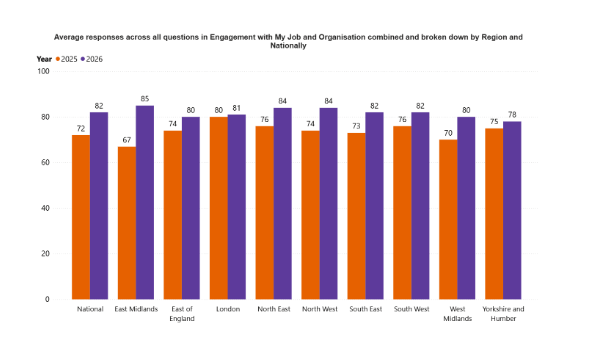
- The national average for the engagement with my job and organisation section increased by 10 points from 72 to 82 in 2026 reflecting a marked rise in workforce morale and a stronger sense of connection to organisational priorities.
- Standard 2: Effective workforce planning systems was the lowest scoring standard with an average of 71, showing that this remains a key area for development and may require focused action to strengthen capability.
The continued rise in participation and the depth of insight shared this year underline the value practitioners place on having a meaningful voice in shaping their working environment. The 2026 responses reflect a workforce that is increasingly engaged and committed to sector‑wide improvement, offering employers a strong evidence base to drive learning, strengthen accountability, and deliver meaningful, sustained change across adults’ and wider social care.
Introduction
Occupational therapists play an essential role in helping people to carry out everyday activities in work and leisure. In England, over 21,000 occupational therapists are employed by the NHS, while 3,500 OTs work in local authorities (according to Skills for Care) which is 3.1 per cent increase on 2024 however there a still around 250 vacant posts and an around 10.3 per cent turnover rate. This highlights the recruitment and retention issues the social care sector is struggling with.
To provide support for this ongoing issue the standards for employers of occupational therapists were established in 2022. These standards set out core expectations of employers to enable OTs to work effectively and safely.
The Health Check survey compliments these by helping organisations who employ OTs to understand some critical questions about their workplace experiences:
- How well do employers deliver the employer standards?
- How well do employees perceive their working environment?
Please note that this summary report relies on data collected from occupational therapists employed by local authorities and related agencies. While the results are considered to represent a reasonable national sample, no claims are made for generalisation of the results to all areas.
The Employer Standards
Full description of the 8 standards for employers of occupational therapists is available on the LGA website. The standards touch on a range of key themes for the workforce, from skills and professional development to wellbeing:
- Standard 1 – Strong and clear occupational therapy framework: This standard is a clear statement on the principles that constitute good occupational therapy practice, and how those principles function across the full range of settings. It outlines the ways in which each organisation can achieve and maintain the theories, skills, research, and evidence that underpin good occupational therapy practice at strategic and operational levels.
- Standard 2 – Effective workforce planning systems: This standard is about using effective workforce planning systems to make sure that the right number of occupational therapists, with the right level of skills and experience, are available to meet current and future service demands.
- Standard 3 – Safe occupational therapy workloads and case allocation: This standard is about ensuring employees do not experience excessive workloads, resulting in unallocated cases and long waiting times for the people accessing the service.
- Standard 4 – Wellbeing: This standard is about promoting a positive culture for employee wellbeing and supporting occupational therapists to have the practical tools, resources, and organisational environment they need to practice safely.
- Standard 5 – Supervision: This standard is about making sure occupational therapy students and qualified occupational therapy practitioners can reflect critically on their practice through high-quality, regular supervision as an integral part of occupational therapy practice.
- Standard 6 – Continuing professional development (CPD): This standard is about occupational therapists being provided with the time and opportunity to learn, keep their knowledge and skills up to date, and critically reflect on the impact this has on their occupational therapy practice.
- Standard 7 – Professional registration: This standard is about supporting an occupational therapist to maintain their professional registration with their regulating body so that they can continue to practice as an occupational therapist.
- Standard 8 – Strategic partnerships: This standard is about creating strong partnerships, system leadership and encouraging collaboration between employers, ICS stakeholders, Higher Education Institutions, training providers, and promoting the degree apprenticeship for occupational therapy workforce development.
Participants
It is essential to understand who took part in the 2026 survey when interpreting the results that follow. The survey was carried out from mid-January to mid-February 2026. A total of 1,722 responses were received from occupational therapists, making up 15 per cent of the total survey responses.
| 2026 | Percentage | |
|---|---|---|
| Registered social workers | 4,528 | 39% |
| Social care workers | 5,386 | 46% |
| Occupational therapists | 1,722 | 15% |
| Total | 11,636 |
Based on feedback from previous Health Check surveys, this year we have included a more in-depth breakdown between service areas to capture a more comprehensive understanding of the perceptions of the employer standards from different groups. Of occupational therapists 827 (48 per cent) work in Adult Services and 895 (52 per cent) did not disclose their service area.
In 2026 there was a large increase in the numbers of people who did not respond to the question on which Service Area they were in.
Due to Children’s services not taking part in this year’s survey (DfE are responsible for Children’s Services) there was not “Integrated Adults and Children” option in 2026 which there was in 2025. This may well have contributed to the increase in no Service Area given. Wherever possible results are broken down by Service Area.
Methodology
The survey results were analysed by calculating the mean score for each question, as this approach provides a clear indication of how respondents collectively felt about each statement. While the majority of questions used a Likert scale ranging from ‘strongly disagree’ to ‘strongly agree’, a small number were presented as free-text questions to capture more specific or qualitative feedback. The mean score therefore reflects the overall average level of agreement or satisfaction for each Likert-based item and can also be expressed as a percentage to show how close the average response is to the maximum possible rating.
A small number of questions were updated this year in response to feedback from previous respondents and key sector stakeholders. These adjustments were made to strengthen the clarity and relevance of the survey. However, most questions remain consistent with earlier versions to ensure reliable benchmarking and year-on-year comparison.
For the purposes of interpreting results, scores or percentages between 0–50 are categorised as low, those between 51–74 are considered moderate, and those between 75–100 indicate a positive or strong outcome. This rating scale has been retained from last year so that comparisons over time can be made confidently.
The results at a glance
This table presents the overall differences in the responses from 2025 to 2026 and the change in percentage points:
| Employer Standard | Average mean score 2025 | Average mean score 2026 | Change |
|---|---|---|---|
| Standard 1: Strong and Clear Occupational Yherapy framework | 82 | 83 | +1 |
| Standard 2: Effective Workforce Planning Systems | 70 | 71 | +1 |
| Standard 3: Safe Workloads and Case Allocation | 75 | 77 | +2 |
| Standard 4: Wellbeing | 82 | 82 | 0 |
| Standard 5: Supervision | 84 | 84 | 0 |
| Standard 6: Continuing Professional Development (CPD | 73 | 75 | +2 |
| Standard 7: Professional Registration | 85 | 86 | +1 |
| Standard 8: Strategic Partnerships | 74 | 76 | +2 |
| Overall engagement with my job and my organisation | 74 | 82 | +8 |
This table shows the performance results across adult services and other areas. Although there are small variations between individual standards, the overall average score is 80 per cent, which represents a two percentage point increase compared with last year. This demonstrates that employers across all OT service areas are maintaining strong standards and continuing to improve.
| Section | Adults | Other | Overall |
|---|---|---|---|
| Standard 1: Strong and clear occupational therapy framework | 84 | 82 | 83 |
| Standard 2: Effective workforce planning systems | 72 | 70 | 71 |
| Standard 3: Safe workloads and case allocation | 79 | 76 | 77 |
| Standard 4: Wellbeing | 84 | 80 | 82 |
| Standard 5: Supervision | 85 | 83 | 84 |
| Standard 6: CPD Continuous Professional Development | 76 | 73 | 75 |
| Standard 7: Professional Registration | 88 | 84 | 86 |
| Standard 8: Strategic Partnerships | 77 | 76 | 76 |
| Engagement with my job and my organisation | 83 | 81 | 82 |
The standards overall
How well do employers deliver the employer standards for occupational therapists?
Employees’ views of how effectively their employers uphold the standards have continued to improve year on year, demonstrating a growing commitment to ensuring occupational therapists can work effectively and safely.
Standards 5 (Supervision) and 7 (Professional Registration) remain the highest-performing areas, reflecting strong practice across services. High-quality, frequent supervision continues to play a critical role in enabling safe, effective occupational therapy delivery, while the professional registration standard ensures employers actively support staff to maintain their regulatory status. This includes taking responsibility for timely registration renewal and ensuring employees understand the processes and expectations involved in any regulatory investigations.
Standard 2 (Workforce Planning Systems) remains the lowest performing area, achieving a moderate score of 71, an improvement of only one point since last year. This continued underperformance indicates that employers need to take more proactive steps to strengthen both short-term and long-term workforce planning. Engaging OTs directly in workforce planning is essential for accurately assessing service needs and ensuring effective recruitment and retention strategies. Meaningful involvement not only helps organisations build a sustainable pipeline of OTs but also supports better retention by making staff feel valued and invested in shaping their service’s future.
Regional differences
The East Midlands (last year’s lowest scoring region) achieved the highest score over all with 83 having seen a significant increase in the perception of standards 1-8, rising from 9 points since last year. With a similar magnitude of improvement seen with the Engagement with my job and organisation increasing 8 points from 2025 to 2026. All originations saw some level of increase across this section.
It is of notable importance to flag here the decreased perception of standards 1-8 seen in the East of England, North East and Yorkshire and Humber all falling by 1 point. This highlights a need for attention and reflection when looking at the local reports to identify where and why these standards have decreased.
| 2026 | 2025 | Change | |
|---|---|---|---|
| National | 80 | 76 | +4 |
| East Midlands | 83 | 72 | +9 |
| East of England | 76 | 77 | -1 |
| London | 81 | 81 | 0 |
| North East | 79 | 80 | -1 |
| North West | 81 | 76 | +5 |
| South East | 79 | 78 | +1 |
| South West | 80 | 79 | +1 |
| West Midlands | 78 | 73 | +5 |
| Yorkshire & Humber | 77 | 78 | -1 |
Average responses across all questions in engagement with my job and organisation combined and broken down by region and nationality
In their own words...
Word clouds
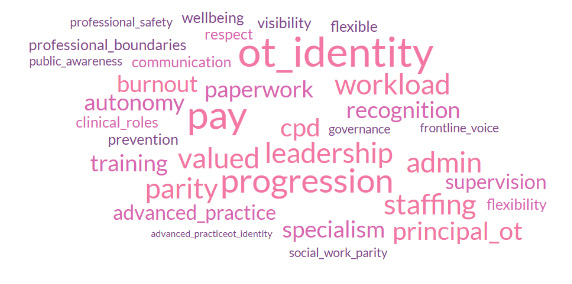
As well as asking quantitative questions, we included some qualitative free-text questions to further understand occupational therapists’ perspectives. The word clouds below illustrate the most common responses we received to the questions. The frequency of the words is demonstrated by how large or small the word appears to be, with larger words indicating greater frequency. They are good using in communications to share results with colleagues.
Please explain one to three changes that your employer could make to encourage you to stay at your current workplace."
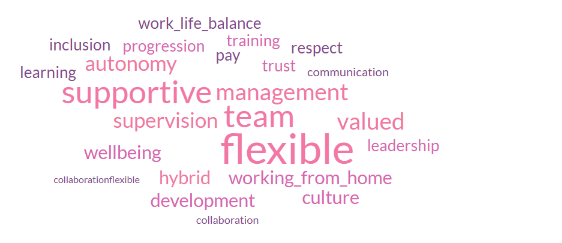
Please explain one to three changes that your employer could make to encourage you to stay at your current workplace"
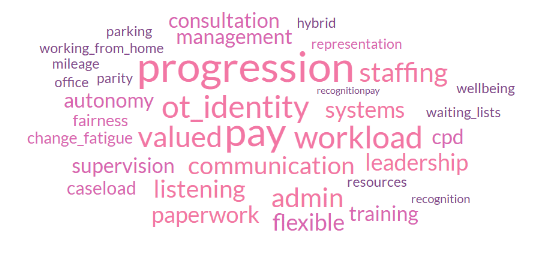
In your opinion, how could the social work profession be improved to encourage social workers to remain in the profession? "
Conclusion
The standards for employers of occupational therapists provide a clear framework for creating safe, supportive, and high quality‑ working environments where OTs are empowered to practise effectively and maintain their wellbeing. Strong employer practice directly translates into better outcomes for the people and communities receiving occupational therapy.
The 2025 Health Check shows that, overall, employers across England continue to make progress. Supervision (Standard 5) and Professional Registration (Standard 7) stand out as consistent strengths, demonstrating sustained commitment to high quality‑ practice and professional accountability which should be used a model for good practice.
However, the findings also highlight important areas requiring urgent attention. Workforce planning (Standard 2) remains the lowest performing‑ standard, and in an environment of increasing demand, this gap poses significant risk to service delivery. Employers should take more deliberate action to strengthen workforce planning systems, ensuring that services are resourced now and in the future. This includes meaningful consultation with occupational therapists, who are essential to understanding service pressures and designing effective solutions.
Within social care recruitment and retention remains an issue and must also be a priority. The feedback from OTs indicates that when they are engaged in workforce decisions, supported with high quality‑ supervision, and offered opportunities for development, they are more likely to stay and thrive within their organisation. Prioritising staff wellbeing, workload balance, and clear development pathways is not only the right thing to do, but also central to building a stable workforce and reducing turnover.
We encourage all employers to use local their Health Check reports to develop a targeted action plan that addresses local priorities and builds on existing strengths. By focusing on wellbeing, strengthening recruitment and retention, and investing in effective workforce planning, organisations can create even better environments for their occupational therapy teams. In doing so, they enable OTs to continue delivering excellent, life‑changing support that helps people live with independence and dignity.