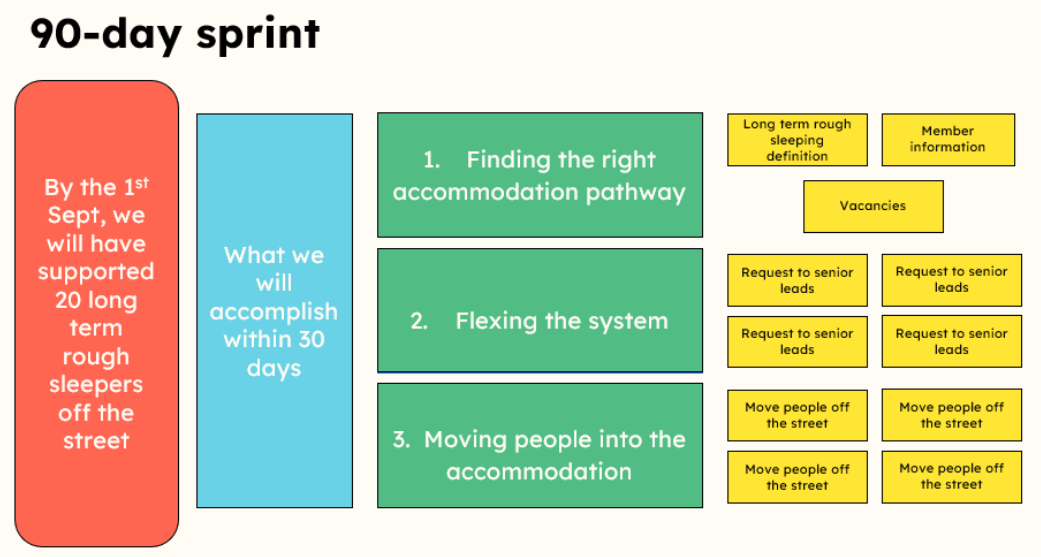
A Service Improvement Plan to address and end street homelessness for an identified cohort of individuals experiencing long-term (six plus months) rough sleeping.
At a glance
- Priority area addressed: A Service Improvement Plan to address and end street homelessness for an identified cohort of individuals experiencing long-term (six plus months) rough sleeping. Out of 26 individuals, a target of 20 supported off the street was agreed amongst the Built for Zero (BfZ) community to achieve in 90 days.
- Budget: No budget – the Service Improvement Plan and wider Built for Zero methodology seeks to meet its aims through collaborative working across services to bring systems change and ‘flexing’ traditional ways of working to bring an end to homelessness for individuals rough sleeping in the borough of Brent amongst statutory, third sector, and voluntary organisations.
- Timeframe to completion: 90 days (from June-September 2025), with interval update meetings every 30 days, as well as smaller 10-min weekly update meetings (internally named ‘huddles’) from beginning to end to discuss successes, challenges, and bring about new ways of thinking to overcome barriers faced by individuals in the homelessness community.
What came out
Eleven people were supported off the street – although the aim of 20 was not met, it was always ambitious and the team were really proud of their achievement. The accommodation the 11 individuals moved into was a mixture of temporary accommodation and sustainable housing.
By flexing the system, two homelessness applications were completed by Brent Council’s Rough Sleeping Team at Crisis Skylight Brent, showing that place-based working can achieve systems change and flexibility in meeting the needs of individuals who are rough sleeping
By working in a person-centred way, the drug and alcohol service completed a comprehensive assessment in the community and an individual was scripted for opiate agonist treatment within 24 hours.
By focussing on another person’s housing pathway, Brent Council’s Single Homelessness Team reopened a homelessness application which had the relief-duty ended after 56 days so a member could be referred into a specialist, women’s only accommodation project in the borough.
By focussing on long-term rough sleepers, one individual in particular was supported off the street after five years of rough sleeping.
Using a live, shared document application, each community partner was given tasks to complete that could be updated in real time. For instance, each partner was paired with a senior stakeholder to request actions such as bringing forward Adult Social Care assessments, allocating supported accommodation placements, and utilising spaces for housing applications to be completed by Housing Officers in the community for individuals who felt safer at their respective lead service provider’s base.
The difference
As part of the Service Improvement Plan, it was agreed that a single referral form for all commissioned supported accommodation projects in the borough would be implemented during the 90-day period. By flexing the system to allow external services such as Crisis and St. Mungo’s to directly refer into accommodation that usually only the Local Authority had access to, individuals were supported off the street in collaboration with Housing Officers and the nuances of each individual’s support needs were noted. This would ensure that wraparound support was provided and those identified as rough sleeping for six plus months could access safe accommodation.
The BfZ community also identified that for the SIP to work, there would also need to be an agreed consensus that no residents in supported or temporary accommodation would be evicted onto the street. An eviction protocol was implemented, with input from social landlords, Brent Council’s housing and homelessness teams, housing related support commissioners, outreach, and crucially, individuals with lived experience.
To measure success, we would know that the ideas worked through seeing the data on the By Name List change, particularly through a decrease in number of those rough sleeping and a decrease into evictions onto the street from the beginning to end of the project.
Implementing learning
The Service Improvement Plan highlighted the need for stronger communication with Adult Social Care. In response, Adult Social Care has begun holding a weekly surgery at Crisis Skylight Brent and opened referrals from all BfZ services. Starting at the end of October 2025, it is already having a positive impact. For example, one member who had been waiting three months for a Care Act Assessment was assessed in the very first week of the surgery.
Brent Council’s Rough Sleeping Team will begin a regular homelessness applications surgery for BfZ members in the community in 2026.
To maintain the progress made during the sprint, we’ve reinstated our fortnightly BfZ meetings to discuss ongoing cases and continue promoting flexible, collaborative working between services.