Feedback report: 13-16 January 2026
1. Introduction
A team of local government peers, led by the Local Government Association (LGA) delivered a Corporate Peer Challenge (CPC) of Bristol City Council between the 13 and 16 January 2026. This was the council’s second Peer Challenge.
CPC is a well-established and respected improvement and assurance tool that provides robust, strategic and credible challenge and support to councils. Further details about the CPC process can be found in Appendix A.
Our peer team consisted of highly experienced and knowledgeable senior local government councillor and officer peers (see section four). We considered the five core areas covered by all CPCs: local priorities and outcomes, organisational and place leadership, governance and culture, financial planning and management and capacity for improvement.
This report provides Bristol City Council with feedback on the peer team’s findings. It provides the council with a set of a high-level recommendations alongside further recommendations under each of the CPC’s core areas. There is an expectation the council will publish this report and a clear action plan to respond to all the recommendations highlighted.
2. Executive summary
Bristol is a vibrant city with a £15 billion economy, a thriving business base and one of the highest graduate retention rates in the country, sustaining a dynamic and future‑facing labour market. Its creative and cultural sector continues to act as a powerful engine for growth, shaping the city’s reputation for innovation, talent and imagination. Alongside this, Bristol holds national and international recognition for strong and long‑standing commitments to climate action. As a designated City of Sanctuary, it is also known for its welcoming character and its role in supporting people seeking safety and new beginnings- the place is very much a product of its past and its people, with proud traditions and a palpable sense of ambition for the future.
The council serves a diverse community:
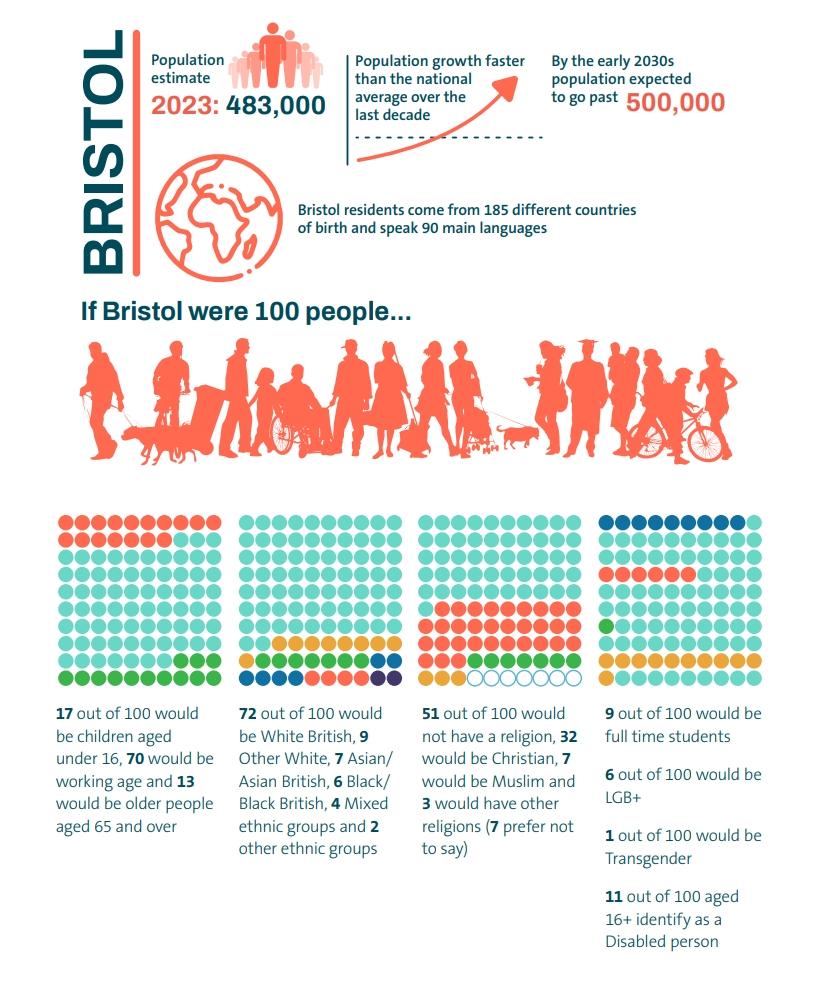
Infographic explained: Bristol residents come from 185 different countries and speak 90 main languages.
If Bristol were 100 people:
- 17 would be children under 16; 70 would be working age and 13 would be older people aged 65 and over
- 72 would be white British; 9 other white; 7 Asian or Asian British; 6 Black or Black British; 4 from Mixed ethnic groups and 2 from other ethnic groups
- 51 would not have a religion; 32 would be Christian; 7 would be Muslim and 3 would have other religions whilst 7 preferred not to say
- 9 would be full time students
- 6 would be LGB+
- 1 would be transgender
- 11 aged 16+ would identify as a disabled person.
This diversity provides a rich social fabric with a civic culture that is both engaged and forward thinking but also brings a complexity of need and stark differentiation in outcomes between geographical areas served by the city council. The peer team heard members, residents, officers and partners refer repeatedly and with pride, of the tradition of activism that is deeply woven into Bristol’s identity, contributing to its reputation as a place where communities participate, challenge and help shape the future of the city.
The council itself has undergone a period of significant cultural and organisational change with a move away from a directly elected mayoral model of governance to a Committee System, a change of political control and the arrival of a new chief executive all within an 18 month period. The council has navigated these changes well, driven by effective leadership from the leader and chief executive who lead with purpose and authenticity, with a clear commitment to build on the city’s strong history of activism, diversity and community engagement.
The significant changes in political governance arrangements could have been disruptive and undermined the council’s role in leading a core city. However, the committee system is in robust health, showing signs of maturity with members and officers thoughtfully engaged in continuous improvement and review. Whilst the changes have been managed well to this point, they continue to evolve and embed, and as they do so it will be important to maintain capacity and momentum to protect this encouraging start.
Bristol is one of eight core cities in England and the new political and officer leadership are playing their respective roles well in this national space. The council has a good story to tell in how it is leading not only the city, but also playing a full and defining role at a regional level – Bristol is the only core city in the South West. However, there is need for the council to sharpen its narrative around this place leadership role, centred around how the council will continue to evolve from a more traditional, municipal approach to a dynamic core city council, operating effectively within a stabilising West of England Combined Authority (WECA) and facing its communities and markets in manner befitting the mid twenty first century local authority. Capitalising on the national devolution agenda (and the opportunities this could offer both Bristol and the wider region) as part of a re-energised WECA, will require the council to review internal capacity and focus to ensure it can achieve the maximum impact as a core city.
The council – members and officers- should rightly reflect with pride on the work they have done to date in refreshing the strategic framework, retaining and updating the One City Plan which is so valued by partners and investors as well as reviewing the Corporate Strategy. There is now a need to further prioritise within the extensive suite of new and emerging corporate plans, strategies and frameworks. The peer team would suggest that paying close attention to three main ‘areas’ will help the council better meet the needs and expectations of communities and partners:
- Ensuring there is equity of outcomes, irrespective of where in the city people live runs through the DNA of the council. The council now needs to prioritise activity that will deliver maximum impact in the short to medium term i.e. neighbourhood health, ALL age skills and the geography and acuity of poverty, particularly in South Bristol.
- The council has an impressive portfolio of growth and investment activity with internationally significant Growth Zones, including Bristol Temple Quarter. Delivery of this essential growth will require unprecedented levels of financial, partnership and organisational capacity and the successful reallocation of existing resources – thus requiring effective prioritisation.
- At the same time as supporting these ambitions for Bristol, it will be vital for the council to protect and sustain the ongoing improvements in statutory services such as Children’s, Adults and Housing.
Bristol City Council is well placed to meet these organisational challenges given the recent improvements in internal culture already alluded to and referenced throughout this report. The chief executive and senior leadership team are valued for their visible and purposeful leadership. However, to sustain improvement attention now needs to be given to better distributing and developing leadership across the whole council so that leaders and managers at all levels are supported in upholding and evolving the positive behaviours displayed by senior leaders.
Organisational cultural improvements are well supported by a new corporate governance framework. This framework is now providing some much-needed transparency and focus on financial management, with greater clarity on roles and responsibilities beyond the finance team. As with many, if not all, councils, Bristol is facing a challenging financial future, but there are credible plans in place to deliver the £41m savings needed for next year and a balanced Medium Term Financial Strategy.
Bristol City Council is a well-respected partner across all sectors and undoubtedly has a mature and established approach to working positively with external stakeholders. Successful delivery of an ambitious (and rightly so) Corporate Strategy is dependent on these successful partnerships continuing to thrive, so that where objectives align, so can effort and capacity. There are a number of key national and regional partners active within the city and ensuring parity of esteem and a conscious approach to managing relationships will help maximise the potential of these partnerships further.
The council is evolving and has made significant progress, putting the right foundations in place to meet the future needs of both the place and wider public sector reform. To continue this positive trajectory, the council needs to make more consistent use of data to become a truly data and insight driven council. This would be further enhanced by a sharper and more cohesive internal and external narrative – all of which will contribute immeasurably to the delivery of the 2025-30 Corporate Strategy.
3. Recommendations
The following are the peer team’s key recommendations:
3.1 Recommendation 1 – Ensure the new committee system continues to mature, supported by sufficient capacity so that it functions well for both officers and members.
Ensure the council secures and consolidates the progress made in implementing the new committee system. Provide sufficient officer and member capacity so that governance arrangements continue to mature, operate effectively, and embed consistent practice across all committees. This will safeguard good decision‑making and strengthen democratic engagement.
3.2 Sharpen your narrative about the council’s role in the city, region and beyond to address different audiences
Develop a clear, confident narrative about the council’s place‑leadership role that speaks to different audiences across the city, region, and national landscape. This should be owned by senior political and officer leadership and supported by strong communications capacity to tell Bristol’s story with clarity and ambition. Whilst onsite there were positive discussions about Communications Improvement Support from the LGA which could be developed into a formal offer of support.
3.3 Prioritise action to deliver equitable outcomes where impact will be greatest
The council should focus its efforts on areas where action will deliver the greatest medium‑term impact on equitable outcomes, supported by strong data, meaningful engagement, and a clear understanding of Bristol’s diverse communities. This should include strengthening investment in all‑age learning and skills provision to better support deprived and socially excluded communities to progress, reskill and access opportunities in the city’s targeted growth sectors. Increased corporate focus will help align this work with the Employment, Skills and Lifelong Learning Plan and ensure it is more effectively connected to residents and communities.
3.4 Continue to drive Cultural and transformational change with distributed leadership.
Continue to drive organisational development, culture change and transformation at pace. Ensure leadership is more widely distributed across the organisation so there is clear accountability and consistent practice across all services, enabling the council to move confidently into its next phase of transformation.
3.5 Nurture and sustain effective partnerships, ensuring parity of esteem
The council has strong and effective partnerships; nurture these relationships, ensuring all partners feel parity of esteem and shared purpose. Work collaboratively with anchor institutions, statutory partners and community stakeholders to deliver shared outcomes for Bristol.
3.6 Position the council as the core city leader within the West of England.
Ensure the council is well‑positioned as the West of England’s (and South West’s) core city, to provide strong, proactive leadership as WECA stabilises and expands its responsibilities. Strengthen engagement mechanisms and use the city’s influence to shape regional and national priorities that benefit Bristol, regional neighbours and its residents.
3.7 Maintain corporate focus on financial transparency and the budget challenge.
Sustain the increased transparency, ownership and corporate attention that has strengthened financial management. Maintain this discipline to meet the significant financial challenges ahead, ensuring that savings plans, transformation benefits, and budget controls are delivered consistently.
3.8 Accelerate progress towards becoming a fully data and insight driven council.
Accelerate the shift to becoming a fully data‑ and intelligence‑driven organisation. Strengthen confidence, capability and consistency in data use across directorates so that insight drives delivery of the Corporate Strategy. Ensure communications are sharp, timely and aligned to evidence, improving both internal clarity and external understanding.
In addition to the key recommendations section five of this report captures our detailed feedback within each of the CPC’s core areas of focus.
4. Peer team
Peer challenges are conducted by experienced LGA peers, including elected councillors and senior officers. The composition of the peer team was shaped by the specific focus of the challenge, with the LGA selecting peers based on their relevant expertise. The peers for this CPC were:
- Councillor Tom Hunt – Leader of Sheffield City Council
- Councillor Zoe Nicholson – Leader of Lewes District Council
- Tom Stannard – Chief Executive of Manchester City Council
- Mark Nicholson – Chief Finance Officer and s151 -Newcastle City Council
- Jeremy DeSouza – Executive Director of Adult Social Care and Public Health – LB Richmond and Wandsworth
- Nicki Butterworth – Corporate Director of Neighbourhoods and Housing – Liverpool City Council
- Matt Nicolls – Head of Communications Improvement LGA
- Emily McGuinness – LGA Peer Challenge Manager
5. Detailed feedback and recommended actions
5.1 Local priorities and outcomes
There is an effective hierarchy of plans and strategies in place, providing cohesion and clarity across both the wider city and the council itself. The refreshed One City Plan 2025 is co-produced by many and varied partners and stakeholders, the delivery of which is supported by the well-established and respected City Office and the One City Boards. The missions contained within the One City Plan of creating an inclusive, sustainable and equitable economy, ensuring that the circumstances of birth do not determine outcomes, connected and cohesive communities and creating a climate resilient city align well with the Council’s own refreshed Corporate Strategy priorities. This mature approach to cross‑organisational collaboration enhances the credibility of the council’s strategic direction and increases the likelihood of successful delivery across shared partnership and community aims.
The success of this collaborative place based approach is testament to the fact that the council is regarded as a strong, valued and collaborative partner able to demonstrate mature and effective partnership working with partners describing constructive engagement in the development of the new Corporate Strategy and the One City Plan, noting that they were able to identify synergies with their own organisational priorities. This collaborative approach also extends to members of the council who demonstrated a meaningful sense of ownership over both the One City Plan and the Corporate Strategy.
Furthermore, the council demonstrates strong and innovative partnership working with major local and regional partners. Examples were highlighted involving the Integrated Care Board, wider health partners, the private sector, and the Combined Authority, suggesting an ability to collaborate across sectors and systems. Relationships with the VCSE sector are positive, with growing investment and opportunities for deeper collaboration. The council maintains productive relationships through Voscur (the local support and development agency for Bristol's Voluntary, Community & Social Enterprise sector) and has supported capacity building across the sector. Notable examples include the ICB’s investment in the Voluntary Sector Alliance and the recent £8m investment in VCSE infrastructure to support micro‑providers in health. Further strengthening VCSE capacity will position the sector to play a more substantial role in delivering the Corporate Strategy and meeting community needs. This creates a more diversified ecosystem of support for residents and enhances resilience across the city. These innovative collaborations strengthen the council’s ability to address complex challenges, leverage sector‑specific expertise, and deliver improved outcomes for residents.
The refreshed Corporate Strategy, running from 2025-2030 sits alongside the refreshed One City Plan, framing around a golden thread that resonates throughout the council, “ One Council, One City, Many Communities, Prevention focused’. There are five priorities set out in the strategy:
- Improving equity of outcomes in education and employment
- Supporting children’s, families’ and adults’ health and wellbeing
- Creating safe, healthy neighbourhoods and affordable, safe and good quality homes
- Making it easier, greener and safer to travel into and around Bristol
- Accelerating climate action and nature recovery
The council is maximising its strong approach to community engagement in ensuring these priorities are grounded in the communities it serves and takes a proactive approach to community-led initiatives, such as the approach the council takes to support racial justice. Enhanced visibility and community leadership, particularly from elected members has helped strengthen trust and foster a shared ownership over local outcomes. However, this does not always translate into positive resident satisfaction, where despite delivering well against published plans and objectives public satisfaction remains low (21 per cent agree the council provides value for money; 32 per cent agree it runs things well). This is indicative of the need for a strengthened council narrative.
The new Corporate Performance Framework agreed in September 2025 is embedding and is intended to support the performance management processes, and includes the establishment of a new Performance Board to provide dedicated senior leadership focus on performance management as part of the quarterly reporting pathway to the eight policy committees. The council make performance data publicly available through a series of performance dashboards and the Open Data Platform. The framework has only recently been introduced and will take time to mature, but there are clear signals of intent to provide a more consistent approach to both monitoring and managing performance. As the performance management framework matures, the council would benefit from reviewing and refining the, in excess of 400 KPIs currently measured, alongside the new Local Outcomes Framework. In doing so the council should actively seek to avoid performance management becoming an exercise in compliance rather than driving meaningful (and data driven) improvement, where there is distributed ownership and accountability beyond the senior leadership team. There is also more to do in terms of using data to better inform all decisions and ensuring the council becomes truly data and insight led.
Across all areas of work, there is a clear emphasis on being ‘Prevention Focused’. The organisation prioritises early intervention and proactive approaches, aiming to achieve sustained, positive impact over the longer term rather than short‑term fixes. This is a vital pillar in the council’s commitment to improving outcomes for all. For example, the council recognises that all of its services have potential health impacts, reflected in the Bristol Public Health Operating Model. The model focuses on both the delivery of public health services and wider opportunities to create the conditions for a healthy city, embedding health and wellbeing. All services have a role to play and the council engages positively through the Bristol Health and Wellbeing Board to deliver this. This is further evidenced through the developing One Council Prevention Framework which will be used to embed a Health in All Policies approach.
While education and skills are rightly recognised as critical to reducing inequity, the council must significantly accelerate its corporate attention and capacity in this area. The 2024–30 Employment Skills and Lifelong Learning Plan provides a clear strategic framework, but stakeholders identified a need for stronger whole‑council alignment and prioritisation to deliver the required pace of change, insufficient acceleration could limit progress on reducing inequality and hinder the council’s ability to meet long‑term economic and social goals. Conversely, a strengthened corporate response would position the council to better influence city‑wide education and skills outcomes. In particular, the City Council could look to enhance its investment in capacity and provision of all-ages learning and skills interventions to help some of its most deprived and socially excluded communities more rapidly progress their careers and/or reskill and upskill, so they are better able to access the growth sectors the City is targeting through its significant expansion of employment space in and beyond the city centre. The employment, skills and lifelong learning plan provides a strong framework for this, but corporate attention will help better support this with investment and better connect it to Bristol's residents and communities.
The council has a significant opportunity to sharpen its strategic narrative and reposition itself as a modern, dynamic core city at the centre of a stabilised and growing WECA region. Feedback suggests that Bristol can move beyond more traditional municipal framing and articulate more clearly its role within the regional economy and its wider communities and markets. This came through strongly from partners who felt the council could be more confident in the story it is telling. There was also a feeling the council was reticent talking about some of its strongest place assets (such as the universities) and had adopted a more risk averse tone in its external communications. With new organisational leadership now in place, there is an opportunity now to take a bolder approach.
Developing a refreshed narrative could enhance external confidence, attract investment, and align the council’s identity with the aspirations of a mid‑twenty‑first‑century core city. This shift would also strengthen regional influence and support delivery of long‑term strategic priorities whilst providing a clear and consistent narrative for internal and external stakeholders to coalesce around.
5.2 Organisational and place leadership
The leader and chief executive demonstrate a strong and effective working relationship that sets a positive cultural tone for the organisation. Their partnership is consistently characterised by collaboration and transparency, visible in both decision‑making processes and their everyday interactions. This modelling of constructive leadership builds trust across the council and reinforces an organisational culture where openness and shared responsibility are expected and valued. This is equally evident in the leadership shown by the policy Committee Chairs.
The council’s commitment to openness and transparency is now firmly embedded in its leadership approach. Staff, partners and members frequently highlight the leader and chief executive’s visible commitment to open communication, and staff particularly value new engagement mechanisms such as conferences for service managers and regular dialogue sessions. The improved engagement scores in the recent employee survey and higher response rates reflect increased staff confidence and signal that the workforce feels more heard and involved.
The senior leadership team is now providing a stabilising influence following a period of significant change. The permanency of key appointments has been welcomed across the organisation, and beyond, as offering renewed consistency and direction. This stability is helping to rebuild confidence and is enabling teams to focus more effectively on delivery rather than navigating continuous transition.
The restructuring of the organisation to create a dedicated Housing Directorate is a positive and strategically important development. Appointing an executive director for housing strengthens leadership capacity at a time when the council faces complex challenges as a major landlord within the city. The appointment of an executive director for resources has also created leadership capacity for the transformation and improvement of resources functions. This enhanced capability positions the council to respond more effectively to housing pressures and progress improvement work with clearer accountability and direction.
The organisation is demonstrating a strong appetite for change and has established a clearer strategic direction, though uncertainty remains around the capacity required for delivery. Recently developed and agreed strategies provide coherence and align well with the council’s growing ambition as the core city of the West of England, but staff and partners expressed concern about the breadth of planned activity and available resources. Without careful prioritisation, strategic ambition risks outpacing capacity, potentially affecting delivery and stakeholder confidence.
The leader and chief executive have invested personally in driving organisational change and are well supported by senior officers and members, including Policy Committee Chairs, in embodying the One Council ethos. A more distributive model of leadership throughout the tiers of management across the organisation is now needed to ensure consistency in the experiences of all staff and create some much-needed strategic thinking capacity for senior members and officers.
As ambition grows, the council would benefit from a unifying narrative that articulates its purpose and direction clearly to staff, residents, partners and potential investors. These groups express a need for coherent messaging that reflects both the city’s opportunities and its challenges. Developing such a narrative would help galvanise collective effort, strengthen partnerships and reinforce Bristol’s identity as a confident, outward‑looking core city.
The peer team heard that ‘Improving Equity of Outcomes’ and transport are emerging as pivotal priorities that require focused alignment of resources and activities. There is a clear opportunity to revisit existing programmes to ensure that sequencing and resourcing decisions support these priorities effectively, while considering how different audiences experience and understand the changes. A stronger focus in these areas would maximise capacity to deliver, enable sharper communication and enhancevisibility of progress for communities and stakeholders.
To make sustained progress on the achieving equity of outcomes, the council will need to embed data and insight more systematically into policy and delivery decisions and ensure existing capacity is deployed to maximum effect in this regard. Although Bristol has a strong history of championing equality, current approaches would benefit from more consistent use of community insight and lived experience. The recent work with Adults Services to create a new Co-Production Policy with people with lived experience, overseen by a Co-Production Advisory Group, and seeking to embed engagement and lived experience into service design and delivery provides the council with a blueprint to build upon. The council does not currently have sufficient data or insight of residents’ communications preferences. This is an obvious gap given the council’s clearly stated aim of ensuring all voices are heard and improving community engagement, and as the Peer Team heard from several sources, this lack of insight could risk the people with the loudest and most articulate voices being disproportionately heard. Strengthening the use of data will help ensure that the voices of all communities, especially those least heard, shape service design and lead to more equitable outcomes.
Partnership working remains a core strength for Bristol, particularly through the One City approach. Partners continue to recognise the model’s effectiveness and see value in co‑developing a place‑based narrative that celebrates Bristol’s strengths while being honest about its challenges. Doing so would strengthen shared accountability, support collective ownership and enhance collaborative responses to citywide priorities.
The council and partners work strongly together to support community cohesion and tackle serious community concerns such as youth violence. Cohesion remains a frequent focus of discussion among well‑engaged partners across policing, fire, health and the voluntary sector, supported by well‑established multi‑agency arrangements. Sustaining this collaboration is vital to maintaining community confidence, addressing complex drivers of harm and enabling coordinated responses to local pressures.
Increasing visibility and distributed leadership among members and officers would further strengthen the council’s place‑leadership role. Stakeholders observe that wider engagement from leaders across the organisation would enhance external relationships and internal alignment. A more distributed leadership model would reinforce the council’s credibility as a civic leader, deepen community and partner relationships, and support delivery of shared ambitions.
The council’s positive engagement with the West of England Combined Authority (WECA) is delivering tangible outcomes with the council playing a leading role in the £540m City Region Sustainable Transport Settlement as well as harnessing the opportunity of working though the MCA to work on the Youth Guarantee Trailblazer to create pathways for young people into training and employment. As part of the wider WECA footprint, the council is able to benefit from major developments such as Brabazon and the Western Innovation Arc as well as key sites within the city boundaries e.g. Bristol Temple Quarter.
Recent governance improvements at WECA, highlighted in the Independent Improvement Panel’s final report, have strengthened the role of Unitary Authorities and Bristol City Council plays an active and important role in continuing to shape the success of the MCA. Bristol City Council’s Leader now chairs the Housing, Planning and Regeneration Advisory Board and new measures such as a rotating Deputy Mayor support more collaborative decision‑making. While the Panel recognised substantial progress and chose to step down, it also identified the need for earlier engagement in decision‑making and stronger officer‑level relationships—areas the council remain committed to improving alongside Combined Authority colleagues. Current work is focused on enhancing regional strategy and impact, including proposals to bring North Somerset into WECA, refreshing governance to support the Growth Strategy, establishing a new Business Board, and expanding the Strategic Place Partnership with Homes England, while ensuring that city‑level priorities such as inclusive growth, net zero and regeneration are fully embedded in regional programmes.
Equally, Bristol takes a leadership role in Core Cities, with the Leader representing Core Cities nationally on Net Zero Thematic work and the council’s Head of Climate and Sustainability chairing the Core Cities Low Carbon Officers Group.
5.3 Governance and culture
The council’s governance and committee arrangements are operating from a position of considerable strength, demonstrating good maturity despite the inevitable complexities arising from recent changes in governance and the wider political landscape. Members and officers are approaching these challenges with notable self‑awareness and professionalism, and the shift in governance is recognised by internal and external stakeholders as having already contributed to improved collaboration and transparency across service areas, reinforcing a sense that local democracy is both active and effective.
This positive trajectory is supported by several factors. Committees are functioning well, with members, communities, and partners increasingly learning how to engage with the new arrangements. However, there remains a need for clearer visibility of committee chairs’ roles and responsibilities and for more systematic coordination of business across and between committees as processes mature. There is an important role for those officers providing direct support to elected members and the political groups themselves to play in helping members continue to fully embrace their policy development and scrutiny responsibilities. Whilst policy development roles are explicit in the committee system, scrutiny roles are often implicit in committee governance structures and can benefit from specific consideration as the organisation becomes more familiar and confident operating with such governance arrangements.
As already mentioned, the chief executive and senior leadership team are well regarded and visible, with staff valuing the strategic direction and increased engagement provided through mechanisms such as conferences for service managers. The Workforce Strategy exemplifies strong strategic intent, and staff‑led networks—particularly the Young Professionals Network—highlight good practice in fostering connection and engagement across the organisation. To sustain and build on this goodwill, the council now needs to distribute leadership of the change agenda more effectively below director level, ensure that strategic intent is backed by resourced delivery plans, and strengthen coordination and clarity around the purpose and contribution of staff‑led groups. Although the most recent staff survey shows increased confidence in relationships with ‘Me and My team’ – currently 79 per cent satisfaction rate, there remains inconsistency in interactions with managers across the organisation. The emerging Action Plan in support of the Workforce Strategy is a key opportunity to reiterate organisational expectations of leaders at all levels.
Corporate governance and internal control arrangements are also a clear strength. Internal control systems are mature and add tangible value to new governance structures through the Performance and Governance and Assurance Frameworks. Internal assurance functions, including Internal Audit, are strong and effective, as reflected in the Annual Governance Statement and supporting processes. Tools such as the Budget Assurance Board provide increasing transparency and are helping to drive improved budget ownership and grip across the organisation – this marks a significant and welcome shift in organisational culture. The Audit Committee offers robust and constructive challenge and is well-led by the current Chair. The Committee benefits from mature cross‑party collaboration, and aligns with good practice through the inclusion of independent members.
The council’s oversight of its wholly owned companies through Bristol Holdings Ltd, supported by independent directors, represents another example of established good practice that reinforces assurance and transparency.
Together, these elements are positioning the council well to deliver on its ambitions. By addressing the remaining areas for development—particularly in strengthening coordination, enhancing role clarity, and ensuring leadership is more widely distributed—the organisation can further embed its progress and increase confidence in its capacity to deliver effective, transparent, and resilient governance.
5.4 Financial planning and management
Whilst not immune from the financial pressures facing the wider sector, the council has established a solid financial foundation, setting a robust budget aligned to its £571m net revenue requirement and a £343m Capital Programme. Its overall level of general and earmarked reserves appears proportionate and healthy for a core city of Bristol’s scale. Clear articulation of the Budget Management Framework and Corporate Assurance Framework provides officers and elected members with a transparent and well‑understood basis for securing financial stability and supporting longer‑term sustainability.
This strong foundation is reinforced by an improved organisational grasp of the scale and complexity of the £41m savings challenge facing the council in 2026/27 and there is increased focus on, and confidence in, the delivery of these savings compared to performance in recent years. Corporate processes to track, monitor, and deliver these savings are in place and reflect a noticeable shift towards greater financial transparency and cultural maturity. At the same time, the council’s track record on statutory accounts remains highly positive: all years to date have been signed off with unmodified audit opinions, and the 2024/25 accounts are now complete with an unmodified opinion (the final auditor opinion was issued and letters signed on 26 January 2026).
The council also demonstrates awareness of its most significant financial risks. The High Needs Block (HNB) deficit continues to escalate and is anticipated to reach £100m by year‑end, posing increasing pressure on the General Fund, although this issue has been largely mitigated through the recent government announcement to fund up to 90 per cent of HNB deficits via additional grant. The council is also maintaining constructive engagement with the Department for Education through its Safety Valve agreement to manage this risk. It is also mindful of additional pressures arising from the need to improve from a C3 (serious failings) Housing regulatory judgement from the regulator of social housing to a C2 (some weaknesses) with key milestones and actions to achieve.
However, the scale of the transformation required to secure future sustainability remains considerable. The One Council Transformation Programme currently contains 115 initiatives, and while it reflects ambition, it would benefit from clearer prioritisation and broader distribution of leadership to ensure it contributes meaningfully to the delivery of cashable savings within the five‑year Medium Term Financial Plan. Similarly, while significant slippage has occurred within the current year’s capital programme, revised oversight arrangements through the Capital Investment Board, chaired by the Section 151 Officer, should help strengthen governance and delivery discipline.
In-year financial management continues to present challenges, with a projected overspend of £16.5m at Period 8, primarily driven by pressures in adult and children’s social care. The Budget Assurance Board, chaired by the chief executive, is actively focused on these areas and provides an appropriate mechanism for managing short‑term pressures. Following the settlement, Full Council set a balanced budget for 2026/27, which includes a Medium-Term Financial Strategy, with a balanced position over the next five years. The budget incorporates underlying pressures and identifies the required £41m of savings through a blend of tactical ‘bottom‑up’ and strategic ‘top‑down’ measures. Delivering these planned savings—next year and throughout the medium term—remains the central financial challenge.
Looking ahead, the council’s financial planning capacity will need to keep pace with the expanding programme of the West of England Combined Authority, as the council’s role, responsibilities, and financial relationship with WECA continue to grow. Internally, the council will also need to address weaknesses in its internal recharge system. Current practices and processes are causing widespread frustration and are creating unnecessary administrative burdens. Collectively, these factors show that the council is building from a position of increased clarity, oversight, and financial discipline. Maintaining this momentum—particularly around transformation delivery, savings realisation, risk management, and strengthening financial processes—will be essential to achieving long‑term financial sustainability.
5.5 Capacity for improvement
Bristol City Council continues to demonstrate a strong appetite for change and a positive orientation towards its new strategic direction. The 2025–2030 Corporate Strategy provides a clear and welcomed framework that aligns effectively with partner priorities and gives the organisation a coherent sense of direction, especially when considered alongside the One City Plan. Over the past 18 months, political and officer leadership have produced a significant number of plans, strategies, and frameworks that collectively represent a strong and consistent strategic vision.
However, the volume of strategic activity presents challenges for organisational capacity. Delivering simultaneously against multiple new strategies while maintaining momentum across core areas such as Children’s, Adults and Housing services, will require careful sequencing, prioritisation, and a more distributed approach to leadership. Not all activity can or should progress at the same time, and the organisation will benefit from clearer decision‑making about where capacity should be concentrated. The One Council Transformation Programme is central to this. With its focus on realigning corporate capacity and delivering essential savings, it has a critical role in helping the organisation shift from traditional municipal ways of working towards a more enabling, outward‑facing approach befitting Bristol’s position as a major core city within the region and its stated ambition to move away from being a traditional municipal council. Ensuring that corporate services, regulatory services, and the Portfolio PMO collectively support this transition and all rally to a single version of the truth, will be essential to realising the benefits of transformation.
While there has been positive progress in improving Children’s Services, Adults Services and Housing, these areas continue to require sustained attention. The council is rightly commended for the trajectory of improvement but maintaining progress while simultaneously delivering on broader strategic priorities will require disciplined oversight and realistic phasing of work. The strategic planning function is now better resourced and is starting to contribute more effectively to the Corporate Strategy, stepping increasingly into its role as a key enabling service, rather than being more perfunctory. Major milestones in 2026, such as regional development of a Spatial Development Strategy, the Local Plan review and related Supplementary Planning Documents for Temple Quarter, are critical to enabling the city’s ambitions and highlight the critical interdependencies between core council services and plans for change and growth.
The council has also taken significant steps to respond to the C3 Regulatory Standards judgement on housing, investing capacity and establishing a new directorate under a newly appointed Executive Director. This renewed strategic focus on housing provides a stronger platform for addressing regulatory challenges, improving repairs, and strengthening responsiveness to tenants. In line with recommendations made elsewhere in this report, there is now a need to reflect on these developments as part of a stronger corporate narrative. Tenants in particular would benefit from clearer communications and engagement.
The council retains its role as a national and international leader on climate action. Practical achievements, most notably the internationally recognised Bristol City Leap (an innovative partnership between Bristol City Council and Ameresco UK which will accelerate green energy investment in Bristol), illustrate the council’s ability to deliver innovative, large‑scale projects. The council’s deeper engagement with partners on net zero ambitions for both the organisation and the wider city further strengthens its position as a climate leader and show the efficacy of their approach to working in partnership.
Looking ahead, the council must accelerate its shift towards becoming a genuinely data and insight- led organisation. Delivering the ambitions of the 2025–2030 Corporate Strategy will require a shared, organisation‑wide understanding of how data should underpin decision‑making, performance management, and transformation. Closer alignment between corporate services and service directorates on this agenda will be vital to unlocking the full benefits of transformation and enabling more effective, evidence‑driven delivery. The Peer Team heard of plans for a Data Maturity Project within the emerging Better, Faster, Cheaper Programme, which is intended to raise the internal profile of use of data and insight.
6. Action plan and progress review
The senior political and managerial leadership of the council should review and reflect on the findings and recommendations from this CPC.
To promote the principle of transparency, it is a requirement of the CPC process that the final report of the peer team is published in-full within three months of the review being completed. In this instance, this requires the report to be published no later than 16 April 2026.
There is a requirement for Bristol City Council to develop and publish an action plan within five-months of the peer team being onsite, no later than 16th June 2026. This action plan should provide clarity on the activity, milestones, and timelines that the council will work to in responding to the team’s findings.
The action plan will also be central to the peer team’s re-engagement with Bristol City Council through a progress review which is due to be completed and published by March 2027.
The Ministry for Housing, Communities and Local Government (MHCLG) have published the Best Value Standards for Local Authorities. These standards expect every council to engage in a Corporate or Finance Peer Challenge at least every five-years. It is expected that Bristol City Council would commission their next Corporate Peer Challenge no later than Jan 2031.
7. Contact details
In the meantime, Paul Clarke, Principal Adviser for the South West is the main contact between your council and the Local Government Association. As outlined above, he is available to discuss any further support you require and can be contacted on
Paul Clarke, LGA Principal Adviser for the South West
Email – [email protected]