Fire and Rescue Services National Employers
Local Government Association,
18 Smith Square, Westminster,
London, SW1P 3HZ
Telephone 020 7187 7335
e-mail: [email protected]
Employers’ Secretary, Sarah Ward
Direct Dial: 020 7187 7335
Website: www.local.gov.uk
To: Chief fire officers
Chief executives/Clerks to fire authorities
Chairs of fire authorities
Directors of human resources
CC: Members of the Employers’ Side of the NJC
21 January 2026
Circular EMP/1/26
Dear colleagues
Thank you to everyone who participated in the Employers side consultation in November 2025. Those round tables provided a really interesting opportunity to discuss all the issues around Grey Book pay, what people think works and what does not work, and where we might want to get to in the future.
Following those sessions, the National Employers Advisory Forum spent some time considering how to turn all that feedback into a future strategy, and the National Employers have also met and agreed a number of those principles and next steps.
The FBU continues to have a shared conversation on this, and they are themselves conducting a more detailed dialogue with their regions over the next few weeks. We wanted therefore, to ensure the Employers side was also across a number of the high-level concepts that the National Employers are considering, following our autumn consultation.
For more on that consultation, and to see the summary of themes, issues, and ideas raised, please look at the specific pay structure reform webpages which are being hosted on the LGA's website.
Background
The existing Grey Book pay structure has been in place for nearly 25 years, and the National Employers alongside the employee representatives through the National Joint Council are exploring whether it is still fit for purpose or whether there is a better way of organising pay and reward for operational roles (those within the Grey Book).
As colleagues who attended our November consultation sessions heard, this work has not just started, it has been developing via discussions around the NJC for some years and it builds on commitments made between the National Employers and the Fire Brigades Union in the joint working group of 2023/2024 and then through the NJC, that the national pay and grading structure should “reflect the demand and role of Fire and Rescue Services as it is now, that the Grey Book pay and grading structure should underscore firefighting as a highly skilled occupation, rewarding skills and knowledge (not simply time served in role), driving professionalised leadership and management at all levels”.
An opportunity to progress this work?
The National Employers agree that there is an opportunity here, as there is significant overlap and consensus between the aims and objectives of what the National Employers, the FBU and the Government want to see.
The question facing us as a sector is whether we can co-design a new pay structure which settles key parts of the aims and objectives for each organisation, through consultation and negotiation:
- Is there a new and clear government backed understanding of the role of the UK Fire and Rescue Service, supported by a new description of the role of the firefighter, supporting wider prevention, response, and resilience?
- Can a new pay and grading structure deliver increased pay/pay progression, flexibility for employers, develop alternative (and specialist) career pathways for employees, can this all be anchored by a job description/job evaluation approach, underpinned by safety principles, while embedding the culture we expect in the Fire and Rescue service?
What could this look like?
With the right investment and support, we could co-redesign the pay structure to ensure a UK wide consistency of skill and competency development, linked to the pay structure.
The pay structure would redefine roles to establish initial entry level, the time when foundation skills are established and learned, and that would lead into being a fully qualified practitioner in role.
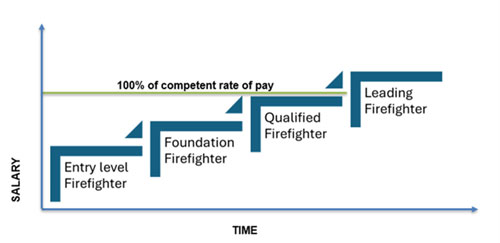
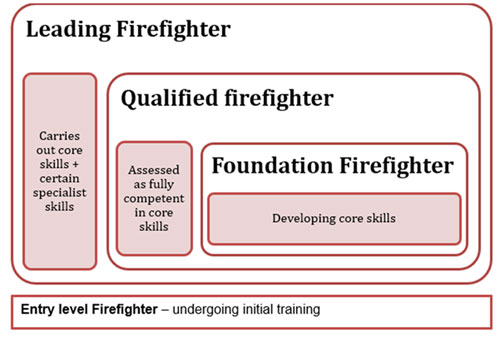
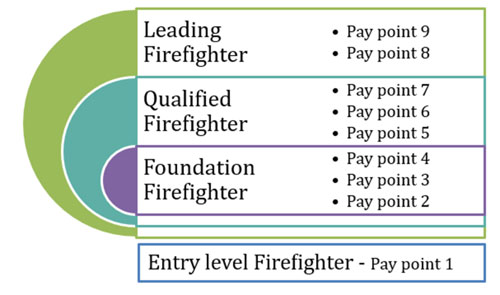
Just using the Firefighter role by way of example, the following illustrations show how a new pay structure could look. Please note these are illustrative examples only:
Example 1 - Firefighter pay progression over time
Example 2 - The relationship between firefighter roles
Example 3 - Firefighter roles and what their pay points could look like
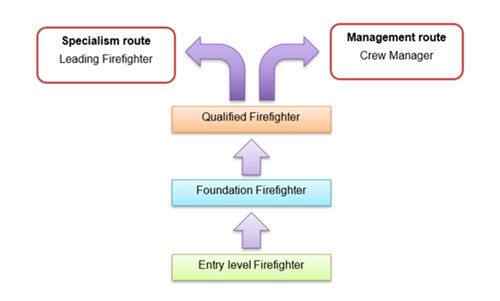
For firefighters, having established roles within the 'qualified' (language continues to be discussed) firefighter role, they might want to lean into expert specialisms within role and become coaches, leaders, or mentors in a specific professional area. We could create a new “leading firefighter” role, to enable a new level above firefighter which is centred around specific skills/knowledge, and not a managerial role.
Others may want to grow their careers via the traditional managerial route and services will continue to need that expertise – so we would keep that career pathway too.
We are describing this in our conversations and codesigning work as the ‘Y shaped career pathway.’ An illustration of this is provided below to bring that idea to life:
For the Management vs specialism route diagram
We could also introduce pay progression points within each of those stages of firefighter career pathway (as shown in example 3 above), in a consistent way across the UK, and linked to knowledge/skill development.
Making the case for funding
This would mean making the case to government for additional investment into the fire and rescue service, by growing what we currently offer within the existing role of a “competent firefighter”, moving away from role maps into a broader job description that allows for an increased offer to the UK, not just on resilience and response, but on protection and prevention.
We would want to ensure confidence of effective use of public funding, to establish a fire and rescue service based on (enhanced) professionalism, reliability, and with the right skills and training to best support local communities. In short, our pay structure would need to be simplified and consistent across the UK, with less room for disagreements and frustration, and more focus on clarity and delivery of role, underpinned by career paths and pay progression.
This conversation is not just being held by NJC members, the NJC is working closely with the Ministerial Advisory Group, the National Fire Chiefs Council and with the workforce team at the Ministry for Housing Communities and Local Government. We know that the FBU are about to hold local meetings in all their regions, for them to have this “in principle” discussion too.
Next steps
The National Employers would like to emphasise that this is all high level still, and nothing has been formally agreed or proposed. These are all discussions. But if we keep developing this work, we know there is a huge amount to do, including full engagement with the devolved administrations. There is a wide set of considerations and areas of focus to debate and codesign solutions for. This includes:
- how this model tracks across to all Grey Book roles, including “control”
- how we ensure we develop and support Retained Duty System firefighters
- leadership and integrity
- operational consistency
- national standards
- protecting promotion routes.
There is a huge amount of detail to co-design, and areas of negotiation to be had. This potentially includes:
- structure and definition detail (including language)
- establishing job evaluation principles in relation to the Grey Book
- dealing with safety concerns (especially around deployment and flexibility)
- rates of pay
- transition principles.
We recognise that this will continue to take time to get right; our shared vision is extremely ambitious and our last NJC meeting underlined that both sides are cognisant of this historic opportunity to codesign and establish change, demonstrating the value of effective industrial relations and our National Joint Council.
To that end, we continue to work with the FBU and commit to an increased focus on trying to maintain industrial calm during this period. We know there are multiple potential areas of dispute, distraction and “rabbit holes” that the NJC could fall into, but we will work with the FBU to avoid this wherever possible, to keep focused on the overarching objective and bigger prize – that of clarification on the role and expectation of the fire and rescue service, reforming the pay and reward structure accordingly, establishing consistency in reward, and consistency in competency, attracting increased investment and thus underlining future sustainability of the service.
We will continue to update you as regularly as possible. The NJC meets again in February, and we should have a clearer understanding of our next steps then. Once we have reached the stage of having proposals to share, we will conduct a comprehensive consultation process with the sector (and the FBU will do the same with their members). In the meantime, you can find information on the LGA website and can contact us with any questions at [email protected]
Yours faithfully,
Sarah Ward
Employers’ side secretary