
Foreword
The LGA has worked closely with councils to develop the National Procurement Strategy 2022 and a toolkit that enables councils to set their own objectives and measure their own progress. It is proving to be very popular.
The National Procurement Strategy puts the councillor role front and centre, and this guide has been produced specifically for us. It looks at the roles councillor’s play – both executive members and those engaged in overview and scrutiny work – and provides hints and tips on how to get the best out of procurement and contract management. Just as in the national strategy the focus is on delivering the council’s objectives not something imposed from outside.
The environment councils are working in is enormously challenging. The sector has seen continued reductions in central government funding and the LGA sees procurement and contract management as important means of ensuring that budgets are well managed, and that best value is achieved across council revenue and capital expenditure.
Councillors have great influence on the way resources are used and can recognise how important procurement and contract management are to the delivery of our objectives.
Councillors do not need to be procurement professionals. But do need to be able to ask the right questions and that is where this guide comes in. As the guide says, it should not be forgotten that councillors need suitable training and development to be able to perform their roles effectively.
Why is procurement important?
Councils are operating in a very challenging financial environment. Demand for local public services is rising, and cost pressures are increasing, yet government grant to councils has reduced markedly since 2010. A question mark has been placed over the sustainability of local public services. Between 2010/11 and 2019/20, central government funding for councils was cut by 55 per cent in real terms and the LGA’s current estimate is that there will be an overall funding gap of £13.2 billion by 2024/25, growing at a pace of over £2.6 billion each year on average.
In this context, delivery of council ambitions – including better outcomes from public services and regeneration of places – requires resourcefulness and councils are responding in a variety of ways. The response includes strategies designed to:
- maximise the value – including the ‘social value’ – achieved from the sector’s estimated £85 billion annual procurement spend
- build greater local connections and partnerships with both suppliers and the voluntary sector, across public sector
- embrace innovation, including supplier innovation
- implement new technologies to improve service delivery, increase efficiency, and reduce costs
- focus on environmentally positive practices and projects to ensure long-term benefits for the community
- adopt innovative strategies to maximise the use of available resource and attract additional income.
These are areas in which procurement can make a major contribution but that requires leadership and best use of resources through partnership working with other public sector organisations (particularly important for social care and health).
What is new in procurement
On 24 February 2025 the rules governing public procurement changed - the new Act will improve the way procurement is done, so that every pound goes further for our public services. The Procurement Act will bring a range of benefits, including:
- creating a simpler and more flexible commercial system that better meets our country’s needs, while remaining compliant with our international obligations
- opening public procurement to new entrants, such as small businesses and social enterprises, so that they can compete for and win more public contracts
- taking tougher action on underperforming suppliers and excluding suppliers who pose unacceptable risks
- embedding transparency throughout the commercial lifecycle so that the spending of taxpayers’ money can be properly scrutinised
- the multi-stage procedures under the Public Contracts Regulations 2015 have been consolidated into a single competitive tendering procedure, known as the competitive flexible procedure. This procedure provides contracting authorities with the opportunity and flexibility to design and undertake a bespoke multi-stage procurement process that works for their organisation and the nature of the market.
Key changes and benefits of the Procurement Act 2023
Change: Four sets of regulations have been transformed into a simpler set of rules.
Benefit: Improved clarity and consistency for contracting authorities no matter which sector they operate in.
Change: Procurement Act 2023 and relevant regulations to be made under the Act offer greater freedoms and flexibilities to design procurement processes.
Benefit: Allows contracting authorities to undertake procurement activities that are fit for purpose to meet organisational needs, as well as local and national objectives.
Change: Procurement Act 2023 and relevant regulations to be made under the Act will improve transparency.
Benefit: Easier access to existing routes to market and market analysis data to help contracting authorities inform procurement strategies and decisions. Greater visibility of opportunities for businesses, and better scrutiny over where and how public money is being spent.
Change: The National Procurement Policy Statement, under s13 of the Procurement Act 2023 contains a number of benefits for Small and Medium Enterprises (SMEs) and Voluntary, Community and Social Enterprises (VCSEs) and reflects the government’s commitment to removing barriers to new entrants accessing public contracts, either directly or indirectly as part of a supply chain.
Benefit: Increasing access to public contracts for SMEs and VCSEs and broadening the marketplace for contracting authorities.
Change: The Procurement Act 2023 and relevant regulations to be made under the Act strengthens the ability to exclude suppliers from procurements who are unfit to deliver public contracts, for example because of past misconduct, corruption or poor performance.
Benefit: better protects contracting authorities from suppliers who pose a risk to contract delivery including the protection of the public, the environment, public funds, national security and the rights of workers.
Change: The Procurement Act 2023 sets out a power to publish a national procurement policy statement (NPPS) and a Wales procurement policy statement (WPPS). Contracting authorities are required to have regard to the appropriate NPPS/WPPS (where one exists) when carrying out their procurement activities, which includes the setting of award criteria.
Benefit: The NPPS/WPPS will explain the government’s strategic priorities for public procurement and provide focus for contracting authorities and suppliers to deliver outcomes in these areas.
Change: The Procurement Act 2023 asks for tenders to be evaluated against the ‘most advantageous tender’ (MAT) rather than the ‘most economically advantageous tender (MEAT).
Benefit: this is not a change in policy and the change is to clarify and reinforce for contracting authorities that tenders do not have to be awarded on the basis of lowest price/cost, or that price/cost must always take precedence over non price/cost factors.
There are exemptions where certain rules do not apply to particular contracts, for example, in some instances for special regime contracts.
A special regime contract means:
- a concession contract
- a defence and security contract
- a light touch contract, or
- a utilities contract.
What is the councillor role?
The LGA's National Procurement Strategy suggests that strategic contribution of procurement should be reflected in an executive portfolio – creating a role that champions best practice procurement inside the council and champions partnership working with other public bodies.
Councillors set the council vision and strategic priorities and must be satisfied that the procurement and commercial arrangements for their delivery are robust. Councillors make key decisions, particularly in major projects, and maintain oversight of the performance of key contracts, agreeing corrective action where necessary. Councillor engagement needs to be supported through training, good procurement and commercial advice and reporting arrangements.
When councillors have oversight of procurement and commercial matters, the quality of decision-making is better, and oversight and accountability are improved. Councillor engagement leads to better project delivery and better outcomes for the local community.
Councils have a variety of executive arrangements including leader and cabinet, elected mayor and cabinet and the committee system. There is no right or wrong set of responsibilities.
The leadership role of the executive might include:
- adopting the corporate procurement strategy, ensuring it remains aligned with strategic objectives and monitoring its implementation
- agreeing a policy on how the best value duty will be delivered
- agreeing a policy on social value in procurement and contract management
- overseeing the corporate arrangements for procurement and contract management to make sure they are operating effectively and efficiently
- making key decisions in the procurement cycle for major projects including the ‘make or buy’ (outsourcing or insourcing) decision and procurement strategy including sourcing from SMEs and VCSEs
- promoting the use of project assurance (for example, gateway reviews) where appropriate
- monitoring the performance of contracts with strategic suppliers and ensuring prompt action is taken if a strategic supplier shows signs of financial distress
- promoting work on procurement with other public sector bodies particularly health
- ensuring contingency plans are in place and regularly refreshed to mitigate the impact of financial distress in strategic suppliers, where council monitoring indicates a raised level of concern
- fostering innovation in procurement methods, service delivery vehicles and vehicles for income generation and creating commercial opportunities (‘commercialisation’)
- learning and sharing the lessons from major projects and key contracts.
The new regime went live on 24 February 2025. Senior council leaders can make sure your organisation is ready to grasp the opportunity and support the process by checking in, and offering support and encouragement for your commercial and procurement teams who are coordinating the change, and championing their work across the wider organisational family.
Your engagement is essential to the outcomes we all want to see.
Overview and scrutiny councillors can constructively contribute to strategic procurement management. The role might encompass:
- ensuring the strategy is aligned with the objectives of the council
- reviewing areas of high spend to identify opportunities for savings and improved value for money
- ensuring that the appropriate resources are in place
- review and challenge of specification for major procurement exercises. Using insight to better understand how need presents and how councils and partners mange it
- considering that appropriate strategic performances indicators and reporting arrangements have been addressed
- challenging the progress of major procurement projects
- reviewing the performance of strategic suppliers and results of council participation in regional or national initiatives aimed at managing strategic suppliers
- ensuring that lessons are learnt from major projects and key contracts and from failures of major suppliers to the public sector
- debriefing and review at the end of contract relationships
- reviewing the operation of contract standing orders (fitness for purpose)
- through the lens of risk, conducting enquiries into new service delivery models and income generation opportunities (commercialisation).
“It is recognised that sound procurement governance leads to better services for local people and in Durham, the strategic importance of procurement is reflected in our Cabinet Portfolio.
“Throughout the public sector, there is an increasing demand for our services and effective and transparent procurement plays an important role to ensure that we achieve best value whilst promoting the long-term interests of the communities we represent.
“In order to achieve this, we strive to have on-going quality assurance of our procurement activity to ensure public money is spent wisely, that we comply with legal and policy requirements and that we uphold the integrity of the procurement decisions that we make. The new Procurement Act will support us in doing this by introducing mandatory transparency notices, simplified procurement processes and enhanced oversight mechanisms which will ultimately promote public benefit and further support our work across social value.”
Councillor Susan McDonnell
Portfolio Holder for Customer Services, Digital and Procurement, Durham County Council
More information on the role of scrutiny and governance can be found on the Centre for Governance and Scrutiny website.
Note that there are some activities which councillors should not be involved in. For example, councillors should not participate in commercial negotiations with suppliers or the evaluation of tenders. Nor should councillors make commercial commitments on behalf of the council (unless by arrangement with council officers). It may be that Councillors will be entitled to receive information that is commercially confidential. But this information cannot usually be published.
Hackney Council’s scrutiny commission
Hackney Council is one of many focused on rooting out poor behaviour by suppliers. Recently, the Living in Hackney Scrutiny Commission has been looking at concerns in the housing area and beginning to draw lessons for the council.
“Quite stark examples of poor behaviour by partnering contractors have been shared with us.
“Contractors had overcharged for works, proposed to deliver (and to charge for) work which was not required, incorrectly claimed work to be complete, and delivered substandard jobs.
“It is clear that large long-term partnering contracts rely on close and intensive management to ensure value for money for residents.”
Councillor Sharon Patrick
Quoted in Hackney Citizen, 4 April 2019
Councillors also provide leadership to counter-fraud and anti-corruption activities across the council which includes procurement fraud. This is often done through the audit committee but councillors in other roles play an important part including overview and scrutiny councillors.
This includes promoting a counter-fraud and anti-corruption culture, helping the council to understand the procurement fraud risks it faces, examining the council’s performance and ensuring that counter-fraud and anti-corruption resources are allocated appropriately. For more on this, see the LGA publication 'Managing the risk of procurement fraud'.
More recent advice to help councils fight procurement fraud can be found on the Gov.uk website.
Audit committees play a broader role in ensuring the effectiveness of arrangements for risk management in procurement as part of the council’s corporate governance framework.
To be able to perform their roles effectively councillors need to receive appropriate training and development, ensuring they are assured of the rigour of the council’s procurement arrangements, including the need for procurement activity to clearly engage with council objectives.
What is ‘procurement’?
Procurement is the process of acquiring goods, works and services from third parties. In other words, it covers the purchasing of everything from paperclips to major infrastructure schemes.
The procurement process includes options appraisal (the ‘make or buy’ decision, sometimes also known as ‘delivery model assessments’). In major projects this is a key stage. Councillors will often be called upon to consider a range of options set out in a ‘business case’ and to decide which option will be pursued.
The aim is to achieve best value for money. In the HM Treasury publication 'Managing public money', value for money is defined in the following way:
It means securing the best mix of quality and effectiveness for the least outlay over the period of use of the goods or services bought. It is not about minimizing upfront prices.
This means that procurement decisions need to take account, as appropriate, of quality and all the costs that will be incurred by the council throughout the life of the asset or contract period not simply the initial price.
The best results are obtained by engaging with the market before advertising an opportunity (to be sure the council’s approach will get a good response from suppliers) and focusing on contract management to ensure the council gets what it is paying for.
There are also compliance issues which cannot be ignored. Every council adopts contract standing orders (sometimes called ‘contract procedure rules’). These are the council’s own procurement rules and are likely to have been updated recently in light of the new Act. Naturally, councillors need to understand and work within those rules. These form part of a broader set of arrangements the council makes locally for procurement and project management, including measures to prevent fraud and corruption, which councillors need to understand and follow.
Further, in local government, as in the rest of the public sector, procurement must be carried out in compliance with public procurement law. From 24 February 2025 Contracting Authorities will be required to follow UK Procurement Law under the Procurement Act 2023 which has reformed existing Procurement Rules.
Further, the National Procurement Policy Statement (NPPS) sets out the current strategic priorities for public procurement and how contracting authorities in England (and those exercising non-devolved functions in Wales and Northern Ireland or procuring under a reserved procurement arrangement) can support their delivery. Contracting authorities are required to have regard to the relevant priorities in the NPPS, alongside other local priorities, when carrying out procurements. These are:
- delivering value for money
- driving economic growth
- priority: contracting authorities should drive economic growth and strengthen supply chains by giving SMEs and VCSEs a fair chance at public contracts, creating high quality jobs and championing innovation
- delivering social and economic value
- priority: contracting authorities should deliver social and economic value that supports the Government’s missions including by working in partnership across organisational boundaries
- building commercial capability to deliver value for money and stronger outcomes
- priority: contracting authorities should ensure the right commercial capability and standards are in place to procure and manage contracts effectively and to collaborate with other contracting authorities to deliver best value.
The Procurement Act 2023 also legislates for provision of a central digital platform (CDP) to facilitate the publishing of required notices and documents in accordance with the new regulations.
The central digital platform as it will be known in legislation, will be an enhancement of the existing Find a Tender service (FTS) and will make it easier to find and bid for contracts, and for buyers to meet their transparency commitments under the Act.
The CDP will be where all UK contracting authorities publish information relating to procurement.
Public procurement law is complex, and councillors need to know that the council has access to professional procurement and legal advice to navigate the rules.
Is ‘commissioning’ different?
The LGA’s definition of commissioning is:
Commissioning is the strategic activity of identifying need, allocating resources and procuring a provider to best meet that need, within available means.
Commissioning is usually about securing services (rather than acquisition of goods or works). The commissioning model has its origins in health and adult social care but the approach has been introduced into many other service areas too, notably children’s services. Some councils had previously adopted it as the model for the whole council (the ‘commissioning council’).
So how is commissioning different from procurement? The best way to think of it is that commissioning is a cycle of activities that includes procurement and contract management or can include procurement and contract management (services can be commissioned in-house).
Procurement professionals have an important role to play throughout the commissioning cycle as the diagram below illustrates.
The starting point is an assessment of the needs of the local population and the outcomes that the council and other local agencies want to achieve. (This is sometimes called strategic commissioning to reflect the population-level focus. Integrated commissioning describes alignment of approaches across agencies particularly across councils and NHS bodies. Integrated commissioning encompasses a variety
of models all of which aim for improved outcomes for service users).
Service users and their organisations clearly need to be involved from the earliest stages and have a lot to contribute throughout the cycle. With appropriate safeguards, providers’ input can also be extremely valuable.
The commissioning cycle
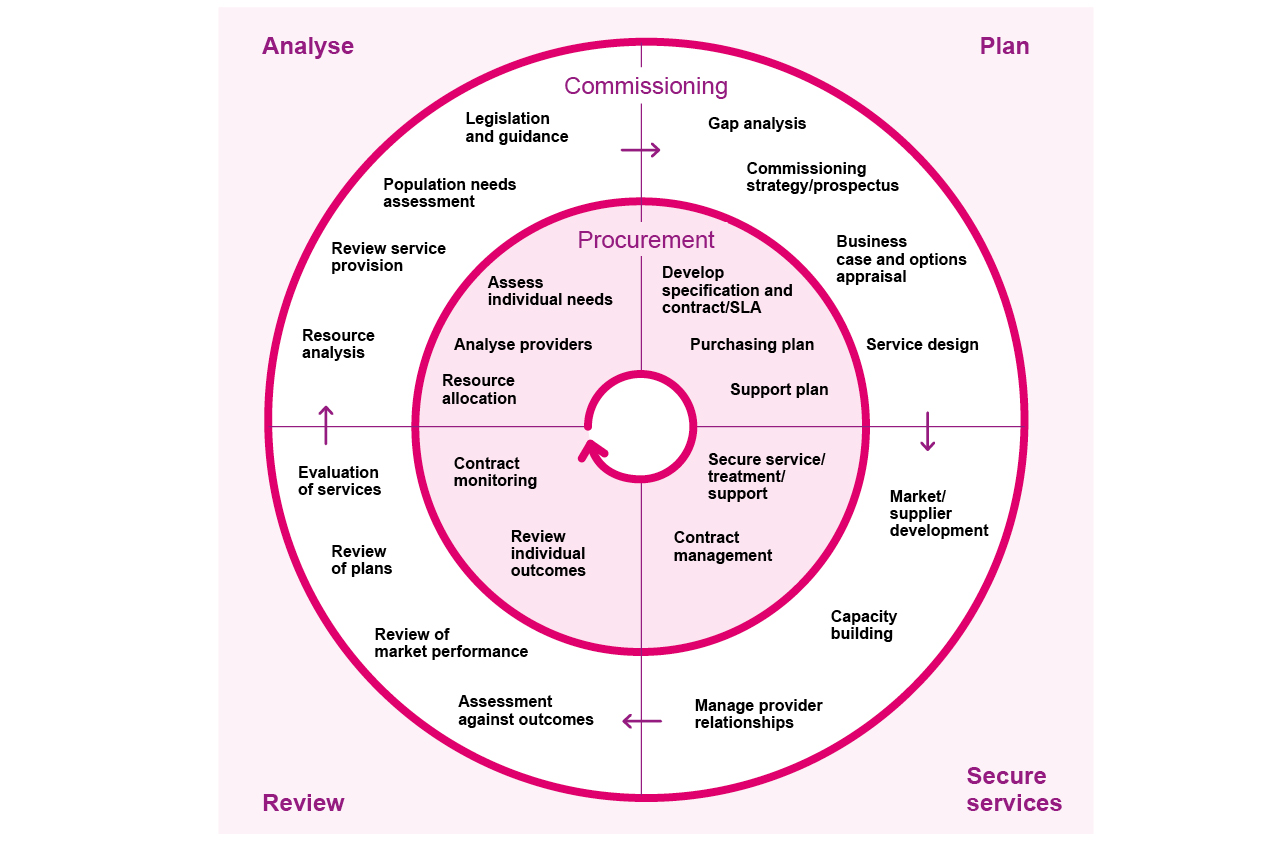
Before a decision is taken to re-procure the service, the council will need to have confidence that there is a diverse marketplace of affordable, quality providers. Market shaping means having a good ‘map’ of the providers and using all the tools (including grants, training and development and development and business support for providers) available to the council to shape the market to meet current and future population needs.
Integrated commissioning
Integrated contracting and commissioning present an opportunity for commissioners to work with providers to ensure that gaps in services are addressed and improved experiences and outcomes for service users are promoted.
Integrated commissioning can take a number of forms:
- strategic involving the complete integration of the processes and governance of the member organisations
- geographic covering all services with a certain place or for a group of people; this can involve virtual arrangements where activity is aligned but not under single management.
Commissioning can take place at system, team or locality level, or at the level of the individual service user.
It can involve clinical commissioners joining with council commissioners, and/or commissioners and providers.
Without specifying any particular model of joint working between councils and the NHS, the LGA’s Integrated Commissioning for Better Outcomes 2018 identifies the ingredients for success in integrated approaches to commissioning. These are:
- building the foundations (relationships based on trust, a shared vision, values and priorities, and strong collective leadership and governance)
- taking a person-centred, place-based and outcome-focused approach
- shaping provision to support people, places and populations (which includes shaping the provider market and managing provider relationships)
- continuously raising the ambition
- the document includes questions in each of these domains which councillors can ask to support improvement locally.
Next, resources are matched to the needs and desired outcomes (or ‘results’ to be achieved). Due to financial constraints, this usually means prioritisation – a key local democratic role for councillors in consultation with the users and the wide community.
In more complex situations there will be options appraisal and service design as part of the cycle. Sometimes the decision will be to de-commission a service (to stop providing it) or to provide it in a radically different way (remodelling). From time to time an externally provided service, be brought back in-house.
More information on Integrated Commissioning models can be found on the Partners In Care and Health web pages.
What is the procurement process?
In local government the procurement processes can be unnecessarily lengthy and complicated. This is costly for the council and for the suppliers that are bidding and ties up key staff for long periods of time. The procurement process should therefore be proportionate and designed according to ‘lean’ principles and councillors should challenge processes which do not remain focused on delivering results (benefits).
Typical roles and responsibilities in a project include the senior responsible owner – a senior manager who has personal responsibility for driving the project forward and making it a success.
The senior responsible owner may chair a project board that typically comprises senior managers from legal, finance, procurement, HR, ICT and property (as appropriate to the contract). The board ensures that all aspects of the project are addressed and will act on feedback from stakeholders.
The project manager is responsible for co- ordinating the project team and overseeing the delivery of the project on a day-to-day basis.
For major projects there must be a dedicated project manager with delegated authority. To manage without is a false economy.
Critical success factors in procurement
- Councillor involvement: Executive direction and decisions on strategic projects; scrutiny and challenge of all major projects to ensure that they support corporate strategies.
- Senior management involvement: Prompt decisions on key issues; enabling access to resources outside the project team’s immediate control.
- Early involvement of procurement professionals and other professional advisers (for example, HR). Includes experienced and qualified procurement personnel on project boards for major projects.
- Clear objectives: Defined at the outset. Keep the project aligned with strategic objectives.
- Results focus: Focus on delivering the right outcomes. Making sure that the process does not get in the way of success.
- Good preparation and planning: Realistic timescales and milestones for delivery; access to key people when required; effort focused in the right way when needed and documentation that is complete and correct.
- Best use of resources: The right people for the job, not just the next available person. Full consideration of the skills and input required. Complete clarity about who should be doing what.
- Empowered project manager: Includes delegation of authority as necessary.
- Good quality data collection and maintenance of asset registers to inform decisions and baselines for bids.
- Requirements detailed in clear specifications with identifiable and measurable outcomes (including KPIs).
- Stakeholder engagement: Resulting in specifications that meet their needs and buy-in to the procurement project.
- Market engagement: Assessments of market health. Supplier days and the like held to engage the market and test the commercial viability of a proposed procurement for example, a new service delivery model or commercialisation project before the procurement is formally commenced. Enables the market to gear up to deliver the requirement.
- Make or buy decision: Major procurements should always be preceded by an assessment of the relative merits of procuring a solution in the market versus delivering the solution in house.
- Piloting before committing to a major project (for example, first generation outsourcing).
- Appropriate risk allocation: Market engagement should inform which risk are retained and which transferred under the contract. Risks should be allocated to the party best placed to manage them.
- Contract design: Should set reasonable expectations of suppliers and provide a fair return.
- Pricing and payment mechanisms: Should incentivise the right supplier behaviours.
- Planning for transition and exit: Should include exit due to supplier insolvency.
- Planning for the cost of supplier insolvency. Options include performance bonds and self-insurance (which should feature in the make or buy decision).
- Living wills: Require suppliers to provide resolution planning information for use by the council in supplier insolvency situations.
- Due diligence during selection process including supplier financial assessment and past performance.
- Well-designed tender evaluation methodology and use of ‘should cost’ models to guard against low bid bias.
- Ongoing risk management: Key project risks identified at the outset and tracked with appropriate corrective action.
- Project assurance: Independent reviews at key decision points, sometimes referred to as ‘gateway reviews) starting during the early planning stages of a project to assure deliverability, affordability and value for money.
There are some well-established reasons why major procurements in local government fail including:
- Lack of councillor and senior management leadership and commitment throughout the process.
- Inadequate business case, where the requirement is uncertain, the contribution to strategic objectives is unclear and/or there is a lack of realism about the council’s ability to deliver services in new ways.
- Inadequate resources, especially the skills and expertise needed to deliver a successful project.
It is therefore good practice to:
- Give proper emphasis to the business case stage in the procurement process including the options available and the make or buy decision.
- Manage major procurements as projects, incorporating risk management and assurance reviews (see Figure 2).
The 'Sourcing playbook' and associated guidance provide helpful advice on the make or buy decision.
The procurement cycle
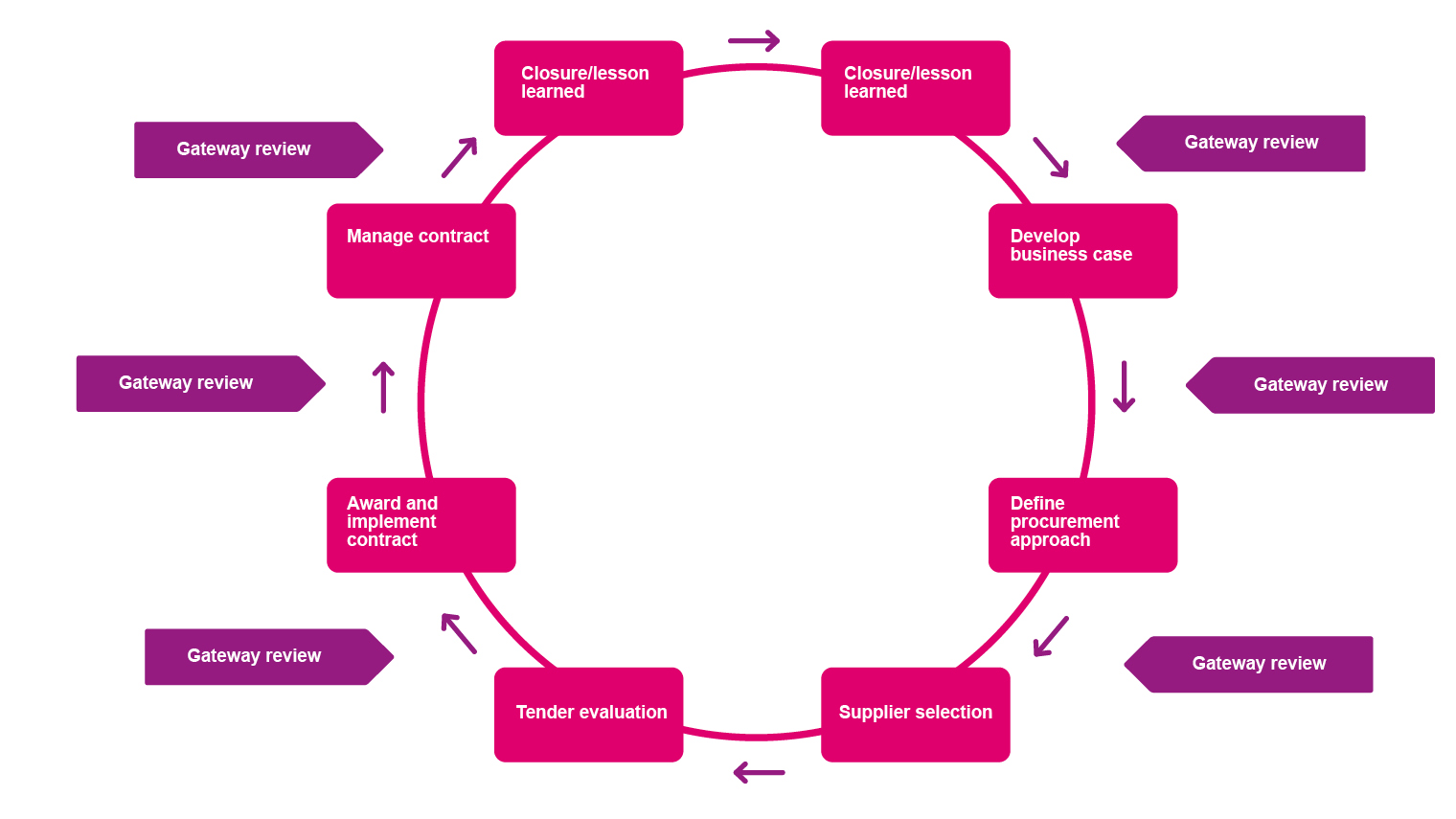
The Procurement Act 2023 defines the stages of procurement or ‘commercial pathway’ as:
- plan
- define
- procure
- manage
The key stages of the procurement process are shown in the diagram above together with an indication of how assurance can be provided to senior management through assurance reviews.
The reviews provide management with assurance that the project is more likely to be completed on time and budget and to meet the client’s requirements.
The assurance process is not an audit of a project but a tool to assist the project owner to deliver a successful project. Councils should decide to apply this form of assurance based on the risks inherent in the project. It is resource-intensive and not appropriate for every project.
How are contracts and relationships managed?
The Procurement Act 2023 encourages best-practice management across the public sector.
Councillors should expect a similar degree of senior management ownership of ongoing delivery throughout the life of the contract (a ‘contract owner’) and a properly-resourced contract management team (especially for service contracts, see below on issues construction contract management).
It is during the contract management phase that the benefits the council is paying for are actually delivered (or not). A ‘let and forget’ approach is never acceptable.
The foundations for success in contract management are laid during the procurement process. Critical success factors for this phase are shown below.
Critical success factors: Contract management
- contract manager involved at the outset of the project
- relationship built during procurement process and actively managed
- a contract management plan in place before procurement including resources and clear roles and responsibilities
- a contract management manual that explains key contractual provisions and documents key processes
- a good document management system
- a contract management system (software) which prompts action when contracts are due to expire
- continuing management of risks
- sustained focus on realising outcomes the benefits identified in the business case
- control of costs including contract variations
- encouragement of continuous improvement/cost reduction
- ongoing financial monitoring of suppliers to detect and act on signs of financial distress
- management of performance shortfalls
- adequate tools to tackle poor performance
- continuity of knowledge throughout the procurement and contract management phases.
What is category management?
Every council needs good visibility of what it is spending and with whom. Councils that have the necessary resources sometimes go further using an approach known as ‘category management’ to structure all of their procurement activity.
Breaking down council expenditure by category is the first step towards category management. For example, construction, waste management and professional services are ‘master categories’ below which there will be categories and sub-categories.
Essentially, category management involves a systematic examination of the structure of demand and supply (i.e. the market) in each category (or sub-category) and the development and implementation of category-specific sourcing strategies and plans where there is an opportunity to improve value for money (such as strategies for how the council will go to market for those requirements in the future). It includes ongoing supplier management.
A category management approach also involves demand/specification management. Challenging the need to purchase the goods or services or carry out the project at all, at the current time or in the way proposed. A number of organisations have controls in place which ensure this challenge is systematic.
A category management project (a review of an area of spend) may conclude, for example, that better value can be obtained by sub-dividing requirements so that SMEs and VCSEs have an improved chance of winning contracts.
Realistically, some sourcing strategies can only be put into effect through collaboration between councils (and other public bodies) due to the volumes that are required and the benefits that can accrue from aggregating requirements.
In local government, Public Sector Buying Organisations (including Yorkshire Purchasing Organisation, Eastern Shires Purchasing Organisation, North East Purchasing Organisation and Central Buying Consortium) are a vehicle for collaboration on the acquisition of common goods and services and there are in addition regional and sub-regional arrangements including framework agreements Councils also have the option of using the framework agreements and other arrangements put in place by the Crown Commercial Service.
Why engage strategic suppliers
Councils need to identify their strategic suppliers in terms of both spending and risk/ dependency.
High-profile failures by key suppliers to local government have made it more important than ever for councils to gain a deep understanding of the business of those suppliers which present the greatest risk (market and supplier intelligence) and to take early action where possible (for example, as soon as signs of financial distress become apparent).
This is not just a task for the procurement process and the financial and other checks that are carried out before a contract is awarded. Engagement needs to be continuous throughout the contract management stage.
Working together on strategic supplier engagement
Many councils have strategic suppliers in common. Some suppliers are strategically important to the whole of local government.
This has been highlighted clearly by the collapse of key suppliers and is reflected in the National Procurement Strategy.
The LGA is supporting a project which is focusing on key markets to the sector including:
- construction
- ICT
- adults social care
- children’s social care.
Councillors can encourage participation in this project.
The Government has published guidance on assessing and monitoring suppliers’ financial standing guidance to support the 'Sourcing playbook' which includes warning signs of potential financial distress. Questions for councillors to ask in relation to financial distress have been incorporated into this Councillor’s Guide.
What questions should I ask?
Corporate arrangements
Here are some questions that councillors might ask about their organisation’s corporate arrangements for procurement:
- How much are we spending as a council?
- What are we spending the money on (categories)?
- Who are we spending the money with?
- Is the corporate procurement strategy aligned to the council’s strategic objectives?
- Has the council assessed itself against the National Procurement Strategy 2022 Toolkit?
- Are we working with other public sector organisations (especially health) on procurement, commissioning and contract management?
- Are we maximising our use of public sector buying organisations and other collaborative arrangements (framework agreements)?
- Are we clear who our strategic suppliers are?
- Are we getting value for money in the major categories?
- Are we getting the outcomes (results) we want?
- Do we have a strategic approach to improving value for money by category?
- Do we have a strategic approach to social value?
- Are we sourcing from smes and vcses?
- Are our relationships with suppliers good?
- Do we have the necessary procurement, commissioning and contract management skills?
- Have we adopted procurement, commissioning and contract management best practices?
- Do our procurement processes focus on the ‘value-adding’ stages – stakeholder/ market engagement and contract management?’
- Do we deliver major projects successfully?
- How well do we manage contracts?
- How well do we monitor our higher risk suppliers?
- Are we working at national and regional levels to manage strategic suppliers that we have in common?
- Are we tackling procurement fraud?
- Do we know what contribution procurement is making to our strategic objectives?
Major projects
- These are some questions councillors might ask at the relevant points in the procurement cycle for a major project:
- How have we identified needs?
- Do we know if service users and other stakeholders are satisfied?
- How good is the current service?
- What outcomes (results) do we want?
- What budget is available?
- Do we have good data on the service/ register of assets
- Have all the options been considered including the ‘make or buy’ decision?
- Have we considered whether there are income generation opportunities?
- Have we considered the general duty to obtain best value, both during the procurement process and during contract performance?
- Have we consulted stakeholders?
- Have we consulted the market?
- Have we considered ‘make or buy’?
- Can we afford it?
- Is there a healthy market?
- Is this the first time it has been done?
- Have we piloted the approach first?
- Is the timescale realistic?
- How are we packaging it? Is packaging encouraging SME and VCSE participation?’
- What service standards are we setting?
- How will service standards be measured?
- What risks will be transferred to the supplier and what risks will sit with the council – is risk allocation optimal and proportionate?
- What social value will be delivered, for example, local employment, training and supply chain opportunities?
- How are we addressing equalities?
- How is health and safety built in?
- Will we meet our environmental objectives?
- Have staff been consulted?
- Who will be in charge of the project?
- Have we got the people to do this?
- How will we manage risk including the risk of supplier insolvency?
- Have we considered using an innovative procurement method?
- Does this project affect anything else we are doing?
- What will happen if things change during the contract?
- What incentives are there on the supplier to perform well/reduce costs/innovate?
- What reports will we receive on the progress of this project?
- What plans have we made to deal with supplier insolvency?
Jargon buster
| Assurance review | A way of providing assurance to senior managers that a procurement project is on track for successful delivery (‘gateway review’). |
|---|---|
| Commercialisation | Taking a more commercial approach to council activities with a social purpose in mind. Often the focus is on income generation. May include use of charging and trading powers or investment or property development. |
| Commissioning | A cycle of activities including strategic planning, budgeting, procurement and performance management. Originated in health and social care. |
| Framework agreement | An agreement between the council and one or more suppliers establishing terms for the award of contracts over a specified period (not normally exceeding four years). A council can also be in framework agreements that have been let by others. |
| Integrated commissioning | Commissioning which is aligned across social care and health budgets, whether pooled or not, focusing on outcomes. |
| Market engagement | Engagement with suppliers to test commercial viability and enable the market to gear up for the procurement. |
| Procurement fraud | Fraud committed during procurement and/or contract management phases. As used here, includes competition law infringements (‘bid rigging’), and so on. |
| Senior responsible owner | The senior manager responsible and accountable for the successful delivery of a major procurement project. May chair a project board. |
| Social value | Wider social, economic and environmental benefits delivered by a contract (for example, local employment, training and supply chain opportunities). |
| Strategic supplier | A supplier is classified as strategic on the basis of the value of spend with them and the risk/dependency they present for the council. Suppliers may be strategic for a group of councils or for the whole local government sector. |
| Strategic supplier engagement | Engagement of strategic suppliers to improve performance, reduce costs, enhance social value and manage risks including the risk of failure due to financial distress. Can be done at local, regional and national levels via strategic supplier relationship management (SSRM). |
Further reading
Local government
LGA (2022) National procurement strategy for local government in England 2022
LGA (2022) National procurement strategy for local government in England 2022: Toolkit
LGA (2013) Making savings from contract management
LGA (2015) Managing the risk of procurement fraud
LGA and others (2017) Encouraging innovation in local government procurement
See also integrated commissioning resources
Social Value Case Study B2B North and Newcastle City Council
Central government
The Procurement Act 2023: A short guide for senior leaders
Government Commercial Function (2019) Contract Management Professional Standards
Government Commercial Function (2025) The sourcing playbook
Government Commercial Function (2024) Central digital platform factsheet
Ministry of Housing, Communities and Local Government (2020) New Advice to help councils fight procurement fraud
Public Sector Fraud Authority (2024) Bid-rigging in all procurement practice note
Other organisations
Centre for Governance and Scrutiny
National Audit Office (2016) Good practice contract management framework