
Executive summary
An introduction to Shared Lives
Shared Lives involves a carefully approved Shared Lives carer being matched with a person who needs support, who then either lives with, or regularly visits the carer. The carers are self-employed, but are recruited, trained, and monitored by Shared Lives schemes, which are registered with the Care Quality Commission (CQC).
Shared Lives is funded by two main sources: council adult social care budgets, or an NHS budget, with a small number funded by children’s social care. In a minority of cases, Shared Lives is funded by direct payments and personal budgets.
Adults with a learning disability are the largest demographic group supported by Shared Lives, although people with a diverse range of needs are supported. Most Shared Lives is provided to adults with Care Act (2014) eligible support needs.
Shared Lives offers three types of care and support currently representing: live-in (60 per cent), short breaks (respite 31 per cent), and day support (17 per cent),
Most referrals into Shared Lives are made by adult, children’s or transitions social workers (or preparation for adulthood teams), social care practitioners or brokers, based in adult social care teams.
Shared Lives schemes are responsible for setting up and maintaining Shared Lives arrangements. An individualised matching process is a cornerstone of the person-centred Shared Lives model, which considers the needs of the individual person and identifies a suitable Shared Lives carer. The Shared Lives scheme then support an introduction and both parties must agree to a match for one to go ahead.
Why growing Shared Lives is a priority
Shared Lives is a proven model of community based and relational support for people with learning disabilities and the CQC judges Shared Lives as the safest and best quality social care service.
Shared Lives offers exceptional, high-quality support, whilst costing less than other forms of adult social care. A 2023 survey by ADASS found that 87 per cent of Directors of Adult Social Care "are of the opinion that greater availability of Shared Lives would reduce or significantly reduce adult social care expenditure."
Research conducted by Shared Lives Plus in 2024 shows that Shared Lives can save £12,000 to £26,000 per person, per year for people with a learning disability compared to supported living or residential care.
As with the previous Government, the current Government has backed Shared Lives as a model which "enshrine(s) ‘home first’ principles that enable people to live independently for longer." They have also opted to continue the Accelerating Reform Fund (ARF) initiative, which invests in Shared Lives, amongst other care innovations.
Barriers to growing Shared Lives
Despite the proven ability of the model to save money, the financial pressures on council budgets can make up-front investment difficult. Establishing a new Shared Lives service involves overheads which include staff costs, Shared Lives carer training, marketing and communications, and on-going support for Shared Lives carers.
Building up any service requires an investment of time, and commissioners will want to factor in the timeframes to recruit, train and approve Shared Lives carers. The matching process, which is key to the quality of the model, is also an additional factor.
Additionally, commissioners and Shared Lives staff will want to work with social workers to make sure they understand the Shared Lives model to encourage suitable referrals into Shared Lives. This needs to be ongoing because of staff turnover.
Six building blocks for growing a robust Shared Lives service for people with a learning disability
There are six building blocks that have been identified below that outline the ideal conditions to drive Shared Lives growth.
Joined up working with local leaders
Strong, collaborative leadership from Shared Lives schemes and senior local leaders provides an essential underpinning to Shared Lives development, including from children’s services leaders.
Effective partnerships with relevant teams and individuals
To flourish, a Shared Lives service needs to be embedded within the local adult social care sector and increasingly within children’s social care, rather than being regarded as an outlier.
Social workers who are familiar with Shared Lives approaches
Skilled and knowledgeable social workers across children’s and adult services are vital to appropriate referrals, and to helping supported people through the matching process. A plan to grow Shared Lives can include methods to emphasise Shared Lives schemes values which will tally with the approaches most social workers take, such as strengths based, rights based and named worker approaches.
It is important to also include tailored safeguarding and other resources for practitioners which highlight the differences in Shared Lives, as well as awareness of the end-to-end referral process and typical timescales.
A high performing Shared Lives team
A high performing, effective Shared Lives team is pivotal in creating and maintaining sustainable Shared Lives arrangements. Common characteristics of a successful Shared Lives team include a range of appropriate skills, a ‘can do’ attitude, and creative approach to problem solving. An effective team typically includes as a minimum, a registered manager, Shared Lives workers and an administrator.
Regular support and monitoring visits are vital to foster positive relationships between the Shared Lives scheme, Shared Lives carers, and people using the service.
Well supported Shared Lives carers
It is good practice for Shared Lives carers to receive a fair fee which reflects the challenging work that they do. Fee and contribution rates are usually reviewed annually, or automatically included in any social care provider fee uplifts and considered against similar local fees for fostering, Staying Put and supported lodgings.
Shared Lives carers also have paid breaks and will be encouraged by the scheme to take these and access a range of training opportunities, and peer support.
Consistent Shared Lives carer recruitment
A consistent flow of new Shared Lives carers into a Shared Lives scheme is an essential building block in any strategy to grow Shared Lives.
An effective method for recruiting Shared Lives carers is to raise awareness amongst groups who are already well established within the local community, including local faith organisations, LGBTQ+ communities, voluntary organisations and local schools. Supporting foster carers to choose to transition to become a Shared Lives carer to provide continuity of support for young people can play a significant role in growing schemes.
Utilising a range of channels and messaging to effectively reach the target audience is important, with Shared Lives schemes often reporting that word of mouth is the most powerful tool for recruiting Shared Lives carers, particularly from a trusted source. Given this, providing incentives for Shared Lives carers to refer can prove effective.
Part one: An introduction to Shared Lives
Founded by Liverpool-based social enterprise PSS in 1978, Shared Lives was initially known as the ‘Adult Placement’ model. Adult Placement went on to develop nationwide through locally established Adult Placement Services. These became Shared Lives schemes in 2008, when the Adult Placement model was rebranded as ‘Shared Lives’. There are currently 146 Shared Lives schemes across all four UK nations, supporting almost 10,000 people.
In England, the 124 Shared Lives schemes regulated by the Care Quality Commission (CQC) work across 137 local council areas. 77 per cent of Shared Lives schemes in England are ‘in-house’, meaning they are based within a council’s provider services. Shared Lives is also contracted-out by some councils, to independent schemes (8 per cent), local council trading arms (6 per cent), registered charities (10 per cent), and Community Interest Companies (2 per cent).
How Shared Lives works
Regulation
Shared Lives carers are self-employed, but are recruited, trained, and monitored by Shared Lives schemes. In England, it is the Shared Lives scheme manager, rather than the individual Shared Lives carer, who is registered with CQC. Shared Lives carers are still required to have their own public liability insurance.
Funding
Shared Lives is funded by two main sources: council adult social care budgets, or an NHS budget. A growing number are funded by children’s social care either as placements or short breaks for 16-18 year olds, or for care leavers who have support needs that fall outside of the Care Act (2014). In a minority of cases, Shared Lives is funded by direct payments and personal budgets.
The Shared Lives scheme ensures Shared Lives carers receive a care and support fee for their care work. In a live-in arrangement, the supported person also contributes towards the cost of accommodation, food, and utilities. Most supported people are entitled to benefits, which can be used for this purpose.
Shared Lives carers are eligible for Qualifying Care Relief (QCR), which means they can earn a significant amount before paying tax.
People supported by Shared Lives
Adults with a learning disability
Adults with a learning disability are the single largest demographic group in the Shared Lives sector. This is the primary support need for 81 per cent of all supported people. Most Shared Lives schemes, 96 per cent, support at least one adult with a learning disability. Most Shared Lives is provided to adults with eligible support needs, following a Care Act (2014) assessment, and as part of a care and support plan. The remainder of adults with a learning disability can access Shared Lives as a self-funder.
Diverse support needs
A key strength of the Shared Lives model is that it can support people with a wide range of primary and additional support needs. These include:
- mental ill health: 6 per cent of people supported by Shared Lives
- profound and Multiple Learning Difficulty (PMLD): 3 per cent
- physical impairment: 2 per cent
- sensory impairment: 1 per cent
- older age: 1 per cent
- learning disability with dementia: 1 per cent
- dementia: 1 per cent
- acquired Brain Injury: 1 per cent
- HIV/AIDS: Under 1 per cent
Types of support arrangements
Shared Lives offers three types of care and support: live-in, short breaks and respite, and day support.
Live-in
66 per cent of Shared Lives arrangements are live-in. In a live-in arrangement, a supported person moves in with a Shared Lives carer for at least four weeks, though many live-in arrangements remain in place for decades. Live-in Shared Lives carers do not provide 24-hour care as this is not safe or effective. Where a person requires round the clock support, care, or supervision, additional care can be put in place. This means that whilst the Shared Lives carer retains overall responsibility for the wellbeing of the supported person, their workload is manageable and sustainable.
Short breaks
31 per cent of Shared Lives arrangements are short breaks. During a short break, a supported person lives with a Shared Lives carer for less than four weeks. This provides respite for primary carers, who could be family, friends, or other Shared Lives carers.
Day support
17 per cent of Shared Lives arrangements are day support. In day support arrangements, Shared Lives carers use their home as a base for care and support activities during the day. A day support arrangement does not support the person overnight; this would be considered a short break.
Supported people per Shared Lives household
In England, one Shared Lives carer household can support up to three people in any combination of arrangements. Ensuring that Shared Lives carers support no more than three people at one time better protects Shared Lives carer wellbeing and promotes high quality person-centred care. These conditions lead to more stable and robust arrangements.
Referrals, matching, and key agreements
Most referrals into Shared Lives are conducted by social workers (including children’s social workers for transitions (preparation for adulthood) and care leavers), social care practitioners or brokers, based in adult social care teams.
Shared Lives schemes are responsible for setting up and maintaining Shared Lives arrangements. An individualised matching process is a cornerstone of the person-centred Shared Lives model. As one commissioner commented, the Shared Lives matching is unique, particularly “the ability to be paired with someone who shares your interests.”
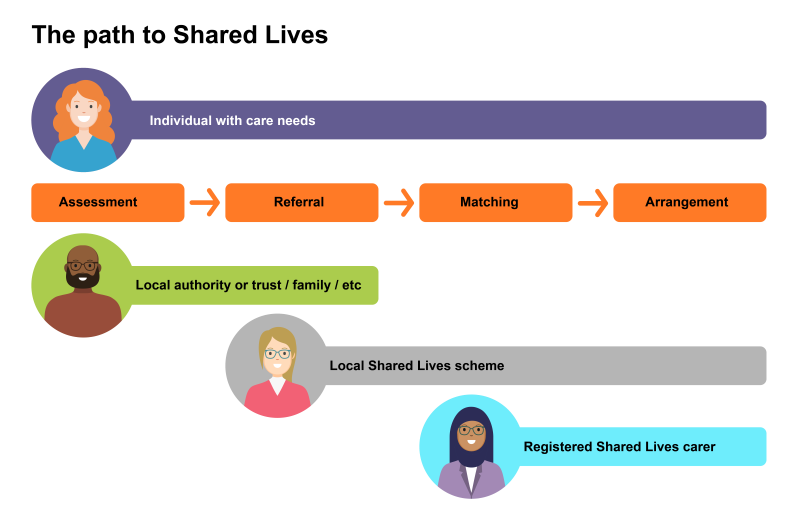
During matching, Shared Lives schemes consider the needs of individual supported people and identify a suitable Shared Lives carer. The Shared Lives scheme then introduces the supported person to their prospective Shared Lives carer through a series of visits, which often progress in length and time as they get to know one another.
Both the supported person (or their advocate where they do not have capacity to make the decision) and the Shared Lives carer must agree for a match to take place. The Shared Lives carer, Shared Lives schemes and supported person (or their advocate) then sign three key agreements, which underpin the arrangement:
- a Shared Lives carer agreement between the Shared Lives carer and the Shared Lives scheme
- an arrangement agreement detailing how the carer will work to achieve the goals in the supported person’s care plan
- a licence agreement setting out the terms of the tenancy between the carer and person supported
In the instance of a Shared Lives arrangement ending in a break down as opposed to a planned ending, social workers can work with Shared Lives scheme workers, the Shared Lives carer and the person supported to determine and resolve the ending of the Shared Lives agreements and help to identify any alternative service provision, if required.
Why growing Shared Lives is a priority
Quality of outcomes
CQC judges Shared Lives as the best quality social care service. In October 2023, CQC rated 97 per cent of Shared Lives schemes in England as good or outstanding, in comparison to 83 per cent for the wider social care sector.
Real stories from Shared Lives schemes, Shared Lives carers and supported people also demonstrate the ways in which it enables people to live richer, fuller lives. People like Meg, Abby, Rachel, Heather and Geoff.
Value for money and cost reduction
Shared Lives offers exceptional, high-quality support, whilst costing less than most other forms of adult social care. A 2023 survey by ADASS found that 87 per cent of directors of adult social care "are of the opinion that greater availability of Shared Lives would reduce or significantly reduce adult social care expenditure."
The most recent research shows that Shared Lives can save £12,000 to £26,000 per person, per year for people with a learning disability compared to supported living and residential care. If all council areas were to support a modest 5 per cent of people with a learning disability in Shared Lives, it could save £1.3 billion each year, after year 3.
Accommodating financial pressure and a new vision for social care
Shared Lives is more relevant than ever in a time where a desire to provide high-quality, life-enhancing care is in competition with ongoing economic stressors. Existing financial pressures on councils are likely to increase as supporting a population which is living longer, and with more chronic conditions, increases the strain on social services. As one commissioner interviewed for this guide said, “It’s not the only, or even the primary, reason to work with Shared Lives… but it would be silly not to mention cost.”
Meanwhile, people are beginning to think about care in a fundamentally different way. The demand for holistic person-centred, strengths-based (where the focus is on a person’s strengths alongside their needs) models like Shared Lives is growing. This change is reflected in the 2014 Care Act, which places legal responsibility on care staff to make individual wellbeing the aim of all social care functions. Shared Lives can be a powerful tool for social care planners to meet these moral and legal obligations. As one commissioner reported, “In my opinion, Shared Lives can make it easier to meet Care Act objectives. It feels less formal, with more flexibility.”
The Shared Lives model’s dual ability to remain cost effective whilst enabling care planners to their meet moral and legal obligations has led to increasing recognition. In 2021, the then government recommended Shared Lives in their People at the heart of care White Paper. In 2023, the Fabian Society’s roadmap to a national care service paper noted that Shared Lives was "increasingly preferred to large residential facilities." The current Government has backed Shared Lives as a model which "enshrine(s) ‘home first’ principles that enable people to live independently for longer."
Shared Lives has also received funding in 2024 and 2025 through the Department of Health and Social Care (DHSC), Accelerating Reform Fund (ARF). This fund aims to support the scaling of innovation in adult social care, with half of all councils making a commitment to focus on scaling Shared Lives.
A condition of the fund required councils to work as a consortium across their local Integrated Care System. Council consortiums are at various stages in the delivery of their ARF Shared Lives activities, with some areas part way through their funded projects and other councils launching activities in early 2025. To date this funded activity has resulted in increased awareness, understanding and support of Shared Lives across the integrated care footprint, alongside developing plans to sustainably scale Shared Lives in the coming years.
For younger adults, especially those who are care leavers, Shared Lives can provide consistency with foster carers transitioning to become Shared Lives carers. The new Children’s Well Being and Schools Bill (2025), currently under legislative review, may lead to further enhancements to the duty on councils to provide accommodation and support to care leavers. Shared Lives can support both care leavers with a learning disability and those with additional needs who might not have Care Act (2014) eligible need, where funding is available from children’s social care to support adults for a period.
Barriers to growing Shared Lives
Financial pressures on services
Despite the proven ability of the model to save money, the financial pressures on council budgets make up-front investment difficult. Establishing a new Shared Lives service involves overheads, from staff and Shared Lives carer training, marketing and communications, and support for Shared Lives carers.
A desire to reduce up-front or ongoing costs can compromise the model, reducing its benefits and effectiveness. For example, a national report from Shared Lives Plus into carer fees found that fee levels were inconsistent across the UK, meaning that the role was financially unviable for Shared Lives carers in some areas if they wanted to leave work, having obvious effects on schemes’ recruitment and retention.
Some areas are also seeing reductions in the additional wrap-around support required by people in Shared Lives. Shared Lives is not a 24-hour service, and additional support may be needed as part of a package of care support. Meanwhile, the increasing complexity of people’s needs means that people with more complex needs are being referred into Shared Lives, sometimes inappropriately.
Time pressures
Small budgets and high need can fuel a drive to place people quickly into familiar care settings with large capacities, such as residential care. One commissioner said: “In my experience the default is…what [setting] do we have that can meet the need quickly and reliably?”
Building up any service requires an investment of time, and it is advisable that commissioner’s factor in the timeframes to recruit, train and approve Shared Lives carers. The matching process, which is key to the quality of the model, is also an additional factor. One commissioner said: “When presented with someone urgently needing care and support, now – today…the longer lead in time [is] a challenge, especially if you are working in a reactive way and responding to crises.”
Lack of awareness
Despite Shared Lives emerging in the late 70s, it is still a relatively unknown and ‘niche’ model of support. It accounts for just 1 per cent of all UK adult social care. There is a lack of awareness among every major stakeholder group required for Shared Lives’ success, including the families of supported people, and social care professionals.
Families and advocates
Lack of familiarity with the model can be off-putting for families and advocates of people with support needs. One commissioner summed up the concerns of these stakeholders, asking “why would I let my loved one go to someone else’s house? It’s not residential - is it proper care?”
Social workers
Referrals are usually made by social workers in children’s and adult services, directly to a Shared Lives scheme. Therefore, if there is a lack of awareness or understanding amongst social workers combined with high staff turnover, this can negatively impact suitable referrals into Shared Lives. A commissioner identified that some social workers think there is a “perceived informality” of relationships within Shared Lives, and that “as a practitioner referring someone, that can seem like a risk.”
Part two: six building blocks for growing a robust Shared Lives service
A clear, rigorous strategy for growth is foundational to developing a Shared Lives service, particularly in the current economic climate. The six building blocks outline ways in which a strategy can create the ideal conditions to drive Shared Lives growth.
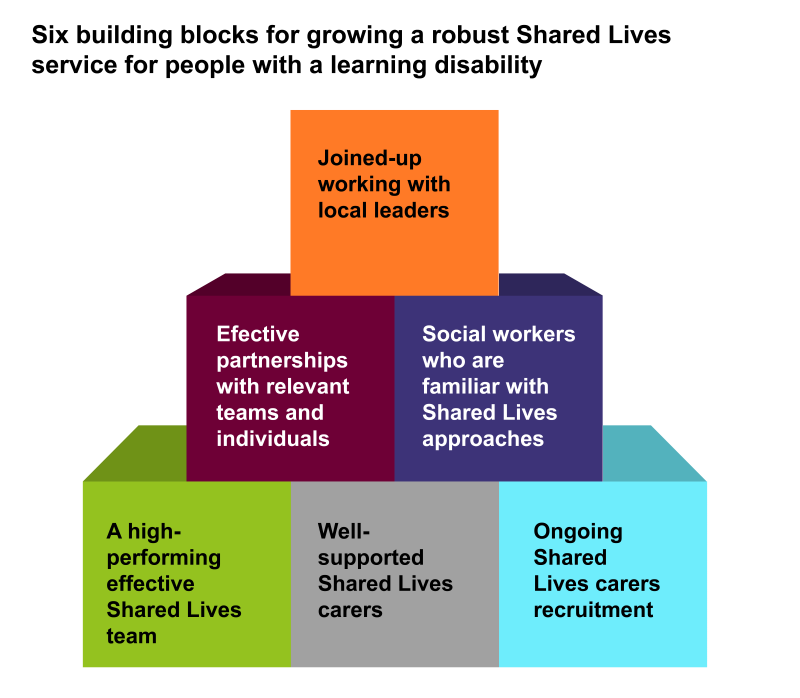
Joined up working with local leaders
Effective partnerships with relevant teams and individuals
Social workers who are familiar with Shared Lives approaches
A high performing effective Shared Lives team
Well supported Shared Lives carers
Ongoing Shared Lives carer
Joined up working with local leaders
Strong, collaborative leadership from Shared Lives schemes and senior local leaders provides an essential underpinning to Shared Lives development. Independent research conducted by the Supporting Adult Social Care Innovation (SASCI) project found that:
At the local level the drive and commitment of the Shared Lives scheme manager, backed by senior leaders in adult social care, is essential to the development and growth of a scheme.”
Dr Carl Purcell, Juliette Malley and Jill Manthorpe: Supporting Adult Social Care Innovation (SASCI)
Early and extensive engagement with senior leaders across adult social care services and the local council, including housing and children’s directorates can provide a substantial boost to a Shared Lives growth strategy. Local leaders may also provide a channel of communication to national stakeholders, such as politicians and other influential individuals.
Presenting a case for investment
A business case for investment provides a solid foundation when formulating a strategy for growing Shared Lives. It is advised that any case for investment in Shared Lives be long-term, with projections for at least three years and in addition, include the following:
- data on current and projected demand, particularly for the current key groups:
- adults with a learning disability in receipt of long-term care
- young people with a learning disability moving on from children’s services who are likely to be eligible for adult social care
- current number of Shared Lives arrangements, broken down by type, primary support needs, banding (level of need)
- current number of adults with a learning disability in receipt of long-term care supported in other ways, including, general needs housing, living with family, supported living and residential care
- unit costs for Shared Lives per type of arrangement and banding
- average unit costs for alternative settings, including residential care and supported living
A successful case for investment in Shared Lives from Devon County Council
In 2022, Devon County Council was faced with a budgetary shortfall and a surge in demand for help and support for vulnerable adults. The council searched for models which could deliver high-quality care whilst simultaneously providing long term savings, against a shortfall of £73 million.
Through this process, the council found that Shared Lives was suitable for a wide range of care and support needs and could save an average £20,000 a year per person. The council engaged the commissioning team, social work teams, and the existing provider, Shared Lives South West, to develop an ambitious strategy for growing Shared Lives. The strategy received senior support from the outset, including from Director of Integrated Health and Social Care, Tandra Forster, who was determined that “If we work together, share resources and learning, and are creative and brave with the money we have, we can continue to invest in and grow Shared Lives, to ensure that even more people benefit from one of the highest quality and safest forms of social care in the future”.
Devon County Council conducted research that found that if the service grew by 30 supported people in year one, and 15 in year two, it would deliver savings of approximately £900,000 per year.
Aligning Shared Lives growth targets with local objectives
As seen in the case of Devon County Council, aligning achievable targets for Shared Lives growth with wider adult social care objectives is an effective method of gaining leadership buy-in. Shared Lives takes time to grow. Councils thinking about commissioning Shared Lives need to work closely with the provider, and with Shared Lives Plus, to develop realistic and achievable growth targets.
Another successful example of this is the London Borough of Camden’s strategy for adult social care. Camden’s strategy demonstrates a clear commitment to grow its Shared Lives service alongside specific targets which are reviewed by the leadership team.
Leading with ‘Shared Lives by default’
Adult social care leadership can take the lead by encouraging practitioners involved in assessments, planning, and care package decisions to consider Shared Lives with other options with a person. It may not always be the right option for a person with a learning disability but implementing ‘Shared Lives is always considered’ reframes Shared Lives as a core option amongst practitioners. This approach involves:
- social workers considering Shared Lives, and having early conversations about Shared Lives with all people requiring support, and their family or advocate
- decision makers responsible for packages of care checking whether social workers for a supported person have considered Shared Lives
- brokerage teams checking with social workers requesting a package of support, whether they have considered Shared Lives.
Locally based steering groups
Stakeholders who could participate in these structures include leaders from across adult social care, housing, children’s services, the NHS and the voluntary sector. An invested collaborative group of knowledgeable and connected stakeholders can drive changes, problem solve, and pool essential knowledge.
Cross-council steering groups
Sharing knowledge across several adjoining councils is a powerful way to improve and develop a local Shared Lives offering. Cross-council partnership working involves setting up a steering group of key stakeholders, including commissioners, project managers, social work leaders, and Shared Lives scheme workers. A successful example is in South Yorkshire, where a cross-council steering group was established by four councils as part of its Accelerating Reform Fund project. Meetings of the steering group are producing valuable learning, which is shared between the councils.
Commissioning high quality Shared Lives services
About a third of all Shared Lives provision in England is delivered by independent, not for profit, providers, commissioned through block or spot contracting. Stakeholders from independent providers often report encountering variable commissioning practices depending on the familiarity of commissioner with the schemes.
Key policies and guidance will help steer the commissioning of Shared Lives, but there are some differences in the model from other social care services which are helpful to recognise.
Effective partnerships with relevant teams and individuals
To flourish, a Shared Lives service needs to be embedded within the local adult social care sector, rather than being regarded as an outlier. Independent research from Supporting Adult Social Care Innovation (SASCI) has also underscored the importance of good collaborative working across teams and organisations:
As well as establishing connections and opportunities for learning across schemes, effective [Shared Lives] schemes work collaboratively at a local level with a range of different teams and individuals.”
Dr Carl Purcell, Juliette Malley and Jill Manthorpe: Supporting Adult Social Care Innovation (SASCI)
The way to secure a central position for Shared Lives within the sector is for the service to work closely and consistently with key local professionals. This may involve:
- identifying all relevant teams and practitioners directly involved in Shared Lives processes, as well as those who play a supporting role
- devising strategies to engage productively with each group.
Examples of relevant teams and practitioners
Adult social work and brokerage teams
Engaging practitioners who can work as allies and champions of Shared Lives in areas such as transitions (preparation for adulthood), brokerage, learning disability, mental health, and direct payments is invaluable. This can take the form of regular meetings between scheme staff and council learning disability, teams to facilitate ongoing dialogue about the matching process and increased awareness about the scheme.
For Shared Lives services located ‘in-house’ within a council, there may be an opportunity for Shared Lives scheme workers to sit near social work teams and brokerage. A Shared Lives manager interviewed for this guide described how this was working for their Shared Lives service, "We have really benefited from sitting next to the social work people with a learning disability team. By sitting next to them, we cut out a lot of the back and forth that goes with discussions about Shared Lives. We are on the same page."
Housing teams
A strong relationship between Shared Lives schemes and housing professionals within councils is extremely valuable when developing and maintaining a Shared Lives service. Housing professionals can assist with appropriate housing allocations, funds to support home adaptations, and signposting Shared Lives as an option to housing recipients.
Children’s social care teams
Children who have been in care could either transition to Shared Lives with their foster carer or move from a different care placement, such as residential care or a residential school if this would work for them. It is vital that the Shared Lives scheme works closely with foster care teams, independent review officers, leaving care personal advisors, social workers and transitions workers to plan early for a referral to Shared Lives, ideally from 16. You can read more about transitions in our training resource for social workers.
NHS services
Shared Lives carers benefit from having strong connections to local community-based health services, such as primary care, general practice, dentistry and nursing. It is important that Shared Lives carers know who they can contact when they need support.
Advocacy services
People with a learning disability have a right to advocacy support in certain circumstances. Making sure people supported by Shared Lives have access to an advocate is essential for empowering supported people.
Productive engagement with key professionals
Encourage individual Shared Lives champions
Social workers play a pivotal role in appropriate referrals. As noted in the SASCI briefing, ‘experienced social workers may play a leadership role in helping to raise awareness of Shared Lives amongst colleagues.’ Social workers who have made a successful referral can be engaged as Shared Lives champions - to speak to their colleagues and to encourage them to make more referrals.
One opportunity to develop champions of Shared Lives within other teams is for scheme workers to participate in their weekly meetings. Shared Lives workers could share impactful stories conveying the life changing value of Shared Lives directly to professionals who could promote its use.
Work with existing systems and processes
To become embedded in local adult social care, information about Shared Lives ought to be easily accessible within business-as-usual systems and ways of working. In practice, this could mean producing a guidance pack on the Shared Lives service, as seen in the case study below. It could be that an in-house service can regularly update council directories, websites, intranets, newsletters and staff induction documents.
You can read more about transitions and Shared Lives in our guide for social care practitioners.
Social workers who are familiar with Shared Lives approaches
I am a huge supporter of Shared Lives – it delivers excellent support to people and enables [them] to live good lives in a loving family home. As a social worker, I know however, that we have a huge role to play in supporting Shared Lives to flourish, and that we need to encourage more referrals into Shared Lives.”
- Lyn Romeo CBE, Former Chief Social Worker for Adults
Skilled and knowledgeable social workers are vital to appropriate referrals, and to helping supported people through the matching process.
It is beneficial to provide social workers with a clear understanding of the end-to-end referral process, as this can help to manage expectations on referral timescales, improve understanding on the social workers role throughout the process and support effective handover to Shared Lives scheme staff.
A plan to grow Shared Lives ought to draw on existing methods that shape practitioners’ approaches:
- strengths-based
- rights-based and least restrictive support
- ideally a named social worker
It is important to also include safeguarding and other resources for practitioners that highlight the differences between Shared Lives arrangements and more formalised settings.
A strengths-based approach
Shared Lives is a strengths-based model of care, which accentuates the personal strengths, gifts and networks of everyone who accesses the service. This approach is more likely to maximise a person’s choice, control, and independence. Many social workers already:
- use strengths-based conversations during assessment and care planning to explore a person’s strengths, gifts, goals and social networks, and how Shared Lives can work with these
- use reviews to understand whether someone's support needs, goals, strengths and aspirations have changed
- work meaningfully with the supported person and their family, advocate, and Shared Lives carer, if already matched, on what their care and support looks like.
You can find more information and guidance on strengths-based practice on the Social Care Institute for Excellence (SCIE) website.
A rights-based approach
A rights-based approach can help encourage a person to express their choices throughout the process of accessing and living in Shared Lives. Key aspects include:
- supporting people’s right to live in a place that they call home which does not restrict their personal freedoms
- taking an external perspective on the system, reflecting on and influencing it by applying human rights values
- co-production with supported people or their advocate throughout the whole process using the strengths-based techniques outlined above.
Resources from West Midlands ADASS and East Midlands ADASS explain how to do good co-production.
Appoint a named worker
Many high performing schemes adopt a named worker approach. This involves the allocation of a dedicated social worker or social care practitioner who has an ongoing responsibility for a person supported by Shared Lives. The named worker acts as primary contact and advocate for the supported person. This could include:
- regularly visiting the Shared Lives carer and supported person to review the arrangement
- working to prevent individuals being overwhelmed by the system, such as helping the person access employment and NHS support
- coordinating access to other forms of health, social care and social support, so that the person benefits from wrap around support
- responding to the needs and issues raised by the Shared Lives carer and the person supported when these arise.
For more on the named worker approach, see these SCIE resources.
Safeguarding
Approaches to safeguarding from other social care professionals will need to consider the uniqueness of Shared Lives arrangements. Social care practitioners acting as investigators can maintain a rigorous approach, whilst appreciating that Shared Lives is fundamentally different to most other types of adult social care. The key areas of nuance are that:
- Shared Lives arrangements take place in ordinary family homes
- the Shared Lives carer role is often difficult and complex.
The appropriateness of boundaries between a supported person and their Shared Lives carer is often less clear than in other residential settings. Shared Lives carers are expected to have both a professional and an informal and caring relationship with the people that they support. From the perspective of the supported person, they may consider the Shared Lives carer to be more of a friend, or family member.
You can read more about the nuances of safeguarding in Shared Lives in our resource for social care practitioners produced for SCIE.
A high performing Shared Lives team
‘Shared Lives workers can be life changing. If they are consistent and supportive and can build meaningful relationships with the Shared Lives carer and their supported person’ - Shared Lives carer.
A high performing, effective Shared Lives team is pivotal in creating and maintaining sustainable Shared Lives arrangements. Common characteristics of a successful Shared Lives team include a range of appropriate skills, a ‘can do’ attitude, and creative approach to problem solving.
An effective Shared Lives team typically includes at least the following roles:
- a registered manager dedicated to Shared Lives only
- at least one Shared Lives worker
- an administrator with process and financial skills
And be able to draw on these resources:
- access to a communications team to promote the scheme
- access to benefits and legal teams
- ideally permanent contracts for all staff, to promote longevity and security
Work distribution
Experience from Shared Lives schemes indicate that keeping an individual scheme workers caseload to 20 households or less is about right in creating more opportunity for growth: the scheme worker can then allocate enough time to promoting the service; training potential Shared Lives carers; and keeping pace with recruitment and referrals.
The Shared Lives registered manager ought to be able to focus on leading the Shared Lives scheme, developing the model in their area and supporting their staff team. This should still allow time to develop meaningful relationships with their Shared Lives carers and supported people. A common feature of Shared Lives schemes rated ‘outstanding’ by CQC is a strong lead, from a dedicated manager, who genuinely involves their Shared Lives carers and the people they support in the running and development of the scheme.
Referrals
Success breeds success in terms of referrals, and once social workers have referred successfully into a Shared Lives service, they will do so again. The following methods have proven successful in increasing referrals to Shared Lives:
- co-location and regular contact with the relevant teams as discussed in the ‘Effective partnerships with relevant teams and individuals’ section above
- a referral form that is familiar, easy to use, and avoids duplication. Ideally online
- a shared referral form that considers more than one service simultaneously or using brokerage to achieve the same result
- agreed pathways with children’s social care with early identification and planning
- encouraging social workers to get in touch and have a timely conversation about whether Shared Lives is suitable and whether there are carers available for the person they are working with, before completing a lengthy form
- clear, accessible information on the costs and conditions involved in Shared Lives
- schemes responding to social workers as quickly as possible to avoid referrals being routed elsewhere because of time pressures.
Matching
Matching is an integral part of Shared Lives and allows the relationships that are the basis of the model to germinate. Shared Lives schemes can be involved from the very beginning by helping both the social worker and the person interested in Shared Lives understand the model, decide whether it would suit the person and then look at the available Shared Lives carers who may be a suitable match for them.
Once information has been exchanged, if both the person and the Shared Lives carer agree to continue, the Shared Lives scheme sets up a series of introductory visits for the person and the Shared Lives carer to get to know each other, and if these are successful, a Shared Lives arrangement is established.
The matching process helps to provide a personalised service. While it is disappointing if an initial match does not work out, the process is focussed on making a long-term, safe and successful match.
Monitoring and support
Regular support and monitoring visits are vital to foster positive relationships between the Shared Lives scheme, Shared Lives carers, and people using the service. The support and monitoring processes used by Shared Lives schemes help to ensure:
- Shared Lives carers receive practical and emotional support from their allocated scheme worker
- Shared Lives arrangements are working well for the people supported in them
- Shared Lives arrangements are safe and effective and meet any regulatory requirements
- help is given by the scheme and social worker to resolve any issues which may arise hopefully preventing breakdown of the service.
It is recommended that Shared Lives schemes conduct a support and monitoring visit every three months, and a yearly review to keep arrangements running effectively. It is wise to provide more frequent contact at the start of arrangements and in difficult times. These visits typically take place in the Shared Lives carer’s home, involving a combination of the Shared Lives scheme worker, the Shared Lives carer and the supported person.
The fees, conditions and support that Shared Lives carers receive ensure carers feel supported and valued, but goodwill gestures are also appreciated, as one Shared Lives manager stated “…our Shared Lives carers said they felt appreciated and part of something bigger. It’s hard to measure. They are an invaluable asset, in addition to the staff team.”
Safeguarding
Shared Lives is the form of social care provision rated most highly, with 97 per cent of Shared Lives schemes consistently rated as ‘Good’ or ‘Outstanding’ by CQC.
In the event of a safeguarding allegation against a Shared Lives carer or member of the household, Shared Lives schemes should prioritise the wellbeing of the supported person. It is also important that a response to an allegation is not in itself abusive and does not damage a valued Shared Lives arrangement beyond repair. You can find more information about safeguarding in our resource for social care practitioners.
Well supported Shared Lives carers
Carer fees
Councils will want to ensure that Shared Lives carers receive fair fees for the challenging work they do, and the immeasurable positive impact they can have on the lives of supported people.
Best practice
Shared Lives carer fee and contribution rates vary across the country, as do the way in which they are calculated and distributed by Shared Lives schemes. It can be helpful to consider the local fees for foster carers, Staying Put and supported lodging when setting fees particularly where there will be transitions from children’s services. Best practice is for Shared Lives arrangement fees and contributions to be divided into three main elements:
Care and support fee
Shared Lives schemes remunerate a Shared Lives carer though a care and support fee in all types of arrangements. The rate of care and support fees reflect the care required from the Shared Lives carer, as specified in a person’s support plan.
Shared Lives schemes calculate a care and support fee to Shared Lives day support carers depending on the amount of support that they provide. This is usually calculated as a block of time: for example, three, four or six hours.
Board and lodgings, and rent contributions
Board and lodgings, and rent contributions are mostly applicable to live-in and short break arrangements. The different types of arrangement are outlined in ‘How Shared Lives works’ in part one of this guide.
Annual reviews and setting rates
It is usual for fee and contribution rates to be reviewed by Shared Lives schemes and commissioning teams every financial year, with a view to adjusting them in line with the cost of living. This can be included as part of any local social care uplifts.
Fee and contribution rates vary widely across the country, as evidenced in twelve regional reports produced by Shared Lives Plus in 2023. The reports provide the most detailed data on fees and contributions ever collected and give a regional breakdown of recommended minimum and optimum rates.
Fees and exceptional circumstances
Any plan to develop Shared Lives will need to include contingency procedures for exceptional circumstances. These include when a Shared Lives carer is unwell for an extended period, when a supported person dies while in Shared Lives, or in the event of a serious safeguarding investigation, where the supported person is removed from the Shared Lives carer’s home.
Shared Lives carers often perform administrative tasks after a supported person dies or is removed from the arrangement. This may include dealing with the person’s belongings, family members or advocates, and liaising with essential services. An additional payment to cover this can be considered.
Access to breaks
Commissioners and practitioners will want to ensure that live-in Shared Lives carers have access to and are encouraged to take time off from daily active care for supported people, as well as occasional longer breaks. As described in ‘About Shared Lives’ in part one of this guide, live-in Shared Lives carers maintain overall responsibility for supported people. They do not provide constant 24-hour care, seven days a week. This would be unsafe, ineffective, and unsustainable. It would also be detrimental to the person using the service, limiting their choice and independence.
Day support provision
Care and support packages involving live-in arrangements can incorporate day support provision where a person requires ongoing care and support throughout the day. Day support could for example provide purposeful occupational and leisure activities outside of the Shared Lives carer’s home, and with people other than the Shared Lives carer.
An individual living in a Shared Lives arrangement may wish to receive day support from another Shared Lives carer, attend a day centre, access support from a personal assistant, attend other day activities, or be supported to work or volunteer. Any day activities that a supported person is assessed as needing will be funded through their care package as a separate element to the care and support fee for the Shared Lives arrangement.
Short breaks and respite
A care and support package that includes a live-in Shared Lives arrangement is likely to include funding to enable the Shared Lives carer to take paid breaks of between four to six weeks per year. This involves for example:
- allocating a budget which covers Shared Lives carer payments for the equivalent of at least 56 weeks each year, divided as follows:
- 52 weeks per year for the Shared Lives carer
- at least four weeks of the 52 included to fund a Shared Lives short breaks carer, or other suitable respite provider
- the long-term Shared Lives carer continues to receive accommodation and support contributions and fees, but not the food and utilities during the respite period
- food and utilities contributions go to the alternative Shared Lives short breaks carer for the duration of the respite period
- all short breaks payments are made through the Shared Lives scheme.
Regular and relevant training
Shared Lives schemes are responsible for ensuring their Shared Lives carers and workers have the appropriate skills, knowledge and abilities for their roles. Training for Shared Lives carers needs to take account of their work-from-home environment, their caring responsibilities, and their family circumstances. A Shared Lives training programme which could be considered ‘competent and confident’ as defined by CQC would include:
- essential core Shared Lives training, aligned to the Care Certificate
- access to mandatory training on learning disability and autism
- access to training for other care and support needs, as required
- access to courses for further development and higher training
- all training to be Shared Lives specific or at least adaptable
- regular renewals of ongoing training, such as first aid and health and safety
- a variety of training methods and timings used – online, video, workbook, in person, coaching, reading, peer-to-peer, to meet all learning styles, abilities and needs
- support to access online training if this is an issue, both by scheme and technical support staff
- accreditation of prior learning, to prevent unnecessary duplication for Shared Lives carers, especially for foster carers for example.
Engaging with Shared Lives carers
Being a Shared Lives carer is a type of lone working and can leave carers vulnerable or feeling isolated. Schemes can counteract this through:
- carer groups/forums
- drop-in sessions
- coffee mornings
- seasonal events, such as a picnic in summer and a party in winter
- social activities, such as meals or bowling for example.
More formally, Shared Lives schemes can engage Shared Lives carers to encourage feedback, which can be used to adapt and improve the service. Shared Lives carers who are involved in their schemes and feel listened to, are more likely to feel valued and recognised for their role. In turn, they are then more likely to provide better outcomes for the people they support.
From Shared Lives Plus’s experience in supporting a range of Shared Lives carer groups, the best forum for engaging Shared Lives carers is for a Shared Lives scheme to set up a semi-independent group. This involves the Shared Lives scheme facilitating the group, without taking part in the meetings themselves. Shared Lives carers ought to be encouraged to feed back any concerns or issues to the Shared Lives scheme as a group at the end of a meeting.
This model is a success for St Anne’s Shared Lives in Leeds, where the Shared Lives scheme organises bi-monthly meetings for Shared Lives carers. At the end of the session, the Shared Lives manager pops-in to answer any questions or take them back to the wider team.
Consistent Shared Lives carer recruitment
A healthy consistent flow of Shared Lives carers into a Shared Lives scheme is an essential building block in a strategy to grow Shared Lives.
Collaborate with relevant teams and individuals
As discussed in the section above (social workers who are familiar with Shared Lives approaches), social workers and other key teams across adult social care and councils are pivotal to the number of referrals made into Shared Lives. These stakeholders also have the potential to improve the appropriateness of referrals by increasing understanding amongst the right healthcare professionals. Additionally, they can open new channels to potential Shared Lives carers, for example foster carers transitioning to Shared Lives.
Get the messaging right
It is paramount that the message used in any recruitment campaign is relevant to the local pool of potential Shared Lives carer. For example, in areas with high rates of renting, some people may be put off by the perceived complications of a live-in or short break arrangement, as this requires a spare bedroom. In this context, recruitment that focuses on the potential of day support may have greater levels of success.
Work with local community groups
An effective method for recruiting Shared Lives carers is to raise awareness amongst groups who are already well established within the local community by attending meetings in person, giving talks, and hosting drop-ins in local community spaces. This could include engagement with local faith organisations, LGBTQ+ communities and voluntary organisations, amongst others.
A proactive approach to engaging with parents and families of children and adults with a learning disability can support awareness raising of Shared Lives as an option through parent, foster carer forums or local schools. This can be particularly in impactful for children who could benefit from Shared Lives as an option as they move on to adult services.
Use appropriate communication channels
Different channels have a wide range of effectiveness depending on the target audience; therefore, it is important to select the best channel for the demographic. For example, younger generations are responsive to digital channels, whereas someone in an older age bracket may benefit from a more traditional channel such as newspapers or mail drop.
To reach a wider audience, a multi-channel approach is essential. Ongoing data tracking of how each channel performs is an effective way to inform future campaigns. Capturing the performance and results of the different campaigns will build a knowledge-bank of what is the most effective.
Word of mouth and incentives
Shared Lives schemes often report that word of mouth is the most powerful tool for recruiting Shared Lives carers. Shared Lives carers who have lived experience can best portray the highs and lows of offering support from their home. Attaching a financial incentive can strengthen the offer, particularly when conveyed via word of mouth from a trusted source. The Shared Lives scheme can also share financial incentives through their own external messaging.
Checklist
This section provides a checklist council leaders and practitioners can follow to put in place the right conditions to support Shared Lives to flourish. The check list is not exhaustive, and further details of actions which are recommended are covered by the guidance and other resources we signpost to. It follows the outlined six building blocks set out in part two of the guidance.
Joined up working with local leaders
- There are clear and widely communicated ambitions for developing and growing Shared Lives in organisational strategies and delivery plans
- The infrastructure to effectively coproduce a plan for the development of Shared Lives and its growth is in place. In some areas, this might mean setting up a coproduction forum or group that meets regularly to inform decisions. It means also that practitioners understand and embed the principles of coproduction in how they work
- Senior leadership regularly reviews the performance of the Shared Lives service at leadership meetings
- Build a robust case for investment in Shared Lives, building support amongst senior leaders and elected members for a long-term investment in Shared Lives, including investment from children’s social care and housing
- Look at multiple data sources to build a picture of current and future need, and work with practitioners to understand who is already supported by adult social care but might be better supported by Shared Lives
- Utilise up to date analysis of the cost savings arising from Shared Lives compared to other traditional care services, such as supported living and residential care
- Managers celebrate and disseminate ‘success stories’ across multiple forums, for example, newsletters, multi-agency meetings, and other events
Effective partnerships with relevant teams and individuals
- When initiating new initiatives that involve Shared Lives, ensure that a broad range of relevant stakeholders are present, including children’s social care, commissioning, brokerage, voluntary and community sector organisations, social work practitioners, housing, the NHS and adults with a learning disability, including young people, and families
- Ensure that Shared Lives workers are either integrated onto the same case management systems as their social work colleagues or that any systems used ‘speak to one another’.
- Encourage social workers, families and people to always consider Shared Lives for long term care packages and make sure they have the information they need to make a choice.
Social workers who are familiar with Shared Lives approaches
- Highlight Shared Lives as a key option for social care practitioners in any strengths-based practice frameworks or guidance used by staff, which in turn can lead to more adults with a learning disability and families knowing about Shared Lives.
- If possible, implement a ‘named worker’ approach across the Shared Lives scheme and learning disability teams, so that each person has a single, named point of contact that they can go to when they need support
- Build Shared Lives learning courses or opportunities into induction programmes for all new social care practitioners
- Recruit and develop Shared Lives champions in leadership roles with social work teams, particularly learning disability, autistic people, transitions, and mental health teams
- Make awareness raising sessions about Shared Lives available to all key staff in adult social care, children’s disability and in care and leaving care teams, and NHS teams, including brokers, NHS nurses working with people with a learning disability, commissioners and social work assistants.
A high performing, effective Shared Lives team
- Ensure that the team is adequately staffed, with a workable ratio of cases per worker, and access to communications support
- Ensure that referral systems are straightforward, fast, and seamless for all staff to follow, including having a referral form that is familiar, easy to use, and avoids duplication and there is clear, accessible information on the costs and conditions involved in Shared Lives
- Ensure that there are robust safeguarding approaches in place, and that every team knows their role in relation to safeguarding.
Well supported Shared Lives carers
- Ensure that carers fees are linked to the Council’s annual review of all providers fees, to ensure that they do not miss out on fee uplifts
- Benchmark carers fees annually against national and regional averages, including similar home-based care such as foster care, supported lodgings and Staying Put
- Ensure that carers have access to a recommended allocation of carer breaks/respite
- Ensure that carers are well supported and connected through a range of activities, such as carer groups/forums, drop-in sessions, coffee mornings and social activities, such as meals or other social activities
- Ensure that carers have access to a full range of mandatory and voluntary training and learning opportunities, including covering topics such as learning disability and autism mandatory training, dementia, mental health, trauma informed practice and transitional safeguarding.
Ongoing Shared Lives carer recruitment
- Ensure that there is a communication and marketing budget for recruiting carers, on an ongoing basis, to cover costs of provisions like mailouts, website updates, facebook adverts, social media posts, flyers, stalls and posters, and attendance at key events
- Develop a strategic whole council approach to recruiting carers, involving the council’s corporate communications team, foster care recruitment and NHS and workforce recruitment partners
- Establish links with range of local community organisations, such as faith organisations, LGBTQ+ communities, voluntary organisations and local schools and regularly attend meetings / sessions held by these organisations to promote Shared Lives.