Executive summary
The employer standards survey, also known as the ‘Health Check’, gives a voice to registered social workers, occupational therapists, and non-registered social care workers. The 2025 Health Check survey received 15,855 responses from 137 different organisations, showing a 3.5 per cent increase in responses from last year.
This report outlines the key findings from registered social workers and social care workers (a separate summary of the responses from occupational therapists will be available shortly on the LGA website). A full breakdown of the data at a national and regional level is available on the Knowledge Hub site. Some key findings from this year’s survey are:
- Satisfaction with the employer standards overall has increased slightly (by one percentage point since 2024)
- The lowest performing standard continues to be continuous professional development (CPD): some social workers feel they don’t have enough dedicated time and resource for their CPD
- The highest performing standard was professional registration, with social workers reporting that: the registration and renewal process is straightforward; they know what is expected of them, and; they understand the regulator’s investigation process
- Perception of overall workplace experiences slightly decreased from last year by one percentage point: working under pressure with limited resource remains a key issue
It is promising that the overall results to the survey indicate that the sector has seen improvements across multiple standards. However, there remains room to improve workplace experiences and opportunities available to social workers.
Introduction
The social work and social care workforce is vital in providing support to individuals and families facing a wide range of challenges, such as poverty, mental health issues, and disability. While the sector is varied with lots of different specialisms, all social workers and social care workers play a key role in supporting people in the face of such challenges. As well as offering urgent support in times of crisis, social work empowers people in the long term to live independently and with dignity.
The social work sector employs over 1.7 million people in a variety of posts, including registered social workers, social care workers, and occupational therapists. The workforce is employed across a range of settings from councils, to the NHS, to the private, voluntary and independent sector. Like other regulated professions, registered social workers must adhere to high professional standards – their employers are also expected to deliver against defined sector standards.
This survey helps organisations who employ social workers to understand some critical questions about their workplace experiences:
- How well do employers deliver the employer standards?
- How well do employees perceive their working environment?
Please note that this summary report relies on data collected from registered social workers and non-registered social care workers employed by local authorities and related agencies (a separate summary of the responses from occupational therapists will be available shortly on the LGA website). While the results are considered to represent a reasonable, national sample, no claims are made for generalisation of the results to other areas of the UK.
The employer standards
The employer standards for social workers were refreshed in 2020. The Standards set out the shared core expectations of employers which will enable social workers in all employment settings to work effectively and safely.
Standard 1 – Strong and clear social work framework
This standard is about promoting a clear statement about the principles that constitute good social work practice, and how those principles function across the full range of social work settings.
Standard 2 – Effective workforce planning systems
This standard is about using effective workforce planning systems to make sure that the right number of social workers, with the right level of skills and experience, are available to meet current and future service demands.
Standard 3 – Safe workloads and case allocation
This standard is about ensuring employees do not experience excessive workloads, resulting in unallocated cases and long waiting times for individuals.
Standard 4 – Wellbeing
This standard is about promoting a positive culture for employee wellbeing and supporting social workers to have practical tools, resources, and the organisational environment they need to practice effectively and safely.
Standard 5 – Supervision
This standard is about making sure students and qualified practitioners can reflect critically on their practice through high quality, regular supervision being an integral part of social work practice.
Standard 6 – Continuing professional development (CPD)
This standard is about social workers being provided with the time and opportunity to learn, keep their knowledge and skills up to date, and critically reflect on the impact on their practice.
Standard 7 – Professional registration
This standard is about supporting social workers to maintain their professional registration with the regulator.
Standard 8 – Strategic partnerships
This standard is about creating strong partnerships and good collaboration between employers, higher education institutions, and other training providers.
Participants
The survey was carried out from early January to mid February 2025. It received a total of 6,961 responses from registered social workers and 7,206 from non-registered social care workers, making up 88 per cent of the total survey responses.
| Occupation | % |
|---|---|
| Registered social workers | 44 |
| Social care workers | 45 |
| Occupational therapists | 11 |
|
|
2025 |
Percentage |
2024 |
Percentage change |
|---|---|---|---|---|
|
Registered social workers |
6,961 |
44% |
7,068 |
-1.5% |
|
Social care workers |
7,206 |
45% |
6,351 |
+13.5% |
|
Occupational therapists |
1,688 |
11% |
1,902 |
-11.3% |
|
Total |
15,855 |
|
15,321 |
+3.5% |
Based on feedback from previous Health Check surveys, this year we have included a more in-depth breakdown between service areas to capture a more comprehensive understanding of the perceptions of the employer standards from different groups. Of the registered social workers, 3,817 (55%) work in Adult Services, 2,596 (37%) work in Children’s Services, 505 (7%) work in Mental Health Services, and 42 (1%) did not disclose their service area.
| Occupation | % |
|---|---|
| Adult services | 55 |
| Children's services | 37 |
| Mental health services | 7 |
| Did not say | 1 |
|
|
2025 |
Percentage |
2024 |
Percentage change |
|---|---|---|---|---|
|
Adult Services |
3,817 |
55% |
3,684 |
+3.6% |
|
Children's Services |
2,597 |
37% |
2,801 |
-7.3% |
|
Mental Health Services |
505 |
7% |
503 |
+0.3% |
|
Did not say |
42 |
1% |
80 |
-47% |
|
Total |
6,961 |
|
7,068 |
-1.5% |
|
|
|
|
|
|
Of the non-registered social care workers, 4,726 (66%) work in Adult Services, 2,249 (31%) work in Children’s Services, 183 (3%) work in Mental Health Services, and 48 (<1%) did not disclose their service area.
| Occupation | % |
|---|---|
| Adult services | 66 |
| Children's services | 31 |
| Mental health services | 3 |
| Did not say | 1 |
|
|
2025 |
Percentage |
2024 |
Percentage change |
|---|---|---|---|---|
|
Adult services |
4,726 |
66% |
4,098 |
+15.3% |
|
Children's services |
2,249 |
31% |
1,989 |
+13.1% |
|
Mental health services |
183 |
3% |
204 |
-10.3% |
|
Did not say |
48 |
1% |
60 |
-20% |
|
Total |
7,206 |
|
6,351 |
+13.5% |
Methodology
The data from the survey was interpreted using a mean average score for each question as the survey aimed to measure attitudes and opinions on a quantifiable scale. Respondents were asked to select options from a Likert scale ranging from ‘strongly disagree’ to ‘strongly agree’. The mean score is used to determine the average performance of a question so it can also be referred to as the average satisfaction score. This score can be converted to the same number as a percentage to indicate the average percentage of the score relative to the maximum score.
Scores or percentages for a question between 0-50 indicate a low outcome, scores between 51-74 indicate a moderate outcome, and scores between 75-100 indicate a good outcome. This is the same scale as last year to allow for meaningful comparisons to be made across time.
The standards overall
How well do employers deliver the employer standards for social workers?
The employer standards for social workers set out the shared core expectations of employers which enable registered social workers in all employment settings to work effectively and safely.
The overall mean average for the standards this year was 75 per cent, increasing by one percentage point from a score of 74 per cent last year. Whilst only a slight increase, this indicates some promising improvements across the delivery of the employer standards.
We observed some differences across adults, children’s, and mental health social workers:
- Each standard was perceived as slightly lower by children’s social workers when compared with adults and mental health social workers, ranging from 1-5 points lower across all standards.
- The largest differences between adults and children’s services were observed in safe workloads and case allocation, wellbeing, and supervision.
- The most favourably perceived standard for adults and mental health social workers was professional registration, whereas the highest perceived standard for children’s social workers was strategic partnerships.
- The lowest performing standard for adults, children’s, and mental health social workers was consistently continuous professional development (CPD). This suggests that CPD should be a focus point across all service areas to improve on.
Workplace experiences and wellbeing: registered social workers and social care workers
As well as measuring the employer standards, we also included questions on workplace experiences more generally and heard responses from both registered social workers and non-registered social care workers. The questions on workplace experiences varied across a range of factors which impact on employee satisfaction and wellbeing – for example, feeling valued by employers, having access to resources they need, and being able to cope with workload.
Registered social workers
The highest-ranking statements for registered social workers regarding their workplace experiences were about their access to guidance and training for using technology in a remote working environment. It is positive to see that employers are supporting their workforce to achieve the necessary digital literacy for online working. The table below shows how the responses differed between service areas:
|
High ranking workplace experience statement |
Adults |
Children’s |
Mental health |
|---|---|---|---|
|
“I have had access to the practice guidance and technology I have needed to work online/remotely with people using services and colleagues” |
86 |
84 |
81 |
|
“My organisation ensures that I am equipped with the level of digital literacy required to use technology effectively for remote working” |
83 |
81 |
79 |
The lowest ranking statements for registered social workers regarding their workplace experience were working under pressure with less resources, administrative obligations, and an increase in the severity of need of people using the social care services. Employers should look to reduce unnecessary burdens on their social care workforce. The table below shows how responses differed between service areas:
|
Low ranking workplace experience statement |
Adults |
Children’s |
Mental health |
|---|---|---|---|
|
“I am not often required to do more with less resources” |
52 |
49 |
51 |
|
“My role does not involve administrative duties that have no or limited impact on outcomes for those who use the service” |
47 |
42 |
43 |
|
“In the past 12 months, I have not experienced an increase in severity of need and trauma in people being referred to me or my team” |
49 |
45 |
41 |
Wellbeing and experience overall were rated lower by registered social workers than any of the standards, with an average of 66 percent, decreasing by one percentage point from last year. It is crucial to evaluate how employers can improve the workplace experiences of social workers holistically, beyond the set standards, especially around the issue of burden and reduced resources.
Non-registered social care workers
The highest-ranking statements for non-registered social care workers show that the social care workforce feel their job makes a real impact, and they largely feel safe and valued at work. The breakdown across service areas is shown in the table below:
|
Highest ranking workplace experience statement |
Adults |
Children’s |
Mental health |
|---|---|---|---|
|
“On the whole, I strive with all my energy to perform my job” |
90 |
90 |
90 |
|
“The work I do makes a real difference to clients and to my colleagues” |
91 |
88 |
90 |
|
“In the last 12 months I felt physically safe at work most of the time” |
89 |
85 |
87 |
|
“My immediate manager/supervisor values my work” |
88 |
86 |
88 |
Similarly to registered social workers, the lowest ranking statements for non-registered social care workers regarding their workplace experience were about pressure and added burden in the workplace. The table below shows the breakdown by service area:
|
Lowest ranking workplace experience statement |
Adults |
Children’s |
Mental health |
|---|---|---|---|
|
“I don’t often experience excessive pressure in my job” |
51 |
47 |
53 |
|
“I am not often required to do more with less resources” |
58 |
55 |
61 |
|
“Most changes introduced into my organisation in recent years have not made it more difficult to do my job well” |
60 |
58 |
61 |
Overall, non-registered social care workers rated their wellbeing and experience the same as last year, with an average of 74 percent. Following on the trend from last year, this was marginally higher in the service areas of Adults (75) and Mental Health (76) than in Children’s (72). However, employers should remain focussed on managing the issues of excessive pressure and added burdens.
In their own words
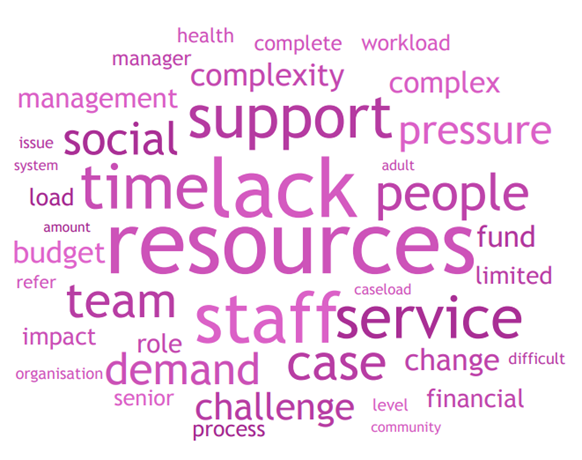
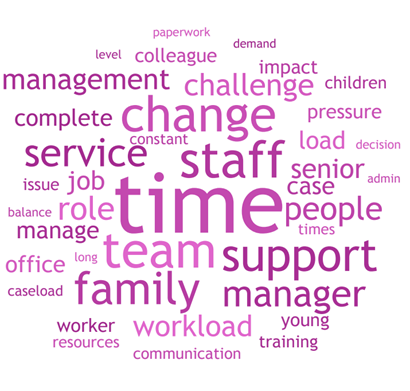
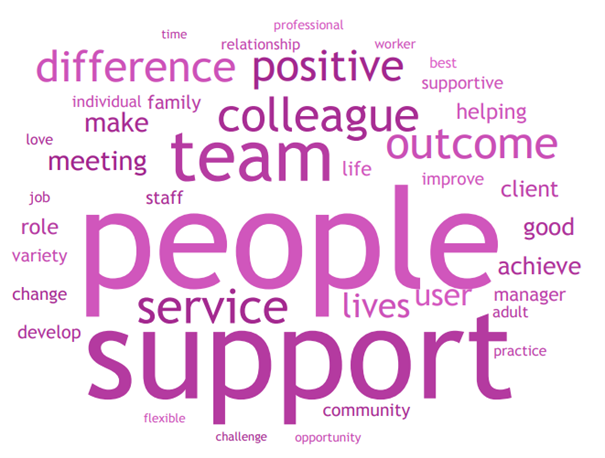
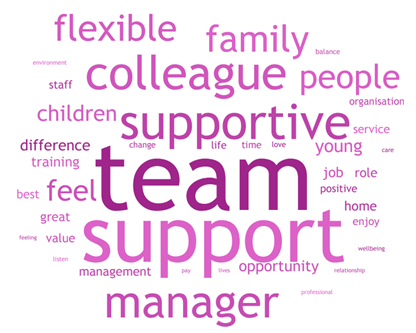
Respondents had the chance to describe their workplace experience in their own words. The word clouds below illustrate the most common responses – the frequency of the words is demonstrated by how large or small the word appears to be, with larger words indicating greater frequency.
What is the biggest challenge you face at work?
In discussing the biggest challenges registered social workers face at work, key themes included lack of resources, time, and facing increasing pressure:
Non-registered social care workers similarly reported a high case load with not enough time, and change creating extra burdens:
What do you enjoy most about your work?
When asked what they enjoy the most about their job, the most prominent themes social workers discussed were around providing support to people and running services that make a positive difference to communities:
When asked what the best thing is about working for your organisation, non-registered social care workers listed their supportive team, management and colleagues, and flexibility:
Regional differences
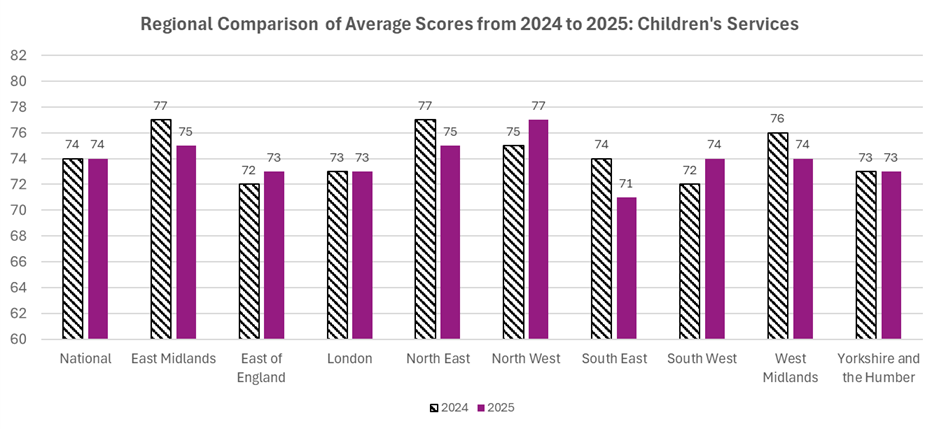
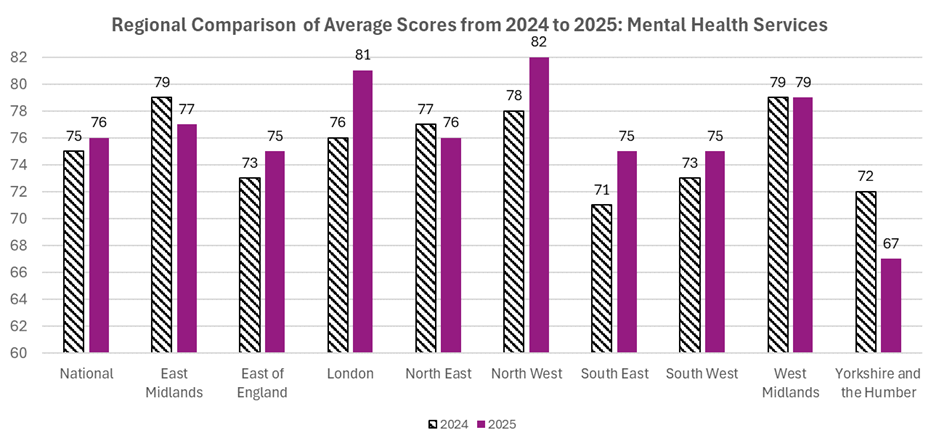
While there is some variation, averages across the standards in every region were consistently within the ‘moderate’ (51-74) or ‘good’ (75-100) range. The map below shows the average overall scores for each region:
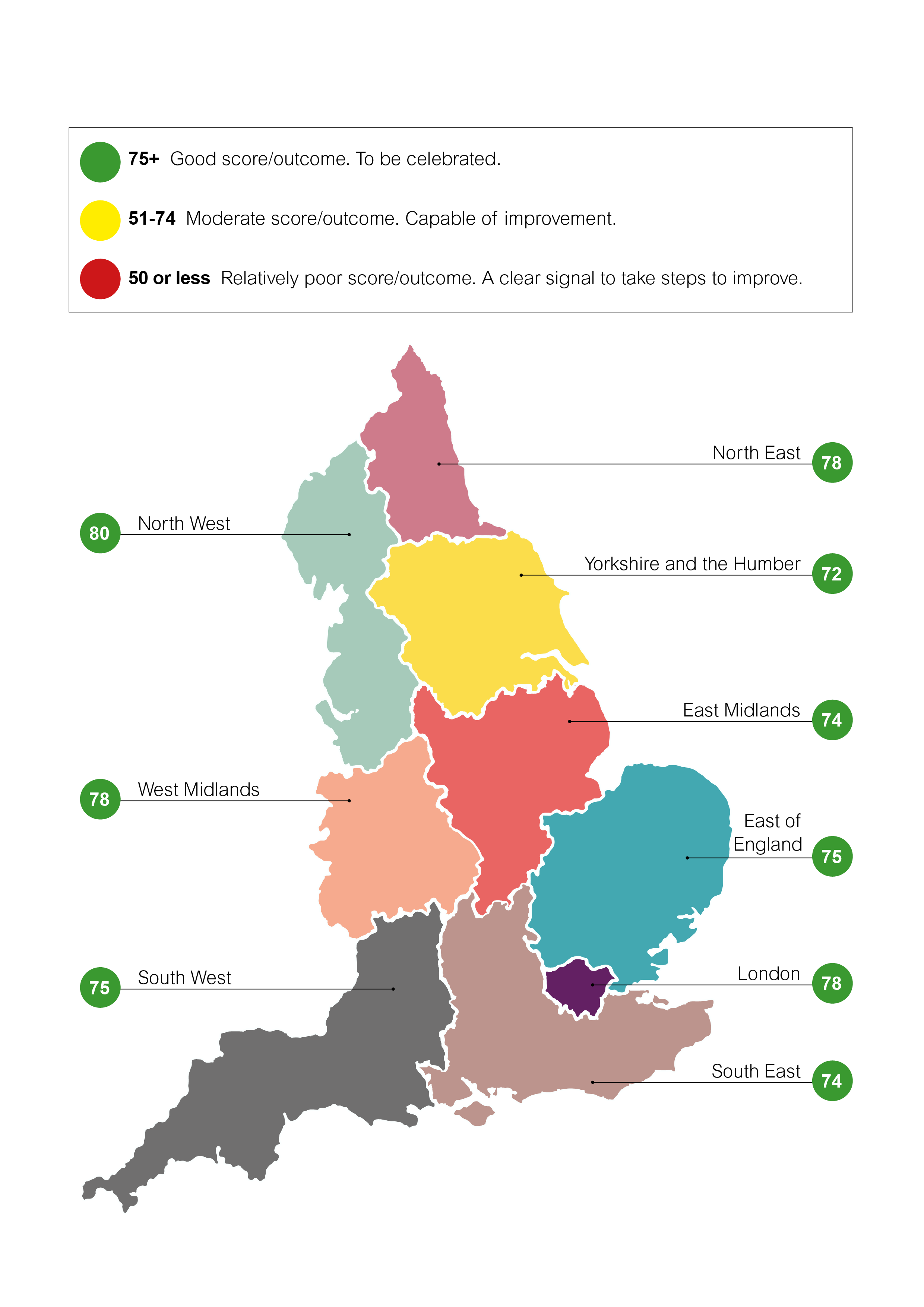
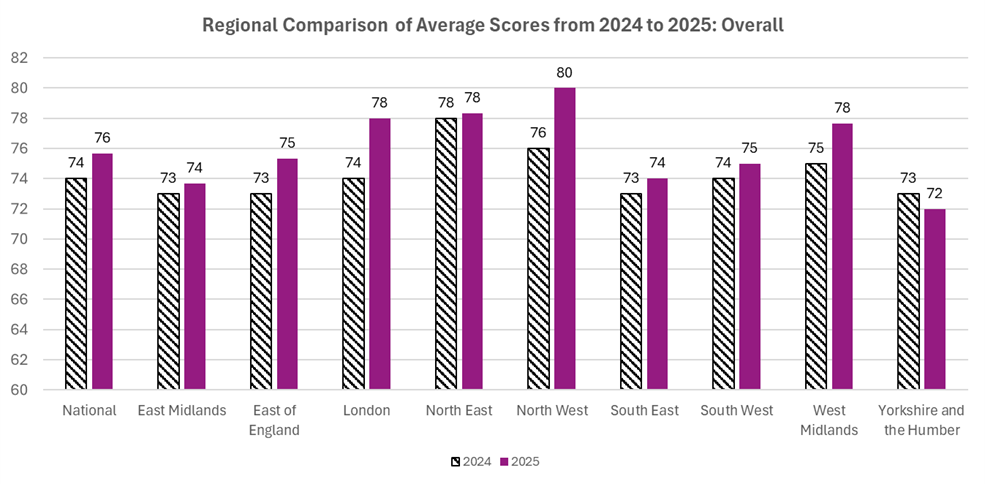
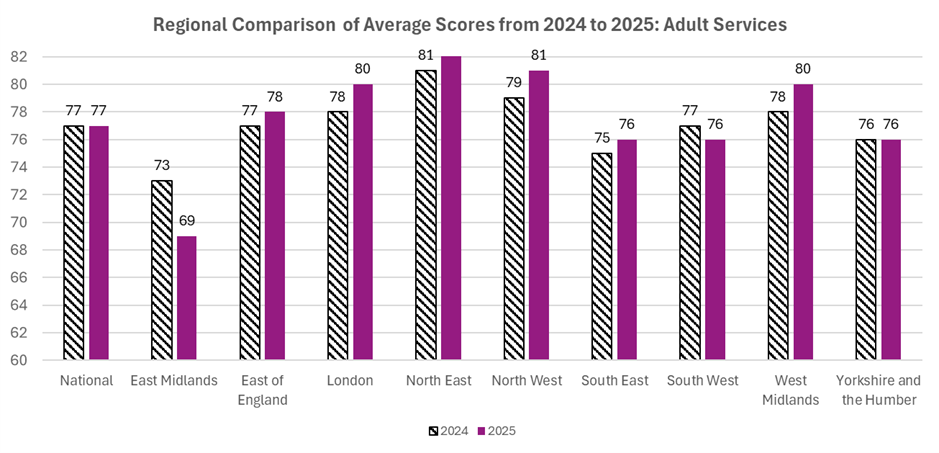
We observed improvements in the majority of the regions, with only 2 out of 9 regions remaining the same (North East) or decreasing (Yorkshire and the Humber) from last year. The largest improvement was seen in London and the North-West, both improving by 4 percentage points from last year.
Social workers in the North-West of England responded to the standards the most favourably, with an average score of 80 percentage points. In contrast, social workers in the Yorkshire and the Humber region responded the least favourably to the standards with an average score of 72 percentage points. However, whilst this is the lowest score, it is still at the top end of the ‘moderate’ range and only 2 percentage points away from the ‘good’ range.
Conclusion
The social care sector faces increasing demands year on year to provide vital services to communities and improve the lives of thousands of adults and children. The employer standards were created to protect the social workers who help to deliver this crucial work and enable them to work safely and effectively. It is positive that we have seen an overall improvement in performance for the standards from 2024 to 2025, both across England and in the majority of individual regions.
The results suggest that social workers generally perceive the standards focused on professional registration (standard 7) and on a strong and clear social work framework (standard 1) in a positive way. Social workers and social care workers report that their colleagues and managers are supportive, and they feel like their work is valued and makes a real difference for service users.
However, consistent with last year, the results highlight that continuous professional development (CPD) and general workplace experiences are two key areas for improvement. It is important that social workers are given opportunities to learn and improve their skills and knowledge. To do this, social workers and their teams should be given time to focus on CPD on top of managing their workload. Lack of resource and additional burdens have had a clear negative impact on the wellbeing of the workforce.
Overall, the 2025 survey results provide valuable insights into the experiences of social workers and social care staff, and highlight areas where employers can focus their efforts to improve working conditions and support for their staff. By addressing the identified challenges and building on the strengths, employers can create a more positive and effective work environment for social workers, ultimately benefiting the communities they serve.
To help employers to implement positive improvements based on their survey results, the LGA will be making resources available to support with action planning. These resources and the full results from the survey (including further breakdown by age, ethnicity, caring responsibilities etc) can be found on the Knowledge Hub.