Introduction
For the last 80 years, since the 1944 education act and the introduction of comprehensive, compulsory, secondary education, support for travel between home and school has been a feature of our education landscape. Often overlooked in wider education debates, local government, in line with nationally prescribed home to school transport duties, provides a vital service in supporting more than half a million children every day to get to school, ready to learn. Effective home to school transport also delivers wider societal benefits, building travel independence in young people, easing congestion on the roads and contributing to more efficient and hence more environmentally sustainable transport.
However, in recent years delivering the statutory home to school transport duties has become increasingly financially unsustainable for local government. In the last three years of published data alone the cost of provision has increased by over 60 per cent. This research explores what is driving these increases and makes suggestions for ways in which the home to school transport policy might evolve in future to continue to meet the needs of children, young people and their families but in a way that is financially sustainable.
This research builds on previous research into home to school transport that we carried out for the LGA in 2019 and for the CCN in 2023. It brings the analysis of pressures on the system up to date and explores the opportunities for future policy change in the context of potential wider reforms to the SEND system.
Methodology
Our methodology for carrying out this short piece of research has comprised five main elements:
- A scan of recent relevant research on this topic to provide context and background.
- A survey for all local authorities to gather data on the number of children and young people in receipt of home to school transport, information on destinations and mode of transport, reflections on how local authorities have sought to mitigate the rising costs of home to school transport and their ideas for future policy developments.
- Interviews with key stakeholders who were able to provide a national perspective including representatives from groups representing the parents and carers of children and young people with SEND, the ADCS, ADEPT and the DfE.
- An in-person workshop with representatives from local authorities, covering a mix of urban and rural areas from across the country.
- Follow-up discussions with a range of key stakeholders to refine and test the findings and recommendations.
We are incredibly grateful to those individuals and organisations who have given their time and expertise to this research, either through completing the survey, joining the workshop or participating in interviews.
Part 1: The current home to school transport landscape
How much are local authorities spending on home to school transport?
Published data shows that in 2023-24, local authorities spent £2.25 billion on transporting children and young people to school and college. This figure has grown dramatically over the last decade – by £1.23 billion, which represents 122 per cent growth. However, looking at the data it is apparent that the most pronounced growth pressures have been experienced in the last three years. Between 2015-16 and 2019-20 expenditure grew by, on average 7 per cent per year. From 2020-21 to 2023-24 expenditure grew on average by 20 per cent per year.
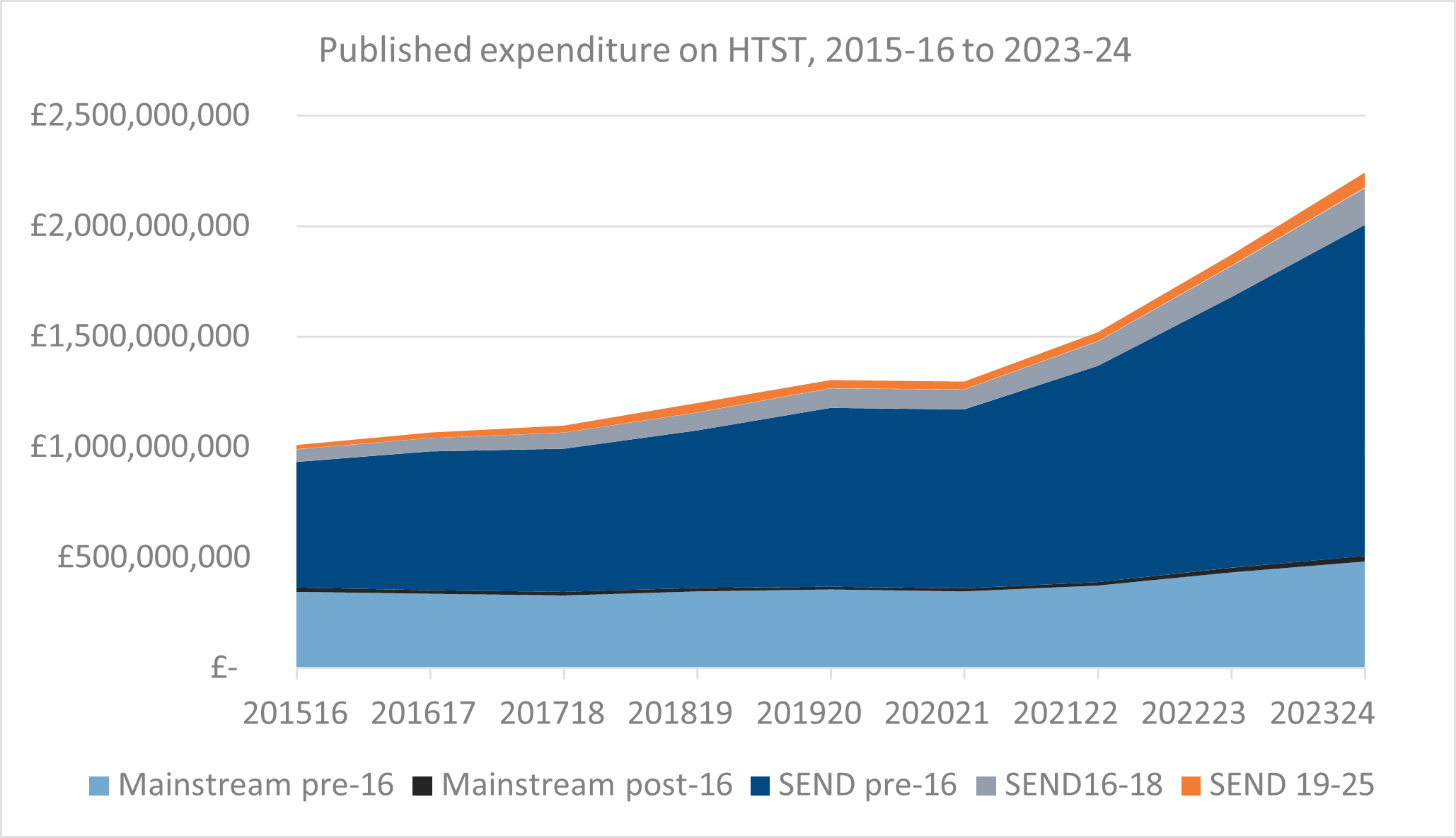
Data collected from local authorities through our survey suggests that this financial year, 2024-25, there may have been a plateau in the growth in expenditure. The 44 local authorities that supplied data for 2024-25 expenditure are projecting, overall, similar expenditure this financial year to last financial year, although this headline figure masks substantial changes at an individual local authority level. However, if there has been a flattening of the growth in expenditure this year, the survey data suggests that this is only a temporary respite. The local authorities that responded to our survey are projecting that in 2025-26 expenditure will grow by a further 11 per cent. If that is the case, then we can project that without a change in policy and legislation, national expenditure on home to school transport may rise to around £2.5 billion by 2025-26.This is broadly in line with the projections that we made in our 2022-23 research for the CCN, when we estimated that by 2027-28 nationally expenditure on home to school transport would be around £2.6 billion.
As shown in the table below, home to school transport for pre-16 children and young people with SEND accounts for just over two-thirds of the overall expenditure in 2023-24 and for three-quarters of the growth in expenditure since 2015-16. In contrast, although expenditure on young people with SEND aged 16 to 18 and 19 to 25 has also risen very rapidly, roughly tripling over the period in question, these categories account for only a small percentage of the overall expenditure and hence the overall growth in expenditure.
Expenditure on mainstream home to school transport represents a more stable picture than SEND home to school transport, accounting overall for around one fifth of the expenditure and 12 per cent of the growth. Between 2015 and 2016 expenditure on mainstream home to school transport has grown by £143 million. However, we can estimate that around £119 million worth of that growth is the impact of general inflation.
|
Category of HTST spend |
Percentage of spend in 2023/24 |
Contribution to growth in spend between 2025-16 and 2023-24 |
|---|---|---|
| Pre16 SEND | 67 per cent | 75 per cent |
| 16-18 SEND | 7 per cent | 9 per cent |
| 19-25 SEND | 3 per cent | 4 per cent |
| Pre-16 Mainstream | 21 per cent | 11 per cent |
| Post-16 Mainstream | 1 per cent | 1 per cent |
In our survey we asked local authorities whether they predicted that expenditure on home to school transport would grow, stay stable or fall over the next five years and how confident they were that they would be able to deliver their duties within the budgets allocated. The charts below capture their responses and show that over 90 per cent of local authorities responding to our survey thought that spending on SEND home to school transport would increase and only around 12 per cent were confident that they would be able to balance their budgets for SEND home to school transport over the next five years. In contrast, local authority predictions on the future of mainstream home to school transport expenditure were much more balanced. Around 45 per cent were projecting growth but an equal proportion thought expenditure would remain largely the same, and 40 per cent were confident in balancing their budgets over the next five years.
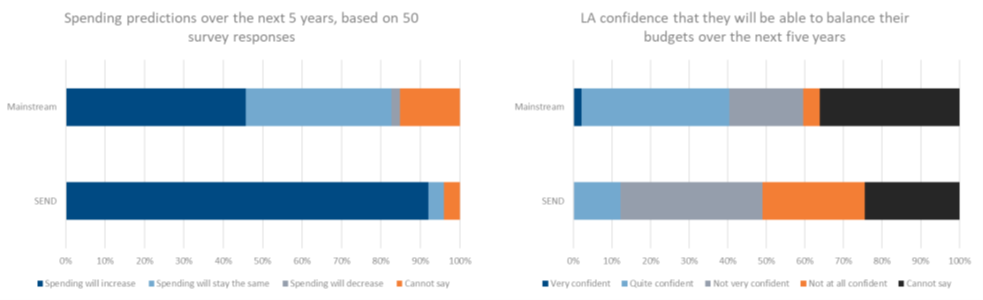
Figure 2: Local authority spending predictions based on survey responses
The financial burden of fulfilling statutory duties around home to school transport is not distributed evenly between different types of local authority. The data clearly shows that large and predominantly rural authorities have to spend considerably more than smaller and more urban local areas in fulfilling their statutory obligations. The table below shows overall per capita expenditure on home to school transport, and per capita expenditure broken down by different categories of transport, for County Councils, Unitaries, Metropolitan areas and London Boroughs.
| Local authority type |
Per capita expenditure on home to school transport |
||
|---|---|---|---|
|
SEND |
Mainstream |
Total |
|
| County Councils | 141 | 57 | 197 |
| Unitaries | 115 | 53 | 169 |
| Metropolitan areas | 109 | 7 | 116 |
| London boroughs | 107 | 2 | 110 |
To take the two extremes, for every child and young person between the ages of 5 and 25, county councils spend nearly double the amount on home to school transport that London Boroughs do. This difference is driven to a very large degree by expenditure on mainstream home to school transport which accounts for 30 per cent of all home to school transport spend in county councils and unitary authorities, but only 4 per cent in London Boroughs and Metropolitan areas. This is, of course, because many more children and young people are eligible for transport in a large and rural county on account of the distance that they live from school, and that once eligible the average journey times will be longer. In London and other urban areas, in contrast, the relatively small geographical sizes combined with population density and a comprehensive public transport system mean that fewer children and young people are eligible for mainstream transport and those who are can be supported effectively with access to free public transport. In fact, we know that the physical size of the local authority (in square kilometres) accounted for 45 per cent of the variation in per capita spend on home to school transport in 2023-24.
What is driving the increased expenditure?
What is driving the increased expenditure?
As we described in our 2023 research report, From Home to the Classroom: Making Travel to School Services Sustainable, there is a simple equation for understanding the cost of providing home to school transport. It is a product of the number of children and young people requiring transport multiplied by the length of the journeys provided; the type or mode of transport used; and finally the basic costs per mile determined by the price of fuel, vehicles, maintenance, drivers’ salaries and the robustness of the market.
per cent
In the last three years local authorities have experienced record levels of growth in home to school transport expenditure, at an average of 20 per year, because all parts of this “equation” have come under pressure simultaneously.
The number of children and young people receiving assistance with travel to school
In our survey we asked local authorities to rank the factors contributing to increasing expenditure on home to school transport. The factor that was ranked highest as contributing to costs on SEND home to school transport was the increasing number of children with EHCPs driving up the number of children eligible for transport on account of their special educational needs. In fact, 31 out of the 51 local authorities that answered the survey question ranked the growth in children and young people with EHCPs as the most important factor driving increasing expenditure in SEND home to school transport.
- Increase in demand. For this LA that looks like a growth of around 11 per cent on pupil numbers year on year. Assuming a unit cost approach for 25-26 alone, this could increase spend by £2.8m just on growth alone.
- Growth in children with EHCPs and the demand for SEND services is outstripping the budget allocated to deliver school transport services
- An increase in the number of EHCPs and the language used within EHCPs to describe the child's needs when out in the community
Unlike many areas of public service delivery, there is currently no published data on the numbers of children and young people in receipt of travel assistance or information about where they travel to or how they are transported. This is a gap that the DfE are in the process of addressing. For the first time this year the Department have run a national data collection exercise on home to school transport as a pilot which, if successful, will be repeated annually.
For the purposes of this research, we have relied on data provided by local authorities in response to our survey to derive estimates on the number of children and young people receiving travel assistance to school. Based on returns from 46 local authorities, we can estimate that nationally there were around 540,000 children and young people receiving home to school transport this year.
As with per capita costs of home to school transport outlined above, there are very significant differences between types of authority in the number of children and young people they transport. The table below shows the average number of children and young people receiving transport per 1,000 of the 5 to 25 population in 2025 according to responses to our survey. As can be seen, the numbers receiving transport per 1,000 children and young people is very similar for those with SEND across different types of local authority but the numbers receiving mainstream transport are much higher in Counties and Unitaries than in London Borough or Metropolitan areas.
| Number on SEND transport per 1000 population | Number on mainstream transport per 1000 population | Total on transport per 1000 population | |
|---|---|---|---|
| County | 15 | 29 | 44 |
| Unitary | 15 | 39 | 55 |
| Metropolitan | 14 | 2 | 16 |
| London Borough | 11 | 0 | 11 |
Over the last five years we would estimate that the total number of children and young people provided with transport has increased by a relatively modest 10 per cent. However, the stable headline numbers conceal a much more turbulent picture of provision beneath. The chart below shows the percentage change between 2021 and 2025 in the numbers of children and young people receiving transport by categories of support. It shows that a very rapid increase in demand for home to school transport for children and young people with SEND, particularly pre-16 SEND, has been offset by a decrease in the numbers receiving pre-16 mainstream transport.
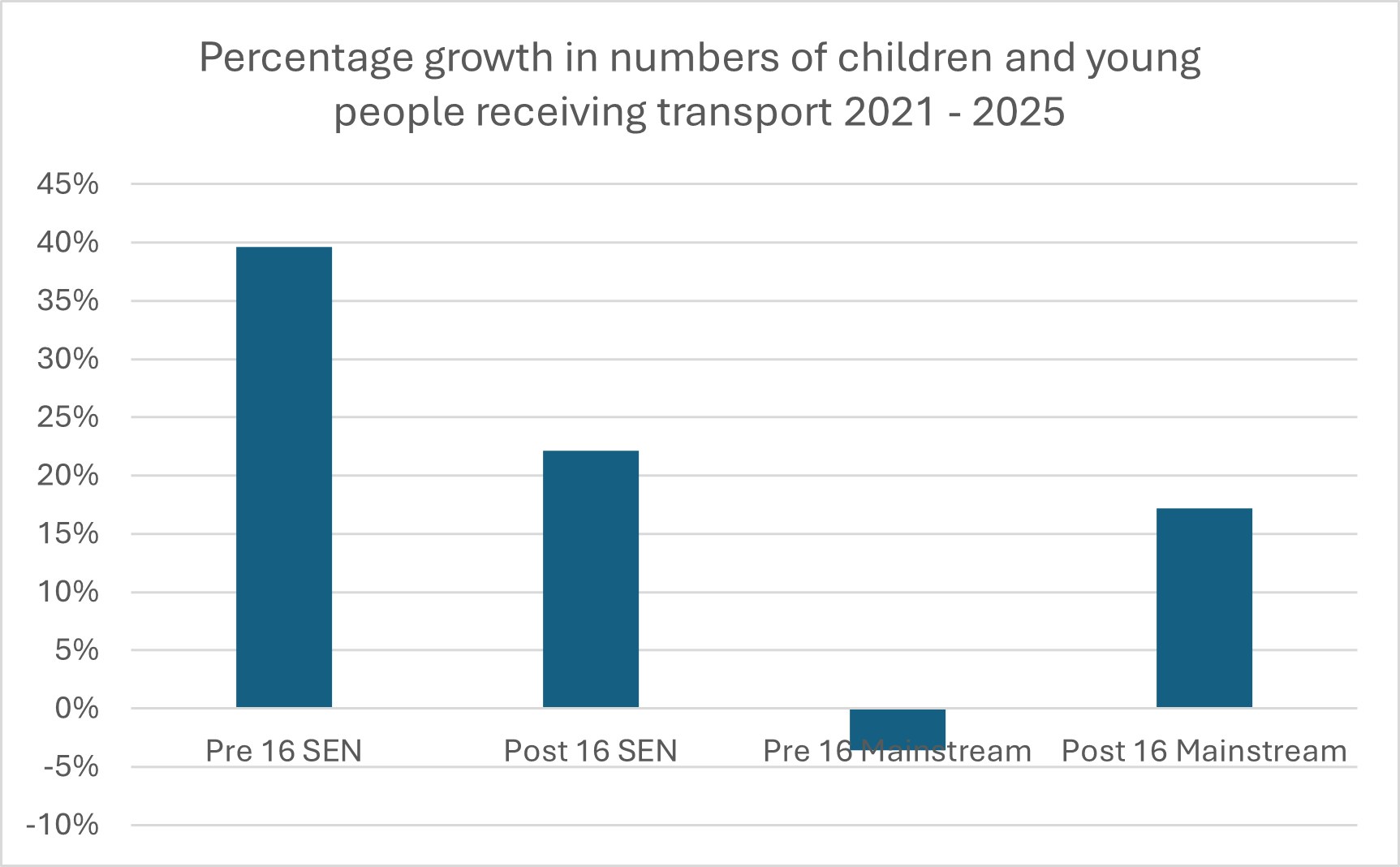
This effectively means that the balance between SEND transport and mainstream transport has shifted over time. Based on our survey we would estimate that in 2021, 32 per cent of all children and young people receiving home to school transport were eligible on account of their special educational needs. By 2025 this percentage had risen to 40 per cent. The higher proportion of children and young people requiring transport for SEND has a significant impact on overall expenditure. Our survey returns suggest that the average cost per child of providing SEND transport is around £9,000 per year compared with an average cost per child of providing mainstream transport of around £3,000 per year – roughly triple the amount. This is in line with research conducted by Impower in 2024 which found that the average annual cost per SEND pupil using transport has increased from £6280 in 2018/19 to £8299 in 23/24.
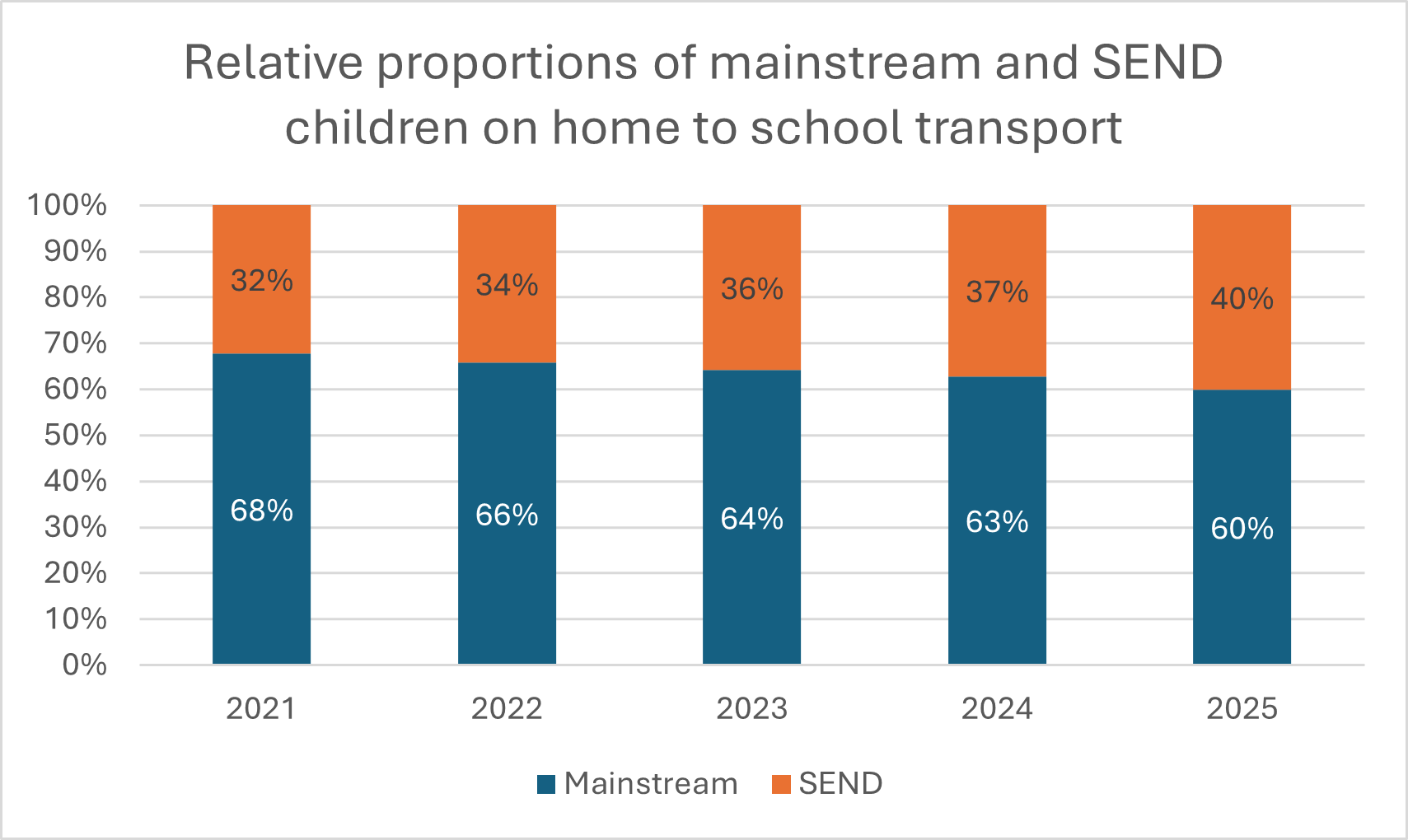
There is, as our survey returns indicate, a strong relationship between the growth in numbers of children with SEND accessing home to school transport and the growth in EHCPs. The chart below shows our estimated national projection of the number of children and young people on home to school transport on account of their special educational needs alongside the number of children and young people nationally with EHCPs.
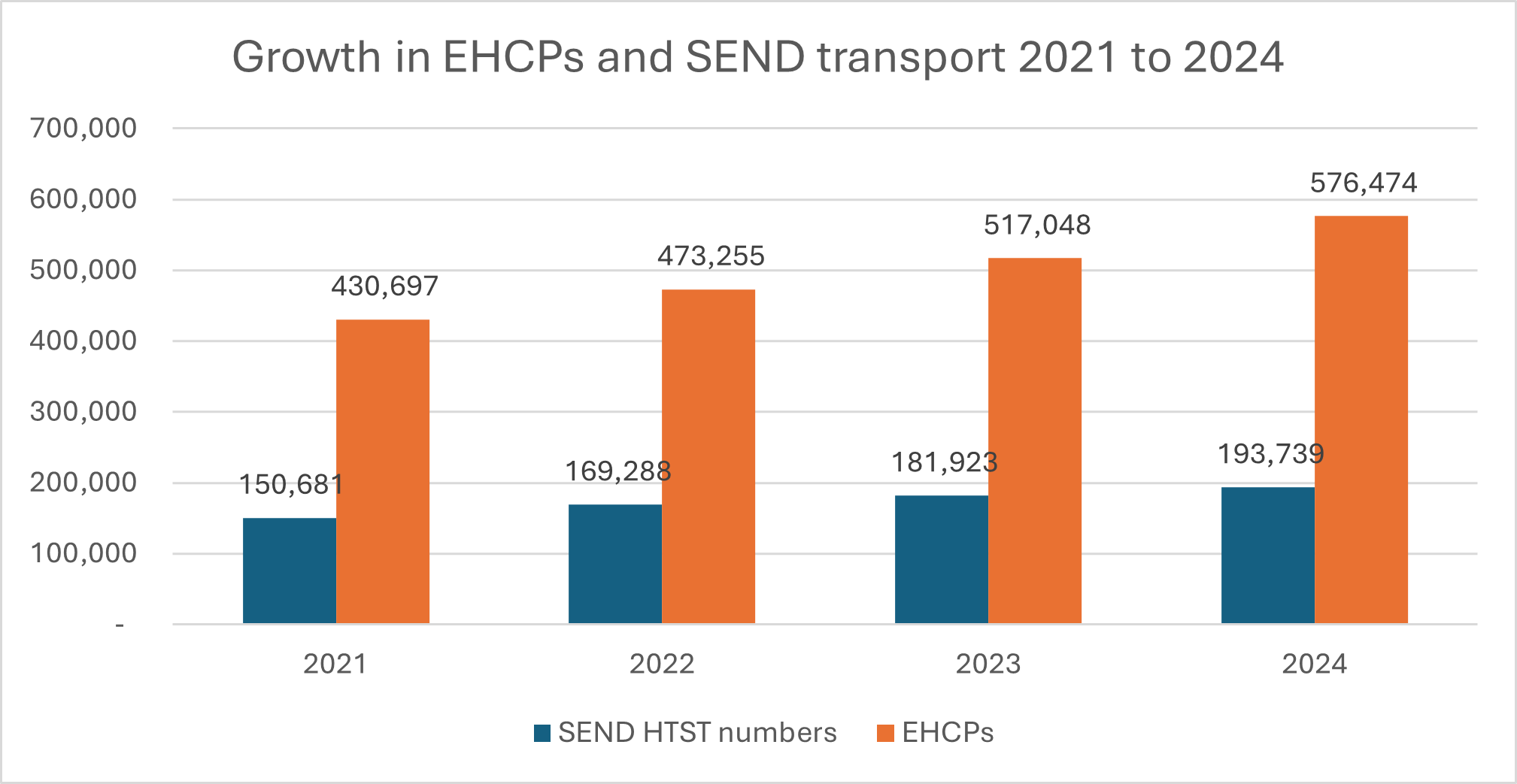
It shows that in England there has been a very similar growth trajectory between the number of children and young people with EHCPs and the number requiring SEND home to school transport. In fact, between 2021 and 2024, based on these estimates, the ratio of children and young people with EHCPs to the number receiving transport for SEND has been remarkably consistent – around 1:3 each year for the last four years. However, we also know that despite consistency nationally there is a high degree of variation at individual local authority level. Among the 48 local authorities for which we have survey data, the ratio of children and young people with EHCPs compared with the number receiving SEND transport varies from 1 child receiving transport for every 1.7 children with EHCPs to 1 child receiving transport for every 5.3 children with EHCPs. This variation will be based on a range of factors including overall EHCPs rates, where children and young people with EHCPs are educated, the size of the local area and individual local authority transport policies.
As the data set out above has made clear, the significant growth in numbers of children receiving transport has been driven by the increasing number of children with special educational needs and statutory plans. Overall numbers of children and young people receiving mainstream home to school transport has fallen slightly over recent years. However, some local authorities have experienced rising numbers of children and young people requiring mainstream home to school transport as well as SEND home to school transport. In our survey the factor that was ranked second in importance in contributing to the rising costs of mainstream home to school transport was the creation of new housing developments. Local authorities that we engaged through this research explained that in areas of population growth, developers were often reluctant to create new secondary school provision. This meant that new housing was being created without access to a nearby secondary school, leaving local authorities to meet the cost of transporting those pupils.
The length of journey made
The second element of the home to school transport “equation” is the length of journeys made. This, again, is a particular issue for transport for children and young people with SEND. Local authorities reported through our survey that “Where children with EHCPs are placed in school, for example more children placed in special schools further from home or schools outside the local authority” was the second most important factor contributing to the rising cost of SEND home to school transport. Fourteen out of the 51 responding councils listed this as the most important factor and a further 23 listed it as the second most important factor:
Increasing numbers of young people requiring travel assistance to schools outside of the borough
Lack of sufficient local specialist placements including Special School places meaning schools close to home are full and children are placed further from home with resulting increases in average price for a journey to school.
Use of independent provision - resulting in students travelling further.
Lack of local specialist places requiring costly and lengthy transport to out county provision - currently 367 young people attending out of county provision costing £6.7 million annually
Overall, our survey data suggests that on average children and young people with SEND are travelling further than children and young people on mainstream transport but not by much. The average one-way trip to school for children and young people with SEND in 2025, based on 29 responses, was 9 miles compared with 7 miles for mainstream pupils (based on 19 responses). However, our discussions with local authorities highlighted a growing minority of children and young people with SEND travelling very long distances to school most often due to the lack of suitable special school places closer to their home and sometimes due to a parental preference for a specific school. The number of children and young people who have required education in a special setting over the last 5 years has grown by 35 per cent.This has placed considerable pressure on home to school transport budgets as local special schools are full, forcing children to travel further distances to access a place that meets their needs. More importantly, long travel to school times can negatively affect children’s quality of life and readiness to learn.
Our survey data provides some insight into where children with SEND are travelling to, and how those patterns have changed over time. Responses from 34 local authorities shows that in 2025 around 54 per cent of children receiving transport for SEND were taken to a special school. A further 18 per cent were transported to mainstream schools and 10 per centto INMSS. Scaling up those responses we can estimate that nationally around 110,000 children and young people were transported to special schools and around 20,000 to INMSS. These are projections, based on limited survey returns. However, they would indicate that around 70 per cent of children and young people in special schools and INMSS are receiving support with transport to access school.
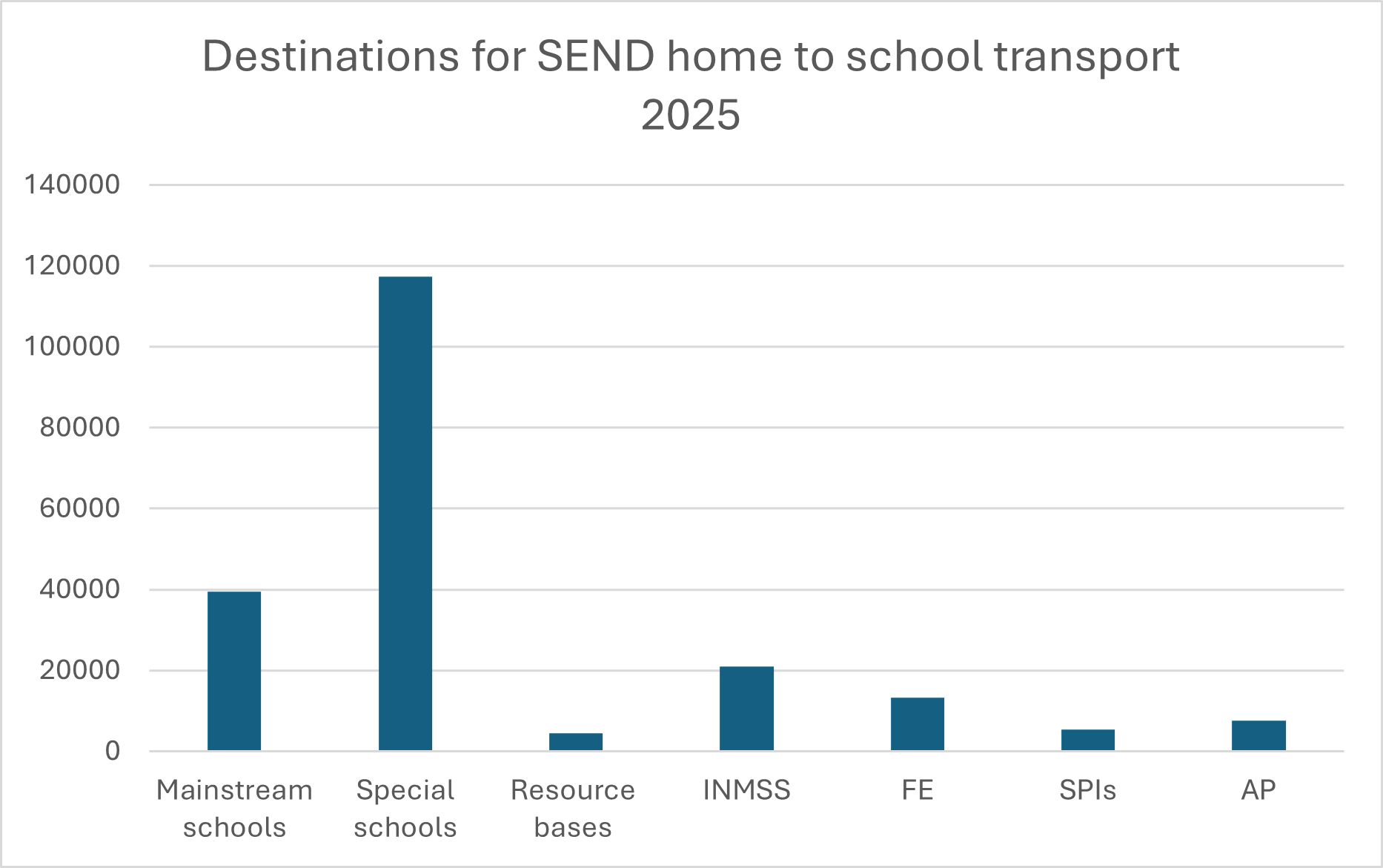
Looking at how transport to different destinations has changed over time is challenging due to the lack of consistent data. There were sixteen local authorities that replied to our survey who were able to provide data on transport destinations for children and young people with SEND from 2021 to 2025 continuously. This data indicates that the numbers of children and young people with SEND transported to mainstream schools has increased by 19 per cent over the period; the number being transported to special schools has increased by 27per cent; and the number transported to INMSS has increased by a very considerable 72 per cent, albeit from a much lower baseline.
The type of transport being used
It is not only the length of the journey that contributes to the overall cost of transport, but also the type of transport being used. In general, larger vehicles such as buses or minibuses tend to be more economical than arranging transport in cars. This is particularly the case where single occupancy taxis are provided. The factor that ranked third highest in our survey of issues contributing to the rise costs of home to school transport for SEND was:
changes in complexity of need, for example, that might require more individualised transport arrangements.”
Increasing number of children and young people requiring travel assistance, more complex needs and the challenging behaviours displayed on home to school transport "
Increasing complexity in the need profile of SEND children accessing transport"
Higher level of needs (social, medical and behavioural) of those travelling requiring more specialist assistance and support and demands from schools/parents for individual transport"
Increasing challenging behaviour requiring 1 pupil in an 8 seater vehicle so that PA can sit away from the strike zone."
In our workshop discussions with local authorities and individual interviews three distinct issues were raised which were contributing to the use of more individual transport arrangements. The first was the growing complexity of the needs of the children and young people requiring transport. In some cases, these were very complex medical or personal care needs which meant that it would not be safe or appropriate to transport the child or young person with their peers. In other cases, local authorities highlighted a growing cohort of young people whose behavioural needs were such that they could not travel with other young people either for their own safety or that of others.
The second issue highlighted by local authorities was the increased complexity of journey types requiring greater use of individual transport. To some extent this was a function of special schools being full and places only becoming available in small numbers. This restricts a local area’s ability to rationally plan its transport routes and may end up with children travelling in opposite directions across an area to the nearest special school place that was available at the time that they needed it, even though nearer places may have been theoretically available at other times. However, journey complexity was also seen as a product of more bespoke education packages being created for individual children. This might include part-time timetables, education in more than one setting during the week, or education placements that were only attended by small numbers of children and young people, drawn from a wide and dispersed catchment area.
The third issue raised related to parents’ views and expectations around transport. Local authorities reflected that in the immediate post-Covid period there had been an understandable increase in parents requesting individual transport arrangements due to fears around infection. This peak has since subsided, but there remain a minority of families of children with SEND who approach discussions around home to school transport with an expectation that transport in an individual taxi is the norm to which they are entitled, despite guidance to the contrary. The ADCS-ADEPT report into home to school transport in 2023 highlighted parental requests for individual transport arrangements as a growing trend. This is often a reflection of the adversarial nature of the SEND system as a whole, in which families feel that they have to fight to receive the support that their children need. In this context it can be challenging for local authorities and families to enter into a constructive dialogue around transport options and how best to ensure that children can access school safely and reliably, because the wider SEND environment has become so combative.
Our survey data shows that in 2025, 46 per cent of journeys for children and young people with SEND were undertaken by minibus and 22 per cent in cars. However, these percentages differed quite significantly by the type of local area. In Metropolitan areas just 7 per cent of children and young people were transported in cars. However, that percentage rises to 21 per cent in London Boroughs, 25 per centin Unitaries and 27 per cent in County Councils based on responses to our survey.
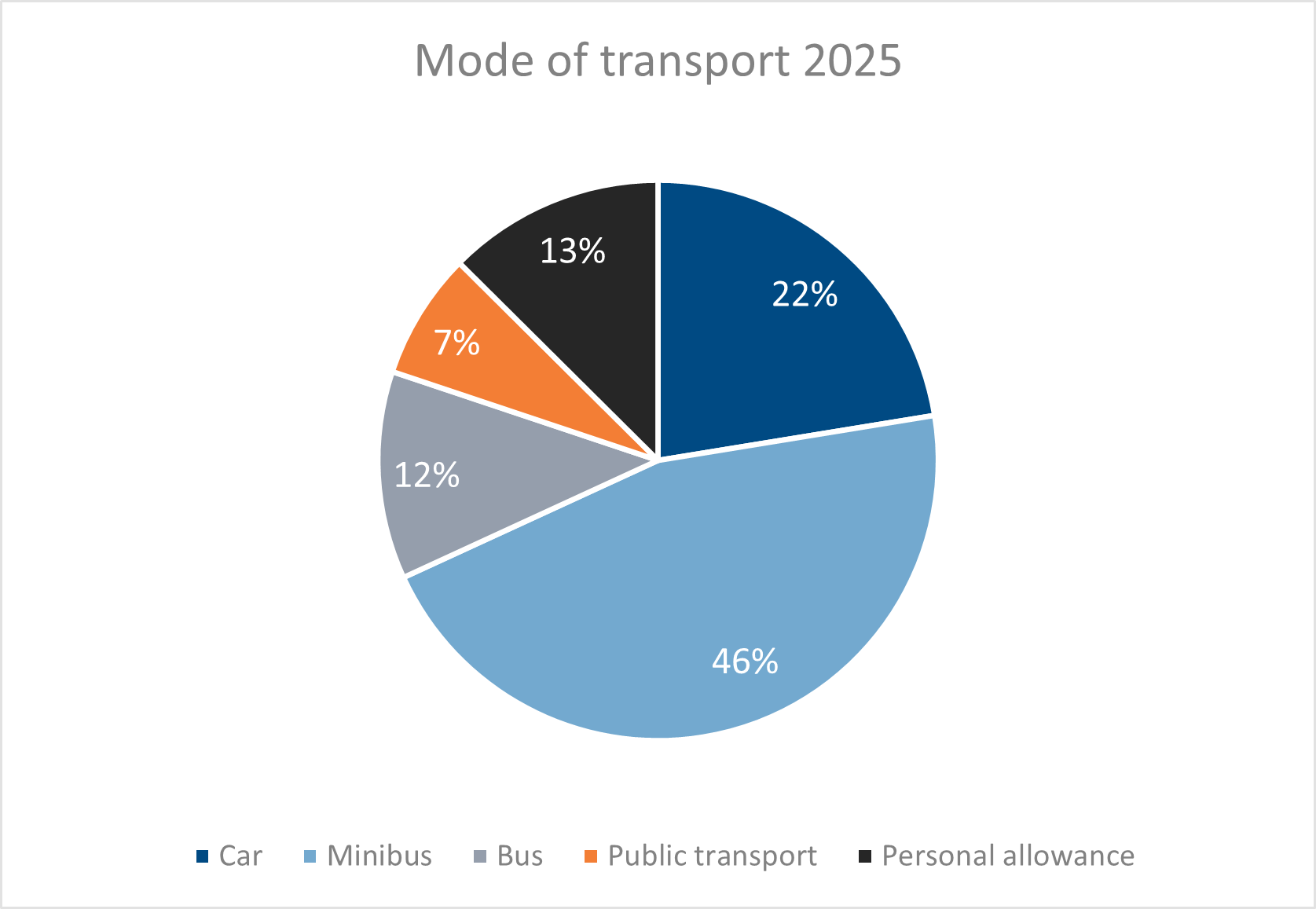
Over time, the use of cars has increased more quickly than other forms of transport, with the exception of personal transport budgets that have doubled in use over the last five years. The table below shows the increase in the number of children and young people with SEND transported by different forms of transport between 2021 and 2025, in 18 local authorities that were able to provide consistent data across the five-year period.
| Cars | Minibuses | Buses | Public transport | Personal transport budget | |
|---|---|---|---|---|---|
| Number transported in 2021 | 6,838 | 12,122 | 5,816 | 1,317 | 2,219 |
| Number transported in 2025 | 9,029 | 14,834 | 6,068 | 1,693 | 4,418 |
| Percentage change | 32 per cent | 22 per cent | 4 per cent | 29 per cent | 99 per cent |
The basic costs per mile
Underlying the changes in demand, journey length and type of transport, the basic underlying costs of commissioning transport of any kind have been increasing. In our survey, local authorities cited
changes in the raw costs of providing transport – fuel costs, vehicle costs, driver salaries”
as the most important factor driving up costs of mainstream transport and the fourth most important factor contributing to increased costs of SEND home to school transport. Other answers include:
Shrinking market and raw transport and staff costs"
inflationary pressures, fuel, wages, minimum living wage, and knock on effects for example on pay differentials. Employer NI changes expected to have an impact this year."
The volatility of raw costs of transport continues to create an uncertain future as we have seen fuel prices and available fleet and staff numbers fluctuate to market forces."
In our interviews and workshops, local authorities described how the inflationary pressures in the market were pushing more transport providers out of business. This often left them, as commissioners, with limited opportunities to run competitive tendering processes for contracts and they often had to agree contracts at short notice if a provider closed. This had the effect of pushing up prices. The general market conditions have been compounded by shortages of drivers, particularly in the post-Covid years, and the overall decline in public transport routes which is particularly pronounced in rural areas. Research conducted by the Campaign for Better Transport found that between March 2021 and March 2023, 23 per cent of bus services in England have been cut, resulting in 2,800 fewer services.
Local authorities also explained that as the number of operators in a particular locality diminished, other providers would need to travel further from their own hubs and bases in order to fulfil contracts further afield. The “dead costs” for transport providers serving routes across a wider geography get built into contract costs for home to school transport and, again, have the effect of raising prices.
Part 2: The future of home to school transport
In this section we explore how changes might be made to home to school transport policy to make it more financially sustainable to deliver while continuing to meet the needs of children, young people and their families.
The fundamental purpose of a home to school transport policy is to ensure that all children and young people can access education, and that no child or young person misses out on their entitlement to education because they are unable to get to school. The current configuration of national home to school transport legislation, ascribes to this fundamental tenet but reflects the era in which it was originally written, when fewer families had access to a car, most children went to their local school, education stopped at 16 for most young people and provision for those with additional needs was much more limited than it is today. This has created some complexities and perversities in the implementation of the statutory duties, particularly post-16, whilst also driving unprecedented demand for support with transport.
Furthermore, home to school transport is inextricably linked to the wider education system - this is no more apparent than in the statistics in Part 1 showing the increases in home to school transport closely linked to the rising number of children and young people with additional needs and the distances those children have to travel in order to access provision that can meet their needs effectively. The Government have promised a Schools White Paper in the autumn, that will detail the move to a more inclusive education system. The long-term aim here is likely to include more children and young people being able to access education in their local community.
Our task has been to reimagine the home to school transport duties in this context - in a way that is true to the principles of access to education and supporting families, that encourages good outcomes, and is part of an overall financially sustainable approach to education, in a way that recognises the world of 2025 is not the world of 1944 … and that the education system is moving in a new direction. A the heart of some of the policy choices we explore in the following sections is a debate about where the appropriate balance of responsibility and cost lies between the state and the parent in supporting children and young people to get to school, and how we can most effectively target the limited resources of the state on those families who need them most in order to deliver the best outcomes for children and young people.
An increasingly contested space
As local authorities across the country grapple with the rising costs of home to school transport, in the context of ever-tighter local government spending, there is a strong sense that this is becoming an increasingly contested space. Most local authorities have been considering the eligibility criteria for home to school transport, particularly at post-16, where the guidance allows for greatest local discretion. This had led to growing numbers of individual appeals and, in some cases, Judicial Reviews. Local authorities report that although the SEND Tribunal does not have a direct role in determining transport arrangements, Tribunal judgements, for example on placements, necessarily have an impact on the provision of transport and can set precedents which are then difficult to follow. The development of what some have called “a quasi-legal industry” around home to school transport, particularly for those who are post-16, is placing the sector under further scrutiny and additional pressure. Neither parents nor local government want home to school transport to become a battleground in which limited time, energy, capacity and resources are used up in resolving disputes. This makes the case for developing a set of future policy options that are, as far as possible, clear, equitable and consistent across the country.
What home to school transport means for parents of children and young people with additional needs
The purpose of this research is to explore the question of how support for travel to and from school could be delivered in a way that continues to meet the needs of children, young people and their families but is also financially sustainable. As will be explored in the remainder of this report, the boundaries, expectations, limitations and future of how we support children and young people with SEND to get to school sits at the very heart of this debate. Our discussions with groups representing parents and carers of children and young people with SEND have therefore given us an extremely valuable insight into how existing home to school transport provision is viewed by families, where children and young people’s needs are not adequately being met by the current system, and where the opportunities might be to achieve a better balance between meeting needs and using finite public resources in the most effective way.
At the heart of what parents’ representatives were telling us was the vital role that home to school transport plays in enabling them to support their children to get to school while also balancing other commitments including work, family time and additional caring responsibilities. Their starting place was recognising the role that assistance with travel to school can play in in reducing some of the barriers faced by families with children with SEND, with which other families do not have to contend. They highlighted that:
- For children of compulsory school age, many working parents of children without SEND rely on breakfast clubs, after school clubs or childminders to balance work and life commitments with the responsibility for getting their children to and from school. For many children with SEND these additional options for support at the beginning and end of the school day frequently do not exist, which makes assistance with travel even more crucial.
- Where parents of children with SEND have more than one child, and at least one of them is in a special school, it is more likely that they will have children at different schools at further distances from each other, making the responsibilities around transporting their children to school that much harder to discharge.
- Young people of secondary school age are often able to make their way to school on foot or by bike without accompaniment by an adult. For young people with SEND at secondary school this is often not possible.
- For most young people beyond statutory school age there is a reasonable expectation that they should be able to make their own way to college or school with a free bus pass, but for some young people with SEND this may never be a realistic expectation. For families with older children with SEND, caring responsibilities may increase at just the time that for other families they are decreasing.
To some extent the provision of home to school transport is mitigating (though not wholly compensating for) the much wider educational and societal challenges faced by the families of children and young people with additional needs, including access to suitable education provision, access to before and after school childcare and recreational opportunities, employment prospects and balancing caring responsibilities with family well-being.
In the wider SEND educational landscape there is a broad consensus around the need for fundamental reform because, despite increased investment, the needs of too many children and young people are not being adequately met. However, provision of home to school transport does not fall into the same category. It is a service which is valued, and parent groups reported that for children of statutory school age, while there will always be individual issues which arise, generally parents felt transport services worked well for their children once they were in place. Contact’s 2024 school transport survey for parents of disabled children found that 80 per cent of respondents said that travel arrangements provided by the council met their family’s needs and 81 per cent were satisfied or very satisfied with the arrangements. However, slow or inconsistent communication while a transport assessment was underway, or at the start of a new school year, was a frequently raised source of stress and frustration among parents. 75 per cent of respondents to Contact’s survey said that better communication was the main area of improvement needed when applying for transport.
Transport of young people with SEND beyond statutory school age was viewed as much more problematic by parents. They felt that the degree of local discretion afforded around transport for young people aged 16-18 in particular had led to a postcode lottery, with some areas continuing to offer quite comprehensive travel assistance to this age group while other areas had reduced their offer considerably. Some parents felt that the use of personal transport budgets for post-16 learners as the only alternative to either independent travel training or subsidised public transport had been a retrograde step for young people and families, diminishing independence for young people with the most complex needs and placing significant additional responsibilities on their parents. Contact reported that almost 60 per cent of families faced to changes to their child’s transport when they turned 16 and 40 per cent of families of children of all ages reported that they had to give up work or reduce their hours in order to transport their child to school.
Going forward, parent and carer representatives were advocating greater clarity and equity around the post-16 offer. They also felt that there were opportunities for local authorities to consider their duties around home to school transport and their duties around meeting the needs of children and young people with SEND more holistically so that decisions about commissioning additional provision, consulting on placements, and putting in place travel assistance could be made in concert. Parent representatives highlighted that too often short-term decisions to save money on transport costs could lead to much larger or longer-lasting costs to the state if those decisions were taken in isolation. They were able to point to examples of parents of children with additional needs giving up work in order to get their children to school, which leads to a much larger cost to the state in lost taxation or additional out of work benefits. Alternatively, there were examples of changes to transport arrangements leading to educational placements becoming unsustainable which resulted in a new placement in a more specialised and costly provision. The challenge is therefore to rethink the duties around home to school transport in a holistic way, not in isolation, and as part of a wider reform of education. We have attempted to embrace this more holistic view in the recommendations that follow.
Parent/carer representatives saw the potential for home to school travel policy to be more instrumental in building independence and creating the skills that young people would need in their adult lives, but stressed that this must be taken forward in partnership with young people, parents and with schools, as part of a planned journey towards adulthood, and with the needs of the child or young person front and centre. The Motability Foundation reported in 2025 that 49 per cent of young people (aged 10-24) with a disability experience anxiety or stress when planning journeys via public transport, 64 per cent feel mentally exhausted when using public transport and 58 per cent physically exhausted. These are some of the barriers that a well-conceived, planned and executed approach to building the skills for independent travel can overcome, but can only be achieved in partnership with young people and their families.
A new set of principles for home to school transport
The core home to school transport duties, to provide transport to school for those living more than 2 miles (up to age 8) and more than 3 miles (for older children), came into force as part of the 1944 Education Act when compulsory, free, secondary education was provided nationally for the first time. It was an essential component of a free-to-access universal education offer, at a time when car ownership was much lower than it is today, and when the expectation was that children and young people would be travelling to their local school.
More than 80 years on, the world of education looks very different now, but many of the core beliefs that underpinned the 1944 education act – that every child is entitled to an education and no child should be deprived of that entitlement because of difficulties in getting to school – still hold true. The question with which policy-makers must grapple is, in the modern world, where 83 per cent of families with dependent children have access to at least one car, what is the right balance of sharing responsibility and cost between the family and the state for getting children to school?
In navigating this fundamental question, we felt that it would be helpful to try to craft a set of core principles to which the different stakeholders might ascribe, and which could provide a guide in any future evolution of home to school transport policy. The suggested list below is offered as a starting point for further consultation and development.
The principles are split into two sections. The first could be described as the core purpose and underlying rationale behind a national home to school transport policy. The second section recognises the wider policy environment in which home to school transport exists. It recognises that home to school transport has a positive contribution to make to wider public goods, but that on its own it is not sufficient to achieve these aims and nor is it appropriate to set undeliverable expectations on local areas in relation to these broader national goals.
Core purpose of home to school transport
- Every child and young person is entitled to a free education, and no child / young person should be prevented from accessing that entitlement because they cannot get to school or college.
- It is the responsibility of the parent or carer to ensure that a child or young person attends school, and that means making arrangements to get their child to school.
- Local government has a duty to support parents in getting their child to school or college by the most efficient and appropriate means possible, when the state has not been able to provide a suitable school place sufficiently close to the child or young person’s home to make it viable for the parent to transport their child to school.
- Local government also has a duty to support parents in getting their child to school or college by the most efficient and appropriate means possible, when the parent faces insurmountable barriers in doing so.
Wider policy intentions
- Support for travel between home and school should promote the goal of an inclusive education – to enable children to be educated as close to home as possible and within their local communities wherever possible.
- Support for travel between home and school should contribute to building the skills that children and young people need for independence in their adult lives. This includes the ability, wherever possible, to be independently mobile within their communities to the extent that their own individual capacity allows.
- Support for travel between home and school should contribute to the Government’s wider goals around addressing the climate emergency and should therefore look to integrate with public transport options and minimise use of single occupancy routes wherever possible.
- Support for travel between home and school should contribute to the Government’s wider goals around reducing financial hardship and promoting routes to employment, particularly among those who have caring responsibilities or facing significant vulnerabilities.
- Support for travel between home and school should contribute to the national ambition to enable children and young people to live healthy, active lives and should therefore promote active travel to school, such as walking and cycling, wherever that is possible.
What are the future policy options?
In developing a set of future policy options for home to school transport we have based these on four key questions:
- Who should be eligible for home to school transport?
- Where should transport be provided from and to?
- What forms of transport should be provided?
- Who should pay for home to school transport?
In addressing each of these questions, there is a tension to navigate between clarity and specificity on the one hand and opportunity for local discretion and individual context on the other. The evidence that home to school transport policy is becoming an increasingly contested space and that there is quite significant local variation in the offer available, described by some parents as a “postcode lottery”, would argue for a national policy around statutory duties that is very clear and unambiguous.
However, going back to our first principle, that no child should miss out on their entitlement to education because they cannot get to school, it is difficult to craft a national policy that covers every individual circumstance in which a parent may be unable to get their child to school. To increase the confidence that no child or young person will slip through the net requires local officers to use their discretion to provide assistance with travel over and above the statutory minimums, where it is warranted by individual circumstances. The risk here is that those discretionary offers can then set a precedent which may be unsustainable if applied more widely. The recommendations that follow aim to tread the line carefully between national clarity and local discretion.
Intersection with SEND policy changes
The analysis set out in the preceding sections of this report makes clear that home to school transport cannot be seen in isolation from the wider SEND system. We know that providing transport for children and young people with SEND under the age of 16 accounts for three-quarters of the growth in expenditure between 2015-16 and 2023-24.
In separate research, conducted for the LGA and CCN, we described a vision for a set of policy changes that would enable more children and young people with additional needs to thrive in their local mainstream school, without the need for a statutory plan. Achieving this would require a fundamental reset of our education system, to build the capacity and enablers of inclusion while reforming the statutory underpinning of the SEND system. The full set of recommendations that we made, and supporting work that we have done to further consult on and refine these, can be read here and here.
The Government has clearly signalled its intention to reform the national approach to supporting children and young people with SEND. In speaking to the ASCL in March 2025, the Secretary of State for education said: “I think we need to take a step back from the system that we have right now, the system that came from the 2014 reforms, and start to think very differently about what that system will look like”.
The single greatest opportunity to ensure that children and young people are able to get to school safely and efficiently, in a manner that is also financially sustainable, is to reduce the distances that children have to travel to get to a school which meets their needs well. This is not only good for local government finances. More importantly, shorter journey times are also better for children’s quality of life and quality of learning. The most impactful way to reduce the distances that children travel to school is to ensure that more children and young people with SEND are able, with the right specialist support, curriculum and teaching, to thrive in their local school. We would argue that the greatest opportunity to transform home to school transport for the better lies in transforming the overall SEND system for the better. We envisage that in the future, home to school transport will not be seen in isolation but that both policy thinking and local management will be much more aligned between home to school transport, SEND and wider education services.
As part of this research, we asked two local authorities (one rural area and one city) to model the impact of some of the policy changes we have been discussing on their home to school transport numbers and expenditure. We asked them to model a scenario in which 10 per cent fewer children and young people required education in a state-funded special setting and instead could be educated successfully in a local mainstream school and 20 per cent fewer children required education in an INMSS setting and instead could be educated successfully in either a mainstream school or a state-funded special school. We also asked them to model a scenario in which the number of children requiring education in special schools reduced by 33 per centand the number in INMSS reduced by 66 per cent. This roughly mirrors the distribution of children and young people with SEND between different types of placement seen in 2014-15 before the SEND reforms were introduced. The table below captures the financial impact of these different scenarios in one urban and one rural authority.
| Rural area - £25 million total spend | Current Numbers | Cost | Revised Numbers | Revised Cost | Savings | per cent saving |
|---|---|---|---|---|---|---|
| State-funded special school numbers reduced by 10% as children attended their local mainstream school | 646 | £5,635,096 | 581 | £5,071,586 | £563,510 | 2 per cent |
| State-funded special school numbers reduced by 33% as children attended their local mainstream school | 646 | £5,635,096 | 433 | £3,775,514 | £1,859,582 | 7 per cent |
| INMSS numbers reduced by 20% as children attended their local mainstream school | 225 | £2,374,772 | 180 | £1,899,818 | £474,954 | 2 per cent |
| INMSS numbers reduced by 66% as children attended their local mainstream school | 225 | £2,374,772 | 77 | £807,422 | £1,567,350 | 6 per cent |
| Urban area - £49 million total spend | Current Numbers | Cost | Revised Numbers | Revised Cost | Savings | Total per cent saving |
|---|---|---|---|---|---|---|
| State-funded special school numbers reduced by 10% as children attended their local mainstream school | 3691 | £44,200,000 | 3322 | £39,780,000 | £4,420,000 |
9.0 per cent |
| State-funded special school numbers reduced by 33% as children attended their local mainstream school | 3691 | £44,200,000 | 2473 | £29,614,000 | £14,586,000 |
29.6 per cent |
| INMSS numbers reduced by 20% as children attended their local mainstream school | 8 | £870,000 | 6 | £696,000 | £174,000 |
0.4 per cent |
| INMSS numbers reduced by 66% as children attended their local mainstream school | 8 | £870,000 | 3 | £295,800 | £574,200 |
1.2 per cent |
Clearly there is a significant dividend for home to school transport in successfully reforming the SEND system so that more children and young people’s needs can be met effectively closer to home. The dividend would not just be for home to school transport, but the opportunity to think differently about how that resource could be invested in supporting better transport infrastructure and holistic support for children and young people’s education.
However, it is not the whole picture, and any change to create a more inclusive education system will take time. The policy options explored below set out a series of measures that could be taken alongside the SEND reforms to ensure that the home to school transport system is fit for purpose.
Who should be eligible?
The most important question that any reform to home to school transport policy must answer is who should be eligible for travel assistance.
Statutory walking distances
The distance criteria, above which children and young people are eligible for assistance with transport, are referred to in the guidance as “Statutory Walking Distances”, even though, as the guidance makes clear there is no expectation that children will walk. The method of getting to school is for parents to decide. The distances are set out as follows:
- A child under the age of 8 is eligible for free travel to their nearest suitable school if it is more than 2 miles from their home.
- A child aged 8 years or over is eligible for free travel to their nearest suitable school if it is more than 3 miles from their home.
However, the guidance goes on to state:
When a local authority assesses whether the distance between a child’s home and their school is further than the statutory walking distance, the route they measure must be the shortest route along which a child, accompanied as necessary, may walk in reasonable safety.”
Furthermore, in considering eligibility for children and young people with special education needs the guidance states:
A child is eligible for free travel to school if they attend their nearest suitable school, and it is within the statutory walking distance of their home, and they could not reasonably be expected to walk there because of their special educational needs, disability or mobility problem, even if they were accompanied by their parent.”
In both instances, even though there is no expectation that children will actually walk to school, the criteria for eligibility are tied to their ability to make the journey on foot. This feels anachronistic. When the home to school transport duty was conceived in 1944, and less than 20 per cent of the population had cars, it may have been a legitimate assumption that either a child walked to school or they were provided with transport by the state.It may also have been perfectly acceptable to expect a child of eight to walk three miles (approximately an hour) to school each day, and three miles back again. For good or ill, that is no longer the case.
Today, on average, 83 per cent of households with dependent children have at least one car. Furthermore, we know that very few children and young people who live more than about 1.5 miles from school actually walk to school. The chart below shows data from the national annual travel survey. It shows that the percentage of children who travel to school by different forms of transport based on age and distance from school. It clearly shows that for children of primary school age, 80 per cent of those who live within 1 mile of school walk to school, but only 4 per cent of those who live more than 2 miles from school. Nor is the picture very different for young people of secondary school age. In that age group 89 per cent will walk to school if the distances involved are less than a mile, but only 7per cent will walk distances of over 2 miles.
Travel to school for 5 to 10 year olds/ Travel to school for 11 to 16 year olds
| Walking | Cycle | Car or Van | Bus | Other | |
|---|---|---|---|---|---|
| Less than 1 mile | 80 | 2 | 17 | 1 | [low] |
| 1 to under 2 miles | 23 | 1 | 71 | 3 | 1 |
| 2 to under 5 miles | 4 | [low] | 84 | 11 | 1 |
| 5 miles and over | 0 | 2 | 69 | 15 | 13 |
|
|
Walking | Cycle | Car or Van | Bus | Other |
|---|---|---|---|---|---|
| Less than 1 mile | 89 | 2 | 9 | 1 | [low] |
| 1 to under 2 miles | 53 | 7 | 32 | 8 | 1 |
| 2 to under 5 miles | 7 | 2 | 50 | 35 | 6 |
| 5 miles and over | 0 | 0 | 30 | 47 | 23 |
If, therefore, the distance criteria set out in the home to school transport policy are not tied to walking in any meaningful way, if they neither reflect how far we expect children to walk in our society today, not how far they actually walk to get to school in practice, then there is a strong argument for decoupling the concept of eligibility for transport support from the ability to make a journey on foot.
The local authorities which we engaged in this research put forward a strong case for basing home to school transport eligibility on a simple distance criterion rather than assessment of walking ability or suitability. At present, a significant minority of children and young people qualify for transport assistance who live within 3 miles of their school but for whom there is no safe walking route, or whose special educational needs mean that they would not be able to walk to school. Making assessments of the safety of a walking route, or an individual’s ability to complete that journey on foot, is time-consuming and costly and the conclusions can be hotly disputed. The argument put forward by local authorities is that it would be simpler and more consistent to apply a single distance criterion, not based on walking. One might say, for example, that any child who lives further than 3 miles from their nearest suitable school is eligible for assistance with transport.; any child that lives within three miles of their nearest suitable school is not eligible.
We asked our two local authorities (one rural, one urban) to model what the effect of changing the eligibility criteria in this way would be. The results, reproduced below suggest that in rural areas the potential savings that could be generated from such a change could amount to over 10 per cent of annual expenditure. In urban areas …[tbd].
| Rural area | Urban area | |
|---|---|---|
| Total HTST annual expenditure | £25 million | £49 million |
| Number currently provided with travel assistance who live within a 3-mile radius of school | 1,493 | 906 |
| Expenditure on travel assistance for those who live within 3 miles of school | £3.3 million | £7.7 million |
| Potential percentage saving on total home to school transport expenditure | 13 per cent | 16 per cent |
Once one decouples the distance criteria from any concept of walking, it opens up a further question on what should the distance cut-off be beyond which it is legitimate to expect the state to provide transport to school rather than the parent? In essence the rationale for the statutory duty based on distance is twofold. The first rationale is ideological: if education is a universal entitlement, then there is an ambition that every child and young person should be able to access a suitable school place within a reasonable distance of their home. This is not always possible, and therefore where the state is not able to provide a suitable school place reasonably close to home it is right that the state should step in and assist with transport.
The second rationale is practical: once relatively large numbers of children and young people are travelling longer distances to school it becomes environmentally and economically more efficient to transport those pupils together rather than in individual parents’ cars. It alleviates congestion on roads surrounding schools, and makes the start and end of the school day easier to manage.
But neither of these reasons point to a “magic number” in terms of miles, above which it becomes unreasonable to expect a parent to arrange transport to school. At present 3 miles is the distance that applies to most children and young people and therefore there remains an argument to continue to use this as the criterion in the absence of any strong evidence that a different distance would be more logical, however this is something that could be reviewed over time.
In considering the application of a simple “distance criterion” to transport eligibility for children and young people with SEND, parent representative groups expressed concern that there would be some parents of children with SEND who live within the 3 mile radius but for whom it would nonetheless be extremely difficult for them to get their children to school and for whom the assessment of the child’s ability to walk to school currently means that there are eligible for travel assistance. Some of the examples they gave were of parents who may themselves have disabilities or special educational needs, parents with no access to a car or suitable public transport, parents whose children require very specialist forms or transport, or parents with multiple and conflicting caring and employment responsibilities.
We would therefore recommend that there continues to be the opportunity to offer travel assistance over and above the core eligibility criteria for those for whom the challenges in getting their children to school are not surmountable. In order to minimise the opportunities for challenge and inconsistency, we would recommend that these conditions are laid out as clearly as possible in guidance while still enabling a degree of local discretion as it will not be possible to legislate for every eventuality.
Means testing
In our discussions with local authorities and parents the question of means-testing eligibility for home to school transport came up regularly. The argument put forward in favour of means-testing was that if there is an upper limit to how much, as a state, we are able or willing to spend on home to school transport it makes sense to target those finite resources at the families who have the least capacity to make transport arrangements themselves, or who face the greatest barriers in doing so.
Certainly, data on car ownership would suggest that there are some arguments in favour of support with home to school travel becoming a means-tested benefit. Although overall 78 per cent of households own at least one car or van, this drops to 56 per cent for households in the lowest income quintile. The table below shows how car ownership differs by one parent and two parent households in different types of local authority. Should we, as a nation, be directing more of our resource to supporting those families in the lowest income brackets and therefore be requiring a greater contribution from those families who have the means to do so?
| Local authority type | Percentage of two parent households that own a car | Percentage of single parent households that own a car |
|---|---|---|
| Metropolitan | 91 per cent | 62 per cent |
| London Borough | 81 per cent | 52 per cent |
| County Council | 96 per cent | 77 per cent |
| Unitary | 94 per cent | 71 per cent |
However, we also encountered strong arguments against the concept of means-testing home to school transport as a benefit. Some of these were practical and some ideological. On the practical side, there were concerns about whether the administrative implications of implementing a means-tested policy at the local level might outweigh the financial benefits
Local authorities do not currently have access to information about a family’s income levels or benefits. Any means-tested policy that was more nuanced than simply setting a cut-off as those families eligible for free school meals, could be difficult to implement. In practical terms, there was also an anxiety that the logistical benefits of transporting children together, for example in terms of congestion, pollution, and efficiency, might be lost.
However, the stronger objections were ideological not practical. There was a strong feeling among some participants that education is a universal entitlement, free at the point of access. Placing a means-tested barrier in the way of this entitlement struck some of those who engaged in this research as wrong. Although the responsibility for getting children to school is the parent’s, many children travel long distances to school through no fault of their own and not as a result of parental choice. If a child cannot access a suitable school close to their home that might be viewed as a failure of state provision and it is therefore right that the state should provide assistance to remedy that failure.
Applying the concept of means-testing to home to school transport eligibility also creates a potential conflict with the wider aspirations for a more inclusive education system, as we would argue that it is particularly problematic for families of children with SEND. Many of these children and young people will have to travel much further than their mainstream peers to access a school that can meet their needs, and the forms of transportation that many require to travel in safety and comfort are more specialised. If a means tested element were applied to all home to school transport arrangements that would place a disproportionate burden on families of children with SEND. If a means-tested element were applied only to families of mainstream children accessing transport that could create a perverse incentive to seek a statutory SEND designation at a point when, we would argue, the wider policy intentions should be about creating a more equitable and inclusive education system in which all children and young people can thrive with less need for statutory plans or separate designations.
For these reasons, despite the arguments we heard in favour, we would not advocate introducing a means-tested element to home to school transport eligibility. However, recognising the barriers that families with the lowest incomes might face in getting their children to school we would recommend a continued opportunity for local discretion to provide travel assistance to families facing the greatest barriers who would not otherwise be eligible.
Stage not age
The current home to school transport duties require local authorities to make provision on a statutory basis for children and young people, who meet the eligibility criteria, and are of compulsory school age. This is the term following a child’s fifth birthday up until the June of the academic year in which a young person turns 16. For young people age 16 to 18, and 19 to 25, a different set of statutory guidance, and different duties, apply.
The current pattern of provision creates anomalies and discrepancies at both extremes of age-range. These are explored in greater detail below:
Children in reception
Most children in England start school in the September after they turn four (the academic year in which they turn five). This means that many children who are eligible for home to school transport after their fifth birthday might have spent a term or more in school without travel assistance. Historically many local authorities have used their discretionary powers to provide travel assistance to four-year-olds in this situation, but as budgets have become tighter this has become less common and more local areas are strictly applying to the letter of the law. However, if this is a chance to redesign policy then aligning local duties with the point at which a child starts reception year, rather than at the statutory school age, feels both right and logical, even if such a change would lead to a small incremental increase in expenditure.
Young people in years 12 and 13
The guidance for local authorities on their duties in relation to providing travel assistance to 16- to 18-year-olds, and for young people aged 19 to 25, is less clear-cut than the duties for those of compulsory school age. The guidance in its entirety can be read here but the key provision states:
- The statutory responsibility for transport for 16-19 year olds (who have started a course before their 19th birthday) rests with local authorities.
- Local authorities have a duty to prepare and publish an annual transport policy statement specifying the arrangements for the provision of transport, or otherwise that the authority considers necessary, to make to facilitate the attendance of all persons of sixth form age receiving education or training.
- The sixth form age duty applies to young people of sixth form age and young people with EHC plans up to age 25 where they are continuing on a course started before their 19th birthday.
Parents of children with SEND have argued strongly that post-16 travel assistance is often not fit for purpose and that it is not equitable, with too high a degree of variation between local areas. Some areas have reformed their post-16 transport policy so that the only forms of travel assistance on offer are subsidised travel on public transport, a personal transport budget or independent travel training. Other local areas offer a more comprehensive range of assistance to young people with SEND. In some areas young people with SEND are eligible for more assistance from the age of 19 than they are between the ages of 16 and 18. Local authorities, meanwhile, have said that post-16 provision is often the area most subject to dispute and legal challenge. Achieving greater clarity and equity in this area, based on a set of shared principles, would seem to be a priority.
For the large majority of young people aged post-16, this period of their lives is when they will be developing their independence and learning the skills that they will need as adults. It therefore feels right that for most young people the offer of subsidised public transport (or some form of personalised transport budget when public transport is not available) so that income is no barrier to accessing education, will be the right solution. Those young people who do not yet have the skills and capacity to navigate public transport independently but have the potential to do so, should be offered independent travel training.
However, there is a group of young people with more complex SEND who either will never have the capacity to travel independently or who live in areas with such limited public transport that independent travel is not feasible. In those cases, the key question is whether a personal transport budget is sufficient to meet their needs or whether other forms of travel assistance should be made available. Some families value the freedom that a personal transport budget can give in terms of enabling greater choice around destination, mode of transport and timing of transport. However, other families report that a personal transport budget is only sufficient to make a contribution to parental mileage (rather than afford any other form of transport), therefore parents have had to give up work or significantly change working patterns in order to get their older children to school or college. Others have argued that for a young person with very complex needs, travelling in a minibus with their peers represents much greater independence and prepares them better for the next stages in their life than being in their parent’s car.
Weighing up the arguments that have been put to us through this research, and given the expectations around raising the participation age, our recommendation for travel assistance for 16- to 18-year-olds is that there is an expectation that travel assistance continues to be provided post-16, but the way in which this is delivered might be different:
- There should be a presumption of growing independence for the large majority of young people and that the role of local government is in facilitating access to public transport so that income is no barrier to accessing education.
- For young people with SEND, who have the capacity and potential to travel independently, independent travel training should be the first offer of support. Parents retain the right to decline that offer, but in such circumstances the only other offer available will be a personal transport budget.
- For young people with SEND with the most complex needs who will never have the capacity to travel independently then families should be given a choice between a personal transport budget or transport on a suitable multiple occupancy vehicle to the nearest place of education that meets needs (which may not be the same as the preferred school/college), if that destination is more than 3 miles from the young person’s home.
- If a young person with SEND post-16 is continuing their education at a setting which they have previously been attending then they should continue to be offered travel assistance in the first instance through independent travel training and access to public transport, if that is feasible, or if not through the choice of a personal transport budget or council provided transport by the most efficient means available.
We recognise that this formulation would lead to increasing 16-18 expenditure for some local authorities but is broadly in line with existing transport policies in other areas. Therefore, careful modelling would need to be carried out to assess the overall cost of implementing such a policy and weigh that up against the other demands on the home to school transport budget.
After Y13
One of the policy recommendations that we made in our wider SEND research for the LGA and CCN was that there should be an alignment of the age of transition between education, health and social care for children and young people with SEND as part of a new purposeful and planned approach to preparing for adulthood. If the age of transition in future were to be set at 18, at the end of Y13 of education, then local government duties around support for travel to school or college should align with that point of transition. Young people with SEND requiring transport after the end of Y13 would then be considered holistically as part of the package of support from the Destinations and Progression service, which we have argued for in our wider SEND research.
In summary
In summary, we are advocating that in future children and young people should be eligible for assistance with home to school travel from the start of reception to the end of year 13, if they live more than 3 miles away (by the most direct road route) from their nearest suitable school. For young people post-16, the principles of supporting access to education remain the same as for pre-16, but the forms of travel assistance on offer will be commensurate with supporting independent travel wherever possible and for those for whom independent travel is not possible there will be a sufficient, but potentially more limited, range of assistance available than for those pre-16.
These duties have the benefit of being clear and straightforward, but in implementing them, in line with the principles described, there should be local discretion to ensure that there is sufficient support for those who face the most significant challenges in getting their children to school whether that is the result of the complexity of their or their children’s additional needs or their degree of economic hardship.
Where from and to?
The second key question that policy makers will need to consider is where the state should provide travel assistance from and to. In order to maximise the impact of finite public money, we would advocate that the legislation and statutory guidance should make clearer that a local authority can discharge its travel assistance duties to eligible pupils in a variety of ways which might be less comprehensive than transport from home to school. In the discussions we have conducted through this research several options have been put forward:
From pick-up points rather than from the home
One idea put forward, and which we believe is in place in some local areas in some circumstances, is that home to school transport might be provided from a pick-up point within one mile of a child or young person’s home rather than from their door. This could also apply for children and young people with SEND, as well as those on mainstream transport, although special consideration would need to be given to those with the most complex needs. Indeed, parent representatives argued strongly that there would need to be safeguards in place for those for whom it was not reasonable to expect travel to pick-up and drop-off points and whose education could suffer as a result.
To a public transport hub
A second idea put forward was that instead of providing transport all the way to school, local authorities might discharge their responsibility for eligible pupils by providing transport to the nearest public transport hub with sufficient bus or train options that would allow them to make their own way to school from there. This would predominantly be an option for young people of secondary school age. For young people with SEND this would need to be considered as part of an assessment of the suitability of independent travel training, and would not be an appropriate offer of travel assistance for those with more complex needs.
Definition of the nearest suitable school
For children and young people with SEND, the school that is preferred by the parent (and which is named in section I of the EHCP) is not always the nearest suitable school. The statutory home to school transport guidance already states that if a local authority considers transport to the parents’ preferred school as incompatible with the efficient use of public resources they can agree to name the preferred school in the EHCP on the condition that the parent (and not the local authority) provides transport to that school. However, many of the local authorities we spoke to as part of this research suggested that they have difficulty in enforcing such agreements in the longer term. They explained that at the point of annual review, the school in which the child is placed (on the original conditional agreement with the parent) becomes de facto the only “suitable” school because it would no longer be appropriate to move the child. They have also found that conditional agreements with parents on transport arrangements seldom stand up to challenge at Tribunal.
This suggests that in the short term, greater specificity may need to be given to the definition of a “suitable” school in statutory guidance or legislation to allow conditional agreements with parents on naming a school to which transport is incompatible with the efficient use of public resources to be enforceable for the duration of that child’s education.
However, in the longer term a better and more aspirational goal should be that the needs of many more children and young people with additional needs could be met in their local mainstream school or in a school or setting closer to home and that for the majority of children with additional needs there should be equity of admissions processes between them and their peers without additional needs. This is explored in greater detail in our report for the LGA and CCN, Towards a sustainable and effective approach to SEND in England.
Modes of transport
In considering the ways in which children and young people are transported to school it would be helpful to reframe the guidance in a way that makes it clear that the core principles of the home to school transport policy are to build independence incrementally over time, to provide transport in the most environmental sustainable way and to maximise the efficient use of public resources. All these principles indicate that individual taxis should only be used as a last resort for transport in very specific circumstances.
Assumption of building independence
In our descriptions of post-16 travel assistance above we have suggested some specific circumstances in which travel assistance through the provision of independent travel training should be the presumption.
However, we would argue that the concept of developing the skills to be able to travel independently should be a core principle on which the policy is built and should build incrementally over time. This applies equally for children accessing mainstream transport as those with additional needs. This progression towards independent might look different for different children. For some children and young people, for example, greater independence might be progressing from only being able to travel in a single occupancy vehicle to being able to travel with a large group of mixed-age peers. The guidance should make clear, as much for establishing realistic expectations among parents, that local authorities should exhaust all other transport options before commissioning individual taxis, and that forms of transport will be reviewed regularly as a child’s skills, needs and behaviours progress.
If greater prominence were to be given in the statutory guidance to building independence and offering independent travel training (plus subsidised public transport access) as a goal for all young people who have the capacity to travel independently, then this should be implemented within the context of a planned pathway for adulthood, with the support of mainstream and special schools, in a holistic way that builds the confidence (and reduces the fear) of parents and young people alike.
Use of public transport
We believe that there is also as yet unexplored potential to look more holistically at the links between the public transport network and home to school transport. This is a much bigger piece of work than the scope of this research allows. However, a cogent question is whether, if one were to invest a proportion of the money that is currently spent on home to school transport and assisted transport for adults, into a more comprehensive and responsive public transport infrastructure could that in time alleviate burdens on public finances, deliver other benefits for communities and give children, young people and their families greater opportunities and freedoms to travel to other destinations? For example, in their 2016 report School Transport Matters, the Campaign for Better Transport notes that:
One notable exception to this trend [of increased use of closed contracts] has been in Northern Ireland, where about half of all eligible pupils travel on Ulsterbus local bus services. Many parents in Northern Ireland are keen that their children receive tickets for local bus services rather than have dedicated routes/school buses, as they then have the flexibility to travel until 6.30 pm allowing participation in after school activities. This counters the argument that parents prefer dedicated school buses.”
If we thought about public expenditure on travel in a more holistic way, we may come to very different conclusions about the best and most effective use of that money?
Compulsory personal transport budgets
Some local authorities engaged in this research raised the question whether there might be circumstances in which their duties to support travel to school could be discharged through the provision of a personal transport budget on a mandatory rather than a voluntary basis.
Many local authorities have moved to the position of offering personal transport budgets as a first option to parents. This is welcomed by many families and, interestingly, use of personal transport budgets has been the fastest growing form of assistance over the last 5 years, according to our survey. However, at present a local authority can only put in place a personal transport budget, for those of statutory school age, with the agreement of the parent.
In the section on post-16 eligibility we have suggested that there might be conditions in which a personal transport budget becomes the default option in situations where a young person aged 16 or over is deemed capable to travel to school or college independently, with the benefit of independent travel training and access to public transport, but that this offer of support is not taken up. Other circumstances in which a compulsory or mandatory personal transport budget, in lieu of other travel assistance, might be considered include:
- For children and young people attending multiple sites of education and/or at atypical drop-off / pick-up times that makes sharing of transport impossible.
- For children and young people whose safety is at risk, or who place others at significant risk of harm, in all forms of commissioned transport.
- For children and young people where a privately or independently commissioned service of the same quality will prove significantly more cost-effective than a service commissioned through a local authority’s transport contracts.
In such cases the creative use of transport allowances, which may be valued at both considerably more than the mileage cost to the parent and considerably less than what it would cost the public purse to transport the child or young person otherwise, should be encouraged.
Who pays for home to school transport and how
The final question that we come to in this exploration of policy options is who pays for home to school transport, and how.
Contributions from health
The difficulty in securing financial or other contributions from ICBs for the transport of children with significant medical needs was frequently raised as an issue by local authorities that took part in our research. The costs associated with such transport range from specialist equipment to medically trained assistants who can travel with children and young people. The lack of engagement from health, in some places, was not just a question of money but also providing the necessary expertise to ensure that local authorities felt confident in bearing the risk of transporting children safely. In some places local agreements around sharing responsibility between the ICB and the local authority for transporting children with the most severe health needs works well, but on the balance of evidence we heard that would appear to be the exception rather than the rule.
We would recommend that, in the context of budgetary pressures across public services and with health being under no less pressure than local government, this is not an issue that can be left to local negotiation to resolve. The Department for Education and the Department for Health should clarify an equitable split of responsibilities, including financial responsibilities, for transport for children with the most common health needs that require substantial and additional support, and set that out in statutory guidance both for local authorities and ICBs.
Looked after children
A second area of frustration raised by local areas was the disagreements that arose for who should be responsible for paying for home to school transport for looked after children placed outside their “home” local authority and travelling to school in the local authority in which they have been placed. It should be clarified therefore that while it is practical and appropriate that the local authority in which the child or young person has been placed should arrange for home to school transport to put in place for any looked after child that is eligible, it is for the placing local authority to meet the costs of such transport.
Selling spare seats on transport
Many local authorities offset the cost of providing home to school transport by selling seats on buses that would otherwise not be used. Home to school transport is currently exempt from the Public Service Vehicle Accessibility Regulations (PSVAR) providing that the service is provided for free. However, if fee-paying passengers are included then the vehicle must be PSVAR compliant. This limits the opportunities for selling spare places both diminishing convenience for families and reducing possible revenue for local areas. It is therefore recommended that consideration is given to extending the home to school PSVAR exemption to also include those who are buying seats solely for the purpose of travelling to and from a place of education.
Considering more holistic funding opportunities
The three suggestions made above are helpful clarifications that may ameliorate difficulties at the margins of provision of home to school transport, but they will not get to the heart of the issue. The evidence collected through this, and other, research suggests that local areas are most effective and most efficient at providing home to school transport when decisions about transport and decisions about placements, admissions and provision are made together. This is particularly true when providing transport for those with additional needs – decisions about the choice of placement and the transport required to get there must be taken together.
In our parallel research on ways in which the education system might need to change to better meet the needs of children and young people with SEND, we argued that if more children and young people’s needs could be met in a mainstream environment, with the appropriate specialist support and input, then a large percentage of the current high needs block would be allocated to mainstream schools, on a cohort-funding model. The remaining high needs block could then be joined with appropriate health funding to create a new joint budget for commissioning provision and support for those with the most complex needs, to be governed by a local partnership board. If the government were to reform high needs funding in this way, then it would be interesting to explore the potential to integrate funding for home to school transport for children and young people with additional needs into this joint budget to allow commissioning, placement and transport decisions to be taken together, drawing on a pooled financial resource.
However, this would be a longer-term goal. It is our understanding that in the short-term consideration is being given to including a home to school transport element in the new local government funding formula. Given that we know the burden of home to school transport expenditure falls disproportionately on larger, more rural areas, this would seem to be a positive short-term step in creating a more equitable funding landscape but should not preclude more ambitious ways of bringing funding together holistically in future.
Of course, the alternative to reducing provision for home to school transport to decrease the financial burden on the state is to use increased taxation as a vehicle to maintain existing levels of service. This could be viewed in the same way as the adult social care precept that local councils are able to add to their council tax bill in order to fund adult social care services. By way of illustration, there are currently 24.9 million homes in England eligible for council tax. If roughly £50 were added to the council tax bill of every eligible dwelling, this would pay for the annual additional cost of home to school transport provision in 2025-26 compared with 2020-21, so essentially would pay for the increase expenditure seen since the post-pandemic baseline. The average Band D council tax rate is £2280 pounds per year, so this would represent a roughly 2 per cent additional levy on council taxes and is much the same as the maximum adult social care precept that local authorities are permitted to charge.
There would of course be political challenges with such a policy, not least given that we know the burden of home to school transport provision is not equitably experienced between local authorities and therefore the burden of increased taxation would be similarly inequitable. However, it provides a good illustration of the revenue raising opportunities that would need to be found in order to sustain home to school transport provision at existing levels.
Conclusion
Effective home to school transport plays a vital role in our education system. Fundamentally, it is the safety-net that ensures no child or young person misses out on their entitlement to education because they cannot otherwise get to school. However, current home to transport duties were designed for a different age, societally, educationally and economically. For local government, continuing to fulfil the current statutory responsibilities for home to school transport is becoming increasingly financially unsustainable, posing a real threat of bankruptcy for some, and necessitating cuts to other vital aspects of children’s services provision in many more.
However, in setting out recommendations in this report for how home to transport policy might evolve in future, we have attempted to go beyond a basic analysis of how to reduce costs to set out a principled, fair and consistent division of responsibility between the state and parents in supporting children to get to school. We have also set out a vision for how a reformed approach to home to school transport might support young people to develop their independence, facilitate the development of an education system that promotes inclusion and belonging, and might stimulate the investment in and growth of public transport infrastructure for the benefit of all. These are significant public goods, in and of themselves.
The principles and recommendations for change set out in this report are a starting point for further reflection, discussion and consideration. We hope that they might provide a basis for future co-production with parents and carers, national and local government, schools, transport providers, and other key partners such as health.