
Introduction
The local government chief executive role is like no other – the range of the role is considerable, the demands of the role are stimulating, and the rewards of the role are real and tangible – after all, post holders will be running multi-million pound organisations and working across organisational and geographical boundaries to help significant parts of the UK become a better place in which to live, grow and do business.
The LGA, Solace and their stakeholders are committed to supporting the development of high performing local government chief executives in the delivery of these outcomes.
The role of a modern local government chief executive is complex and demanding, and this is increasingly borne out by lower retention trends than in previous decades – in District Councils, 62 per cent of chief executives started their role since 2020 (so four years or less), and only 11 per cent have been in their post for at least ten years, while in upper tier councils, 72 per cent have been in post since 2020 and only 5 per cent have a decade or more in post (PENNA recruitment data 2024). This compares to an average of eight years in role for a publicly listed company chief executive, where tenure rates are slightly higher but also reducing.
The framework is a live document and is expected to evolve. It is anticipated that, as a supporting document, this guide, like the framework itself, will see elements change and grow over time.
The context and role of the Chief Executive is constantly evolving and changing, not least as the Devolution landscape evolves, which is why effective recruitment and ongoing professional support matters.
The LGA and Solace’s Chief Executives’ Development Framework, launched in 2023, sets out for the first time a comprehensive (yet always under review) set of accountabilities that local government chief executives hold, and the foundational knowledge, experience and judgements required for the role. This was co-created with active chief executives in local government, and we already have many positive stories of how this is being draw on – for candidates as well as recruiters.
An associated development programme between Solace and the LGA, built around the seven themes of the Chief Executive’s Development Framework, is now also live, supporting over 40 chief executives each year to build their leadership and management skillset and learn from trusted peers. This initiative is complimentary to a wider support programme that includes new chief executive briefings, the Development Hub and Ignite.
In the spirit of starting well and with the Development Framework as a cornerstone, this guide has been developed in consultation with HR leaders, Solace and recruiters as a practical toolkit for local authorities and their recruitment partners to consider the principles of the Chief Executives Development Framework in the preparation and delivery of effective recruitment to the Chief Executive role.
Effective recruitment matters – it is shown to lead to a stronger pool of applicants, higher retention rates, better organisational reputation, stronger delivery and lower costs to local government organisations in the long -run.
This guide is provided as an open-source document for HR directors, elected members, recruiters and candidates to access and draw upon. It is a starting point and not intended to be all-encompassing, focused on chief executive recruitment but is highly applicable for wider senior officer recruitment activity. Even if not all aspects of the Development Framework speak to your local or organisational context, there will be parts that should, and we hope that this guide will help prompt discussion.
We are committed to continuous improvement and so if you have any ideas for how future editions of this guide or the framework itself can be strengthened or improved pleased share your ideas at [email protected]

About the Local Government Chief Executive Development Framework
The full Local Government Chief Executive Development Framework Development Framework can be found on our resource hub.
This framework has been developed to clearly define the standard foundation knowledge and skills required for the profession. It covers seven themes that have been agreed by active chief executives as forming the essential requirements of their role.

The seven themes have been identified as the essential, core requirements of the role, and each theme is accompanied by:
- a definition
- a set of professional leadership standards for excellence outlining the requirements for acquiring knowledge, gaining experience and sharpening judgement.
We recognise that the chief executive role is much broader than the seven core themes identified, especially as local government continues to adapt and evolved. The framework prioritises the core responsibilities of a local government chief executive, and is a dynamic, living document, prepared to flex and adapt to changing needs.
Starting well: considerations when embarking on chief executive recruitment
Local government chief executive recruitment can arise at any time and for any number of reasons. In any event, the Chief Executives’ Development Framework can offer areas to consider when embarking on chief executive recruitment.
Being prepared and starting well is the key to a successful recruitment process. However, before that, local government organisation leaders should consider all options when a chief executive vacancy arises, namely:
- While there must always be a statutory Head of Paid Service, what will be the leadership model? Same as before? A chief executive, a managing director or something different?
- Are new operating models to be considered?
- Are there current or potential sharing arrangements that need to be considered?
- Are interim/acting up arrangements required?
- What development support is available?
If a recruitment need is identified, it is important to involve Human Resources at the earliest stage. Standing, voice and influence of the HR director/HR lead is an important feature in ensuring a robust and smooth process. Effective relationships between the HR director and internal stakeholders is critical and there can be a role for the HR director in navigating differing points of view.
Advance preparatory work at the beginning will help iron out areas of uncertainty and minimise risk to the recruitment process. Who is involved in initial discussions will vary depending on circumstances and context, but it is important that the HR director (or equivalent) and leader of the council should have early discussions.
A new chief executive recruitment is an opportune time to consider and review:
- What is the anticipated evolving context of the place for the next chief executive?
- Based on that context, what are the foreseeable focus areas and political priorities of the council in the years ahead?
-
What kind of chief executive are you seeking? There is no such thing as the ‘perfect candidate’, but what are the critical requirements?
Clarity of the ask: What professional background, knowledge, experience and skills are required in the next chief executive to deliver on those priorities? What is the appetite for experienced and/or aspiring candidates? Out of sector candidates?
o What is the relative strength of the leadership team below? Any knowledge, experience or skills gaps that the chief executive will need to fill?
o What is the focus and what are the trade-offs? What could be met through on-the-job training and development?
o Do additional statutory appointments such as Returning Officer or SIRO sit with the chief executive role? Neither have to be but it is useful for applicants to know this in advance. - Based on those requirements, is a review and potential update of the job description and person specification for the role required?
This will define the criteria by which all candidates will be assessed, so getting this right is critical. The content of the Chief Executives’ Development Framework is a useful reference point here – see the job description and person specification template in the appendix for more information. - Salary benchmarking – where does the role sit against the wider market?
- What is the narrative about the organisation and the place that you will wish to share with prospective applicants. An opportunity to showcase the council, materials that give an accurate and balanced overview of the locality, the organisation, its priorities, its values and employee support mechanisms is critical in an increasingly competitive market. Early involvement of the council’s marketing and communications team is advisable.
There are also practical considerations to take into account:
- Is the local government organisations Employment Committee (or equivalent) identified? Is it suitably trained for local government chief executive recruitment? LGA and recruiters can provide external training to members of both the appointments panel as well as those participating as stakeholders as appropriate.
- If the salary range for the role is to be amended for any reason, have the appropriate steps (i.e in accordance with your constitutional governance and Chief Officer Pay Policy) been taken to formalise this?
- Which stakeholders are to be involved in the recruitment and at which stages? Consideration should be given to both internal (including senior leadership team, staff networks, trade unions, a wider pool of elected members, potentially from across the local government organisation, particularly for local government organisations in no overall control) and external stakeholder involvement (strategic partners, service users, children and young people etc). Ensure it is a diverse and representative stakeholder programme.
- Is a recruiter to be engaged to support the recruitment process? If so which services will they be providing? Timing of the procurement process should be factored into the overall project, with the commissioning of the recruiter sufficiently robust, transparent and evidenced. As a key stakeholder and conduit, HR should be involved in selection of the recruiter (subject to any potential conflict of interest). If a recruiter is to be used, where they can add value beyond just managing the process should be considered.
- If a recruiter is to be engaged, build in enough time to fully brief them. It is critical they understand the context and drivers of a place and adapt their approach and process to reflect this. Recruitment methods should adapt to the particular type of chief executive the organisation is seeking.
- Is a technical assessor to be engaged? Ideally a serving or very recent chief executive should be engaged. You may be able to source a technical assessor locally or, if a recruiter is involved, they will be able to source potential technical assessors for your consideration.
The above activity will help ensure that the Council’s requirements can be reasonably specified and that the Council can confidently act as an effective client and that candidates understand what the ‘ask’ is.
We recommend you work with your recruitment partner or HR recruitment lead on the actual recruitment processes and activities. This document focuses on helping you start well, so when you engage with your recruitment partner or manage the process in-house, you have clarity of your requirements. This is where the local government sector have encouraged us to focus further guidance and support.
If engaged to support the project, a recruiter will have insight and market intelligence to bring to discussions, but this should ideally finesse the proposition rather than develop it from scratch.
It is important you discuss with your recruitment partner or HR recruitment lead how you will ensure there is a pool of candidates that represent the diverse communities they would serve. At the same time, it is important to ensure your organisational values and commitment to diversity and inclusion help your recruitment partner/HR recruitment lead to achieve a diverse pool of candidates.
There are a range of aspiring leaders programmes that are delivered by the LGA, Solace, and others in the local government sector, with a particular focus on supporting people form under-represented backgrounds to move in to senior leadership roles. Your recruitment partner/HR recruitment lead may benefit from connecting with these programmes. These are summarised in the “next steps” section of this support guide.
Candidate assessment
When selecting a chief executive, one size doesn’t fit all – local and organisational context differs, which means different Local Authorities will be looking for different things. It is YOUR process, and you should always prioritise local fit criteria. But alongside your particular requirements, there are some general skills and behaviours we believe all local government chief executives should hold and be able to demonstrate.
How do you assess against the core themes of the Development Framework?
The shape and form of a recruitment process will also differ according to local and organisational context. That said, the steps taken to establish and evidence how a recruitment decision is made is very important. Assessment should be fair, balanced, inclusive and unbiased – all the while being compared against consistent criteria and recorded robustly – which is why it is so important to get the Person Specification right from the beginning as this will provide the framework to assure on objective assessment.
Your HR team and/or your recruitment partner/recruitment lead will be able to offer insight into the various assessment options available. However, broadly speaking, the various stages of assessment should reflect:
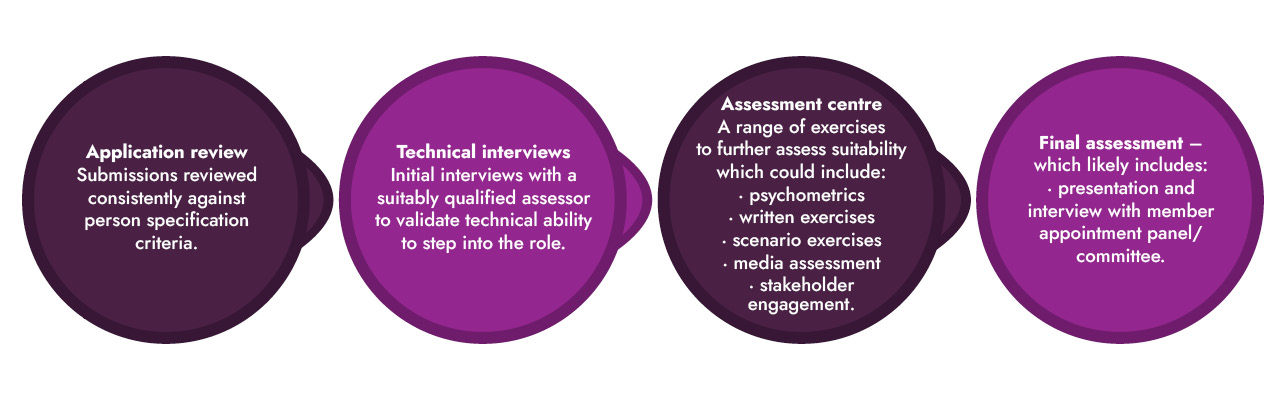
Ways in which the core themes of the Chief Executives’ Development Framework could be tested as part of candidate assessment are as follows:
| Core theme | Description | Assessment stage/type | ||||||
|---|---|---|---|---|---|---|---|---|
| Written application | Technical interview | Psychometrics | Written/ scenario exercises | Media | Stakeholders | Member presentation and interview | ||
| The core role | Co-ordination, management, staffing, advising, elections, emergencies. | X | X | X | X | X | X | |
| Politics and political interface | Impartiality, guiding, politics, political parties, tiers of local government, interface and overlaps. | X | X | XX | X | X | X | X |
| Good governance | Unified powers, reasoned and reasonable, open, advice, independent, citizenship. | X | X | XX | X | X | X | X |
| Managerial leadership | Leadership, direction, culture, risk control and safeguarding, teamwork, collaboration, systems leadership. | X | X | XX | X | X | X | X |
| Resource management | Budgeting, savings, investment, asset management, financial risk, prudence. | X | X | X | X | X | X | |
| Public ethics | Ethical principles, ethical cultures, fairness, services, practices, violations. | X | X | XX | X | X | X | X |
| Continuous improvement | Learning and curiosity, innovation, service re-design, digital and AI, performance, impact and results. | X | X | XX | X | X | X | |
Table key: X = Primary evidence, XX = Secondary evidence
Your HR team or recruitment partner will be able to offer a range of bespoke and licensed assessments and exercises across the various assessment stages to ensure councillors secure a rounded view of each candidate.
Candidate care
The importance of effective candidate care cannot be overstated. Any recruitment is a two-way process. Key areas for consideration include:
- The importance of effectively managing internal candidate (if any) dynamics and inter-relationships – circumstances that require discretion and care.
- Candidate confidentiality - a key aspect of any recruitment process and requires careful consideration and management throughout, especially in a recruitment process that involves a range of internal and external stakeholders (and potentially attracts media interest).
Wider guidance and information on attracting, supporting and retaining candidates can be found in Solace’s Guide to Senior Recruitment.
Post-appointment support for chief executives
Giving the new chief executive the best start when they arrive in post is important. After all, securing the job is only the first step in a much bigger journey. The job can also be solitary, but with good networks and support need not be.
Post-appointment consolidation of what was learnt during the recruitment is important. This can take many forms in the short, medium and long term.
We would strongly encourage participation on the LGA/Solace Local Government Chief Executives’ Development Programme as an immediate first step. The programme is aimed at supporting newly appointed chief executives to create a solid foundation to build upon when taking on the role.
The expectation is that they will continue to deepen their knowledge and experience across a broader spectrum of existing and emerging topics over time. This approach is set out as four pillars of support:
- early wraparound support
- a foundations training programme for newly appointed chief executives
- commitment to develop a gateway of accessible resources in one place
- ongoing support for continued development and sharpened judgement.
It is also a great opportunity to build out your new chief executive’s support network. You can express an interest by emailing [email protected]
In addition, we would encourage personalised support from within and outside the council. Networks, peer support and a continuous cycle of self-reflection will all support a new chief executive in starting well. There will be geographical/regional partnerships such as London Councils and organisations that include the Association of County Chief Executives and the District Councils Network.
Embedding the Development Framework into objective setting
You can embed the development themes into objective setting and draw on this as a measure to assess if the probation period has been completed satisfactorily. There will be specific deliverables, and the development framework can be a great way to assess the ‘how’ these are achieved.
By accounting for all of the themes in objective setting, it can also ensure your chief executive is on course to continue to develop a rounded set of skills and behaviours, essential enablers of adaptive leadership.
You can access our guide to embedding the Development Framework in to objective setting and appraisals.
Further information and support
Your chosen recruiter or HR recruitment lead will also be able to provide advice and support in most instances and, with your HR director, will be able navigate any divergent views.
Please also refer to the jointly negotiated JNC Handbook, as the conditions of service should be accounted for in designing and communicating your chief executive vacancy.
In addition, further advice and information can be sought from your regional LGA Principal Adviser or Solace.
LGA Workforce Programmes
Appendix: chief executive job description and person specification template
The following template has been developed in consultation with HR, Solace, chief executive and recruiter colleagues, incorporating the themes of the Chief Executive Development Framework.
This content is not intended to be exhaustive but should offer prompts for consideration when developing/updating a chief executive role profile.
Requirements will vary between council types and local context – for example, consideration should be given to elements that aren’t explicitly included in the first foundational iteration of the Framework, including:
- place/system leadership at the sub-regional level and beyond
- community engagement, relationship building and local leadership
- public/private partnership leadership
- place shaping.
While the LGA and Solace have taken reasonable care to create this template, no liability or responsibility will be accepted for any direct or consequential loss, financial or otherwise, or any other obligation or liability incurred by its use.
Job Description
Purpose of the role
The core chief executive role requires acting as lead council adviser, managerial leader and statutory Head of Paid Service, which includes:
- Be the council’s Head of Paid Service as defined in the Local Government and Housing Act 1989 and thereby ensure the proper and efficient management of all the Council’s employees.
- Accountable for overall service delivery and managerial effectiveness of the organisation, including accountability of functions and staff.
- Advisor to the council: ensuring the best advice is available to the council at all tiers, including the co-ordination of advice from others, including the s.151 Officer, Monitoring Officer and head of scrutiny.
- To uphold the Nolan Seven Principles of Public Life.
- Responsibility for the effective management of staffing resources.
- Effective resource management, including prioritisation, resource allocation, revenues and controlled spending while investing and spending for long-term value as well as near-term cost/benefit.
- To build a culture of openness, inclusivity, learning and public service and assure effective teamwork and corporate working.
- Impartially manage the political interface and overlaps of officers with councillors, codes, standards, protocols and respect.
- To ensure good and effective governance across the organisation.
- To ensure effective management of risk, control and safeguarding: effective internal control systems and (where appropriate) oversight of children’s and adults’ safeguarding.
- To champion and embed a culture of continuous improvement, encouraging learning and curiosity.
- To review instances of failure of due process (judicial reviews, serious complaints, ombudsman, Ofsted and Care Quality Commission reports) with legal support
- To act independently as Electoral Registration Officer (if applicable) and Returning Officer (in some cases, councils appoint officers other than chief executives to act as Returning Officer for local and national elections.)
Main Duties and Accountabilities
Politics and political interface
- Act as principal policy advisor to the council, ensuring Elected Members receive the highest quality advice on strategy and policy issues.
- Manage the interface between the policy making role of elected members and the executive role of the officers to ensure the delivery of policies, plans and strategies, setting the vision and future direction and ensuring the organisation is well placed to deliver desired outcomes.
- Develop and maintain effective working relationships with elected members.
- Promote a culture of political awareness amongst officers to help translate political will into appropriate future strategies and delivery of outcomes.
Good governance
- Ensure, in consultation with the Monitoring Officer and Section 151 Officer, that legal, financial, procedural and other provisions governing the affairs of the council, are properly observed and that appropriate action is taken to protect the best interests of the council.
- Ensure that risks associated with council services as a whole are effectively managed and mitigated effectively, including the risk of fraud and corruption.
Managerial leadership
- Provide inspirational and decisive leadership to all employees, facilitate the development of the senior management team and officers to achieve integrated and effective service provision.
- To play an active leadership role across the wider public service system within the locality.
Resource management
- Ensure successful delivery of services through the effective performance management of the council as a whole, setting ambitious and challenging targets, identifying priorities and tackling under-performance effectively.
Public ethics
- Ensure that ethical principles around the rights and liberties of individuals, communities and the public good are embedded and upheld in council service design, delivery, resource allocation and staffing.
- Ensure that fairness is observed in equal treatment, equal opportunity, relational equality, and equity.
Continuous improvement
- Create a culture of continuous improvement and innovation, identifying opportunities for income generation, with plans for the effective implementation of efficiency savings.
Other duties
- Demonstrate commitment and support for safeguarding the welfare of children, young people and adults at risk.
- Ensure all duties are carried out in compliance with the council’s financial regulations, policies for diversity, equal opportunities, risk assessment, health and safety and all relevant statutory or professional requirements.
- Fulfil statutory responsibilities relating to emergency planning.
- Perform any other duties imposed by law, or which the council may reasonably require.
Person specification
The following template draws on the Chief Executive Development Framework throughout. It is therefore to be considered a starting point, not the finished article.
A person specification can offer a blend of essential and desirable criteria. When designing a person specification that includes content from the Chief Executives’ Development Framework as set out below, it is important to ensure that experience criteria does not inadvertently discourage aspiring applicants seeking to take the next step in their career (if applications from step-up applicants is desirable) or those from different sectors (if such wider interest is desirable).
Qualifications
To be specified locally based on context and circumstances. Where qualifications are specified, equivalent experience should also be recognised.
Knowledge
- The statutory role of local authorities and Head of Paid Service and the role of the council’s core statutory officers in assuring probity and propriety.
- National and regional policy issues which relate to local government.
- Essence of public administrative law.
- The electoral basis of democratic legitimacy and community engagement in the locality.
- An understanding of tiers of government and political differences between them.
- Principles of organisational design and management and staffing accountabilities.
- Workforce best practice, including planning, strategies, equality, diversity and inclusion and service-specific operational workforce plans.
- Understanding of options for alternative service delivery models.
- Good governance principles in the corporate and public sector, as well as internal processes of scrutiny and formal checks and balances.
- Local Government financial management – revenue, capital and investment/treasury, funding streams.
- Proportionality rules for political parties and locus of decision making (constitution and statutory regulations).
- An understanding of party politics, its structure, organisation and connection with local civil society.
- An understanding of the political make-up of the Council and its committees, the responsibilities of councillors in their various decision-making, scrutiny and community leadership roles.
- Sustainability, carbon reduction and policies designed for wellbeing of current and future generations.
- Familiarity with digital and artificial intelligence (AI) and the application of technology-powered, new media enabled, but human-led services.
- Relevant statute, including Civil Contingencies Act (2004), Social Value Act and local authority responsibilities.
- Representation of the People Acts and relevant guidance from the Electoral Commission and the Ministry of Housing, Communities and Local Government (MHCLG).
- Local authority safeguarding duties and responsibilities.
- Health and safety legislation.
Experience
- Substantial and consistent leadership and managerial achievement at senior level.
- Strategic policy formulation, including influencing at a national/regional or sub-regional level.
- Working in and adapting to a range of political environments, holding regular conversations with Local MPs and political group leaders on the council’s priorities for attention and action and discussions with scrutiny members and all members in their front-line community leadership roles.
- Inclusively leading and motivating a diverse team of senior professional managerial staff to a high level of achievement.
- Regular engagement with statutory officers and chief officers on changing political landscape locally and dynamics within and between political parties.
- Effective budget and capital programme management and the annual budgeting process.
- Effective performance management: reported metrics of relative cost-effectiveness to comparators.
- Creating a positive culture of learning and improvement.
- Developing a street-level understanding of a local area (its wards, districts, boundaries, and connections).
- Delivery of alternative service delivery models for infrastructure investment and service delivery.
- Success in innovative service re-design, transformation and culture change delivering customer-centred, efficient and sustainable services.
- Embedding Social Value in procurement and commissioning arrangements.
- Working successfully in strategic partnerships and building strong relationships with government, public agencies, private sector, voluntary bodies, statutory and non-statutory bodies.
- Personal leadership in the achievement of equal opportunity in both employment and service delivery.
Skills and abilities
- A high degree of openness, honesty and personal integrity with an ability to engender trust & confidence amongst peers, staff, residents & stakeholders.
- Ability to provide inspiring leadership, to lead calmly and with clarity of purpose in novel, highly visible and accountable circumstances.
- Political acumen and sensitivity, with the ability to develop productive working relationships with elected members and advise all political groups and the Council as a whole in an objective and bias-free way.
- Have a confident communication style and negotiation skills that motivates staff, fosters team working and improves organisational effectiveness.
- Able to deescalate tensions and de-personalise conflict between individuals and parties
- Data literate and excellent analytical and creative problem-solving skills, holding a systemic understanding behind the numbers, with an ability to cut through to the root cause of an issue, including an ability to analyse, calculate and manage risks.
- Able to balance management grip and empowerment commensurate to risk and its mitigation through internal controls.
- Ability to drive high quality, high performing services.
- Personal resilience with the capacity to cope with ambiguity, uncertainty and pressure and the ability to work under public scrutiny whilst maintaining a sense of perspective.
- Personal commitment to continuous improvement and the development of others.
- Commercial acumen to understand and successfully exploit commercial opportunities.