
1. Executive summary
This report provides a series of key recommendations for action at a local, regional and national level to address the workforce challenges that face the finance profession in English councils.
Data has been gathered through an extensive survey about the current workforce, vacancies, difficulties in recruitment and retention, staff training and development and the overall capacity to meet the service needs.
Following on from the survey, various organisations and key individuals were consulted, from both the human resource and the financial services perspective, from Local Government and from other sectors, to capture opinions on issues and potential solutions in getting the workforce to where it needs to be.
Finally, the findings have been analysed and a series of conclusions and proposed actions compiled into four work themes to be implemented in three work packages – national, local authority and regional. The progress in developing these actions will be dependent on resources and funding being available.
Between October and December 2023, all chief finance officers (CFOs) in English councils were invited to complete the online survey with forty questions. 105 councils responded and completed the survey.
Various statistics were collected. Most significantly:
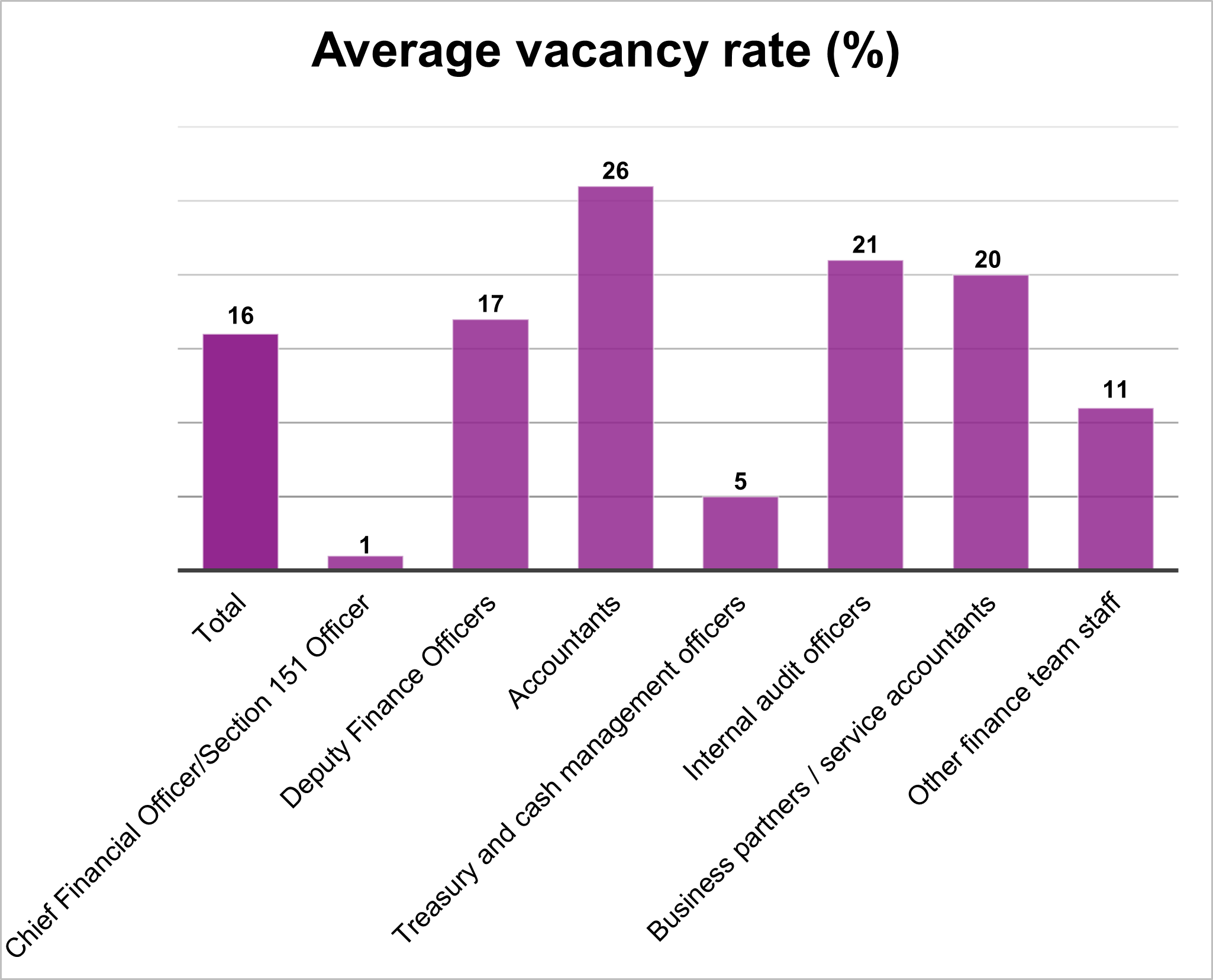
- Approximately 16 per cent of finance posts across England were vacant. 26 per cent of accountancy roles were vacant, 21 per cent of internal audit roles were vacant and 20 per cent of business partner roles were vacant.
- On average, local authority finance teams had a turnover of approximately 12.5 per cent per annum and rising. Turnover in districts was higher. The main reason for employees leaving the service was for money. Staff leaving for retirement was the second most common reason.
- 4.5 per cent of the finance workforce were agency/interim staff, with increasing expenditure forecast in this area. Most respondents stated that the main reason for using agency staff and interims was because the recruitment exercise did not deliver.
Most authorities did not have a finance workforce plan.
Further details of the results are contained in Section 3, and the Local Government Association (LGA) has produced a full report on the survey1.
The second part of the information gathering process involved a series of ‘deep dive workshops’ with relevant finance and HR groups, and individual interviews with a selection of key people from new recruits to the heads of finance in other sectors in order to inform the findings.
These are the main conclusions from the survey and the follow up 'deep dive' sessions, set out in the four themes we have identified.
Leadership capacity and capability
- Steps are needed to make more CFO candidates available – from within and from outside the sector. There are many established, experienced senior finance professionals that are retiring, transferring into other sectors or moving into more flexible, interim roles on an associate basis.
- Several councils reported gaps in their succession paths at deputy CFO level. This is a particular problem for the smaller authorities.
- In other councils, they are not able to keep potential staff motivated to achieve the CFO role – it takes too long, the attractions of reaching that grade are not enough and the risks too great.
- CFOs also need the right people skills to be capable of leading and motivating a team that, in many cases, is demoralised and lacking confidence.
- An approach is needed to get more CFO candidates from other sectors including the private sector. The approach needs to de-risk the process through clear guidance, briefing and preparation and an effective assurance process.
- More mentoring for CFOs is needed and it should be extended to deputy CFOs as part of their preparation for CFO promotion. As well as the current LGA involvement, it will require help from The Chartered Institute of Public Finance and Accountancy (CIPFA). More effort is needed to improve the availability of deputy CFOs (currently 16 per cent vacancies), and to fast track staff development for potential staff in that role.
- Assistance to build effective team working at the senior finance levels should be made available and encouraged. That would reduce the pressures on the CFO position and maximise the collective contribution of the team.
Attracting and recruiting the right staff
- Pay is seen as the main obstacle to recruiting the right staff. The remuneration package needs re-thinking, particularly for apprentices and young applicants, in light of their changing values and needs at different times in their career and personal life.
- More effort is needed, nationally, to promote careers in local government finance, to create more understanding and awareness of the attractions and to provide case studies of careers.
- Work to promote careers in local government finance has to breakdown some of the negative publicity and disillusionment in and towards the sector. It needs to be co-ordinated with and build on the wider campaign to recruit into local government, but it needs to specifically recruit finance resources in competition with the accountant roles being recruited into the other sectors.
- The local government finance promotion will need to specifically increase the availability of candidates for accountant, internal audit and business partner roles. Actions will range from focused marketing and promotion, through to rethinking job contents.
- Currently, there are in the order of 100 new CIPFA staff qualifying in local government each year. That is not enough to address the current shortfalls in the national resource pool.
- An initial London-only pilot of the National Graduate Development Programme (NGDP) Finance Graduate Scheme (now called Impact: The Local Government Graduate Programme finance scheme) has proved successful, and an exercise is now underway to explore the level of interest nationally. It is an important example of the benefits of collective recruitment – for the councils and for the recruits. The scheme needs to be promoted and fully utilised.
- The Society of London Treasurers Graduate Scheme that is working well for London Boroughs needs to be fully evaluated and rolled out across the country for the recruitment of graduates. It is an important example of the benefits of collective recruitment – for the councils and for the recruits.
- More needs to be done, nationally, to monitor and model the state of the workforce, to forecast vacancies and staff retiring, to identify the potential staffing shortages and additional skill needed and to direct an effective national response.
- More collaboration and information sharing by finance managers and HR about finance recruitment activity, problems and successes is needed – nationally and regionally.
Developing our people
- Some authorities did not have a finance training plan. All authorities need to have a training plan and a budget shaped by the service needs, by the current capability to meet those needs and by the changing skills required for finance.
- Some councils did not have an annual finance Continuing Professional Development (CPD) process. All finance staff need to have both an annual CPD process and career planning which will link into the collective workforce plan.
- The qualification route is heavily focused on new starters. More needs to be done to encourage and help established members of the finance team to get qualified.
- As with recruitment, particular attention to developing staff with the required skills and qualifications for accountant, internal audit and business partner roles is needed. It is important to ensure that the scope for new training methods is explored and any plans to build resource capacity can be matched with training provision.
- Managers and team leaders need to have the opportunity for more training in people management and talent management, to support an effective work culture (mirroring the One NHS finance model).
- Districts, on average, spend 40 per cent less on their finance training per finance team member than the larger councils. They have less management headroom for coaching and development. This is also an opportunity for collaboration and working together, at regional and sub regional levels, for example to jointly commission training.
Creating the right environment to deliver
- Whilst a turnover of 12.5 per cent is not exceptional, it is causing significant costs and demoralising the teams. It means staff are having to take on increased duties as business as usual, which is not sustainable.
- The draw of higher pay in other sectors continues to pose a challenge in retaining Local Government finance staff, particularly in times of increasing living costs.
- Building a strong clearly defined working culture with a strong employee value proposition and paying close attention to staff needs, motivation and career progression will help to reduce turnover.
- All authorities need to have a finance workforce plan covering staff development and working culture at the appropriate level of detail.
- Workforce plans are also needed to help manage staff workloads.
- There are potential benefits from more workforce planning collaboration regionally or in local area groups that could include other public sector organisations. There are potential benefits in shared recruitment campaigns, in training and development, and in sharing specialist resources.
- There is potential to reduce the use of agency / interim staff, specifically where it is used because recruitment has failed. Better workforce planning, more staff retention and equipping staff with a wider range of skills will help.
Implementation
The conclusions and recommendations have been translated into a portfolio of 23 proposed actions (in Section 5). The implementation will be overseen and supported by a small sector wide group with representatives from local authorities, the LGA and CIPFA. It is proposed that all actions will be implemented through three workstreams – individual local authorities, regional / area local authority groups, and nationally coordinated through the sector wide group.
We also recognise that the proposed actions will need ‘seed’ funding and resourcing in some areas to ensure there is the capacity to introduce and sustain some of the key actions. This will be an important consideration as part of the continuing LGA and CIPFA discussions in particular in respect of the current training and development work.
2. Introduction
The Department for Levelling Up, Housing and Communities (DLUHC), now the Ministry for Housing, Communities and Local Government (MHCLG), has grant funded the Local Government Association (LGA), with support from the Chartered Institute for Public Finance and Accounting (CIPFA), to produce a workforce plan that assesses the future capacity of finance teams and capability requirements against their current position and sets out the actions and investment required to achieve the necessary resourcing levels. A CIPFA project team has undertaken the work supported by research capacity and workforce advice from the LGA. This builds on the previous work reported by Local Partnerships2.
A national workforce plan can only go so far towards securing a stable and sustainable skilled workforce for local government finance. Local authorities themselves must take ownership of the issue and prioritise work accordingly. Each council is required to appoint a statutory officer responsible for financial administration, and that includes management of the finance workforce. However, local authorities are beset with other challenges and face unprecedented demand and cost pressures, so national stakeholders must provide tools, opportunities and guidance to support local efforts.
The aims of this report
This report aims to provide a series of key recommendations for action at a local, regional and national level to address the key workforce challenges that face the finance profession in English councils.
The report was produced with and for the sector, and included comprehensive research using a detailed workforce survey, a series of 'deep dive' workshops, with finance professionals and interviews with key stakeholders and partner agencies.
Our approach
The work carried out was undertaken in four main stages.
|
Stage |
Activity |
|---|---|
| 1. Data gathering |
|
| 2.Stakeholder consultation |
|
| 3.Analysis of findings and conclusions |
|
| 4. Implementation planning |
|
* The government finance function ensures that public money is spent efficiently and effectively.
Data has been gathered through an extensive survey about the current workforce, vacancies, difficulties in recruitment and retention, staff training and development and the overall capacity to meet the service needs.
Following on from the survey, various organisations and key individuals have been consulted (see Appendix A), from both the human resource perspective and the financial services perspective, from local government and from other sectors, to capture opinions on issues and potential solutions in getting the workforce to where it needs to be.
Finally, the findings have been analysed, conclusions drawn, and issues raised with a series of proposed actions compiled into four work themes to be implemented in three work packages – national, local authority and regional and are themed to form a focus on the priorities and develop a call to action.
3. Context
There are concerns, from within local government finance teams and in the wider local government community, about the capability and capacity currently available to meet the local government finance service’s needs. Many authorities have reported high turnover and difficulties in recruiting suitably skilled and experienced finance professionals to deal with the ever increasing acute and complex pressures facing local government finance.
There are real questions about how to make finance roles in local government a more attractive proposition and how more staff can be retained by making it an appealing workplace. Staff are taking on significant responsibility and risk in an increasingly demanding environment. There are particular concerns about the increased use of agency staff and interims with rising costs and operating problems.
The earlier report by Local Partnerships (Local government finance capacity and capability study) identified a number of findings including:
- The main cause of capability and capacity issues in finance teams was the reduction of real term funding to councils over the past decade, together with funding uncertainty year on year and increasing workload demands over the same period.
- Capacity and capability issues affect all levels in finance teams and a wide range of service skills. There are particular issues with technical specialisms, such as financial reporting, internal audit and with recruiting to senior posts.
- Pay issues have also had an impact. In particular, there has been compression at the top end of the scale, with the result that high-end jobs are not regarded as attractive in salary terms, involve significantly more work and greater personal and professional risk for insufficient increase in reward.
- There have also been changes to the skillset needed by finance teams, with greater commercial knowledge and understanding particularly cited.
- Many councils have had to make deliberate decisions to scale back graduate schemes and other training and development programmes which has meant that new recruits and internal promotions have been relatively unsupported.
- The increasing prevalence of flexible and remote working as a result of the pandemic may aid recruitment and retention but make staff development more difficult.
- Issues of churn, flexible working and recruitment are not affecting councils uniformly, with location, size, type and prevailing workplace culture being cited as factors impacting on the challenges.
- There is a perception among candidates that local government is under-regarded.
- The context within which the roles and responsibilities of a section 151 officer are now being executed are unprecedented at a time when the supply of suitably capable and experienced candidates for these roles is diminishing.
- Local government however is still seen as a good employer that offers an interesting variety of work with opportunities for advancement and an attractive benefits package. The work is local and supports local communities. Local government still has a lot to offer in terms of rewarding and interesting work that assists communities and many people like the idea of serving their local community.
With this context, MHCLG asked for more information to be gathered and a programme of actions compiled that will alleviate problems.
4. Research method and findings
The report was produced using a research methodology which includes a survey of all English councils’ finance teams, a series of deep dive workshops and interviews with key stakeholders and national agencies.
4.1 Local government finance survey
Approach
All chief finance officers (or equivalent position) in English councils (317 in total) were asked to complete an online survey between October and December 2023. 105 councils participated in the survey (a response rate of 34 per cent). By council type, the response rate was highest from counties (43 per cent / 9 councils) and lowest from metropolitan districts (11 per cent / four councils).
Regionally, response was highest from East of England (44 per cent / 21 councils) and lowest from the North East region (17 per cent / two councils).
The survey comprised forty questions to better understand:
- current staff numbers and status
- recruitment and retention issues
- agency and interim usage
- training and qualifications required
- future plans that existed
- other issues relating to the capacity to deliver services.
The research collected information at the level of resource groups within a local government finance team, including:
- chief finance officer / section 151 officer
- deputy finance officers
- accountants (people involved in corporate finance teams)
- treasury and cash management officers
- internal audit officers
- business partners / service accountants (people involved in supporting services for tasks such as budget monitoring and decision making)
- other finance team staff but excluding procurement officers, administrative staff, revenues and benefits officers and those mainly concerned with exchequer services such as payments (including payroll) and receipts.
Key survey findings
- Based on the survey data, as of 1 October 2023, there were approximately 13,400 staff employed in finance related roles by English local authorities. The average council employed approximately 42 finance staff in terms of headcount and 36 in terms of full-time equivalent.
- Just over 9,300 staff were estimated to be in post across England, at an average of 29 per council, whilst almost 1,800 posts were vacant, at an average of six per council.
- Average vacancy rates for finance posts across English local authorities based on these findings, were approximately 16 per cent as of 1 October 2023. Most significantly 26 per cent of accountancy roles were vacant, 21 per cent of internal audit roles were vacant and 20 per cent of business partner roles were vacant.
- One third of all responding councils said they were having /have had difficulties filling accountant posts.
- On average, local authority finance teams had a turnover of approximately 12.5 per cent per annum, broadly consistent with general local government turnover rates. Rates in districts were higher at 13.5 per cent. Most authorities said their finance turnover rates had risen in the last three years, with single tier / counties showing the highest increase.
|
|
Average turnover rate |
|---|---|
| Average per council – overall |
12.5% |
| Average per council – district |
13.5% |
| Average per council – single tier / county |
11.0% |
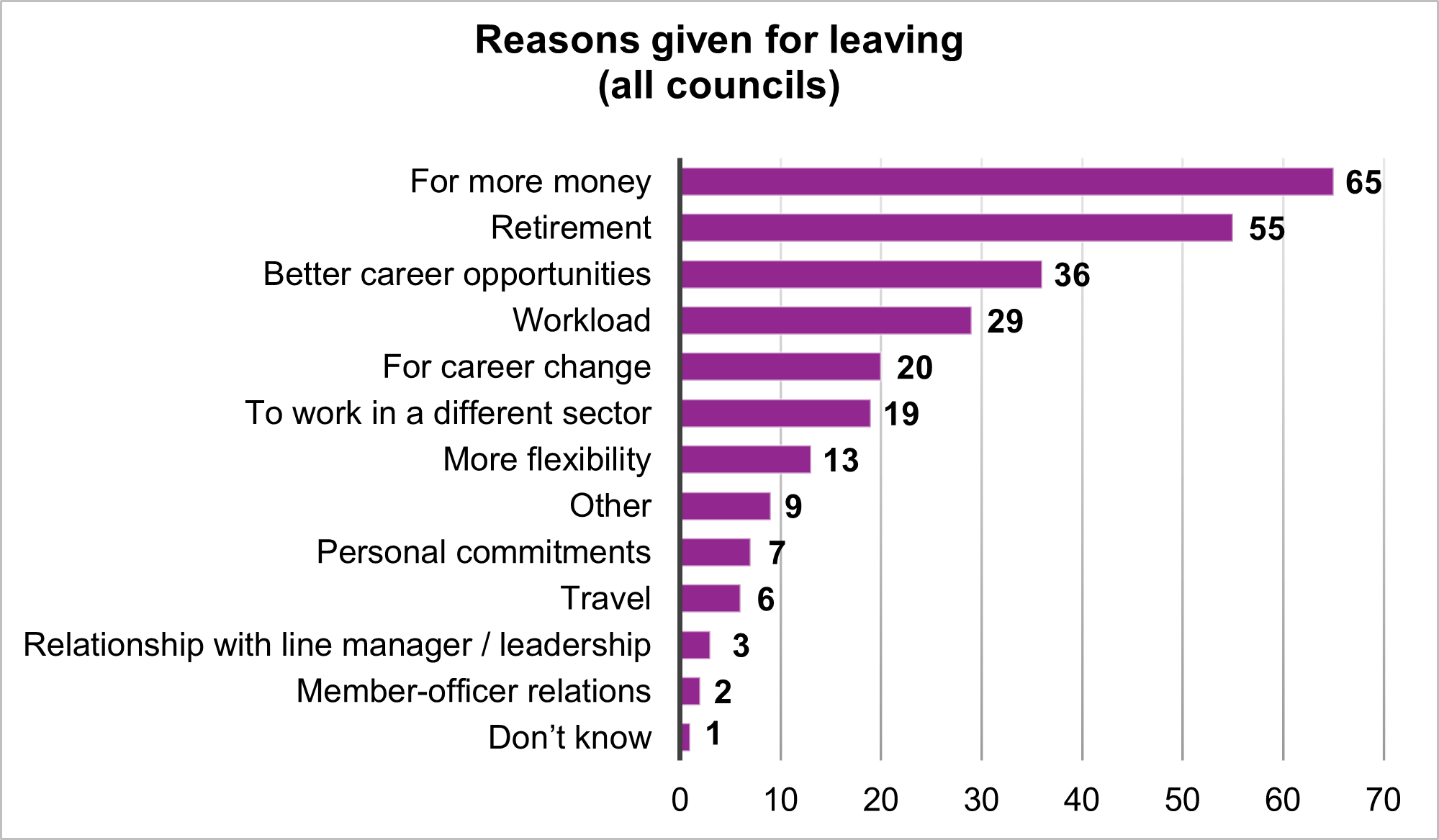
- Two thirds of respondents said the main reasons for employees leaving the service was to increase their pay. Staff leaving for retirement was the second most frequent reason.
- Almost 1,300 agency staff were estimated to be employed by local authority finance teams on 1 October 2023, with a full-time equivalent of approximately 1,200. On average, four agency staff were employed by finance teams per council.
- Half of all respondents stated that the main reason for using agency staff and interims was because the recruitment exercise did not generate enough candidates with the required skills. The number appointable with required experience was low.
- Based on the survey data, the national expenditure for local government finance agency staff in 23/24 is forecast at £540 million.
- Four fifths of all councils said they found it difficult to recruit finance business partners, and 76 per cent said they found it difficult to recruit permanent accountants.
- However, only two fifths of all respondents said it was difficult to recruit agency staff / interims that were accountants.
- Nearly all respondents said all chief finance officer / section 151 officer / deputy finance officers have the appropriate finance qualifications.
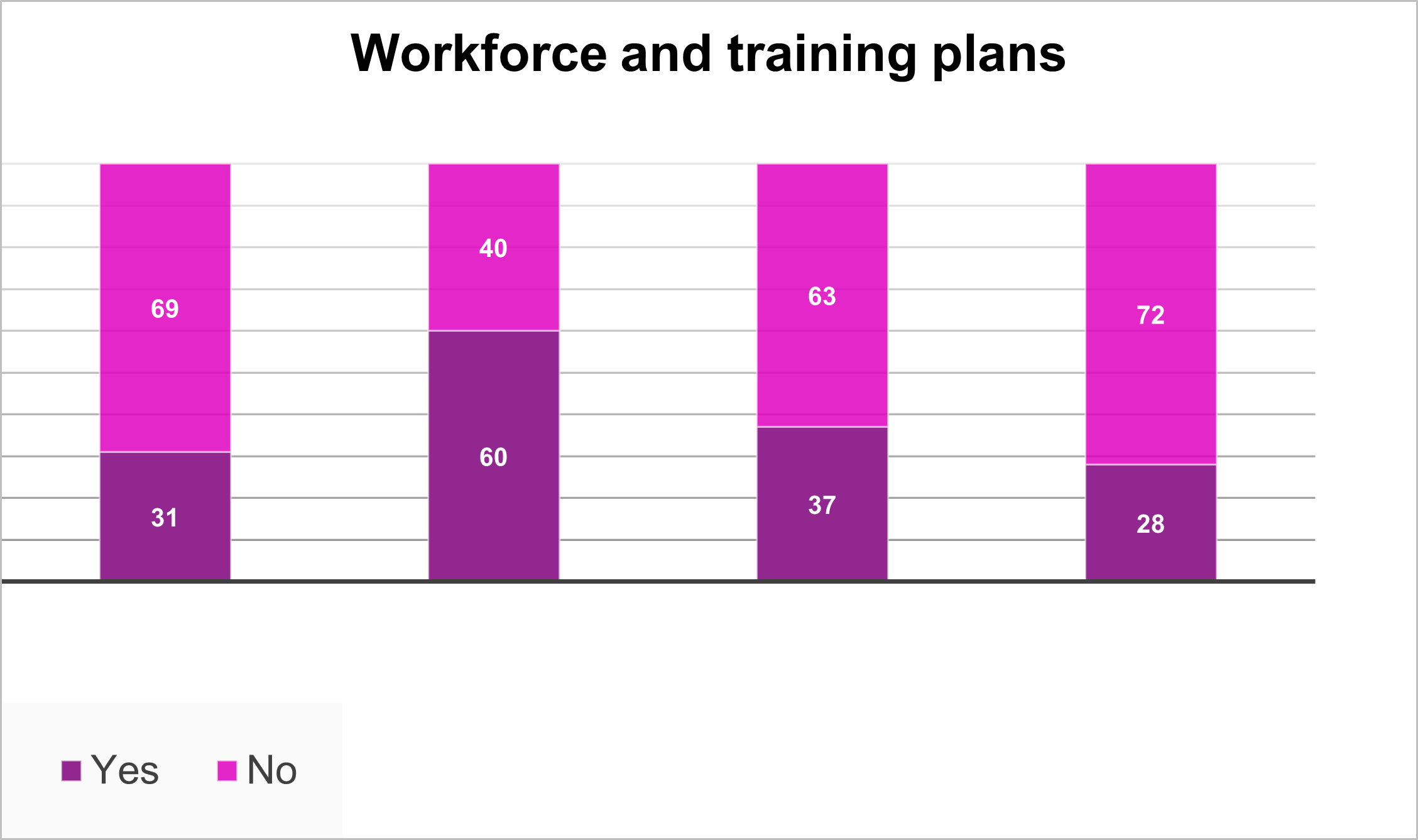
- Two thirds of councils who responded said they do not currently have a finance workforce plan.
- One third of all respondent authorities did not have a training and development plan, with an agreed budget specifically for the finance service.
- Half of all respondents said they do not have a successional training programme (a programme of structured development and training opportunities centred around a clear succession plan).
- Only 23 per cent of authorities had undertaken any projections of the staffing numbers needed in future years to meet anticipated demand for finance services.
- Councils across England spent an estimated £3.4 million on finance team training in 2022/23, at an average of approximately £11,000 per council.
- An estimated 710 apprenticeships were employed by local authority finance teams, of which approximately 270 (around 39 per cent) were employed in graduate apprenticeships.
- Participants were asked how confident they were that, over the next year, their council will have enough of the right staff (in terms of numbers and skills) to maintain the finance service adequately. The results varied. The most concerned were districts and their ability to have enough accountants and business partners to maintain the finance service adequately over the next year.
- Participants were also asked what their biggest workforce challenge at the moment was. The responses were summarised into the themes below:
- recruitment and retention staff with the right capabilities (includes pay challenges)
- staff workloads, finance challenges and capacity pressures
- ageing workforce, succession planning
- developing skills and retaining knowledge
- others, for example, upgrading systems, securing business partners.
4.2 Workshops and interviews
Approach
The second part of the information gathering process involved a series of ‘deep dive workshops’ with relevant finance and HR groups, and individual interviews with a selection of key people from new recruits to the heads of finance in other sectors that informed the findings. A list of the workshops and interviews can be found in Appendix A.
These sessions involved discussions around the survey findings to add qualitative details. They also involved consultation on changes that are needed and testing out ideas for solutions.
There was a wide range of differences amongst the authorities participating – some authorities were very concerned with the resourcing difficulties and struggling to deliver the required service demands, others were recruiting and maintaining their staffing requirements and feeling confident in their ability to deliver services. Generally, but certainly not in all cases, the smaller authorities were impacted more than the larger authorities.
Additional findings
The findings coming from the interviews and workshops were developed into themes. The findings are grouped under the themes below:
Leadership capacity and capability
CFOs were concerned with the technical complexities of delivering the latest statutory requirements and avoiding further high-profile failures.
There were calls for CFOs to get the help and support they need – specifically to be able to speak openly and candidly with members and the executive in a constructive environment. There is a view that better understanding by members and service leaders of the finance issues and financial management processes would help improve that engagement and the CFO’s ability to fulfil their role.
There were concerns that the role of the CFO and the senior managers is too heavily focused on tactical financial management, reporting and 'firefighting', and not enough on strategic financial management, forward looking.
There were common concerns about recruiting and retaining staff with the right skills to do the CFO job. There are many established, experienced senior finance professionals that are retiring, transferring into other sectors or moving into more flexible, interim roles on an associate basis. The demand for CFOs that have the right experience, qualifications and motivation to do the job exceeds the supply.
36 per cent of authorities that had recruited CFOs in the last three years said it was difficult and 10 per cent of the CFOs that were surveyed are not confident that their authority will have a CFO with the necessary skills in place over the next year, to maintain the finance service adequately.
Because demand exceeds supply, there were concerns in the feedback that authorities are competing with each other to recruit for senior financial vacancies, or potentially recruiting officers who are not experienced enough to do the role.
There were different views expressed about whether candidates from the private sector can fulfil the local government CFO role, particularly at a time when there are increasing complexity and technical challenges and an expectation of greater due diligence.
Finance leaders from NHS and other parts of the public sector reported more success in recruiting from the private sector.
Several councils reported gaps in the succession paths at deputy CFO level. It is common to find several staff reaching retirement at the same time, creating a significant knowledge gap and issues around corporate memory. This is a particular problem for the DCFOs in smaller authorities.
In other councils, they are not able to keep potential staff motivated to achieve the CFO role – it takes too long, the attractions of reaching that grade are not enough and the risks are too great.
This is evident with Deputy Finance Officer vacancies at 17 per cent.
CFOs talked about the challenges in keeping their staff assured and motivated. There was the view that:
General feeling at the moment around resilience or lack of it - we sort of feel like the mood in finance is we are destined to fail.
Attracting and recruiting the right staff
All staff who participated in our workshops and interviews rated recruitment for finance as difficult and for most, it is getting worse. A quote from one CFO:
Our staff are currently over stretched – we have staff doing three or four roles it’s not sustainable.
From the survey statistics and the feedback from the workshops and interviews, the roles with particularly high rates of vacancies and rated very difficult to recruit are accountants, internal audit and business partners.
The main reasons for the difficulties in recruitment put forward were:
- relatively low remuneration compared to other sectors
- limited supply of candidates with the right experience / skills / potential
- difficulty competing with nearby local authorities
- low image of work in local government due to media reports of failing councils
- perceived low career opportunities
- several of the authorities had put recruitment on hold pending a restructure
- council recruitment freeze to save costs.
Coping with the pay differential
The pay issue is a major recruitment barrier. These are some typical quotes from the workshops:
We have just completed a major recruitment campaign, but it hasn’t worked. We can’t fill finance business partner roles – salaries are too low.
Following a major finance restructuring programme, we went to the market to recruit 20 roles, but problems with pay – not enough for the responsibility.
We provide a tailored portfolio of other benefits such as enhanced annual leave, but we keep getting problems with low pay.
Most authorities are doing something to try to compensate for low pay. One of the most successful steps in attracting staff has been around providing flexible working times. The success of this approach was confirmed in discussions with central government.
Those departments that are more flexible on attendance in the office are more attractive.
Market supplements or other pay augmentation is another commonly used approach to attract staff. Examples included:
- lease car deals
- free /subsidised parking
- paying professional subscriptions fees
- staff discounts
- wellbeing – access to occupational health services
- free will writing service
- extended maternity leave
- staff volunteering time.
Some authorities reported that they have tried 'golden hellos', as a last resort to fill critical vacancies but this has had mixed success. It can cause resentment in existing staff whose pay and reward remains unchanged, creating the perception of a two-tier workforce, and it has the associated costs.
Other sectors are facing similar challenges.
In a recent advert for a London-based management accountant role, the recruiter put equal emphasis on the company benefits including early finish Fridays and a day off for the employee’s birthday. Early finish Fridays are also listed four bullet points above the firm’s competitive pension plan and life assurance offer.
From the workshops and interviews, authorities have also found more recruitment success from offering career framework / career grade / performance pay terms to candidates rather than fixed salary and internal time served progression.
We're hoping that you get rewarded for your performance rather than just this internal time served progression – so employees see the possibility of promotions which we have never been able to factor into job recruitment before.
One authority is currently looking into alternative pension arrangements.
We have found that younger candidates are not necessarily looking for the same job security as people have done in the past. And therefore, the benefits which focus on longer term paybacks like pensions may not be as appreciated as in the past.
Geography has a big impact on ease of recruitment with remote regional authorities having the most difficulty. About half the authorities that we talked to provide relocation expenses. However, it is not just recruitment for a local authority job, but if the area does not provide employment opportunities for the candidate’s partner, they will be less attracted to the role.
Recruitment from other sectors
There was a strong interest in doing more to recruit from other sectors, including the private sector.
The view is that there is simply not enough supply of the available and skilled resources. Consequently, as in the case of CFO recruitment, there are views that local government should be expanding the catchment to include a wider source of recruits.
Stop just focusing on local government experience as prerequisite for a job.
However, there were some concerns about the difficulties of adapting to local government roles, particularly for private sector staff.
Private sector are put off by the hierarchical structure / governance arrangements – in their world they report into CX and senior team they don’t want to work in a large bureaucracy.
There are major parts of what local government delivers that require specialist finance knowledge of complex and regulated areas such as the adults and children’s care markets and social housing as examples. These have specific operating models and financial reporting requirements, both of which can represent a barrier to entry for financial professionals outside of the sector.
One authority had recently recruited two accountants from the private sector, but they had struggled to fit in with the team. They were used to more ownership, financial authority and empowerment to make decisions.
There were concerns raised that some councils are not taking full advantage of new ways of approaching the market, for example, by using well frequented social media platforms to attract entry level candidates or by making it easier for people to apply in an increasingly paperless and instant world.
One authority tested a different way to do recruitment and it reported was highly successful.
We found our 'traditional' recruitment processes, had a drop off rate of 40 per cent at the application form stage, which got us thinking! People were clearly interested in our roles, but this would not be enough. Rather than the application form being the gatekeeper to an interview, we offered virtual recruitment evenings, with a guaranteed interview for everyone who was qualified, and the form filling formalities coming later.
National marketing and promotion
The most common problem, raised by many staff consulted, was the absence of a national local government finance career marketing and promotion campaign, with material, a website and case examples, to provide information and to set a positive tone. Currently, most recruitment is left to individual authorities. Job candidates often had little knowledge about the work of local government and even less about the role of finance in local government. Some of the many comments made:
There's some work for us to do as a sector to try to reset our image in finance as a profession.
We need a national website to promote Local Government finance careers that would be really beneficial and that way each local authority is able to promote themselves via a central place – and we could direct people to the finance opportunities in the sector as well as provide a way to promote the wider benefits.
It is important to do a day in the life - know a bit more about it and then engaged - people have little idea about what the finance job is about.
Some of the key messages that respondents felt needed promoting include:
- The job itself is exciting as you have an actual impact.
- Local government finance offers a greater variety in job content than other employers.
- The work environment includes a high level of attention on staff care and careers, compared to other sectors.
- There is a wide selection of potential career opportunities across the public sector.
- The work provides a real opportunity to make a difference in the community.
National support is also needed to provide guidance to authorities in managing the recruitment process.
Are we really good at selling our vacancies in the current job market? Do we really know how best to actively sell in the job market? Probably not. And I suspect that's the case for a lot of authorities.
As already stated, in many cases, authorities are competing for the limited supply of candidates.
One challenge is how do we differentiate our councils, so you stand out?
Nearly all the recruitment is from another [local authority] just pinching from others.
There was a general view that many of the strategies for recruitment were 'guesses'. There is very little information available nationally about vacancies and recruitment activities, and about what works and what does not work – not only in filling vacancies but whether the staff recruited had longevity in roles and the sector.
A second national issue of concern is the specific collective availability of qualified staff for accountant, internal audit and business partner roles, which results in the current levels of vacant posts. 26 per cent of accountancy roles are vacant, 21 per cent of internal audit roles are vacant and 20 per cent of business partner roles are vacant. The staff consulted have no confidence that those vacancy rates will change under the current workforce development arrangements.
Apprentices and graduates
Apprenticeships and graduate apprenticeships are viewed as the most appropriate routes to build resource capacity, particularly by single tier & county authorities. The survey identified an estimated national total number of apprenticeships currently in place of 710, of which 270 are graduate apprenticeships.
As well as the lack of available information and promotion for local government finance, several of the participants complained that CIPFA was no longer doing college 'milk rounds'.
There were several references to the National Graduate Development programme (NGDP) finance scheme (now called Impact: The Local Government Graduate Programme finance scheme) that has been set up for London authorities. The general NGDP scheme was set up to focus on recruiting potential local government managerial leaders. The finance scheme is a variation that links into the CIPFA apprenticeship training.
Developing our people
From the workshops, it is clear that some councils see investment in finance staff as low priority in the current economic climate, where authorities are struggling to deliver their statutory community services.
Finance managers were asking for more support in selling the benefits of investment in finance training and development – building professional capability, widening the skill set, providing resilience and supporting service delivery to elected members.
Constantly, I'm having to remind members it is false economy to cut financial services in favour of front line as you need capacity in both, to deliver effective front line services.
The survey collected data for annual finance team expenditure on training.
|
Districts |
Single tier / counties |
All councils |
|
|---|---|---|---|
| Average net expenditure on finance team employee training |
£4,000 |
£19,000 |
£11,000 |
| Average number of finance staff |
17 |
58 |
36 |
| Average net expenditure per member of staff |
£235 |
£328 |
£306 |
Single tier/county councils are spending 40 per cent more per staff member on training than districts.
Feedback from the workshops and the interviews stressed that it is not just the financial cost of training and development, but also the effort in coaching and mentoring using experienced managers. Again, this is a particular problem for the smaller authorities with limited headroom for activities which are not seen as essential.
There were strong views that lack of finance skills is associated with cases of accounting failure – including the issue of section 114 notices3.
40 per cent of the authorities that were surveyed did not have a finance staff training and development plan or dedicated budget.
There were differences in the extent to which authorities assist with training for their staff, provide time off for learning, use their senior / experienced staff for coaching, and promote a culture that includes creating an appetite for learning.
Another concern raised in the workshops and interviews was that training was often deferred when work pressures were high.
It’s a balancing act, [for example] people will be booked onto a course and if this clashes with an organisational need the training and investment gets dropped.
Several authorities have talked about a two-part attitude to training:
We've got a cohort of long service finance managers that are perhaps not as willing to change, particularly as we are moving into automation. AI, PowerBi data analytics and a focus on efficiency improvements and all of that sort of stuff. Then we have got younger managers who embrace all of these things and have a great appetite for training and development. The challenge for me for me is how can I afford to support the rising stars and really help them through development and progression and not lose them to other councils?
A further concern that was expressed is that local government finance does not have a collective talent management strategy, such as the NHS One Finance talent strategy. From an external finance resourcing leader:
There is a lack of collective investment in local government finance people.
- The ‘NHS inclusive talent management’ provides guidance on these issues – it defines four different resource groups with different attitudes and requirements for development. It provides guidance for NHS finance managers on how to take those groups forward. (See Appendix B).
The workshops reported mixed responses to questions about internal CPD within the finance team environment – some authorities apply it rigorously, others do very little officially.
The survey indicated that treasury management (65 per cent) and internal audit (71 per cent) staff were particularly low on qualified personnel.
Participants felt there was a need for more training around the latest technical support for finance:
We need people with skills in financial systems / use of automated processes / AI [and so on] rather than financial technical expertise. This is causing a flight risk from the council as people with these skills are attracted elsewhere.
There have also been requests for support for experienced staff currently working in finance teams to get professional training and financial qualifications. This will broaden their skill set and enable more flexible resourcing solutions as well as build confidence. Whilst young apprentices get assistance – time off for learning, professional learning fees and so on, there is nothing to encourage or support the experienced staff.
On training and development, there are repeated concerns that the smaller authorities are disadvantaged – they do not have the capacity to spend time developing staff, nor do they have the extent of skills to be able to embed practical capability in the wide growing range of finance skills.
Creating the right environment to deliver
Turnover
The average turnover for the survey group across all roles was 12.5 per cent per annum and is increasing.
The councils experiencing the highest rates of turnover were districts. With a small finance team, the impact of staff leaving is bigger, in terms of reducing the team experience and capability and often due to single points of competence. Again, this impacts the morale of the rest of the team which can cause a snowball effect.
Participants were asked to name the main reasons given for leaving the organisation on departure, from a list of possibles. The most common reasons were 'for more pay', 'retirement', 'better career opportunities' and 'workload'.
Similar findings came out of the workshops and interviews.
Other major reasons put forward by workshop participants for high turnover included that local government is an industry with low esteem and highly publicised failures.
Participants described the impacts of the high turnover. It has resulted in the loss of experienced staff and caused real time resource shortages. This in turn has impacted employee morale due to constant change and increased workload due to vacancies resulting in more people choosing to leave. It causes further demoralisation of staff coping with the changes and often results in more leavers.
Similar findings came out of the workshops and interviews.
Money (salary) is driving people's decisions and behaviour about staying or moving jobs in a lot of cases.
If you are a young person just starting out with the cost-of-living crisis, there is a need to earn more, quicker that doesn’t match the pace of progression – this is impacting on whether they chose to stay or not especially as rent and mortgages increase disproportionately to pay.
The ageing workforce is a huge challenge for us, that is replacing those who leave.
There is a need for clear career progression and how people can develop and gain promotion and upskill into more interesting diverse roles.
It’s also the added pressure in the job itself - I've just had one of my long-term experienced members of staff retire early because of the audit pressures.
The increasing workload and growing expectation being placed on finance teams, is causing many staff to rethink job change or retirement.
Age profile of the workforce means we have major problem in 3-5 years as people in the team will retire.
There is also a view that local government is not changing its diversity profile.
My authority is not ethnically diverse at the top. And if you don't see people who look at like you, maybe you'll go elsewhere because you don't see an opportunity for you to grow and progress – it’s a real concern.
However, from the workshops and interviews, it is clear that some authorities are taking positive steps to deal with turnover.
Some provided additional material benefits as described in the section on attracting and recruiting the right staff.
Providing hybrid working / flexible working was considered a huge benefit to retention relative to how work used to be. (However, there are concerns that working from home may be withdrawn in the post COVID era.)
There was also a strong view that work variety is important to keep people in roles and in the sector and that there is also a need to revisit job descriptions and look at job design to create opportunities for development.
In finance there's a whole richness of different roles people can do. So, we use things like job families or generic job descriptions so that, for example, a financial accountant in our council, can also work across all the different seven directorates, so they're not just siloed in one particular area. They've got the opportunity to work in different areas and advance that way. So, it's really looking at all the things that can motivate staff in addition to salary.
Secondment was stressed as another way of creating variety, but several authorities had stopped secondments in recent times, with other workload pressures and a strong concern that secondments often resulted in staff leaving their employment.
Some years ago, all authorities in one region had a collaborative secondment arrangement – but for some reason it stopped working. It is something they will be considering again.
Values and culture
Career management and professional training were regarded as important factors in retaining staff. Further, clear career progression - how people can develop and gain promotion and upskill into more interesting diverse roles - is essential.
We found that continuous professional development, with positive, regular one to ones is very, very important along with a healthy work life balance.
There was a common view that staff who had a strong interest in supporting the community and delivering social values were more likely to stay in local government and be less attracted to higher salaries outside local government. There is a view that attracting people with a strong commitment to public services and the right behaviours should be considered ahead of their professional or skills background which can be developed.
Some authorities have achieved strong staff retention and commitment by defining and operating with a staff / work culture, that is 'branded' and an integral part of the working environment. This approach includes identifying the Employee Value Proposition4 and paying close attention to staff needs, motivation and career progression. It increases attention to staff engagement and communications, makes more of what finance is achieving and how the team members contribute to the successes.
We found from our experience money is not the top reason why someone stays in the organisation. It was very much about job motivation, meaningful work is very, very important and then getting recognition for what you do is paramount and then employee involvement - job security and remuneration lower down.
In my London borough, we're looking at the employee value proposition linked to our branding.
All authorities are doing this to some extent, but there was a strong opinion that doing more is the most effective way to achieve more job satisfaction and resistance to leave.
We co-designed and launched our workforce strategy, engaging with staff and managers, aligning focus on recruitment and induction with wider focus on leadership, culture and employee experience to ensure a sustained focus is also placed on retaining existing staff as well as attracting new staff.
Workforce planning and management
Repeating some statistics from the survey:
- 67 per cent of the authorities that completed our survey did not have a finance workforce plan
- 72 per cent had no forward estimate of finance staffing numbers required
- 40 per cent of authorities do not have a training and development plan, with an agreed budget, specifically for the finance service
- 62 per cent do not have a programme of structured development and training opportunities centred around a clear succession plan.
That was confirmed in the workshops and interviews.
We discussed overall recruitment, retention in councils, and the problem is finance teams don't have workforce or people plans. So, they have no approach to addressing the problem. This is quite common across all of the councils in our group – even though there is workforce plan at corporate level - it's not drilled down to service areas.
However, some authorities do take finance workshop planning seriously:
In my London Borough we've rolled out corporate people plans for each of the service areas. So, each of the service areas has a corporate plan. It's themed, so it's got the employee experience, recruitment and retention built in. We look at the specific issues that are faced in each particular service area and we have an action plan that supports that.
Further, in the workshops and the interviews, staff talked repeatedly about:
- concerns about staffing gaps emerging, with no candidates to fill the vacancies
- significant groups of staff getting close to retirement
- shortages in meeting certain skill requirements and a related dependency on agency staffing
- a general lack of confidence in that, over the next year, their council will have enough of the right staff (in terms of numbers and skills) to maintain the finance service adequately.
Workforce and succession planning are seen as essential to achieve the ambitions for Equalities, Diversity and Inclusion.
Diversity - committed to this but a real struggle to do this
While the workshops and interviews highlighted the lack of workforce planning and management at national level, there was also much discussion about regional and local area collaboration groups potentially addressing workforce issues jointly. There is currently little collaboration of that nature. There are some examples, notably London authorities, who are jointly working on graduate apprenticeships through the Impact: The Local Government Graduate Programme finance scheme.
There is apprehension about committing to collaboration. There were views that further collaboration is difficult in some cases because of the different political environments. The traditions of competition with other authorities rather than mutual support are difficult to overcome.
However, there were views that there are significant potential benefits from collaboration as the shortage of available recruits and the costs of using agency staff get worse, if it can be made to work. There are precedents of regional collaboration in other functions such as children’s services that should help in getting successful outcomes from collaboration in financial services.
Use of agency / interim staff
From our survey results, the use of agency/interims varied from 'not used at all' to 'heavy use', and that was confirmed in workshops and interviews, with most use of agency/interims in the larger authorities. Overall, the survey showed that 4.5 per cent of the finance workforce were agency/interim staff and forecast increasing expenditure in this area. Total expenditure on agency/interim staff by the survey participants for the year 2022/23 totalled £16 million. There is a significant increase in expenditure for 2023/24 where the total for the first six months is £28 million for the participating authorities.
Feedback from the workshops and interviews identified that increased expenditure was due to some increasing agency costs, but largely down to increasing use of agency/interims.
The survey provided information on the reasons for using agency staff.
By far, the highest reason was 'recruitment exercise did not generate enough candidates'. Another high reason for the use of agency/interim staff was 'specialist knowledge was not available in-house'.
|
Per cent |
Reason for using agency / interim staff |
|---|---|
|
30.8 |
Recruitment exercise didn't generate enough candidates |
|
12.4 |
Specialist knowledge was not available in-house |
|
12.4 |
To close down accounts / reduce audit backlog |
|
11.1 |
Lack of capacity to recruit immediately/to cover during recruitment exercise |
|
8.5 |
Post was to cover short-term work/specific task only |
|
8.5 |
To cover long-term absence in the team |
|
8.5 |
To cover short-term absence in the team |
|
6.4 |
To meet unprecedented demand |
|
1.3 |
To cover maternity leave |
From the discussions:
Agency / interim staff cost more than double the regular cost of a substantive member of staff.
As well as the high costs, there were several concerns about the problems with using agency staff/interims and the value for money.
The workshops and interviews raised several risks – agency/interims did not have the same commitment (they were there just to get paid), they had no long-term interest in the service or authority, it took time to bring them up to speed, it was demoralising for existing staff to work alongside them getting higher pay with no real sense of responsibility. There were other negative comments:
It delivered the outcome for the work but was negative in terms of team building and inclusion.
We believe use of Agency has reduced the pool of full-time staff availability.
Interims are not often aware of council culture and processes so there is a learning curve. In the short term we prefer to give honoraria or overtime payments to reward existing staff.
The lack of knowledge from agency staff put immense pressure on the finance team in order to meet Statutory Accounting deadlines.
The quality is varied and needs to be closely managed.
There are two types of agency staff, - those who want to do job and get more money and those who can't do/can't keep job. Can easily get second type.
The survey captured views on the success of using agency/interim Staff. One third of the respondents reported the use of agency/interim staff as not very successful or not successful at all. However, the survey did confirm that recruiting agency/interim staff is easier than recruiting permanent staff, particularly for accountants, internal audit and business partners. It is a growing pool of available resources sourced largely by staff leaving permanent employment early.
5. Analysis, conclusions and recommendations
5.1 Leadership capacity and capability
Analysis and conclusions
There is a clear need to further promote the CFO role, to ensure that local authorities can recruit and develop CFOs who are able to provide members and other officers with regular briefings on the financial challenges and their role in helping to tackle those challenges. There is a need to facilitate effective engagement, dialogue and support on financial management issues across the whole of a local authority- a vital role of the CFO. However, the statutory role of the CFO and the increasing prevalence of adversarial language in this space is making senior finance staff more reluctant to put themselves forward for the role.
CFOs need the emotional intelligence and political awareness to navigate this difficult space. They also need the right people skills to be capable of leading and motivating a team that is disillusioned and lacking confidence, a team with staff increasingly drawn to leaving. This is about giving all CFOs the people management skills they need. (CIPFA, with the LGA, has developed a new development programme for CFO/ section 151 officers to align with programmes for chief executives and monitoring officers. The CFO training needs from this work have been fed into the compilation of that programme.)
Steps are needed to make more CFO candidates available – from within and from outside the sector. If the calibre of appointment at section 151 level deteriorates across the sector and if those in position are not adequately supported, there are likely to be more instances of local authorities failing to apply public funds in a manner that can be considered appropriate, economic, efficient and effective or indeed, not in accordance with statutory and regulatory requirements. There is a risk that there will be more local authority failures in the headlines, and public services will suffer.
Authorities need to plan further ahead to meet succession requirements finance leaders coming through the organisation, and to do more in terms of recruitment and development of capability at Deputy CFO levels. Further, that development must build up the motivation for the CFO role as well as the capability.
There is very little recruitment or cross fertilisation into the CFO role from other sectors. The nature of the role, the terms and conditions, do not make it an appealing proposition. Recruitment from other sectors has risks, but it also has the benefits of bringing capacity, capability, fresh ideas and potential solutions into the workspace.
An approach is needed to get more CFO candidates from other sectors including the private sector. The approach needs to de-risk the process through clear guidance, training and preparation needed and an effective check process. Thought also needs to be given to the messaging when recruiting from outside the sector - people need to understand they are coming into a different environment and will need to develop additional/ different skills as well as using existing ones.
CFOs need more time to focus on finance strategy and to maintain effective working relationships with members and service leaders. Some of the authorities that are successful in their leadership, have an effective a joint leadership team or executive with members, sharing ownership and decision making, recognising the potential for over reliance on the CFO and the need for corporate accountability. However, again that relies on a capability at Deputy CFO and other senior management levels and an understanding of the importance of these roles.
Assistance in building effective team working at the senior finance levels should be made available and encouraged to reduce the pressures on the CFO position and to maximise the collective contribution of the team.
More team working should also reduce the tactical workload of the CFO and enable a greater focus on forward looking strategic financial management.
More effort is needed to improve the availability of deputy CFOs, and to fast-track staff development for potential staff for that role. They need the skills to fully support the CFO and the experience to take on that role.
Recommendations
The following actions are recommended to strengthen the leadership capacity and capability of local government finance teams.
A1) Ensure that the new s151 development programme helps section 151 officers to develop their strategic leadership and people management skills. The training content needs to be specified in detail, informed by work to confirm the gaps in the availability and content of existing training for CFOs. This will be different depending on the experience of the CFO and should be tailored to reflect this. The programme will then be widely promoted in the sector, with clear expectations that all CFOs will engage with it.
A2) Provide further coaching sessions for teams working at senior financial management levels, on request for authorities that have new financial management teams or feel there are gaps in the effectiveness of their current working arrangements. The content will build senior team working practices and help them to sort delegation and empowerment whilst ensuring that statutory responsibilities are fulfilled. It should give CFOs more time to focus on finance strategy and to maintain effective working relationships with members and service leaders.
A3) Create and deliver training modules to prepare deputy CFOs and senior finance managers for potential promotion to the CFO post. The modules will make use of existing training materials and will provide training to cover:
- accelerated training to complete the professional finance qualification
- briefings on the full CFO job content and required capabilities
- education about financial governance in local government, about specific finance issues in the individual service contexts, and others.
A4) Encourage authorities to make more provision for experienced mentoring of fast-track CFO candidates within the authority.
A5) Further promote the current national CFO mentoring scheme which has been created by the LGA in partnership with the finance profession to provide access to impartial experience and advice from established or recently retired section 151 officers, for CFOs. This will be supported by CIPFA and the LGA.
A6) CIPFA to promote and support the larger authorities, with a wider senior finance management team to include candidates from other sectors, including the private sector, in their recruitment for CFOs and other senior roles. They will need support about where to recruit, and how to write the person specification to ensure they get people with the right skills and the ability to develop them.
A7) Provide guidance and specific training content for CFOs and other senior finance managers being recruited from those other sectors, to enable staff to come in and come up to speed as quickly as possible, avoiding potential risks.
5.2 Attracting and recruiting the right staff
Analysis and conclusions
There are two problems that need to be addressed. Firstly, vacancies are not filled quickly because there are not enough suitable candidates applying for these jobs. Secondly, if there are candidates available, they are not being attracted to work in local government finance.
Authorities need to consider the wide range of alternative benefits that some ouncils are using to compensate for lower pay and attract more staff. They include direct remuneration benefits and the softer behavioural benefits. There is general LGA workforce support which can help finance teams to understand and implement best practice in remuneration, retention and staff benefits.
More effort is needed to promote careers in local government finance to create more understanding and awareness of the attractions including career management, job content variety, potential high-profile impacts and the community benefits. This has to address some of the negative publicity and disillusionment in the market.
More needs to be done, specifically, to increase the availability of candidates for accountant, internal audit and business partner roles. Actions are needed from focused marketing and promotion, through to rethinking job contents and ensuring the availability / accessibility of the right training.
Actions are also needed, as in the case of CFOs, to de-risk and support the transfer in of staff joining with no experience of the content and issues involved in local government finance. This will include support about where to recruit, how to write the person specification to ensure they get people with the right skills, points to consider when developing messaging, and developmental support once successfully recruited. Part of these actions will involve further dialogue and learning lessons from the government finance function and the NHS.
More guidance needs to be made available with up-to-date information about the state of the market, sharing ideas and individual authorities connecting into national recruitment campaigns. Information is needed about the different media for advertising and the alternative benefits that are resulting in successful recruitment.
The primary route to bring more candidates into the local government finance resource space is through apprentices / graduate apprentices with support and training through the qualification programme. The current rates of recruitment through this route are not adequate to make significant differences to the available resource pool because of high numbers of staff retiring or leaving the sector.
The following table shows the numbers of trainees achieving CIPFA qualification, employed within local government.
|
Year |
Numbers qualifying |
|---|---|
|
2020 |
131 |
|
2021 |
112 |
|
2022 |
95 |
|
2023 |
99 |
The total number of staff working in local government finance nationally (from the survey) at the levels of CFO, Deputy 151 officer, accountant, internal audit and business partner is estimated at 20,000. Staff turnover is 2,500 per annum, with a significant proportion of that down to staff retiring. A conservative annual estimate of staff retiring would be 10 per cent of the turnover , that is 1.25 per cent of the finance team. On that basis, 250 staff qualifying annually are needed just to stop further increases in vacancies. More research is needed to gather information on national turnover numbers. However, more data is needed on numbers of staff leaving the collective local government finance profession in order to develop a more precise forecast of the newly qualified finance staff required, from a national perspective. Data is needed particularly about numbers retiring.
Since the advent of the apprenticeship levy, councils have increased the use of apprenticeship training to boost recruitment, development and succession planning across the sector. Many councils use apprenticeship training route to grow their own and use an 'apprenticeship first’ approach where all vacancies are considered for an apprenticeship role. There is a need in finance services however to boost the use of apprenticeships. The LGA apprenticeship programme can help share practice and learning to help those councils who haven't yet or are having any difficulties in using their apprenticeship levy to good effect.
Impact: The Local Government Graduate Programme finance scheme is a specialised stream of the national scheme, offering a four-year programme dedicated to developing future local government finance leaders. An initial London-only pilot of the Finance Graduate Scheme has proved successful, and an exercise is now underway to explore whether there is sufficient interest to expand the scheme nationally. The next group will start employment with councils in Summer 2025. The success of the scheme is partly due to the fact that recruits are brought on board as a group, with the social links and a shared development programme. It is an important example of the benefits of collective recruitment – for the councils and for the recruits. The scheme needs to be promoted and fully utilised.
More needs to be done, nationally, to monitor the state of the local government finance workforce, to keep up to date information on vacancy levels, recruitment difficulties, and so on. This will inform the need for the provision of training for qualifications and further recruitment campaigns nationally and regionally.
Recommendations
The following actions are recommended to help authorities to attract and recruit more of the right financial resources.
B1) Authorities to review the remuneration package for finance apprentices and young applicants, taking full advantage of the available flexibility in remuneration options, with support from the LGA workforce service.
B2) There is merit in authorities revisiting their benefits packages and considering the diverse range of options that different councils are using and including those in the workforce plan, with assistance from LGA workforce support. The action will be facilitated through HR and CIPFA regional groups and forums.
B3) Start a national marketing and promotion campaign for careers in local government finance. It will be a professional campaign over a two-year period of time, managed strategically.
This is about informing potential candidates about what the work entails, and the career opportunities. It is about attracting and selling jobs, at all levels, to the resource market. It’s about using the best technologies for promotions – websites, social media. It’s about preparing materials for authorities to use for local recruitment campaigns and job advertising. It will involve case studies, showing the variety and high profile of the work, and the contribution to the community. It is about providing a boost for the local government finance sector but enabling local authorities to put their individual mark on specific job vacancies. The work will include specific details of the roles and opportunities for accountants, internal audit and business partners.
A new national recruitment campaign for local government is currently being rolled out. The campaign for local government finance needs to build on that content and ensure consistent styling and values, while targeting the audience of individuals who are pursuing a career in finance and conveying the messages about what the content (and attraction) is for local government finance work.
B4) Finance managers to work with HR leads and explore potential job design and job description changes for staff being recruited into accountants, internal audit and business partners that may help to attract more candidates, with help from CIPFA.
B5) Prepare materials to support the recruitment of people coming in from other sectors. This has to be a whole package why they should join the sector; what training is required to de-risk the sector and get them up to speed and working effectively as quickly as possible. It will need to be tailored for the individual sectors.
B6) Promote Impact: The Local Government Graduate Programme finance scheme.
B7) Consult on a coordinated plan for engagement with school and college leavers, led by CIPFA. It will review the scope for more involvement in the milk round with more engagement of potential graduate apprentices and career presentations by national stakeholders. Work placements can be offered to schools and colleges. CIPFA new entrants should be encouraged to re-visit their schools or colleges on career day as part of their CPD, building partnerships with key stakeholders. There is also the potential to link with Working in local government - #LocalGov Careers - Youth Employment UK.
B8) Facilitate more collaboration and information sharing by finance managers and HR about finance recruitment including a focus on the problems and examples of successful solutions for finance, regionally shared through the LGA recruitment bulletins and regional CIPFA / LGA groups.
B9) Continue to monitor the continuing state of local government finance resourcing for individual roles to inform the design of solutions to the problems that need addressing. The number of vacancies in roles, recruitment successes and failures need to be captured. Complete a specific exercise to gather detailed information about staff numbers leaving the profession and use that information combined with the survey data to develop a model of staff coming in and going out that can be used to forecast vacancies and newly qualified staff needs.
5.3 Developing our people
Analysis and conclusions
Developing staff and building capability from within is an important element of the finance workforce plan for local government. It is a key enabler for ensuring that authorities have the finance resources they need – individually and collectively. It goes some way to reducing the dependency on the vagaries of the external resource market, including the use of agency and interim staff. It is also a proven mechanism to improve job satisfaction and motivation.
Investment in staff capability and development is essential and the benefits outweigh the costs. This message needs to be shared and embedded in local authorities’ working practices. All authorities need to have a finance training plan and budget that is part of their finance workforce plan, integrated with the authority’s overall workforce plan. At the same time, finance teams need to give priority to training activity and ensure the commitment to time off by trainees and time taken by managers in coaching and developing the staff.
The workshops reported mixed responses to questions about CPD – some authorities apply it rigorously, others do very little officially. Again, that signals that management is not seeing talent management as a priority. All finance staff should have an annual CPD process, which will feed into the collective workforce plan. All staff should have some form of CPD and a development plan whether they are keen to develop or happy to stay in their current role.
Similarly, whilst the qualification route is heavily focused on new starters, more needs to be done to encourage and help more established members of the finance team to get qualified and to progress in their careers.
Getting all staff involved in developing their capabilities is a challenge. A collective talent management strategy, such as the NHS One Finance talent strategy, would help.
The current arrangements rely heavily on individual local authorities recruiting apprentices and graduates and training them up to qualification. The process typically takes four years and requires an investment of costs and staff time. As already stressed, there is limited forward planning as well as restricted capacity to take on more training and mentoring. However, more is needed, if the permanent levels of vacancies are to be addressed. Investment in finance staff development has benefits for the individual authority but also for the industry and the national pool of available resources.
As with recruitment, particular attention to developing staff with the required skills and qualifications for accountant, internal audit and business partner roles is needed and would have important benefits for the national capability as well as building the team capability. Again, this will need national support. This is one of several pointers to the need for a review of current training provision and for assurance that any plans to address current and projected staff shortages can be matched by the appropriate training needs.
Districts, on average, spend 40 per cent less on their finance training than the larger councils per finance team member. They have less management capacity for coaching and development. However, there is a significant opportunity to bring in more regional or sub-regional collaboration for example to jointly commission training.
Recommendations
These recommendation actions are aimed at improving the finance team capability and supporting succession planning.
C1) All authorities must have a training plan and associated budget. It is part of their workforce plan, shaped by the service needs, by the current capability to meet those needs and by the changing skills required for finance services. CIPFA, subject to agreement with stakeholders, will ensure that the relevant code will include these requirements at the next financial management (FM) code review.
C2) Review the training needs and the training provision for those roles within the local government finance profession with acute resourcing difficulties – both in terms of scale of provision and contents of the curriculum. It will involve considering options to redesign and deliver new training and qualification solutions and applying the necessary changes.
C3) Provide opportunities for managers and team leaders to have more training in people management and talent management, to deal with the changing work culture (mirroring the One NHS finance model).
C4) Provide encouragement, financial assistance and time off for staff who have been working in finance roles but do not have formal qualifications, to gain those qualifications – for their benefit and ultimately for the authority’s benefit.
5.4 Creating the right environment to deliver
Analysis and conclusions
Whilst a turnover of 12.5 per cent per annum is not exceptional in local government, it is causing significant costs and demoralising the finance teams.
High turnover rates and the inability to recruit means staff are having to take on increased duties as business as usual and this is not sustainable. It increases risk to the authority.
The alternative approach is to use agency / interim staff to fill roles that are difficult to recruit. However, that is costly and not always an effective resourcing approach. It involves staff management and support. It is encouraging more employed staff to work from agencies.
The conclusion is that reducing turnover and increasing retention has to be a major workforce management priority.
From the information collected through the workshops and interviews, building a strong clearly defined working culture with an employee value proposition and close attention to staff needs, motivation and career progression is the most effective and practical way to reduce turnover. This could include some quick wins through wider job design and development of more outcome-based job descriptions to help develop and make the most out of skills employees have.
This approach of attention to staff engagement and communications, makes more of what finance is achieving and how the team members contribute to the successes.
A good working culture ensures all staff have a discussion about their career plan that reflects where they are and what their ambitions are, as part of their annual review. Even if it is simply that they want to stay in their current role, there are options to expand capability, learn more about related parts of their function, develop relationships, and so on.
Finance managers need to produce an end-to-end journey map for their talent so that there is a clear understanding of the possible progressions and development. This should be from the onboarding stage through to career journey so there is confidence that the organisation understands the needs and requirements of new staff. The options for secondments and employment in different areas to expand experience and awareness need to be a regular feature of that annual appraisal. Also, all staff need to have plans for CPD – linked to their career plan and the team’s training and development plan, with annual appraisals.
Defining and managing the work culture is an integral part of the workforce plan and all authorities need a finance workforce plan at the appropriate level (Appendix C provides a simple workforce plan template for finance teams). A finance workforce plan starts with the CFO, with help from HR. The CFO and senior managers need the skills to create and deliver the plan and need to be signposted to LGA briefings and support if they are not doing this currently.
Increasing job variety, including secondments, is another factor that is expected to reduce turnover. This is an integral part of the process of managing staff, developing their career planning and helping them to achieve it.
Workforce and succession planning, where informed by best practice, can help to achieve ambitions for equalities, diversity and inclusion.
However, CFOs will need to see the importance of workforce plans when they are already pressured with a demanding workload for their time. The benefits need to be spelled out through communications with the profession, and for the profession to access support through the LGA workforce service.
Finance resourcing has to be continuously aligned with the changing service requirements. As an example, there was growing concern about the increasing audit complexity and workload that has to be adequately resourced.
There are potential benefits from more workforce planning collaboration regionally or in local authority groups to address common resourcing problems and opportunities.
On training and development, there are repeated concerns that the smaller authorities are disadvantaged – they do not have the capacity to spend time developing staff, nor do they have the extent of skills to be able to embed practical capability in the wide growing range of finance skills. This prompts questions about the potential for more collaboration amongst authorities to share resourcing and staff development, and for the larger exemplar authorities to play a leading role in building the national local government finance capability.
There are potential benefits from joint career promotion and recruiting campaigns. Discussions with graduates confirmed the attractions of having working contacts with trainees in other authorities. Secondments across authorities can expose staff to more variety and different ways of working. There could be cost savings and benefits from sharing the contracting of associates and the collective use of associates that are well rated.
However, the current apprehension about collaboration in workforce recruitment must be recognised and addressed. Further work is needed to explore opportunities and develop examples of best practice and learning for sharing.
There is potential to reduce the use of agency / interim staff, specifically where it is used because recruitment has failed to deliver a permanent appointment. Better workforce planning, more staff retention and equipping staff with a wider range of skills will help. An agency / interim staff policy needs to be included in the workforce plan.
Recommendations
Recommended actions here are intended to create a working culture that is most attractive to staff and increases service productivity. Most authorities are doing something to help this. These proposed actions are about doing more. Investing more time in cultural change and understanding is needed to help retain staff and reduce turnover.
D1) Finance teams should have a workforce plan which reflects good practice that is led and promoted by the CFO but is owned and bought into by the whole team. CIPFA will promote the content, development and use of workforce plans for finance teams through the regional finance networks and support through the LGA’s LG National Workforce Planning network with support from the LGA workforce service.
D2) CIPFA will add to the national financial management guidance content on the importance and value of workforce planning, staff development and training; the need for all staff in council finance teams to have an annual opportunity to discuss and review their career plans (to whatever degree appropriate) and to update their CPD programme, with signposting to recommended practice.
D3) Finance teams need to make sure all their staff have an annual opportunity to discuss and review their career plans (to whatever degree appropriate), and to update their CPD programme.
D4) Facilitate more communication and sharing of ideas about finance workforce plans and about developing and managing the working culture within finance teams, through the regional finance and HR networks. Some authorities are already doing this, and they should be promoted as exemplars. Put in place mechanisms for sharing ideas, case studies, examples of community impacts from the finance work, and so on. This should also link to existing generic best practice guidance/ examples made available by the LGA workforce team.
D5) Initiate pilots to test out collaboration with two or three participating authorities, testing shared recruitment, specialist resourcing, shared secondments, training, contracting and use of agency staff, and so on.
D6) Authorities to set clear policy, as part of their workforce plan, on when they use agency / interim staff.
6. Implementation actions
Approach
Implementation has been overseen and supported by a small sector-wide group comprising representatives from local authorities, LGA and CIPFA. This group has provided advice on implementation of the action plan and monitors this to assure completion of the proposed actions.
We recognise that the proposed actions require additional resourcing in some areas to ensure there is the capacity to introduce and sustain some of the key actions. This will be an important consideration as part of the continuing LGA and CIPFA discussions in particular in respect of the current training and development work.
Update on implementation of action plan
The table below sets out the initial action plan based on the conclusions and recommendations of the original survey. You can also see the latest updates on implementation of the action plan, including links to the relevant resources that have been developed as a result.
(X) in the table indicates a supporting role.
|
Actions |
Leads |
||||
|---|---|---|---|---|---|
|
National |
Regional |
Local authority |
Timescales (start and end date) |
Support |
|
|
Leadership |
|||||
| A1) Ensure that the new s151 development programme helps section 151 officers to develop their strategic leadership and people management skills. |
X |
- |
- |
July 2024 – December 2024 (end of first cohort then ongoing) |
CIPFA |
| A2) Provide further coaching sessions for teams working at senior financial management levels, on request for authorities that have new financial management teams or feel there are gaps in the effectiveness of their current working arrangements. |
X |
- |
- |
To be confirmed |
CIPFA |
|
A3) Create and deliver training modules to prepare deputy CFOs and senior finance managers for potential promotion to the CFO post. The modules will make use of existing training materials and will provide training to cover:
|
X |
- |
- |
To be confirmed |
CIPFA |
| A4) Encourage authorities to make more provision for experienced mentoring of fast-track CFO candidates within the authority. |
X |
(X) |
- |
October 2024 - March 2025 |
CIPFA |
| A5) Further promote the current national CFO mentoring scheme which has been created by the LGA in partnership with the finance profession to provide access to impartial experience and advice from established or recently retired section 151 officers, for CFOs. This will be supported by CIPFA and the LGA. |
(X) |
- |
X |
Ongoing |
LGA and CIPFA |
| A6) CIPFA to promote and support the larger authorities, with a wider senior finance management team to include candidates from other sectors, including the private sector, in their recruitment for CFOs and other senior roles. They will need support about where to recruit, and how to write the person specification to ensure they get people with the right skills and the ability to develop them. |
X |
- |
(X) |
To be confirmed |
CIPFA |
| A7) Provide guidance and specific training content for CFOs and other senior finance managers being recruited from those other sectors, to enable staff to come in and come up to speed as quickly as possible, avoiding potential risks. |
X |
- |
- |
January 2025 onwards |
CIPFA |
|
Actions |
Leads |
||||
|---|---|---|---|---|---|
|
National |
Regional |
Local authority |
Timescales (start and end date) |
Support |
|
|
Attracting and recruiting |
|||||
| B1) Authorities to review the remuneration package for finance apprentices and young applicants, taking full advantage of the available flexibility in remuneration options, with support from the LGA workforce service. |
- |
(X) |
X |
By March 2025 |
LGA |
| B2) There is merit in authorities revisiting their benefits packages and considering the diverse range of options that different councils are using and including those in the workforce plan, with assistance from LGA workforce support. The action will be facilitated through HR and CIPFA regional groups and forums. |
- |
(X) |
X |
January 2025 - December 2025 |
LGA and CIPFA |
| B3) Start a national marketing and promotion campaign for careers in local government finance. It will be a professional campaign over a two year period of time, managed strategically. |
X |
(X) |
- |
January 2025 |
LGA and CIPFA |
| B4) Finance managers to work with HR leads and explore potential job description changes for staff being recruited into accountants, internal audit and business partners that may help to attract more candidates, with help from CIPFA. |
(X) |
- |
X |
July 2024 onwards |
Local authorities and CIPFA |
| B5) Prepare materials to support the recruitment of people coming in from other sectors. This has to be a whole package why they should join the sector; what training is required to de-risk the sector and get them up to speed and working effectively as quickly as possible. It will need to be tailored for the individual sectors. |
(X) |
- |
X |
January 2025 onwards |
CIPFA |
| B6) Promote Impact: The Local Government Graduate Programme finance scheme. |
- |
X |
- |
July 2024 onwards |
LGA |
| B7) Consult on a coordinated plan for engagement with school and college leavers, led by CIPFA. It will review the scope for more involvement in the milk round with more engagement of potential graduate apprentices and career presentations by national stakeholders. Work placements can be offered to schools and colleges. CIPFA new entrants should be encouraged to re-visit their schools or colleges on career day as part of their CPD, building partnerships with key stakeholders. There is also the potential to link with Working in local government - #LocalGov Careers - Youth Employment UK. |
(X) |
X |
- |
January 2025 onwards |
CIPFA |
| B8) Facilitate more collaboration and information sharing by finance managers and HR about finance recruitment including a focus on the problems and examples of successful solutions for finance, regionally shared through the LGA recruitment bulletins and regional CIPFA / LGA groups. |
- |
CIPFA/ LGA regional workforce groups |
X |
Ongoing |
LGA and CIPFA |
| B9) Continue to monitor the continuing state of local government finance resourcing for individual roles to inform the design of solutions to the problems that need addressing. The number of vacancies in roles, recruitment successes and failures needs to be captured. Complete a specific exercise to gather detailed information about staff numbers leaving the profession and use that information combined with the survey data to develop a model of staff coming in and going out that can be used to forecast vacancies and newly qualified staff needs. |
X |
- |
(X) |
July 2024 - June 2025 |
CIPFA (requirements), LGA (surveys) |
|
Actions |
Leads |
||||
|---|---|---|---|---|---|
|
National |
Regional |
Local authority |
Timescales (start and end date) |
Support |
|
|
Developing our people |
|||||
| C1) All authorities must have a training plan and associated budget. It is part of their workforce plan, shaped by the service needs, by the current capability to meet those needs and by the changing skills required for finance services. CIPFA, subject to agreement with stakeholders, will ensure that the relevant code will include these requirements at the next FM code review. |
- |
- |
X |
When CIPFA FM code is updated |
CIPFA |
| C2) Review the training needs and the training provision for those roles within the local government finance profession with acute resourcing difficulties – both in terms of scale of provision and contents of the curriculum. It will involve considering options to redesign and deliver new training and qualification solutions and applying the necessary changes. |
X |
- |
- |
When the qualification is updated |
CIPFA |
| C3) Provide opportunities for managers and team leaders to have more training in people management and talent management, to deal with the changing work culture (mirroring the One NHS finance model). |
X |
- |
- |
Pilot October 2024 - March 2025 |
LGA, CIPFA and local authorities |
| C4) Provide encouragement, financial assistance and time off for staff who have been working in finance roles but do not have formal qualifications, to gain those qualifications – for their benefit and ultimately for the authority’s benefit. |
(X) |
- |
X |
July 2024 onwards |
Local authorities |
|
Actions |
Leads |
||||
|---|---|---|---|---|---|
|
National |
Regional |
Local authority |
Timescales (start and end date) |
Support |
|
|
Creating the right environment |
|||||
| D1) Finance teams should have a workforce plan which reflects good practice that is led and promoted by the CFO but is owned and bought into by the whole team. CIPFA will promote the content, development and use of workforce plans for finance teams through the regional finance networks and support through the LGA’s LG National Workforce Planning network with support from the LGA workforce service. |
- |
- |
X |
September 2024 - August 2025 |
LGA and CIPFA |
| D2) CIPFA will add to the national financial management guidance content on the importance and value of workforce planning, staff development and training; the need for all staff in council finance teams to have an annual opportunity to discuss and review their career plans (to whatever degree appropriate) and to update their CPD programme, with signposting to recommended practice. |
X |
- |
- |
When the code is updated (linked with C1) |
CIPFA |
| D3) Finance teams need to make sure all their staff have an annual opportunity to discuss and review their career plans (to whatever degree appropriate), and to update their CPD programme. |
- |
- |
X |
July 2024 - June 2025 |
CIPFA |
| D4) Facilitate more communication and sharing of ideas about finance workforce plans and about developing and managing the working culture within finance teams, through the regional finance and HR networks. Some authorities are already doing this, and they should be promoted as exemplars. Put in place mechanisms for sharing ideas, case studies, examples of community impacts from the finance work, and so on. This should also link to existing generic best practice guidance/ examples made available by the LGA workforce team. |
X |
- |
- |
July 2024 - January 2025 |
LGA and CIPFA |
| D5) Initiate pilots to test out collaboration with two or three participating authorities, testing shared recruitment, specialist resourcing, shared secondments, training, contracting and use of agency staff, and so on. |
(X) |
X CIPFA/ LGA regions - voluntary |
- |
July 2024 - January 2025 |
CIPFA |
| D6) Authorities to set clear policy, as part of their workforce plan, on when they use agency / interim staff. |
- |
(X) |
X |
To be confirmed |
CIPFA |
Appendix A: Workshops and interviews
|
Group events |
Individuals |
|---|---|
|
|
Appendix B: One NHS talent management
Talent management framework
The strategy aims to develop a framework for talent management to be applied at organisation, system and regional level that allows:
- Individuals to have an annual talent management conversation to assess where they are, to articulate their aspirations and to work with their line manager to agree a programme of development to allow them to progress.
- Chief finance officer and their senior management team to discuss the outcomes of those conversations to assess the talent pipeline for their structure, and the development that needs to be supported to result in a continuum of those ready now (six to 12 months), ready soon (12 to 24 months), and future ready (2 years and over) to step into roles within the structure.
- Systems and regions to focus on critical roles where the pipeline is particularly challenging and how support can be provided to help individuals to move organisations, to support job swaps or secondments, and to facilitate cross organisational working.
- Recognition for those that have achieved their aspirations and how they can continue to develop, stay up to date, support others within the system and potentially provide a short term ‘caretaking’ role as gaps arise. How NHS Finance can utilise their expert knowledge and skills within the function in roles such as improvement and innovation of the function is also of importance.
The output of the framework will then be used to map the development needs. This can then be used to develop PDPs for individuals, to develop organisational development and training plans, to inform regional training and development plans and to inform national requirements. As part of the process, leaders will be able to identify individuals that are happy in their current role, but feel that there are no opportunities for advancement within the team. Discussions can then take place as to opportunities to expand that role and/or how the individual can be supported to take on more responsibility within the system or a new role, providing them with exposure to other teams, keeping their talent and expertise within NHS Finance.
Proposed approach
Finance curriculum: Will link to the finance curriculum which will allow individuals to assess the development that they need within their current role but also to look at the next level, and their level of aspiration to assess the current gap.
Talent management conversation: Will signpost resources to support quality talent management conversations, ensuring that all three identified groups of staff are considered. This will include the NHS England talent management tool ('Scope for growth' which is currently in pilot stage) with the links to the wider NHS talent management programme articulated. Upskilling of line managers may be required, and training and signposting of training resources also provided.
Talent pipeline model: One NHS Finance to recommend a model for assessing the talent pipeline for roles. To be appropriate for discussions at team level, organisation level, system level and regional level. To link in with the NHSE talent management programme and the NHSE regional talent boards.
Development needs: Signposting to available development opportunities, nationally and regionally, including those specifically aimed at those needing support to recognise their potential. Will link in with and include signposting to leadership academy programmes. Development may also include coaching, mentoring, sponsorship and structured development programmes, along with more informal job shadowing.
Secondments: Sharing best practice and linking with HR colleagues as to how secondments and job swaps can be more readily available and accessible.
Recruitment into finance: Linking in with the FFF programme for attracting people to a career within NHS Finance, whether that be from the private sector, other public sector organisations or other roles within the NHS. Being clear as to the employee value proposition that can be communicated inside and outside the NHS to attract a diverse workforce to NHS Finance.
Supporting line managers: Upskilling and supporting line managers to hold quality conversations, identify potential and support development and next steps.
Indicators of success
Success of the talent management strategy will be measured through indicators that will include:
- Individuals receive a dedicated annual talent management conversation.
- Every role has a talent management pipeline identified, which is reviewed at least every 12 months by the senior management team.
- Individuals have their own talent management development plan which is reviewed at least annually.
- System leaders are aware of the talent within the system and are clear as to the talent pipelines for critical roles within the system.
- Staff are provided with the opportunities to gain the experience/development required to achieve their talent management plan.
- Improvements in staff survey feedback experienced by the team.
Appendix C: A finance workforce plan template
This simple template has been informed by workforce planning support delivered by the LGA and in particular, it follows the stages of the workforce planning guide.
The stages of workforce planning
- Understand the service/council and its environment.
- Analyse the current and future workforce.
- Identify workforce gaps against future needs.
- Actions to address workforce challenges (surpluses, shortages or skills mismatch).
- Monitoring progress and evaluation.
Workforce plan template
The template can be used to design and develop an overarching council-wide or a service specific workforce strategy and action plan.
Content
Foreword
Executive summary
Defining the plan
1.1 Purpose, scope and ownership
1.2 Strategic context and vision for the workforce
Analysis of the current workforce
2.1 Workforce profile
2.2 Current workforce/ Service issues
Defining the future workforce
3.1 Future workforce demand
3.2 Workforce projections
Strategic workforce development action plan
Monitoring and review of the plan
Endnotes
- LGA finance capacity survey 1
- Local Partnerships 'Local government finance – capacity and capability study' 2
- Section 114 notice - The primary reason why most authorities issue a section 114 notice is because they expect their expenditure to exceed their income for a particular financial year – which is not permitted under the 1988 Local Government Act. 3
- An Employee Value Proposition (EVP) can be defined as: A statement of the values, rewards, recognition, support, and organisation culture that an employer gives employees, enabling them to do their best work and achieve their highest potential. 4