
Key messages
- Lead members have a vital role in driving whole-system change – ensuring prevention is embedded in all council functions, and promoting collaboration with partners in the NHS, the wider public sector, the voluntary, community and social enterprise (VCSE) sector and the business sector.
- Lead members are well placed to be local health champions, engaging with communities to hear their priorities, and supporting them to take an active role in prevention.
- Given severely constrained resources and growing need, approaches to prevention should, as far as possible, be based on evidence, consider return on investment and be ambitious – embracing transformation rather than sticking with ‘business as usual’.
- Adopting the health in all policies approach (HiAP) provides a useful framework to support whole system working across all sectors and with all partners. Understanding and applying the three levels of prevention (primary, secondary and tertiary) will help areas develop comprehensive prevention strategies which focus on longer term health outcomes, as well as short term interventions.
- Health and Wellbeing Boards (HWBs) need to ensure that all the key elements for effective prevention are in place, and that their strategic plans include a long-term focus on health through primary prevention.
Why is prevention important?
This country has a rich history of preventing ill health. Edward Jenner developed the first smallpox vaccine in 1796. The link between contaminated water and cholera was identified using data analytics in England in 1854. Penicillin was discovered by Sir Alexander Fleming in 1928. British scientists led the medical science and built the evidence base to establish the link between smoking and cancer during the 1950s. In 2007 it became illegal in England to smoke in enclosed public spaces.
Without doubt, the health of the nation has improved over the decades – helping people to live longer lives. However, people are spending too many years in poor health, with these gains in health not felt equally across society.
Data from the Office for National Statistics (ONS) released in 2024 shows that people in England and Wales are expected to live fewer years in good health – healthy life expectancy – than they did in 2017 to 2019. But this is not inevitable; much of ill health could be prevented.
The World Health Organisation (WHO) estimates that almost one third of the disease burden in developed countries can be attributed to four main behaviours:
1. Smoking – smoking costs the NHS £2.4 billion and a further £1.2 billion in social care costs.
2. Alcohol intake – alcohol-related harm is estimated to cost £3.5 billion in England.
3. Poor diet – obesity costs the NHS £6 billion.
4. Physical inactivity – physical inactivity is associated with one in six deaths in the UK and is estimated to cost the UK £7.4 billion.
Prevention is about helping people stay healthy, happy and independent for as long as possible. This means reducing the chances of problems from arising in the first place and, when they do, supporting people to manage them as effectively as possible.
Preventative approaches have become influential in many areas, including health, policing, and youth justice. It is based on the idea that it's easier, more effective, and less expensive to prevent someone from getting into a bad situation than to get them out of it once they're in.
“There comes a point where we need to stop pulling people out of the river. We need to go upstream and find out why they're falling in”.
Archbishop Desmond Tutu
Prevention has become increasingly important in recent years as the cornerstone of the drive to reduce people’s need for high-cost health treatments and care services. But given the current level of economic pressures on councils and the NHS, shifting the health and care system from treatment and high-level services to prevention is challenging.
Despite a huge amount of evidence showing that prevention is cost-effective in delivering health gain over the medium and longterm. Prevention is often set a higher bar to cross than treatment, which is inequitable, short sighted and a poor use of taxpayer’s money.
The benefits of prevention go far beyond improved health for individuals and reduced pressure on health and social care – the consequences of poor health have an impact on the economic prosperity and social wellbeing of the country. For this reason, prevention is everyone’s business.
A strong case was made for investing in prevention back in 2002 when the Wanless Report estimated that effective public health policy which leads to high levels of public engagement in terms of their health could save the NHS £30 billion a year by 2022/23.
A review of international studies suggests that past investments in prevention have had a significant long-term social return on investment. Around £14 of social benefit for every £1 spent across a broad range of areas.
A healthy population is essential for a strong economy, and economic productivity, with good health within workforces and our populations providing the economic and financial potential for our country. Poor health amongst working-age people alone costs the economy around £150 billion a year.
“Why treat people and send them back to the conditions that made them sick?” – Professor Sir Michael Marmot
The wider determinants of health and health inequalities
The nation's health is partly the result of the quality of the health or social care we receive. It also depends on the social and economic environment in which we are born, grow up, live, work and age – as well as the decisions we make for ourselves and our families. Most experts agree these are more important than health and social care in ensuring longer, healthier lives.
The determinants of health are the social, economic, cultural, environmental and lifestyle factors that impact a person’s wellbeing – all of which can, potentially, be modified to improve health.
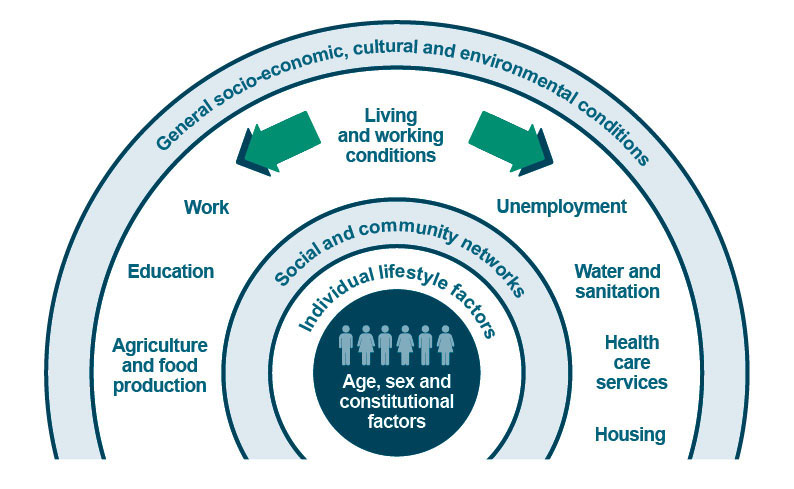
The wider determinants of health, increasingly referred to as the ‘building blocks of health’, including access to education and transport, employment and good quality housing – play a key role in what makes us healthy, along with our behaviours and the environment we live in.
There is a social gradient, with the poorest typically experiencing worst outcomes across the course of a chronic disease.
Councils are uniquely placed to positively influence many of the wider determinants of health, improve health and wellbeing and tackle inequalities. Many councils are adopting health in all policies approaches, established by the World Health Organisation, to consider the health impact of all key decisions and putting health at the heart of council decision making. For example, planning and public health colleagues working together to design green spaces for new urban developments. The LGA offers facilitated support to councils to implement a Health in all policies (HiAP) approach to embed health improvement across all the activity of the council and its partners (see resources).
Elected members have a crucial role in understanding the needs of their communities and addressing health inequalities and improving health. This is part of the role of all elected members, however those with relevant portfolio or chairs of Health and Wellbeing Boards play a particular role in the strategy around prevention and wider determinants of health. To support health improvement in their communities, members need to:
- understand their local ward data on health and wellbeing
- openly discuss and challenge the data and priorities for the council
- apply their community knowledge to the decision-making process
- understand how their local area, services, data and information fits in with the national and local policy context
- have open discussions on how to best implement evidence-based interventions in their ward
- regularly engage with their director of public health and public health team to understand the data/wider data for their neighbourhood and local authority.
The LGA delivers free Prevention Matters training for elected members to champion health improvement and prevention in their communities
What are the three levels of prevention?
Prevention is often categorised into three levels – primary, secondary and tertiary.
|
Primary |
Secondary |
Tertiary |
|---|---|---|
|
Before condition occurs |
During development of condition |
After condition has occurred |
Primary prevention involves activity to reduce the risk that people will develop poor health. Examples include:
- designing a built environment with cycle paths and walkways to encourage exercise and building homes away from traffic congestion
- universal lifestyle services that help people improve their diet or stop smoking
- build support networks to decrease social isolation
- steps to limit junk food advertising on council-controlled sites.
Secondary prevention involves more targeted interventions for people who are at risk of, or in the early stages of, developing illness. The aim is early diagnosis and early intervention to stop, slow the progress of, or reduce the impact of poor health on the individual; also, to reduce or delay the need for more extensive health or care services. Examples include:
- screening, such as the NHS Health Check for individuals between ages 40 and 74 to identify risks of stroke, heart disease, type 2 diabetes, kidney disease and dementia so they can go on to receive advice and treatment where needed
- case finding, such as GP practices identifying people on their lists in danger of falling, followed by home visits to check for trip hazards, and prescribing exercise to promote strength and balance
- telehealth, telecare and other assistive technology delivered at an early stage to enable people to maintain health and independence.
Tertiary prevention refers to interventions for people who already have a life-limiting illness or disability. The aim is to help them reduce or manage the impact of the illness, improving their quality of life and their independence; also, to reduce or delay the need for more extensive health or care services such as admission to hospital or residential care. Examples include:
- initiatives to help people with long term mental health problems retain or enter employment
- support for carers, such as support groups and individual counselling
- community support for people with dementia, including befriending services, and dementia-friendly areas
- reablement and rehabilitation services to help people return to their homes after a period in hospital.
The levels do not provide an absolute distinction between different types of approach – some interventions will operate on more than one level. However, they are a useful framework which show the synergies between the services that have statutory responsibility for undertaking prevention – local authority public health and adult social care, and the NHS. They illustrate how integration – aligning systems, resources and budgets – can bring cross-system benefits and improved health outcomes.
Understanding the three levels will help local partners to develop a comprehensive approach to prevention which includes primary prevention measures to improve health outcomes for populations in the longer-term.
Barriers to prevention
There are various barriers that have made it harder for councils to adopt a more preventative approach.
Acute pressures crowd out preventative spending. Problems in acute services have more political salience – they are more visible to the public and politicians. Conversely, the impact of cuts to preventative services may not be felt for years.
Political incentives do not align with taking a preventative approach. The political cycle is short, while the benefits of preventative policies can take years (if not decades) to be felt. Shifting to a preventative approach can also often carry some risk, but a culture of blame makes policy makers risk averse. And the benefits of taking a preventative approach regularly accrue to other parts of government, further reducing the incentive to act.
Siloed funding and service delivery hinders prevention. Policy making, funding and service design are siloed. But people’s needs and interactions with public services are more complex. Rigid siloes make it harder to take preventative measures, as the benefits usually accrue to a different part of the public sector.
Achieving a strategic shift to prevention
A shift to prevention as a key strategic approach across all policies is needed if we are to slow and then halt this currently unmitigated rise in preventable diseases.
In order to do this a clear system-wide approach needs to be taken to develop an environment in which policy/legislation, budgets and service contribute to and are held accountable for their part in slowing and then halting the rise in preventable disease.
This approach needs to be multi-stranded including short and long-term measures. There are five key pillars (diagram below) to achieving this, from the policies and budgets needed through service design, accountability and evaluation of impact.

Making the case for investment
We do not actually know what the whole health and social care system currently spends on prevention. A figure of 4-5 per cent is typically quoted for England, which roughly reflects the money spent on the public health grant as a proportion of total government spending on health.
Given the current financial climate, the case for any investment in prevention must be as robust as possible. This applies both to available funding and the difficult issue of shifting resources to prevention while maintaining provision for people with acute health and care needs. In such circumstances, ‘who pays?’ is often a crucial question another question is ‘who benefits?’
There is a significant body of research showing the overall financial impact of a range of modifiable conditions. For example, the annual cost to society of alcohol-related harm is estimated at £21 billion, and alcohol costs the NHS £3.5 billion a year.
Trips and falls cost the NHS more than £2 billion a year, with a 35 per cent increase in acute care costs in the year following a fall. In practice, these issues need to be resolved by strong local partnerships willing to trust each other and share both budgets and risks.
This section provides information that can help construct a case for investment in prevention to inform local planning. There is a growing body of evidence that, in general, preventative interventions result in savings and are an efficient use of resources. For example:
- housing interventions to keep people warm, safe and dry result in £70 savings to the NHS for every £1 spent
- every £1 spent on drug treatment saves society £2.50 in reduced NHS and social care costs and reduced crime
- sexual health services have strong Returns of Investment – £11 for every £1 invested in teenage pregnancy and £9 for every £1 spent on contraception
- every £1 spent on community sport and physical activity generates nearly £4 for the economy and society.
Analysis by the University of York suggests that the expenditure through the public health ring-fenced grant is three to four times as cost-effective in improving health outcomes than if the same money had been spent in the NHS baseline.
In considering investment decisions, local areas will need to use the best information available. Prevention is cost effective and will result in savings for the health and care system and wider in the long-term. against setting the bar higher for prevention than for other interventions – most activity in health and care that results in positive outcomes are not expected to demonstrate where costs will be saved or cash released.
Perhaps most importantly, although the return on investment for prevention may often be long-term, this does not mean that it is not the right thing to do. For example, the risk of dementia is increased by physical inactivity, smoking, diabetes, hypertension and obesity in mid-life and by poor mental health. Although no reliable estimate can yet be produced for rate of return on investment, this information clearly gives weight to prioritising investment in activity shown to modify the risk factors for this devastating condition.
Prevention isn’t just for adults
Prevention and early intervention in childhood fosters healthy behaviours throughout life, especially for improvements in immunisation take up, healthy weight and oral health.
For example, tooth decay is the most common reason for hospital admission among children aged five to nine. For young children, tooth extractions usually require a general anaesthetic and an admission to hospital. This is associated with increased morbidity and places a financial burden on the NHS. Distribution of free tooth brushing packs by health visitors to families in groups at high risk of poor oral health is a cost-effective preventative measure and recommended by NICE, whilst the Return on Investment for one supervised toothbrushing programme estimated that for every one pound spent, the health service benefit at five years was £3.06.
Childhood vaccinations are another cornerstone of prevention, protecting individual children while also contributing to herd immunity, which safeguards entire communities by reducing the spread of preventable diseases. High vaccination uptake is crucial to prevent outbreaks of illnesses such as measles, which can have severe long-term consequences.
Investing in children’s health prevention not only improves immediate outcomes but also lays the foundation for healthier adulthood, reducing the strain on health and care systems in the future. For example, evidence shows that promoting children’s healthy weight through, for example, school meal programmes and active travel initiatives not only enhances physical health but can also boost academic performance and mental wellbeing.
Similarly, early support for parents through health visiting programmes and targeted parenting interventions can improve developmental outcomes and reduce the likelihood of future health and social care challenges.
Questions to consider
How do you know that your council is doing all it can to deliver on prevention?
Policies and budgets are ‘prevention proofed’
What are the key health issues in our community that need preventive measures?
Understanding the specific health challenges can help prioritise actions and allocate resources effectively.
How can we integrate prevention into all aspects of our council's work?
This involves ensuring that preventive measures are considered across all policies and services such as planning, housing, education, and other sectors with clear accountability on delivery.
What evidence-based strategies can we implement to address these issues?
Using proven methods can increase the likelihood of successful outcomes.
How can we engage the community in our prevention efforts?
Community involvement is crucial for the success of preventive measures. This can include public forums, surveys, and partnerships with local organisations.
What partnerships can we form to enhance our prevention initiatives both inside and outside the local authority?
Collaborating with NHS, schools, VCSE, DWP, Police can amplify the impact of preventive measures.
How will we measure the success of our prevention programs?
Setting clear metrics and regularly evaluating progress ensures that the initiatives are effective and can be adjusted as needed.
What are the potential barriers to implementing these preventive measures, and how can we overcome them?
Identifying and addressing obstacles early can help in smooth implementation.
How can we ensure sustainable funding for our prevention programs?
Long-term planning and securing diverse funding sources are essential for the continuity of preventive efforts.