
Key messages
- Councils have a range of duties and responsibilities to promote the health and wellbeing of young people in their area. This includes the prevention of mental illness and the promotion of mental health and, as appropriate, assessment and treatment under the Mental Health Act.
- Councils are also responsible for providing targeted support for children and young people in care, those with special educational needs and disabilities (SEND) and those supported by youth offending teams.
- Councils can collaborate with NHS commissioners and providers, schools and colleges, and the voluntary and community sector to provide a range of mental health support for young people from universal services through to specialist mental health care.
- Family and household circumstances can have a major influence on young people’s mental health and wellbeing. Councils should find ways to reduce known risk factors and invest in initiatives that promote protective factors.
- A whole household approach to young people’s mental health recognises the important roles that parents, carers or siblings can play in supporting young people’s mental health.
- Promising approaches share common goals and principles. They set out to offer a wider range of support, make the system easier to navigate, avoid the ‘cliff-edge’ of support ending at age 18, share resources for young people and families and support families to create mentally healthy homes.
- Local leaders can champion a whole household approach to young people’s mental health. Engaging young people and families is important for addressing inequalities in mental health. Young people and families benefit from the opportunity to contribute to the design and delivery of services across the mental health pathway.
- As part of a whole-household approach, young people said they want: support for parents and the whole family, to strengthen the relationship between young people and their parents/carers and to foster a nurturing environment in the household.
- Within the complex commissioning landscape, councillors can act as useful navigators for community stakeholders, young people and families. They can hold commissioners across agencies to account for delivering services which meet local needs.
Duties on councils and their partners
Unitary and upper tier councils have statutory responsibilities to provide support for people experiencing mental health problems, including care assessments and planning, crisis intervention, advocacy, and the provision of a number of roles, such as Approved Mental Health Professionals who are directly involved in the safety and support of people in urgent mental health distress. They directly commission a range of services related to mental health and wellbeing. Key services include public health, social care, drug and alcohol support, and others which affect population wellbeing and access to support.
In carrying out their duties, these councils should:
- Produce and publish Joint Strategic Needs Assessments (JSNAs) and Local Health and Wellbeing Strategies (LHWS) in collaboration with NHS commissioners.
- Commission public health services to promote the mental health of young people and their families.
- Support maternal and infant mental health through health visiting services and provide therapeutic substance misuse and sexual health services.
- Ensure that children and adults’ services work together to commission and deliver support to young people transitioning from child to adult services, up to the age of 25.
- Work with local NHS commissioners to jointly commission mental health support for children and young people within their local area.
- Provide for and promote the welfare of children in care, including a duty under the Children Act 1989 to safeguard and promote the welfare of the children they look after.
- Work with partners to support children and young people with special educational needs and disabilities (SEND). Read the Special educational needs and disability Must Know guide for further information
- Other local authority services may provide mental health support for young people including youth services probation services, and family hubs. Many of these services are often delivered as part of the local authority’s early help (or early intervention) offer.
Councils at district level might not have statutory responsibilities to deliver public health services or social care, but they still hold several key functions which affect community health and wellbeing. They are responsible for housing, leisure, culture, green space and environment, benefits, and licensing. There are strong links between housing and mental health. Poor mental health can make it difficult for people to manage housing issues and conversely problems with housing, including homelessness, can worsen people’s mental health outcomes. Councils should work closely with local housing and mental health service providers to put in place measures to prevent mental health problems arising and deliver joined up support to those experiencing mental health difficulties.
District councils are closely involved with community-based activities and neighbourhood management, where health is promoted and prevention takes place, so are well placed to bridge communities with wider mental health systems and decision making.
Young people's mental health
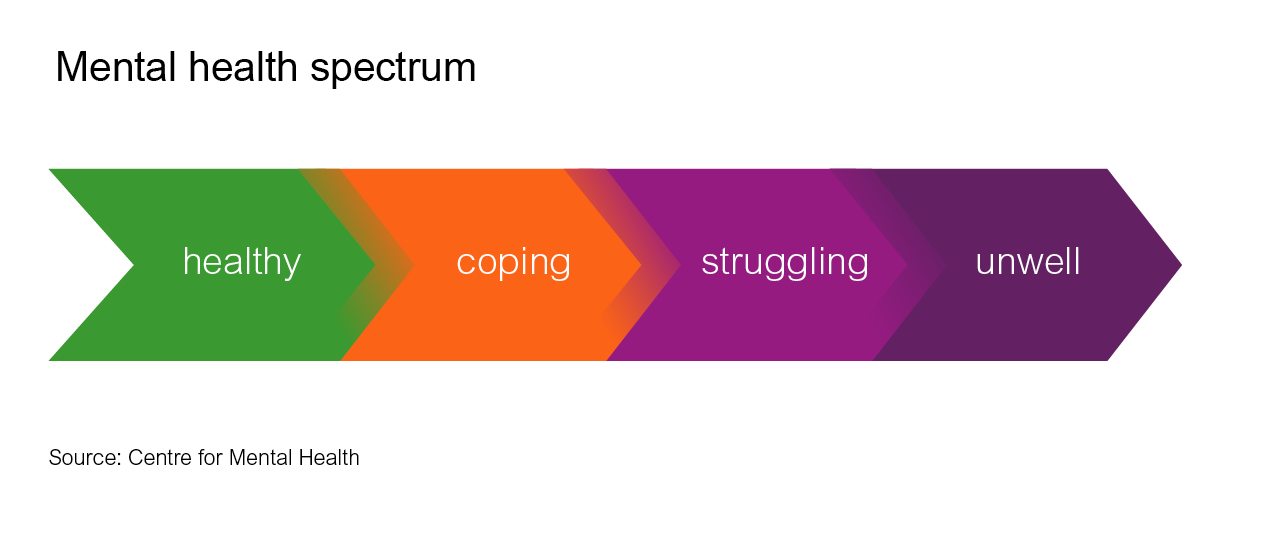
The mental health spectrum
Mental health is best thought about in terms of being on a spectrum (Figure 1). At any one time, all young people will be somewhere on the spectrum. Young people and families require different kinds of information, advice, and support across the spectrum.
Councils have a part to play across the spectrum.
In 2023, one in five children and young people aged 8 to 25 years old were identified as having a probable mental disorder. The rate of identification increased from one in nine in 2017 to one in six in 2020, coinciding with the COVID-19 pandemic. Lord Darzi’s Independent Investigation of the National Health Service in England found that referrals to Children and Young People’s mental health services have tripled between 2016 and 2024.
The period of transition
Research finds that most adult mental health problems have their roots in childhood and adolescence. Half of mental health problems first emerge by the age of 14, and three quarters by age 24. The period of transition can be a difficult and uncertain time for young people due to the various moves they experience within education, employment, and living circumstances.
For young people with emotional or mental health needs, this can be a particularly challenging time. Without the right support in place, many young people ‘fall through the cracks’ between child and adult services. However, well co-ordinated care and support, can protect young people’s mental health.
A whole household approach mental health
What the evidence tells us
Research shows there is a strong link between parental mental health and young people’s mental health. Children living in families that struggle to function well are more likely to have a mental disorder than those from healthy functioning families, analysis has shown.
Analysis by the Children’s Commissioner for England estimates that 2.3 million children grow up in a ‘vulnerable family background’, and 900,000 children live with parents who have a mental illness. Over a third (38.2 per cent) of children living in families with the least ‘healthy functioning’ had a mental health problem. While studies demonstrate the importance of working with families and households, most mental health services still focus on treating the individual.
Risk and protective factors within households
Children and young people’s mental health is influence by a range of risk and protective factors within families and households. Public Health England (2016), The mental health of children and young people in England
Protective factors
- Family harmony and stability
- Positive parenting
- Affection
- Clear, consistent discipline
- Support for education
Risk factors
- Family disharmony and break up
- Inconsistent discipline style
- Parents/carers with mental illness
- Parental substance misuse
- Emotional abuse
- Parental criminality or alcoholism
- Death and loss
- Poverty and financial instability
Implementing whole household approaches
Councils should consider ways to reduce these known risk factors and invest in initiatives that promote the protective factors. Centre for Mental Health's review of promising initiatives identified a range of approaches embedded in local areas.
What might an approach look like?
- Systemwide redesign of Child and Young People’s Mental Health Services with a focus on community support, transition to adulthood and involvement of parents.
- Parenting programmes and tailored support for parents whose children have mental health problems. This includes support aimed at foster carers and adoptive parents.
- Flexible, non-judgement holistic support for young people, tailored to work around family needs and circumstances.
- Family mediation for young people at risk of homelessness.
Collectively, and in different ways, promising approaches shared a number of common goals and principles. They set out to offer a wider range of support, make the system easier to navigate, avoid the ‘cliff-edge’ of support ending at age 18, share resources for young people and families, and support families to create mentally healthy homes.
What do councils need to think about to help make it work?
- An emphasis on partnership working, especially with NHS commissioners and with the voluntary sector.
- Packaging a range of services ‘under one roof’, giving young people and their families flexible access to the help they need.
- Engaging young people and their families in service design and delivery.
- Having a strong digital presence, where information on supporting mental health in the home and accessing services is easily available.
Engaging young people and families
Young people and families benefit from the opportunity to contribute to the design and delivery of services across the mental health pathway. Their involvement can make sure that help is accessible and acceptable, that it meets the needs of diverse communities, and that resources and information are effective and easily used to support mental health in the home. Engaging young people and families is especially important for addressing inequalities in mental health.
Local councils can demonstrate leadership through:
- Meaningful consultation during strategy design and refresh – hearing from young people about the support they need and the outcomes they want.
- Standing committees of young people who scrutinise and inform plans at every stage. These can be based within a community partner organisation or directly run by the council.
- Parent/carer and young person representation on Health and Wellbeing Boards.
- Working with young people to co-design resources and information, especially digital resources
- Developing ways for parents/carers and young people to take on peer support roles in local systems.
- Ensuring that parents and carers are supported and offered active roles in school-based mental health programmes, for example as mental health champions.
Councils can also adopt specific initiatives, for example MH:2K, which facilitate youth leadership from the outset, helping young people to identify the mental health issues that they see as most important, engage their peers, and work with decision-makers and researchers to make recommendations for change.
National policy context
Children and young people’s mental health has been the subject of great public and policy interest in recent years, and as a result a raft of measures has been introduced to improve mental health outcomes for children and young people, and the support available to them. Policies and strategies have predominantly focused on expanding access to support through education settings and NHS Children and Young People’s Mental Health Services (CYPMHS). In particular, Future in Mind (2015), the Five Year Forward View for Mental Health (2016), the Transforming Children and Young People’s Mental Health provision: green paper (2018), and the NHS Long Term Plan (2019) have all contributed positively to increasing the availability of provision to meet identified need.
Yet, many children and young people continue to face challenges accessing support for their mental health and their experiences of services are not consistently good. Patchy implementation of policies has also fuelled a postcode lottery in provision meaning that children and young people do not get a consistent offer of support. What is more, while some attempts have been made to integrate mental health support across the system, there has been an overall lack of progress in effectively integrating services within children’s social care and the special education needs (SEN) and disabilities system of support, meaning children in these groups face particular challenges in accessing support.
Education
Councils can support the delivery of whole school and college approaches to mental health and work with schools and colleges to deliver preventive mental health initiatives such as campaigns, staff training or embedding mental health and wellbeing within the curriculum. School nurses also have a vital role to play in promoting young people’s mental health as part of a whole school and college approach. Public Health England and the Children and Young People’s Mental Health Coalition have produced a whole school and college approach guide.
The Departments for Education and Health and Social Care, working with the NHS, are rolling out Mental health support teams (MHSTs) to support children and young people within schools. MHSTs provide additional capacity to promote and support mental health and wellbeing in primary, secondary and further education settings and have 3 core functions:
- provide early, evidence-based interventions for common mental health issues
- support mental health leads to develop and embed a whole school or college approach
- give timely advice to staff, and liaise with external specialist services, to help children and young people get the right support and stay in education
Resources
Questions to consider:
- Does your local area provide tailored mental health support to young people up to the age of 25?
- What support does the local system provide for young people who do not meet the threshold for secondary mental health care but who have emerging mental health difficulties?
- What support do young people and families receive in your local area to prevent mental health difficulties?
- Does your local area offer mental health support digitally or remotely?
- What mental health support is offered to children with SEND locally? How integrated is mental health provision within your SEND local offer?
- What mental health support is available to children and young people experiencing mental health inequalities? For example, support for those from racialised or LGBT+ backgrounds, living in poverty and those with disabilities.
- What opportunities are there for children, young people, and families to inform decision-making and the design of mental health services?
- Does your local area offer peer support and training opportunities for parents and carers on young people’s mental health?
- What support is provided to parents and carers of young people who use mental health services in your area?
- What training and support is available for foster carers and adoptive parents around young people’s mental health?
- How is the transition from child to adult mental health services experienced by young people in your area?
- How easy is it parents and carers to access the right information, advice, and guidance about local mental health support?
Key policy documents
- Supporting Families 2021 to 2022 and beyond: A policy paper (2021)
- The NHS Long Term Plan (2019)
- Transforming Children and Young People’s Mental Health Provision: a Green Paper (2018)
Government guidance
- Promoting the health and wellbeing of looked-after children: a statutory guidance for councils, clinical commissioning groups and NHS England. Department of Health and Department for Education
- The SEND code of practice: 0 to 25 years provides guidance for councils, education settings and health bodies on the special educational needs and disability (SEND) system for children and young people aged 0 to 25
- Prevention Concordat for Better Mental Health and consensus statement
Key data sources
- Public Health England: Fingertips tools Children and Young People's Mental Health and Wellbeing Profiling Tool provides local data across a number of indicators.
- NHS Digital: Mental Health of Children and Young People Survey. This survey series provides England’s best source of data on trends in child mental health.
- NHS Mental Health Dashboard brings together key data from across mental health services to measure the performance of the NHS in delivering our Long Term Plan for mental health.
Local Government Association documents
- Children and Young People’s mental health: An independent review in policy success and challenges over the last decade
- Improving young people’s mental health - what does a whole household approach look like? 22 March 2021, conference presentations.
- Building resilience: how local partnerships are supporting children and young people's mental health and emotional wellbeing.
- Improving children and young people’s mental health and emotional wellbeing: Findings from the LGA’s peer learning programme.
- Improving transition from children to adult mental health services: Learning, messages and reflections from the LGA conference.
- LGA Children’s mental health task and finish group: key findings and recommendations
- Must know for youth services
- Must know for SEND
Resources