Key messages
- In 2021, councils in England and Wales had shown solid progress in implementing the ambition set out in the LGA National Procurement Strategy 2018, however in 2025 very little has changed at the aggregated levels. This could be due to councils achieving what they consider a sufficient standard, but the range of responses show that some councils are scoring significantly higher than others. Our challenge is to find the examples of excellence and find ways of supporting more councils in achieving this.
- The assessment looks at strategic policy areas such as commercialisation, community benefits, contract management and engaging with local businesses and the voluntary sector.
- 60 per cent of English councils (excluding Combined Authorities) took part in the self-assessment process, slightly less than in previous assessments. Reasons for not participating included:
- the use of CCIAF and other benchmarks
- local government reorganisation impacting the relevance to some councils and available resources
- lack of resources, prioritisation.
- This year, we also invited Combined Authorities to assess. Five out of the 12 responded. We have excluded their data from these results as it isn’t comparable, but the results have been made available to those who responded. Achieving an assessment of ‘Mature’ continues to be seen as a very satisfactory outcome – we expected few councils to assess as ‘Leader’ or ‘Innovator’.
- Each council determines their own priorities and what mattered to them – there are no national targets.
- Identified areas of good practice will continue to be shared through case studies, webinars and conference sessions.
- A continued investment in procurement skills and knowledge, particularly commercial skills, will help councils to deliver even greater financial and social benefits.
- The Procurement Act 2023 (PA23) came into force on 24 February 2025 and aims to create a simpler, more flexible, and transparent system for contracting authorities in the UK. To ensure councils are able to fully benefit from these changes, they must ensure they have the right procurement capability and capacity.
- A new National Procurement Policy Statement (NPPS), came into effect alongside PA23, and sets out the Government’s strategic priorities for public procurement and how contracting authorities, including councils, can support their delivery. As part of this, public sector contracting authorities are asked to benchmark themselves, and the LGA has successfully negotiated to have the latest version of the National Procurement Strategy recognised as a core set of values to be benchmarked against.
- The NPPS also sets out the Government’s strategic priorities for public procurement and how contracting authorities, including councils, can support their delivery. These priorities are:
- social value
- commercial and procurement delivery
- skills and capability for procurement.
Background
In July 2018, we published our revised National Procurement Strategy for Local Government in England – ‘Delivering the ambition’ – which superseded our original 2014 strategy and had further been updated in 2022 but not benchmarked against hence the comparison with the 2018 version outlined in this paper. The 2018 strategy differed from its predecessor in several ways:
- It focused on three key themes which, consultation has shown, reflected local government’s priorities:
- showing leadership
- behaving commercially
- achieving community benefits.
- It took a broad view of the scope of procurement beyond compliance and tactical issues to include interrelated aspects of commercialisation, commissioning, contract management and the delivery of social value.
- It included a part two toolkit defining a maturity index for each of the 13 areas listed under the three themes. There are five levels in the maturity index:
- Level one – minimum
- Level two – developing
- Level three – mature
- Level four – leader
- Level five – innovator.
- Councils were invited to self-assess against the maturity index in 2018, the results of which can be found in the first diagnostic report, published in 2019. This was repeated in 2021 with the results shown here.
In 2025, we repeated the England-wide self-assessment. The councils in Wales were also invited to participate. We chose to replicate the diagnostic using the 2018 value codes to allow for like-for-like comparison even though later updates to the strategy have been released. Councils that participated have comparative data with their own responses from 2021 and 2018 alongside comparisons with the national averages, and those of their region.
This report presents the results from the 2025 assessment with some comparisons to prior years.
Please contact [email protected] if you would like to see the results in more detail.
About this research
We use the diagnostic approach to allow councils to ‘self-assess’ their capabilities against the 59 'value codes' under each of the three themes and enablers set out in the National Procurement Strategy. The three themes are: Leadership, Behaving Commercially and Achieving Community Benefits, with the enablers being cross cutting issues.
A diagnostic differs from a traditional survey in the following ways:
- It is a statement of fact based against predefined outcomes rather than a subjective opinion (that is, one council’s ‘Very good’ could be another council’s ‘Average’).
- It uses a controlled list of invited participants, one per council, and is based on focused topics, identified as important by councils themselves, which can be adapted to environmental changes and business improvement.
- It seeks to identify root causes for issues while allowing participating organisations to define what actions and resources are needed to drive their own improvement.
The National Procurement Strategy 2018 was designed as a dynamic document with a view to its aspirations being measured and reported on. The exercise in 2025 was the same as the exercise in 2021 and 2018 to allow councils to be able to compare progress since then against each of the value codes.
The facility for councils to include supporting information and local examples in support of their self-assessments remained and is now being used nationally to inform change.
On completion of the diagnostic, councils were able to download a copy of their own responses. Later, upon closing the diagnostic entry window, they could download their data again with comparative regional and national ‘benchmarks’ based on all responses received.
The diagnostic was completed by 102 county / unitary / metropolitan councils (including one from Wales) and 89 district councils.
59 County, Unitary or Metropolitans have completed for all three years. 24 Districts/Boroughs have completed for all three years (note that some have merged and some no longer exist due to local government reorganisation in the interim period).
Findings
Understanding the assessment
In reporting the findings, it is important to put the range of defined outcomes into context – from ‘Minimum’ to ‘Innovator’.
When launching our National Procurement Strategy, we made it clear that it was not attaching any priorities, targets or scale of importance to any of the 55 value codes. It recognised that there were differences between upper tier and district councils and that even neighbouring councils in the same tier could have widely differing priorities. It was for each council taking part in the assessment to define what matters and decide the level of attainment to which it wanted to aspire. It is important to note that:
- level three ('Mature') assessments are a creditable outcome and, in most cases, might not warrant further improvement in the short to medium-term
- level four or five assessments would only be made when an individual council had evolved to a point that it could act as an exemplar to other councils in a given area and be able to help others raise standards where they considered it to be important
- level two or even level one assessments could also be acceptable, particularly if the assessing council did not deem a given value code to hold local importance
- other factors that need to be considered when reporting the findings are that:
- a gap between upper tier and district councils was to be expected given the differing priorities, operational scale and resourcing levels
- regional variations were also to be expected reflecting socio-economic, political and geographical considerations
- individual assessments made for each value code were likely to be averages and did not reflect the potentially wide variations of outcome that are usually found within individual councils – variations of up to four levels are not uncommon
- average findings can be influenced by the number of councils responding and the size of the target group (for example the number of councils in a region)
- moving up one assessment level can take a significant amount of resource and/or time depending on the content of the agreed local action plan.
Typically, good practice is defined as an assessment at level four or five, with three being a perfectly acceptable level of attainment. In reality, very few would be expected to assess at level five ('Innovator') as, by definition, this makes them sector pioneers for new thinking, techniques and approaches. Assessments at level four ('Leader) are more likely to be achieved and can be counted as ‘good practice’ which should be promoted across the sector.
2025 assessment outcomes
County, unitary and metropolitan councils
Chart 1: Average results for tier one councils for both 2021 and 2025
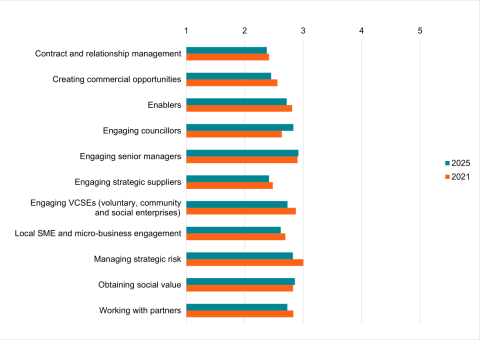
This diagram shows the average scores for each of the sections. The green bar shows the score for 2025 and the orange bar the comparison score from 2021.
- Only two sections show an improvement: Engaging councillors and Engaging senior managers.
- The greatest improvement is in Engaging councillors.
The actual scores are shown in the table below with a comparison to 2021.
Table 1: Tier one council 2025 scores
| Category | Average | Low | High | Range | Change |
|---|---|---|---|---|---|
| Engaging senior managers | 2.9 | 2 | 3.4 | 1.4 | 0 |
| Obtaining social value | 2.9 | 2.4 | 3.5 | 1.1 | 0.01 |
| Engaging councillors | 2.8 | 2.4 | 4 | 1.6 | 0.02 |
| Managing strategic risk | 2.8 | 2.2 | 3.1 | 0.9 | 0.01 |
| Engaging VCSEs voluntary, community and social enterprises) | 2.7 | 2 | 3.2 | 1.2 | 0.02 |
| Working with partners | 2.7 | 2.3 | 3.4 | 1.1 | 0.02 |
| Enablers | 2.7 | 2.3 | 3.2 | 1 | 0.03 |
| Local SME and micro-business engagement | 2.6 | 2.1 | 3.1 | 1 | 0.06 |
| Creating commercial opportunities | 2.5 | 2 | 2.9 | 0.9 | 0.1 |
| Engaging strategic suppliers | 2.4 | 1.7 | 2.9 | 1.2 | 0.04 |
| Contract and relationship management | 2.4 | 2 | 2.8 | 0.8 | 0.01 |
Table 2: Tier one council 2021 scores
| Category | Average | Low | High | Range | Change |
|---|---|---|---|---|---|
| Engaging senior managers | 3 | 2.7 | 3.2 | 0.5 | - |
| Obtaining social value | 2.9 | 2.6 | 3.2 | 0.5 | - |
| Engaging councillors | 2.8 | 2.2 | 3 | 0.9 | - |
| Managing strategic risk | 2.8 | 2.3 | 3.3 | 1 | - |
| Engaging VCSEs voluntary, community and social enterprises) | 2.8 | 2.4 | 3.2 | 0.8 | - |
| Working with partners | 2.8 | 2.3 | 3.2 | 0.9 | - |
| Enablers | 2.6 | 2.2 | 3 | 0.8 | - |
| Local SME and micro-business engagement | 2.6 | 2.1 | 2.9 | 0.8 | - |
| Creating commercial opportunities | 2.5 | 2.1 | 2.8 | 0.8 | - |
| Engaging strategic suppliers | 2.5 | 2.2 | 2.7 | 0.5 | - |
| Contract and relationship management | 2.4 | 1.9 | 2.6 | 0.7 | - |
The highest performing section in 2021 was Managing strategic risk, possibly as a result of the focus given during the pandemic.
Working with third parties (Voluntary Sector, SMEs, other partners) has dropped in position, but there is no significant drop in scoring. However, Obtaining social value has increased in position and average score.
The same three sections stay at the bottom of the table (also consistent with 2018) with no significant change in average score. The question we need to ask ourselves is whether this is by choice – what does ‘good’ look like for these value codes.
The top performing Section in 2025 is Engaging senior managers. The chart below shows the distribution of scores.
Chart 2: How tier 1 authorities scored in the 'Engaging senior managers' section of the National Procurement Strategy
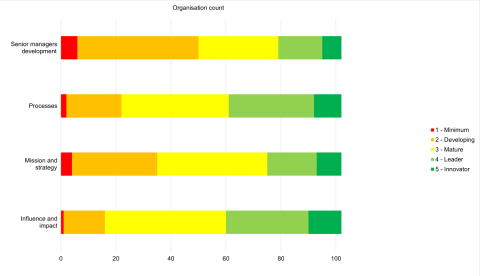
Compare this to the lowest performing Section in 2025 – Contract and relationship management:
Chart 3: How tier one authorities scored in the 'Contract and relationship management'
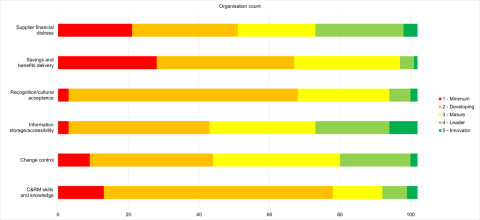
The challenge we face is to determine what ‘good’ looks like for our councils and ensure that we share the experience of the higher performing councils with those performing at Minimum or Developing.
District Council comparison
Chart 4: Average results for tier two councils for both 2021 and 2025
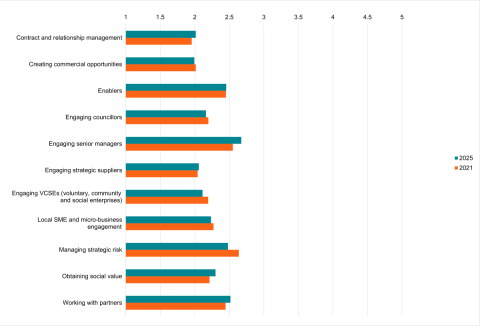
Graph showing the average results for tier two councils for both 2021 and 2025, full results are detailed in the table below. These diagrams show the average scores by Section for the smaller district and borough councils with comparisons to 2021.
Overall, as expected, the smaller councils score lower than for the larger councils with an average of around half a point less. This is similar to prior years and has been attributed to several factors such as:
- resource restrictions
- lack of dedicated ownership of procurement as a function in smaller authorities
- smaller and less diverse spend profiles.
We did however, see an increase in the number of smaller councils participating in the diagnostic. Up 22 per cent on 2021 and 34 per cent since 2018.
The actual scores are shown in the table below with a comparison to 2021.
Table 3: Tier two council 2025 scores
| Category | Average | Low | High | Range | Change |
|---|---|---|---|---|---|
| Engaging senior managers | 2.7 | 2.5 | 3 | 0.5 | 0.05 |
| Working with partners | 2.6 | 2.4 | 2.7 | 0.3 | 0.08 |
| Managing strategic risk | 2.5 | 2.4 | 2.7 | 0.3 | -0.03 |
| Enablers | 2.4 | 2 | 2.5 | 0.5 | 0.01 |
| Obtaining social value | 2.3 | 2.1 | 2.5 | 0.4 | 0.06 |
| Local SME and micro-business engagement | 2.1 | 2.2 | 2.3 | 0.1 | 0 |
| Engaging councillors | 2.1 | 1.9 | 2.4 | 0.5 | -0.02 |
| Engaging VCSEs voluntary, community and social enterprises) | 2.1 | 2 | 2.2 | 0.2 | -0.02 |
| Engaging strategic suppliers | 2.1 | 1.9 | 2.2 | 0.3 | 0.07 |
| Contract and relationship management | 2 | 1.7 | 2.2 | 0.5 | 0.05 |
| Creating commercial opportunities | 1.9 | 1.7 | 2.1 | 0.4 | -0.01 |
Table 4: Tier two council 2021 scores
| Category | Average | Low | High | Range | Change |
|---|---|---|---|---|---|
| Engaging senior managers | 2.6 | 2.4 | 3.1 | 0.7 | - |
| Working with partners | 2.6 | 2.3 | 2.8 | 0.5 | - |
| Managing strategic risk | 2.4 | 1.9 | 3.1 | 1.2 | - |
| Enablers | 2.4 | 2.1 | 2.8 | 0.7 | - |
| Obtaining social value | 2.2 | 2 | 2.4 | 0.4 | - |
| Local SME and micro-business engagement | 2.2 | 1.9 | 2.3 | 0.4 | - |
| Engaging councillors | 2.2 | 1.8 | 2.6 | 0.8 | - |
| Engaging VCSEs voluntary, community and social enterprises) | 2.2 | 1.9 | 2.4 | 0.5 | - |
| Engaging strategic suppliers | 2 | 1.6 | 2.2 | 0.6 | - |
| Contract and relationship management | 1.9 | 1.6 | 2.3 | 0.7 | - |
| Creating commercial opportunities | 1.9 | 1.7 | 2.2 | 0.5 | - |
Very little has changed for the section scores. Most sections have improved slightly. What is interesting is that the position of the sections has remained consistent.
The worst performing sections are consistent with the larger councils as is the top scoring section Engaging senior managers.
This diagram shows the distribution of scores for (firstly) Contract and relationship management and (secondly) Creating commercial opportunities.
Chart 5: How tier two authorities scored in the 'Contract and relationship management' section of the National Procurement Strategy
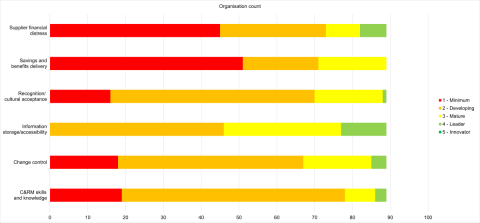
Chart 6: How tier 2 authorities scored in the 'Creating commercial opportunities' section of the National Procurement Strategy
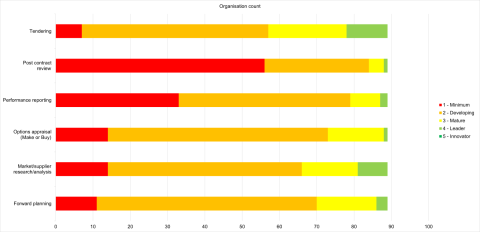
As with the larger councils, a review of what ‘good’ should look like could be taken into account. But it is interesting that several councils score 4-Leader.
Regional variation
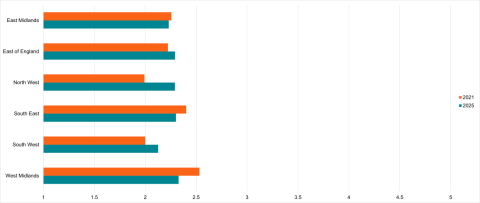
The chart below shows the average tier one council score by region, for both 2021 and 2025. The range between the highest scoring region and the lowest is 0.6 in 2025, up slightly from 2021.
Chart 7: Average tier one council score by region, for both 2021 and 2025, full alternative text within document
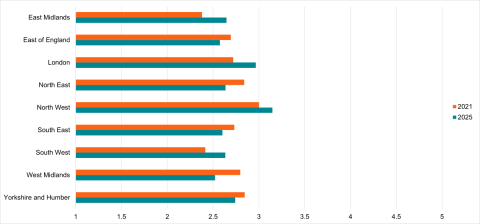
Chart 8: Average tier one council score by region, for both 2021 and 2025, full alternative text within document
Identifying good practice
Good practice can be identified in two ways:
- looking at councils who have scored four-Leader or five-Innovator for any of the value codes
- analysing the comments.
The latter is being done using AI tools, however the following is interesting as a representation of areas where we are performing well:
- Over a third of the larger councils scored the following Value codes with either Leader or Innovator:
| Managing strategic risk | GDPR (legislation) |
| Obtaining social value | Policy and scope (social value) |
| Obtaining social value | Procurement (social value) |
| Obtaining social value | Commissioning for social value |
| Obtaining social value | Social value TOMs (themes, outcomes and measures) |
| Engaging senior managers | Influence and impact |
| Engaging senior managers | Processes |
| Enablers | Embedding change |
Only one Value code was scored Leader or Innovator by a third of the smaller councils; Managing strategic risk: GDPR (Legislation). A further nine were scored Leader or Innovator by at least 10 per cent of the smaller councils.
| Obtaining social value | Policy and scope (social value) |
| Engaging senior managers | Influence and impact |
| Engaging senior managers | Processes |
| Engaging senior managers | Senior managers development |
| Working with partners | Culture |
| Contract and relationship management | Information storage/accessibility |
| Creating commercial opportunities | Tendering |
| Enablers | Embedding change |
| Enablers | Developing talent |
And as a comparison, here’s the value codes where councils scored lower:
- There are 11 Value codes where less than 10 per cent of the larger councils scored either Leader or Innovator.
| Contract and relationship management | Recognition/cultural acceptance |
| Contract and relationship management | Savings and benefits delivery |
| Enablers | Exploring digital technology |
| Managing strategic risk | Supply chain and contractor failure |
| Engaging councillors | Councillor development |
| Local SME and micro-business engagement | Contract management with SMEs |
| Engaging VCSEs (voluntary, community and social enterprises) | Contract management with VCSEs |
| Engaging VCSEs (voluntary, community and social enterprises) | Governance of VCSE engagement |
| Local SME and micro-business engagement | Governance of SME engagement |
| Creating commercial opportunities | Post contract review |
| Engaging strategic suppliers | Existing strategic supplier engagement |
Similarly, there are 11 Value codes where none of the smaller councils identified themselves as either Leader or Innovator (note that this is five out of nine of the Engaging VCSE Value codes).
| Engaging VCSEs (voluntary, community and social enterprises) | Procurement with VCSEs |
| Engaging VCSEs (voluntary, community and social enterprises) | Policy and scope (VCSEs) |
| Engaging VCSEs (voluntary, community and social enterprises) | VCSE relationships |
| Engaging VCSEs (voluntary, community and social enterprises) | Contract management with VCSEs |
| Engaging VCSEs (voluntary, community and social enterprises) | Governance of VCSE engagement |
| Local SME and micro-business engagement | Procurement with SMEs |
| Local SME and micro-business engagement | Governance of SME engagement |
| Engaging strategic suppliers | Data collection and analysis |
| Engaging strategic suppliers | Existing strategic supplier engagement |
| Contract and relationship management | Savings and benefits delivery |
| Engaging councillors | Councillor development |
Next steps
The National Advisory Group, which reports to our Improvement and Innovation Committee will continue to look at ways in which it can help channel resources as a means of helping councils to seek improvement in the areas that matter to them. Many of the regional heads of procurement groups also seek to do likewise based on localised priorities. We will also:
- make this report available to all councils (chief executives, leaders and heads of procurement) and professional networks
- develop new proposals for targeting resources aimed at improvement – particularly for contract management and working with partners
- produce case studies and encourage councils to present them through our various conferences, webinars and roundtables
- encourage regions to develop local action plans
- a revised NPS will be launched in 2026, incorporating changes from the Procurement Act 2023, the National Procurement Policy Statement and in the changes in priorities and practice since 2022
- a new benchmarking exercise for councils to complete will take place in 2026, based on the revised NPS. As this NPS will be significantly different from the previous version, results will no longer be directly comparable but will provide a new benchmark for councils to use
- councils who would like to undertake a peer review of their responses to this NPS diagnostic will be able to do so, providing all parties consent to sharing their responses
- attempt to identify contacts in those councils which did not engage in the 2025 diagnostic exercise, to find out why this is the case.