Realise best value from your data assets
Trying to deliver services to residents in a siloed council is like tuning an orchestra where every section is playing a different song.
Local authorities are on the frontline – grappling with rising demands, constrained budgets, and the constant challenge of delivering essential services. Residents, members and local partners demand that councils make the best use of their own assets to improve service delivery, target resources and modernise for the artificial intelligence (AI) age.
- Digital, data and technology functions need to be aligned to embrace transformation.
- Councils already have a way of bringing together systems – it’s local government’s ‘best kept secret’.
What’s this best kept secret?
- It’s enabled Nottingham City Council to realise a Net Present Value of £4.1 million, with predicted benefits to £5.7 million to 2026.
- It’s facilitated Camden Borough Council in recovering nearly £3.35 million in backdated business rates – and secured ongoing income from those properties going forward.
- It’s supported Salford City Council in reducing its outstanding council tax queries by 43 per cent.
- It’s helped Leeds City Council discover £92,826 additional annual tax revenue.
- It’s enabled Conwy County Borough Council to achieve an impressive 46.1 per cent reduction in the average number of days to repair streetlighting failures.
An independent report in 2022 demonstrated that local authorities in England and Wales have realised increased revenue and cost savings of an estimated £250 million over the last five years. Over the next five years, through further integration into council systems, 6:1 return can be expected. In simple terms this means that for every £1 invested local authorities can expect to realise £6 in cost efficiencies and increased revenue.
All of this has been achieved by utilising local government’s Best Kept Secret: adding a unique identifier for location to council datasets.
These identifiers are the Unique Property Reference Number (UPRN), a unique numeric identifier for every addressable location in Great Britain and the Unique Street Reference Number (USRN), the identifier for every street in Great Britain.
The power of identifiers in an AI world
AI thrives on high quality, clean, consistent, and well-structured data. Unique identifiers play a vital role in ensuring data accuracy, efficiency, and reliability. They provide a consistent way to distinguish records, connect related data across systems, and streamline access to information. Without them, data becomes harder to manage, prone to duplication and errors, and far less effective as a foundation for decision-making and service delivery.
Examples of unique identifiers are your NHS Number, your National Insurance number and your car registration number plate.
There are also identifiers for location. When councils deliver services to place, utilising these is vital.
UPRNs and USRNs are these powerful tools that enable data-driven decision-making across the organisation. By linking services, systems, and intelligence to a single, definitive reference point, they break down departmental silos, improve operational efficiency, and enhance service delivery.
For leaders like you, this means clearer insight, better outcomes for residents, and a stronger foundation for transformation, integration, and accountability.
For members and residents, this means being able to achieve the benefits realised by Nottingham, Camden, Salford, Leeds and Conwy in the examples above. Saving taxpayers money and delivering better services. A win-win.
They’re yours already, use them
- Planning authorities have Address Custodians who maintain the definitive address and land and property record for the authority.
- County authorities have Street Custodians who manage the definitive street records.
- Unitary authorities have both.
Although this data is maintained locally by your own authority custodians in a local gazetteer, it follows a national process governed by local government. The entire public sector benefits from this collective agreement, which is funded by central government and now mandated by the Government Digital Service for use across central government systems.
This means that government departments also use your data for the benefit of your residents. It also means that you can more easily exchange data with central government. Just a few examples include:
- HMRC – systems across HMRC are being retrofitted to include UPRNs to eliminate ambiguity and reduce duplication.
- MHCLG – works with GeoPlace on policies such as building safety, identifying tall buildings, the property portal, Energy Performance Certificates, home buying and selling and digital planning.
- NHS – NHS numbers are now linked to the patient’s UPRN (home address) and used for predictive analysis.
- Department for Transport – uses local authority street data as the official source of road length statistics which feeds into policy around funding, road safety, congestion, and traffic statistics.
Extracting value
Through GeoPlace’s benchmarking, 64 per cent of local planning authorities in England and Wales maintain their address data to the very highest standard, with 79.5 per cent of highways authorities reaching the same level of quality.
But only 53 per cent are utilising it to the best advantage of their local residents.
Over the past 25 years, many councils focussed on creating/collecting this data but weren’t necessarily using it as well as they can. Now, with constrained budgets, increasing service demands, and the rise of AI-driven technology, councils must fully realise the return on your existing investment. This approach is fully supported by the Local Government Association (LGA).
Integrate and apply
The LGA states that UPRNs, the unique identifier for addressable locations – is
“key to almost everything that’s delivered or achieved by councils… Everything that local government does happens somewhere, be it housing a homeless person, collecting someone’s bin or providing support to a family in difficulty.
Precise location information is essential for councils to deliver services to the residents they serve.”
GeoPlace works with every local authority in England and Wales to benchmark data quality on an annual basis, and crucially, how well that data is being utilised, or integrated, in every authority. To access the integration report for your council, contact communications@ geoplace.co.uk. This report sets out:
- the overall integration score
- maturity level
- scorecard for services such as
- planning and building control
- social care
- housing
- council tax
- electoral registration
- areas for improvement.
The report also includes links to 30 case studies from local authorities already realising value in these service areas.
The general rule of thumb is that the more services that integrate the UPRN and USRN, the greater the service benefits. For example, in Nottingham, the ROI study found the following benefits:
- data integration: the total impact of integrating addressing data from 2018 to 2026 using the UPRN is estimated to be around £2.4 million
- collection of business rates: with an impact of an estimated uplift of £6.2 million in newly-identified business rates
- children’s social care and early helpservices: the total impact of investing in better addressing will be an estimated increase of £0.4 million
- safer housing: the overall efficiency gain to the council for licensing and enforcement is in the range of £215,000 per annum
- waste management: the total impact over the period 2018 - 2026 is estimated at £0.6 million
- workplace parking levy: a conservative estimate suggests that the direct savings would be at least £5,000 per annum
-
other social and environmental benefits were identified but not quantified at this time including:
- electoral registration
- planning
- climate change, including net zero, retrofit and energy assessment.
Maximising value for your authority
For over 25 years, GeoPlace with the LGA and Ordnance Survey has equipped councils with guidance and resources to realise the full benefits of their data. Here’s our four-step guide:
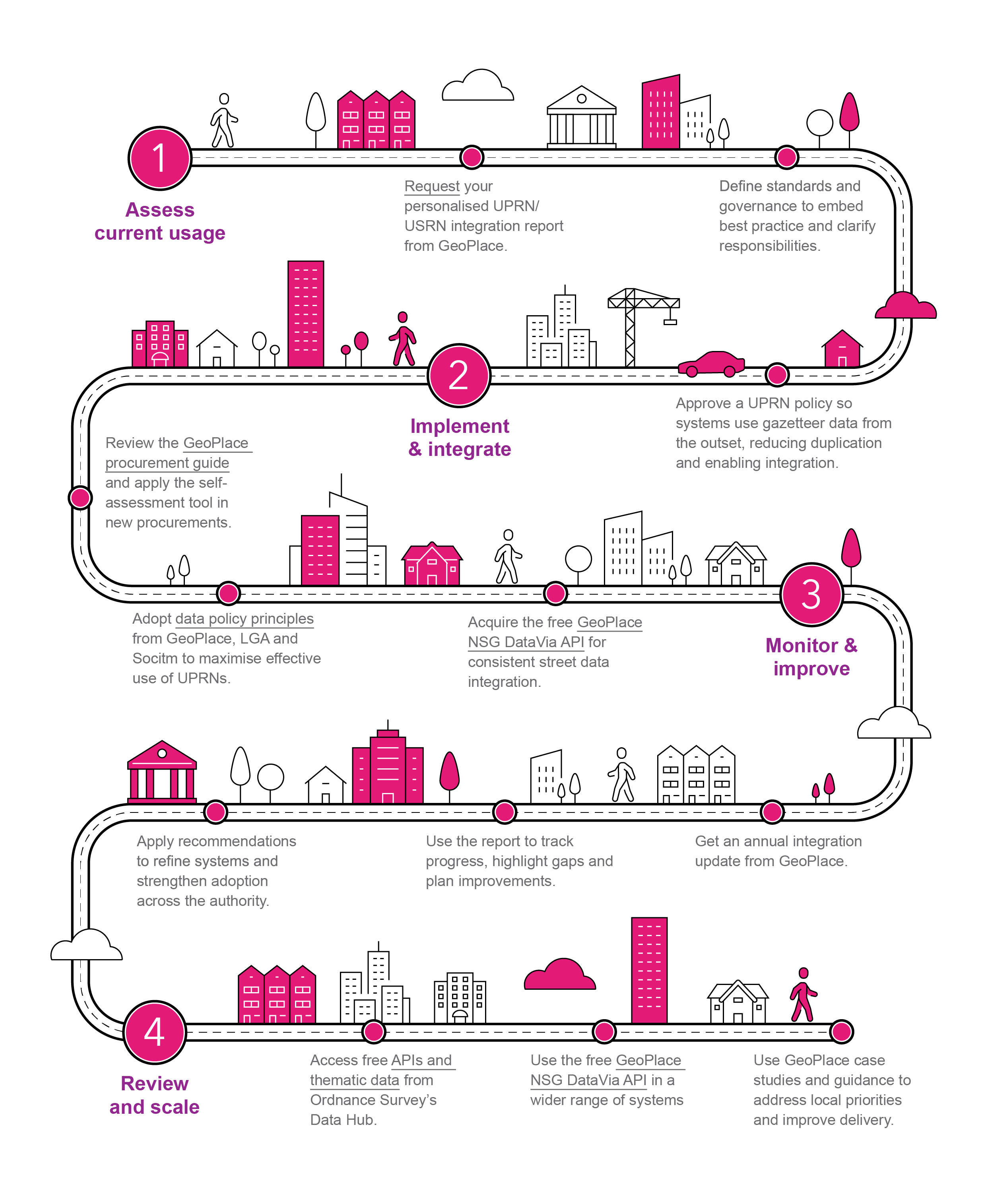
Download above diagram as a PDF with links
Text explanation of diagram
Step 1: Assess current usage
- Request your personalised UPRN/ USRN integration report from GeoPlace.
- Define standards and governance to embed best practice and clarify responsibilities.
- Approve a UPRN policy so systems use gazetteer data from the outset, reducing duplication and enabling integration
Step 2: Implement & integrate
- Review the GeoPlace procurement guide and apply the self-assessment tool in new procurements.
- Adopt data policy principles from GeoPlace, LGA and Socitm to maximise effective use of UPRNs
- Acquire the free GeoPlace NSG DataVia API for consistent street data integration
Step 3: Monitor & improve
- Apply recommendations to refine systems and strengthen adoption across the authority.
- Use the report to track progress, highlight gaps and plan improvements.
- Apply recommendations to refine systems and strengthen adoption across the authority.
Step 4: Review and scale
- Access free APIs and thematic data from Ordnance Survey’s Data Hub.
- Use the free GeoPlace NSG DataVia API in a wider range of systems
- Use GeoPlace case studies and guidance to address local priorities and improve delivery.
Further support and guidance
1. Talk to your Custodian or GeoPlace. If you don’t know who your Custodian is, use the LGA’s Find My Custodian tool
2. Visit GeoPlace’s integration Knowledge Base
3. Review LGA supported webinars including:
• best kept secret: unlocking the hidden value of your data
• techUK: How local authorities can achieve millions in efficiency savings from location data
• how to derive efficiencies and insight from the data you didn’t know you had
4. Get free support and advice from GeoPlace.