Executive summary
This is the fourth review of the Local Government Association’s (LGA) Strategic Supplier Relationship Management (SSRM) programme. The LGA’s National Advisory Group for Procurement commissioned the programme in 2019 to improve dialogue with strategic suppliers to local government. Previously local government had not always acted strategically across councils in its view of supplier markets and the companies that operate within them, and a key aim of the programme has been and remains to rectify that position.
In the four years of operation the programme has been successful in providing councils with market intelligence and a better understanding of the impact (and sometimes frustrations) that councils have on their strategic suppliers. This is making local government think differently about how it needs to interact with markets and individual companies.
Both local government and the companies that provide goods and services to it are dealing with the twin challenges of emergence from the COVID-19 pandemic and the cost-of-living crisis. This has highlighted the need for local government to work closely with all those companies that provide goods and services to it.
During the year the programme was extended to include the Information and Computing Technology (ICT) category which has added to the knowledge that the SSRM programme is gathering about issues affecting key suppliers to local government.
Overview
About the Local Government Association (LGA)
The LGA is the national membership body for local authorities and works on behalf of member councils to support, promote and improve local government. The core membership of the LGA now comprises 329 of the 333 councils in England and includes district, county, metropolitan and unitary authorities along with London boroughs and the City of London Corporation. The 22 Welsh unitary councils are in membership via the Welsh Local Government Association. The LGA also operates an associate arrangement for those organisations whose purpose and objectives are aligned - associates include fire and rescue authorities, police, fire and crime commissioners/police and crime commissioners, national park authorities and town and parish councils via the National Association of Local Councils (NALC) corporate associate membership.
The LGA is a politically led, cross-party organisation that works on behalf of councils to ensure local government has a strong, credible voice with national government. The LGA aims to influence and set the political agenda on the issues that matter to councils, so they are able to deliver local solutions to national problems.
The LGA provides a range of practical support on a free of charge or on a subsidised basis, to enable local authorities to exploit the opportunities that this approach to improvement provides. This includes support of a corporate nature such as leadership programmes, peer challenge, LG Inform (the LGA’s benchmarking service) and programmes tailored to specific service areas such as children's, adults', health, care, financial, culture, tourism, sport and planning services.
National procurement strategy for local government
The LGA refreshed the National procurement strategy (NPS) for local government in 2022. The NPS focuses on three key priorities for the local government procurement sector:
- Showing leadership: This includes information on engaging with senior managers, councillors, strategic suppliers and partners in relation to procurement and commercial matters and why this is important.
- Behaving commercially: This focuses on the importance of creating commercial opportunities including income generation, managing risk and managing existing contracts and relationships.
- Achieving community benefits: This deals with creating social value through procurement, engaging with SMEs and micro businesses and engaging with voluntary, community and social enterprise groups.
The NPS also outlines the key ‘enablers’ which will assist local authorities in meeting these priorities. These include adding value, developing talent, exploiting digital technology, enabling innovation and embedding change.
Strategic Supplier Relationship Management (SSRM) programme
The LGA’s National Advisory Group for Procurement has identified that it is essential for local government to have strong strategic relationships with the key suppliers to local government to be better sighted on issues affecting the industries and markets in which they operate. It is, therefore, an important requirement for local government to have excellent strategic supplier relationships in place and is a key element of the ‘showing leadership’ priority set out in the NPS.
‘Strategic supplier relationship management’ refers to the process of identifying who the strategic suppliers to local government are and engaging with them to improve performance, reduce cost, seek additional social value, mitigate risk, and harness innovation. Effective management of strategic supplier relationships can deliver a range of benefits including improved outcomes for the public, added social value, reduced cost, reduced risk and innovation. The SSRM programme identifies those key suppliers, by spend, in the main spend categories for local government and is continuing a series of meetings with three to five of those suppliers in each category with the aims of achieving the following:
- establishing relationships so that both parties can readily speak to each other in the event of difficulties/issues arising
- understanding the issues affecting each key industry supplying services to local government
- recognising that the process by which councils commission and procure goods and services has an impact on how suppliers and the supply chain can deliver. Learning and sharing good practice
- identifying how all parties can work better together.
This report sets out progress during 2022/23 in engaging with those key suppliers.
Grant determination letter (GDL)
The LGA received a grant from the Department for Levelling-up, Housing and Communities (DLUHC) in relation to this programme. At a high level the GDL provides for the LGA to undertake following:
- Strategic supplier relationships
- lead on relationships with local government’s key suppliers that are not part of the Cabinet Office crown representative programme, and where relevant working with Government policy lead departments
- work with crown representatives to ensure that the programme meets the needs of local government
- Collaboration
- provide opportunities for councils to network and collaborate through the work of the groups in children’s, adults and construction categories.
Specifically for 2022/23 the DLUHC set out the following targets as part of the grant determination:
- Knowledge, support and access to councils through procurement networking and learning opportunities, engagement with key suppliers, working on key themes such as net zero or modern slavery, online resources and case studies, including in children's, adults and construction categories.
Outputs
- Support the sector by identifying procurement strengths and challenges, engaging with key suppliers and providing resources and focused support, including access to networks and learning development opportunities.
KPIs
- At least five opportunities for councils to meet together focused on key suppliers or key themes to resolve market issues – by end of September 2022.
- At least ten opportunities for councils to meet together on key suppliers or key themes to resolve market issues – by end of March 2023.
Section 1: Nursing homes and homecare
SSRM leads: Gail Stephens and Vivianne McKay
Overview of the year
During the summer of 2022 the SSRM leads held virtual update meetings with contacts at Barchester, Bupa and HC-One. These were followed up with further catch-up sessions during 2022 with them. There have been changes in personnel at HC-One and an additional representative for the project identified from Care UK.
The purpose of these regular update meetings is to explore the issues that the sector faces throughout the year and also provide an opportunity to raise potential agenda items for the thematic part of the adults social care network meetings. The suppliers are invited to these meetings as and when required.
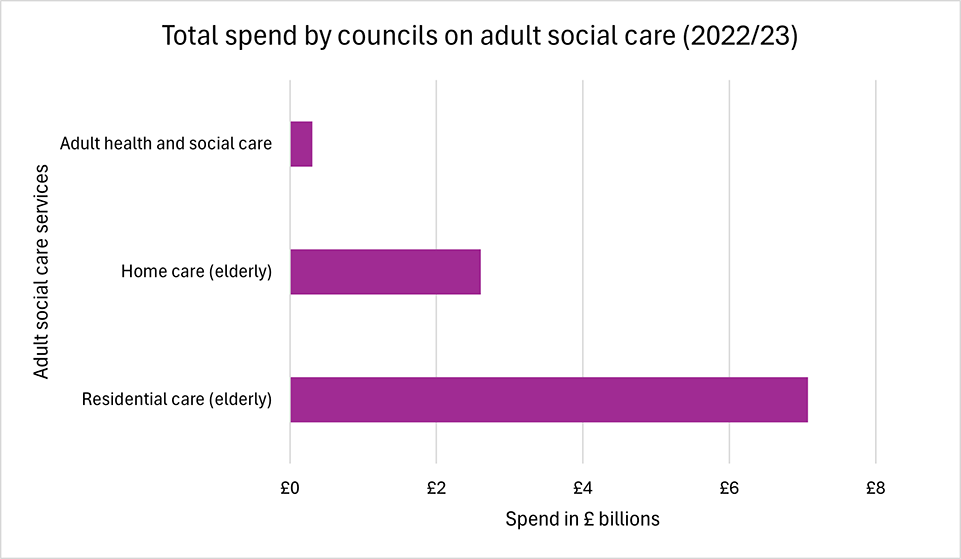
The diagram below sets out spend reported by councils for adult social care, residential care and home care in 2022/23.
Graph 1: Total spend by councils on adult social care (2022/23)
Key issues addressed during the year
The meetings with the strategic providers in the sector highlighted the following issues:
- parts of the sector reported ongoing challenges with staff recruitment and retention. Some of the providers were resolving these via the development of their in-house bank schemes and others have started recruitment from overseas (outside the EU) particularly nurses
- inflationary pressures were evident resulting from increased costs for food, utilities and staffing costs
- fee increase requests from suppliers for 2023/24 were reported to be around 10-12 per cent
- the need for more placements to meet complex needs and dementia care was discussed and considered during the adult network meetings
- sale and potential impact of 100+ Four Seasons homes and HC-One sale of 50+ homes
- all companies in the sector urged councils to engage on the winter planning process at an earlier stage in the year and to involve them in the solution
- the ‘Fair cost for care’ exercise was undertaken in 2022. All providers had an expectation that the process and any outcomes would address some of the funding issues and cost pressures. The outcome, success and impact of the exercise is yet to be communicated
- most providers reported improved occupancy levels in 2022/23 near to pre-pandemic figures.
It was not possible to engage meaningfully with homecare suppliers due to the very localised and fragmented structure of that sector.
Actions
- During the year the SSRM leads sought to obtain information from the providers on what they considered to be best commissioning/procurement best practice for the LGA to collate and publish. This work remains ongoing.
- The representative for Care England was invited to join the local authority network meetings in 2023 to more fully represent other suppliers in the market. Contact was made with Care England and an officer identified who has agreed to attend in April 2023.
Proposed activities for 2023/24
It is intended to undertake the following activities during 2023/24:
- continue ongoing engagement and dialogue with local government representatives from the strategic residential and nursing homes sector
- continue engagement with the Care England Board through the local authority network meetings
- finalise the collation of good practice commissioning/procurement guidance and arrange for this to be published
- continue to observe and report on strategic changes within the sector and the impact of any new reforms or market changes.
Section 2: Children’s services
SSRM leads: Becky Polito and Karen Faulkner
Overview of the year
There have been several significant developments across the sector including but not limited to:
- the publication by the Department for Education (DfE) of responses to three reports:
- the Independent review of children’s social care (‘The care review’)
- the Child safeguarding practice review panel report on the deaths of Star Hobson and Arthur Labinjo-Hughes (‘the National Panel review’)
- the Competition and Markets Authority Children’s social care market study (‘the CMA report’).
- the introduction of national standards for unregulated accommodation:
- the DfE introduced regulation for supported accommodation for 16 to 17-year-old young people in care and care leavers. These reforms to supported accommodation represent a major change for local authorities and providers.
These developments combined with the sector emerging from the impacts of the COVID-19 pandemic and a national cost of living crisis made this a challenging year for the sector.
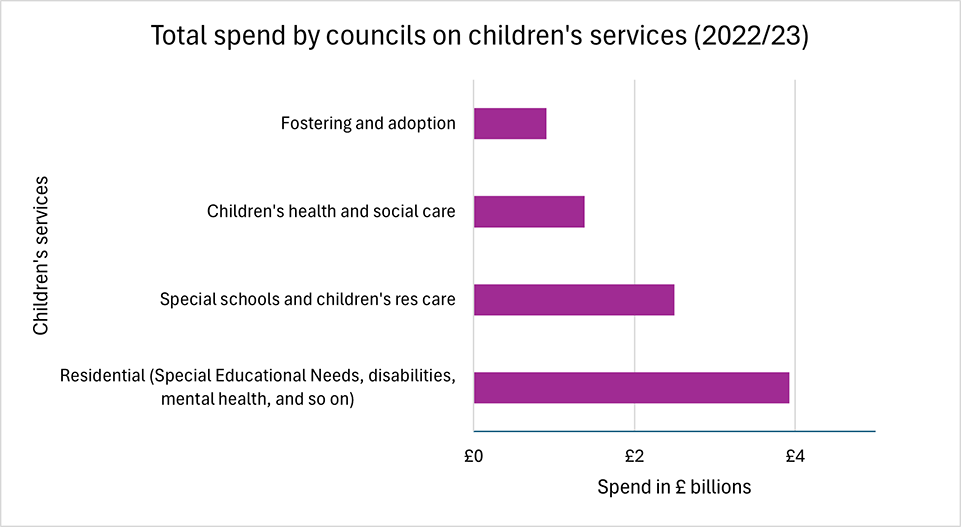
The diagram below sets out spend reported by councils for children’s residential care, special schools, children’s health and social care and fostering and adoption.
Graph 2: Total spend by councils on children's services (2022/23)
Key achievements
The SSRM leads published the ‘Final report on internal growth’ and carried out a review to check progress. The review also looked at quality trends, with data showing either a local authority, regional or national picture. It also allowed local authorities to view how individual provider quality has changed over the last two years.
A piece of work was carried out to highlight areas of good practice in local authority commissioning, procurement, and contract management of independent foster care services. To deliver this independent foster care agencies (IFA) were contacted, through the Nationwide Association of Fostering Providers (NAFP), to seek provider recommendations on areas of good practice. The report was published on the LGA’s Knowledge Hub and the Children’s Cross Regional Arrangements Group (CCRAG) national portal in December 2022.
As part of a commitment to ensure that the approach and understanding of ‘strategic suppliers’ is still relevant, several independent foster care services engagement workshops were held covering the following areas:
- How would you want the children’s SSRM programme to define ‘strategic’?
- How can the SSRM leads for children engage with the wider market more efficiently to achieve benefits for providers and local authorities?
- What priorities would providers like to put forward for the children’s SSRMs to review?
- How would you like the SSRM leads to keep providers up to date on progress / engage with you in the future?
The SSRM leads will continue to review the feedback received which will inform priorities for the 2023/24 programme.
During 2022/23 consideration was given to working with providers and local authorities to capture evidence of outcomes for children and young people. Given the time and remit allocated to the SSRM project it was decided that there is insufficient capacity through the SSRM programme to commit to this and that the primary focus should remain on relationship management.
Key outcomes
The following outcomes were achieved during the year:
- following publication of the best practice report prepared with the NAFP, the SSRM leads have embedded dialogue around and sharing of good practice into their business as usual
- increased national awareness of the SSRM programme
- improved access to reports / tools via the national CCRAG database
- continued commitment and engagement from local authorities and providers
- engagement with the National Directors of Children’s Services group.
Proposed activities for 2023/24
In 2023/2024 the SSRM leads will:
- continue to review and update the National Overview of Children’s Home market showing how the market has changed from June 2020 – June 2023
- identify the potential impact on the changes to unregulated provision in 2023-2024
- approach local authority consortia leads seeking examples of IFA provider's innovative practice in response to current challenges, such as cost of living and foster carer recruitment and retention
- work with relevant stakeholders to identify good practice in local authority commissioning, procurement, and contract management of children’s residential services
- ensure that priorities are focussed on, following the IFA workshops last year
- continue to work with regional/sub-regional consortia to identify how the SSRM programme can help them work better with key providers.
Section 3: Construction and infrastructure
SSRM lead: Bev Thomas
Overview of the year
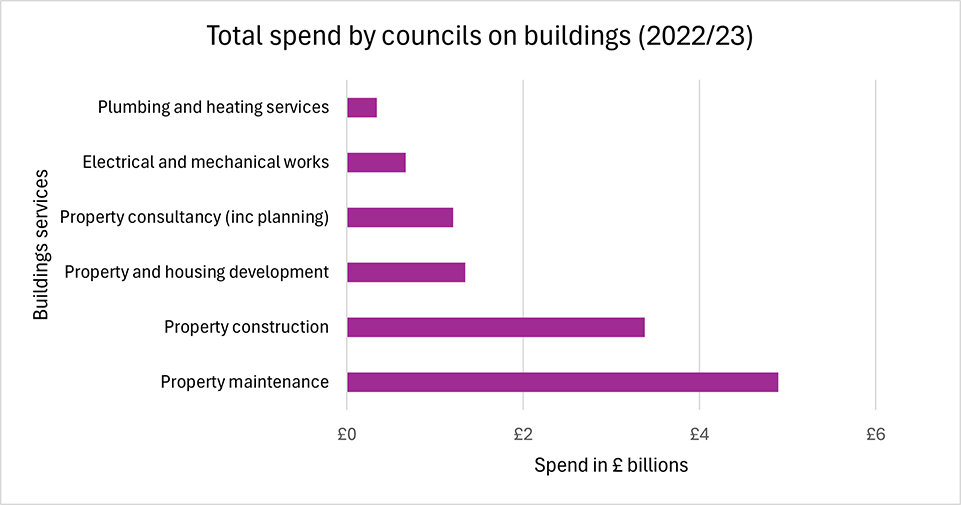
The table below sets out council reported spend on ‘buildings’ in 2022/23. This included property development, construction and maintenance:
Graph 3: Total spend by councils on buildings (2022/23)
The industry and the delivery of construction projects were impacted by the following:
- COVID-19 and Brexit - product availability, timing, and price increases
- councils are struggling to attract the construction industry to bid for work
- market:
- suppliers choosing to bid for contracts that were easiest to bid for and where they can make the most profit
- bidders reluctant to bid for fixed prices
- although materials cost increases are significant, labour costs are causing the main cause of concern for the industry.
- inflation issues:
- product availability
- lead times
- price inflation – raising energy costs/ freight and labour costs
- inflation risk and management
- cost of living crisis.
- recruitment – particularly a shortage of HGV drivers
- products produced in China and South-East Asia - transport delays and high costs
- Russia invasion of Ukraine:
- obtaining wood pellets as the supply is mostly from Ukraine
- timber sheet materials from Russian/Ukrainian forest – the conflict is causing a significant increase in prices for these commodities.
Despite the challenges posed by increased material costs, supply chain disruptions and labour shortages, the UK construction industry continues to grow.
The latest data from the Office of National Statistics, shows that industry estimated output for February 2023 increased by 2.4 per cent in volume terms. This follows a 1.7 per cent fall in January 2023, with February 2023 being the highest monthly value in level terms (£15,558 million) since records began in January 2010. The increase resulted from increases in repair and maintenance (4.5 per cent) and new work (1.1 per cent).
Key achievements
The key activities undertaken during the year are set out below.
- The LGA Construction Steering Group meetings were held on a quarterly basis throughout the year and attended by the SSRM lead. Discussions points included the common assessment framework, value toolkit, carbon reduction price increases, the Building Safety Reform Bill/Digital Working Group, the Construction Playbook and the Gold Standard Review.
- The SSRM lead supported the planning of the National Construction Conference for 2023 which took place in London (2 February 2023) and Leeds (7 March 2023). Both events were well attended despite the train strikes. Key topics included, delivering decarbonisation, the state of the nation (Chair of NACF) and workshops (greenhouse gas accounting tool, the construction playbook, supply chain resilience and managing rising costs and inflation in construction projects).
- The lead also participated in the Home Office MSA Public Sector Working Group and chaired a sub-group with the objective “To provide recommendations on how government and public sector policy and systems can support more effective modern slavery due diligence.” The discussion points included:
- What policies and systems are in place in Government and the wider public sector and how can these be brought to the table?
- How can these policies and systems support more effective due diligence of modern slavery?
- The sub-group also identified that any recommendations must recognise that:
- the public sector ‘policies and systems’ are driven by the requirements from central government
- how the requirements are implemented will differ across the public sector.
- Using data from Oxygen Finance Insights (previously Porge) it was established that £3,682.78 million (April 2020 – March 2021) was spent on highways maintenance and civils. Without a specific breakdown of the category, it was not possible to identify the top suppliers, top councils and the types of highways works. A review of the frameworks data identified that only three councils had used a framework for highway maintenance and minor civil engineering works.
- The opportunity to facilitate meetings with councils to focus on key suppliers or key themes to resolve market issues was superseded by the regional and national events/webinars on the inflationary issue.
Proposed activities for 2023/24
- continue work with the Construction Steering Group to influence, shape, lead and communicate policy, consider what is happening in the market and sharing good practice
- support the preparation and delivery of the National Construction Conference 2024
- act as conduit between the LGA’s National Advisory Group for Procurement and the Construction Steering Group
- continue to work with the Government’s crown representatives to explore issues at a local level
- further develop the engagement with industry national and professional bodies.
Section 4: Information and Communications Technology
SSRM lead: Terry Brewer
Overview of the year
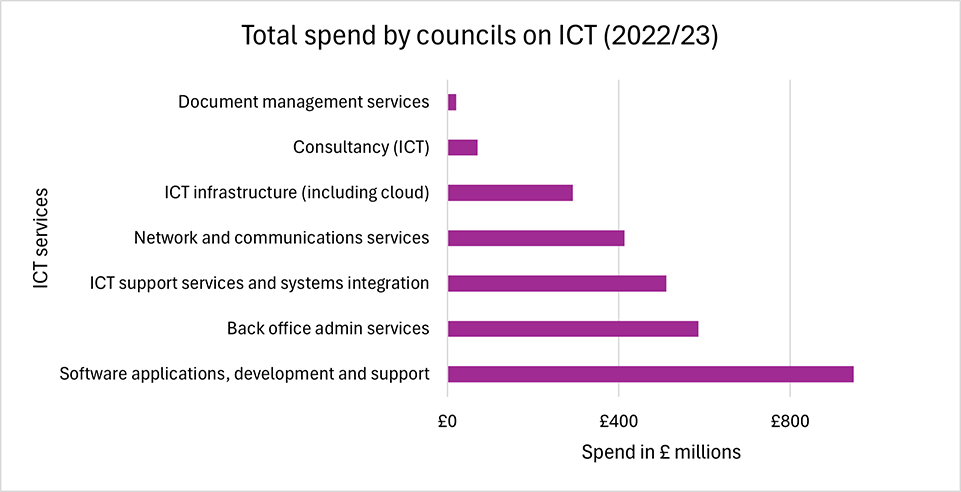
Work to achieve a better understanding of the Information and Communications Technology (ICT) market started in 2022/23. Expenditure by local government on ICT is over £2.5 billion per annum representing a significant area of spend. The diagram below sets out an overview of the spend in this category.
Graph 4: Total spend by councils on ICT (2022/23)
The ICT market is characterised by resellers who promote, quote and transact opportunities with their own local government customers for hardware or software.
Key achievements
To understand the how resellers view the local government market, meetings were held with Bytes, Civica and Phoenix as these are the resellers with whom local government has the largest spend. It was also considered important to meet some of the OEMs (original equipment manufacturers) to understand if they shared views expressed by the resellers. Consequently, a meeting was held with a hardware manufacturer. Additionally, a meeting was held with Tech UK which is the trade body for the ICT industry, with 950 members of whom approximately two thirds are SMEs.
Key outcomes
The messaging from those organisations with whom meetings were held were remarkably consistent, the key points being:
Tendering issues
- the industry perceives there are too many input-based specifications, often based on what a council procured many years previously
- there is a widespread lack of pre-market engagement which means there are no opportunities to update councils of developments in a fast-moving industry and where there might be opportunities to reduce costs/take advantage of efficiencies
- councils go out to tender too frequently on a price only basis or with a very low percentage weighting for quality and subsequently fail as a result in getting the best outcomes - price only tenders will be subject to deal registration from software providers which will limit the savings that might be achieved
- framework agreements are used predominantly which means that there is almost no opportunity for bidders to engage with councils on their needs
- there is a lack of professional procurement staff in councils who specialise in the procurement of ICT requirements
- a number of councils aggregate requirements – resellers believe this does not provide good value as it fails to give individual councils a detailed analysis of their needs.
When combined, these points mean that there are very few or no opportunities in tendering processes for companies to understand what problems councils are seeking to solve and the success criteria sought. In the view of those companies spoken to, councils should seek whole process solutions, setting out what problems they are seeking to solve for example deployment issues, optimisation of licences, and so on. To enable companies to assist with identifying an optimal way for providing a solution.
Social value
Companies in the industry are increasingly being asked to provide social value as part of tendering for council contract work. It is considered however that many councils fail to recognise that OEMs and resellers in the ICT industry provide their services ‘remotely’ and social value requirements should reflect that. For example, it is rarely possible for local employment to be provided. In addition, resellers are only providing an element of the requirements, most of the costs are with OEMs and there is a need to consider how vendors can contribute to the social value requirements of councils.
A further issue was raised by Tech UK regarding SMEs – it reports that it is difficult for new entrants and SMEs to enter the arena and be heard and there needs to be discussions between the industry and councils to identify methods by which new entrants can be heard.
Apprenticeships
One company suggested that there could be a joint private/public sector-based approach to apprenticeships – companies in the ICT industry do not always use all of their apprenticeship levies and it was proposed that explorations should begin to explore whether joint arrangements could be put in place to share apprenticeships to
- ensure levy monies are fully used, and
- to provide a broader experience for apprentices.
Proposed activities for 2023/24
This was the first year of engagement with the ICT industry as part of the LGA’s SSRM programme. Year two will focus on building on the relationships started during 2022/23 and seeking to extend these by holding meetings with more OEMs.
Additional activities will include:
- arranging a virtual roundtable meeting to discuss the SSRM programme with Tech UK members - will seek to include some councils
- arranging a social value webinar for Tech UK members
- providing a webinar for ICT leads/IT buyers in local government.
Section 5: Procurement data to underpin SSRM
SSRM lead: Greg Povey
Project overview
The 2018 National Procurement Strategy for Local Government update and refreshed during 2023, has raised the profile of procurement by highlighting the need for local authorities to maximise the value they receive from their third-party expenditure. It is, however, apparent that local government lacks good quality procurement data on which to base key procurement decisions. A gap exists between best practise in sharing procurement data and enabling the central gathering of data to be shared locally to address the current lack of quality data.
In the last year the Cabinet Office has significantly developed the Procurement Reform Bill which is due to receive Royal Assent in 2024. Spend publication, transparency data and performance data initiatives are all in scope for further development as part of the reforms. It is important that local government plays an active role in the various Cabinet Office working groups so that the voice of the sector is heard and that the Procurement Act 2023 brings forward deliverable, resource proportionate positive benefits.
Key developments during the year
During the year there were the following developments:
- The Cabinet Office confirmed that the Contracts Finder and Find a Tender services will be merged into a single transparency platform called ‘Find a Tender’.
- The Cabinet Office has split the transparency platform development into three phases: - Phase one is to be ready for Spring 2024 (when the Procurement Act is due to go live) focusing on data to support taking procurements out to market (for example, pipeline notices, market engagement notices, tender notices, and so on). Phase two will focus on data post contract award (for example, spend/KPIs/copies of contracts). During phase three the Cabinet Office has committed to the transparency platform featuring a spend analytics tool alongside the data registers. A spend analytics tool is one of the key deliverables of the LGA procurement data project which falls under the umbrella of the SSRM programme; local government requires better capabilities in co-ordinating procurement data and mapping spend on suppliers. This will enable the SSRM initiative to add value in assisting individual councils.
- The Reform Bill sets out that spend data will be published in a format compliant with the Open Contract Data Standards (OCDS). OCDS is an international format, and this initiative will help the Cabinet Office (and the wider public sector) to link the contracting authority spend to a specific contract and a specific supplier. Where the contract is worth over £5 million this will link this data to the actual contract performance and a copy of the contract. This new world of procurement data publication will aid multiple stakeholders enabling greater innovation, oversight, governance, value for money, improved performance and benefits delivery.
- The Cabinet Office is formulating the data architecture and also secondary guidance on spend in an iterative process. Various working groups are looking at spend publication (threshold, method) and transparency requirements (award details, KPI performance and making public copies of the contract).
- Following the recent discovery work undertaken by the CCS Spend Analytics refresh programme, the Central Digital Platform (Find a Tender) team is now embarking on a more focused piece of research to meet the payment publication requirement.
Key achievements
Key activities undertaken during last year included representing the LGA on the following groups:
- the Cabinet Office Transforming Public Procurement programme
- the Transparency Working group. The key outcome for this group is to make sure that data fields and timescales are realistic, as well as lobbying for the reporting burden of the Transparency Code to be considered and potentially reduced taking into account the increased spend data being published
- the Spend Working Group which recently updated its name to the Payment Working Group to align with the wording of the Bill clause
- the Central Digital Platform and Spend Analytics Group - this group is considering the practicalities of Public Procurement Organisation Numbers (PPON – a unique ID for each contracting authority), supplier’s IDs and data integration, and so on.
In addition, the following activities were undertaken:
- participating in a research interview for the piloting and design of new notices
- meeting with Bettergov to support a focused interview on the payment systems used within contracting authorities and supporting its research into data integration technologies which will enable payment publication on the transparency platform.
Proposed activities for 2023/24
The following activities will be undertaken during the forthcoming year:
- continuing to support the various working groups to deliver a spend publication system together with the tools to enable local government to enhance its procurement capabilities
- making the case, through the transparency working group, that the data which local authorities will be required to share, and the way it is to be shared, should be considered with local government in mind. Linked to this, seeking to ensure that timescales for implementation are realistic for local government to implement, recognising the different IT enterprise architectures and the skills maturity of councils
- making the case to the groups working on ‘Tell Us Once’ (supplier selection questionnaire data) and the Debarment Initiative (which is aimed at taking account of supplier past performance) to ensure that local government is given sufficient time and support to implement these new practices.