
Foreword
Councils are in a unique position to bring services together and offer the kind of joined-up support that makes a real difference. This briefing shows how investing in young parent families isn’t just the right thing to do, it’s smart policy. It improves outcomes for children, strengthens communities and saves money in the long run.
We hope this resource helps councillors and local leaders to champion young parents in their areas, and to work with partners to build systems that are inclusive, responsive and ambitious for every family.
Cllr Wendy Taylor
Chair, LGA Health and Wellbeing Committee
Cllr Amanda Hopgood Chair
LGA Children, Young People and Families Committee
Teenage pregnancy strategy 25 years on: What next for young parents
The 10-year Teenage Pregnancy Strategy, launched 25 years ago, was the first cross-government initiative to include a focus on improving support for young parents alongside a prevention programme. While it achieved significant progress, the evolving challenges faced by young people today highlight the need for a renewed focus on both prevention and support, ensuring that local leadership remains responsive and effective.

Why a continued focus on young parents is needed
Thanks to the continued hard work of councils and their health and voluntary sector partners, since the start of the strategy there has been a 70 per cent fall in the rate of under-18s becoming pregnant and consequently a very large reduction in the number of young parents. In 1998, 23,800 young women who conceived under 18 continued their pregnancies. This dropped to 9,300 in 2015 and to 5,600 in 2022. Numbers of young mothers under 20 have also declined from 63,000 in 1998, to 33,000 in 2015 and 20,600 in 2022. (Office for National Statistics, 2025).
However, evidence from the Family Nurse Partnership (FNP) and reports from local services show that this smaller number of young parents have increasing and complex needs, requiring more intensive support for them and their babies. These complex needs are also apparent in some young parents in their early twenties.
Every young parent has their own individual story and like all parents wants to do the very best for their child. However, because of the risk factors for early pregnancy, some young people enter parenthood already carrying a heavy burden of disadvantage. Family poverty, persistent school absence by age 14, slower than expected educational attainment between ages 11 and 14 (Crawford et al, 2013) and having care experience, all contribute to vulnerability. There is less data collected on young fathers, but research suggests a similar pattern of disadvantage as illustrated in Adverse Childhood Experiences (ACE) statistics. Young women and men who have experienced four or more ACEs are between three and seven times more likely to experience an accidental teenage pregnancy or become a teenage parent. (Wood et al, 2022).
As a result, young mothers and fathers may have missed out on the protective effects of high quality relationships and sex education, emotional wellbeing and resilience, positive parenting models and having a trusted adult in their life. For some these vulnerabilities can make parenting very challenging.
Recently, concern for young parents and their babies has been heightened by the rising trends in these underlying risk factors since 2015, which have been exacerbated by the COVID-19 pandemic. Notably, family poverty (Joseph Rowntree Foundation, 2023; Policy Press, 2022) school absence and educational attainment (Committee of Public Accounts, 2023), young people’s mental health (NSPCC, 2022) and a sharp rise in the numbers of 15- and 16-year-olds going into local authority care (Nuffield Family Justice Observatory, 2021).
How adversity affects outcomes for young parents and their babies
It has always been difficult to quantify the extent to which pre-existing disadvantage, or the challenges of parenting at a young age, contribute to the inequalities experienced by young parents and their children. Most likely it is a complex interplay of both. What is clear is that routine and research data continue to show disproportionately poor outcomes, impacting the life chances for young parents and their babies and contributing to inter-generational poverty and disadvantage.
The data below refer to outcomes for babies and children born to young mothers under 20. However, when looking at local need it’s important to note that poor outcomes persist for mothers aged 20 to 24, notably poor mental health, which also affect young fathers.
- Stillbirth: 21 per cent higher rate for children born to women under 20
- Sudden unexpected death in infancy: three and a half times as likely compared to overall population and seven times as likely compared to mothers aged 35 to 39.
- Incidence of low birth weight of term babies: are at significantly increased risk of being born extremely preterm and with extremely low birth weight
- Infant mortality rate: 25 per cent higher risk to the overall average for babies born to women under 20
- Maternal mental health: mothers under 20 have higher rates of postnatal depression and poor mental health for up to three years after birth. Parental depression is the most prevalent risk factor for negative impact on poor child development outcomes.
- Child development and school readiness: at age five, children of teenage mothers have an almost nine-month development delay behind the average on verbal ability. Reports have also noted social and developmental delays in babies and children born and growing up during the pandemic (Parent Infant Foundation, 2022), compounding challenges further for young parents.
- Safeguarding: 60 per cent of children involved in serious case reviews were born to mothers under 21.
- Repeat care proceedings: at least 1:3 women who have had a child taken into care, and return to the family court had their first child as a teenager.
A lens on local need
National statistics make a compelling case for action. However, looking at data through the lens of a local service even more powerfully conveys the burden of stress and disadvantage experienced by some young parents, which can affect their capacity to safeguard themselves and their babies.
In a voluntary sector young parent support service in a council in the south-west, assessment data from 352 young mothers and fathers joining the service found 76 per cent had experience childhood trauma, 63 per cent self-harm and suicidal ideation, 39 per cent substance abuse, 27 per cent domestic abuse and 26 per cent sexual abuse.
In the same service an assessment of 292 children’s safeguarding needs found 38 per cent had a social work assessment, 30 per cent were at risk of neglect, 20 per cent had a child protection plan, 17 per cent were at risk of physical harm, 16 per cent had a child in need plan, 13 per cent had care proceedings and five per cent were at risk of sexual harm.
The impact of the COVID-19 pandemic appears to have further increased the daily stresses experienced by the young parents. Asked what they found harder since 2020, 29 per cent said having a secure home, 48 per cent keeping their home warm, 55 per cent paying for electricity and 53 per cent having enough food.
This combination of vulnerabilities and risks is illustrated in the NSPCC analysis of case reviews published since 2018, which involved young mothers and fathers who were teenagers when their baby was conceived or born. (NSPCC, 2021) Previous experience of trauma, domestic abuse, sexual exploitation, drug and alcohol use, unstable living situations and poor mental health were all identified as contributory factors. Similar findings are reported in the study of Recurrent Care Proceedings, which found 42 per cent of the mothers involved had their first child as a teenager. (Nuffield Family Justice Observatory, 2022).
The importance of specialist support, a trusted practitioner and a coordinated care pathway
With such clear evidence of inter-generational risk and inequality, there has been a consistent call to recognise and address the needs of young parents from safeguarding, maternity and child health organisations. All recommend specialist and coordinated support starting early in pregnancy with specialist maternity care to secure the protective benefits of antenatal care, and continuing into parenthood.
Organisations recommending specialist and coordinated support for young parents
- NICE (Antenatal Care guideline 2021)
- NSPCC (Learning from case reviews 2021)
- Nuffield (Mothers in Recurrent Care Proceedings 2022)
- Royal College of Paediatrics and Child Health (State of Child Health 2020)
- MBRRACE UK (Saving Lives, Improving Maternity Care 2022)
The key element of specialist support is having a skilled practitioner working closely with young mothers and fathers to understand and address their individual needs, including mental health, and build their confidence and capacity as parents; and in partnership with other agencies, support their engagement with education, training and pathway to employment, and help them develop and achieve their personal goals.
Evidence of the benefits of specialist support is drawn from the strategy’s Sure Start Plus pilot programme which provided a personal adviser for pregnant teenagers, and the internationally recognised Family Nurse Partnership, first introduced to the UK in 2007 and implemented in many councils across England. In a programme of change begun in 2016, the FNP National Unit continues to improve and adapt the FNP programme in England by testing a series of innovations and improvements to strengthen outcomes, increase value for money, ensure greater flexibility and share learning with other services. This included a range of swiftly implemented changes, such as widening the eligibility criteria up to age 24 years for mothers with additional vulnerabilities. As the numbers of very young parents has fallen, this has helped councils maintain the programme’s cost effectiveness by extending its benefits to a larger cohort.
The importance of a trusted adviser and a trauma informed approach
Underpinning the success of specialist support is a strength based approach to young parents, to identify and build on their assets. A consistent theme from the evidence and experience from local services is also the importance of practitioners building a trusted relationship with young parents, many of whom may be wary of professionals. Only then will young parents feel able to share their concerns and challenges without fearing a judgement that they can’t cope.
Trust is particularly important for engaging young fathers who often report feeling side-lined or under surveillance by practitioners.
Notably a key learning point from the NSPCC review and the MBRRACE report was the need for practitioners to understand better how factors such as experience of trauma or domestic abuse can impact young mothers and fathers’ capacity to care for themselves and their child, and to be more enquiring into the underlying causes of poor mental health. Echoing the recommendation from the earlier Ofsted report on Serious Case Reviews (Ofsted, 2011), NSPCC highlighted that practitioners need to be aware that in a young parent family there may be three children in need – mother, father and baby – with each requiring a trusted relationship and careful attention.
Early intervention can transform lives and break cycles of poverty and disadvantage
A young parent family case study
Baby Ava was born when mum, Aisha, was 16 and dad Lenny was 20. They had been seeing each other for a few months and, although they didn’t plan to get pregnant, both of them had always wanted a baby.
Aisha lived with her grandparents as a child and slept on the sofa because they lived in a trailer. Aisha’s mum only let her stay once a week, and Aisha says that her mum didn’t care when Aisha started getting into trouble at school. Aisha remembers that there was always fighting and violence from her stepdad, “but she always stayed with him no matter what he did to her or to me.” Aisha says she can only remember bad things and feeling bad about herself. Aisha was suspended from school in year 10, and didn’t really attend after that. Her needs were assessed by social care, and they referred her to CAMHS, but Aisha didn’t turn up to her appointments, and didn’t end up using the service.
Lenny got into drinking and smoking at a young age, and by age 15 had a criminal record for dealing drugs. Lenny got into fights, and needed hospital care a few times for injuries that the police were worried were caused by older drug dealers, one of whom was seeing Lenny’s mum. Lenny cared for his mum throughout his childhood, due to her mental health needs, and he looked after his younger siblings. He was close with his grandad, who died when Lenny was 16.
When Aisha became pregnant, her family kicked her out, so she moved in with Lenny and his family, sharing a single bed. They started arguing a lot, and the police were called out a few times. Just before Ava was born, they moved into an emergency accommodation caravan because Lenny’s mum said they couldn’t stay. The police were called out again, and social care said Ava was not safe staying with Aisha and Lenny, so Ava was placed with Aisha’s mum for a few days.
The family were supported by The WILD young parents team through the Child Protection and PLO process, with attachment support at home, and groupwork with other young parents. Aisha and Lenny learned more about how their own childhoods were affecting their parenting, and about Ava’s developmental and emotional needs. They loved spending time outdoors at the WILD Garden, and singing with the other families. Aisha and Lenny created safety plans for when things got stressful, found new ways to express their feelings, learned to cook on a budget, and got help with housing and mental health support.
Aisha now has a part-time job, and Lenny is a peer supporter for new young parents at the WILD Garden. They both sing in the WILD choir, and have moved into their new flat. Ava is starting to say a few words, and loves coming to her weekly WILD group with her parents. They see Lenny’s mum once a week, but don’t see Aisha’s family very often. They both feel they are learning to create a family that is different than the ones they knew growing up. Aisha says she wants Ava to have a proper childhood, and Lenny says that ‘he didn’t know there was another way to be a father’.
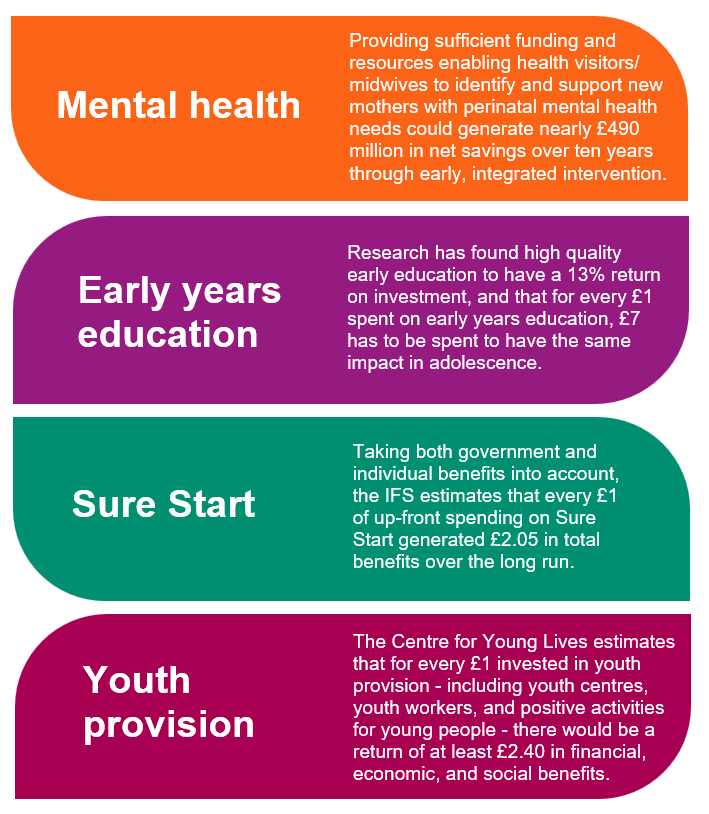
Investment in young parent families saves money
Multi-agency collaboration and coordinated care pathway for young parents
While specialist services with skilled trusted practitioners are essential for providing one-to-one tailored support, close collaboration with other services is vital to ensure a joined up care pathway for young parents. 'The framework for supporting teenage mothers and young fathers' (PHE/LGA, 2019) sets out the relevance and importance of young parents to each service with suggestions of how they can be tailored to meet their needs. Although the Framework requires some updating, it provides a useful reference resource for multi-agency working.
A care pathway for young parents: A checklist for local areas
Early access to free pregnancy testing, impartial advice on pregnancy options and referral to abortion service for young women choosing not to continue the pregnancy.
For those continuing the pregnancy, referral to antenatal booking + information to support healthy early pregnancy-folic acid & healthy start. Notification to Family Nurse Partnership or local specialist young parent support service.
Careful pre-birth assessment for young mothers and fathers to identify and provide early help for any health, relationships, safeguarding or social problems.
Antenatal care and preparation for parenthood for young mothers and fathers in a trusted and youth friendly environment.
Help with choosing postnatal contraception during the antenatal period with chosen method provided before leaving maternity care.
Clear referral pathways between maternity and specialist young parent service (Family Nurse Partnership, voluntary sector service, Health Visiting).
Specialist service with trusted practitioners providing tailored support to meet individual need, coordinate help with health, contraception, education, training, employment, housing, benefits.
Advocacy and support for young parents to continue or return to education. Personal development plans for young mothers and fathers building aspirations and skills, linked to local NEETs programme for 16 to 24 year olds.
Promotion of national Care to Learn childcare funding for young parents returning to education or training, and support with submitting application form.
Support and information to access mainstream services – e.g. Family Hubs - for smooth transition from specialist services with introductory visits to reduce apprehension.
Top tips for success
- Believe in and value young parent families. Many young mothers and fathers have experienced complex childhood adversity but with the right support they can give their babies the best start in life, fulfil their own potential and enrich the local community. Celebrate the successes of your young parents.
- Follow the evidence and provide specialist support for young parents and their babies, starting in maternity services and continuing into parenthood. Investment in specialist services transforms lives, breaks cycles of intergenerational disadvantage – and saves money.
- Don’t forget young fathers. They want to be involved and children with positively involved fathers have better outcomes. Always include them in early assessments and provide tailored support to address their individual needs and support their ambitions.
- Keep a flexible approach to age limits. Look at your local data and consult with services to understand need. With lower numbers of very young parents, ensure support also reaches the most vulnerable in their early twenties.
- Promote co-ordinated multi-agency working to provide a supportive care pathway for young parents, maximise contributions from all relevant education, health, social care and voluntary sector services.
- Share the skills of specialist practitioners with the wider workforce – for example Family Hubs, Children’s Centres and housing support – to raise awareness of young parents’ needs and help ensure young parents have positive interactions with other professionals.
- Listen to and learn from young mothers and fathers. They are the experts by experience and can help shape the services that best meet their needs.
Case studies
The following case studies illustrate the range of dedicated and specialist support services for young parent families provided by councils across England.