The joint Local Government Association (LGA) and Association of Directors of Public Health (ADPH) Annual Public Health Conference brought together nearly 1,300 delegates in its largest virtual gathering to date.
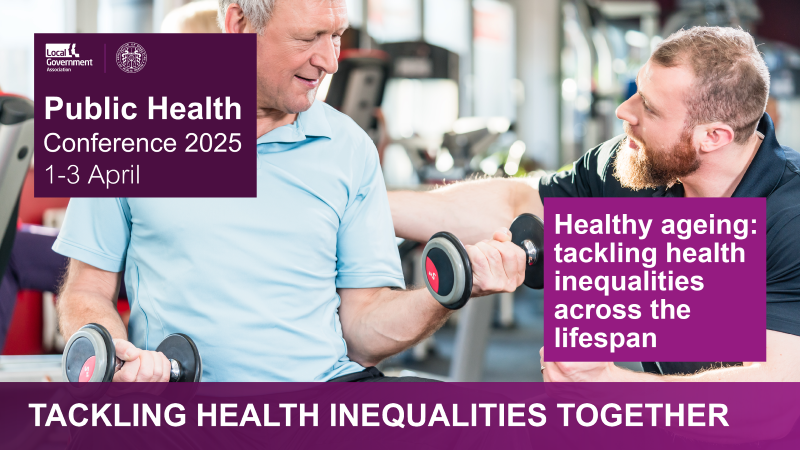
From 1-3 April, panellists and participants came together to share insights on public health practice, exploring how to tackle the health inequalities facing our communities. For the first time ever, the conference hosted a virtual Innovation Zone, sponsored by the National Institute for Health and Care Research.
Opening the conference, LGA Chair Cllr Louise Gittins set the tone with a clear call for a national health inequalities strategy - rooted in prevention and joint local-national leadership. “We must create a society where all residents, regardless of their background or postcode, can thrive and live healthy lives,” she urged.
Keynote speaker Professor Sir Michael Marmot reminded us why this work matters, stating that addressing inequalities is not just a moral imperative but essential for “the economy, sustainability and the future of society.” He praised the "real political will to make a difference" shown by local leaders across the country.
Across the three days, the conference spanned a wide range of vital topics, from tackling teenage pregnancy and understanding urban health, to devolution and addressing alcohol harm. A standout moment was hearing from two brilliant young people, Arshan and Jordan, who shared powerful personal stories about health inequalities, underscoring the need for policies shaped with young people, not just for them.
The closing plenary, “Shaping the future of public health,” chaired by Cllr David Fothergill, brought together a dynamic panel: Greg Fell (President, ADPH), William Roberts (Chief Executive, Royal Society for Public Health), Professor Tracy Daszkiewicz (Vice-President, Faculty of Public Health) and Siva Anandaciva (Director of Policy, The King’s Fund). Their discussion captured how to future-proof public health and deliver real impact amidst system and global challenges.
When asked about measuring return on investment, Greg Fell pointed out the challenge of visibility: “Public health can often be a tough sell. People have short attention spans and aren’t interested in something that might happen in 20 years. We need to show how public health makes immediate impacts.” The panel called for a broader approach to evidence, moving beyond easily quantifiable metrics to long-term, transformative outcomes.
The future workforce was another key theme. Professor Daszkiewicz stressed the importance of nurturing public health professionals who understand their purpose and are equipped to work across sectors. “We need to create an environment that allows people to realise their passion,” she said.
There was also a refreshing focus on public health success stories. William Roberts celebrated the “greatest hits” of public health - from reductions in teenage pregnancy to water fluoridation and cleaner air. He encouraged leaders to build on proven approaches, rather than reinventing the wheel.
The message was clear: public health needs to be central to decision-making. The onus is now on us to translate these insights into consistent, collaborative efforts, and to champion bold leadership that drives genuine progress for our communities.