In this joint blog by the Local Government Association (LGA) and The Health Creation Alliance (THCA), we explore what health creation is in practice – and what it can achieve when local government and other local partners create the conditions for communities to take control and shape both services and their environment.
In local government, we talk a lot about prevention, early intervention and tackling health inequalities. But what if we considered how we might do all three at once?
That’s the idea behind health creation. It’s not just about avoiding illness – it’s about creating the conditions for people and communities to maximise their health and wellbeing by being meaningfully connected to others, confident that they will be able to shape what happens around them, and having a stake in their future; it’s about having agency and control, individually and collectively.
What is health creation?
Health Creation is the process through which individuals and communities gain a sense of purpose, hope, mastery and control over their own lives and immediate environment; when this happens their health and wellbeing are enhanced. Read more about the process of creating health in The Health Creation Alliance’s Manifesto for whole system change
A new model for health and care
THCA’s 2024 manifesto set out a clear case for change. It argues that the current model of health and care is no longer sustainable – it hasn’t reduced the burden of preventable illness, and health inequities are growing. What’s needed is a radical shift: from siloed, service-led approaches to health creating systems that are shaped with and by communities and in which communities take leading roles.
This means changing the culture and the way public-facing organisations work, to create the conditions for people to be connected, to gain confidence to take control. It means
- Listening and Responding: Effective, genuine listening to the reality of people’s and communities’ lives and acting on what is heard builds trust and supports engagement
- Truth-telling: When people, communities and practitioners identify and acknowledge what holds them back from being well or keeps them isolated, they can start to get to the root causes of problems and solutions.
- Strengths-focus: Health creation happens when attention is paid to what people and communities can do for themselves or others and this is accompanied by increased confidence for connecting with others.
- Self-organising: Helping people and communities to connect meaningfully with others makes it possible for them to find solutions and take actions together.
- Reciprocity: A health creating environment is nurtured when it all partners get what they need and have the opportunity to give back in ways that are appropriate for them. Reciprocity builds respectful relationships, where communities live well in close proximity and services are mutually responsive and play complementary roles.
- Power-shifting/sharing: Lasting health creation happens when the other five health creating features result in a power shift from practitioners to people and communities.
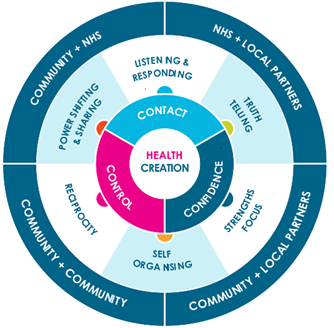
Health creating practice is, of course, already happening in pockets in many places, described in a variety of ‘asset-based’ or strength-based language, and some local authorities work in this way more than others. The manifesto called for health creation to be consciously adopted and embedded everywhere. It offers a tried and tested Framework for Health Creation and outlines a practical path forward, including eight personal actions, thirteen calls to action for integrated care systems, and seven asks of government – all aimed at embedding health creation and removing barriers into the heart of how we work.
It also highlights the importance of community infrastructure – the informal networks, trusted spaces and local leadership that enable people to support one another. When this infrastructure is recognised and resourced, it becomes a vital part of the wider health system.
Why this matters for local government?
Local government is at the heart of the major health reforms now shaping England’s future. The 10-Year Health Plan calls for a radical shift from hospitals to communities, from analogue to digital, and from treating sickness to preventing it. The emerging Neighbourhood Health Service is central to this vision, aiming to deliver integrated, personalised care closer to home, especially in areas with the greatest need. Councils are uniquely placed to lead this transformation — not only because they understand the wider determinants of health, but because they are embedded in communities and can build the trust and relationships needed to make lasting changes.
The English Devolution and Community Empowerment Bill reinforces this role, giving more areas the powers and flexibility to shape local priorities and invest in what works. Meanwhile, strategies like Giving Every Child the Best Start in Life highlight the importance of early years, family support and inclusive local services. Health creation offers a practical, values-led approach that aligns with all of these ambitions — helping councils move from managing demand to building resilience, and from delivering services to co-creating wellbeing with communities. It’s a way to make national policy real at the local level.
What we’ve seen on the ground
At THCA, we’ve worked alongside local leaders, frontline staff and communities to explore what health creation looks like in practice. Through our leadership and skills programmes, that is underpinned by the Framework, we’ve seen how this approach can make a real difference.
Here’s what we’ve found when there is a genuine desire to create the conditions:
- People feel more connected – to themselves, to each other and to the services around them
- Confidence grows – and with it, people start to take more control over their health lives, their health and wellbeing and are more likely to want to influence and help shape services and environments so that they work better for them and their communities
- Services shift – because when communities can play roles – in designing and delivering – from the start, the solutions are more relevant, inclusive and sustainable
We’ve seen this in action in places where our framework has helped redesign mental health support, improve access for marginalised groups and shape outreach services that meet people where they are.
Places putting health creation into practice
Across the country, local systems are finding new ways to create health by working alongside communities. These four examples show how different partners – from GPs and councils to campaigners and tenants – are shifting power, building trust and supporting community-led change.
Merstham, Surrey – Growing Health Together
In Merstham, a community facing significant health inequalities, local GPs and partners launched Growing Health Together, a place-based initiative that listens to what matters most to residents. Instead of defaulting to clinical interventions, the project supports community-led solutions - like gardening groups, housing support, and mother-and-baby meetups. Through working alongside residents and valuing their lived experience, the initiative is helping to create the conditions for long-term wellbeing.
North Lewisham – Standing with patients as advocates for action
Around five years ago, North Lewisham Primary Care Network (PCN) launched a community forum to co-design services and address health inequalities. This forum, part of the Lewisham Health Equity Plan, enabled ongoing dialogue between local partners and residents. When poor housing emerged as a key issue, Lewisham Citizens led a campaign joined by headteachers and GPs. The Lewisham Health Equity Fellows mobilised 26 GPs to sign a letter to the Mayor, demanding strategic action. Together with faith leaders and community members, they marched to deliver the letter in person, demonstrating how health professionals can stand with communities to advocate for change.
Settle, North Yorkshire – Redesigning Mental Health Pathways
Service provision for people who are experiencing mental ill health was not working well from the user perspective. Using the Health Creation Framework to underpin the process, the first step was collective realisation and recognition that existing provision was sub-optimal. Through facilitated new connections between community, NHS, local authorities and people with lived experience, and greater representation of those people on governance structures, the group developed better routes into accessing a variety of informal support principally through a community hub as well as more trusted routes into formal support when needed.
Towards a National Voice for Tenants of Social Housing
Tenants of social housing want to influence national and regional policy on decisions that affect them. Commissioned by A Voice for Tenants group, THCA reached out through its member network and held conversations with over 100 tenants, including the Association of Retained Council Housing (ARCH) and National Federation of ALMOs (NFA) Tenants’ Groups. Tenants have clear ideas about how all 4 million tenants might be able to have a say about many issues and they want to see themselves reflected in the National Tenant Advocacy Organisation. Phase two is about to begin with tenants leading the both the development and the operations of an organisation that can do this, supported by an ‘accountable body’ and THCA in the short term. See Tenants at the Table for further insight.
These examples illustrate how wider health systems can evolve when they centre community voice and leadership. They demonstrate the potential of health creation when services align with what matters to people.
Why this matters for local government
Local government is in a unique position. We understand the wider factors that shape our health – housing, education, employment, green spaces – and we’re close enough to communities to see what’s really going on.
To create health, we need to do more than deliver services for communities. We need to work with people and communities as equal partners creating the conditions for them to play roles and together shape the ecosystem of services and local activities so that they grow community agency. That means listening, sharing power and building on the strengths that already exist in our communities.
The NHS is also going through a period of transition and ‘neighbourhood health’ is fast emerging as the key route to providing accessible and integrated health and care services in communities. Councils play a critical role in shifting the focus from sickness to prevention, and from hospitals to communities.
Health creation offers a purposeful, practical, values-led approach that aligns with the
ambitions of integrated care systems, public health teams and community development. The Health Creation Alliance is making the case for neighbourhood health services to be ambitious, embedding health creation into their design and ensuring councils are actively involved in governance. This approach enables all partners to shift from managing demand to building resilience, and from reacting to problems to creating the conditions for people to live well.
The Health Creation Alliance is hosting its Partnership Summit on 21 October 2025 in Manchester. Called Health Creation Wealth Creation; investing in community agency, with a focus on neighbourhood health, social care, housing and employment, it invites delegates to step into the 'change space' where cross-sector conversations build confidence for action.
Free to attend, you can find out more and book your place through Eventbrite, accessed through The Health Creation Alliance website.