In 2022/23, 543,000 older people and 293,000 working-age adults received publicly funded long-term social care in England. An additional 225,000 episodes of care were provided on a short-term basis. On an average day in the NHS in 2023, 275,000 people attended an outpatient appointment, and 44,000 would attend a major A&E department. This care is made possible by the hard work of 1.2 million social care staff and 1.3 million NHS staff (The King's Fund, 2024).

Opportunities to strengthen leadership
- Strained relationships between leaders can lead to behaviours that erode trust. When delivering technical improvement support it is most effective when paired with leadership development focused on collaboration, joint-decision-making, and governance.
- In the absence of strong relationships or robust governance structures, systems under pressure often revert to siloed thinking, with organisations focusing on their own interests rather than collective solutions.
- Systems that move too quickly to action often achieve only short-term temporary improvements, but underlying issues often persist or shift within the system. This reflects a focus on symptoms rather than addressing the root causes.
Limited ability to drive and sustain evidence-based improvement
- Although systems are rich in data, it is dispersed across organisations and often lacks clear alignment with decision-making needs – whether strategic, operational, or commissioning. Ongoing issues with data quality and accessibility persist. A High Impact Change Model has been developed to guide systems in using data effectively for decision-making.
- While our support and recommendations have been received at the end of a support projects, systems often encounter difficulties in then translating them into actionable and sustained plans. Limited capacity and resourcing is a common barrier, particularly dedicated staff and funding.
- There is often a disconnect between implementation plans and financial planning, which makes it difficult to evidence financial benefits and leaves improvement efforts exposed to short-term financial pressures and susceptible to being deprioritised.
Challenges in embedding improvement support within routine practice and sustaining its impact over time
- The improvement support landscape is crowded, with multiple national, regional and consultancy-led offers often delivered without co-ordination. Systems report feeling overwhelmed and distracted, which can dilute the effectiveness of the support.
- Barriers to systems engaging with support include the ‘stigma’ of needing assistance, perceived duplication of existing support, limited system capacity and the simultaneous rollout of various national and regional interventions. To ensure clear communication that positions support as a valuable, non-judgemental resource, taking the sector-led approach is key. Tailoring the support to align with existing system priorities and ensuring systems have the capacity to engage can help foster greater uptake.
- Scoping support processes are generally seen by systems as valuable for clarifying shared needs and establishing clear expectations. In many cases, the scoping support was considered a pivotal phase in the success of the support delivery activity.
- Systems often find it challenging to sustain the momentum from short-term, focused support interventions, making it challenging to maintain progress. There is a clear need for longer-term, intensive support that includes leadership development, behaviour change and implementation assistance. To be effective, this support needs to be sector-led, aligned with system priorities, delivered consistently over time, with dedicated capacity and clear measures of progress to ensure accountability and adaptation as needed.
The suggested way forward to inform and enhance future improvement efforts is detailed below and in Section 5 of this report:
- Consistently adopt the sector-led approach to improvement support – collaborating on bespoke, targeted and universal support with system and sector wide partners to ensure it reflects today’s challenges and meets local needs.
- We know that financial pressures in health and social care can make joint working more difficult and put a strain on leadership relationships. We believe the focus should be on systems being mutually clear, as early as possible, about financial challenges and the financial benefit realisation of improvement work and building strong leadership and organisational development as part of any improvement support. This will help systems stay connected and effective under pressure.
- People’s voices – whether patients, service users or carers – aren’t being heard clearly enough in many parts of health and social care system. There is often no strong infrastructure in place to listen to, learn from and act on their experiences. Systems need support to build in this capacity and capability and put people’s lived experience at the heart of improvement.
- We know that systems have valued the diagnostic insights and recommendations from short-term improvement support; however, we’ve learnt that brief interventions alone are insufficient and lasting improvement requires support over a longer timeframe. Our experience indicates that systems would benefit most from longer-term support, helping them to not only understand the recommendations but also to develop, implement and embed actionable plans over time.
- In supporting system leaders with improvement initiatives, it is important to embed a whole-systems approach that focuses on the critical conditions for success – strong relationships, clear and strategic decision-making, effective actions and measurable outcomes. Systems also need support to implement an integrated Management Operating System, and to build the capacity and capability necessary to sustain meaningful change over time.
- Systems need support in looking at the data and intelligence they hold in all the different partner organisations through a whole systems lens and recognise it to be a strategic asset, equally important as other intangible assets like intellectual property.
- To make the most of this asset, systems need support in using data effectively for decision-making. They also need help to embed the universal, sector-wide High Impact Change Model , which provides practical guidance on how data can best be used to support decisions and improve outcomes (Daniel Kim, Systems Thinker).
- A more effective approach to sharing best practice with systems is needed. The approach needs to encourage peer-to-peer learning and support systems in adapting proven methods to their local context. This approach should empower systems to become early adopters and innovators, guided by an understanding of insights from behavioural science.
- Wherever possible, national policy and guidance should be supported by practical advice on how to put it into practice, along with tailored support to help local areas apply it in ways that work for them. This will help reduce the risk of different interpretations and avoid unintentional variation in outcomes.
Overview of the support programme’s impact
As well as providing learning and insights, the improvement support provided through the Programme has been wide-ranging, had meaningful impact and received positive feedback from the health and social care system colleagues we’ve supported, highlighted below.
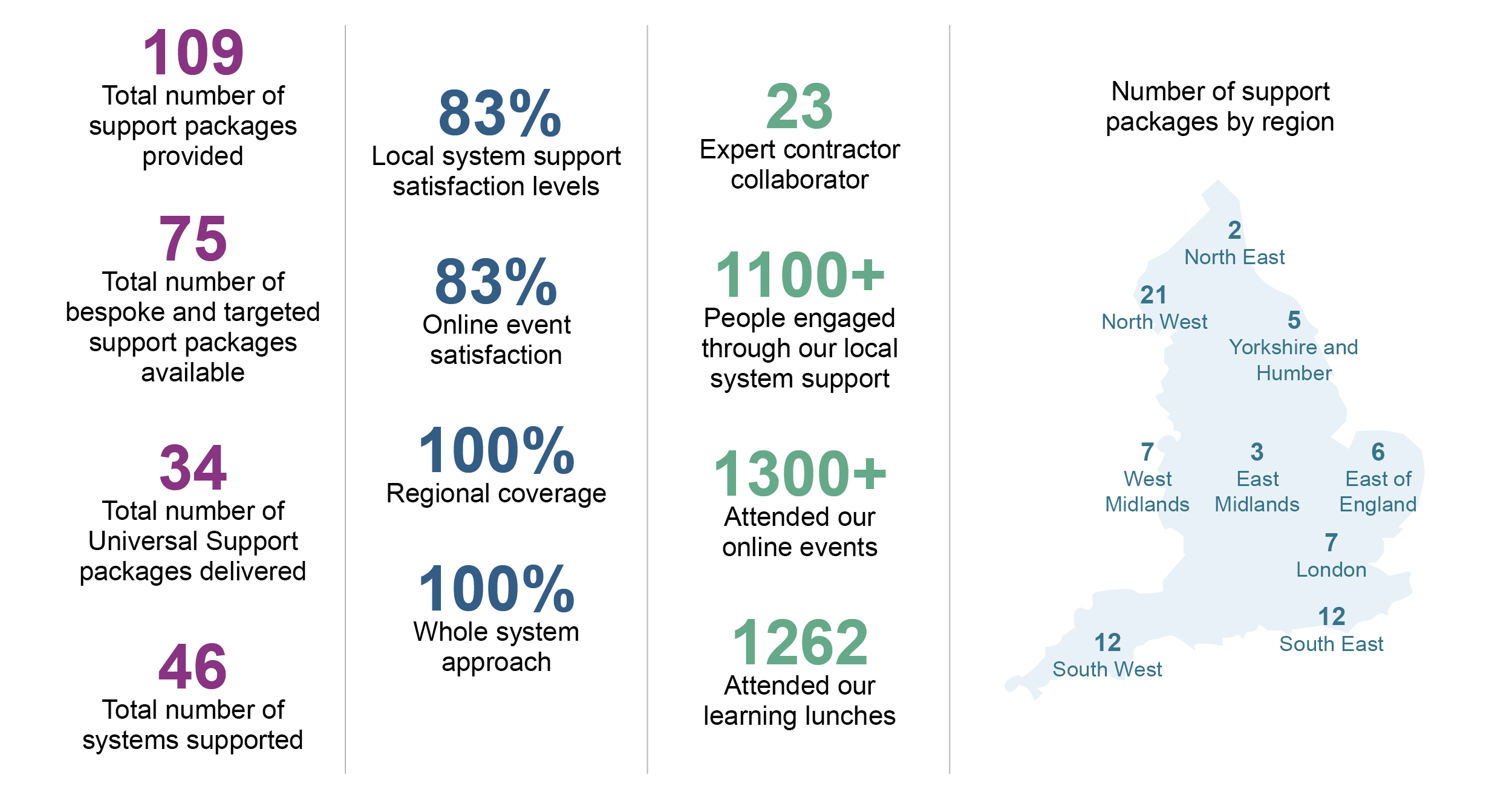
Programme output from April 2023 – March 2025
Total number of systems supported
Feedback received from systems receiving BCF Support
I feel you really captured the current state of our system and the key challenges we face."
The system agreed that the support has got them to a good place that is realistic and sustainable."
It felt like a supportive offer, it didn't feel like an unsafe space."
Our experience of the [BCF] support and appraisal has been totally positive."
I absolutely would recommend the programme, for what this support has achieved, and what it has the potential to achieve."
The contractor successfully facilitated the renewing of commitment to change across partners, enabling the system to look at implementing sustainable change and productive ways of working, including through a better understanding of personal and organisational drivers."
From April 2023 to March 2025 the Programme supported 46 individual local health and care systems. We have delivered 36 universal support activities such as the High Impact Change Models for Using Data for Decision Support and the High Impact Change Model for Improving the timely and effective discharge of people with dementia and delirium into the community. We also delivered 75 bespoke or targeted support activities in the 46 local health and care systems, falling into the following categories:
- Mediation support for system leaders
- Leadership support: culture, behaviour, and governance
- Discharge pathway diagnostics
- In-house D2A support offer
- Review of data models
- Care Transfer Hubs review and implementation support
- Capacity and demand capability, planning and tools
- Appraisal of BCF Plans
- Financial planning and modelling support
- Piloting optimal handling care
- Scoping diagnostics
- Peer review
- AI project
- Programme management
The Support Programme has been strengthened by an independent external evaluation conducted by IPSOS, commissioned independently by the DHSC, which has added valuable learning. In Section 4 we outline the key insights and reflections we have drawn from this evaluation.
Highlighted pages