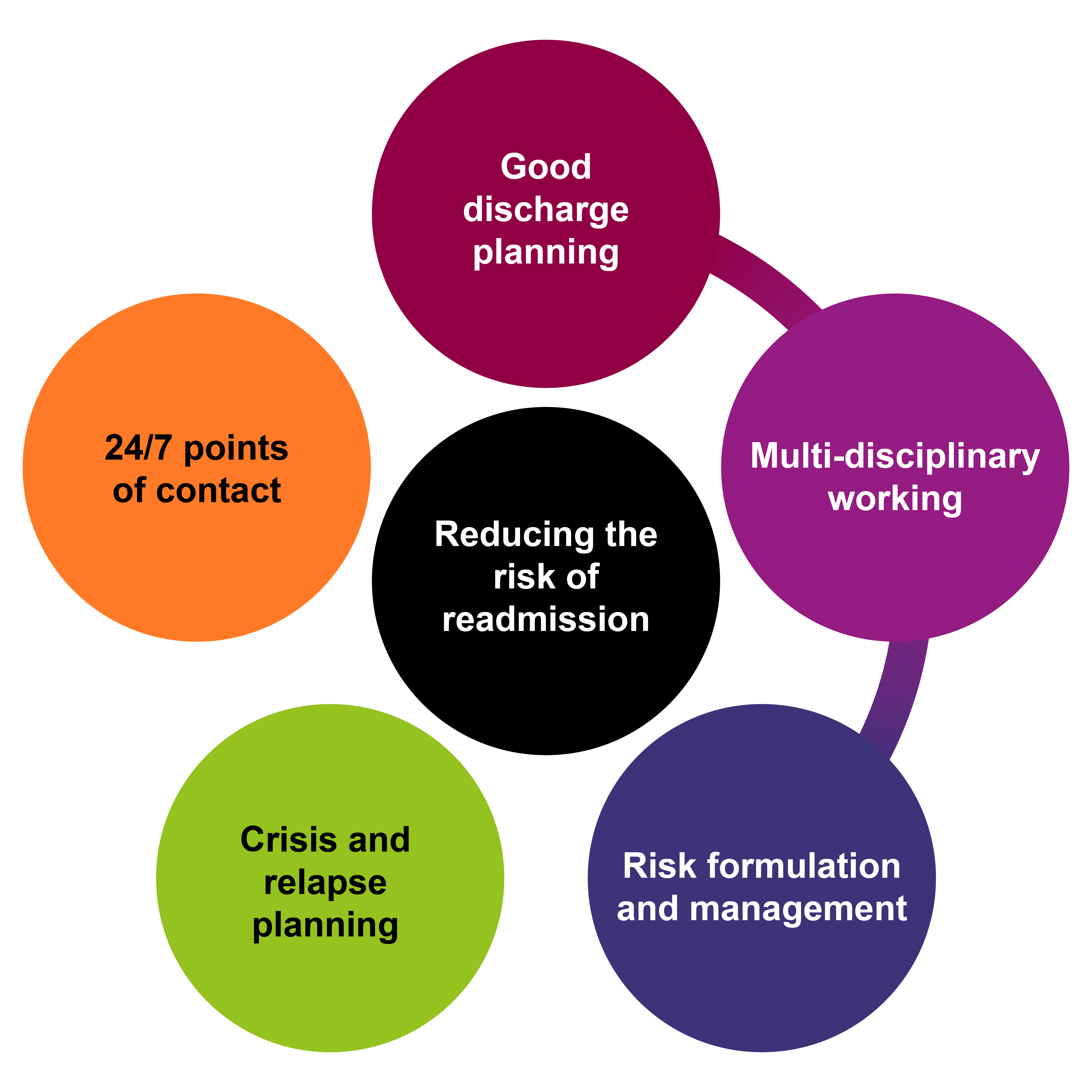
Section 117 aftercare plans focus on reducing the risk of hospital readmission through effective discharge planning (s117(2)(b))

Objective
Section 117 aftercare plans are designed to maintain recovery, build resilience, and minimise the likelihood of future detentions under the MHA.
Why is this important?
A key objective of Section 117 is to reduce the risk of a person being readmitted to hospital for treatment for their mental disorder. This requires discharge and aftercare planning that reduces the risk of relapse and readmission by ensuring continuity of care, support in the community, and a clear focus on addressing the underlying factors that contributed to the persons initial admission.
What does good look like?
- Seamless transition from hospital to community: Discharge planning should begin for all people at the point of admission, in line with good practice. Where a person becomes eligible for Section 117 aftercare through detention under a qualifying section of the Mental Health Act, specific Section 117 aftercare planning should commence from that point and be integrated into the wider discharge planning process.
Discharge planning should take account of the person’s needs and pathway, including, where relevant, the use of specific frameworks and processes (for example, Care, Education and Treatment Reviews for people with a learning disability and autistic people), and should ensure early and coordinated planning for accommodation, care, and support.
Particular attention should be given to securing appropriate housing and support arrangements, recognising that delays in accommodation are a common barrier to discharge, especially for people with complex needs.
This distinction is important to ensure that standard care planning is not conflated with Section 117 aftercare, and that Section 117 duties are applied lawfully, consistently, and only where the eligibility criteria are met. - Strengths-based risk enablement assessment and management: Risk assessment and management should be undertaken as part of the Section 117 aftercare planning process using strengths-based and trauma-informed approaches. This should be completed collaboratively with the person and focus on supporting choice, independence and recovery, while understanding and responding to risks to the person’s safety and wellbeing.
In line with NICE guidance, assessment should focus on the persons needs and circumstances, including the development of a shared risk formulation and safety planning, rather than reliance on predictive tools or static risk categorisation.
Plans should be proportionate and co-produced, enabling positive risk-taking where appropriate, reducing the likelihood of deterioration or crisis, and supporting the person to live the life they choose, with risks actively understood, shared and managed. - Continuity of care and relationships: Wherever possible, people should be supported by the same team of professionals throughout their recovery journey.
- Building resilience and social networks: Aftercare services include support to help build resilience and develop strong social networks that will help them cope with the challenges of everyday life and, in many cases, living with severe mental illness.
Practical considerations
- Hospital discharge framework: Is there robust hospital discharge framework to ensure that all people receive a high-quality and well-coordinated discharge and eligibility for Section 117 aftercare is acknowledged at the earliest point? See A framework for achieving excellence in mental health discharge
- Ensure early referral to adult social care: Are all people eligible to Section 117 aftercare referred to adult social care as part of the discharge planning process at the appropriate time? Have their social care needs been comprehensively assessed and any social care aspects of Section 117 aftercare planned prior to discharge?
- Involve care coordinators in discharge planning: Are care coordinators actively involved in all discharge planning meetings to ensure that the aftercare plan is comprehensive and well-coordinated?
- Provide post-discharge follow-up: Are systems and processes in place to ensure that people receive a follow-up visit within 72 hours of being discharged from hospital to ensure that they are safe and well and that their aftercare plan is in place?