
Introduction
In October 2024, the first version of this work was published (Community Coordinated Support for the ASC front door) as a response to the pressure that exists on adult social care. It explored the methodology that might be used to organise a comprehensive, complementary offer from the voluntary, community, faith and social enterprise sector that benefits local citizens and nurtures and increases other forms of support. In this way it supports the effective working of the adult social care front door.
Based on real world learning carried out for PCH by SPINDL CIC, with London Borough of Barking and Dagenham, West Northamptonshire and City of Doncaster, the approach identifies important aspects for organising a new front door. These are not only around key values (strength-based, co-production, empowering people) but also working approaches (building networks, developing over time) that need to be in place to create a good quality alternative offer to run alongside the traditional front door.
A collaborative community approach is more equitable: By connecting people up to a wider range of resources in the community, access is improved, individual contribution is increased (further increasing community capacity) and demand for more formal care is reduced.
A collaborative community approach is a way of delivering accessible and sustainable support to the community and supporting people to live healthy and independent lives: It engages and coordinates the voluntary, community, faith and social enterprise sector and others to deliver a wide range of support to all who need it, not just statutory care to those who meet eligibility criteria, thereby driving prevention.
The approach has three elements and five guiding principles. It has been designed to be flexible in recognition of the different needs and capacities of different council areas. It has been reviewed and further tested against real world application.
To resolve the challenges of the adult social care front door, the approach requires a whole council, long-term approach to building system wide capacity.
This document is a ‘how to’ guide for the development of a collaborative community approach to supporting the adult social care front door. Rather than being prescriptive, this guide aims to empower practitioners to think about what might work best in their local context and to provide the tools to help them.
The approach
The approach is designed to adapt to any context. We recognise every context is different. A critical piece of learning is not to ignore these differences, but to build from wherever local strength lies.
The collaborative community approach centres around neighbourhoods, weaving and building in services, operating on a basis of Enabling Help (inspired by MacKeith, 2021), or other complementary practice, and held in networks, collaborations and co-governance arrangements.
The collaborative community approach invites all to focus on citizens’ connection, confidence, capability and control, starting in the neighbourhood and building out to enable people to lead their best lives in a flourishing community. Citizens are engaged, with support to be actively involved, as co producers. Service delivery is defined through Enabling Help using the Liberated Method, (inspired by Smith, 2023), with networks, collaboration and co-governance and a set of principles to apply.
The approach relies on full collaboration with and leadership from voluntary, community, faith and social enterprise sector and most importantly focuses on people, bringing them into the centre of a newly designed systemic, neighbourhood-based ecosystem approach.
A doorway that places neighbourhoods at the centre of a caring ecosystem that is based on flourishing communities, enabling help and held in networks, collaborations and co-governance arrangements: 1) citizens living their best lives in flourishing neighbourhoods; 2) enabling help; 3) networks, collaborations and co-governance. These three elements are supported by five principles where people are able to lead their best lives. The five principles feeding into this are groundbreakers and architects; relationships first; organise for a purpose, inclusion and learning; allow emergent action; start where you are, build out and deepen.
Citizens 'living their best lives" in flourishing neighbourhoods
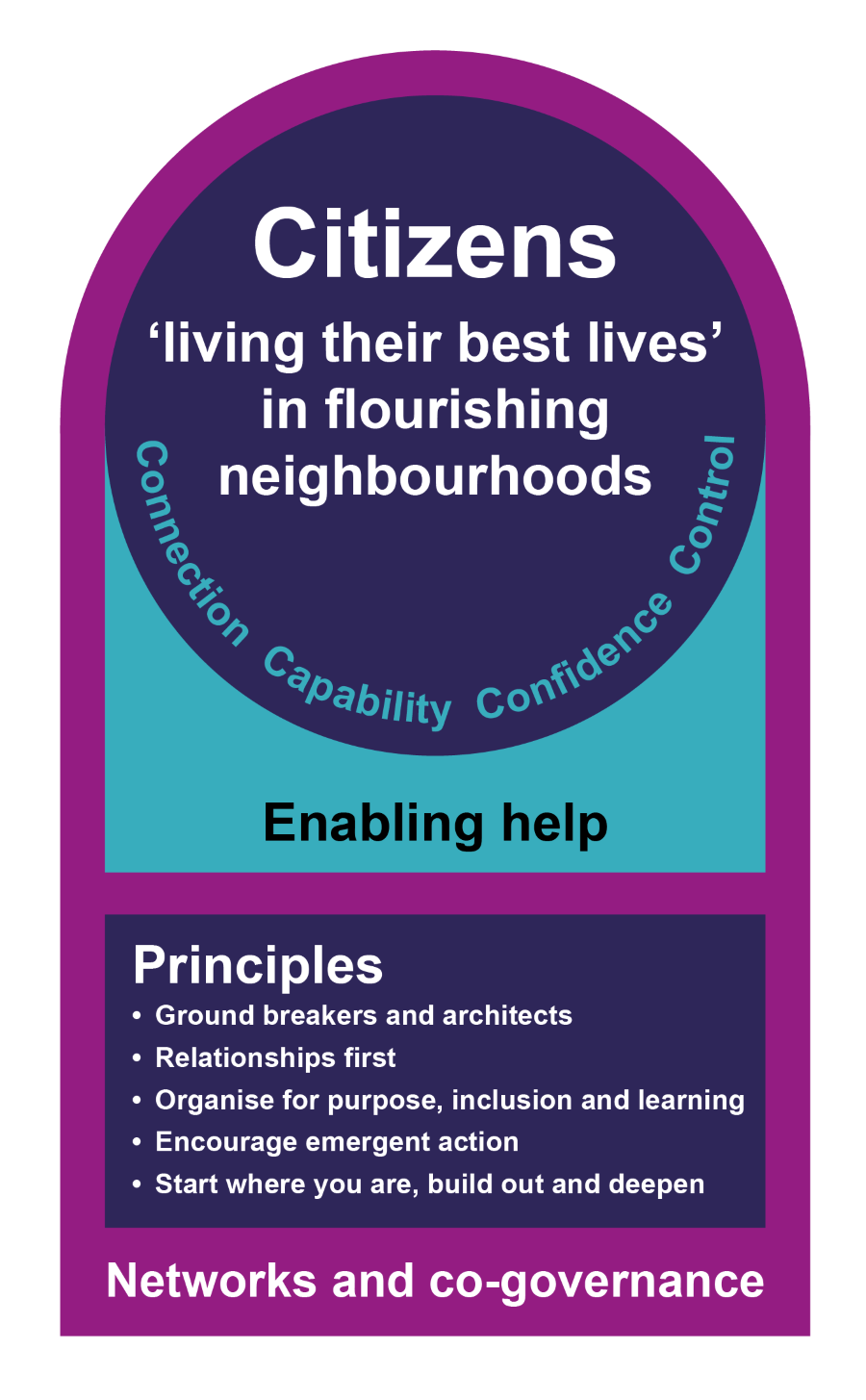
What is different about the collaborative community approach to supporting the adult social care front door?
A collaborative community approach enables access to a wider range of assets and support within a place: It does this through a coordinated, integrated system that deals with multiple needs simultaneously, whilst maintaining established access routes. There are dedicated resources to nurture citizen engagement and involvement, stimulating citizen-led action that provides a significant level of support. By nurturing and resourcing this potential grows.
“We need to stop trying to improve services. If you start with services as your focus for change, you end up with services. People don’t want services, certainly not those that have a lot going on in their lives. People want support, relationships, practical help. People want to be understood.”
- Mark Smith, Changing Futures Northumbria
Flourishing communities emerge out of putting citizens in control, building capability, connection and confidence. Neighbourhoods offer a significant opportunity to achieve this through physical proximity and provide an intersection between critical aspects of business, public service and communities. Provision and systems operating on a larger scale can then build from neighbourhoods into place, sub-regional and regional systems.
Public services can best integrate into neighbourhoods via adopting an Enabling Help and/or a Human Learning Systems philosophy to delivery. In this way public service delivery matches the strength and asset-based foundation that exists in community. Services become based on relational, motivational, developmental, holistic, flexible, and contextual practices. Specific attention will need to be given to any interface, aided by a focus on universal, inclusive access and robust data sharing systems.
Moving to implement change requires a focus on relationships. Through trust building and connecting across diverse groups, including citizens, new and multiple resources are unlocked and combined. Relationships are brought together around purpose, connecting people's passions and natural motivation to do the best they can. Understanding power dynamics and rank/status is especially important to the longevity of any change because it is the distribution of resources and inclusive decision making that will ensure long-term success.
The work must evolve. The nature of relational work is, by design, emergent and reliant on those first people who start to engineer the change. They must 'set the scene' and role-model the change, working on an invitational basis to include more and more people in a process of movement building.
The work needs to be scaffolded by networks and collaborative governance arrangements that are solidly built on the principles. The systems and practices used are vitally important to reinforce and not to undermine the work, using learning and reflection to drive it forwards.
Why neighbourhoods
The aim of this work is to unlock the capacity and capability of diverse public sector and voluntary, community, faith and social enterprise activity alongside the inherent capacity and capability within citizens, community and local business.
Unlocking and connecting these various resources creates a powerful change and reduces overall demand, not through cost-cutting, but because the love and care that exists in community is actively supported and resourced to flourish.
This work requires relationships to be built. They need to be built so that cultures and ways of working can become more person-centred and they need to be built to connect multiple resources. Generally speaking, physical proximity is needed to build relationships, especially in communities.
This is why neighbourhoods are the most appropriate context. In neighbourhoods (a group of around 5,000 people, rather than a town of 50,000) collaboration with citizens and multiple agencies becomes possible. This natural overlap in someone’s life happens in context, in neighbourhood. This recognises that the context of neighbourhood varies from urban to rural, as does the relationship between places, such as villages and market towns. Other contexts leave out key agencies or become too unmanageable from a citizen and population perspective.
In addition to relationships being vital to the work itself, relationships are vital to creating the change. Through trust-building and connecting across diverse groups, including citizens, a new story of how we can care for one another can emerge. Relationships are brought together around purpose, connecting people's passions and natural motivation to do the best they can.
The work does not stop in neighbourhoods – it begins there.
Applying the approach: a how to guide
The insight gained from work so far leads us to propose three sets of considerations to continually hold as you progress the work in your area:
- build action in each of the three elements of the approach
- practise the five principles
- reflect on outcomes and continually adjust the approach to better fit your needs.
In line with the principles, the specific starting points will be defined by the strengths of your local system. We would suggest building from those strengths, moving the conversation into neighbourhoods as quickly as possible so citizens and grassroots organisations can be engaged as early as possible.
Starting in neighbourhoods
We suggest that a neighbourhood is roughly 4,000 to 5,000 people, depending on local context and identity, acknowledging the village or market town relationship in more rural areas. Whilst it is important to work at a neighbourhood level there are two issues to be aware of:
Boundaries need to be permeable. Life and communities generally do not split themselves down hard lines on a map.
Neighbourhoods do not and should not replace a focus on those with protected characteristics and networks of identity. At a place level, there should be a cross-cutting focus on social justice and equity.
There are three building blocks to nurturing ‘neighbourhoods of care’.
Enabling help
Enabling Help (MacKeith, 2021) is an evidence-based framework that supports practice and liberates staff to work more effectively to support people. The following principles underpin this work:
- relational – building trust to engage with help
- motivational – building belief that change is possible
- developmental – valuing and building capabilities to do things differently
- holistic – looking at the whole picture and joining the dots
- flexible – tailoring the help to the person
- contextual – highlighting the impact of the wider environment
- behavioural- tailored by behavioural insight approaches.
To maximise its impact, the framework should extend beyond adult social care to encompass all services, supports and activities. Central to this approach is organising around people rather than organisations. The person being helped is seen as a co-collaborator, not a passive recipient.
Liberated Method
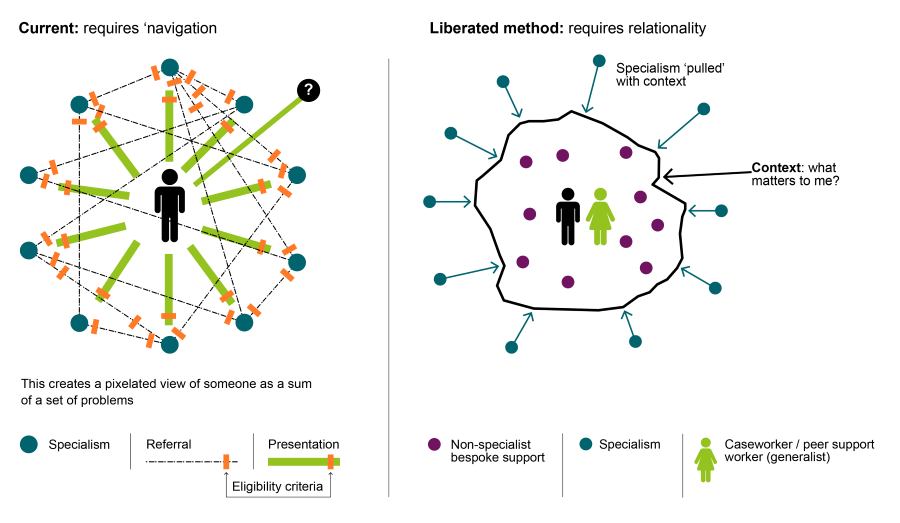
A well-documented example of this way of working is the Liberated Method (Smith, 2023). The method was named by staff who felt liberated to work in the way that worked for the people they supported. The work was guided by a simple set of rules and principles.
The principles of Enabling Help are very often at the centre of many other approaches. It can help to recognise this when connecting across to other departments and services. There are many, but below are a few of the complementary practices:
- Human Learning Systems (Lowe, Plimmer, 2019)
- Restorative justice (various, including First Nation teachings)
- Reimagining Help (Nesta, 2020)
- Community Led Support (NDTi, 2017)
- The three conversation approach (Newman)
There are many more complementary practices that may already exist in local systems. It is helpful to draw these parallels out to build momentum for different ways of working.
Social prescribing and connecting across provision
A bridging capacity is very helpful as a ‘glue’ that can connect across multiple service provision. This capacity can be twofold:
- direct provision of an Enabling Help style service to support people who would otherwise need a GP (or any other service)
- a pathway mechanism which uses a customer relationship management system to ensure both the individual and their data have a smooth journey through the different parts of the system.
This bridging capacity can very helpfully concentrate on ensuring equitable access for all groups, including those with protected characteristics, through local access points, face-to-face entry points, and a dedicated telephone line with sufficient capacity and effective referral systems. With a bridging function like this, informed and continual consent should be at the heart of any shared systems. The entry points should be able to share data to wherever the person wishes it to go to receive the desired and agreed support. Shared data is vital to be able to not only make the process for the person receiving support to be smooth, but also to produce flow data showing how people are flowing through the various forms of support.
This function needs to be embedded in communities and follow the Enabling Help and Liberated Method to maximise its potential, as virtual delivery and signposting doesn’t support those most in need and the potential impact is lost.
Networks, collaboration and co-governance
This element of the approach is critical for long-term development and community ownership. It brings attention to the collaborative and contractual environment in which the work is carried out and operates on multiple geographical scales. Three parts have been identified.
Neighbourhood networks
Neighbourhood networks provide open forums that bring citizens, grassroots groups and agencies together. They are spaces, places and times that people come together from across the neighbourhood to share and connect – they replicate the heart of community, just as the village green or town square facilitates connection and exchange.
Relationships are built and information is shared, providing a relational response to the challenge of coordination, alignment and sharing local knowledge. Local priorities can be discussed in the context of experiences gathered from local people and key data from the public agencies, such as Population Health Management. They can provide transparency and accountability, supporting provision to recruit locally. They can also be mechanisms through which training can be provided, such as in asset-based community development and Enabling Help. A good example of a strategic commitment to this is from the London Borough of Barking and Dagenham.
Neighbourhood networks
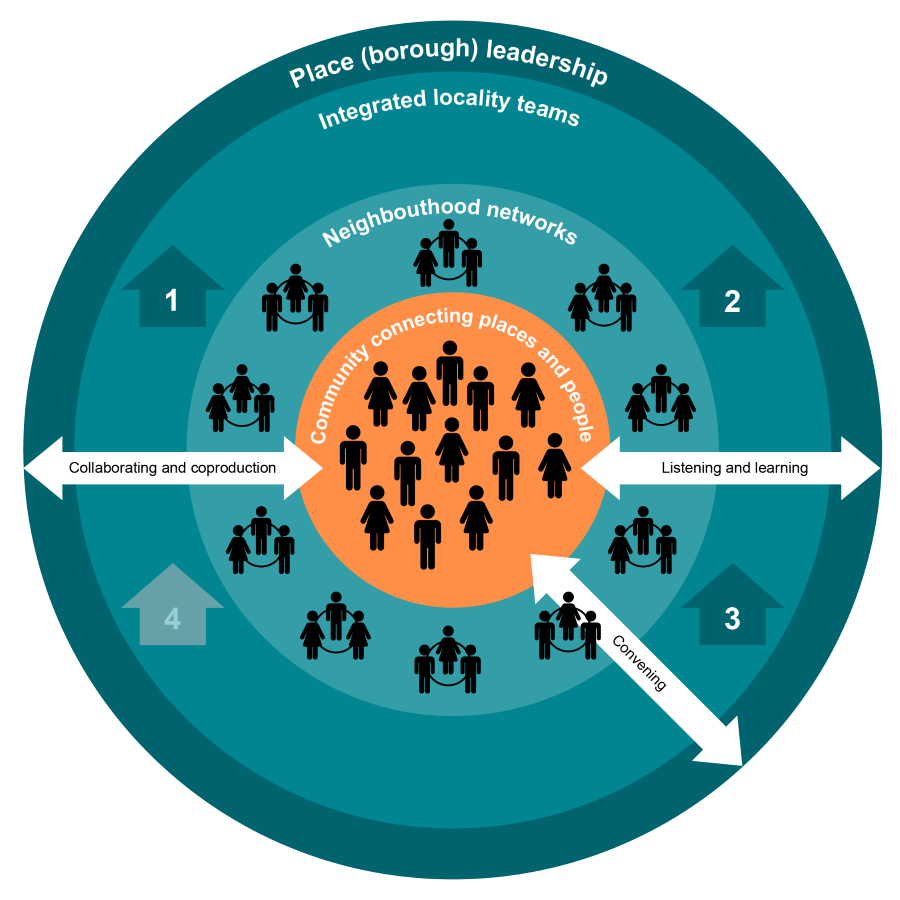
Networks of place and of identity
Communities of identity and marginalised voices need forums in which diversity, inclusion and equity are a focus. These may not be place-based.
These networks can bring together organisations and groups that represent people that might otherwise be marginalised or minoritised within neighbourhoods and respond to issues at a neighbourhood and/or a place level.
They can provide a learning exchange function between neighbourhoods and place activity, resolving issues that cannot be resolved at a neighbourhood level.
Place-based citizen voice
Maintaining a citizen focus on a place level continues to centre decision-making around the direct experience of living in a place. All parts of the system gather insight on an ongoing real-time basis. From service feedback, conversations with a Community Builder to consultations, opportunities to listen occur every moment of every day. The challenge of curating and collecting this data to feed into strategic decision making is significant – but worth tackling as a way of streamlining the feedback loops from decision-making to citizen.
Practise the principles
We’ll explore how these principles look in reality, building on other well-established approaches of good practice.
Ground breakers and architects
“I think the mindset of how we solve problems in the NHS is the biggest thing we have to shift. Seeing a problem, finding a solution and implementing it is completely the wrong mindset for leading a continuous improvement organisation. That's the shift: unlearning that you are the source of the solution and learning that you are the ultimate architect of the environment, in which others can solve problems.”
- Dr Amar Shah, Consultant Forensic Psychiatrist and the National Clinical Director for Improvement
For change to happen, ground breakers and architect-style leaders from across the system need to step forward. It may appear insufficient, but the boldness of simply and honestly outlining and describing the problem is a powerful tool to bring people around a common issue.
Questions: Ground breakers and architects
For your council area, consider:
- How do we find and support people who can lead this new way of working?
- How can we talk openly about the root causes of problems to agree on what needs to change?
- How can we encourage everyone to find solutions, not just those in a formal leadership position?
Resources: Ground breakers and architects
Relationships first
- Start with those present, the possibility and build on your strengths
- Aim for citizen voice and 360° engagement as soon as possible
- Develop and invite in, based on a shared vision that is fluid and adaptable to new people joining
- Be aware of power dynamics. Power gradients, where some people may feel inferior to others, are a natural part of the current way of working. Be aware of how this manifests so that capability, connection, confidence and control is achievable for citizens.
Relationships are the foundation of a good life and essential for this framework. Torbay has done much work to create a community coordinated helpline approach that diverts 86 per cent of need from the `front door` of adult social care. This and the approach advocated by Hilary Cottam (and many others) are founded on good relationships. Relationships were also the key to creating more community-led change aspirations in the council areas interacted with to produce this guidance. Relationships matter – from the community level up into the whole system.
Questions: Relationships first
For your council area, consider:
- How well do we build trust with citizens, communities?
- How do we reach across organisations, sectors and silos to find common purpose?
- What support do staff get to build good relationships in their work?
- How do staff support each other and learn about building relationships?
- How do we address power differences so everyone's voice matters?
- How do we create a shared and flexible vision that everyone can join?
Resources: Relationships first
Organise for purpose, inclusion and learning
Purpose gives a direction. Start with where you are – this might be “we need to reduce demand into Adult Social Care”. But as you start here, understand that exploring what this means to other people will necessitate changes, so the purpose becomes a shared purpose. It will continue to change as collaboration builds. Purpose around citizens and aspirations, such as living our best lives, with a focus on connection, confidence, capability and control, has been proven to reduce demand in care and health services.
This shared purpose is critical: it is not the property of the most senior leaders; it is held by everyone – it is only by achieving this that everyone can play a role. By the same logic it must also be independent of services and something that is easily understood.
As shared purpose is built, effort must go into inclusion, especially those groups and people that would not normally be included. It is from these marginalised groups that there is a deep understanding of how the failings of the current system are embodied. This will produce a tension that, if managed well, results in deeper relationships and better solutions. This work is inherently emotional. Those that are systematically excluded carry a greater burden within society, having to conform to systems and attitudes that are often traumatising. Part of this work is therefore providing time and space for healing.
Learning happens on two levels:
- the relational content of the work
- the actions taken.
By building this time and reflection in, it gives an opportunity to consider and ensure psychological safety and to increase trust. The new depth to relationships can be undermined by existing systems, from governance to service design, measurement and monitoring. These may require a rethink.
In complex environments, continuous learning drives performance improvement. Such environments are characterised by variety and change. Continuous learning enables workers’ practice to improve – through experimentation, gathering data, sense-making and reflective practice.
Questions: organise for purpose, inclusion and learning
For your council area, consider:
- How do we create a shared purpose that everyone, including those often marginalised, agrees on and that can evolve as we work together?
- Do we have time and space to build the relationships needed for a shared vision?
- How do we learn from what we do and from our relationships, to keep improving?
- How do we create a safe environment where people can be open and share different ideas?
- How will we measure success in a way that reflects our new approach?
- How do we support and empower collaboration instead of just telling people what to do?
Resources: organise for purpose, inclusion and learning
Encourage emergent action
Prioritising relationships and building shared purpose with different stakeholders and marginalised groups mean that tightly defined and controlled plans are not appropriate, for two reasons:
- they limit what is possible, excluding actions in the control of other stakeholders
- they operate on a predict and control basis.
Much of our current systems work on the basis of:
- predict action (and often cost)
- control for delivering the action
- measure success against progress made on the predicted actions.
Removing this default control mechanism means that significant uncertainty is introduced. This prompts questions about:
- How do we know we are being successful?
- How do I know what I am meant to do? (What is my role?)
This is why relationships are prioritised – we must trust one another to be taking action that is in line with, and effectively working towards, the purpose.
A general focus on creating possibility and opportunity, rather than managing scarcity and risk, will create a solutions-driven approach. Consistency in this strength-based approach is important. In asset-based community development, strength-based questions are used, rather than needs-based ones and it stimulates a different conversation, relationship and outcomes. This is similar to Enabling Help and the Liberated Method. Evaluate your baseline to identify the key areas that need the most support and development. Prepare for a long-term conversation that will bring uncertainty – and offer open leadership through this uncertainty.
Avoiding uncertainty means foregoing the chance for growth and transformation. Acknowledging a lack of complete knowledge supports constant progress along the path to improvement.
Questions: Encourage emergent action
For your council area, consider:
- How do we create space for new community-led ideas?
- How do we move from trying to control everything to trusting our relationships and other people to make progress?
- How do we find and build on the existing strengths in our community?
- How do we make it okay to try things and learn if they don't work perfectly?
- How do we change a scarcity mindset to focus on what's possible together?
- How do we support leaders when things are uncertain in this new approach?
- How do we involve more people and new ideas?
Start where you are, build out and deepen
There is a tension if you are not currently working in neighbourhood structures. You need to aim to work in this context, but do not assume you need to build direct relationships. Instead build relationships, one by one that can get you closer, using your existing network. This method has two benefits:
- you build and strengthen your own network
- you spread the conversation wider as you go, building steady support for the change.
As you reach out, consider what parts of your system you could reach that are closest to working with citizens, where they are collaborators or in the lead? The process of development should deepen existing relational work. Simultaneously, as a new cultural space is created, the scope can widen out, using others to bridge into groups and people not currently involved.
Key to success is long-term sustained commitment to the principles, supported by resource commitments to enable you to develop the work for each element. Things may not work perfectly the very first time.
This approach does not require all elements to be fully in place to function but suggests that the full set of elements will maximise effectiveness. It is a strengths-based approach that should be applied in your context, building up over time.
In Leeds, 2011 marked a new strategy: Better Lives. Cath Roth MBE, then director of adult social services at Leeds Council, invested in strengths-based approaches through both the community led support programme with NDTi and asset-based community development out in the community, which realised £6 million cost avoidance in the first two years. Sustaining Neighbourhood Networks for Older People started in 1994 and continues today.
Questions: Start where you are, build out and deepen
- How do we use our current connections to connect into neighbourhoods?
- Do our resources and conversations focus on community strengths or solely on problems?
- What is our long-term plan to make this way of working a normal part of our system?
- How will we check our progress in different areas over time?
- How do we make sure we are supporting communities and not just controlling them?
- How do we find and involve the people who are closest to the issues to lead this work?
Resources: Start where you are, build out and deepen
Conclusion
The collaborative community approach to supporting the adult social care front door successfully orientates the attention of practitioners to the system critical elements and principles to achieve long-term change that improves lives, enables contribution and reduces demand.
This approach has wide application in supporting councils to re-orient approaches to social care that better maximise the assets and strengths from across their system and from their communities.
There is value in building social capital and a sense of community, not just for community health but also to promote and maintain the health and independence of individuals. Councils and their partners play a key role in supporting this development. This approach allows the promotion of independence and wellbeing of individuals, whilst conserving limited resources for appropriate and targeted use.
As part of its ongoing evolution and evaluation we would be grateful for any feedback which should be sent to [email protected] as part of our ongoing development programme.
Appendix 1 – reflections on previous approach
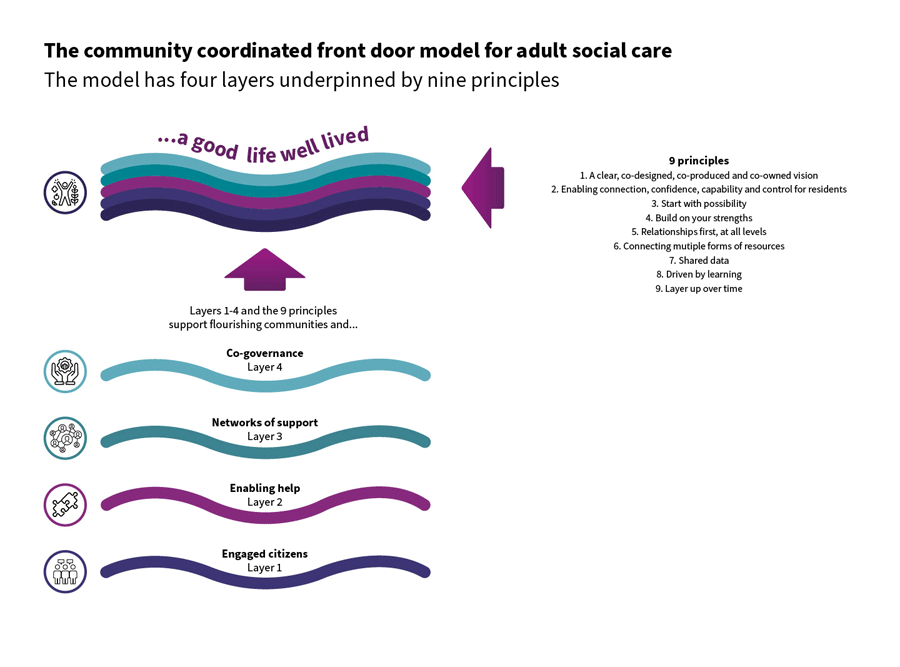
- The approach has worked as a lens into an area, focusing on a whole system approach to reducing demand into social care.
- The principles work but they were not all applicable in all situations, for example, data sharing.
- We have found that Layer 1 (engaged citizens) lacks greatest investment and often understanding. We have found the working context within community is very mixed, but there is a movement from Councils to working more with communities. Adult social care is not always engaged directly in this or actively supporting it, so there is not consistent engagement. This means it is very dependent on individuals rather than systemic. A focus on assessing need and intervening to fix problems is not working and is unsustainable, whereas building relationships, trusting and seeing the strengths, what’s strong and what might be possible, looking broadly at what resources are available gives us the opportunity of a flourishing community, where we get to lead our best lives.
- There is a mixed picture in understanding and adopting Enabling Help (layer 2) principles although given the consistent investment in approaches such as the 3 conversation approach, Community Led Support, strengths-based working, solutions focused approaches, appreciative enquiry and similar approaches, there appears to be a general level of understanding and agreement that being person-centred is an effective way of supporting people.
- Navigating and lack of connectivity are peas in a pod. Sectors, organisations and silos and our focus on fixing things all reinforce dependency and disable people`s ability to thrive. Supporting people who are surviving, not thriving, when focussed on building their ability to become more self-reliant, to have the skills needed to improve their economic situation, to support their family…to feel they can improve things, is critical. How many times do we talk of signposting? It’s in recent guidance on more preventive approaches, as is working with the voluntary, community, faith and social enterprise sector. Anyone with experience of working with those with multiple challenges who were simply and only signposted to support, will tell you that this approach doesn’t work. People often do not follow up and contact the service they have been signposted to, because they don’t have the confidence, the capacity, the resources to do so. Enabling Help aims to purposely understand the specific context of the individual and to facilitate self-directed or person-led support. This draws in what is needed, but most importantly supports motivating and developing the individual to be more connected, confident, capable and in control.
- Networks (layer 3) are largely well-developed but vary in visibility and ‘tone’. Many people have often made a significant personal commitment to improving life in their area, so networks of relationships exist in many places. Where there is more variability is how these networks are consciously built into positive and growing networks. There is also, generally, a lack of robust connection into the grassroots sector – often because of the difficulty in achieving visibility and personal relationships. Awareness and connectivity are often lowest for those grassroots organisers. These people may be working for nothing, motivated by care and compassion for their neighbours who may not have the time and resource to attend events and meetings in other places.
- Co-governance (layer 4) is the other layer that is least well developed. One interesting development is in the London Borough of Barking and Dagenham which has been working hard on a Community Benefit Society, a cooperative vehicle for the voluntary, community, faith and social enterprise sector to organise around.
- Inclusion of businesses and local trades people is often a blind spot for many areas, who focus solely on the public and voluntary, community, faith and social enterprise sector. Locally rooted businesses and tradespeople bring significant resource and wider assets and should be encouraged to get involved in an approach that seeks to maximise the full range of potential resources. This includes care providers, some of whom deliver wider wellbeing or Enabling Help and support through a range of approaches including recruiting volunteers to support with companionship and other unfunded activities.