
Background
The adult social care front door faces significant pressure, often struggling to meet the needs of all individuals seeking support. This report presents an evolved collaborative community approach to supporting the adult social care front door as a response to this challenge. It outlines a methodology for organising a comprehensive, complementary offer from the voluntary, community, faith and social enterprise sector whilst connecting preventative work across sectors. This approach aims to benefit both local citizens and the efficient and effective operation of the adult social care front door by providing a parallel supportive system.
This report identifies key aspects for establishing this new approach, encompassing core values (strength-based, co-production, empowering people) and working approaches (building networks, developing over time). These elements are essential for creating a high-quality alternative offer that operates alongside the traditional front door. The model has been reviewed and further tested in real-world applications. Rather than being prescriptive, it aims to empower practitioners to consider what will work best in their local context and provides tools to aid this process.
Case for change; background
Within all communities, adults of all ages are living with physical and mental health needs. We are an aging population that is living with physical and mental impairments and illness for much longer now than in previous decades. We know that, with help, people can live fulfilling and independent lives outside a formal care setting. Achieving this often involves support from the voluntary, community, faith and social enterprise sector and other stakeholders.
This report explores the positive steps that councils can take to facilitate this and introduces a model that describes necessary steps and preconditions for this to be successful.
What is a common adult social care front door model?
Provision varies across the country but often the ‘front door’ will be where an individual’s needs are first reported and may be discussed as part of an initial assessment, before a referral is passed to a community or specialist team for further assessment. In some cases, there is no need for further assessment as the initial discussion may enable information and advice to be provided about services and support that may be sufficient to meet the person’s needs. The person may be signposted to those services, rather than proceeding to further assessment. If it appears that the person may have adult social care needs, the local authority has a duty to assess, even if the person has the means to pay for care and support themselves. Any further assessment (after the initial discussion) would include an assessment of eligibility, using statutory criteria under the guidance of social work professionals. If the individual’s needs meet these criteria, then they will be eligible for support.
The current system, as it stands in many councils, may not offer an optimal use of resources or lead to the best outcomes for all who draw on social care. If someone is lonely and isolated, they may not be entitled to statutory social care services, but still may have a need for support. If someone meets the criteria for social care but would rather remain independent and within their community, it may be that a more personalised community offer would be preferable. This both improves social outcomes for individuals and conserves resource so that it can be targeted at those who are most in need.
What is different about the collaborative community approach to supporting the adult social care front door?
A collaborative community approach is more equitable. By connecting people up to wider resources in the community, access is improved, individual contribution is increased (further increasing community capacity) and demand for more formal care is reduced.
A collaborative community approach enables access to a broader range of assets and supports within a locality by establishing a coordinated voluntary, community, faith and social enterprise sector access system that addresses multiple needs simultaneously while maintaining existing access routes. It also involves dedicated resources to cultivate citizen engagement and involvement, encouraging citizen-led initiatives. Key to success are systems that facilitate collaborative working across various voluntary, community, faith and social enterprise sector organisations at both operational and strategic decision-making levels. This approach envisions a doorway that places neighbourhoods at the centre of a caring ecosystem grounded in asset-based community development, Enabling Help, and sustained by networks, collaborations, and co-governance.
What would be the value of expanding the adult social care front door to encompass a comprehensive complementary voluntary, community, faith and social enterprise sector support?
Engaging the voluntary, community, faith and social enterprise sector allows for the delivery of a wide range of support to all who need it, not just statutory care for those meeting eligibility criteria. This creates additional preventative work, potentially reducing and delaying the demand on statutory services in the long term. By nurturing neighbourhoods of care, the foundation for more effective services is created, empowering citizens and building their capability, connection, and confidence.
In October 2024, the first version of this work was published (Community Coordinated Support for the adult social care front door) as a response to the pressure that exists on adult social care. It explored the methodology that might be used to organise a comprehensive, complementary offer from the voluntary, community, faith and social enterprise sector that benefits local citizens and nurtures and increases other forms of support. In this way it supports the effective working of the adult social care front door.
Based on real world learning carried out for PCH by SPINDL CIC, with London Borough of Barking and Dagenham, West Northamptonshire and City of Doncaster, the approach identifies important aspects for organising a new front door. These are not only around key values (strength-based, co-production, empowering people) but also working approaches (building networks, developing over time) that need to be in place to create a good quality alternative offer to run alongside the traditional front door.
- A collaborative community approach is more equitable: By connecting people up to a wider range of resources in the community, access is improved, individual contribution is increased (further increasing community capacity) and demand for more formal care is reduced.
- A collaborative community approach is a way of delivering accessible and sustainable support to the community and supporting people to live healthy and independent lives: It engages and coordinates the voluntary, community, faith and social enterprise sector and others to deliver a wide range of support to all who need it, not just statutory care to those who meet eligibility criteria, thereby driving prevention.
- The approach has three elements and five guiding principles: It has been designed to be flexible in recognition of the different needs and capacities of different council areas. It has been reviewed and further tested against real world application.
- To resolve the challenges of the adult social care front door, the approach requires a whole council, long-term approach to building system wide capacity.
- This document is a ‘how to’ guide for the development of a collaborative community approach to supporting the adult social care front door: Rather than being prescriptive, this guide aims to empower practitioners to think about what might work best in their local context and to provide the tools to help them.
The approach
The approach is designed to adapt to any context. We recognise every context is different. A critical piece of learning is not to ignore these differences, but to build from wherever local strength lies.
The collaborative community approach centres around neighbourhoods, weaving and building in services, operating on a basis of Enabling Help (inspired by MacKeith, 2021), or other complementary practice, and held in networks, collaborations and co-governance arrangements.
The collaborative community approach invites all to focus on citizens’ connection, confidence, capability and control, starting in the neighbourhood and building out to enable people to lead their best lives in a flourishing community. Citizens are engaged, with support to be actively involved, as co producers. Service delivery is defined through Enabling Help using the Liberated Method, (inspired by Smith, 2023), with networks, collaboration and co-governance and a set of principles to apply.
The approach relies on full collaboration with, and leadership from, voluntary, community, faith and social enterprise sector and most importantly focuses on people, bringing them into the centre of a newly designed systemic, neighbourhood-based ecosystem approach.
Case for change
Within all communities, adults of all ages are living with physical and mental health needs. We are an aging population that is living with physical and mental impairments and illness for much longer now than in previous decades. We know that, with help, people can live fulfilling and independent lives outside a formal care setting. Achieving this often involves support from the voluntary, community, faith and social enterprise sector and other stakeholders.
This report explores the positive steps that councils can take to facilitate this and introduces a model that describes necessary steps and preconditions for this to be successful.
Why neighbourhoods
The aim is to unlock the capacity and capability of various public sector, voluntary, community, faith and social enterprise sector and business assets and activities, alongside the inherent capacity and capability within citizens and the community. Connecting these diverse resources can lead to significant change and a reduction in overall demand, not through cost-cutting, but by nurturing the existing care and compassion within the community to flourish and grow.
Building relationships is crucial for this work to facilitate person-centred cultures and connect multiple resources. Physical proximity in neighbourhoods (a grouping of roughly 4,000 – 5,000 people) is often necessary for effective collaboration between citizens and multiple agencies. This local context allows for a natural overlap in people’s lives.
Relationships are vital for both the work itself and for creating change by fostering trust and connections across diverse groups. This can lead to a new narrative of mutual care. It is worth noting that the work starts in neighbourhoods but does not end there.
A citizen centred approach
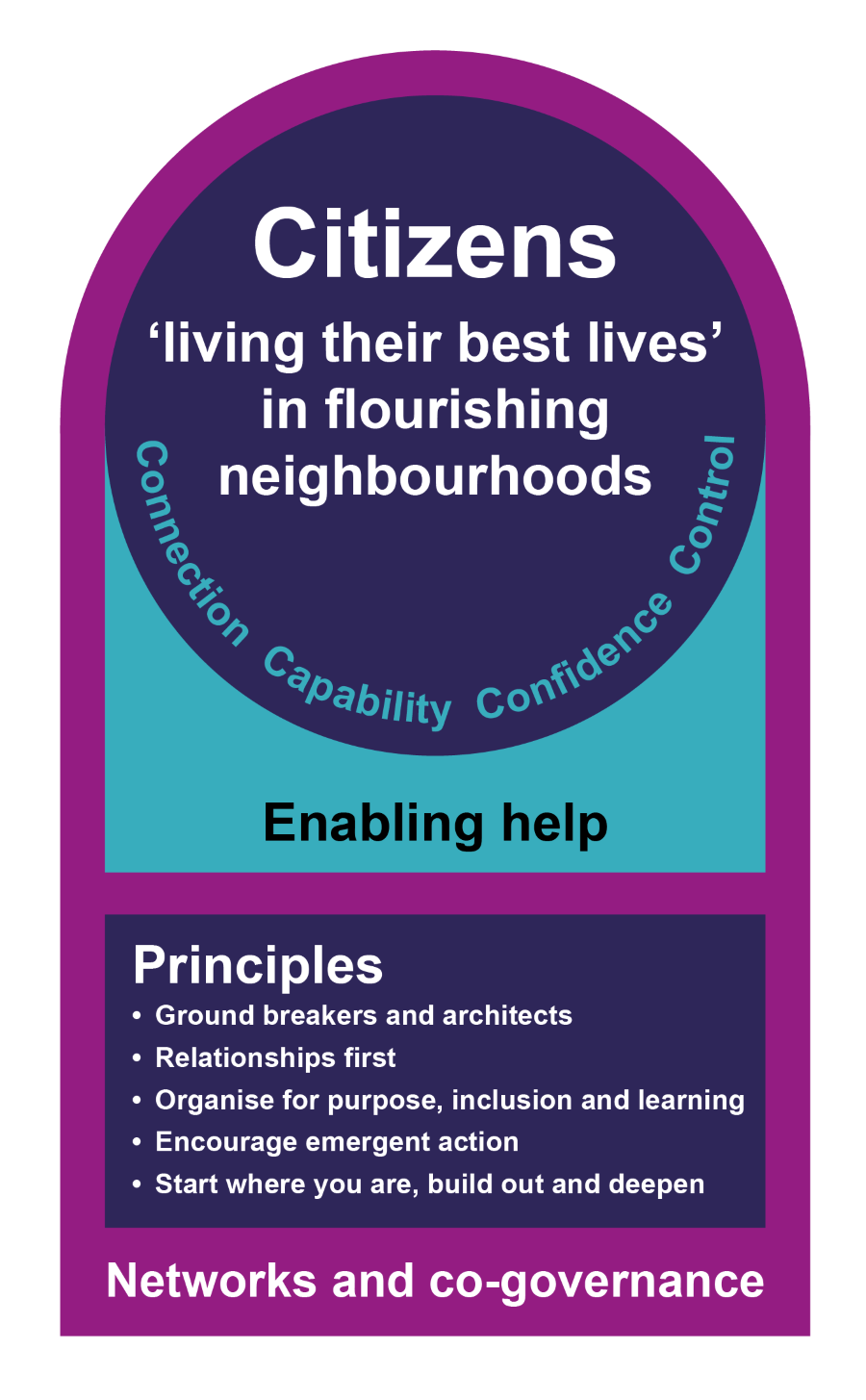
The approach is designed to be adaptable to various contexts, recognising the unique needs and capacities of different council areas. Central to the approach is that all elements are channelled towards building citizens’ connection, confidence, capability and sense of control. A crucial learning point is to build upon existing local strengths rather than disregarding local differences. The approach has three elements supported by five guiding principles.
Three elements:
- flourishing neighbourhoods
- enabling help
- networks, collaborations and co-governance.
Five guiding principles:
- ground breakers and architects
- relationships first
- organise for purpose, inclusion and learning
- encourage emergent action
- start where you are, build out and deepen.
The collaborative community approach to supporting the adult social care front door comprises three elements:
- Flourishing neighbourhoods: This element focuses on community building where organisations reach into communities to build relationships and catalyse citizen-led activity, using approaches like asset-based community development. It involves providing grassroots support to community groups to help them operate, organise, and connect. Access to buildings and land, ideally community-owned and controlled, provides vital gathering spaces.
- Enabling help: This involves adopting the Enabling Help framework (MacKeith, 2021) and the Liberated Method (Smith, 2023), which are relational, motivational, developmental, holistic, flexible, contextual, and behaviourally informed. This approach should extend beyond adult social care to all services, focusing on organising around people and engaging with them as co-collaborators. Bridging capacity is helpful to connect across different service provision, offering direct support and a pathway mechanism with a customer relationship management system. Ensuring equitable access for all groups through local entry points is also crucial.
- Networks, collaboration and co-governance: This element focuses on the collaborative environment at multiple geographical scales. Neighbourhood networks provide open forums for citizens, grassroots groups, and agencies to connect and share information. Place-based networks bring together organisations representing marginalised groups and facilitate learning exchange between neighbourhoods. Maintaining a strong place-based citizen voice ensures that strategic decision-making is centred around the direct experiences of citizens.
Practise the principles
Implementing this model requires embracing the five guiding principles:
- Ground breakers and architects: This principle acknowledges that for change to happen, there need to be ground breakers and architect-style leaders from across the system – to step forward and bring a boldness and honesty to outlining and describing a problem or challenge and its root causes, as well as leading the work needed to address them.
- Relationships first: This principle emphasises starting with who is present, building on strengths, and aiming for early citizen engagement. It requires awareness of power dynamics to empower citizens and recognises that relationships are fundamental at all levels.
- Organise for purpose, inclusion and learning: Establishing a shared purpose that evolves through collaboration is critical. Effort must be made to include marginalised groups, and time for reflection and learning is vital for building trust and improving practice. Continuous learning drives performance improvement in complex environments.
- Encourage emergent action: This principle acknowledges that tightly controlled plans are often inappropriate due to the involvement of multiple stakeholders. Trusting one another to act in line with the shared purpose is essential. A focus on creating possibility and opportunity fosters a solutions-driven approach.
- Start where you, build out and deepen: This involves starting where you are and gradually widening the approach, particularly aiming to work at a neighbourhood level by building relationships. The approach is strengths-based and should be implemented gradually over time, deepening practice as you go, with sustained long-term commitment and resource.
Conclusion
The collaborative community approach to supporting the adult social care front door offers a valuable framework for councils to re-orient their approaches to social care by better utilising the assets and strengths within their systems, organisations, groups, communities and citizens. Building social capital and a sense of community is crucial for promoting and maintaining the health and independence of individuals. Starting in a neighbourhood that citizens identify with creates the greatest chance of success. This approach aims to promote individual independence and wellbeing while conserving limited resources for appropriate and targeted use. Continuous evolution and evaluation are encouraged, and feedback is welcomed: [email protected]