This case study outlines how Bolton Council is working to integrate performance, finance and risk management
Background and Introduction
Bolton Council governs a metropolitan borough in Greater Manchester covering around 140 km², combining dense urban centres with surrounding moorland and former mill towns. The borough’s population is around 310,000, with a relatively young age profile and an ethnically diverse community.
The council operates a ‘hub and spoke’ performance model with a small corporate team of four staff and performance leads in directorates. The team is located within the Corporate Resources directorate.
Appointed in September 2022, the chief executive oversaw Bolton Council’s second corporate peer challenge in July 2024 which was instrumental in the council’s decision to undertake a fundamental review of performance management. An accompanying case study provides an overview of the council’s wider response to the corporate peer challenge.
The peer team picked up consistent messages during their on-site visit that there were opportunities to strengthen Bolton’s ‘one council’ corporate approach in support of the council’s priorities. The peer team recommended that the council should better align its corporate and financial strategies and plans and publish corporate performance, finance and risk information in a more consistent manner to enable effective oversight and scrutiny.
This led the council to embark on a wholesale review of its performance management function and integrate its performance, finance and risk reporting.
The council’s new performance, risk and finance reporting route and processes
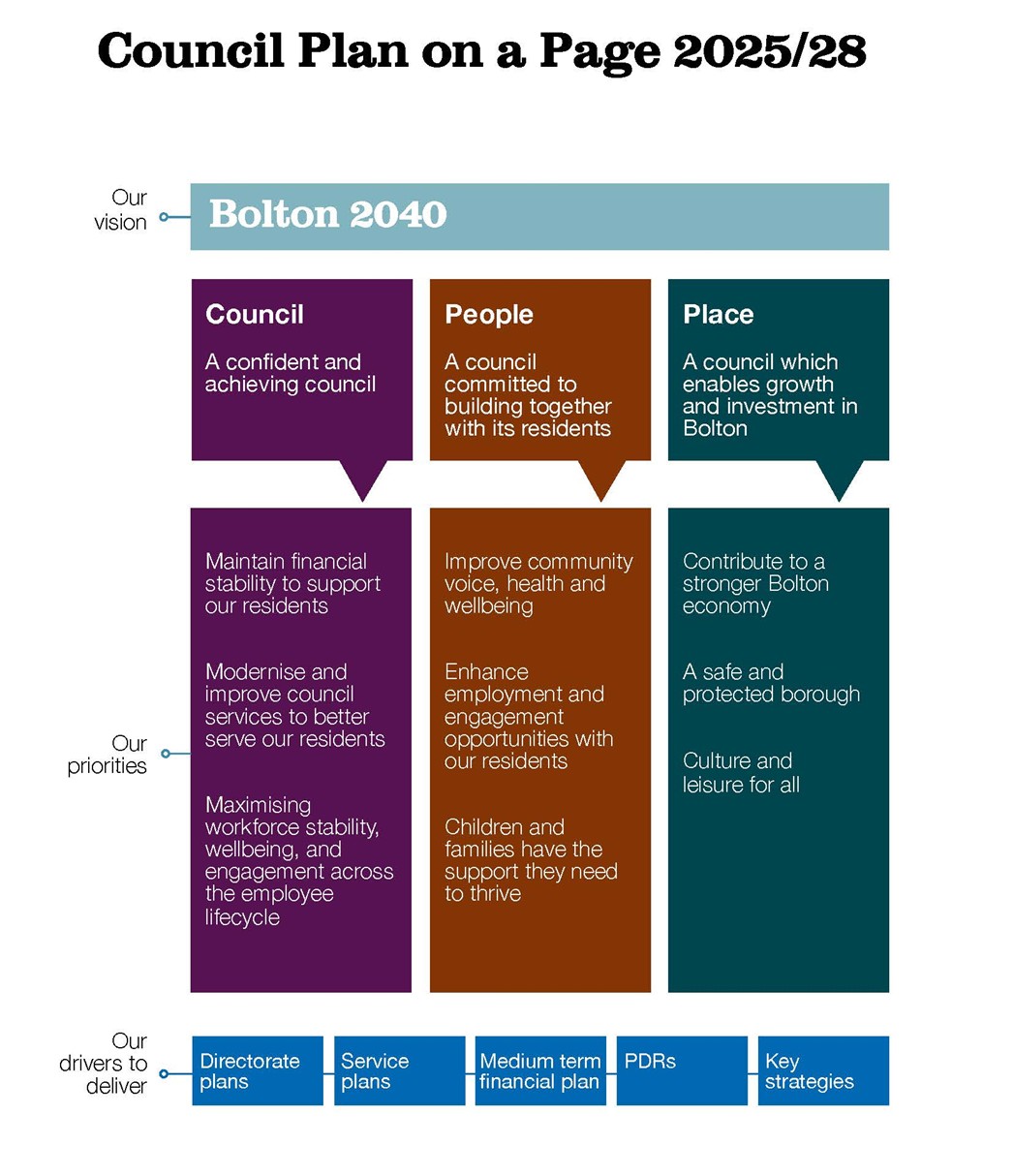
The process started in May 2025 which saw the production and sign-off of the new Council Plan (2025 – 2028) with nine corporate priorities across the council’s three pillars of Council, People and Place. These priorities are cross-council and not associated with a particular directorate. Each of the priorities has between three and eight metrics that are measured quarterly or annually. Some priorities, particularly those that are complex and which are not fully in the council’s control, also have metrics that are for information only.
A new, streamlined suite of metrics that were identified with input from across all directorates, was a significant change from previous plans and it set the scene for changes in reporting and management.
Corporate performance reporting now happens now through a Power BI driven, integrated Bolton Council Dashboard that is publicly available. It is simple and brings together corporate and directorate performance, a high level and succinct performance narrative against the three council pillars, council and directorate finance reports and the council risk register. It is designed to enable easy navigation of complex information and enable a high level, holistic view of performance, finance and risk.
In particular, changes included:
- Distinguishing between performance measures that are within the council’s control and those to which they contribute, the latter providing context as well as being monitored with partners.
- Introducing tolerance levels for each performance metric, recognising the complexity of the performance environment.
- Trend level data across multiple quarters and years.
- Streamlining the volume of reporting across performance, finance and risk.
The updated approach to performance monitoring
A new approach to performance monitoring has also been devised, mirroring the changes in reporting. This happens at directorate and corporate level. Directorate performance boards have been introduced, meeting quarterly with a remit to ‘review and improve’. The ‘review’ aspect includes providing assurance on operational performance against directorate indicators (including finance, risk and HR), strategic key performance indicators (including those in the council strategy) and service reviews.
The ‘improve’ aspect involves deep dives into particular service areas, ensuring improvement actions are identified and implemented. Boards have to escalate any significant service failure or risk to Corporate Leadership Team (CLT), particularly where there are wider impacts or if solutions require input from other directorates. The boards are chaired by the respective director, include representatives from finance and risk management as required, and operate to a standard agenda. The performance team will support the meeting though data and intelligence.
Heads of service play a key role in service reviews and will plan the agenda and input in close collaboration with the performance and policy team. The boards are intended to be an opportunity for the head of service to showcase performance as well as challenges or spotlight issues that will benefit from the support, knowledge and practice of the directorate as a whole. They are intended to be forward looking, positive and solutions focused.
Corporate assurance happens though six-weekly half day meetings of the CLT to review any areas of underperformance flagged by directorate performance boards and conduct a deep dive into a particular service area or theme of the council. The corporate performance dashboard is shared ahead of meetings, and the performance team plays a pivotal role in preparing and facilitating the meetings. Chaired by the chief executive, there is a focus on using performance data to explore change and improvement. The chief executive models positive challenge and meetings are characterised by mutual respect and collective responsibility and accountability to members and residents.
The performance dashboard is becoming the ‘single version of the truth’ with regards to performance reporting and will be used as a live digital tool in the various meetings. This has had a massive impact in moving conversations from challenging data to asking ‘so what?’ questions.
Impact
Most importantly, the new council performance dashboard is enabling new methods to assess performance alongside finance and risk, recognising that these are intrinsically interconnected and changes in one will impact others. This leads to a better understanding and exploration of the possible cause and effects of improvement actions, and these becoming a more dynamic process. Introducing tolerance levels has had a notable impact on the culture of performance management in shifting what was a ‘pass/fail’ system to a more open and constructive conversation about what enables better or worse outcomes.
The introduction of the performance dashboards has led to a significant reduction in reporting, freeing officer capacity and shifting from monitoring to management of performance. The council agreed to use the council dashboard and reduce reporting to quarterly updates to Cabinet only. This integration has streamlined what was previously a process involving over fifty meetings each year, creating a more efficient, data-driven system that provides clearer insights and supports more effective decision-making.
The use of performance boards has also driven tangible action and service improvement. This includes shifts in resources to support priority delivery, earlier identification and mitigation of risks, and the escalation of cross-cutting issues for consideration through corporate leadership.
Next steps
The approach is new and it will take time to bed in. The culture is shifting to one of positive enquiry and the council is keen to adopt a greater forward look whereby performance and service reviews will spot early signs of failure which can be mitigated.
There is a clear aspiration that, as the culture continues to mature, reporting will evolve to include a more open and balanced discussion of both challenges and successes. The holistic focus on performance, finance and risk is seen as crucial here.
Next steps include supporting elected members to better understand and scrutinise performance information.
Tips
Having a senior sponsor from finance and risk is necessary but not sufficient. Seek real engagement and commitment from the finance and risk teams and engage in a process of genuine collaboration, recognising practices, timescales and other pressures that exist for the different teams.
Involve councillors early and continuously in the process and create opportunities for them to input and test changes to the performance reporting system.
Keep it simple – use simple language in performance dashboards and guidance notes. Keep referring to the purpose and the fact that a performance management system is a means to an end, not an end in itself.
Re-invent the role of the corporate performance team to one that is about collaboration, support, learning and improvement.
Setting tolerance levels for performance measures and targets was a really important step in shifting the performance culture. It highlighted complexity, took away the sense of ‘pass or fail’ and the associated sense of blame and encouraged better conversations, leading to action.
Council contact
Calum Gaskell, Strategy and Policy Manager