This case study describes Surrey County Council’s data transformation programme, which is making great progress towards its vision of becoming a fully data-enabled organisation, using data as a strategic asset to improve decisions, services, and outcomes for residents.
Background and challenge
In 2021, Surrey County Council (SCC) identified significant challenges within its data landscape: limited data maturity, siloed management and use of information, inconsistent quality, and the absence of a strong data-driven culture.
The vision
SCC set out to become a fully data-enabled organisation - treating data as a strategic asset to enhance decision-making, improve services, and deliver better outcomes for residents.
Transformation timeline: 2021-2025
From the outset, SCC recognised that addressing these challenges would require a long-term commitment rather than a quick fix. The journey began with a two-year period of review and strategy development, followed by a three-year transformation programme.
Programme objectives
Building on the findings of the data review, the transformation programme aimed to:
- improve data quality – ensuring it is accurate, consistent, well-defined, and supported by clear ownership and accountability
- increase the visibility and accessibility of data and insights
- enable easier data sharing across teams, partners, and systems
- foster more collaborative ways of working between data teams
- ensure residents’ data is managed legally, securely, and ethically
- strengthen skills in managing, interpreting, and analysing data
- build a deeper organisational understanding of the value of data
- generate insights that drive tangible actions and measurable improvements in outcomes
- develop a holistic view of organisational performance and impact.
Data strategy
Following its data review, SCC developed a comprehensive Data Strategy to address weaknesses and realise its ambition of becoming a data‑enabled council. Aligned with the council’s Organisation and Digital Strategies, it positioned data as a critical enabler of wider transformation.
The strategy applied a broad definition of data—structured and unstructured, digital and paper-based—and focused on both governance and the creation of actionable insights. It emphasised that cultural and behavioural change was as important as new systems and recognised the need to expand capacity by introducing specialist roles in data governance.
Programme structure
The programme was divided into three workstreams with each setting out the activities that were expected to be undertaken over the next three years. These workstreams were:
- Workstream 1: Building the foundations
- Workstream 2: Engagement and skills
- Workstream 3: Delivering insights.
Governance
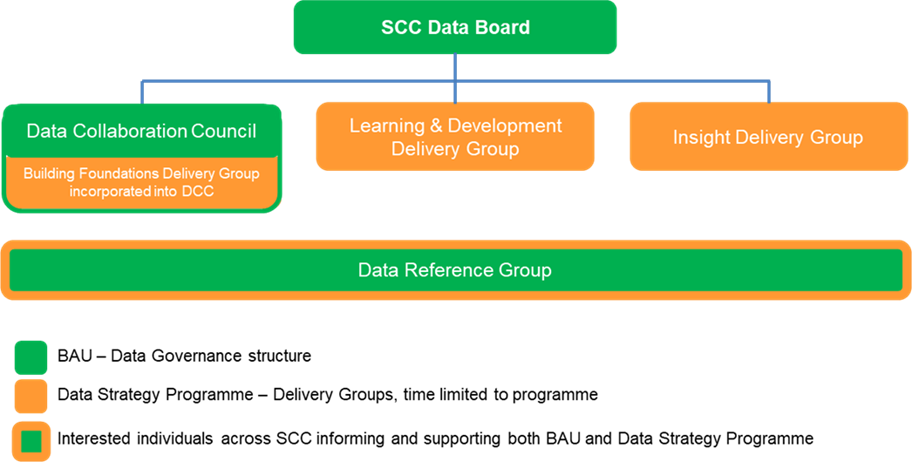
The programme was overseen by a Data Board, supported by a dedicated team led by the Head of Data and the Assistant Director for Insights. Each project strand had its own lead officer, while governance groups ensured solutions were developed collaboratively and met the needs of individual services, the council, and its partners.
Figure 1: Programme governance structure
Resources
Resources were secured to establish a small team of data specialists and to procure tools to support data quality and data cataloguing. Additional resources were acquired to help manage the programme overall.
Key achievements
Foundational improvements:
- established data governance office
- implemented data quality tools and master data records
- created data catalogue and standards
- developed data architecture and ethics framework.
Skills and culture:
- launched Data Academy and learning resources
- engaged stakeholders and promoted a set of data principles
- recognised data management as a core function.
Insights:
- refreshed Surrey Office of Data Analytics (SODA) programme
- initiated projects (around issues such as domestic abuse and serious violence)
- improved contractor data standards.
Benefits
- Data maturity: The council’s data maturity rose by 21 per cent, moving from Level 3 to Level 4 using the LGA’s Local Government Data Maturity Assessment Tool (which has five levels, with Level 5 being the highest maturity).
- Data management: This is now recognised as a distinct discipline requiring specialist expertise and resources, separate from general IT or digital skills.
- Increased capabilities: A dedicated data governance office has enabled systematic improvements in data quality, resolution of long-standing challenges, creation of master datasets, and adoption of best practice in data migration.
- Art of the possible: New capabilities have demonstrated how better data management can be achieved across a large, complex organisation with diverse systems.
- Tackling organisational challenges: The programme has directly addressed critical issues, such as resolving HR data migration problems, integrating systems to streamline adult social care supplier payments, and designing a new waste management model.
- Data quality and roles: The introduction of a data quality tool has strengthened stewardship and ownership roles, expanded expertise across the organisation, and laid the groundwork for ‘data trust scores’ to provide a strategic view of dataset quality.
- Data cataloguing: Early work on a data catalogue is mapping the council’s data, improving understanding, access for analysis, and accountability, while enhancing the asset information register.
- Culture change: The council’s data culture maturity level improved from 3 to 4, reflecting growing recognition of the importance of data management, the need for patience in achieving returns, and the value of addressing issues to save resources and time.
Lessons learned
- Knowledge: Data management and governance are often misunderstood and wrongly seen as part of IT or digitalisation. Greater awareness is needed of their distinct roles, responsibilities, and expectations.
- Time: Fixing data issues at their source takes time but prevents recurrence and saves resources in the long run.
- Return on Investment (ROI ): ROI is hard to quantify, but benefits come from reducing errors, duplication, and manual effort, leading to more trustworthy data, better collaboration, and long‑term savings through system rationalisation and disposal of unused data.
- Data quality: Many data quality issues stem from poor business processes, so improvements require streamlining and refining those processes.
- Data architecture: The current architecture is not well suited to integration or reuse. Understanding and redesigning it is essential and must be prioritised.
- Staff involvement: Data management and analytics are not just for specialists; all staff need to build skills and recognise their role in managing data.
- Roles and responsibilities: Unlike finance or HR, data accountabilities are not clearly defined, leading to under‑resourcing. Clearer roles are needed.
- Long‑term approach: Data improvement is a long‑term effort, which SCC has found to be best driven from the bottom up, with early buy‑in achieved by tackling issues that matter most to senior leaders and members.
What next?
SCC remains committed to continuing its data transformation journey by building on the momentum of the past three years. The next phase will focus on embedding proven improvements—such as stronger governance, better data quality, and clearer roles—while expanding these practices across all services.
Efforts will also prioritise developing staff capability, refining data architecture, and strengthening collaboration with partners. By doing so, the council aims to create a sustainable, organisation‑wide data culture that delivers more efficient services, better decision‑making, and improved outcomes for residents and businesses.
Conclusion
SCC has undertaken a major data transformation journey, grounded in a clear strategy and thorough analysis of its challenges. While significant progress has been made, data management still lags behind other core functions such as finance, HR, and risk, leading to an underestimation of both the scale and complexity of the council’s data issues. The supporting architecture has also not been fully recognised or mapped, highlighting the need for continued focus.
The programme has demonstrated what is possible in data management and governance, showing how technology, investment and systematic action can raise data maturity and deepen organisational understanding of data issues, in a relatively short space of time. By embedding a culture of effective data use and maximising its value, Surrey is laying the foundations for sustained improvement—and providing a model that other councils can follow in modernising their own data practices.